Introduction
Qilianshan (Chilianshan or Qilian Shan) is a mountain range on the border between the Qinghai and Gansu provinces in northwestern China. It runs northwest to southeast, geographically forming the northeastern ramp of the Qinghai-Xizang (Tibet) Plateau. Most of area is uninhabited except the county towns and their suburbs as well as sparse small towns along the highway system. Thus, collecting graptolites from these barren areas is rather difficult. Moreover, most of the graptolites from the East Qilianshan have not yet been described, although several were illustrated by Mu (Reference Mu1963b), who employed a series of manuscript names to refer to them, often attributed to Mu and Zhang but without publication details. A few of these were more or less simultaneously described and illustrated in a relatively little-known publication by Mu et al. (Reference Mu, Li, Ge, Chen and Zhang1963), but the majority remained nomina nuda. Paleogeographically, the study area was located along what was likely to be the northeastern margin of the North China paleocontinent, in a region of high tectonic activity and associated arc volcanism (Boucot et al., Reference Boucot, Chen and Scotese2013; Cocks and Torsvik, Reference Cocks and Torsvik2013; Torsvik and Cocks, Reference Torsvik and Cocks2017). Thus, the present graptolite specimens are particularly valuable. Chen et al. (Reference Chen, Zhang, Goldman, Bergström, Fan, Wang, Finney, Chen and Ma2017) described the Darriwilian to early Katian graptolite fauna from Northwest China and its periphery. The material dealt with here is mostly the succeeding Katian graptolite fauna (Ka1–4 intervals of Bergström et al., Reference Bergström, Chen, Gutiérrez-Marco and Dronov2009) in the same region formerly located along the periphery of the North China Craton. We return briefly to a discussion of the broader significance of this work following presentation of the faunal succession and its lithostratigraphic associations.
Biostratigraphy
The graptolite fauna occurs in three Upper Ordovician lithostratigraphic units: the Tianzhu, Sijiagou, and Xiehao formations, in ascending order (Fig. 2). The boundaries among these units are diachronous. Because the graptolite-bearing strata are infrequent in the East Qilianshan succession and yield relatively few taxa, we prefer not to define formal biostratigraphic units based on these occurrences. Instead, we group strata into a series of informal assemblages that appear to be of different ages based on the occurrences here of species with well-defined ranges in other regions. To distinguish these informal assemblages from proper biozones—i.e., from rigorously defined subdivisions of a rich and stratigraphically well-controlled regional succession—we refer to the East Qilianshan biostratigraphic units as the ‘Amplexograptus maxwelli beds,’ or the ‘Diplacanthograptus geniculatus-Orthograptus quadrimucronatus beds,’ and so on. The names refer to common and distinctive taxa, with preference given to species that are shared with other regions. We describe these associations below.
In the Sijiagou section, the lower Tianzhu Formation (SC3, 2, and 1) yielded a graptolite fauna that unite as the Amplexograptus maxwelli beds, the lower Sijiagou Formation (SB1 and 3) is assigned to the Diplacanthograptus geniculatus-Orthograptus quadrimucronatus beds, and the upper Sijiagou Formation (SB2, SD4, and SD2) is assigned to the Anticostia macgregorae beds. In the West Qiqiaogou section, the Amplexograptus maxwelli beds occur in the Tianzhu Formation as well. In both West and East Qiqiaogou sections, the Xiehao Formation could correspond to the Appendispinograptus longispinus Biozone, but the Anticostia macgregorae beds have not been found. The two isolated locations—Zhigou and Jiutiaoling—are located near Xiehao (Fig. 1). One species, Dicellograptus cf. D. complanatus Lapworth, Reference Lapworth1880 occurs in the upper Sijiagou Formation of Zhigou and could belong to the A. longispinus Biozone (Bo2–3 intervals of VandenBerg and Cooper, Reference VandenBerg and Cooper1992). Four species occur in the Jiutiaoling collections: Climacograptus bicornis (Hall, Reference Hall1847) was collected from the Sijiagou Formation (RHf327 and 333); and Styracograptus miserabilis? (Elles and Wood, Reference Elles and Wood1906), Diplacanthograptus spiniferus (Rudemann, Reference Ruedemann1912), and Diplacanthograptus geniculatus (Mu and Zhang in Mu et al., Reference Mu, Song, Li, Xu and Zhang1982) were collected from the Tianzhu Formation? (RHf139). As discussed further below, this appears to indicate that these units span the interval of the late Sandbian to early Katian based on the known ranges of these taxa in North America (Riva, Reference Riva1974a; Goldman et al., Reference Goldman, Leslie, Nõlvak, Young and Bergström2007, Reference Goldman, Mitchell, Melchin, Fan, Wu and Sheets2011) and the United Kingdom (Zalasiewicz et al., Reference Zalasiewicz, Taylor, Rushton, Loydell, Rickards and Williams2009).
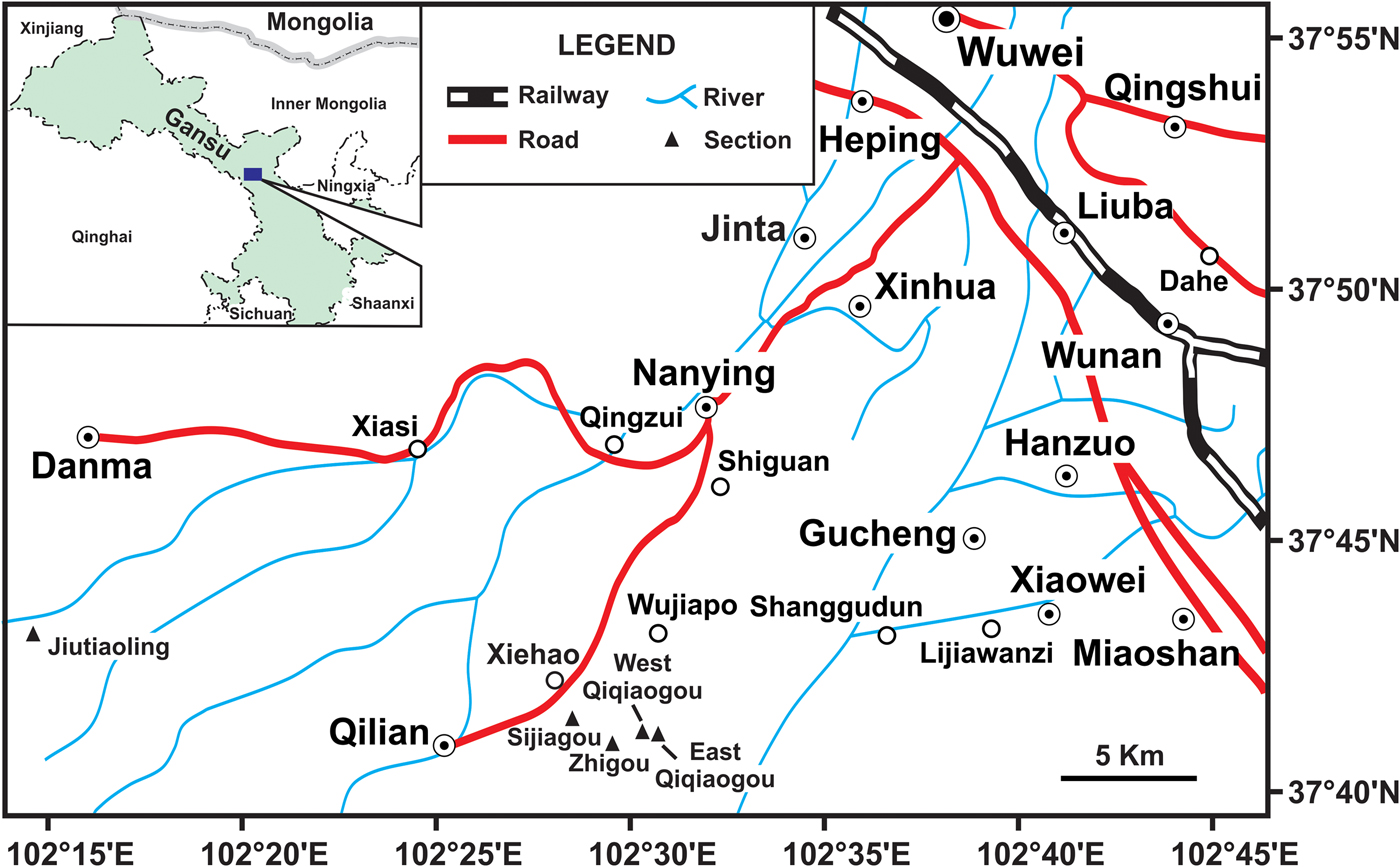
Location map showing three sections and two isolated localities near Xiehao, Tianzhu, Gansu Province, China.

Amplexograptus maxwelli beds
Specimens referred here to Amplexograptus maxwelli (Decker, Reference Decker1935) were initially identified as the endemic species Amplexograptus gansuensis Mu and Zhang in Mu et al., Reference Mu, Song, Li, Xu and Zhang1982. This material was reported from the Tianzhu Formation in both the Sijiagou and West Qiqiaogou sections (Mu and Zhang, Reference Mu and Zhang1964). However, Amplexograptus gansuensis was revised by Chen et al. (Reference Chen, Ni, Mitchell, Qiao and Zhan2000a) as conspecific with Amplexograptus maxwelli based on their study of similar material from the Diplacanthograptus lanceolatus Biozone of the Yingan Formation at Dawangou, Xinjiang. Elsewhere, Amplexograptus maxwelli is widely known from the late Sandbian to early Katian (Finney, Reference Finney1986; Goldman et al., Reference Goldman, Campbell and Rahl2002, Reference Goldman, Leslie, Nõlvak, Young and Bergström2007). Pseudoclimacograptus tianzhuensis Mu and Zhang in Mu et al., Reference Mu, Song, Li, Xu and Zhang1982, illustrated by Mu (Reference Mu1963b, fig. 8c), is an endemic species, although in the West Qiqiaogou section it occurs with Amplexograptus maxwelli. Among the specimens collected by Youkui Zhang in the Tianzhu Formation from isolated outcrops at Jiutiaoling, which is located at the western margin of the present study area (Fig. 1), several are herein identified as Climacograptus bicornis. This species was widely distributed throughout the paleotropical regions during the late Sandibian age (e.g., VandenBerg and Cooper, Reference VandenBerg and Cooper1992; Goldman et al., Reference Goldman, Leslie, Nõlvak, Young and Bergström2007; Zalasiewicz et al., Reference Zalasiewicz, Taylor, Rushton, Loydell, Rickards and Williams2009; Chen et al., Reference Chen, Zhang, Goldman, Bergström, Fan, Wang, Finney, Chen and Ma2017). To sum up, only a few graptolite species occur in the Tianzhu Formation. It is difficult to erect a biozone depending on such a small fauna that was not densely collected. We refer to the strata that yield this low-diversity fauna as the Amplexograptus maxwelli beds. Taken together, the available information suggests that the Amplexograptus maxwelli beds could correspond to an interval from the upper part of Sa2 to the lower part of Ka1 intervals (Fig. 2).
(1–3) Stratigraphic columns for the Sijiagou, West Qiqiaogou, and East Qiqiaogou sections, respectively, showing graptolite faunas and their biostraigraphic unit assignments (see text for discussion); SB1–SB3, SC1–SC3, SD2, SD4, Sh1–Sh6, and Sh9–Sh14 are sample numbers. (4) Inset diagramatic representation of graptolite biostratigraphic succession in the East Qilianshan sections and their likely correlation with the international Ordovician stages and stage slices of Bergström et al. (Reference Bergström, Chen, Gutiérrez-Marco and Dronov2009) and Gradstein et al. (Reference Gradstein, Ogg, Schmitz and Ogg2012) as well as to the Australasian succession of VandenBerg and Cooper (Reference VandenBerg and Cooper1992) with which the present faunas share many species.

Diplacanthograptus geniculatus-Orthograptus quadrimucronatus beds
No graptolites have been collected from the upper Tianzhu Formation in the Sijiagou section or from the Sijiagou Formation in the West Qiqiaogou section (Figs. 1, 2). However, a few graptolites, including Diplacanthograptus geniculatus and Orthograptus quadrimucronatus (Hall, Reference Hall1865) have been collected from the lower Sijiagou Formation (SB1 and 3) in the Sijiagou section. Diplacanthograptus spiniferus was discovered together with Diplacanthograptus geniculatus in the Sijiagou Formation at Jiutiaoling. Diplacanthograptus geniculatus is endemic to the study region, however, O. quadrimucronatus is a long-ranging but distinctive and common member of the Katian graptolite assemblages (Goldman, Reference Goldman1995). This species first occurs near the base of the Diplacanthograptus caudatus Biozone, at the base of the Katian and ranges upward into the late Katian Dicellograptus complanatus Biozone (Koren’ et al., Reference Koren’, Oradovskaya, Pylma, Sobolevskaya and Chugaeva1983; VandenBerg and Cooper, Reference VandenBerg and Cooper1992; Mitchell et al., Reference Mitchell, Goldman, Cone, Maletz and Janousek2003; Goldman et al., Reference Goldman, Leslie, Nõlvak, Young and Bergström2007). In Kalpin, Xinjiang, it occurs from the D. lanceolatus to the Diplacanthograptus spiniferus biozones (Chen et al., Reference Chen, Ni, Mitchell, Qiao and Zhan2000a). Diplacanthograptus spiniferus is also widely distributed in the early Katian strata. The type material originates from the Utica Shale (Ruedemann, Reference Ruedemann1912, Reference Ruedemann1947) in eastern North America, where it characterizes the eponymous biozone (Riva, Reference Riva1974a), although that unit represents only a portion of the global duration of this species (Bergström and Mitchell, Reference Bergström and Mitchell1990). In Scotland, this species first appears in the lower part of the middle Caradocian Dicranograptus clingani Biozone (Ka1) and ranges upward into the overlying late Caradocian Pleurograptus linearis Biozone (Ka2) (Zalasiewicz et al., Reference Zalasiewicz, Taylor, Rushton, Loydell, Rickards and Williams2009). In Australia, it occurs within the Climacograptus baragwanathia (Ka1, Ea2) to the Dicellograptus gravis (Ka2, Ea4) biozones (VandenBerg and Cooper, Reference VandenBerg and Cooper1992). Thus, discovery of this fauna suggests the presence of an interval, here referred to the Diplacanthograptus geniculatus-Orthograptus quadrimucronatus beds, in the upper Tianzhu and lower Sijiagou formations, between the Amplexograptus maxwelli and Anticostia macgregorae beds, which could roughly correspond to the Ka1–3 intervals.
Anticostia macgregorae beds
The present biounit includes a low-diversity graptolite fauna that is dominated by the eponymous species, Anticostia macgregorae Stewart and Mitchell, Reference Stewart and Mitchell1997, and Anticostia tenuissima (Ross and Berry, Reference Ross and Berry1963). This assemblage occurs in the upper Sijiagou Formation (SB2, SD4 and SD2) in the Sijiagou section (Figs. 1, 2). Anticostia macgregorae was first described from the Amplexograptus prominens Biozone (Richmondian, corresponding partially to the conodont Amorphognathus ordovicicus Biozone) from the Vauréal Formation of the Anticosti Island (Stewart and Mitchell, Reference Stewart and Mitchell1997). It is also present in the upper D. complanatus Biozone of Scotland (Williams, Reference Williams1987), and the Appendispinograptus supernus Biozone of Siberia (Koren’ et al., Reference Koren’, Oradovskaya, Pylma, Sobolevskaya and Chugaeva1983). Štorch et al. (Reference Štorch, Mitchell, Finney and Melchin2011) reported material of Anticostia macgregorae from the Paraorthograptus pacificus Biozone in Nevada. In China, it occurs in the D. complanatus Biozone at Yakeruike, near the Wushi County in the western margin of the Tarim Platform (Chen et al., Reference Chen, Zhang, Li, Fan, Tang, Chen and Zhang2012). Another anticostid, Anticostia tenuissima occurs from the Orthograptus quadrimucronatus Biozone of the Hanson Creek Formation in Nevada (Ross and Berry, Reference Ross and Berry1963) and ranges upward into the Dicellograptus ornatus Biozone (Štorch et al., Reference Štorch, Mitchell, Finney and Melchin2011). At the location of USGS D474c (1.5 mi [2.4 km] from the north end of Martin Ridge, Nevada, USA), it associated with Climacograptus hastatus (Ross and Berry, Reference Ross and Berry1963). The latter is recognized as a common species in the early Ashgill or Ka4 elsewhere and is widely distributed in the Wufeng Formation of the Yangtze Platform region of China (Mu et al., Reference Mu, Li, Ge, Chen, Lin and Ni1993; Chen et al., Reference Chen, Rong, Mitchell, Harper, Fan, Zhan, Zhang, Li and Wang2000b). Mitchell et al. (Reference Mitchell, Goldman, Cone, Maletz and Janousek2003) reported Anticostia macgregorae and Anticostia fastigata (Davies, Reference Davies1929) from the Ea4, D. gravis Biozone (= P. linearis Biozone) in the Phi Kappa Formation of Idaho. Thus, the suite of anticostids reported herein indicates an age equivalent to that of the P. linearis to the D. complanatus biozones.
The diversity of the graptolite fauna from the D. complanatus Biozone in the world is usually low (Elles and Wood, Reference Elles and Wood1904, Reference Elles and Wood1906, Reference Elles and Wood1907; Davies, Reference Davies1929; Berry, Reference Berry1960; Ross and Berry, Reference Ross and Berry1963; Toghill, Reference Toghill1970; Koren’ et al., Reference Koren’, Oradovskaya, Pylma, Sobolevskaya and Chugaeva1983; Williams, Reference Williams1987; VandenBerg and Cooper, Reference VandenBerg and Cooper1992; Mu et al., Reference Mu, Li, Ge, Chen, Lin and Ni1993; Zalasiewicz et al., Reference Zalasiewicz, Taylor, Rushton, Loydell, Rickards and Williams2009). The Anticostia macgregorae beds in the present study bear a graptolite fauna of particularly low diversity, suggesting that it might come from this interval, although the low diversity of the Anticostia macgregorae beds might also reflect sampling bias in this remote and difficult region.
Appendispinograptus longispinus Biozone
Exposures of the Xiehao Formation in the West and East Qiqiaogou sections, as well as Zhigou, which is an isolated locality between Sijiagou and Qiqiaogou near Xiehao (Figs. 1, 2) provide the bulk of the collections assigned to this biozone. These strata produce the richest and most diverse assemblage of graptolites discovered from the Katian strata in the study area with a total of eight genera and 15 species. The fauna is dominated by climacograptids of the genera Appendispinograptus Li and Li, Reference Li and Li1985, Climacograptus? Hall, Reference Hall1865, Styracograptus Štorch et al., Reference Štorch, Mitchell, Finney and Melchin2011, and Alulagraptus new genus. Among the fauna from this interval, there are again several endemic species, e.g., Alulagraptus ensiformis (Mu and Zhang in Mu et al., Reference Mu, Li, Ge, Chen and Zhang1963), Climacograptus? papilio Mu and Zhang in Mu et al., Reference Mu, Li, Ge, Chen and Zhang1963, and Dicellograptus sinicus Mu and Zhang in Mu et al., Reference Mu, Li, Ge, Chen and Zhang1963, but the majority are widely shared with the late Katian, paleotropical faunas elsewhere (Table 1). Most of these shared species have their first appearance within the D. complexus Biozone of South China (Chen et al., Reference Chen, Rong, Mitchell, Harper, Fan, Zhan, Zhang, Li and Wang2000b, Reference Chen, Fan, Melchin and Mitchell2005) or its equivalents: the lower part of the A. supernus Biozone in Kazakhstan (Koren’ et al., Reference Koren’, Mikhaylova, Tsay, Apollonov, Bandaletov and Nikitin1980) and Siberia (Koren’ et al., Reference Koren’, Oradovskaya, Pylma, Sobolevskaya and Chugaeva1983), the Bo2 in Australasia (VandenBerg and Cooper, Reference VandenBerg and Cooper1992), the D. ornatus Biozone in North America (Carter and Churkin, Reference Carter and Churkin1977; Melchin, Reference Melchin1987; Mitchell et al., Reference Mitchell, Goldman, Cone, Maletz and Janousek2003; Štorch et al., Reference Štorch, Mitchell, Finney and Melchin2011; Loxton, Reference Loxton2017) and the lower part of the Dicellograptus anceps Biozone in Scotland (Williams, Reference Williams1982; Zalasiewicz et al., Reference Zalasiewicz, Taylor, Rushton, Loydell, Rickards and Williams2009). This group of species generally ranges upward into the latest Katian or Hirnantian strata (Chen et al., Reference Chen, Rong, Mitchell, Harper, Fan, Zhan, Zhang, Li and Wang2000b, Reference Chen, Fan, Melchin and Mitchell2005; Štorch et al., Reference Štorch, Mitchell, Finney and Melchin2011). In contrast, Dicellograptus complanatus and Anticostia thorsteinssoni (Melchin, Reference Melchin1987), which here appear in collections Sh10-2 and Sh13, respectively (Fig. 2), elsewhere have their last appearances in the lower parts of the A. supernus and D. anceps biozones (Bo2), whereas Paraorthograptus kimi (Koren’, Reference Koren’1979) (collection Sh5, Fig. 2) first appears in their upper part (Bo3) together with the more widely reported and closely related Paraorthograptus pacificus (Ruedemann, Reference Ruedemann1947) (Koren’ et al., Reference Koren’, Oradovskaya, Pylma, Sobolevskaya and Chugaeva1983; Loxton, Reference Loxton2017). These relationships indicate that the Xiehao Formation collections most likely represent some part of the D. complexus to P. pacificus biozones. Given the relatively limited occurrences in the present collections of taxa restricted to one or the other of these biozones, we treat these latest Katian collections as a whole and refer them to a combined A. longispinus Biozone, which correlates closely with the similarly inclusive A. supernus and D. anceps biozones in their respective regions (Koren’ et al., Reference Koren’, Mikhaylova, Tsay, Apollonov, Bandaletov and Nikitin1980, Reference Koren’, Oradovskaya, Pylma, Sobolevskaya and Chugaeva1983; Williams, Reference Williams1982; Loydell, Reference Loydell2012).
Occurrences of graptolite species in the Appendispinograptus longispinus Biozone. BR = Blackstone River section (Loxton, Reference Loxton2017); EQ = East Qilianshan (this paper); KL = Kolyma (Koren’ et al., Reference Koren’, Sobolevskaya, Mikhaylova and Tsai1979); NV = Nevada (Štorch et al., Reference Štorch, Mitchell, Finney and Melchin2011); SK = southern Kazakhstan (Koren’ et al., Reference Koren’, Mikhaylova, Tsay, Apollonov, Bandaletov and Nikitin1980); YR = Yangtze region (Chen et al., Reference Chen, Rong, Mitchell, Harper, Fan, Zhan, Zhang, Li and Wang2000b).

Broader significance
East Qilianshan is situated in the North Qilian Orogenic Belt (Song et al., Reference Song, Niu, Su and Xia2013) or the North Qilian Accretionary Belt (Yang et al., Reference Yang, Song, Allen, Su, Dong and Wang2018). The Qilian orogenic belt is located in a region at the junction of the North China Craton, the Yangtze Craton, and the Tarim Craton (Song et al., Reference Song, Niu, Su and Xia2013). Both Song et al. (Reference Song, Niu, Su and Xia2013) and Yang et al. (Reference Yang, Song, Allen, Su, Dong and Wang2018) recognized that the North Qilian orogenic belt was a back-arc basin between the Qilian Ocean and the Alashan block during the Ordovician. Graptolite fauna in the East Qilianshan is quite different from that in the Yangtze region, especially in the late Katian. Most of the species present in the East Qilianshan faunas are widely distributed and nearly all are also recorded from the Yangtze region. The distinctive feature of the East Qilianshan faunas lies not in the species present, but in those particular species that are absent and in the generally low biodiversity of the faunas. The relatively well-sampled Appendispinograptus longispinus fauna in the East Qilianshan back-arc basin, for instance, is dominated by biserial graptolites, including Amplexograptus Elles and Wood, Reference Elles and Wood1907, Anticostia Stewart and Mitchell, Reference Stewart and Mitchell1997, Pararetiograptus Mu in Mu et al., Reference Mu, Li, Ge, Chen, Ni, Lin and Mu1974, Paraorthograptus Mu in Mu et al., Reference Mu, Li, Ge, Chen, Ni, Lin and Mu1974, Rectograptus Přibyl, Reference Přibyl1949, Appendispinograptus, Climacograptus, Diplacanthograptus Mitchell, Reference Mitchell1987, Styracograptus, and Pseudoclimacograptus Přibyl, Reference Přibyl1947. Many of the species present appear to have been epipelagic (Goldman and Bergström, Reference Goldman and Bergström1997; Sheets et al., Reference Sheets, Mitchell, Melchin, Loxton, Štorch, Carlucci and Hawkins2016). In contrast, dicranograptids (e.g., Tangyagraptus Mu, Reference Mu1963a and Diceratograptus Mu, Reference Mu1963a) and retiolite-type graptolites (e.g., archiretiograptids), which are more common in deep-shelf and continental-margin sites, have not been found. Even dicellograptids are less diverse and exhibit lower richness in the East Qilianshan faunas than those of the Yangtze region. A similar contrast is evident in faunas recorded from North America between oceanic settings along the ancient Laurentian margin versus those from the Taconic retroarc foreland basin (Goldman and Bergström, Reference Goldman and Bergström1997; Jacobi and Mitchell, Reference Jacobi and Mitchell2018) as well as in the contrasts between the oceanic rocks deposited along the margin of Laurentia in what is now southern Scotland and the contemporaneous and relatively closely juxtaposed Avalonian clastic shelf setting of Wales (Zalasiewicz et al., Reference Zalasiewicz, Rushton and Owen1995). Thus, the faunal differentiation of the present faunas might have been related to ecological characteristics associated with the different environments of the rapidly filling, clastic sediment-dominated, back-arc basin of East Qilianshan and the more openly oceanic setting represented in platform basin of the Yangtze region characterized by anoxic bottom-water conditions and a large pelagic sediment contribution from dust and surface productivity (e.g., Zhao et al., Reference Zhao, Jin, Jin, Geng, Wen and Yan2016; Li et al., Reference Li, Schieber, Fan, Li and Zhang2017). Thus, we suggest that the observed faunal differentiation between the present study area and sites like the Yangtze region were of an ecological character rather than differentiation caused by biogeographical isolation. Recent work on graptolite paleobiology and evolutionary dynamics indicates that habitat preference, which could be expressed in the faunal differentiation noted here, had a significant influence on their rates of extinction and biogeographic distribution (e.g., Cooper and Sadler, Reference Cooper and Sadler2010; Sheets et al., Reference Sheets, Mitchell, Melchin, Loxton, Štorch, Carlucci and Hawkins2016; Boyle et al., Reference Boyle, Sheets, Wu, Goldman, Melchin, Cooper, Sadler and Mitchell2017). Thus, expanding the number and paleogeographic range of sites from which it is possible to contrast diversity and habitat adds data critical to our understanding of the interaction of these features as they influence macroevolution.
Materials and methods
We focus in this paper on the systematic description and discussion of material from five locations in this region that were recorded by Mu and Zhang (Reference Mu and Zhang1964): West Qiqiaogou, East Qiqiaogou, Zhigou, Sijiagou, and Jiutiaoling (Fig. 1). These locations administratively belong to Tianzhu County, Gansu Province, but are geographically located near Wuwei City. Among these localities, Zhigou and Jiutiaoling are isolated locations from which only a few graptolite collections are available. In contrast, the Sijiagou, West Qiqiaogou, and East Qiqiaogou sections were measured and collected in ascending order by Youkui Zhang during his work for the Gansu Geological Survey in the early 1960s (Fig. 2), and we relied upon these three sections to establish the faunal succession in this publication. Observations, photographs, and drawings were taken using a Leica M125 stereo microscope, and a Leica DFC450 C camera and a drawing tube, respectively.
Repositories and institutional abbreviations
All of the studied materials are housed in the Nanjing Institute of Geology and Palaeontology, Chinese Academy of Sciences (NIGP). Type materials listed below are deposited in: AMNH = American Museum of Natural History, New York, USA; AMS = Australian Museum, Australia; BU = Lapworth Museum, University of Birmingham, UK; GSC = Geological Survey of Canada, Canada; NM = National Museum in Prague, Czech Republic; NMV = Museums Victoria, Australia; OMNH = Invertebrate Paleontology, Sam Noble Museum, University of Oklahoma, Norman, USA; SM = Sedgwick Museum, University of Cambridge, UK; TsGM = Central Geological Museum, Russia; USNM = National Museum of Natural History (United States National Museum), Smithsonian Institution, Washington, DC, USA.
Systematic paleontology
This section was completed by two of the authors (XC and CEM). The principal of the new phylogenetic systematic suprageneric taxonomy proposed by Mitchell et al. (Reference Mitchell, Goldman, Klosterman, Maletz, Sheets and Melchin2007b), Maletz et al. (Reference Maletz, Carlucci and Mitchell2009), and Štorch et al. (Reference Štorch, Mitchell, Finney and Melchin2011) is followed in the present study. Maletz (Reference Maletz2014) recently proposed a suprageneric taxonomy for the Axonophora that modified the results of these previous studies to conform to his preference for morphologically delimited taxa and his expert opinion about the likely evolutionary relationships among them. We disagree with that approach and so do not adopt that revised classification here.
Suborder Axonophora Frech, Reference Frech1897 emend Maletz et al., Reference Maletz, Carlucci and Mitchell2009
Infraorder Diplograptina Lapworth, Reference Lapworth1880 emend Štorch et al., Reference Štorch, Mitchell, Finney and Melchin2011
Family Dicranograptidae Lapworth, Reference Lapworth1873
Subfamily Dicranograptinae Lapworth, Reference Lapworth1873
Genus Dicellograptus Hopkinson, Reference Hopkinson1871
Type species
Didymograptus elegans Carruthers, Reference Carruthers1867.
Dicellograptus complanatus Lapworth, Reference Lapworth1880
Figure 4.11
- Reference Lapworth1880
Dicellograptus complanatus Lapworth, p. 160, pl. 5, fig. 17a–c.
- Reference Elles and Wood1904
Dicellograptus complanatus; Elles and Wood, p. 139, pl. 20, fig. 1a–d.
Type specimen
Lectotype, BU 1072b, upper Hartfell shales, Dob's Linn, Scotland (Elles and Wood, Reference Elles and Wood1904, pl. 20, fig. 1b), selected by Toghill (Reference Toghill1970, p. 13).
Occurrence
Appendispinograptus longispinus Biozone, Xiehao Formation at the East Qiqiaogou section.
Materials
One incomplete specimen with well-preserved proximal parts of the tubarium.
Remarks
Only the proximal part of the tubarium is preserved in the present specimen. It agrees with the type specimens in general characters. However, the thecal spacing of the present form is slightly closer than in the type specimens described by Elles and Wood (Reference Elles and Wood1904).
Dicellograptus cf. D. complanatus Lapworth, Reference Lapworth1880
Figures 3.5, 4.6
- cf. 1880
Dicellograptus complanatus Lapworth, p. 160, pl. 5, fig. 17a–c.
Line drawings. (1, 2, 6) Dicellograptus minor Toghill, Reference Toghill1970: (1) NIGP 11658 (Sh10-1); (2) NIGP 11654 (Sh10); (6) NIGP 11655 (Sh10-1). (3, 4, 7) Dicellograptus sinicus Mu and Zhang in Mu et al., Reference Mu, Li, Ge, Chen and Zhang1963: (3) NIGP 11649 (Sh12); (4) NIGP 11650 (Sh3); (7) NIGP 11648 (Sh12). (5) Dicellograptus cf. D. complanatus Lapworth, Reference Lapworth1880, NIGP 11660 (Sh5). (8) Dicellograptus cf. D. sinicus Mu and Zhang in Mu et al., Reference Mu, Song, Li, Xu and Zhang1982, NIGP 11651 (Sh12). Scale bars = 1 mm.

Line drawings. (1, 12) Anticostia lata (Elles and Wood, Reference Elles and Wood1906): (1) NIGP 11717 (Sh6); (12) NIGP 11679 (Sh14). (2, 4) Paraorthograptus kimi (Koren’, Reference Koren’1979): (2) NIGP 11901 (Sh5); (4) NIGP 11902 (Sh5). (3) Anticostia macgregorae Stewart and Mitchell, Reference Stewart and Mitchell1997, NIGP 11699 (SD4). (5) Amplexograptus maxwelli (Decker, Reference Decker1935), NIGP 11716 (Sh1). (6) Dicellograptus cf. D. complanatus Lapworth, Reference Lapworth1880, NIGP 11661a (Sh24), upper Sijiagou Formation, Zhigou. (7, 8, 10) Dicellograptus sinicus Mu and Zhang in Mu et al., Reference Mu, Li, Ge, Chen and Zhang1963: (7) NIGP 11652 (Sh12); (8) NIGP 11646 (Sh12); (10) holotype, NIGP 11647 (Sh12). (9) Anticostia tenuissima (Ross and Berry, Reference Ross and Berry1963), NIGP 11694a (SD2). (11) Dicellograptus complanatus Lapworth, Reference Lapworth1880, NIGP 11645 (Sh10-2). (13, 14) Anticostia teres? (Perner, Reference Perner1895): (13) NIGP 11696 (SB2); (14) NIGP 11697 (SB2). Scale bars = 1 mm.

Occurrence
Appendispinograptus longispinus Biozone, Xiehao Formation at the West Qiqiaogou section and upper Sijiagou Formation at Zhigou.
Materials
Two incomplete specimens with well-preserved proximal parts of the tubarium.
Remarks
The specimens differ from those of Dicellograptus complanatus in having a narrower stipe (Dicellograptus complanatus: 0.36–0.50 mm; Dicellograptus cf. D. complanatus: 0.18–0.45 mm).
Dicellograptus minor Toghill, Reference Toghill1970
Figure 3.1, 3.2, 3.6
- Reference Toghill1970
Dicellograptus ornatus minor Toghill, p. 16, pl. 6, figs. 5–7, text-fig. 3d–g (non text-fig. 3c = D. ornatus Elles and Wood, Reference Elles and Wood1904).
- Reference Chen, Fan, Melchin and Mitchell2005
Dicellograptus minor; Chen et al., p. 239, text-fig. 3c (with two references in synonymy).
Holotype
SM A19333, upper Hartfell shales, Dob's Linn, Scotland (Elles and Wood, Reference Elles and Wood1904, pl. 20, fig. 2c), selected by Toghill (Reference Toghill1970, p. 16).
Occurrence
Appendispinograptus longispinus Biozone, Xiehao Formation at the East Qiqiaogou section.
Materials
Three flattened specimens.
Remarks
Although the details of thecae are not well preserved, the general characters of the tubarium agree with those of the type specimens.
Dicellograptus sinicus Mu and Zhang in Mu et al., Reference Mu, Li, Ge, Chen and Zhang1963
Figures 3.3, 3.4, 3.7, 4.7, 4.8, 4.10, 13.1–13.3
- Reference Mu1963b
Dicellograptus sinicus Mu and Zhang; Mu, p. 357, fig. 1b (nomen nudum).
- Reference Mu, Li, Ge, Chen and Zhang1963
Dicellograptus sinicus Mu and Zhang in Mu et al., p. 57, pl. 23, figs. 3, 4.
- Reference Mu, Song, Li, Xu and Zhang1982
Dicellograptus sinicus; Mu et al., p. 307, pl. 76, figs. 9–11.
- Reference Mu, Li, Ge, Lin and Ni2002
Dicellograptus sinicus; Mu et al., p. 428, pl. 128, figs. 13, 14.
Holotype
NIGP 11647 (Figs. 4.10, 13.1), originally illustrated by Mu et al. (Reference Mu, Li, Ge, Chen and Zhang1963, p. 57, pl. 23, fig. 4), not NIGP 11649 selected by Mu et al. (Reference Mu, Song, Li, Xu and Zhang1982).
Occurrence
Appendispinograptus longispinus Biozone, Xiehao Formation at the West and East Qiqiaogou sections.
Description
Tubarium consisting of two reclined stipes. First thecal pair diverging from the sicula horizontally, turning upward abruptly at their apertural parts, with long subapertural spines, reaching a length of 3.6 mm. Subsequent three thecal pairs possessing subapertural spines as well. However, some of the subapertural spines on the subsequent thecae located a short distance from the thecal apertures as a result of the different preservation. Sicula long and slender, 2.2 mm long; aperture 0.2 mm wide with a short virgella. First theca arising from the middle metasicula and extending downward along the sicula, turning outward near the aperture of the sicula. Proximal parts of two stipes each strongly upwardly arching and becoming parallel with each other in the mesial part (from roughly the third theca to the seventh to tenth thecae) after which becoming ventrally flexed and ranging from divergent to recurved. Stipes appearing to have been loosely helically coiled, and thus some of the variance in timing and degree of divergence could be a preservational artefact. Stipe width increasing considerably over the proximal to mesial portions of the stipes, from 0.4 mm at the aperture of th11 to 0.6 mm at th41 in the holotype. However, other specimens (e.g., NIGP 11646; Fig. 4.8), exhibiting a more dramatic change of the width, from 0.4 mm at the aperture of th11 to 0.75 mm at th51. Increasing width in the proximal stipes reflecting the increasing width of the thecae themselves, which is accompanied by a greater inclination of the infragenicular walls and a more strongly introtorted supragenicular region. Stipe widths decreasing to ~0.5 mm on average as the stipes diverge outward and supragenicular walls become nearly parallel to the stipe axis with slightly isolated apertures. 2TRD2 = 1.00–1.63 mm; 2TRD5 = 1.27–1.91 mm; 2TRD10 = 1.45–2.81 mm.
Materials
Six complete specimens.
Remarks
The present form resembles Dicellograptus elegans in the shape of the stipes (particularly their proximally parallel to distally more divergent to recurved form), the long and slender sicula, and the long subapertural spines on the first pair of thecae. However, Dicellograptus elegans lacks the zone of expanded stipe widths and subapertural spines present proximally in Dicellograptus sinicus. Additionally, the thecae are slightly more widely spaced in the present species. The present form also resembles Dicellograptus turgidus Mu, Reference Mu1963a in the general shape of the tubarium. However, it again differs from the latter in having well-developed subapertural spines from the second to fourth pairs of thecae.
Dicellograptus cf. D. sinicus Mu and Zhang in Mu et al., Reference Mu, Li, Ge, Chen and Zhang1963
Figure 3.8
- cf. Reference Mu, Li, Ge, Chen and Zhang1963
Dicellograptus sinicus Mu and Zhang in Mu et al., p. 57, pl. 23, figs. 3, 4.
Occurrence
Appendispinograptus longispinus Biozone, Xiehao Formation at the East Qiqiaogou section.
Materials
One complete specimen.
Remarks
Compared to Dicellograptus sinicus, the specimen is characterized by more closely spaced stipes in the proximal parts, with closer thecal spacing (9 thecae in the first 5 mm).
Family Diplograptidae Lapworth, Reference Lapworth1873
Genus Amplexograptus Elles and Wood, Reference Elles and Wood1907
Type species
Diplograptus perexcavatus Lapworth, Reference Lapworth1876.
Amplexograptus maxwelli (Decker, Reference Decker1935)
Figures 4.5, 5.6–5.8, 6.5, 6.7, 7.11, 14.5, 14.6, 14.10
- Reference Decker1935
Diplograptus (Amplexograptus) maxwelli Decker, p. 242, pl. 1, figs. 1–7, 1a–6a.
- Reference Mu1963b
Amplexograptus disjunctus Mu and Zhang; Mu, p. 360, fig. 7b–d (nomen nudum).
- Reference Mu1963b
Amplexograptus gansuensis Mu and Zhang; Mu, p. 360, fig. 7a (nomen nudum).
- Reference Mu, Song, Li, Xu and Zhang1982
Amplexograptus disjunctus Mu and Zhang in Mu et al., p. 322, pl. 78, figs. 32, 33.
- Reference Mu, Song, Li, Xu and Zhang1982
Amplexograptus gansuensis Mu and Zhang in Mu et al., p. 321, pl. 78, figs. 30, 31.
- Reference Chen, Rong, Mitchell, Harper, Fan, Zhan, Zhang, Li and Wang2000b
Amplexograptus maxwelli maxwelli; Chen et al., p. 290, figs. 5.19, 5.27, 7.16, 7.22, 9.8 (with 11 references in synonymy).
- Reference Goldman, Campbell and Rahl2002
Amplexograptus maxwelli; Goldman et al., p. 925, figs. 3.11–3.16, 4.2, 4.4–4.6 (with six references in synonymy).
- Reference Mu, Li, Ge, Lin and Ni2002
Amplexograptus gansuensis; Mu et al., p. 529, pl. 152, figs. 16, 17.
Line drawings. (1, 3, 9) Anticostia macgregorae Stewart and Mitchell, Reference Stewart and Mitchell1997: (1) NIGP 11698 (SD4); (3) NIGP 11704 (Sh13); (9) NIGP 11702 (SD4). (2) Anticostia thorsteinssoni (Melchin, Reference Melchin1987), NIGP 11703 (Sh13). (4, 5) Rectograptus abbreviatus (Elles and Wood, Reference Elles and Wood1907): (4) NIGP 11783 (Sh10-1); (5) NIGP 11670 (Sh5). (6–8) Amplexograptus maxwelli (Decker, Reference Decker1935): (6) NIGP 11722 (Sh1); (7) NIGP 11723 (Sh1); (8) NIGP 11719 (SC3). Scale bars = 1 mm.

Line drawings. (1–3) Anticostia lata (Elles and Wood, Reference Elles and Wood1906): (1) NIGP 11659 (Sh5); (2) NIGP 11831 (Sh11); (3) NIGP 11760 (Sh11). (4, 6, 8–10) Pseudoclimacograptus tianzhuensis Mu and Zhang in Mu et al., Reference Mu, Song, Li, Xu and Zhang1982: (4) NIGP 11891 (SC1); (6) NIGP 11888 (Sh1); (8) NIGP 11885 (SC1); (9) NIGP 11884 (SC1); (10) NIGP 11896 (SC3). (5, 7) Amplexograptus maxwelli (Decker, Reference Decker1935): (5) NIGP 11715 (Sh1); (7) NIGP 11711 (Sh1). Scale bars = 1 mm.

Line drawings. (1–8) Climacograptus? papilio Mu and Zhang in Mu et al., Reference Mu, Li, Ge, Chen and Zhang1963: (1) NIGP 11802 (Sh10-1); (2) neotype, NIGP 11791 (Sh10-1); (3) NIGP 11785 (Sh10-1); (4) NIGP 11795 (Sh10); (5) NIGP 11779 (Sh10); (6) NIGP 11784b (Sh10-1); (7) NIGP 11781 (Sh13); (8) NIGP 11786 (Sh10). (9, 10) Pseudoclimacograptus tianzhuensis Mu and Zhang in Mu et al., Reference Mu, Song, Li, Xu and Zhang1982; (9) NIGP 11883 (SC2); (10) NIGP 11882 (SC2). (11) Amplexograptus maxwelli (Decker, Reference Decker1935), NIGP 11712b (Sh1). Scale bars = 1 mm.

Type specimens
Syntypes (7), west of Nebo Store, OMNH A2041; and A2042–A2047, Rock Crossing, Criner Hills, Oklahoma, USA (Decker, Reference Decker1935, pl. 1, figs. 1–7, 1a–6a).
Occurrence
Amplexograptus maxwelli beds, Tianzhu Formation at the Sijiagou and West Qiqiaogou sections.
Description
Tubarium small with a length of 13 mm and a uniform distal width of 1.4–1.6 mm. Sicular aperture 0.17 mm wide with a short virgella (Fig. 7.11) and antivirgellar spines (Fig. 5.8). Th11 extending downward from its origin in the middle part of the sicula and turning outward and upward at the base of the virgella, whereas the ventral wall of th12 is only slightly inclined from the colony axis, forming an asymmetrical proximal end of the tubarium. Thecae of typical amplexograptid form with straight and parallel to slightly inclined supragenicular walls, conspicuous genicular flanges (mesial flanges; Riva, Reference Riva1987), and apertural lappets (Figs. 4.5, 14.10; which commonly causes the thecal apertures of flattened specimens to appear slightly introverted). Infragenicular walls dorsally curved and indicating an alternate arrangement of thecae. Thus, tubaria of the present species aseptate with only a free nema in the middle of the tubarium, consistent with the very delayed insertion of a median septum exhibited by the type material (Riva, Reference Riva1987). 2TRD2 = 1.10–1.25 mm; 2TRD5 = 1.25–1.40 mm; 2TRD10 = 1.4–1.5 mm.
Materials
Four complete and well-preserved specimens.
Remarks
Some of the present specimens possess prominent genicular flanges (Figs. 4.5, 5.6, 7.11), however almost all of the specimens are rather flattened and many are mildly distorted. Consequently, we are uncertain whether they all belong to Amplexograptus maxwelli maxwelli or whether some could represent Amplexograptus maxwelli spinosus Chen et al., Reference Chen, Ni, Mitchell, Qiao and Zhan2000a.
Genus Anticostia Stewart and Mitchell, Reference Stewart and Mitchell1997 emend Štorch et al., Reference Štorch, Mitchell, Finney and Melchin2011
Type species
Anticostia macgregorae Stewart and Mitchell, Reference Stewart and Mitchell1997
Anticostia lata (Elles and Wood, Reference Elles and Wood1906)
Figures 4.1, 4.12, 6.1–6.3, 13.4, 14.3
- Reference Elles and Wood1906
Climacograptus latus Elles and Wood, p. 204, pl. 27, fig. 3a–h, text-fig. 135a–d.
- Reference Štorch, Mitchell, Finney and Melchin2011
Anticostia lata; Štorch et al., p. 336, figs. 14G, O, Y, 19H–J, M, O, T (with 16 references in synonymy).
Type specimen
Lectotype, SM A19680, upper Hartfell shales, Dob's Linn, Scotland (Elles and Wood, Reference Elles and Wood1906, pl. 27, fig. 3a), selected by Riva (Reference Riva1988, p. 228).
Occurrence
Appendispinograptus longispinus Biozone, Xiehao Formation at the West and East Qiqiaogou sections.
Materials
Five specimens, most of them flattened, only one preserved in relief.
Remarks
The present species has been described by many authors. Among the features visible in flattened material, Anticostia lata differs from Amplexograptus maxwelli in having more prominent genicular flanges, more weakly inclined supragenicular walls, and a considerable length above its point of upward turning in th11, which is also more strongly upwardly grown. In addition, Anticostia lata also widens much more gradually and has a greater distal width than Amplexograptus maxwelli.
Anticostia macgregorae Stewart and Mitchell, Reference Stewart and Mitchell1997
Figures 4.3, 5.1, 5.3, 5.9, 13.7, 14.2
- Reference Stewart and Mitchell1997
Anticostia macgregorae Stewart and Mitchell, p. 221, figs. 4, 5A–M, pl. 1, figs. 1–9.
Holotype
GSC 115740, Tower Member of Vauréal Formation, Anticosti Island, Canada (Stewart and Mitchell, Reference Stewart and Mitchell1997, fig. 5A, B).
Occurrence
Anticostia macgregorae beds, upper Sijiagou Formation at the Sijiagou section and A. longispinus Biozone, Xiehao Formation at the East Qiqiaogou section.
Description
Tubarium ~20 mm long, 0.9 mm wide proximally (but is slightly narrower at the second pair of thecae than at the first), gradually increasing distally to a maximum of ~1.8 mm. First theca (th11) growing outward and upward for a considerable distance from the sicula. Unfortunately, present material does not show the growth of the protheca of th12 and its crossing cannel th11 even in their uncompressed specimens. Virgella and antivirgellar spine well developed. Tubarium aseptate. Thecae generally glyptograptid in form but with slightly introverted apertures produced by conspicuous apertural cusps. 2TRD2 = 1.70–1.75 mm; 2TRD5 = 1.72–1.75 mm; 2TRD10 = 1.85–1.90 mm; 2TRDdist = 2.00–2.10 mm in a few specimens.
Materials
Seven specimens, three of them partially preserved in relief.
Remarks
The present specimens possess most of the characters described by Stewart and Mitchell (Reference Stewart and Mitchell1997) based on their type specimens. However, one specimen (Fig. 5.3) differs from the type specimens in having more widely spaced thecae (10 thecae in 10 mm).
Anticostia tenuissima (Ross and Berry, Reference Ross and Berry1963)
Figure 4.9
- Reference Ross and Berry1963
Glyptograptus tenussimus Ross and Berry, p. 141, pl. 11, fig. 6.
- Reference Štorch, Mitchell, Finney and Melchin2011
Anticostia tenuissima; Štorch et al., p. 338, figs. 14N, U–X, 19E–G, Q, R (with five references in synonymy).
Holotype
USNM 138685, Hanson Creek Formation, northern end of Martin Ridge, Nevada, USA (Ross and Berry, Reference Ross and Berry1963, pl. 11, fig. 6).
Occurrence
Anticostia macgregorae beds, upper Sijiagou Formation at the Sijiagou section.
Description
Tubarium length to at least 5 mm; proximal width 0.75 mm, increasing gradually to 1.2 mm at the sixth thecal pair. Mesial spine occuring on th11. Thecae all elongated with sigmoid ventral walls, alternately arranged in the aseptate tubarium. 2TRD2 ~1.3 mm; 2TRD5 = 1.6 mm.
Materials
Only one specimen, not well preserved.
Remarks
The present specimen conforms well with the characteristically short first thecae, close thecal spacing, and bluntly rounded geniculae, and the usual anticostid tubarium construction. Štorch et al. (Reference Štorch, Mitchell, Finney and Melchin2011) provided detailed comparisons among the contemporaneous species.
Anticostia teres? (Perner, Reference Perner1895)
Figures 4.13, 4.14, 13.6
- ?Reference Perner1895
Diplograptus (Glyptograptus) teres Perner, p. 28, pl. 8, fig. 13a, b.
- ?Reference Kraft, Štorch and Mitchell2015
Anticostia teres; Kraft et al., p. 207, figs. 5A–G, 11E.
Type material
Lectotype, NM L27529, Lejškov, Czech Republic (Perner, Reference Perner1895, pl. 8, fig. 13a, b), refigured by Přibyl (Reference Přibyl1949, pl. 2, fig. 12) and Kraft et al. (Reference Kraft, Štorch and Mitchell2015, fig. 5E), designated by Přibyl (Reference Přibyl1949).
Occurrence
Anticostia macgregorae beds, upper Sijiagou Formation at the Sijiagou section.
Description
Tubarium length to at least 10 mm; proximal width 1.1 mm, increasing gradually to 1.66 mm at the fifth thecal pair, then remaining uniform. Sicula bearing a short, straight virgella; antivirgellar spines not preserved. Th11 turning upward at ~0.25 mm below the sicular aperture and is broadly arched. Th12 completely covering the sicula in reverse view, turning upward just above the turning point of the th11. A subapertural spine occuring on both th11 and th12. Thecae all elongated with sigmoid ventral walls, prominent apertural cusps, and alternately arranged in the aseptate tubarium. 2TRD2 = 1.50–1.75 mm; 2TRD5 = 2.0 and uniform thereafter.
Materials
Two flattened specimens preserved on one slab.
Remarks
The type specimen of Anticostia teres is a fragment. The present specimens agree with those described by Kraft et al. (Reference Kraft, Štorch and Mitchell2015) in both form and dimensions. The specimens from the Czech Republic probably occur in rocks that are coeval with the P. linearis Biozone of the British succession and have not previously been discovered outside of Perunica and Baltica (Kraft et al., Reference Kraft, Štorch and Mitchell2015). Thus, we designate the present specimens as Anticostia teres?, pending discovery of further material.
Anticostia thorsteinssoni (Melchin, Reference Melchin1987)
Figures 5.2, 14.1
- Reference Melchin1987
Orthograptus thorsteinssoni Melchin, p. 200, pl. 2, figs. 8, 10, 12.
- Reference Goldman, Bergström and Mitchell1995
Orthograptus thorsteinssoni; Goldman et al., figs. 2G–I, 3H.
- Reference Štorch, Mitchell, Finney and Melchin2011
Anticostia thorsteinssoni; Štorch et al., p. 340, figs. 14D, 19S.
Holotype
GSC 78409, Truro Island, Canada at 12.0 m (Melchin, Reference Melchin1987, pl. 2, fig. 8).
Occurrence
Appendispinograptus longispinus Biozone, Xiehao Formation at the East Qiqiaogou section.
Materials
Only one incompletely preserved flattened specimen.
Remarks
Tubaria of this species of Anticostia has relatively straight and weakly inclined thecae as well as prominent proximal spines (virgella, antivirgellar spines, and th11 mesial spine). The present specimen resembles the type specimens and others described by Goldman et al. (Reference Goldman, Bergström and Mitchell1995) and Štorch et al. (Reference Štorch, Mitchell, Finney and Melchin2011) in their characteristic features, however, the present specimen is slightly wider across the first thecal pair than the type material (1.3 mm rather than 0.9–1.2 mm). Because the species is known from relatively few specimens, however, its dimensional ranges are not well established. The stratigraphic range of this species also is not well established, although all reported occurrences are from equivalents of the D. ornatus Biozone.
Genus Orthograptus Lapworth, Reference Lapworth1873
Type species
Graptolithus quadrimucronatus Hall, Reference Hall1865.
Orthograptus quadrimucronatus (Hall, Reference Hall1865)
Figure 13.5, 13.10
- Reference Hall1865
Graptolithus quadrimucronatus Hall, p. 144, pl. 13, figs. 1–10.
- Reference Goldman1995
Orthograptus quadrimucronatus quadrimucronatus; Goldman, p. 525, figs. 10.1–10.9, 11.1–11.6, 15.1–15.5, 17.5–17.9 (with 18 references in synonymy).
Type specimen
Syntypes (3), GSC 1898a, b, d, Utica shale, Lake St. John, Quebec, Canada (Hall, Reference Hall1865, pl. 13, fig. 1–7), listed by Bolton (Reference Bolton1960, p. 104).
Occurrence
Diplacanthograptus geniculatus-Orthograptus quadrimucronatus beds, lower Sijiagou Formation at the Sijiagou section.
Materials
Only four incomplete, flattened specimens.
Remarks
The present materials agree with the type specimens, which were restudied by Goldman (Reference Goldman1995). The material at hand presents several different preservational aspects, as is common for this species. From the subscalariform and biprofile specimens (Fig. 13.5, 13.10, respectively), the prominent apertural spines, virgella, and antivirgellar spines as well as an asymmetrical first pair of thecae are clearly visible. These features are consistent with the astogenetic pattern G structure expected for colonies of this species, although because they are flattened specimens, the detailed features of this proximal structure are not evident.
Orthograptus quadrimucronatus occurs from the Corynoides americanus through the Amplexograptus manitoulinensis biozones in North America (Goldman, Reference Goldman1995). Indeed, the species is common in the early Katian strata throughout much of the paleotropics, as discussed above. The occurrence of the present form in East Qilianshan could imply an equivalent sinterval between the Amplexograptus maxwelli and Anticostia macgregorae beds.
Genus Pararetiograptus Mu in Mu et al., Reference Mu, Li, Ge, Chen, Ni, Lin and Mu1974 emend Štorch et al., Reference Štorch, Mitchell, Finney and Melchin2011
Type species
Pararetiograptus sinensis Mu in Mu et al., Reference Mu, Li, Ge, Chen, Ni, Lin and Mu1974
Remarks
The first graptolites referable to Pararetiograptus were described by Mu (Reference Mu1963b) and Mu et al. (Reference Mu, Li, Ge, Chen and Zhang1963) based on material from Qilianshan. In the recent revision of Pararetiograptus, Štorch et al. (Reference Štorch, Mitchell, Finney and Melchin2011) based their choice of the proper spelling of this name on the usage by Mu (Reference Mu1974, p. 233), who referred to the taxon as ‘Parareteograptus nov.,’ and stated briefly how tubaria in this taxon differed in form from those of Reteograptus Hall, Reference Hall and Hall1859. Mu (Reference Mu1974) also gave the same taxon a new name ‘Pararetiograptus (gen. nov.)’ in his later publication (Mu et al., Reference Mu, Li, Ge, Chen, Ni, Lin and Mu1974, p. 163). In this publication, the authors provided a more detailed description of ‘Pararetiograptus,’ as well as description and illustration of ‘Pararetiograptus sinensis, (gen. et sp. nov.),’ which the authors selected as the type species.
Similarly, Štorch et al. (Reference Štorch, Mitchell, Finney and Melchin2011) attributed authorship of Retiograptus grandis var. uniformis to Mu and Zhang in Mu, Reference Mu1963b, which, as a consequence, they considered to be a nomen nudum that was first made available by Mu and Lin (Reference Mu and Lin1984). On the basis of these supposed dates of priority and their similarity in form, Štorch et al. (Reference Štorch, Mitchell, Finney and Melchin2011) considered Pararetiograptus uniformis (Mu and Zhang in Mu et al., Reference Mu, Li, Ge, Chen and Zhang1963) to be a junior synonym of Pararetiograptus sinensis. In fact, the opposite appears to be the case. Mu (Reference Mu1963b) indeed illustrated this species without description, but the species was described formally in the later publication (Mu et al., Reference Mu, Li, Ge, Chen and Zhang1963), a fact of which Štorch et al. (Reference Štorch, Mitchell, Finney and Melchin2011) were unaware. Thus, the Qilianshan taxon, Pararetiograptus uniformis, is the senior name for Pararetiograptus sinensis.
Pararetiograptus sp.
Figures 12.1–12.3, 12.6, 12.7, 19.5, 19.9
Occurrence
Appendispinograptus longispinus Biozone, Xiehao Formation at the West and East Qiqiaogou sections.
Description
Tubarium length to at least 43 mm, with a width of 1.3 mm at the proximal end, increasing rapidly to a maximum width of 4.0 mm, and generally maintained thereafter. Proximal end exhibiting a stout, short virgella, enlarged antivirgellar spines, and a prominent apertural spine on th11. Thecal apertures nearly horizontal, consisting of an apertural ring that is linked to paired ventral lists. Tubarium aseptate. Relatively short, strongly inclined thecae bearing arched dorsal lists located approximately at the boundary between successive alternating thecae, giving the impression of a strongly zigzaged median strand. Dorsal lists uniting with the ventral lists and apertural lists at the dorsal margin of the thecal aperture and are nearly parallel to the ventral lists. Thus, lists forming a nearly pentagonal thecal framework. 2TRD2 = 1.0–1.2 mm; 2TRD5 = 1.1–1.4 mm; 2TRD10 = 1.25–1.50 mm; 2TRDdist = 1.55–1.80 mm.
Materials
Specimens common; all preserved in flattened form.
Remarks
Tubaria assigned to this form strongly resemble those of other species referred to Pararetiograptus in the configuration of the lists and reduction in thickness of the thecal walls. The present material is remarkable for its great width combined with unusually closely spaced thecae. The specimens are markedly wider than those referred to Pararetiograptus magnus Mu in Mu et al., Reference Mu, Li, Ge, Chen, Ni, Lin and Mu1974 and yet have much more closely spaced thecae, which in general could be caused by tectonic deformation but does not appear to be so in this case. Mu (Reference Mu1963b) and Mu et al. (Reference Mu, Li, Ge, Chen and Zhang1963) referred these Qilianshan specimens to Reteograptus grandis Ruedemann, Reference Ruedemann1947, with which they agree in their dimensions (including the relatively closeness of thecal spacing compared to colony width) and general colony form. Ross and Berry (Reference Ross and Berry1963) transferred Ruedemann's species to Orthograptus. The type material of O. grandis is deformed and metamorphosed, which makes determination of its precise structure difficult, but restudy of the types and additional material from the Phi Kappa Formation in Idaho by one of us (CEM) suggests that the species likely has paired apertural spines on the proximal thecae and might be a gigantic member of the O. quadrimucronatus species group, similar to O. eucharis (Hall, Reference Hall1865) (see Herr, Reference Herr1971; Goldman and Bergström, Reference Goldman and Bergström1997) and O. pulcherrimus (Keble and Harris, Reference Keble and Harris1934) (see VandenBerg and Cooper, Reference VandenBerg and Cooper1992), both of which have a similar thecal structure and also were placed by their original authors in Retiograptus. The present material, however, does not appear to possess paired thecal spines and has a thecal structure more consistent with that of species of Pararetiograptus than with O. grandis. Further work is required to accurately determine these relationships and so we leave the present material in open nomenclature.
One ~25 mm long distal fragment (Fig. 19.9) has an overall nearly uniform maximum width (4.4–4.8 mm) and thecal spacing, but exhibits three narrower zones spaced at ~7 mm intervals. This feature suggests some source of growth periodicity affected this large colony.
Genus Paraorthograptus Mu in Mu et al., Reference Mu, Li, Ge, Chen, Ni, Lin and Mu1974
Type species
Climacograptus innotatus var. pacificus Ruedemann, Reference Ruedemann1947.
Paraorthograptus kimi (Koren’, Reference Koren’1979)
Figure 4.2, 4.4
- Reference Koren’1979
Pacificograptus pacificus kimi Koren’, p. 68, pl. 8, figs. 1–8.
- Reference Mu, Song, Li, Xu and Zhang1982
Paraorthograptus brevispinus Mu and Li in Fu, p. 467, pl. 292, fig. 6.
- Reference Xia1982
Paraorthograptus brevispinus jiangshanensis Xia, p. 90, pl. 21, fig. 13.
- Reference Yang, Ni, Li, Chen, Lin, Yu, Xia, Jiao, Fang, Ge and Mu1983
Paraorthograptus brevispinus; Yang et al., p. 471, pl. 166, fig. 12.
- Reference Wang, Zeng, Zhou, Ni, Xu, Sun, Li, Xiang and Lai1983
Paraorthograptus fenxiangensis Wang in Wang et al., p. 143, pl. 6, fig. 8.
- Reference Mu, Li, Ge, Chen, Lin and Ni1993
Paraorthograptus occidentalis (Ruedemann, Reference Ruedemann1947); Mu et al., p. 210, pl. 49, figs. 4–14, text-fig. 29c.
- Reference Chen, Fan, Melchin and Mitchell2005
Paraorthograptus brevispinus; Chen et al., p. 244, text-fig. 3F, I, L, Q–S.
- Reference Loxton2017
Paraorthograptus kimi; Loxton, p. 184, pl. 2, figs. 10, 11, pl. 17, figs. 6–8, 17, 18.
Holotype
TsGM 1/11565, middle of the Chashmankolonian beds, Shakhriomon-2 Pass, Zeravshan-Gissar mountainous region, Uzbekistan (Koren’, Reference Koren’1979, fig. 2b).
Occurrence
Appendispinograptus longispinus Biozone, Xiehao Formation at the West Qiqiaogou section.
Description
Tubarium length to at least 11 mm, with a width of 0.7 mm proximally and increasing gradually to a maximum width of 1.4–1.5 mm distally. Sicula and very proximal portion broken off. Thecae inclined and geniculate with straight and slightly everted apertural margins, nearly parallel supragenicular walls, oblique infragenicular walls, and genicular spines. Thecae alternately arranged throughout the aseptate tubarium. A straight nema visible within the distal portion of the tubarium. 2TRDdist = 1.67 mm.
Materials
Only two flattened specimens, one of them broken in its middle portion.
Remarks
The present material agrees with the holotype (Koren’, Reference Koren’1979, pl. 8, fig. 2b) and the specimens described by Loxton (Reference Loxton2017) in all characters. It differs from Paraorthograptus pacificus in having a narrow and relatively uniform width.
Genus Rectograptus Přibyl, Reference Přibyl1949
Type species
Diplograptus pristis var. truncatus Lapworth, Reference Lapworth1877.
Rectograptus abbreviatus (Elles and Wood, Reference Elles and Wood1907)
Figure 5.4, 5.5
- Reference Elles and Wood1907
Diplograptus (Orthograptus) truncatus var. abbreviatus Elles and Wood, p. 235, pl. 29, fig. 6a–e, text- fig. 155a–d.
- Reference Mu, Li, Ge, Chen and Zhang1963
Orthograptus truncatus abbreviatus; Mu et al., p. 58, pl. 23, fig. 11.
- Reference Mu, Song, Li, Xu and Zhang1982
Orthograptus abbreviatus; Mu et al., p. 324, pl. 79, figs. 15, 16.
- Reference Mu, Li, Ge, Lin and Ni2002
Rectograptus abbreviatus; Mu et al., p. 710, pl. 195, fig. 1.
- Reference Chen, Fan, Melchin and Mitchell2005
Rectograptus abbreviatus; Chen et al., p. 241, text-fig. 3T (with three references in synonymy).
Holotype
BU 1248, upper Hartfell shales, Dob's Linn, Scotland (Elles and Wood, Reference Elles and Wood1907, pl. 29, fig. 6a).
Occurrence
Appendispinograptus longispinus Biozone, Xiehao Formation, at the West and East Qiqiaogou sections.
Materials
Three complete specimens.
Remarks
The present specimens agree with the type materials in all characters, especially with the illustrations of Elles and Wood (Reference Elles and Wood1907, pl. 29, fig. 6a, e). Chen et al. (Reference Chen, Fan, Melchin and Mitchell2005) recorded this taxon from the Yangtze region where it first appears in the D. complexus Biozone and ranges upward through the late Katian. This species also occurs uncommonly in the early Hirnantian strata in the Yangtze region (Chen et al., Reference Chen, Fan, Melchin and Mitchell2005), Nevada (Štorch et al., Reference Štorch, Mitchell, Finney and Melchin2011), and Scotland (Melchin et al., Reference Melchin, Holmden and Williams2003). The occurrence of the present form in East Qilianshan could coincide with its peak occurrence in the Katian of the Yangtze region.
Superfamily Climacograptoidea Frech, Reference Frech1897 emend Mitchell et al., Reference Mitchell, Goldman, Klosterman, Maletz, Sheets and Melchin2007b
Genus Alulagraptus new genus
Type species
Climacograptus uncinatus Keble and Harris, Reference Keble and Harris1934, which has recently been reillustrated by VandenBerg (Reference VandenBerg, Wilkinson, Zalasiewicz, Rushton and Muir2018), who selected NMV P14401 as the lectotype.
Diagnosis
Climacograptid with a single pair of septal spines extending outward from the nema and passing through the obverse and reverse sides of the tubarium in the proximal part of the colony. Septal spines can bear vane-like appendages. Sharply geniculate thecae exhibiting ventral margins that are nearly parallel to the tubarium axis and possess simple apertures reinforced by complete apertural selvages. Tubarium with a complete median septum that includes crossbar lists that link the lateral tubarium walls to the nema. Proximal end of tubarium rounded and bearing a virgella but no thecal or other sicular spines.
Etymology
Alula is derived from Latin, indicating a small wing-like structure.
Remarks
Spines and appendages in many biserial graptoloids are usually derived from the lateral side of the tubarium, i.e., from the ventral walls of thecae. In addition to these thecal spines, many Lasiograptidae (sensu Mitchell et al., Reference Mitchell, Goldman, Klosterman, Maletz, Sheets and Melchin2007b) also produce long spines that arise at regular intervals from the nema and extend from the obverse and reverse sides of the tubarium along the median septum (e.g., Elles and Wood, Reference Elles and Wood1908; Mitchell, Reference Mitchell1988; Bates and Kirk, Reference Bates and Kirk1991; Štorch et al., Reference Štorch, Mitchell, Finney and Melchin2011; Maletz et al., Reference Maletz, Bates, Brussa, Cooper, Lenz, Riva, Toro and Zhang2014). Reflecting the location of these structures along the median septum, Elles and Wood (Reference Elles and Wood1908) referred to these spines as ‘septal process’ and noted that these spines often bear broad paddle-like processes referred to as scopulae. Paired scopulae occur commonly in, e.g., Hallograptus bimucronatus (Nicholson, Reference Nicholson1869) (see Ruedemann, Reference Ruedemann1947, pl. 81, figs. 12–14) and Neurograptus fibratus (Lapworth, Reference Lapworth1876) (see Elles and Wood, Reference Elles and Wood1908, p. 332, fig. 218) where they are clearly built upon ramifying spines that were embedded within the median septum and extend outward symmetrically from the nema. Broadly similar spines, also spaced at intervals along the lateral walls, are present Glossograptus holmi Bulman, Reference Bulman1931 as well (Whittington and Rickards, Reference Whittington and Rickards1969), although presumably these evolved independently. Keble and Harris (Reference Keble and Harris1934) described a new species, Climacograptus uncinatus, which presents another independently derived instance of similar paired spines extending from the lateral walls of the tubarium. Alulagraptus ensiformis presents a further elaboration of this structure. Both species are primarily preserved in scalariform view as a consequence of these septal spines. Keble and Harris (Reference Keble and Harris1934, p. 173) inferred that the spines “probably prevent the tubarium coming to rest except with the thecal apertures at right angles to the bedding surface.” This form of preservation obscures the thecal characters of most specimens of Alulagraptus n. gen., however, the paralectotype specimen of Alulagraptus uncinatus, which is preserved in subscalariform view (NMV P14379; Keble and Harris, Reference Keble and Harris1934; VandenBerg, Reference VandenBerg, Wilkinson, Zalasiewicz, Rushton and Muir2018), as well as specimens from the Alulagraptus uncinatus Biozone in the Phi Kappa Formation of Idaho (Carter, Reference Carter1972; Carter and Churkin, Reference Carter and Churkin1977; Mitchell et al., Reference Mitchell, Goldman, Cone, Maletz and Janousek2003), reveal that Alulagraptus uncinatus exhibits sharply geniculate thecae with short, weakly inclined ventral walls and apertures that are reinforced by a thin apertural selvage (see Fig. 18.4).
Some details of the proximal structure of Alulagraptus n. gen. can also be discerned from the available material. The sicula of Alulagraptus uncinatus, like those in species of Styracograptus, appears to lack a prosicula and the nema attaches directly to the distal (aboral) margin of the metasicula (Fig. 18.2–18.4). The nema subsequently divides distally of the growing edge of the Alulagraptus uncinatus tubarium into a Y-shaped structure that the colony eventually grows around at the level of the third or fourth thecal pair (Thomas, Reference Thomas1960, pl. 11, fig. 156). The septal spines in Alulagraptus ensiformis occur in a similar location and can also arise from the nema, but unlike Alulagraptus uncinatus, these spines appear not to be a result of a terminal bifurcation of the nema because the nema is visibly present in the distal parts of the tubaria of Alulagraptus ensiformis (Figs. 10, 17). As in other climacograptids, the nema in both species is supported by crossbar lists that form at the base of each of the successive dorsal walls that form a median septum in these graptolites (Figs. 10.3, 17.2–17.5; see Goldman et al., Reference Goldman, Mitchell, Melchin, Fan, Wu and Sheets2011 for further discussion). Several Phi Kappa slabs that bear numerous mature tubaria of Alulagraptus uncinatus also contain growth stages that are consistent in size and shape with the proximal end of the more mature specimens and that suggest a Pattern D primordial astogeny (sensu Mitchell, Reference Mitchell1987) and that match the dimensions of the certain specimens of Alulagraptus uncinatus, however, this interval in the Phi Kappa Formation also includes specimens of Styracograptus tubuliferus (Lapworth, Reference Lapworth1876), which also have this proximal structure and not entirely dissimilar sicular dimensions. Consequently, many details of the primordial astogeny remain uncertain. Nevertheless, the available information is sufficient to indicate that this small clade likely descended from a species of Styracograptus.
Alulagraptus ensiformis (Mu and Zhang in Mu et al., Reference Mu, Li, Ge, Chen and Zhang1963)
Figures 10, 11.4, 15.1, 15.5, 17, 20
- Reference Mu1963b
Climacograptus ensiformis Mu and Zhang; Mu, p. 362, fig. 12a–e (nomen nudum).
- Reference Mu, Li, Ge, Chen and Zhang1963
Climacograptus ensiformis Mu and Zhang in Mu et al., p. 58, pl. 23, fig. 9.
Holotype
NIGP 11749 (Figs. 10.4, 17.3), the well-preserved specimen originally figured by Mu et al. (Reference Mu, Li, Ge, Chen and Zhang1963, pl. 23, fig. 9).
Occurrence
Appendispinograptus longispinus Biozone, Xiehao Formation at the East Qiqiaogou section.
Description
All specimens in scalariform view; length to 10 mm. Open oval apertures clearly visible along the flattened ventral walls of the tubarium. Apertures 0.5–0.6 mm wide, occupying roughly half to two-thirds of tubarium width. Aperture height somewhat variable (probably owing to preservation) but mostly 0.3 mm or less. Nema straight and probably continuous throughout the tubarium. Crossbar lists connecting the nema to lateral thecal walls (arrows in Figs. 10.3, 17.2, 17.5, 20). Sicula and proximal structure of the tubarium all covered in the available scalariform specimens, leaving only a short, straight virgella visible below the proximal end. Tubarium expanding rapidly from 0.35–0.45 mm across the rounded proximal end to 0.7–0.8 mm at the level of the scopuli, beyond which most are of uniform width of 1 mm. Thecae difficult to discern in the proximal end, however, 2TRD at the level of the scopular spines ~1.1 mm. 2TRDdist = 1.45–1.95 mm.
The most prominent character of the tubarium is the pair of appendages, which are roughly symmetrical, vane-like structures of somewhat variable size. In the younger tubaria among the present material, only scopular spines are present and, thus, it appears that the scopulate vanes develop preferentially in mature colonies. Spines appear to provide a framework that supports the scopulate vanes, which grew upward and outward from the nearly horizontal scopular spines. In several specimens, the scopulate vanes exhibit a Y-shaped, two-lobed form; furthermore, specimen NIGP 11738 (Figs. 10.7, 15.1), which lacks scopulate vanes, appears to have a branched spine on its right side with the upward limb having an orientation similar to the upper lobe of the more mature specimens. Among these more mature specimens, several (Fig. 17.1, 17.2) appear to have similarly branched spines. Because the scopulate vanes projected from the obverse and reverse sides in the proximal part of the tubarium, they leave the aperture openings free.
Materials
Fifteen well-preserved specimens from younger tubaria to mature individuals.
Remarks
Thecal form and dimensions in Alulagraptus ensiformis are very similar to those that Carter (Reference Carter1972) reported for Alulagraptus uncinatus. In addition to the presence of scopulae, Alulagraptus ensiformis differs from Alulagraptus uncinatus mainly in the configuration of the scopular spines. Those in Alulagraptus uncinatus form an upwardly divergent Y-shape structure at the apex of the nema (Thomas, Reference Thomas1960, pl. 11, fig. 156; Carter, Reference Carter1972, fig. 2J; Figs. 18.2, 18.3), which does not continue within the tubarium beyond this division point. This is a very unusual condition for axonophoran graptolites, which generally incorporate the nema into the structural framework of the thecae. Even in axonophorans in which the nema is free of these connections (as in the species of Anticostia), the nema is a universal feature of their tubaria. Nonetheless, no known specimen of Alulagraptus uncinatus exhibits a nema in the distal part of the tubarium, whereas a nema is visibly preserved in the distal part of nearly all Alulagraptus ensiformis specimens, which project horizontally from a through-going nema and can show traces of the nema at various locations distal to the scopulae. In keeping with the usual condition of axonophoran graptolites, therefore, we infer from this that the nema extended throughout the tubarium as its central axis and that scopular spines in Alulagraptus ensiformis formed as lateral branches of the nema, comparable to those in the Lasiograptidae (e.g., Orthoretiolites hami Whittington, Reference Whittington1954; well-illustrated and discussed by Bates and Kirk, Reference Bates and Kirk1991; see also discussion of this group by Štorch et al., Reference Štorch, Mitchell, Finney and Melchin2011). These structural differences in tubarium configuration combined with the presence of branched scopular spines and bilobed scopulae suggest that this present material represents a distinct species.
Genus Appendispinograptus Li and Li, Reference Li and Li1985 emend Chen et al., Reference Chen, Fan, Melchin and Mitchell2005
Type species
Climacograptus venustus Hsü, Reference Hsü1959.
Remarks
Mitchell et al. (Reference Mitchell, Chen and Finney2007a) determined that the ‘membranes’ or ribbon-like structure which grows under the lower surface of the first thecal spine pair is parasicula. This inference was further supported by Loxton et al. (Reference Loxton, Melchin, Mitchell and Senior2011). In the present specimens, parasiculae are well developed in Appendispinograptus longispinus (Hall, Reference Hall1902). Possible parathecae have also been preserved in Appendispinograptus longispinus (Figs. 8.11, 11.8).
Line drawings. (1, 2, 6–8) Pseudoclimacograptus tianzhuensis Mu and Zhang in Mu et al., Reference Mu, Song, Li, Xu and Zhang1982; (1) NIGP 11881 (Sh1); (2) holotype, NIGP 11887 (Sh1); (6) NIGP 11896-1 (SC2); (7) NIGP 11896-2 (SC2); (8) NIGP 11886 (SC1). (3–5) Climacograptus? papilio Mu and Zhang in Mu et al., Reference Mu, Li, Ge, Chen and Zhang1963: (3) NIGP 11777 (Sh10-2); (4) NIGP 11794 (Sh10); (5) NIGP 11777-1 (Sh10-1). (9–15) Appendispinograptus longispinus (Hall, Reference Hall1902): (9) NIGP 11768 (Sh3); (10) NIGP 11764 (Sh3); (11) NIGP 11763 (Sh3); (12) NIGP 11865 (Sh5); (13) NIGP 11868 (Sh9); (14) NIGP 11822 (Sh13); (15) NIGP 11766 (Sh3). Scale bars = 1 mm.

Appendispinograptus hanyuanensis (Ge in Mu et al., Reference Mu, Li, Ge, Chen, Lin and Ni1993)
Figure 11.1
- Reference Mu1963b
Climacograptus longispinus var. trispina Mu and Zhang; Mu, p. 361, fig. 10e (nomen nudum).
- Reference Mu, Song, Li, Xu and Zhang1982
Climacograptus longispinus trispina Mu and Zhang in Mu et al., p. 319, pl. 78, figs. 14, 15.
- Reference Mu, Li, Ge, Chen, Lin and Ni1993
Climacograptus hanyuanensis Ge in Mu et al., 160, pl. 36, figs. 10, 16, pl. 37, figs. 12–17, pl. 38, fig. 13, pl. 40, fig. 12.
Holotype
NIGP 57374, Daduhe Formation, Hanyuan, Sichuan, China (Mu et al., Reference Mu, Li, Ge, Chen, Lin and Ni1993, pl. 36, fig. 10).
Occurrence
Appendispinograptus longispinus Biozone, Xiehao Formation at the East Qiqiaogou section.
Description
Tubarium length to at least 25 mm, with a tapering proximal end. Width across the first thecal pair ~1 mm, increasing upward gradually to a maximum width of 2.4 mm at the middle to distal part of the tubarium. Virgella ~4.9 mm long, with a pair of basal spines that originates from the ventral margin of the proximalmost part of the first thecal pair. Thecae of typical climacograptid type. 2TRD2 = 1.45 mm; 2TRD5 = 1.81 mm; 2TRD10 = 2.00 mm; 2TRD15 = 2.36 mm; 2TRD20 = 2.36 mm.
Materials
Only one flattened specimen preserved in the black shale.
Remarks
Tubaria of Appendispinograptus hanyuanensis described by Ge (in Mu et al., Reference Mu, Li, Ge, Chen, Lin and Ni1993) exhibit a somewhat intermediate form between Appendispinograptus supernus (Elles and Wood, Reference Elles and Wood1906) and Appendispinograptus longispinus. Like in the former, the tubaria of Appendispinograptus hanyuanensis are relatively narrow compared to those of the latter, but have slightly longer thecae relative to colony width than either of these taxa, although less so than Appendispinograptus leptothecalis (Mu and Ge in Fu, Reference Fu1982). Also, like Appendispinograptus supernus, they appear to exhibit less torsion, which allows the distal thecae to remain in biprofile view compared to the typical subscalarifom preservation in the distal parts of the Appendispinograptus longispinus tubaria. As in the present specimen, the four type specimens of Appendispinograptus hanyuanensis all possess an elongated virgella in addition to the long basal spines on the first pair of thecae. Those specimens also appear to have a delayed median septum that begins near the tenth to twelfth pair of thecae. In contrast, Appendispinograptus supernus is aseptate throughout and Appendispinograptus longispinus tubaria become septate at approximately the eighth to tenth pair of thecae. The described specimen agrees with the type specimens in their dimensions and thecal characters, however, we cannot determine the condition of its median septum.
Appendispinograptus longispinus (Hall, Reference Hall1902)
Figures 8.9–8.15, 9, 11.2, 11.5, 11.6, 11.8, 16
- Reference Hall1902
Climacograptus bicornis var. longispinus Hall, p. 54, pl. 12, figs. 8, 9.
- Reference Mu1963b
Climacograptus bellulus Mu and Zhang; Mu, p. 361, fig. 10f (nomen nudum).
- Reference Mu1963b
Climacograptus bicornis crassispinus Mu and Zhang; Mu, p. 361, fig. 10a (nomen nudum).
- Reference Mu1963b
Climacograptus bicornis rigida Mu and Zhang; Mu, p. 361, fig. 10b (nomen nudum).
- Reference Mu1963b
Climacograptus duplex Mu and Zhang; Mu, p. 361, fig. 10c (nomen nudum).
- Reference Mu1963b
Climacograptus longispinus; Mu, p. 361, fig. 10d.
- Reference Riva1974b
Climacograptus longispinus longispinus; Riva, p. 111, pl. 7, text-figs. 2–4 (with four references in synonymy).
- Reference Koren’, Mikhaylova, Tsay, Apollonov, Bandaletov and Nikitin1980
Climacograptus longispinus hvalross Ross and Berry, Reference Ross and Berry1963; Koren’ et al., p. 134, fig. 37a–d.
- Reference Mu, Song, Li, Xu and Zhang1982
Climacograptus bellulus Mu and Zhang in Mu et al., p. 318, pl. 78, figs. 8, 9.
- Reference Mu, Song, Li, Xu and Zhang1982
Climacograptus bicornis crassispina Mu and Zhang in Mu et al., p. 316, pl. 77, figs. 28–29.
- Reference Mu, Song, Li, Xu and Zhang1982
Climacograptus bicornis rigida Mu and Zhang in Mu et al., p. 316, pl. 78, fig. 1.
- Reference Mu, Song, Li, Xu and Zhang1982
Climacograptus duplex Mu and Zhang in Mu et al., p. 318, pl. 78, figs. 10, 11.
- Reference Mu, Song, Li, Xu and Zhang1982
Climacograptus longispinus; Mu et al., p. 318, pl. 78, figs. 12, 13.
- Reference Yang, Ni, Li, Chen, Lin, Yu, Xia, Jiao, Fang, Ge and Mu1983
Climacograptus cf. duplex; Yang et al., p. 447, pl. 160, fig. 12.
- Reference Yang, Ni, Li, Chen, Lin, Yu, Xia, Jiao, Fang, Ge and Mu1983
Climacograptus duplex basilaris Ge in Yang et al., p. 447, pl. 160, fig. 17.
- Reference Ge1984
Climacograptus bellulus; Ge, p. 247, pl. 2, figs. 6–8.
- Reference Ge1984
Climacograptus duplex; Ge, p. 250, pl. 3, figs. 7–11.
- Reference Mu, Li, Ge, Lin and Ni2002
Climacograptus bellulus; Mu et al., p. 627, pl. 175, figs. 18–20 (with three references in synynomy).
- Reference Mu, Li, Ge, Lin and Ni2002
Climacograptus bellulus wannanensis Li, Reference Li1984; Mu et al., p. 628, pl. 175, figs. 21, 22.
- Reference Mu, Li, Ge, Lin and Ni2002
Climacograptus bicornis cf. crassispinus; Mu et al., p. 630, pl. 176, fig. 7.
- Reference Mu, Li, Ge, Lin and Ni2002
Climacograptus bicornis crassipinus; Mu et al., p. 629, pl. 176, figs. 11, 15.
- Reference Mu, Li, Ge, Lin and Ni2002
Climacograptus bicornis rigidus; Mu et al., p. 630, pl. 177, fig. 4.
- Reference Mu, Li, Ge, Lin and Ni2002
Climacograptus duplex; Mu et al., p. 636, pl. 178, figs. 8, 9.
Appendispinograptus longispinus (Hall, Reference Hall1902), line drawings: (1) NIGP 11759 (Sh2); (2) NIGP 11754 (Sh2); (3) NIGP 11809 (Sh9); (4) NIGP 11812 (Sh9); (5) NIGP 11811 (Sh5); (6) NIGP 11758 (Sh2); (7) NIGP 11756 (Sh2); (8) NIGP 11769 (Sh3); (9) NIGP 11807 (Sh10). Scale bars = 1 mm.

Type specimen
Lectotype, AMS F 46106, Stockyard Creek, Australia (Hall, Reference Hall1902, pl. 12, fig. 8), selected by Berry (Reference Berry1966, p. 437).
Occurrence
Appendispinograptus longispinus Biozone, Xiehao Formation at the West and East Qiqiaogou sections.
Description
Tubarium ~40 mm long, with a pair of long and pendent basal spines, making an arch with a length of nearly 20 mm. Proximal end of the tubarium ~1 mm wide, increasing gradually to a maximum width of 2 mm distally. One specimen reaching 2.6 mm in maximum width. Thecae of typical climacograptid type with parallel supragenicular walls and slightly inclined infragenicular walls. Geniculae sharp with horizontal apertural margins. 2TRD2 = 1.00–1.55 mm; 2TRD5 = 1.36–1.82 mm; 2TRD10 = 1.45–2.27 mm; 2TRDdist = 2.00–2.36 mm. Tubarium generally appearing to undergo torsion distally, with the facing direction of the thecal apertures rotated from ~45–90° over the length of the largest specimens.
Critical features of the species are the basal spines and the long and narrow parasiculae associated with them. Angle between two basal spines quite variable in the present material. Basal spines given off by each of the first two thecae at the points where they turn upward. Basal spines underlain by parasiculae of variable length and thickness. On the specimen illustrated in Fig. 9.2, parasicula first appearing at the mouth of the sicula. Following one budding off the first and crossing under the tubarium, around the virgella to the second stipe side. In a few specimens (Figs. 9.7, 11.8), parathecae growing out along the distal side of the basal spine for a short distance. Aperture of th12 covered by the paratheca, indicating the paratheca might originate from the theca. Paratheca continuing to lengthen over an extended interval during the growth of the mature tubarium. In most of the specimens, parasiculae and parathecae with similar lengths giving the impression of a single, broad pair of basal spines.
Materials
Twenty flattened, but well-preserved specimens.
Remarks
The present specimens agree with most of the characters of the type specimen. Compared with the characters of the mature individuals described by Riva (Reference Riva1974b) and Koren’ et al. (Reference Koren’, Oradovskaya, Pylma, Sobolevskaya and Chugaeva1983), it differs in having a simple membrane system that includes only one pair each of paratheca and parasiculae, but a similar degree of tube development is present among specimens referred to the species by Štorch et al. (Reference Štorch, Mitchell, Finney and Melchin2011). Comparison to Appendispinograptus hanyuanensis is given above.
Alulagraptus ensiformis (Mu and Zhang in Mu et al., Reference Mu, Li, Ge, Chen and Zhang1963), line drawings: (1) NIGP 11739 (Sh9); (2) NIGP 11744b (Sh9); (3) NIGP 11743 (Sh9, arrow indicates the crossbar lists connecting the nema and the lateral thecal walls); (4) holotype, NIGP 11749 (Sh9); (5) NIGP 11742a (Sh9); (6) NIGP 11737 (Sh9); (7) NIGP 11738 (Sh9); (8) NIGP 11746 (Sh9); (9) NIGP 11748 (Sh9); (10) NIGP 11735 (Sh9). Scale bars = 1 mm.

Line drawings. (1) Appendispinograptus hanyuanensis (Ge in Mu et al., Reference Mu, Li, Ge, Chen, Lin and Ni1993), NIGP 11806 (Sh9). (2, 5, 6, 8) Appendispinograptus longispinus (Hall, Reference Hall1902): (2) NIGP 11751 (Sh11); (5) NIGP 11755 (Sh2); (6) NIGP 11810 (Sh6); (8) NIGP 11757 (Sh2). (3) Appendispinograptus cf. A. longispinus (Hall, Reference Hall1902), NIGP 11641 (Sh2). (4) Alulagraptus ensiformis (Mu and Zhang in Mu et al., Reference Mu, Li, Ge, Chen and Zhang1963), NIGP 11736 (Sh9). (7, 9) Diplacanthograptus spiniferus (Ruedemann, Reference Ruedemann1912): (7) NIGP 11734a (RHf139), Sijiagou Formation?, Jiutiaoling; (9) NIGP 11730 (RHf139), Sijiagou Formation?, Jiutiaoling. (10, 11, 13) Climacograptus bicornis (Hall, Reference Hall1847): (10) NIGP 11818 (RHf327), Tianzhu Formation?, Jiutiaoling; (11) NIGP 11820 (RHf333), Tianzhu Formation?, Jiutiaoling; (13) NIGP 11819 (RHf327), Tianzhu Formation?, Jiutiaoling. (12) Diplacanthograptus geniculatus (Mu and Zhang in Mu et al., Reference Mu, Song, Li, Xu and Zhang1982), NIGP 11729b (SB1). Scale bars = 1 mm.

Appendispinograptus cf. A. longispinus (Hall, Reference Hall1902)
Figure 11.3
- cf. Reference Hall1902
Climacograptus bicornis var. longispinus Hall, p. 54, pl. 12, figs. 8, 9.
Occurrence
Appendispinograptus longispinus Biozone, Xiehao Formation at the West Qiqiaogou section.
Materials
One well-preserved flattened specimen.
Remarks
The basal spines are more rapidly expanding than those of the type specimens of Appendispinograptus longispinus. Because we only have one incomplete proximal specimen at hand, we refer to it as Appendispinograptus cf. A. longispinus.
Appendispinograptus supernus (Elles and Wood, Reference Elles and Wood1906)
Figures 12.8, 13.9
- Reference Elles and Wood1906
Climacograptus supernus Elles and Wood, p. 196, pl. 26, fig. 11a–d, text-fig. 127a–c.
- Reference Chen, Fan, Melchin and Mitchell2005
Appendispinograptus supernus; Chen et al., p. 249, text-fig. 5E, X, FF (with seven references in synonymy).
- Reference Loxton2017
Appendispinograptus supernus; Loxton, p. 215, pl. 1, figs. 1, 9, 11, 12, pl. 3, fig. 15, pl. 11, fig. 10, pl. 14, figs. 5, 10–12.
Type specimen
Lectotype, BU 1167, upper Hartfell shale, Dob's Linn, Scotland (Elles and Wood, Reference Elles and Wood1906, pl. 26, fig. 11c), selected by Riva (Reference Riva1974b, p. 120).
Line drawings. (1–3, 6, 7) Pararetiograptus sp.: (1) NIGP 11907 (Sh2); (2) NIGP 11913 (Sh11); (3) NIGP 11906b (Sh11); (6) NIGP 11903 (Sh11); (7) NIGP 11907-1 (Sh2). (4, 11, 12) Diplacanthograptus geniculatus (Mu and Zhang in Mu et al., Reference Mu, Song, Li, Xu and Zhang1982): (4) NIGP 11726 (SB1); (11) NIGP 11724 (SB1); (12) NIGP 11733a (RHf139), Sijiagou Formation?, Jiutiaoling. (5, 9, 10) Styracograptus tatianae (Keller, Reference Keller1956): (5) NIGP 11830 (Sh14); (9) NIGP 11875 (Sh5); (10) NIGP 11841 (Sh2). (8) Appendispinograptus supernus (Elles and Wood, Reference Elles and Wood1906), NIGP 11862 (Sh14). Scale bars = 1 mm.

Light micrographs. (1–3) Dicellograptus sinicus Mu and Zhang in Mu et al., Reference Mu, Li, Ge, Chen and Zhang1963: (1) holotype, NIGP 11647 (Sh12); (2) NIGP 11649 (Sh12); (3) NIGP 11648 (Sh12). (4) Anticostia lata (Elles and Wood, Reference Elles and Wood1906), NIGP 11679 (Sh14). (5, 10) Orthograptus quadrimucronatus (Hall, Reference Hall1865): (5) NIGP 11662 (SB3); (10) NIGP 11665 (SB1). (6) Anticostia teres? (Perner, Reference Perner1895), NIGP 11696 (SB2). (7) Anticostia macgregorae Stewart and Mitchell, Reference Stewart and Mitchell1997, NIGP 11699 (SD4). (8) Styracograptus miserabilis? (Elles and Wood, Reference Elles and Wood1906), NIGP 11894 (RHf139), Sijiagou Formation?, Jiutiaoling. (9) Appendispinograptus supernus (Elles and Wood, Reference Elles and Wood1906), NIGP 11862 (Sh14). Scale bars = 1 mm.

Occurrence
Appendispinograptus longispinus Biozone, Xiehao Formation at the East Qiqiaogou section.
Materials
Only one flattened specimen.
Remarks
The present specimen bears basal spines that are slightly longer than those of the type material. It is similar to the juvenile forms of Climacograptus bicornis (Hall, Reference Hall1847) in general shape. In addition to differences in their proximal structure (not visible in the present material), this species differs from the latter in having a slightly narrower proximal end that widens to a lesser degree distally. Comparison to Appendispinograptus hanyuanensis is given above. See also detailed discussion by Loxton (Reference Loxton2017) for other comparisons.
Genus Climacograptus Hall, Reference Hall1865 emend Mitchell, Reference Mitchell1987
Type species
Graptolithus bicornis Hall, Reference Hall1847.
Climacograptus bicornis (Hall, Reference Hall1847)
Figures 11.10, 11.11, 11.13, 19.6, 19.8
- Reference Hall1847
Graptolithus bicornis Hall, p. 268, pl. 73, figs. 2c, d (?), f–h, 4.
- Reference Chen, Zhang, Goldman, Bergström, Fan, Wang, Finney, Chen and Ma2017
Climacograptus bicornis; Chen et al., p. 256, figs. 6-74G, L–O, 75A–L (with 29 references in synonymy).
Type specimen
Lectotype, AMNH 1030a, black shale in the lower part of the Austin Glen Greywacke, New York, USA (Hall, Reference Hall1865, pl. A, fig. 13), selected by Riva (Reference Riva1974a, p. 7).
Occurrence
Amplexograptus maxwelli beds, Tianzhu Formation? at Jiutiaoling.
Materials
Five flattened specimens.
Remarks
As a globally distributed species, the present form has been described by many authors from various countries. However, the present specimens bear prominent genicular flanges, which are possibly even extended into genicular spines on a few thecae. We did not separate them as an independent species because the character is only present on a few thecae and might not be a stable character.
Climacograptus? papilio Mu and Zhang in Mu et al., Reference Mu, Li, Ge, Chen and Zhang1963
Figures 7.1–7.8, 8.3–8.5, 15.3, 15.6–15.8
- Reference Mu1963b
Climacograptus papilio Mu and Zhang; Mu, p. 362, fig. 11d–f (nomen nudum).
- Reference Mu, Li, Ge, Chen and Zhang1963
Climacograptus papilio Mu and Zhang in Mu et al., p. 58, pl. 23, fig. 8.
- Reference Mu, Song, Li, Xu and Zhang1982
Climacograptus papilio; Mu et al., p. 319, pl. 78, figs. 17, 18.
- Reference Mu, Li, Ge, Lin and Ni2002
Climacograptus papilio; Mu et al., p. 645, pl. 180, figs. 2, 3.
Type specimen
Neotype, NIGP 11791 (Fig. 7.2), Xiehao Formation, Tianzhu, Gansu, China, designated here. Mu et al. (Reference Mu, Li, Ge, Chen and Zhang1963, pl. 23, fig. 8) illustrated a specimen with a detailed description, but without giving its collection number. This specimen is different from the ‘holotype’ designated later by Mu and Zhang (in Mu et al., Reference Mu, Song, Li, Xu and Zhang1982, pl. 78, fig. 17). Thus, the specimen illustrated by Mu et al. (Reference Mu, Li, Ge, Chen and Zhang1963) should be the correct holotype of this species. However, that specimen cannot be found in the collections. Consequently, we designate the Mu et al. (Reference Mu, Song, Li, Xu and Zhang1982) specimen as the neotype herein.
Light micrographs. (1) Anticostia thorsteinssoni (Melchin, Reference Melchin1987), NIGP 11703 (Sh13). (2) Anticostia macgregorae Stewart and Mitchell, Reference Stewart and Mitchell1997, NIGP 11704 (Sh13). (3) Anticostia lata (Elles and Wood, Reference Elles and Wood1906), NIGP 11659 (Sh5). (4, 7–9) Pseudoclimacograptus tianzhuensis Mu and Zhang in Mu et al., Reference Mu, Song, Li, Xu and Zhang1982: (4) holotype, NIGP 11887 (Sh1); (7) NIGP 11884 (SC1); (8) NIGP 11896-1 (SC2); (9) NIGP 11896-2 (SC2). (5, 6, 10) Amplexograptus maxwelli (Decker, Reference Decker1935): (5) NIGP 11711 (Sh1); (6) NIGP 11716 (Sh1); (10) NIGP 11712b (Sh1). Scale bars = 1 mm.

Light micrographs. (1, 5) Alulagraptus ensiformis (Mu and Zhang in Mu et al., Reference Mu, Li, Ge, Chen and Zhang1963): (1) NIGP 11738 (Sh9); (5) NIGP 11744b (Sh9). (2, 4) Styracograptus tatianae (Keller, Reference Keller1956): (2) NIGP 11830 (Sh14); (4) NIGP 11841 (Sh2). (3, 6–8) Climacograptus? papilio Mu and Zhang in Mu et al., Reference Mu, Li, Ge, Chen and Zhang1963; (3) NIGP 11795 (Sh10); (6) NIGP 11784b (Sh10-1); (7) NIGP 11781 (Sh13); (8) NIGP 11777 (Sh10-2). Scale bars = 1 mm.

Occurrence
Appendispinograptus longispinus Biozone, Xiehao Formation at the East Qiqiaogou section.
Description
Tubarium length to at least 30 mm, with a maximum width of 2.3 mm, which increases gradually from a proximal width of ~1 mm. Thecae with sharp geniculum, straight and parallel supragenicular walls as well as straight and oblique infragenicular walls. From one well-preserved specimen (Figs. 7.8, 15.7), short genicular flanges or spines extend from thickened genicular selvage. Median septum straight, beginning at approximately th8 (visible as a parallel-sided band surrounding the nema; Fig. 15.3, 15.8); nema commonly extending beyond to the end of the tubarium. Thecae generally remaining in similar profile along tubarium length, suggesting that the colony did not develop torsion during growth.
The most important feature is the fin-like or butterfly-like basal appendages that cover the proximal end of the tubarium above what appear to be prominent basal spines from the first thecal pair. In one specimen (Fig. 7.5), a portion of the basal spines is visible to extend beyond the incomplete appendages. Thus, we infer that the basal appendages continued to develop as the tubarium matured. In some specimens, a third fin-like structure occurs that might wrap around the virgella and the very proximal end of the tubarium (Fig. 7.1, 7.3). In different angles of preservations, the two fin-like appendages might overlap each over (Figs. 7.7, 15.7).
Materials
Many flattened specimens preserved in black shale bedding surface.
Remarks
Because the proximal end of the tubarium is usually shrouded by the appendages, the proximal structure is uncertain. For this reason, it is also possible that the present species might belong to Appendispinograptus and, therefore, we questionably retain the species in Climacograptus.
The present form superficially resembles Alulagraptus ensiformis in having basal web-like appendages, but in this case, they appear to be based on the basal thecal spines rather than scopular spines and, thus, are oriented at 90° to those of Alulagraptus ensiformis. This inference is supported by the fact that specimens are typically preserved in biprofile view (like other climacograptids with large basal spines on the first pair of thecae, e.g., the Appendispinograptus species discussed above), rather than in fully scalariform aspect as in Alulagraptus ensiformis. When the web-like structures break during the lateral compression, the broken appendages can be preserved in different layers of the black shale (Figs. 7.4, 15.3). Many of the web-like structures reveal a pattern of lines (Fig. 7) that recall those in the basal vanes or web-like structures of many climacograptids (Fig. 16.2). Uncompressed specimens of Climacograptus bicornis (see Bulman, Reference Bulman1945–1947), Appendispinograptus longispinus (see Mitchell et al., Reference Mitchell, Chen and Finney2007a), and Appendispinograptus supernus (see Loxton et al., Reference Loxton, Melchin, Mitchell and Senior2011) reveal that the membrane-like structures present in those species are in fact compressed parasicular and parathecal tubes that grew out of the aperture of the sicula and basal thecae. The present material is too poorly preserved to ascertain the original structure of basal appendages in C.? papilio, however, their general location and similarity to those of better known species suggest that these too could have comprised a stacked set of parasicular and parathecal tubes rather than a thin planar sheet.
Appendispinograptus longispinus (Hall, Reference Hall1902), light micrographs: (1) NIGP 11812 (Sh9); (2) NIGP 11865 (Sh5); (3) NIGP 11764 (Sh3); (4) NIGP 11769 (Sh3); (5) NIGP 11822 (Sh13); (6) NIGP 11811 (Sh5); (7) NIGP 11768 (Sh3); (8) NIGP 11763 (Sh3); (9) NIGP 11766 (Sh3). Scale bars = 1 mm.

Alulagraptus ensiformis (Mu and Zhang in Mu et al., Reference Mu, Li, Ge, Chen and Zhang1963), light micrographs: (1) NIGP 11745 (Sh9); (2) NIGP 11750 (Sh9); (3) holotype, NIGP 11749 (Sh9); (4) NIGP 11741 (Sh9); (5) NIGP 11743 (Sh9); (6) NIGP 11742a (Sh9); (7) NIGP 11747 (Sh9). Arrows indicate the crossbar lists connecting the nema and the lateral thecal walls. Scale bars = 1 mm.

Alulagraptus uncinatus (Keble and Harris, Reference Keble and Harris1934), Phi Kappa Formation, Trail Creek Summit section, Idaho, USA (Mitchell et al., Reference Mitchell, Goldman, Cone, Maletz and Janousek2003), light micrographs: (1) USNM 725915, relatively mature specimen in typical scalariform view, second thecal series facing upward, sicular aperture visible in rounded proximal end and with slight web between septal spine and thecal wall on reverse side of colony; (2) USNM 725916, specimen showing branching of septal spines from termination of nema behind third thecal aperture and apex of sicula behind second (likely th21), note indistinct additional sicula on slab to lower left of proximal end of main specimen; (3, 5) USNM 725917: (3) juvenile colony with three thecae and forked nema projecting beyond growing end of colony, short sharp virgella and smooth sicular aperture; (5) interpreted image highlighting location of apertures of first thecal pair (green rings), sicula (s), which lacks normal prosicula but with nema (yellow strand) arising directly from apex of metasicula, and presence of crossbars on nema (xb); (4) USNM 725918, relatively mature specimen, obliquely compressed (subscalariform view), showing both thecal series and climacograptid-type thecae. Scale bars = 1 mm (1, 2, 4), or 0.5 mm (3).

(1, 3, 7) Diplacanthograptus geniculatus (Mu and Zhang in Mu et al., Reference Mu, Song, Li, Xu and Zhang1982): (1) NIGP 11724 (SB1); (3) NIGP 11733a (RHf139), Sijiagou Formation?, Jiutiaoling; (7) NIGP 11726 (SB1). (2, 4) Diplacanthograptus spiniferus (Ruedemann, Reference Ruedemann1912): (2) NIGP 11730 (RHf139), Sijiagou Formation?, Jiutiaoling; (4) NIGP 11734a (RHf139), Sijiagou Formation?, Jiutiaoling. (5, 9) Pararetiograptus sp.: (5) NIGP 11903 (Sh11); (9) NIGP 11906b (Sh11). (6, 8) Climacograptus bicornis (Hall, Reference Hall1847): (6) NIGP 11818 (RHf327), Tianzhu Formation?, Jiutiaoling; (8) NIGP 11819 (RHf327), Tianzhu Formation?, Jiutiaoling. Scale bars = 1 mm.

Proximal part of the tubarium of Alulagraptus ensiformis, NIGP 11748, light micrograph. Arrows indicate the crossbar lists connecting the nema and the lateral thecal walls. Scale bar = 1 mm.

Genus Diplacanthograptus Mitchell, Reference Mitchell1987
Type species
Climacograptus spiniferus Ruedemann, Reference Ruedemann1912.
Diplacanthograptus geniculatus (Mu and Zhang in Mu et al., Reference Mu, Song, Li, Xu and Zhang1982)
Figures 11.12, 12.4, 12.11, 12.12, 19.1, 19.3, 19.7
- Reference Mu1963b
Climacograptus geniculatus Mu and Zhang; Mu, p. 361, fig. 9b (nomen nudum).
- Reference Mu, Song, Li, Xu and Zhang1982
Climacograptus geniculatus Mu and Zhang in Mu et al., p. 318, pl. 78, figs. 6, 7.
- Reference Mu, Li, Ge, Lin and Ni2002
Climacograptus geniculatus; Mu et al., p. 638, pl. 178, figs. 15, 16.
Type specimen
Lectotype, NIGP 11734, the original specimen of Mu (Reference Mu, Li, Ge, Chen and Zhang1963, fig. 9b), designated here. Although they figured this specimen, Mu and Zhang (in Mu, Reference Mu1963b) did not describe the taxon and provided only a perfunctory comparison to Diplacanthograptus spiniferus. Thus, the name remained a nomen nudum until formally described by Mu and Zhang (in Mu et al., Reference Mu, Song, Li, Xu and Zhang1982), who refigured this specimen along with NIGP 11725a. Neither they nor Mu et al. (Reference Mu, Li, Ge, Lin and Ni2002) specifically selected one of these two as the type specimen. Thus, we select the historically first illustrated specimen, NIGP 11734, as lectotype.
Occurrence
Diplacanthograptus geniculatus-Orthograptus quadrimucronatus beds, lower Sijiagou Formation at the Sijiagou section and Tianzhu Formation? at Jiutiaoling, China.
Description
Tubarium long and narrow with a length of as much as 22 mm and a very narrow width of 0.44–0.6 mm proximally, which increases gradually to 0.7–1.0 mm at th10, and a maximum width of 1.2–1.3 mm distally. Sicula and the growth of the proximal thecae are not clearly observed. However, virgella and mesial spine of the first thecae (th11) seem well developed and consist of a pair of asymmetrical basal spines. A short parasicula appears to be present on some specimens (e.g., Figs. 12.5, 19.7). Median septum is possibly complete, straight proximally and undulating distally.
Thecae with slightly concave supragenicular wall nearly parallel to tubarium axis, sharp geniculum, and straight, nearly horizontal aperture and infragenicular wall. Apertural margins and genicular flanges are thickened and generally extended into genicular spines. Ventral length of th11 = 0.57–0.6 mm; that of th12 = 0.6–0.75 mm. 2TRD2 = 1.55–1.75 mm; 2TRD5 = 1.9–2.2 mm; 2TRD10 = 2.0–2.2 mm and distally.
Materials
Six specimens, all preserved as films.
Remarks
Mu (Reference Mu1963b) pointed out that the basal spines of the present form suggest affinities with Diplacanthograptus spiniferus. Tubaria of Diplacanthograptus geniculatus differ from those of other diplacanthograptids in being narrower with relatively long thecae that possess genicular spines.
Diplacanthograptus spiniferus (Ruedemann, Reference Ruedemann1912)
Figures 11.7, 11.9, 19.2, 19.4
- Reference Ruedemann1908
Climacograptus typicalis mut. spinifer Ruedemann, p. 411, pl. 28, figs. 8, 9, text-fig. 363.
- Reference Ruedemann1912
Climacograptus spiniferus Ruedemann, p. 84.
- Reference Riva1974a
Climacograptus spiniferus; Riva, p.11, pl. 1, figs. 4, 8, text-figs. 2–4.
- Reference Chen, Zhang, Goldman, Bergström, Fan, Wang, Finney, Chen and Ma2017
Diplacanthograptus spiniferus; Chen et al., p. 281, fig. 6-80G, M–O (with 15 references in synonymy).
Type specimen
Lectotype, AMNH 1041/5a, possibly from the basal Utica shale, Ballston Spa, New York, USA (Riva, Reference Riva1974b, pl. 1, figs. 4, 8).
Occurrence
Diplacanthograptus geniculatus-Orthograptus quadrimucronatus beds, Tianzhu Formation? at Jiutiaoling, China.
Materials
Two flattened specimens.
Remarks
Diplacanthograptus spiniferus is a globally distributed species and the specimens at hand agree with the characters of the type material. The species was thoroughly redescribed by Riva (Reference Riva1974a) and its relationship to Diplacanthograptus geniculatus is discussed above.
Genus Styracograptus Štorch et al., Reference Štorch, Mitchell, Finney and Melchin2011
Type species
Climacograptus tubuliferus Lapworth, Reference Lapworth1876.
Styracograptus miserabilis? (Elles and Wood, Reference Elles and Wood1906)
Figure 13.8
- ?Reference Elles and Wood1906
Climacograptus scalaris var. miserabilis Elles and Wood, p. 186, pl. 26, fig. 3a–h.
- ?Reference Goldman, Mitchell, Melchin, Fan, Wu and Sheets2011
Styracograptus miserabilis; Goldman et al., p. 231, fig. 2A–D, G–I.
Type specimen
Lectotype, BU 1150, upper Hartfell shales, Dob's Linn, Scotland (Elles and Wood, Reference Elles and Wood1906, text-fig. 120a), selected by Williams (Reference Williams1987, p. 79).
Occurrence
Diplacanthograptus geniculatus-Orthograptus quadrimucronatus beds, Tianzhu Formation? at Jiutiaoling, China.
Materials
One small specimen.
Remarks
The single, immature specimen does not justify full description but exhibits the characteristically long proximal thecae (the upward-grown portions of both th11 and th12 are ~1 mm long), which increase slowly in length distally. The present material corresponds well to the characters of the type material (restudied by Goldman et al., Reference Goldman, Mitchell, Melchin, Fan, Wu and Sheets2011). The comparatively long thecae give the colony an elongate, narrow appearance. In contrast, the similar Styracograptus tatianae (Keller, Reference Keller1956) is equally narrow but generally widens more rapidly and has much more closely spaced thecae in the proximal end.
Styracograptus tatianae (Keller, Reference Keller1956)
Figures 12.5, 12.9, 12.10, 15.2, 15.4
- Reference Keller1956
Climacograptus tatianae Keller, p. 89, figs. 25, 26.
- Reference Štorch, Mitchell, Finney and Melchin2011
Styracograptus tatianae; Štorch et al., p. 359, figs. 21H, I, O, R–U, 22C, G, I, J, N (with five references in synonymy).
Holotype
Specimen (37) from the Dulankarinsky Horizon, Chi-Illi Mountains, Kazakhstan (Keller, Reference Keller1956, fig. 25). Deposited in the Geological Institute of the USSR Academy of Sciences.
Occurrence
Appendispinograptus longispinus Biozone, Xiehao Formation at the West and East Qiqiaogou sections.
Materials
Three specimens, one preserved in relief.
Remarks
The characters of the present specimens resemble that of the type material in size and form. The upward-grown portions of the first thecal pair are 0.36–0.41 mm in the present material. Thecal length increasing substantially distally; 2TRD5 = 1.1–1.3 mm; 2TRD10 = 1.7 mm. Note the slightly thickened nema (Fig. 15.2) and gently recurved virgella (Figs. 13.8, 15.2), which are common in this species. Although the long and oblique virgella is not well preserved in two of the specimens (Fig. 12.9, 12.10) and proximal structure is not preserved, the narrowly rounded proximal end of the tubarium in all of the present specimens is typical.
Genus Pseudoclimacograptus Přibyl, Reference Přibyl1947 emend Mitchell, Reference Mitchell1987
Type species
Climacograptus scharenbergi Lapworth, Reference Lapworth1876.
Pseudoclimacograptus tianzhuensis Mu and Zhang in Mu et al., Reference Mu, Song, Li, Xu and Zhang1982
Figures 6.4, 6.6, 6.8–6.10, 7.9, 7.10, 8.1, 8.2, 8.6–8.8, 14.4, 14.7–14.9
- Reference Mu1963b
Pseudoclimacograptus tianzhuensis Mu and Zhang; Mu, p. 360, fig. 8c (nomen nudum).
- Reference Mu, Song, Li, Xu and Zhang1982
Pseudoclimacograptus tianzhuensis Mu and Zhang in Mu et al., p. 315, pl. 77, figs. 23, 24.
- Reference Mu, Li, Ge, Lin and Ni2002
Pseudoclimacograptus tianzhuensis; Mu et al., p. 692, pl. 189, figs. 26, 27.
Holotype
NIGP 11887 (Figs. 8.2, 14.4), preserved in relief, originally illustrated and designated by Mu and Zhang (in Mu et al., Reference Mu, Song, Li, Xu and Zhang1982, pl. 77, fig. 24).
Occurrence
Amplexograptus maxwelli beds, Tianzhu Formation at the West Qiqiaogou and Sijiagou sections, China.
Description
Tubarium long and narrow with a length of 23 mm. Width increasing slightly from 0.55–0.65 mm at the proximal end to a uniform distal width of 0.7–1.0 mm (1.5 mm distally in one specimen). A possible long and narrow sicula is poorly preserved. Occurrence of a diamond-shaped patch in the central region at the proximal end suggests a Pattern C proximal development (Fig. 6.6; Mitchell, Reference Mitchell1987). Proximal end is narrowly rounded and both of the first pair of thecae exhibit substantial upward growth. A mesial spine is present on th11. Undulating or zigzag median septum is well developed in most individuals, probably arising from th22 or delayed to th32 or th41. Short horizontal prothecal septa and intrathecal folds are present in the proximal part of the tubarium in the holotype and other specimens. Thecae elongated, of climacograptid type with sharp geniculae; supragenicular walls parallel to colony axis and ranging from slightly convex to slightly concave; infragenicular walls double sigmoid. Apertures are relatively large, with simple horizontal to slightly introverted apertural margins, occupying one quarter to one third of the width of the tubarium. 2TRD2 = 1.1–1.15 mm; 2TRD5 = 1.2–1.5 mm; 2TRD10 = 1.2–1.75 mm; 2TRDdist = 1.6–2.2 mm in a few specimens.
Materials
Twelve specimens, either flattened or preserved in relief.
Remarks
The present materials include specimens with variable tubarium width and thecal spacing. Some of these specimens might belong to Styracograptus, however, we provisionally include all them within one species in light of the limited number of specimens and their endemic occurrence.
Acknowledgments
We are very thankful to M. J. Melchin (St. Francis Xavier University, Canada) and an anonymous reviewer for helpful comments on the manuscript. The present study was supported by the Strategic Priority Research Program of the Chinese Academy of Sciences (XDB26000000, XDA19050101), the National Science and Technology Major Project of China (2017ZX05035002-001), and the National Natural Science Foundation of China (41802017). This is also a contribution to the IGCP Project 653 ‘The Onset of Great Ordovician Biodiversification Event’ and the Geobiodiversity Database (GBDB) project (http://www.geobiodiversity.com).