Implications
In organic egg production, the area provided by multi-tier aviaries is included when calculating the net area available to the birds, leading to more birds being housed on the same floor area. Little is known on how this affects egg production and hen behaviour. Use of verandas increased with reduced floor space per hen. Laying percentage was reduced at the highest stocking density, most likely reflecting the simultaneous reduction in nest and drinker availability, although still being within the minimum allowed. In terms of egg production per housing area, the highest stocking density would still result in a larger net income per square metre.
Introduction
Many organic egg production systems use single-tier aviaries with access to perches, nest boxes and an outdoor area. However, multi-tier aviary systems, where conveyor belts below the tiers allow the manure to be transported out of the aviary at regular intervals, are becoming more common. The area on the tiers can be included in the net area available to the animals (also referred to as usable area) when calculating maximum indoor stocking density in organic egg production, which is 6 hens/m2 (EC 889/2008, 2008), thus allowing more hens per actual floor area of the house than in other systems. A multi-tier system is thus a poultry house where the usable area is not all at ground level (Expert Group for Technical Advice on Organic Production (EGTOP), 2012). It should be noted that the number of levels the birds can access in a multi-tier system is usually higher than the number of tiers imply, as each tier may have more than one level.
Multi-tier aviary systems are used mostly in Germany, The Netherlands, Switzerland and Sweden, whereas France and the United Kingdom do not allow multi-tier systems to be used in organic egg production. Certain EU countries allow more tiers than others up to the regulated maximum of four tiers (EC 74/1999, 1999). In addition, covered verandas between the house and the outdoor area can be used. In some countries and recommended by EGTOP (2012), if these verandas can be closed off from the outdoor area and if the hens have permanent access to them, their area can be included in the available indoor net area.
The combination of multi-tiers and verandas makes the stocking density per actual indoor floor area quite different among EU member countries (Jensen et al., Reference Jensen, Jespersen, Tvedegaard and Halberg2012): from 6 hens/m2 in France and the United Kingdom, 12 hens/m2 in Denmark (two tiers and verandas) and Germany (three tiers), 14 hens/m2 in Austria (three tiers and verandas), and up to 18 hens/m2 in the Netherlands (four tiers). EGTOP (2012) recommends that the stocking density in multi-tier systems remains at 6 hens/m2 usable area, but that stocking density per floor area should be limited to 50% above this, equivalent to 9 hens/m2 floor area, which includes the area provided by verandas with 24-h access. Until now, the scientific studies of the behaviour and welfare consequences of increased stocking densities in aviary systems have been done in conventional, single-tier systems (Nicol et al., Reference Nicol, Brown, Glen, Pope, Short, Warriss, Zimmerman and Wilkins2006; Zimmerman et al., Reference Zimmerman, Lindberg, Pope, Glen, Bolhuis and Nicol2006) and without access to outdoor areas (Carmichael et al., Reference Carmichael, Walker and Hughes1999; Moesta et al., Reference Moesta, Briese, Knierim and Hartung2008a and Reference Moesta, Briese, Knierim and Hartung2008b). Thus, little is known on the effects of increased indoor stocking densities in multi-tier systems on the behaviour and welfare of organic laying hens.
An increased stocking density can be achieved by adding more birds, by reducing the available floor area or both. We chose the former because this would be how organic egg producers in practice would increase their stocking density. The study was designed to investigate differences in behaviour, welfare and production level of organic laying hens in a multi-tier system with permanent access to a veranda and kept at stocking densities of 6, 9 and 12 hens/m2 available floor area (treatments D6, D9 and D12, respectively). In addition, the concurrent effects of reduced access to resources were assessed at the lowest stocking density by blocking access to the top tier as an additional fourth treatment (treatment D6x), also resembling the single-tier system currently used by many organic egg producers. This allowed us to separate, at least to some degree, the relative effects of available floor area and reduced access to resources on the variables measured. Except for the stocking density in D12, the experiment followed the EU regulations on the keeping of organic laying hens (EC 889/2008, 2008). Results on egg production, laying behaviour and use of veranda and outdoor area are presented here, whereas most of the welfare related measures, including live weight changes, perching behaviour and health results, are presented in Steenfeldt and Nielsen (Reference Steenfeldt and Nielsen2015); this associated article should therefore be consulted for a full evaluation of the welfare consequences of allowing more hens per available floor area in these types of organic egg production systems.
Material and methods
Animals and housing
Housing system and design
The study was conducted in one house (L×W: 58.8×13.0 m2; roof ridge height: 6.8 m) on a commercial organic farm in northern Denmark (56°40' N/9°29' E) over two, 47-week periods, with year 1 being from May 2011 to March 2012, and year 2 from May 2012 to March 2013.
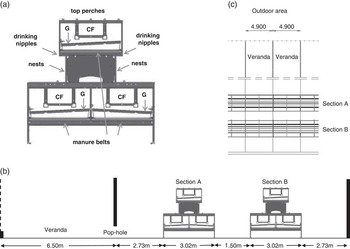
A multi-tier aviary system (Harmony Combo 2TM (two tiers); Landmeco, Ølgod, Denmark; www.landmeco.dk; Figure 1a) was installed on the concrete floor of the house in two rows (referred to as sections) running parallel along the length of the house (Figure 1b and c). The aviary system had a chain feeding system placed above grid flooring, under which automatic manure belts were installed, with three feeder chains and belts on each section (two on the lower tier, and one on the upper tier; Figure 1a). Nests (L×W×H: 1.20×0.55×0.45 m3) for egg laying were placed above an egg-conveyor belt in the middle of each section between the two tiers, with access from each side of a section. The nests were opened automatically at 0400 h and closed at 1600 h. Nipple drinkers were evenly spaced (four per meter) on both sides of the nests along the length of each section (Figure 1a). Each section had a total of 13 perches (metal tubes, diametre=3 cm), five of which were running along the very top of the section (top perches). Rooms were identically lit with no dawn/dusk dimming. The initial lighting programme was 11L : 13D, increasing gradually to 14L : 10D over the following 3 weeks, at which point the daily light period was kept at 0700 to 2100 h for the remaining period. The light sources were fluorescent tubes (four per room) placed in the ceiling on either side of the sections and on the veranda, and chains of LED lights stringed underneath the nests, illuminating the first level of the tiers. In addition, daylight could enter via shuttered ventilation hatches along the brick wall, and through the pop-holes. On bright days, a newspaper could be read in each room without the aid of artificial lighting.
(a) Diagram (cross section) of the multi-tier aviary system (Harmony Combo 2TM; Landmeco, Ølgod, Denmark; www.landmeco.dk). In treatment D6x, access to the top tier (above the nests and drinking nipples) was blocked by netting; (b) diagram (side view) to scale of a room showing the position of the two multi-tier sections (A and B). Stippled vertical line on the left indicates curtain between veranda and outdoor area; (c) plan view to scale of two of the 12 rooms showing the two multi-tier sections (A and B) traversing the length of the house. The two pop-holes per room leading to the veranda are indicated. CF=chain feeders; G=grid flooring.

A veranda (L×W: 58.8×6.5 m2), consisting of a roofed, concrete floor, was established along the entire length of the building, to which the birds could gain access through pop-holes (W×H: 100×50 cm2; Supplementary Figure S1). From the veranda, the birds had daily access to an outdoor area, except in extreme weather conditions. The veranda was sheltered from the outside by taut curtains, which were rolled up and down automatically according to a timing device. When rolled down completely, the curtains also prevented access to the outdoor area. The curtains were opened after expected egg laying at 1030 h (and 1130 h during Daylight Saving Time in the summer) and closed at dusk when the hens were expected to be indoors.
The house and veranda were divided into 12 identical rooms (W: 4.90 m; Figure 1c) by wooden walls, which prevented visual contact between hens in separate rooms. Doors between adjacent rooms, three inside the house and one on the veranda, provided access for farm staff and researchers. The floor area beneath each section (L×W: 4.90×3.02 m2), totalling 29.6 m2/room, was closed off with metal frames during the entire experiment. The hens had access to the different areas of the room via the grid flooring beneath the nests and (except for treatment D6x, see below) via the top of the sections. The available floor area per room was 66 m2 (in the house: (13.0×4.9 m2)−29.6 m2=34.1 m2; on the veranda: 6.5×4.9 m2=31.9 m2). Each room had two pop-holes accessing the veranda. The outdoor areas are described below as they differed in size according to treatment.
Birds and treatments
For each of the two experimental years, a flock of 6534 non-beak trimmed pullets (Hisex White, 18 weeks of age) were obtained from a commercial company (n=13 068 birds in the study). They had been reared from day-old on an organic farm specialized in rearing pullets for organic production with access to outdoor area from 9 weeks of age and supplied with roughage daily. During rearing they had been accustomed to a system with slats raised over the floor, where feed and drinkers were available, and with the distance between slats and floor being increased as the birds grew. The birds were vaccinated against Newcastle disease, infectious bursal diseases (Gumboro), infectious bronchitis and avian encephalomyelitis according to the vaccination programme recommended by the breeding company.
Four treatments were included in the experiment, three of which consisted of increasing indoor stocking densities (6 birds/m2 (D6), 9 birds/m2 (D9) and 12 birds/m2 (D12) available floor area). The remaining treatment (D6x) had the same stocking density as D6, but the top tiers of each aviary section were made inaccessible to the birds, thus reducing access to perches and feed troughs, and resembling the single-tier system currently used by many organic egg producers. The distribution of the four treatments across rooms was the same in both years, as the equipment (blocking of the top tier in treatment D6x) and size of outdoor area were fixed for each room. The treatments were placed in the following order across the 12 rooms: D9, D6x, D12 and D6, repeated so that three rooms separated rooms with the same treatment. Each treatment was replicated three times in each flock, giving a total of six replicates per treatment.
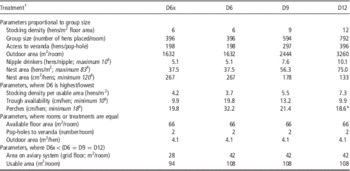
The differences in stocking densities were achieved by placing a different number of birds per room; this also resulted in other differences between treatments, such as nest area and perch length per hen (Table 1). For the treatments with full access to both tiers, the limiting factors for number of birds per room were perch and trough availability. Four perches were added to the rooms allocated to treatment D12 to ensure sufficient perch space per hen (Table 1). The outdoor area available to each room was adjusted to fit the relevant number of birds. In order to achieve 4 m2 outdoor area per hen for all group sizes, the shape of the areas differed between rooms, but all outdoor areas had at least 5 m in front of the veranda before the shape changed (see Supplementary Figure S2).
Description and calculation of different housing dimensions and resources for the four treatments, grouped according to treatment differences

† D6x, D6, D9, D12: letter D followed by a number refer to stocking density (6, 9 or 12 hens/m2 floor area), ‘x’ indicates that access to the top tier has been blocked.
‡ Minimum and maximum values from the EU regulations for organic laying hens (EC 889/2008, 2008) and hens in alternative systems (EC 74/1999, 1999) are indicated in italics.
* This includes four added perches on the first tiers in treatment D12 without which the availability would have been only 16.1 cm/hen.
Feed, roughage and water
All hens were fed an organic compound layer diet (Natur Æg Fase 1; DLG, Copenhagen, Denmark; Table 2) during the experimental period from 18 to 65 weeks of age. The feed was based mainly (>95%) on organically grown feed ingredients and did not contain ingredients arising from genetically modified organisms (EC 834/2007, 2007; EC 889/2008, 2008). The feed was pelleted and crumbled and offered ad libitum. The chain feeding system was activated five times per day at regular intervals (every 3 h and 15 min) from 0730 h (first feeding) until 2030 h (last feeding). It was not possible to register feed intake per room, and the amount fed was registered automatically on a daily basis for the whole flock. From week 30, the hens were offered free access to oyster shells (1 to 2 mm) placed on the floor in small plastic sacks with a hole in the middle. Access to organic foraging material was ensured by daily distribution of home-grown barley-pea silage (~30 to 50 g/hen) on the floor in the veranda. Water consumption (l/day) was automatically registered by a computer for the whole flock.
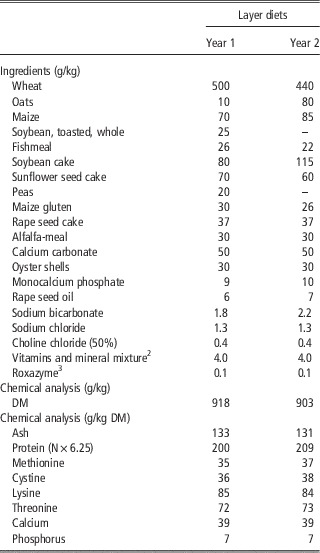
Mean composition and chemical analyses of layer dietsFootnote 1 fed during years 1 and 2, respectively

DM=dry matter.
1 Values given are the average composition and chemical analyses from four batches of layer diet per year.
2 Supplying per kg diet: vitamin A 12.000 IU; vitamin D3 3.000 IU; vitamin E (α-tocopherol) 25 mg; vitamin B1 4 mg; vitamin B2 5 mg; vitamin B6 8 mg; vitamin B12 0.012 mg; d-pantothenic acid 12 mg; niacin 45 mg; folic acid 1.4 mg; FeSO4, 7 H2O 60 mg; ZnO 80 mg; MnO 80 mg; CuSO4, 5 H2O 15 mg; KI 0.45 mg; Na2SeO3 0.2 mg.
3 Roxazyme: endo-1,4-betaglucanase (IUB no. 3.2.1.4), endo-1,3:1,4-betaglucanase (IUB no. 3.2.1.6) and xylanase (IUB no. 3.2.1.8); 2600 units/kg diet EU no. E1602.
Measurements, data collection and analyses
Egg production
Eggs were collected and counted daily to get the overall productivity for the whole flock. However, once every 2nd week the daily egg production was recorded per room. The evening before, square metal rods with the same width as the egg belt were placed on the belt with a distance corresponding to the width of each room, allowing the eggs laid in each room to be collected separately. The egg collection started at 1200 h and the motion of the egg belts was managed manually during this collection to allow time to count and weigh the eggs laid in the nests from each room. The number of cracked eggs per room was noted. Egg weights were calculated as an average per room (excluding cracked eggs); egg production per room was calculated by dividing number of eggs (including all non-nest eggs; see below) with number of hens per room adjusted for mortality. On the same day it was recorded for each room how many eggs were laid on the floor, on the aviary system outside the nests, and on the veranda (non-nest eggs).
Chemical analyses of feed
The dry matter content of samples of the layer diet (n=8; samples from four batches per year across the experimental period) was determined by drying at 103°C for 8 h. Samples were freeze-dried before analysis and milled after drying to pass through a 0.5-mm screen. All samples were analysed for ash according to method 930.05 of the Association of Official Analytical Chemists (AOAC) (2000), as well as for nitrogen (Hansen, Reference Hansen1989), methionine, cysteine, lysine and threonine (EC 152/2009, 2009), and for phosphorus by the colorimetric vanadomolybdate procedure (Stuffins, Reference Stuffins1967) and calcium according to method 975.03 (AOAC, 2000; Table 2).
Video recordings on veranda
The behaviour of the birds was recorded in each room by a video camera positioned on the veranda with a view of the main floor area and the pop-holes. Half of the veranda was clearly visible in all recordings (Supplementary Figure S1), and the number of birds present within this area was counted hourly during the light period on 3 days (40, 48 and 60 weeks of age in year 1; and 36, 42 and 50 weeks of age in year 2). The days (in August, October, December and March) were chosen based on weather conditions (similar rainfall (0.8±0.46 mm) and wind speed (4.7±1.67 m/s), and with temperatures and sunshine reflecting the time of year) and to cover early and late in the laying period as well as two overlaps in age between flocks (40 to 42 weeks in October, 48 to 50 weeks in December). Although birds were not always evenly distributed on the veranda, this did not appear to favour one half above the other, nor be affected by group size based on comparisons between rooms at similar time points. Data were doubled to correspond to the whole veranda, and proportions adjusted to the exact number of birds in each room on the day of observation. Means were calculated within room and day across morning (0800 h until access was given to outdoor area) and afternoon (1400 to 1700 h) periods.
Assessment of vegetation on outdoor area
The vegetal cover of the outdoor areas was assessed once for each flock (at 27 and 41 weeks, respectively) using a 5 point scale (0=bare soil, 4=complete cover). For each room, the level of vegetation was scored at 5 m intervals along the barriers on each side and in the middle. Based on preliminary analysis of these raw data, the three vegetal cover scores were averaged for each 25 m up to a distance of 125 m from the house (i.e. largest distance common to all treatments), and these were used for statistical analysis. The vegetation was able to regrow completely between the two flocks.
Statistical analyses
Data were analysed using Minitab (version 17, www.minitab.com) including all four treatments to allow direct comparisons between treatments with similar access to certain resources (see Table 1). A GLM was fitted to egg variables (weight, placement, proportion cracked), fitting age in weeks (n=19) and room within treatment to account for repeated measures and fitting year/flock and treatment as fixed effects together with their interaction. Laying percentage was analysed across the production period fitting year/flock and treatment as fixed effects together with their interaction. Vegetal cover scores were analysed fitting room within treatment and year/flock as fixed effects as well as treatment and distance to house (n=5) together with their interaction. Observations on use of the veranda area were analysed fitting room within morning or afternoon period and treatment, as well as age in weeks (n=3) within year to account for repeated measures and fitting year/flock, treatment and morning or afternoon period (n=2) as fixed effects with all two-way interactions. The Gaussian distribution of the residuals was tested by plotting these against fitted values and an Anderson-Darling normality test was applied to the residuals. Post-hoc comparisons were done using Tukey simultaneous tests.
Results
Egg production
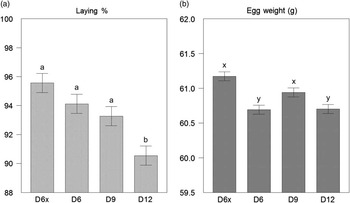
Egg production differed significantly between the two flocks, with a higher laying percentage observed in the 1st year (94.2% v. 92.5% (±0.47), respectively; F 1,16=6.6; P=0.020), but with a lower average egg weight (59.8 v. 62.0 g/egg (±0.05), respectively; F 1,222=1148.7; P<0.001). Hens kept at the highest density (D12) had a lower laying percentage than any of the other treatments (F 3,16=10.2; P=0.001; Figure 2a). Egg weight was affected by treatment (F 3,222=12.6; P<0.001) with eggs being slightly heavier in treatments D6x and D9 (Figure 2b).The proportion of cracked eggs did not differ between treatments, but increased with age and differed between flocks, with a higher percentage of cracked eggs in the more productive first flock (2.1% v. 1.3% (±0.05), respectively; F 1,224=182.4; P<0.001), and a gradual increase from 1% to 2% in week 30 to 2% to 3% towards the end of lay (F 216,224=2.0; P<0.001).
(a) Overall laying percentage (±s.e.) and (b) mean egg weight (±s.e.) for the four treatments. Please note that the y-axes do not start at the origin. Within each figure, bars with different letters differ significantly (a) ab P⩽0.045; (b) xy P⩽0.047.

Laying behaviour
Very small, but significant differences were found in the use of the nest boxes in each side of the room. Across treatments, the largest proportion of eggs was laid in the nest boxes closest to the veranda. A significant interaction was found between year/flock and treatment (F 3,223=3.9; P=0.010), but the numerical differences were low (Table 3). The proportion of eggs laid outside the nests was almost twice as large in the 2nd year (1.5% v. 2.8% (±0.06), respectively; F 1,220=257.8; P<0.001), and a significant interaction with treatment was found (flock by treatment interaction; F 3,220=13.3; P<0.001; Table 3). These non-nest eggs were laid either on other parts of the tiers, on the floor or on the veranda, and the distribution between these three locations differed between flocks and treatments (Table 3).
Mean egg weights and egg placement variables for each of the four treatments in each year

x,y,a,b,cMeans with different superscripts within variable and flock/year differ significantly.
1 All main effects of flock/year and treatment: P<0.001.
2 D6x, D6, D9, D12: letter D followed by a number refer to stocking density (6, 9 or 12 hens/m2 floor area), ‘x’ indicates that access to the top tier has been blocked.
3 Pooled s.e.m.
4 Eggs laid in nests in section A constitute the remaining percentage up to 100%.
5 Non-nest eggs laid on the veranda constitute the remaining percentage up to 100%.
Use of veranda
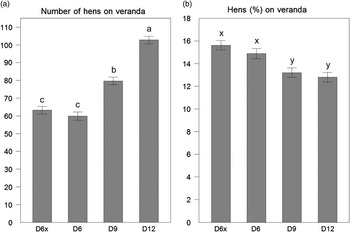
No significant interactions with treatment were found for flock/year or time of day (morning or afternoon) for the use of the veranda. A small but significant difference was found between the 2 years in the percentage of hens on the veranda across observations (13.6% v. 14.7% (±0.30), respectively; F 1,100=6.2; P=0.015). Similarly, a smaller proportion of hens was seen on the veranda in the morning than in the afternoon (12.3% v. 16.0% (±0.30), respectively; F 1,100=78.4; P<0.001). More hens were observed on the veranda as stocking density increased (F 3,100=79.4; P<0.001; Figure 3a), and this increase was almost, but not quite proportional to the increase in stocking density (F 3,100=10.3; P<0.001; Figure 3b).
(a) Mean number of hens (±s.e.), and (b) mean percentage of hens (±s.e.) in each treatment on the veranda across observation days and time of day. Within each figure, bars with different letters differ significantly (a) abc P⩽0.045; (b) xy P⩽0.047.

Use of outdoor area
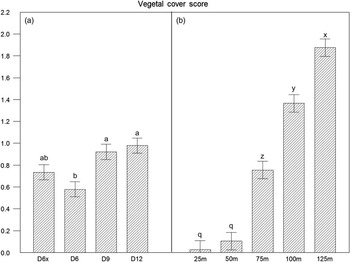
The vegetal cover of the outdoor areas differed significantly between treatments (F 3,91=6.9; P<0.001) with less vegetal cover observed in treatment D6 than D9 and D12 (Figure 4a). Vegetal cover also changed with distance from the house (F 4,91=100.1; P<0.001) with a sharp and linear increase in cover after 50 m from the house (Figure 4b). A small, but significant difference in vegetal score was found between years (0.74 v. 0.92 (±0.051) for years 1 and 2, respectively; F 1,91=6.4; P=0.013).
Mean vegetal cover score (±s.e.; 0=bare soil and 4=complete vegetal cover) (a) for the different treatments, and (b) relative to distance from the house. Within each figure, bars with different letters differ significantly (a) ab P⩽0.045; (b) xyzq P⩽0.047.

Discussion
The current study aimed to investigate health, welfare and production consequences of increasing stocking density (6, 9 or 12 hens/m2 floor space) in organic egg production. It is not possible to change stocking density without changing at least one of its two components, either group size or room size. We chose to increase group size and keep the layout of the rooms the same, as this reflects better what happens in practice when stocking density is increased. This obviously creates additional differences between the treatments, most importantly the availability of nests, food troughs, nipple drinkers and perches. However, we included a fourth treatment (D6x) in which hens kept at the lowest stocking density where barred access to the top tier, allowing us to disentangle – to a certain extent – the confounding effects of some of these additional treatment differences.
Egg production and laying behaviour
The higher laying percentage in the 1st year was not offset by the slightly lighter eggs in this flock. This increased egg production was not a reflection of hen weight, as the birds in the 2nd year were heavier throughout the production period (Steenfeldt and Nielsen, Reference Steenfeldt and Nielsen2015), but may have been caused by subtle differences in the feed composition between the two flocks. The finding that across flocks laying percentage was reduced in the largest group size may be a consequence of the concomitant reduction in drinker or nest accessibility. The reduction in access to water could have led to a lower food intake in the largest groups, resulting in reduced laying capacity. However, results from hens in cages show that even at 14 hens per nipple (i.e. 40% higher than treatment D12) no reduction in egg production was seen (Gernat and Adams, Reference Gernat and Adams1992). Savory (Reference Savory1978) found no significant differences in egg production when restricting the daily water supply of layers to 90% of ad libitum intake for a period of 6 weeks. In addition, in the present study the presence of rain puddles on the outdoor area gave the birds alternative access to water at times. Although hens prefer smaller nests (Ringgenberg et al., Reference Ringgenberg, Fröhlich, Harlander-Matauschek, Würbel and Roth2014), we have been unable to find published results on the influence of nest availability on total egg production in non-cage laying systems. Decreased access to nests lead to more floor eggs in ducks (Makagon and Mench, Reference Makagon and Mench2011), but we found only a slightly higher fraction of eggs laid outside the nests in the largest groups in one of the flocks, and non-nest eggs were included in the total count. We cannot exclude that more eggs were laid and lost on the outdoor area in the largest groups, but outside access was possible only after expected time of lay. The reduction in laying percentage in the largest groups still resulted in a higher egg production per housing area, that is D12 hens produced 91% more eggs than hens in D6, resulting in a larger net income per square metre for the producer at the highest stocking density, even when taking into account additional expenses for hens and feed. Although this study was not designed to test the current legislative minimum limits regarding access to resources in organic egg production, it is remarkable that laying percentage was affected in the largest group size, even when access to all resources except floor space was within the EU rules.
Use of veranda and outdoor area
The decrease in available indoor floor area as stocking density increased was reflected in the use of verandas with higher densities of birds on the veranda in the larger groups. It was not, however, proportional to group size as a smaller proportion of birds were seen on the veranda in the larger groups. A decreasing percentage of birds go outside with increasing flock size (Hegelund et al., Reference Hegelund, Sørensen, Kjær and Kristensen2005), which has also been found in smaller flocks comprising 250, 500 and 1000 birds (Harlander-Matauschek, Reference Harlander-Matauschek2001). In terms of number of birds, however, both these studies showed more birds outside as flock size increased. In the present study, we only had indirect measures of how many birds ventured outside. More vegetation remained on the outdoor areas in the larger groups indicating less use of the distant outdoor areas, and this measure took into account the differences between treatments in the size of the outdoor area. The number of birds seen on the veranda is likely to correlate to a certain degree with the number of birds outside, at least in terms of maximum values as the hens had to pass through the veranda to gain access to the outdoor area. In addition, the pop-holes in the present study led to the veranda, and Richards et al. (Reference Richards, Wilkins, Knowles, Booth, Toscano, Nicol and Brown2011) found that in groups of 1500 hens ~8% of hens never approached the pop-holes. We found that the number of hens observed on the veranda increased with increasing group size indicating that numerically more hens went outside in the larger groups, as the verandas emptied of birds as soon as the curtain was raised. However, the greatest reduction in vegetal cover was observed in the treatment with least birds and full access to the aviaries (D6). Gilani et al. (Reference Gilani, Knowles and Nicol2014) found an effect of pop-hole accessibility on range behaviour, but the dimensions of the pop-holes in the present study were unlikely to have limited access to the verandas in the group sizes tested (Harlander-Matauschek et al., Reference Harlander-Matauschek, Felsenstein, Niebuhr and Troxler2006).
A recent study by Gebhardt-Henrich et al. (Reference Gebhardt-Henrich, Toscano and Fröhlich2014) is among the few investigating the use of verandas and outdoor areas by laying hens kept in aviary systems and in different flock sizes (2000 to >9000 hens). By tagging 5% to 10% of the birds with radio frequency identification tags, they found that at least 80% of tagged birds visited the veranda, and at least 50% went outside. Surprisingly, they found no association between the percentage of hens registered outside the house (on veranda or outdoor area) and flock size, but individual hens in small and medium sized flocks visited the areas outside the house more frequently and spent more time there than hens from large flocks. We did not measure movement of hens, but the findings by Gebhardt-Henrich et al. (Reference Gebhardt-Henrich, Toscano and Fröhlich2014), together with those of Harlander-Matauschek (Reference Harlander-Matauschek2001) indicate a larger flux in and out of the house in smaller groups.
Conclusions
Increasing the stocking density in organic egg production systems using multi-tier aviaries from 6 to 12 hens/m2 affected the egg production and space use of the hens. Number of hens using the veranda increased with stocking density and hens kept at the lowest stocking density and the smallest group size appeared to use the outdoor area more extensively, based on an assessment of vegetation cover. Laying percentage was significantly lower at the highest stocking density, most likely due to the concomitant reduction in nest and drinker accessibility, but no systematic effects were found on other laying variables (eggs laid outside nests, aviary side preferences, egg weights). For the measures reported here (laying behaviour, use of veranda and outdoor area), the welfare consequences for the hens of doubling the indoor stocking density were minor; however, a more complete welfare assessment based on additional results are reported in Steenfeldt and Nielsen (Reference Steenfeldt and Nielsen2015).
Acknowledgements
The authors are grateful for the hospitality and collaboration of Arend (André) M. Hingstman, who owns and runs the organic egg production farm in which the study was carried out. The authors also thank Erik L. Decker, Henrik K. Andersen, Carsten K. Christensen and Leif Rasmussen for their indispensable technical and practical assistance. This project was funded by Aarhus University and the Danish Ministry of Food, Agriculture and Fisheries.
Supplementary material
To view supplementary material for this article, please visit http://dx.doi.org/10.1017/S1751731115000713