


Introduction
The accumulation of possessions naturally occurs as a means of being prepared for future requirements. People store food for later consumption, heavier clothes for wearing in colder weather, and books and magazines to enjoy reading during leisure time. For some people, the accumulation of possessions can become compulsive where either the number of items amassed is greatly in excess of any future need or the items themselves are relatively useless. Frost and Hartl's (Reference Frost and Hartl1996) cognitive-behavioural model describes hoarding as a multi-faceted problem involving difficulties in forming emotional attachments, behavioural avoidance, erroneous beliefs about the nature of possessions, and information processing deficits. Information processing deficits are thought to include “problems with organizing (information and possessions), problems with making decisions and possible problems with memory” (Frost, Steketee and Greene, Reference Frost, Steketee and Greene2003, p. 324). These deficits are unlikely to be mutually exclusive, as difficulties with decision-making and memory/attention are likely to contribute to organizational problems.
Organizing possessions is a complex phenomenon involving skills in categorization and sorting where the individual must be able to: decide which items are kept and which are discarded, put like things together, and decide where items should be located in their home. Effective organization requires an individual be able to attend to the task, make decisions, problem-solve and be able to change plans or strategies when they are ineffective. These tasks are often referred to as executive functioning. Deficits in organization ability may be explained by problems with memory and attention. It has been hypothesized that people with hoarding problems exhibit difficulties in maintaining focus and perspective (Frost et al., Reference Frost, Steketee and Greene2003); a lack of confidence in memory (Frost and Hartl, Reference Frost and Hartl1996); problems with sustained attention and response inhibition (Grisham and Barlow, Reference Grisham and Barlow2005); and distractability (Saxena and Maidment, Reference Saxena and Maidment2004). Some support has been found for these hypotheses.
Research into memory deficits has found that those who hoard demonstrated greater procedural learning impairment, as compared to OCD and anxious control groups, using the Serial Reaction Time Task (SRT) (Goldman et al., Reference Goldman, Martin, Calamari, Woodard, Chik and Messina2008), recalled less information on the Rey-Osterrieth Complex Figure Test (RCFT) and the California Verbal Learning Test (CVLT), and used less effective organization strategies on the RCFT (Hartl et al., Reference Hartl, Frost, Allen, Deckersbach, Steketee and Duffany2004). Hartl, Duffany, Allen, Steketee and Frost (Reference Hartl, Duffany, Allen, Steketee and Frost2005) also found that people with hoarding difficulties reported more symptoms of inattention and hyperactivity than non-hoarders.
Grisham, Brown, Savage, Steketee and Barlow (Reference Grisham, Brown, Savage, Steketee and Barlow2007) conducted an experimental exploration of attentional deficits amongst a sample of individuals with hoarding difficulties. They compared a group of participants who hoarded to a mixed clinical group and a community control group utilizing the Digit Span test from the Wechsler Adult Intelligence Scale – Third Edition (WAIS-III; Wechsler, Reference Wechsler1997a); the Visual Memory Span from the Wechsler Memory Scale – Revised (WMS-R; Wechsler, Reference Wechsler1987) and the Conner's Continuous Performance Test II (CPT-II; Conners, Reference Conners2000). They had mixed results but overall found that the hoarding group demonstrated significantly slower and more variable reaction time, increased impulsivity, greater difficulty distinguishing targets and non targets, and impaired spatial attention. They also suggested that the hoarding group had a “decreased ability to develop a consistent strategy relative to the other groups” (p. 1479). They found no significant differences on the Digit Span test but did identify differences on the Visual Memory Scan-forward, with the hoarding group scoring significantly lower than the other two groups, which they believed indicated possible deficits in spatial attention. It is important to replicate these findings as this is the only study that has investigated attentional deficits amongst people who hoard utilizing these standardized tests. Supporting a possible link between attention deficits and hoarding symptoms, recent research has identified that the inattentive symptoms of Attention Deficit Hyperactivity Disorder (ADHD) predicted the severity of clutter, difficulty discarding and acquiring in people diagnosed with hoarding difficulties (Tolin and Villavicencio, Reference Tolin and Villaviencio2011). A review into tests of attention amongst people diagnosed with OCD has indicated that there is little evidence for dysfunctional attention (Kuelz, Hohagen and Voderholzer, Reference Kuelz, Hohagen and Voderholzer2004). This could indicate that problems in attention may indeed be specific to compulsive hoarding and it would be useful to directly assess this.
Frost and Steketee (Reference Frost and Steketee1999) have proposed a theory of under-inclusiveness to explain the organization and categorization deficits seen in people who hoard. Frost and Steketee used the term “under-inclusiveness” to describe organizational deficits in hoarding whereby each possession is seen as unique and belonging in a category by itself. Individuals who hoard, therefore, have difficulty in grouping possessions together due to the “specialness” of each item, which greatly contributes to the clutter and chaos. Wincze, Stejetee and Frost (Reference Wincze, Steketee and Frost2007) tested this aspect of the model by comparing 21 individuals who hoard with 21 individuals with non-hoarding OCD and 21 non-psychiatric controls. Wincze et al. (Reference Wincze, Steketee and Frost2007) found that the groups did not differ when sorting common household items but, when sorting personally relevant items, the participants with hoarding problems took more time and created more piles than the other two groups. Grisham, Norberg, Williams, Certoma and Kadib (Reference Grisham, Norberg, Williams, Certoma and Kadib2010) also found that people with hoarding problems took longer to sort personal objects than a non-clinical and clinical comparison group. They also rated themselves as being more anxious, both before and after the task. Mackin, Arean, Delucchi and Mathews (Reference Mackin, Arean, Delucchi and Mathews2010) utilized the card-sorting test in Delis–Kaplan Executive Function System with older depressed adults, with and without hoarding symptoms. They identified that depressed older adults who hoarded took more time, and completed less categories, than non-hoarding depressed older adults. Wincze et al. recommend the use of neuropsychological tests, such as the Wisconsin Card Sorting Test (WCST). A review of several factor analyses conducted on the WCST identified two factors; a measure of “executive functioning” which, in this test, consists of the ability to recognize possible sorting concepts (categories completed, trials to first category) and an inability to shift from an incorrect response set (perseveration errors); and a measure of “sustained attention” (failure to maintain set) (Greve, Ingram and Bianchini, Reference Greve, Ingram and Bianchini1998). Wincze et al. (Reference Wincze, Steketee and Frost2007) argued that it is likely that this test would be a more objective measurement of the tasks, or underlying abilities, required for sorting.
In comparison, no significant differences have been found between healthy controls and people with OCD on neuropsychological performance, including the WCST (Olley, Malhi and Sachdev, Reference Olley, Malhi and Sachdev2007; Simpson et al., Reference Simpson, Rosen, Huppert, Lin, Foa and Liebowitz2006). One study, however, found that OCD participants with higher self-report ratings of hoarding behaviour performed significantly worse on the WCST than individuals with lower ratings of hoarding behaviour (Lawrence et al., Reference Lawrence, Wooderson, Mataix-Cols, David, Speckens and Phillips2006), which may lend support to the theory that the WCST would be able to identify deficits in those who hoard.
Compulsive hoarding is a problem that affects a significant number of people and has a severe impact on their lives. This research aims to test one aspect of Frost and Hartl's (Reference Frost and Hartl1996) cognitive-behavioural theory of compulsive hoarding. Specifically, it aims to test the theory that cognitive deficits, such problems with working memory, attention and categorization, contribute to hoarding problems. This will be measured using the WCST, the Spatial Span test and the Digit Span test. Although Grisham and colleagues did not find poorer results on the Digit Span test for those with hoarding problems compared to controls we decided to include this test for two reasons. First, it is important to replicate the findings of the Grisham study to strengthen the conclusions that can be made about cognitive deficits in this population. Second, Digit Span is a sensitive test of the ability to sustain attention and can be administered in a very short time frame, making it a potentially useful clinical assessment of attentional capacity for patients with hoarding problems. The main research hypothesis is that participants with compulsive hoarding will score significantly different on the WCST than population norms. Specifically, those with compulsive hoarding will have significantly higher numbers of “perseveration errors”, lower numbers of “completed categories”, and a higher number of “trials to first category”, indicating deficits in executive functioning. Additionally, they will have higher incidences of “failure to maintain set”. Finally, based on results from Grisham and colleagues, while we do not expect to find any significant differences on the Digit Span test between the two groups, we do expect to find that people with compulsive hoarding will score significantly lower on the Spatial Span test forward, as compared to population norms. This measure is used to assess immediate visual-spatial memory and attention. A significantly lower score on the Spatial Span test forward would replicate the previous research findings and lend support to the theory of spatial attention deficits in people who hoard.
Method
Participants
All participants were recruited at the Curtin University Psychology Clinic in Perth, Western Australia. This is an outpatient clinic that received referrals from across the state. The inclusion criteria were as follows: participants had to meet the compulsive hoarding criteria as outlined by Steketee and Frost (Reference Steketee and Frost2007); be aged between 18 and 65 years; and have a minimum score of 36.9 on the Saving Inventory-Revised (SI-R). This score was selected as it represents one standard deviation above the community mean and is consistent with clinical cut-offs used in other investigations (Hartl et al., Reference Hartl, Duffany, Allen, Steketee and Frost2005; Grisham, Frost, Steketee, Kim and Hood, Reference Grisham, Frost, Steketee, Kim and Hood2006). Participants’ SI-R scores ranged between 44 and 88, with a mean of 60.12, which was consistent with other research findings. Participants were to be excluded if they had a neurological disorder that could potentially impact on their neuropsychological test scores. Twenty-seven participants were invited to attend testing sessions. Three participants, two female and one male, were found to not meet the criteria for inclusion and were therefore omitted from the study. One participant identified a neurological disorder and two participants did not have clinically significant scores on the SI-R. Participants (n = 24) ranged in age from 39 years to 65 years, with a mean age of 54.75 years. Eleven participants achieved scores on the OCI-R that indicated they had concurrent OCD, which was consistent with their initial clinical interview using the OCD component of the Structured Clinical Interview for DSM-IV (SCID) (First, Spitzer, Gibbon and Williams, Reference First, Spitzer, Gibbon and Williams1996). The results of this measure were used to assist in determining whether concurrent OCD, and the severity of OCD symptoms, influenced performance in neuropsychological tasks by comparing the performance of the hoarding participants that had concurrent OCD to those who did not. The gender distribution of participants was 18 female (75%) and 6 male (25%). Of the 24 participants, 8 (33.3%) indicated that they lived alone while 16 (67%) stated that they lived with others.
Measures
Structured Clinical Interview for DSM-IV (SCID)
The SCID is a semi-structured clinical interview for making Axis I diagnoses developed by First et al. (Reference First, Spitzer, Gibbon and Williams1996), based on the diagnostic criteria outlined in the Diagnostic and Statistical Manual of Mental Disorders (APA, 2000). The OCD component of the SCID is designed to identify whether the individual currently meets the criteria for an OCD diagnosis.
Saving Inventory Revised (SI-R)
This measure was designed to assess hoarding behaviour and was originally developed by Frost and Gross (Reference Frost and Gross1993), and later revised by Frost, Steketee and Grisham (Reference Frost, Steketee and Grisham2004). The SI-R is a 23-item self-report questionnaire that provides an overall score. It also provides sub-scores in three factors recognized with hoarding: difficulty discarding, excessive clutter, and excessive acquisition. Each item is measured on a 5-point Likert scale specific to each question. These authors found that the SI-R demonstrated high internal consistency, good test-retest reliability and was able to distinguish hoarders from OCD without hoarding, as well as community controls. The authors also found this measure demonstrated good convergent validity with other measures of hoarding and also with self-rated and observed-rated clutter in the home. The mean community score was 23.7 (SD 13.2) and the mean of hoarders, 62 (SD 12.7) (Frost et al., Reference Frost, Steketee and Grisham2004).
Neurological screen
An initial screen was given to each participant to determine whether or not they had been diagnosed by a doctor for a neurological disorder such as dementia, multiple sclerosis, Parkinson's disease or a cerebro-vascular accident (CVA). This aimed to rule out any individual that may have neurological symptoms.
Obsessive Compulsive Inventory Revised (OCI-R)
This measure is a self-report instrument initially developed by Foa, Kozak, Salkovskis, Coles and Amir (Reference Foa, Kozak, Salkovskis, Coles and Amir1998) and later revised by Foa et al. (Reference Foa, Huppert, Leiberg, Langner, Kichic and Hajcak2002). The measure consists of 18 items and 6 subscales: Washing, Obsessing, Hoarding, Ordering, Checking, and Neutralizing. Each item is measured on a 5-point Likert scale of symptom frequency and associated distress. The authors found the OCI-R had high internal consistency and moderate to high test-retest reliability. The measure was found to have a solid factor structure and was moderately related to observer ratings of OCD and strongly related to another self-report rating scale. The authors found that the measure was able to differentiate between individuals with and without OCD and recommended a cut-off score of 21 for differentiating clinical OCD.
Digit Span test
The Digit Span test is a subtest of the Wechsler Adult Intelligence Scales, 3rd edition (WAIS-III; Wechsler, Reference Wechsler1997a) and has been standardized and normed. The test involves the presentation of a series of orally presented number sequences that the individual must repeat. It involves repeating back sequences as stated, Digits Forward, and repeating digits in a reverse order, Digits Backward. This test is “very sensitive to the ability to establish and sustain a focus of attention” (Groth-Marnat, Gallagher, Hale and Kaplan, Reference Groth-Marnat, Gallagher, Hale, Kaplan and Groth-Marnat2000). The standardization sample included a stratified sample of 2450 individuals from the ages of 16 to 89, with each age group having 100–200 participants. Each group had equal numbers of males and females. This ensured that each participant in this study was being compared to 100 individuals of the same age grouping and sex. Administration time is approximately 10–15 minutes.
Spatial Span test
The Spatial Span test is a subtest of the Wechsler Memory Scales, 3rd edition (WMS-III; Wechsler, Reference Wechsler1997b) and has been standardized and normed. The test involves the presentation of a board of blocks, where the examiner touches blocks in sequence and the individual must tap the same blocks in the same order, Spatial Span Forward, or in reverse order, Spatial Span Backward. This Spatial Span forward is a simple visual-spatial attention task; however, Spatial Span backwards is more complex and involves both attention and working memory. Scaled scores are available for Spatial Span forward, Spatial Span backward, and Spatial Span total. The tests in the WMS-III were normed on a standardization sample of 1250 people between the ages of 16 and 89 in equal numbers of males and females; in age groupings, this meant that each individual was compared to 50 others, matched for age and sex to identify their normed score. Administration time is approximately 10–15 minutes.
Wisconsin Card Sorting Test (WCST)
The WCST was initially developed by Berg and Grant in 1948 but was standardized and normed by Heaton, Chelune, Talley, Kay and Curtiss (Reference Heaton, Chelune, Talley, Kay and Curtiss1993). The test consists of four stimulus cards (one red triangle, two green stars, three yellow crosses, and four blue circles) and two response decks of 64 cards each. The client is instructed to match each consecutive card to one of the four stimulus cards and receives immediate feedback of correct or incorrect each time. The client is not told the rules for sorting but must work it out by themselves. The sorting criteria are then changed and the individual must adapt to the new rules. The individual is initially asked to sort to colour, then form, then number and then back to colour, all with no warning. The test provides several measures including: perseveration errors (PE); categories completed (CC); failure to maintain set (FTMS); and trials to first category (TFC). A computerized version will be used for this research, as it is useful in eliminating recording and scoring errors (Strauss, Sherman and Spreen, Reference Strauss, Sherman and Spreen2006). Administration time is 15–30 minutes. The WCST's normative data were derived from a sample of 899 normal subjects aggregated from six distinct samples in the US and has been differentiated into distinct age-related groupings (Heaton et al., Reference Heaton, Chelune, Talley, Kay and Curtiss1993).
Procedure
The researcher conducted a brief phone interview to ascertain whether interested participants met the criteria of compulsive hoarding, as defined by Steketee and Frost (Reference Steketee and Frost2007). These criteria include: the accumulation of a large number of possessions that have cluttered the living areas of their home in a disorganized manner; difficulty in resisting the urge to acquire items that added to the clutter; a reluctance to part with items; a marked distress and/or reduced functioning associated with the accumulation of clutter and/or parting with items; and that the problem had persisted for over 6 months. Testing sessions for participants typically took between 1 and1½ hours. A focused clinical interview was initially conducted to confirm that the participant met Steketee and Frost's proposed diagnostic criteria for Compulsive Hoarding. During this interview, the OCD component of the SCID was used to determine whether participants met the diagnostic criteria for OCD. After the participants were determined to have met the compulsive hoarding criteria, they were asked to complete a consent form; a neurological screen; the SI-R, and the OCI-R. The SI-R and OCI-R were primarily used as measures of severity, although were also useful in supporting the clinical diagnoses. While the use of hoarding questions, to people who had compulsive hoarding, was likely to have inflated the OCI-R scores, only one participant would not have met the cut-off for OCD without them. As the participant appeared to meet the criteria for OCD during the clinical interview, and changing the group designation of this participant did not make any significant difference to the results, the participant was kept in the OCD group. The participants were then tested using the Digit Span test, the Spatial Span test, and the computerized-version of the WCST. The same researcher conducted all interviews and all testing.
Results
Descriptives
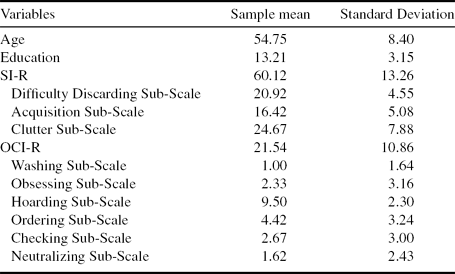
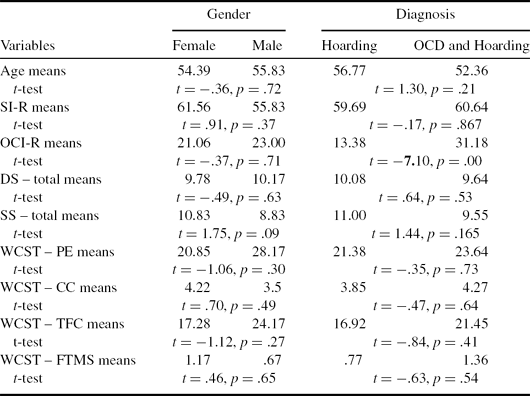
Demographic characteristics and scores on the SI-R and the OCI-R are summarized in Table 1. Independent Group t-tests were utilized to detect the potential confounding influences of variables such as gender and diagnosis (see Table 2). There were no significant differences in the target variables between males and females and so for the purposes of this study they can be considered as one group. Of the 24 participants, 11 gained scores of 21 or greater on the OCI-R, indicating clinical severity of OCD symptoms. An investigation of group differences between those with hoarding problems only (n = 13), compared to those with hoarding problems and concurrent OCD (n = 11), indicated a significant difference in their OCI-R scores as expected. No other significant differences in means were found between the groups with regard to target variables.
Hoarding sample characteristics

Means and independent groups t-tests for gender and diagnosis
Notes: Female, n = 18; Male, n = 6; Compulsive Hoarding only, n = 13; Compulsive Hoarding and OCD, n = 11;
SI-R (Savings Inventory-Revised), OCI-R (Obsessive-Compulsive Inventory-Revised), DS – total (Digit Span Total Scaled Score), SS – total (Spatial Span Total Scaled Score), WCST – PE (WCST perseveration errors), WCST – CC (WCST categories completed), WCST – TFC (WCST trials to first category), WCST – FTMS (WCST failure to maintain set)
Data screening
The raw scores of the DS and the SS were converted into scaled scores based on participants’ ages. Initial screening of the DS, SS and WCST data indicated that the “perseveration error” scores on the WCST were not normally distributed. This was thought to be likely due to the age range of the participants, particularly with regard to certain ages being absent from the sample. In order to correct for this, individual “perseveration error” scores were converted to z scores, based on the mean and standard deviation for their age. These population means and standard deviations were sourced from the Wisconsin Card Sorting Test Manual (Heaton et al., Reference Heaton, Chelune, Talley, Kay and Curtiss1993). These new z-scores provided an age-adjusted “perseveration error” score for each participant. These age-adjusted scores were found to be normally distributed. The z-score conversion also has the advantage of allowing for the influence of age, which is known to affect performance on tests of executive functioning. The use of age-adjusted WCST scores made no difference to the absence of significant group differences. This calculation was also conducted for the other WCST sub-scores, providing age-adjusted scores for “categories completed”, “failure to maintain set” and “trials to complete first category”. Analyses were then conducted using the age-adjusted scores for comparison.
Correlational analysis
Variables including gender, education and living situation were not significantly correlated to the variables of interest. SI-R was significantly positively correlated with “failure to maintain set”. This indicated that higher rates of errors, after 5 or more correct responses, were correlated with greater hoarding severity. OCI-R scores were negatively correlated with age, indicating that younger participants were more likely to have higher ratings of OCD symptoms.
Main analysis
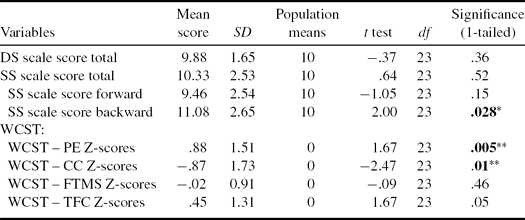
One-tailed one-sample t-tests were conducted on the neuropsychological test scores to compare the group with compulsive hoarding with the test reference groups. Initial tests on the Digit Span scaled scores and Spatial Span scaled scores were conducted using a population mean of 10 (see Table 3). There were no significant differences identified between those with hoarding problems and the population norms on the Digit-Span-total scores. The norms used were from the US test data as an exploration of the WAIS-III, between an Australian sample and the US standardization sample, identified test model equivalence (Bowden, Weiss, Holdnack, Bardenhagen and Cook, Reference Bowden, Weiss, Holdnack, Bardenhagen and Cook2008). A one-sample t-test on Spatial Span scores found that hoarders did not perform significantly different from the population norms in Spatial Span-total or Spatial Span-forward. There was an unexpected significant difference in Spatial Span-backward, whereby this sample of people with hoarding difficulties performed better on Spatial Span-backward than would be expected in a normal population.
One-sample t-tests for neuropsychological tests
Notes: * p ≤ .05; ** p ≤ .01
One-sample t-tests were also conducted on the WCST data (see Table 3). When utilizing the age adjusted z- scores, both “preservation errors” and “categories completed” were significantly different to population norms (t = 1.673, p < .01; t = −2.472; p = .01). This sample of people who compulsively hoard was more likely to have higher numbers of perseveration errors and fewer categories completed than would be expected from a population of the same age. Differences in the number of “trials to first category” were notable but did not achieve the level of significance. There was no significant difference, between the hoarding group and population norms, for “failure to maintain set”.
Additional analyses
The relationship between hoarding and OCD was examined using the SI-R and the OCI-R. There was no significant correlation between the two scores indicating that hoarding severity was not linked to the presence of OCD symptoms for this sample. However, there was a significant correlation between the SI-R and OCI-R hoarding sub-scale (r = .502, p < .05) indicating that they are measuring a similar concept. Specifically, the OCI-R hoarding sub-scale was significantly correlated with the SI-R clutter subscale (r = .608, p < .01) and the SI-R acquisition sub-scale (r = .450, p < .05) but not the SI-R difficulty discarding subscale. This may indicate that, for this sample, the OCI-R hoarding subscale reflects clutter and acquisition factors more than discarding difficulties. No other OCI-R subscales significantly correlated with the SI-R.
Discussion
The primary hypothesis of this study, that this sample of compulsive hoarders would have significantly poorer scores on the WCST compared to the population norms, was supported. Significantly higher scores were obtained in “perseveration errors” and significantly lower scores in “categories completed”, when scores were age-adjusted. There was also a trend of higher scores on the “trials to first category”. This finding would lend support to the theory that deficits in executive functioning may be implicated in the development or maintenance of compulsive hoarding behaviour. Although the present study suggests that people who hoard exhibit relative weaknesses on the WCST, no conclusions about differential diagnosis or predictive power can be made due to the absence of a matched normal comparison group. However, the concurrent diagnostic assessment was useful in supporting the link between the findings and a compulsive hoarding diagnosis. As previously mentioned, a review of several factor analyses conducted on the WCST identified two consistent factors. The first is a measure of executive functioning, which, in this test, consists of the ability to recognize possible sorting concepts (categories completed, trials to first category) and an inability to shift from an incorrect response set (perseveration errors) (Greve et al., Reference Greve, Ingram and Bianchini1998).
When looking at specific WCST scores representing executive functioning, this sample of people who hoard had significantly more perseveration errors than would be expected compared to age-matched population norms. Explanatory causes for high numbers of perseveration errors could involve “poor planning, poor abstraction, deficient mental flexibility, hence poor hypothesis generation” which would “prevent the subject deciphering the valid rule” and make it difficult to “respond appropriately to the negative feedback after the rule has changed” (Kaplan, Sengor, Gurvit, Genc and Guzelis, Reference Kaplan, Sengor, Gurvit, Genc and Guzelis2006, p. 377). This results in the individual repeating the previously accepted response rather than the new response.
It is likely that these deficits in executive functioning could help explain the difficulties that people with compulsive hoarding have in sorting and organizing their possessions. They would have difficulty in identifying effective strategies for managing their possessions and would have difficulty in shifting strategies in response to ineffectiveness. This theory would be supported by the previous finding by Hartl et al. (Reference Hartl, Frost, Allen, Deckersbach, Steketee and Duffany2004) that found that those who hoard used less effective organization strategies on the Rey Complex Figure Test (RCFT). The possible role of ineffective response to feedback that appears to impact on the high number of perseveration errors supports previous findings that people who hoard have procedural learning deficits (Goldman et al., Reference Goldman, Martin, Calamari, Woodard, Chik and Messina2008).
One theory to explain the difficulties that people with compulsive hoarding have in developing effective strategies, resulting in high numbers of perseveration errors, may involve impulsivity. Leshem and Glicksohn (Reference Leshem and Glicksohn2007) found that higher impulsivity was linked to more perseveration errors in the WCST. Individuals with compulsive hoarding may have difficulty inhibiting inappropriate responses and thus use an impulsive approach rather than a planned approach. This explanation may be supported by brain studies that showed different vmPFC activation in those who hoard (An et al., Reference An, Mataix-Cols, Lawrence, Wooderson, Gaimpietro and Speckens2008), an area that is believed to be involved in impulse control (Boes et al., Reference Boes, Bechara, Tranel, Anderson, Richman and Nopoulos2008). In addition, Grisham et al. (Reference Grisham, Brown, Savage, Steketee and Barlow2007) found that people with compulsive hoarding had significantly higher scores on the impulsivity subscale of the ADHD Symptom Checklist (ADHD-CL) than a mixed clinical group and a nonclinical community group. This impulse control difficulty may be manifested in a haphazard approach to sorting and organizing possessions, where items are merely moved from room to room. It may also help to explain the recent finding that 61% of a sample of people with compulsive hoarding also met the criteria for compulsive buying (Frost, Tolin, Steketee, Fitch and Sebo-Bruns, Reference Frost, Tolin, Steketee, Fitch and Sebo-Bruns2009). While impulsivity was not specifically measured in this study, the research findings indicate that impulsive behaviours may have a significant influence on hoarding behaviours. Future research could focus on identifying the specific relationship between hoarding behaviour, impulsivity and neuropsychological functioning.
The other WCST score, thought to be a measure of executive functioning, that was significantly different was “completed categories”. This sample of people who hoard completed fewer categories, when scores were adjusted for age, compared to test norms. As with perseveration errors, a lower number of categories completed was likely to be influenced by difficulties in developing effective strategies, poor response to performance feedback, and impulsivity. In addition, the identification of categories involves an ability to be able to “abstract from the concrete object to note similarities between objects, with respect to a particular feature” (Eling, Derckx and Maes, Reference Eling, Derckx and Maes2008, p. 251). Due to difficulties with under-inclusiveness, where each item is seen as special and unique, it might be expected that people with compulsive hoarding would have greater difficulty in the identification of similarities. This would likely be seen in the inability of many people who hoard to group “like” items together and be able to make decisions about what should be discarded. The WCST is also able to measure conceptual organization through the number of trials needed to complete the first category (Golden, Espe-Pfeifer and Wachsler-Felder, Reference Golden, Espe-Pfeifer and Wachsler-Felder2000). The trend to increased number of “trials to complete first category” than test norms would predict is also likely to be a reflection of difficulty formulating a strategy, responding to feedback, and difficulty in identifying similarities.
The second factor, reliably identified in factor analyses of the WCST, involves “failure to maintain set” and is thought to reflect a measure of sustained attention (Greve et al., Reference Greve, Ingram and Bianchini1998) or distractability (Golden et al., Reference Golden, Espe-Pfeifer and Wachsler-Felder2000). Interestingly, Greve et al. found that this factor did not correlate with other measures of attention, a finding that has been replicated in this study. Additionally, “failure to maintain set” was only correlated with “categories completed” out of all the WCST measures, supporting the idea that it is capturing something different. While the sample group's “failure to maintain set” scores were not significantly different to test population norms, it was the only tested variable that was significantly correlated with hoarding severity. Observations during the testing process identified that the majority of the set failures appeared to occur when a correct match (e.g. colour) also matched on another concept (e.g. shape). Participants then began matching according to the other concept, forgetting the original matching strategy. This difficulty is likely to contribute to hoarding severity as the individual who compulsively hoards can become distracted from the important characteristics of the items to other less important features.
As expected, the sample group mean-scaled score did not differ significantly from the test population norms for the Digit Span. This supports the finding by Grisham et al. (Reference Grisham, Brown, Savage, Steketee and Barlow2007) that found no differences on the Digit Span test between those who hoard and other groups. The lack of significant differences appears to indicate that auditory attention is intact in people with hoarding difficulties. In addition, Grisham et al. found no significant differences in Spatial Span-total and those findings were also replicated in this study. There were, however, different findings in the Spatial Span-forward and Spatial Span-backward. This study found no significant differences in Spatial Span-forward, compared to test norms, but did find that participants scored significantly better on the Spatial Span-backward. One reason for this may be related to Spatial Span-backward being a measure of visual working memory as well as visual-spatial attention. It could be that people who hoard have developed their visual spatial working memory as a function of their necessity to constantly search for required items in highly cluttered surroundings. In addition, the Spatial Span-backward was the fourth task, after Digit Span-forward, Digit Span-backward and Spatial Span-forward, and may represent better task understanding and focus. Replication of this assessment may provide further information on whether this represents a real difference in visual spatial memory in people who hoard. It is important to note that the Spatial Span has been eliminated from the new Wechsler Memory Scale-IV (WMS-IV) in part because the test did not “require both elements of storage and manipulation because the backward condition is not significantly more difficult than the forward condition” (Wechsler, Reference Wechsler2009, p. 8). Other visual spatial working memory tests may be more useful in future research.
The mean score of the compulsive hoarding group on the SI-R was 60.12, which is similar to the mean of 60.5 found by Grisham et al. (Reference Grisham, Frost, Steketee, Kim and Hood2006). From this group of 24 individuals with compulsive hoarding, 46% (11) met the criteria for OCD and had OCI-R scores indicating clinical OCD. As 54% of the sample did not have a diagnosis of OCD, there is support for the view of Rachman et al. (Reference Rachman, Elliot, Shafran and Radomsky2009) who argued that a substantial number of people with compulsive hoarding could not be classified as having OCD. Pertusa et al.'s (2008) research with people with compulsive hoarding identified a similar concurrent OCD rate of 48%. A review of other studies identified concurrent OCD rates of between 17% and 66% (Pertusa at al., Reference Pertusa, Frost, Fullana, Samuels, Steketee and Tolin2010). In addition, the severity of OCD symptoms was not correlated with the severity of hoarding or with any of the neuropsychological variables. The separation of participants into groups of hoarding only, and hoarding and OCD, did not identify any significant differences related to the OCD diagnosis apart from age. This suggests that the neuropsychological deficits identified in this study can be attributed to the presence of compulsive hoarding and not OCD symptoms or diagnosis. Other research has identified that people with OCD do not have deficits in attentional tasks or the WCST (Kuelz et al., Reference Kuelz, Hohagen and Voderholzer2004; Olley et al., Reference Olley, Malhi and Sachdev2007; Simpson et al., Reference Simpson, Rosen, Huppert, Lin, Foa and Liebowitz2006). Additionally, while the SI-R was significantly correlated to the OCI-R hoarding subscale, there were no significant correlations between the SI-R and the other OCI-R subscales. All of these findings provide support for the belief that compulsive hoarding and OCD are different, although frequently concurrent, disorders.
This study had limitations that may impact on its generalizability. The population was purposively selected and may not be representative of the community population of people who hoard. Additionally, while the sample size was adequate to pick up large effect sizes, it was not large enough to pick up moderate effect sizes (n = 27) that may have implications for “trials to first category” not reaching significance. The use of a control group may provide additional support for the significant findings; however, the scores of the control group would still need to be evaluated utilizing the normed data. Also, we used the Spatial Span test to measure spatial attention and although it was the optimal test at the time, the recently developed spatial attention tests in the WMS-IV are likely to offer more accurate, valid measurements. In addition, the tests used were only able to capture a few aspects of neuropsychological functioning and are therefore limited in their ability to fully assess the complexity of information processing. A final limitation was that no concurrent test for anxiety or depression was conducted. The absence of a measure of anxiety and depressive symptoms may have impacted on the research results, as they are known to have an impact on some timed test performances. However, the behavioural observations of the examiner did not indicate significant examples of this in the study and the DS, a test considered more sensitive to the effects of anxiety (Groth-Marnet, Reference Groth-Marnat2003), was not significantly different to a normal population. Further studies should include measures of depression and anxiety to investigate their influence on test performance, specifically with people who hoard. People who hoard have been found to have higher levels of anxiety than controls (Frost, Steketee, Williams and Warren, Reference Frost, Steketee, Williams and Warren2000) and high rates of co-morbidity (Tolin, Frost and Steketee, Reference Tolin, Frost and Steketee2007) and this may have impacted on test scores. It is important to note that these findings of neuropsychological deficits in those with compulsive hoarding do not denote causality. A longitudinal study would be required to test out the issue of whether, over time, hoarding contributes to neuropsychological deficits or visa versa.
The findings from this study lend support to Frost and Hartl's (Reference Frost and Hartl1996) cognitive-behavioural theory of compulsive hoarding, specifically that deficits in information processing play a role in compulsive hoarding behaviour, namely difficulty discarding, excessive acquisition and the build-up of clutter. In particular, it found that people with compulsive hoarding were more likely to formulate ineffective, impulsive strategies, respond ineffectively to performance feedback, and have difficulty formulating concepts. This is seen in the typical sorting and organizing strategies demonstrated by those with compulsive hoarding. They often have difficulty collecting “like” things together and tend to move items from room to room with little overall strategy. People with compulsive hoarding also have difficulty in shifting from their ineffective strategies, even when confronted with their lack of success, evidenced by increasing clutter. Additionally, it was found that “failure to maintain set” was correlated with hoarding severity, which appeared to be related to difficulty in staying focused on the relevant sorting characteristic.
These findings suggest that individuals with compulsive hoarding are likely to have a neuropsychological component to their difficulties. However, the results may simply be a consequence of high levels of anxiety and depression and future research will need to measure this as a possible confounding variable. The information from this research can assist to direct specific treatment components to develop more effective sorting strategies, increase responsiveness to negative feedback, and improve categorization skills, such as identifying similarities between objects and grouping like objects. The targeting of these neuropsychological deficits, while concurrently addressing issues of emotional attachment, erroneous beliefs and avoidance, is likely to improve treatment outcomes for people who hoard.
Acknowledgments
We would like to express our appreciation and thanks to all the participants for their time and efforts in assisting us with this research.



Comments
No Comments have been published for this article.