INTRODUCTION
The porcelain crab genus Megalobrachium Stimpson, Reference Stimpson1858 is distributed in temperate to tropical coasts of the Americas and composed of 12 species. Among them, eight are known from the eastern Pacific and four from the western Atlantic (Haig, Reference Haig1960; Gore & Abele, Reference Gore and Abele1976; Gore, Reference Gore1982; Rodríguez et al., Reference Rodríguez, Hernández and Felder2005; Osawa & McLaughlin, Reference Osawa and McLaughlin2010; Poupin & Lemaitre, Reference Poupin and Lemaitre2014).
Among the material from the National Museum of Natural History in Washington and Universidad del Valle in Cali, Colombia, examined as part of an ongoing study on the phylogeny of Megalobrachium, were one male and three females from the Pacific coast of Panama and Colombia previously identified as M. erosum (Glassell, Reference Glassell1936). Close examination of these specimens proved that they represent a new species, herein described and illustrated. In order to clarify some aspects of the morphology, M. erosum is re-described on the basis of the type and additional material.
Specimens examined are deposited in the Colección de Referencia de Biología Marina, Universidad del Valle, Cali, Colombia (CRBMUV); Departamento de Oceanografia da Universidade Federal de Pernambuco (DOUFPE); Museu Nacional do Rio de Janeiro (MNRJ); Museu de Zoologia da Universidade de São Paulo (MZUSP); and National Museum of Natural History, Smithsonian Institution, Washington, DC (USNM).
Abbreviations used include: cl, carapace length, taken from the front to the posterior median margin of the carapace; cw, carapace width, taken at the level of its widest point; Mxp1-3, maxillipeds 1 to 3; P1, cheliped (pereopod 1); P2-4, pereopods 2 to 4; St, station; WA, western Atlantic Ocean; EP; eastern Pacific Ocean.
SYSTEMATICS
Order Decapoda Latreille, 1802
Infraorder Anomura MacLeay, 1838
Family Porcellanidae Haworth, 1825
Genus Megalobrachium Stimpson, Reference Stimpson1858
Megalobrachium Stimpson, Reference Stimpson1858, p. 228. Type species: Megalobrachium granuliferum Stimpson, Reference Stimpson1858, by original designation.
Porcellanides Nobili, Reference Nobili1901, p. 22. Type species: Porcellanides festae Nobili, Reference Nobili1901, by monotypy.
Porcellanopsis Rathbun, Reference Rathbun1910, p. 601. Type species: Porcellanides festae Nobili, Reference Nobili1901, by monotypy.
Pisonella Glassell, Reference Glassell1938, p. 436. Type species: Petrolisthes (Pisosoma) sinuimanus Lockington, 1878, by original designation.
SPECIES INCLUDED
The genera of the original combination are indicated within brackets. Megalobrachium erosum (Glassell, Reference Glassell1936) [Pisosoma] (EP); M. festae (Nobili, Reference Nobili1901) [Porcellanides] (EP); M. garthi Haig, 1957 (EP); M. lemaitrei n. sp. (EP); M. mortenseni Haig, Reference Haig1962 (WA); M. pacificum Gore & Abele, Reference Gore and Abele1974 (EP); M. peruvianum Haig, Reference Haig1960 (EP); M. poeyi (Guérin-Menéville, 1855) [Porcellana] (WA); M. roseum (Rathbun, 1900) [Porcellana] (WA); M. sinuimanus (Lockington, 1878) [Petrolisthes] (EP); M. smithi (Glassell, Reference Glassell1936) [Pisosoma] (EP); M. soriatum (Say, 1818) [Porcellana] (WA); M. tuberculipes (Lockington, 1878) [Pachycheles] (EP).
Megalobrachium erosum (Glassell, Reference Glassell1936)
(Figures 1A–E, 3A–C, 4A–C & 5A, B)
Pisosoma erosa Glassell, Reference Glassell1936, p. 289. Pisonella erosa – Glassell, Reference Glassell1938, p. 437, 442. Megalobrachium erosa – Chace, Reference Chace1942, p. 100.
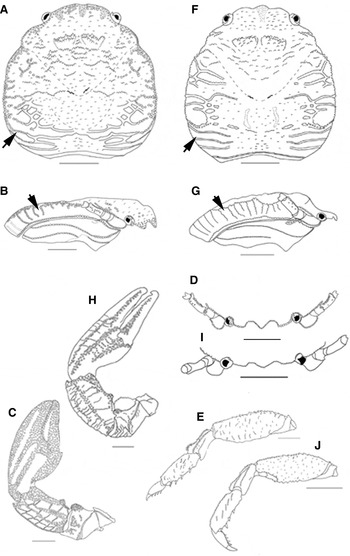
Megalobrachium erosum (Glassell, Reference Glassell1936), female (cl 5.2, cw 5.4 mm), USNM 104104 (A–E). Megalobrachium mortenseni Haig, Reference Haig1960, female (cl 5.1, cw 5.3 mm), MZUSP 24529 (F–J). (A and F) carapace, dorsal view. (B and G) same, lateral view. (C and H) left P1, dorsal view. (D and I) frontal-orbital region of carapace, dorsal view. (E and J) left P2, lateral view. Arrows: reticulated pattern in the mesobranchial region of the carapace (A and F); ridges in lateral face of carapace (B and G). Scale bars: 1 mm.

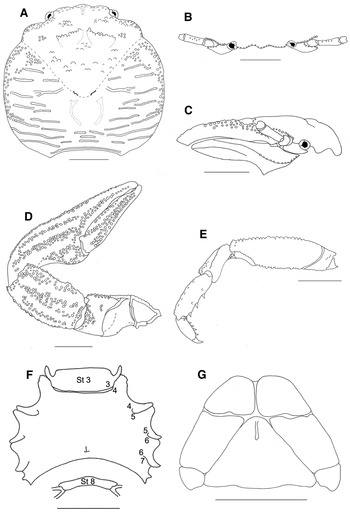
Megalobrachium lemaitrei n. sp., male holotype (cl 4.5, cw 4.8 mm), CRBMUV 2011-015. (A) carapace, dorsal view. (B) frontal-orbital region of carapace, dorsal view. (C) carapace, lateral view. (D) left P1, dorsal view. (E) left P2, lateral view. (F) thoracic sternum, ventral view. (G) telson, external view. Abbreviations: St3, St8, thoracic sternites 3 and 8, respectively; 3/4–6/7, thoracic sternal sutures. Scale bars: 1 mm.

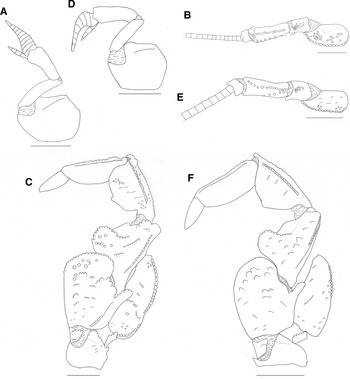
Megalobrachium erosum (Glassell, Reference Glassell1936), female (cl 5.2, cw 5.4 mm), USNM 104104 (A–C). Megalobrachium lemaitrei n. sp., male holotype (cl 4.5, cw 4.8 mm), CRBMUV 2011-015 (D–F). (A and D) left antenulle, ventral view. (B and E) left antenna, lateral view. (C and F) left Mxp3, lateral view. Setae omitted. Scale bars: 0.5 mm.

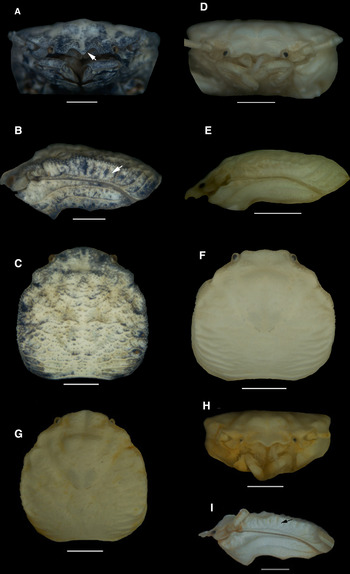
Megalobrachium erosum (Glassell, Reference Glassell1936), female (cl 5.2, cw 5.4 mm), USNM 104104 (A–C). Megalobrachium lemaitrei n. sp., male holotype (cl 4.5, cw 4.8 mm), CRBMUV 2011-015 (D–F). Megalobrachium mortenseni Haig, Reference Haig1960, (female cl 5.1, cw 5.3 mm) MZUSP 24529 (G–I). (A, D and H) cephalothorax, frontal view. (B, E and I) carapace, lateral view. (C, F and G), same, dorsal view. Arrows: median lobe of carapace frontal margin (A); ridges in lateral face of carapace (B and I). Scale bars: 1 mm.

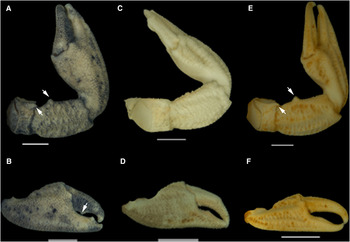
Megalobrachium erosum (Glassell, Reference Glassell1936), female (cl 5.2, cw 5.4 mm), USNM 104104 (A and B). Megalobrachium lemaitrei n. sp., male holotype (cl 4.5, cw 4.8 mm), CRBMUV 2011-015 (C and D). Megalobrachium mortenseni Haig, Reference Haig1960, female (cl 5.1, cw 5.3 mm), MZUSP 24529 (E and F). (A, C and E), right P1, dorsal view; (B, D and F) same, chela, dorso-anterior view. Arrows: strong teeth on dactylus, carpus and merus (A, B and E). Scale bars: 1 mm.

Megalobrachium erosum – Haig, Reference Haig1960, p. 213, 222, pl. 16, figure 8, pl. 40, figure 2; 1962, p. 191; Haig et al., Reference Haig, Hopkins and Scanland1970, pp. 26, 29; Hendricks, Reference Hendricks1993a, p. 7, Reference Hendricks, Salazar-Vallejo and Gonzálezb, p. 310, list 11; Hendricks & Harvey, Reference Hendricks and Harvey1999, p. 378; Boschi, Reference Boschi2000, p. 93; Vargas & Cortés, Reference Vargas and Cortés2004, p. 467, Table 1; Hendricks et al., Reference Hendricks, Brusca and Findley2005, p. 175; García-Madrigal & Andréu-Sánchez, Reference García-Madrigal and Andréu-Sánchez2009, p. 52; Osawa & McLaughlin, Reference Osawa and McLaughlin2010, p. 111; Vargas-Zamora et al., Reference Vargas-Zamora, Sibaja-Cordero and Vargas-Castillo2012, p. 1766.
MATERIAL EXAMINED
TYPES. Holotype: female, cl 4.1 mm, cw 4.3 mm (USNM 71539), Mexico, Baja California, Magdalena Bay, coll. S.A. Glassell, 12 February 1931, 22 m. Paratype: 1 male, cl 2.7 mm, cw 2.7 mm (USNM 71539), same data as holotype.
NON-TYPES. 1 female, cl 2.4 mm, cw 2.4 mm (USNM 103899), Mexico, Baja California, Bahía de Los Ángeles, St 702-37, coll. R/V ‘Velero III’. 1 female, cl 3.2 mm, cw 3.6 mm (USNM 103898), Mexico, Baja California Sur, Bahía San Juanico, St 616-37, coll. RV ‘Velero III’. 2 males, cl 5.7 and 6.0 mm, cw 5.7 and 5.8 mm, 1 female, cl 4.3 mm, cw 4.6 mm (USNM 104104), Mexico, Nayarit, Santa Isabel Island, St 217-34, coll. RV ‘Velero III’, 5 March 1934, 18.5 to 46 m.
RE-DESCRIPTION
Carapace subcircular, as long as broad in males, slightly broader than long in females. Frontal region with median longitudinal furrow separating two deep mounds, remarkably depressed, granulate. Frontal width much less than half of maximum carapace width. Frontal margin distinctly granular, with no setae, slightly convex in dorsal view, strongly sinuous in frontal view; median lobe prominent, slightly overreaching lateral lobes, laterally with deep sinuses; lateral lobes broadly triangular. Carapace lateral margin distinctly crested from hepatic to mesobranchial margins; metabranchial margin rounded, poorly defined; posterior margin broadly concave, fringed with setae. Anterior and posterior dorsal surfaces of carapace differently ornamented. Hepatic, gastric and epibranchial regions swollen, particularly on protogastric region, crested with rounded granules, delineated by distinct furrows. Cervical groove well defined, anteriorly ending in shallow notch. Posterodorsal surface of carapace with prominent, transverse, subparallel ridges of granules extending laterally to metabranchial margin, ridges on mesobranchial margin forming reticulated pattern of eroded appearance. Grooved lateral face of carapace interrupted into small, subsquarish cavities framed by distinct lines of rounded granules uniting lateral carapace margin and pterygostomial margin. Pterygostomial flap entire (without membranous areas), with 2 strong, sinuous crenulate ridges; branchiostegal margin fringed with long plumose setae.
Thoracic sternite 3 well defined, completely separated from sternite 4. Sternites 4–7 broad, sutures between sternites incomplete, distinct only laterally.
Ocular peduncle completely filling orbit, very short, subcylindrical dorsally; ventral surface flattened, with tubercles distally; cornea slightly dilated.
Antennular basal segment large, with low, triangular process mesiodistally; segments 2 and 3 unarmed, subcylindrical; segment 3 broadened distally. Dorsal flagellum composed of ~10 articles; ventral flagellum with 4 flattened articles decreasing in size distally.
Antennal segment 1 moderately broad, granulate, hidden beneath anterolateral margin of carapace; segments 2 and 3 subcylindrical, granulate laterally, their combined length longer than segment 1, partially hidden beneath anterolateral margin of carapace; segment 4 short, smooth. Flagellum more than 8 times longer than peduncle.
Mxp3 with dactylus to merus pediform, densely fringed with long plumose setae on ventral margin; dactylus and propodus smooth, dorsal margin of propodus crested proximally; carpus to ischium granulate on lateral surface; merus with large rounded lobe on median part of ventral margin; ischium operculiform; exopod lanceolate, granulate, dorsolateral margin crenulate, fringed with plumose setae, flagellum well developed. Mxp2 pediform; dactylus and propodus distinctly setose, dactylus remarkably short; exopod lanceolate, flagellum well developed.
P1 equal in size, with scattered, short plumose setae ventrally, covered with conspicuous granules on dorsal surface. Dactylus distinctly stout, broadly triangular in general outline, strongly curved distally; tip curved, crossing with that of fixed finger; cutting edge with low teeth of similar sizes, subproximal tooth massive, stronger. Fixed finger equal in width to dactylus, with strong, subdistal tooth on cutting edge. Palm broad, its maximum width about 2/3 of maximum length; dorsal surface with 3 pronounced, longitudinal carinas. Carpus with strong, blunt proximal tooth on dorso-anterior margin; posterodistal margin with short tooth. Merus with strong tooth on dorso-anterior distal margin.
Walking legs decreasing in size from P2 to P4, flattened laterally, moderately slender, distinctly granular, fringed with scattered, long plumose setae, numerous on ischia and meri. Meri, carpi and propodi unarmed but distinctly granular on dorsal margin; lateral and mesial surfaces sparsely squamose. P2 and 3 carpi about half length of merus, 2/3 length of propodi. P4 carpi about 2/3 length of merus, 2/3 length of propodi. P2-4 propodi each with 5 movable, corneous spines on ventral margin, 3 medially aligned, 2 on distal corner near articulation with dactylus. P2-4 dactyli about 2/3 length of propodi, each with row of 4 movable, corneous spines on ventral margin.
Male and female abdomens subrectangular, somites rugose dorsally; lateral margins with dense, long plumose setae. Male gonopods well developed on somite 2; pleopods in females well developed on somites 4 and 5. Uropods reaching distal margin of telson. Telson broader than long, subdivided into 7 plates in both male and female, slightly rugose on external surface; proximal median plate with longitudinal, poorly defined cicatrix on distal third of midline.
TYPE LOCALITY
Mexico, Baja California, Magdalena Bay.
DISTRIBUTION
Eastern Pacific: Baja California and Gulf of California (Bahía de Los Ángeles and from Punta Malarrimo to Percebu Lagoon, Sonora, Tiburon Island, Magdalena Bay), Nayarit (Santa Isabel Island); intertidal down to depths of 50 m (Haig, Reference Haig1960).
Megalobrachium lemaitrei n. sp.
(Figures 2A–G, 3D–F, 4D–F & 5C, D)
Megalobrachium erosum – Gore & Abele, Reference Gore and Abele1976, pp. 16, 17; Gore, Reference Gore1982, p. 5, Figure 2 [not Megalobrachium erosum (Glassell, Reference Glassell1936)].
TYPE MATERIAL
Holotype: male cl 4.5 mm, cw 4.8 mm (CRBMUV 2011-015), Colombia, Bahía Málaga, Curichichi Island, coll. J.F. Lazarus-Agudelo, 28 September 2011, intertidal, under rocks.
Paratypes: 1 female cl 3.2 mm, cw 3.5 mm (USNM 184904), Panama, Las Perlas Archipelago, Pajaros Island, 8°34′36″N 79°01′18″W, north-east cove, Little Island in cove behind East Point, ‘Panama Survey’, 1 March 1971, 1.8 to 18 m. 1 ovigerous female cl 3.3 mm, cw 3.9 mm (USNM 189210), Canal Zone, east end of Venado Beach, Smithsonian STRI Panama Survey coll., 4 November 1971, intertidal. 1 ovigerous female cl 4.0 mm, cw 4.2 mm (MZUSP 33233), Colombia, Bahía Málaga, Curichichi Island, coll. J.F. Lazarus-Agudelo, 28 September 2011, intertidal, under rocks.
COMPARATIVE MATERIAL
Megalobrachium mortenseni Haig, Reference Haig1962. 1 male, cl 3.1 mm, cw 3.3 mm (USNM 1253579), Panama, Canal Zone, Limon Bay, Fort Randolph, St 153-1, 9°23′N 79°53′46″W, coll. M.L. Jones & C.E. Dawson, 3 November 1973. 1 male, cl 4.4 mm, cw 4.6 mm (DOUFPE 6470), Brazil, Pará, RV ‘Almirante Saldanha’, Norte/Nordeste I, St 1804B, 00°09′N 46°55′W, 27 m. 3 males, cl 3.5 to 4.8 mm, cw 3.7 to 5.0 mm, 1 ovigerous female, cl 5.3 mm, cw 5.7 mm (DOUFPE 6475), Piauí, R/V ‘Almirante Saldanha’, Norte/Nordeste I, St 1730, 2°37′S 41°27′30″W, 21 m. 1 female, cl 3.7 mm, cw 3.9 mm (MZUSP 10652), Bahia, Abrolhos. 3 males, cl 4.0 to 5.2 mm, cw 4.1 to 5.3 mm, 1 ovigerous female, cl 5.1 mm, cw 5.3 mm (MZUSP 24529), Espírito Santo, Piúma, 20°50′578″S 40°28′553″W, coll. A. Jório, 28 March 2010, 21.5 m. 1 male, cl 4.1 mm, cw 4.3 mm (MNRJ 3646), Rio de Janeiro, Angra dos Reis, Ilha Grande, Furão Beach, coll. G.W. Nunan, 20 July 1966. 1 ovigerous female, cl 5.7 mm, cw 5.9 mm (MZUSP 9531), São Paulo, São Sebastião, Porto Beach, 12 July 1964.
DESCRIPTION
Carapace subcircular, slightly broader than long in both male and female. Frontal region with median longitudinal furrow separating 2 low mounds, remarkably depressed, granulate. Frontal width much less than half of maximum carapace width. Frontal margin granular, fringed with short setae, slightly convex in dorsal view, weakly sinuous in frontal view; median lobe slightly overreaching lateral lobes, laterally with shallow sinuses; lateral lobes rounded. Carapace lateral margin crested from hepatic to mesobranchial margins; metabranchial margin rounded, poorly defined; posterior margin broadly concave, fringed with setae. Anterior and posterior dorsal surfaces of carapace differently ornamented. Hepatic, protogastric, gastric and epibranchial regions moderately swollen, crested with rounded granules, distinctly delineated by well recognizable smooth furrows. Cervical groove well defined, anteriorly ending in deep notch. Posterodorsal surface of carapace with prominent, transverse, subparallel ridges of granules extending laterally to meso- and metabranchial margins. Carapace lateral face deeply grooved between lateral carapace margin and pterygostomial margin. Pterygostomial flap entire (without membranous areas), with 2 strong sinuous, crenulate ridges; branchiostegal margin fringed with long plumose setae.
Thoracic sternite 3 well defined, completely separated from sternite 4. Sternites 4–7 broad, sutures between sternites incomplete, distinct only laterally.
Ocular peduncle completely filling orbit, very short, subcylindrical dorsally; ventral surface flattened, with few tubercles distally; cornea slightly dilated.
Antennular basal segment large, with low, triangular process mesiodistally; segments 2 and 3 unarmed, subcylindrical, segment 3 broadened distally. Dorsal flagellum with ~ 8 articles; ventral flagellum with 4 flattened articles decreasing in size distally.
Antennal segment 1 moderately broad, sparsely granulate, hidden beneath anterolateral margin of carapace; segments 2 and 3 subcylindrical, their combined length longer than segment 1, slightly granular mesially, partially hidden beneath anterolateral margin of carapace; segment 4 short, smooth. Flagellum more than 7 times longer than peduncle.
Mxp3 with dactylus to merus pediform, densely fringed with long plumose setae on ventral margin; dactylus and propodus smooth, dorsal margin of propodus slightly crested proximally; carpus to ischium sparsely granulate; merus with large rounded lobe on median part of ventral margin; ischium operculiform; exopod lanceolate, sparsely granulate, dorsolateral margin crenulate distally, fringed with plumose setae, flagellum well developed. Mxp2 pediform; dactylus and propodus distinctly setose, dactylus remarkably short; exopod lanceolate, flagellum well developed.
P1 equal in size, densely fringed with long plumose setae ventrally, covered with conspicuous granules on dorsal surface. Dactylus distinctly narrow, usually gently curved distally; tip crossing with that of fixed finger; cutting edge with low teeth of similar sizes, subproximal massive tooth usually absent. Fixed finger subequal in width to dactylus, strong subdistal tooth on cutting edge usually absent, sometimes inconspicuous. Palm moderately slender, its maximum width about half of palm maximum length; dorsal surface with 3 pronounced, longitudinal carinas. Carpus with or without obsolete tooth on dorso-anterior margin proximally. Merus with obsolete tooth on dorso-anterior margin distally.
Walking legs decreasing in size from P2 to P4, flattened laterally, slender, slightly granular, fringed with scattered, long, plumose setae, particularly numerous on ischia and meri. Meri, carpi and propodi unarmed but distinctly granular on dorsal margin; lateral and mesial surfaces smooth. P2 and 3 carpi about 1/3 length of merus, 2/3 length of propodi. P4 carpi about 2/3 length of merus, as long as propodi. P2-4 propodi each with 5 movable, corneous spines on ventral margin, 3 medially aligned, 2 on distal corner near articulation with dactylus. P2-4 dactyli about half length of propodi, each with row of 4 movable, corneous spines on ventral margin.
Male and female abdomens subrectangular, somites smooth dorsally; lateral margins with dense, long, plumose setae. Male gonopods well developed on somite 2; pleopods in females well developed on somites 4 and 5. Uropods reaching the distal margin of telson. Telson as long as broad in males, broader than long in females, subdivided into 7 plates, smooth on external surface, proximal median plate with longitudinal, well defined cicatrix on distal third of midline.
TYPE LOCALITY
Colombia, Bahía Málaga, Curichichi Island.
DISTRIBUTION
Pacific coasts of Panama (Las Perlas Archipelago and Canal Zone) and Colombia (Bahía Málaga); intertidal down to depth of 18 m.
ETYMOLOGY
The species is named in honour of our colleague and friend Rafael Lemaitre (NMNH) in recognition of his outstanding contributions to the taxonomy of decapod crustaceans.
REMARKS
Megalobrachium lemaitrei n. sp. is closely similar to its eastern Pacific counterpart M. erosum in the general pronounced eroded appearance of the carapace and P1. This aspect prompted previous workers to conclude that all eastern Pacific specimens having such appearance were attributed to M. erosum. However, M. lemaitrei n. sp. is distinguishable from M. erosum s. str. by: (1) the frontal margin of carapace is weakly sinuous in frontal view, with a very low, distally rounded median lobe flanked by shallow sinuses (Figures 2B & 4D) in M. lemaitrei n. sp., whereas it is strongly sinuous in frontal view, with a prominent, broadly triangular median lobe flanked by deeper sinuses in M. erosum (Figures 1D & 4A); (2) the lateral carapace surface has a deep, entire (uninterrupted) groove, between the dorsolateral carapace margin and the pterygostomial margin in the new species (Figures 2C & 4E), whereas it is similarly grooved but interrupted, subdivided into small, subsquarish cavities framed by well-marked lines of rounded granules uniting the lateral carapace margin and the pterygostomial margin in M. erosum (Figures 1B & 4B); (3) the mesobranchial region of the carapace has transverse, subparallel ridges of minute granules (Figures 2A & 4F), instead of possessing ridges forming a reticulated pattern of eroded appearance in M. erosum (Figures 1A & 4C); (4) the carapace is noticeably wider than long (Figures 2A & 4F), rather than being about as wide as long in M. erosum (Figures 1A & 4C); (5) the P1 meral and carpal teeth are obsolete, sometimes absent in the new species (Figures 2D & 5C), whereas they are distinctly stronger in M. erosum (Figures 1C & 5A); (6) the P1 dactylus is distinctly narrower, gently curved distally, and lacks a subproximal tooth on the cutting edge in the new species (Figures 2D & 5D), while it is broadly triangular, truncate, strongly curved distally, and has a subproximal stout tooth on the cutting edge in M. erosum (Figures 1C & 5B); (7) the body and appendages are densely setose, especially on the carapace and lateral margins of the abdomen, ventral margins of the P1 propodi and P2-4 in the new species, whereas they are sparsely setose in M. erosum.
Gore & Abele (Reference Gore and Abele1976) recorded M. erosum from the Las Perlas Archipelago, Panama, almost 4000 km south of the previously known range of the species, the Gulf of California and western coast of Baja California, Mexico. Although we have examined one female of M. lemaitrei n. sp. from the Las Perlas Archipelago (paratype, USNM 184904, collected on 1 March 1971), we were unable to locate Gore & Abele's (Reference Gore and Abele1976) material identified as of M. erosum from Las Perlas in the USNM collection (collected on 12–13 June 1973). However, in a subsequent report on the Panamanian material of M. erosum, Gore (Reference Gore1982) noted that in the Panamian females (USNM 184904, 189210, both specimens lots are paratypes of the new species in the present study), the carapace width ‘noticeably exceeds the carapace length, and thus is not about as broad as long (Haig, Reference Haig1962).’ He also observed that the P1 carpal tooth is ‘only little developed, and an irregular row of smaller teeth runs along the anterior margin of the carpus’, which are also unusual for M. erosum and rather allied to those of the present new species. Nevertheless, Gore (Reference Gore1982) assigned these specimens to M. erosum based on the ‘greatly eroded appearance of the carapace and the heavily granulate and eroded P1’. Therefore, it is reasonable to assume that Gore & Abele's (Reference Gore and Abele1976) material of M. erosum from the Las Perlas Archipelago actually represents M. lemaitrei n. sp.
Megalobrachium mortenseni is the Atlantic analogue of M. erosum and is hereafter compared with M. lemaitrei n. sp. Megalobrachium mortenseni and M. lemaitrei n. sp. superficially resemble each other in the general aspect of the carapace and P1. However, M. lemaitrei n. sp. is different from M. mortenseni by: (1) the carapace and P1 have much heavier eroded appearance (Figures 2A, D, 4F & 5C) than in M. mortenseni (Figures 1F, H, 4G & 5E); and (2) the P2-4 meri are only slightly and sparsely squamose on the lateral and mesial surfaces, and slightly crested on the dorsal margin (Figure 2E), instead of being distinctly squamose laterally and mesially, and sharp crested dorsally in M. mortenseni (Figure 1J). In addition, M. lemaitrei n. sp. can be separated from M. mortenseni by at least two characters that also separate M. lemaitrei n. sp. from M. erosum (see distinguishing characters 2 and 5 of the latter two species mentioned above, and Figures 1G, H, 4I & 5E, for M. mortenseni).
Megalobrachium mortenseni varies from whitish to pale yellow in fresh colouration and is found underneath rocks in gravel and sandy bottoms down to 30 m depth (Werding, Reference Werding1977; Veloso & Melo, Reference Veloso and Melo1993; Almeida et al., Reference Almeida, Souza, Boehs and Bezerra2010), whereas preserved M. erosum and M. lemaitrei n. sp. are light pink to nearly white and pale cream in colour, respectively (Glassell, Reference Glassell1936; Haig, Reference Haig1960, personal observation) and pale cream, respectively. Megalobrachium erosum has been found in depths of 9 to 45 m from coral and sand bottoms, shell and sand, and rock and sand (Haig, Reference Haig1960), while M. lemaitrei n. sp. inhabits underneath rocks from the intertidal zone down to 18 m depth.
ACKNOWLEDGEMENTS
We gratefully thank Juan Felipe Lazarus-Agudelo (CRBMUV) for enabling us to study the Colombian material of Megalobrachium, and Rafael Lemaitre (USNM) for granting access to the collection under his responsibility and for providing working space. Thanks also extend to Karen Reed (USNM) for her kind assistance throughout the execution of this work. This paper greatly benefited from comments from two anonymous reviewers.
FINANCIAL SUPPORT
This work was supported by CNPq (301806/2010 – 1) and PETROBRAS (4600224970), and by FAPESP (2011/06230-2) through a doctoral fellowship allowed to LAAF.