INTRODUCTION
Pontinus kuhlii (Bowdich, Reference Bowdich1825) is a subtropical benthic fish which lives on rocky bottoms of the continental shelf and beyond, commonly at depths ranging from 100 to 450 m, but is also found at more shallow or greater depths (Goode & Bean, Reference Goode and Bean1896; Tortonese, Reference Tortonese1975). It is distributed in the eastern Atlantic, from the Gulf of Guinea to Portugal, including the Azores, Madeira, Canary Islands and Cape Verde (Schneider, Reference Schneider1992). One record of the species from South Africa is considered doubtful (Eschmeyer, Reference Eschmeyer1969). In the Mediterranean, this species was first recorded in Sicilian waters by Sauvage (Reference Sauvage1878), who classified it as Sebastes (Sebastichthys) bibroni. Unfortunately, this author did not specify the exact geographical location where the specimen had been caught within Sicilian waters, although the distribution maps for this species published subsequently by other authors locate this record off south-eastern Sicily (Hureau & Litvinenko, Reference Hureau, Litvinenko, Whitehead, Bauchot, Hureau, Nielsen and Tortonese1986; Merella et al., Reference Merella, Alemany and Grau1998; Mercader & Garcia-Rubies, Reference Mercader and Garcia-Rubies2010). After a century since this initial Mediterranean record of P. kuhlii, the second Mediterranean specimen for the same species was collected at Cabo de Palos Bank, in Spain, by Massutí & Massó (Reference Massutí and Massó1975) and subsequently also in the Balearic Islands (Riera et al., Reference Riera, Grau, Pastor and Pou1995; Merella et al., Reference Merella, Alemany and Grau1998; Manent & Abella, Reference Manent and Abella2005), western Sardinia (Pais et al., Reference Pais, Chessa and Delrio2005), the northern Tyrrhenian Sea in Tuscany (Voliani & Serena, personal communication) and northern Tunisia (Mercader & Garcia-Rubies, Reference Mercader and Garcia-Rubies2010). Herein, the first record of P. kuhlii in Maltese waters is reported.
MATERIALS AND METHODS
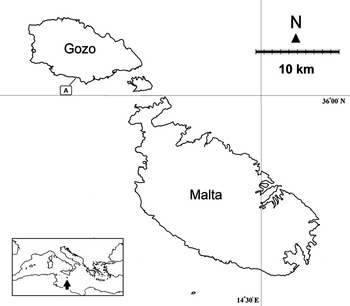
In October 2013, one specimen of Pontinus kuhlii was caught approximately two nautical miles off the south-western coast of Gozo, Malta (Strait of Sicily, 36°0.440′N 14°14.383′E; Figure 1). The specimen was collected in early morning (about 5:00 a.m.) by bottom longline, at about 50 m of depth, from a rocky seabed. The fisherman who caught it did not preserve the specimen but one of the authors of the present paper (Alan Deidun) had the opportunity to briefly examine it and to take a number of photographs of the same specimen.
Location (A) off the south-western coast of Gozo (Maltese archipelago), where the specimen of Pontinus kuhlii was fished.

RESULTS
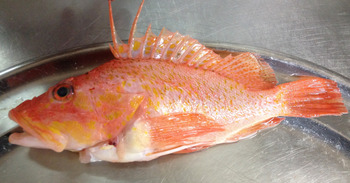
The fresh specimen (Figure 2) exhibited a reddish colour dorsally, paling ventrally, with yellow patches and striations along maxillary, preoperculum, operculum and along body sides; the fins were pale red, the dorsal one with evident yellow spots on the interspine membrane and red spots on its soft part; smaller dark red spots were also present along different parts of the body; the mouth cavity was pale rose. The specimen had a total length (TL) of 26.5 cm and was characterized by a large head, with relatively small eyes in a dorsal position (about 6 times in the head), bearing 4 suborbital spines, whilst the preoperculum and the operculum carried 4 and 2 spines respectively. Well-developed spines were present on top of the head. Dorsal fin has 12 spines, the first short and robust, with the second and the third being the longest. Pectoral rays unbranched. Caudal fin truncated at the posterior margin.
Specimen of Pontinus kuhlii caught offshore Gozo.

DISCUSSION
The description of our specimen is consistent with that of the other specimens caught for the same species in the Mediterranean and agrees with the general description of this species (Goode & Bean, Reference Goode and Bean1896; Eschmeyer, Reference Eschmeyer1969; Hureau & Litvinenko, Reference Hureau, Litvinenko, Whitehead, Bauchot, Hureau, Nielsen and Tortonese1986). Pontinus kuhlii is the only species of the genus Pontinus Poey, 1860 occurring in the Mediterranean and is distinguished from the other scorpaenids by the unbranched pectoral fin rays, the absence of an occipital pit, the presence of dorsal fin with 12 spines and the great prominence of the second and third dorsal spines. Within the Mediterranean Basin, P. kuhlii is considered as an Atlantic immigrant, with two other scorpaenid species of Atlantic origin within the same Basin being Trachyscorpia cristulata echinata (Koehler, 1896) and Scorpaena stephanica (Cadenat, 1943). Pontinus kuhlii is considered rare in the Mediterranean but, since it commonly inhabits rocky bottoms at great depths and these are rarely explored by fishermen, its occurrence within the same Basin could be underestimated.
The scarce information on the biology and ecology of P. kuhlii does not allow us to draw any conclusion on the settlement status of this species in our geographical area. The specimens collected previously in the Mediterranean range from 20 to 37.5 cm in length, although the species may reach a maximum TL of 55 cm (Catarino et al., Reference Catarino, Stefanni and Menezes2013); based on the age–length relationship developed for the same species in the Canary Islands by López Abellán et al. (Reference López Abellán, Santamaría and Conesa2001), these specimen lengths all correspond presumably to an adult size and to an age exceeding six years; according to the same relationship, our specimen would fall on average within the 8–9 years old category, with the full possible age range spanning between seven and twelve years.
Considering that the provenance of Sauvage's P. kuhlii specimen in Sicilian waters is not fully specified, the present paper represents the first documented record of this species in the Strait of Sicily and its confirmed occurrence in this geographical area is testimony to its range expansion from the western to the eastern Mediterranean Basin. Its migration pattern within the Basin is similar to that of other incoming Atlantic species which recently crossed over to the eastern Mediterranean through the Strait of Sicily, such as the lesser amberjack Seriola fasciata (Andaloro et al., Reference Andaloro, Falautano, Sinopoli, Passarelli, Pipitone, Addis, Cau and Castriota2005), the African hind Cephalopholis taeniops (Deidun et al., Reference Deidun, Castriota and Arrigo2011), the saddled snake eel Pisodonophis semicinctus (Bodilis et al., Reference Bodilis, Cheminée, Miniconi, Arceo and Francour2012) and the Sally lightfoot crab Percnon gibbesi (Cannicci et al., Reference Cannicci, Garcia and Galil2008). These species are part of the increasing influx of tropical and sub-tropical species from the eastern Atlantic into the Mediterranean, which, along with an even greater inverse influx of tropical species of Indo-Pacific and Erythrean affinity through the Suez Canal, is a phenomenon which is receiving increasing scientific attention and which is likely due to the recent changes in hydroclimatic conditions of the same Basin (Ben Rais Lasram & Mouillot, Reference Ben Rais Lasram and Mouillot2009; Andaloro et al., Reference Andaloro, Falautano, Perzia, Maricchiolo and Castriota2012).
Since P. kuhlii is being recorded for the first time from Maltese waters, it is being assigned a popular name in Maltese, which is currently missing—Skorfna tal-qiegh, which translates into ‘deepwater rockfish’.
ACKNOWLEDGEMENT
The authors are indebted to restaurateur Mr Walter John Cassar who first alerted them to the capture of such a specimen.