Job improvement behaviors are desirable from an organization’s point of view as they imply employees finding new ways of improving efficiency in their jobs (Boudrias & Savoie, Reference Boudrias and Savoie2006). Because they are typically defined as being self-started, these behaviors, which include idea generation and implementation with regards to job tasks (e.g., Parker et al., Reference Parker, Williams and Turner2006), can be considered as a specific subset of proactive behaviors (Grant & Ashford, Reference Grant and Ashford2008). Likewise, as they involve the production of new ideas, they are also oriented towards change (Crant, Reference Crant2000) and reflect an “every day” creative involvement in work (Villanova & e Cunha, Reference Villanova and e Cunha2021). Research on the antecedents of both proactive behaviors (Grant & Ashford, Reference Grant and Ashford2008) and creative and innovative behaviors at works (Amabile et al., Reference Amabile, Conti, Coon, Lazenby and Herron1996; Anderson et al., Reference Anderson, Potočnik and Zhou2014; Liu et al., Reference Liu, Bracht, Zhang, Bradley and van Dick2020) has emphasized the importance of supportive leadership that provides employees the room to experiment. Transformational leadership, characterized as being both supportive and encouraging of experimentation (Bass, Reference Bass1999), thus appears to be a particularly appropriate type of leadership to study as an antecedent to job improvement behaviors.
In this study, we investigate the relationship between transformational leadership and job improvement behaviors as mediated by employee vitality and moderated by leader extraversion. This multi-level moderated mediation model is based in part on the broaden-and-build framework (Fredrickson, Reference Fredrickson2001), which proposes that creative output (such as job improvement behaviors) may result from positive emotions. We argue that transformational leaders cultivate employee vitality (a positive, energetic feeling), which in turn fosters job improvement behaviors. Given that extraversion (a trait marked by confidence, sociability and enthusiasm) has been linked to positive affect (Lucas et al., Reference Lucas, Le and Dyrenforth2008), we further advance that transformational leadership carries more potential for lifting employee vitality when it is done by extroverted leaders, as the transfer of positive affect is more likely to occur. The leader affect literature (e.g., van Knippenberg & van Kleef, Reference van Knippenberg and van Kleef2016) puts forward that leader affective displays are determinant in setting the emotional tone of exchanges (emotional contagion) and in providing receivers the cues needed to interpret the meaning of actions (affect-as-information). This points to the possibility that leader extraversion influences how leaders do these transformational leadership behaviors. Instead of relegating leader extraversion to the role of an antecedent in a mediation chain (which is the typical approach; e.g., Zaccaro, Green, et al., Reference Zaccaro, Green, Dubrow and Kolze2018), our alternative perspective suggests that leader extraversion may allow leaders to naturally perform a more enthusiastic and energetic style of transformational leadership behaviors, resulting in higher employee vitality and improvement behaviors.
Overall, then, our study contributes to the leadership and creative behavior research literature by providing new knowledge regarding the psychological context that foster creative behaviors at work. First, this research responds to calls for a more holistic view of how leadership behaviors are done (Hansen et al., Reference Hansen, Ropo and Sauer2007) by considering that leader extraversion enhances the quality of leader behaviors (i.e., transformational leadership). While a common perception is that the effect sizes between leader traits such as extraversion and leader effectiveness are rather small, our theoretically novel approach suggests that the literature so far may have been undervaluing this personality trait (and potentially others) by missing a part of the picture. Indeed, while Zaccaro, Green, et al. (Reference Zaccaro, Green, Dubrow and Kolze2018) present an extensive review of the potential roles of individual differences in the study of leadership, they make no mention of the type of interaction we are suggesting. The investigation of the moderation effect of leader extraversion performed in this article represents our main contribution to the literature because it opens the door to the exploration of an unconsidered class of moderators of leadership behavior (leader traits). Second, while employee vitality and the broaden-and-build framework both have recognized roles in creative involvement at work, we put forward a novel model that highlights how transformational leadership, contextualized by leader extraversion, may enhance job improvement. So doing, the present study widens our understanding of how leadership processes can influence the broadening and building tendencies of employees.
Theoretical Background
Transformational Leadership and Job Improvement
Transformational leadership has been an important object of study in the leadership literature for over four decades (e.g., Burns, Reference Burns1978; Crede et al., Reference Crede, Jong and Harms2019). Through four behaviors, leaders are theorized to build a relationship with followers in which both leaders and followers are inspired to higher motivational and moral goals (Bass & Riggio, Reference Bass and Riggio2005). The four behaviors that characterize transformational leadership are inspirational motivation, individualized consideration, idealized influence, and intellectual stimulation. Inspirational motivation is presenting an attractive vision of the future linked with goals. Individualized consideration is to show concern for the individual needs of every employee. Idealized influence is acting as a role model in terms of work ethics and values. Finally, intellectual stimulation is the encouragement to think originally, to try different things, and to question assumptions. Transformational leadership has been linked with a plethora of positive outcomes at the levels of followers, teams, and organizations (see the meta-analyses of Chiaburu et al., Reference Chiaburu, Smith, Wang and Zimmerman2014; Judge & Piccolo, Reference Judge and Piccolo2004; Koh et al., Reference Koh, Lee and Joshi2019; and Wang et al., Reference Wang, Oh, Courtright and Colbert2011).
Turning to job improvement, this construct concerns an employee’s creative involvement that contributes to maximizing effectiveness in their tasks (Boudrias et al., Reference Boudrias, Morin and Lajoie2014; Boudrias & Savoie, Reference Boudrias and Savoie2006). These actions include exploring potential improvements in the way tasks are done, making beneficial suggestions, and concretely implementing innovative approaches at work. By making positive changes in their tasks, employees contribute to organizational effectiveness by streamlining processes and improving products and services. Past studies have indicated that job improvement behaviors are correlated to organizational citizenship behaviors and to innovative behaviors but that the concepts are distinct (Pigeon, et al., Reference Pigeon, Longpré and Boudrias2015). Job improvement can be considered as extra-role performance, as it is not typically prescribed in job tasks, but it is closely related to in-role or task performance because its substantive content concerns one’s tasks specifically. Conceptually, job improvement is related to task revision (Staw & Boettger, Reference Staw and Boettger1990), which is defined as actions taken to correct errors and procedures in tasks, and to personal initiative (Fay & Frese, Reference Fay and Frese2001), defined generally as self-started behaviors proactively aimed at achieving an objective. It diverges from task revision in that job improvement is not specifically concerned with the correction of mistakes (any improvement counts) and it can be considered as an example of personal initiative that is specifically oriented at improving the way tasks are done. Job improvement behaviors are also conceptually related to employee voice or creativity, as both imply the formulation of ideas for improvements (e.g., Dyne et al., Reference Dyne, Ang and Botero2003). However, job improvement also involves the implementation of ideas. Transformational leadership has been linked to different operationalizations of creative or innovative behaviors (e.g., Aryee et al., Reference Aryee, Walumbwa, Zhou and Hartnell2012; Gong et al., Reference Gong, Huang and Farh2009; Svendsen & Joensson, Reference Svendsen and Joensson2016), which can justify the expectation that it will also be positively related to job improvement behaviors. However, previous research suggests this relationship might also depend on other variables (i.e., mediators and moderators) to be observed consistently (Pieterse et al., Reference Pieterse, van Knippenberg, Schippers and Stam2010).
Hypothesis 1: Transformational leadership is positively correlated with job improvement behaviors
Transformational Leadership to Job Improvement Via Vitality: An Application of Broaden-and-Build
The broaden-and-build theory of positive emotions (Fredrickson, Reference Fredrickson2001) is an interesting general framework to think about intermediate variables involved in the relationship between leadership behaviors and job improvement. This theory stresses the important consequences of positive emotions in employees in order to enable and sustain their improvement efforts. This theory proposes two consequences of positive emotions. First, in opposition to negative emotions which narrow the scope of possible relevant actions (for example, when fear is experienced, few reactions other than fight, flight or freeze are particularly relevant), positive emotions broaden the available thought-action repertoire. Namely, positive emotions encourage play, exploration, and savoring/integrating experiences. Second, these actions then favor a person’s creativity in building resources. More specifically, positive emotions give energy and mental resources to employees, enabling their engagement in creative efforts. In organizational sciences, previous researchers such as Carmeli and colleagues (e.g., Atwater & Carmeli, Reference Atwater and Carmeli2009; Carmeli & Spreitzer, Reference Carmeli and Spreitzer2009; Kark & Carmeli, Reference Kark and Carmeli2009) and Lin et al., (Reference Lin, Kao, Chen and Lu2016) have found that vitality contributes to various forms of creative involvement at work. In line with these researchers’ position that positive emotions foster creative activity, we put forward that vitality is linked with job improvement in our study.
Vitality is defined as the subjective feeling of having energy (Ryan & Frederick, Reference Ryan and Frederick1997). It is related to variables such as positive affect, well-being, and health and is considered to be a component of thriving at work (Porath et al., Reference Porath, Spreitzer, Gibson and Garnett2012). Whereas positive affect and well-being can include feelings such as calm and serenity, vitality implies both positive valence and arousal. The importance of employee vitality in leadership processes is clear once we consider the fact that it is not only a pleasant state for individuals, but that the energy inherent to this state can be usefully directed by an able leader. If transformational leaders are to increase efforts by employees (Ng, Reference Ng2017), it is a corollary that energy levels of employees should also increase.
We therefore advance that a main mechanism through which transformational leaders may increase job improvement behaviors is employees’ vitality at work. Transformational leaders are optimistic about achieving difficult and worthwhile goals, they encourage explorations of ideas, and they express consideration and respect for their employees while modeling important values. For employees, optimism, autonomy, and consideration are important resources that can contribute to high feelings of energy at work (e.g., Bakker & Demerouti, Reference Bakker and Demerouti2007). Gooty et al. (Reference Gooty, Gavin, Johnson, Frazier and Snow2009) stated (p. 355): “At the core of transformational leadership is the leader’s ability to enthuse followers about a dream or a higher sense of purpose.” One could say that transformational leadership is about building enthusiasm. Based on the preceding, we hypothesize:
Hypothesis 2: Subordinates’ vitality mediates the relationship between transformational leadership and job improvement.
Leader Extraversion as a Condition for Transformational Leadership Effectiveness on Vitality and Job Improvement
Extroverts are sociable, assertive, and tend to feel more positive emotions (Bono & Illies, Reference Bono and Ilies2006). Typically, the theory underlying links between leader extraversion and effectiveness is that extraverts are simply more leader-like. And indeed, extraverted leaders do tend to be more effective on average than their non-extraverted counterparts (Judge et al., Reference Judge, Bono, Ilies and Gerhardt2002; Zaccaro, Dubrow, et al., Reference Zaccaro, Dubrow, Kolze, Antonakis and Day2018; Zaccaro, Green, et al., Reference Zaccaro, Green, Dubrow and Kolze2018). The characteristics of extraverts, which fits both leadership expectation of followers (van Knippenberg, Reference van Knippenberg2011) and core requirements of leadership positions (Zaccaro, Green et al., Reference Zaccaro, Green, Dubrow and Kolze2018), create a generally favorable context for the exercise of leadership. This would enable (a) the diffusion of positive affects between leaders and followers and (b) the optimal delivery of leadership behaviors. As a result, employees would perceive leader behaviors more favorably and would be more energized by them.
Accordingly, we propose that leader extraversion is a moderator of transformational leadership in that it flavors these leadership behaviors in such a way as to enhance their energizing potential. To this point, we note that some researchers combine the sociable and positive emotionality aspects of extraversion in a single meso-dimension called enthusiasm (DeYoung et al., Reference DeYoung, Quilty and Peterson2007). Emphasizing this point, Lucas et al. (Reference Lucas, Le and Dyrenforth2008) report that positive affect should be considered a basic element of extraversion. Considering this, our argument is that leader extraversion in transformational leadership allows for more positive affect to transfer to subordinates.
Research into leader affect proposes two basic paths through which it can impact employees: Affect-as-information and emotional contagion (van Knippenberg & van Kleef, Reference van Knippenberg and van Kleef2016). Affect-as-information is concerned with how people interpret affective displays cognitively. People take affective displays as signals regarding a person’s appraisal of a thing or event (van Kleef, Reference van Kleef2009), which in turn can influence their own appraisal of the object in question. For example, leader anger can communicate preparation for activity whereas sadness can communicate a more passive disposition (Tiedens, Reference Tiedens2001). On the other hand, emotional contagion is a social process in which a listener mimics the affective displays of a speaker, thereby inducing similar emotions in the former (e.g., Cherulnik et al., 2011; Chi et al., Reference Chi, Chung and Tsai2011). For example, according to Clarkson et al. (Reference Clarkson, Wagstaff, Arthur and Thelwell2020) review of the literature of emotional contagion in the leadership context, positive affect on the part of leaders tends to increase positive affect in followers. It is also worth noting that emotional contagion and affect-as-information are not mutually exclusive processes. Rather, they are likely to occur simultaneously (van Knippenberg & Van Kleef, Reference van Knippenberg and van Kleef2016).
In combination with these affective explanations, extraversion is likely to moderate the relationship between transformational leadership and vitality because of a high level of extraversion if likely to change the way transformational leadership behaviors are done. Namely, as extraverts tend to be more enthusiastic these behaviors will be done more enthusiastically on average by the extroverted leader. This will be true even in the case where an introverted leader does transformational leadership behaviors as frequently as an extroverted leader. Frequent enthusiasm in transformational leadership will in turn mean more frequent positive emotional contagion and more frequent information suggesting the appraisal that work is exciting. Based on this, we hypothesize:
Hypothesis 3: Leaders’ extraversion positively moderates the relationship between transformational leadership behaviors and follower vitality, such that this relationship is stronger when extraversion is high.
Finally, we propose a moderated mediation model concerning the relationship between transformational leadership and job improvement. Therefore, we expect that follower vitality is a mediator in that relationship and that leader extraversion has a moderating effect on the relationship between transformational leadership and follower vitality. The hypothesized model means that transformational leadership has an indirect effect on job improvement through follower vitality and this indirect effect is conditional on the level of leader extraversion.
Hypothesis 4: Leaders’ extraversion positively moderates the indirect effect of transformational leadership on job improvement through follower vitality, such that transformational leadership will be more strongly linked with vitality and subsequent job improvement behaviors when leaders are high in extroversion.
Method
Participants
The participants all come from a large Canadian organization. The organization’s vocation is one of public security. As part of an organizational survey on leadership and attitudes, all employees (5,369 in total, 505 leaders and 4,864 subordinates) were invited to answer a questionnaire including measures of transformational leadership and vitality. Collaborating with the organization’s human resources department, those employees with easy access to e-mails were sent a link to the questionnaire and an individualized login code. The bulk of participants (e.g., patrollers) had more difficult access to their e-mails during work hours. We distributed paper questionnaires keyed to the team’s leader (i.e., there was a number printed on the paper copy to indicate which leader was to be evaluated by the participant – we also asked participants to identify the leader they were assessing directly in the questionnaire to confirm the match) in every station. We provided envelopes with each copy of the questionnaire; completed questionnaires could be deposited in a box (one box per station) that we collected at the end of the study. The organization encouraged employees to participate in this survey during work hours. In total, 2,104 organizational members answered this survey. Leaders (that is, employees with managerial duties) were also given the opportunity of participating in a personality assessment, outside of work hours, that provided a report on their leadership style based on their personality.
A total of 619 followers could be matched to 101 leaders who took a personality assessment (an average of 6.11 followers per leader). Retained participants therefore represent approximately 14% of the organization. Followers had median position tenure between 6 and 10 years, with less than 3% having less than 6 months of experience in their positions, and approximately 16% having more than 15 years of experience. Over 90% of followers had at least college education, with 43% having some university education. Most followers were male (61.55%). Median age was between 30 and 39 years old (although the modal category was between 40 and 49 years old). Most followers identified as Caucasian (91.28%). As for leaders, they had median position tenure between 6 and 10 years, with less than 5% having less than 6 months experience in their position and over 17% having more than 15 years of experience. Over 95% of leaders had at least college education, with 80% having some university education. Most leaders were male (72.84%). Median age was between 40 and 49 years old (this was also the modal category). Most leaders identified as Caucasian (93.75%).
Instruments
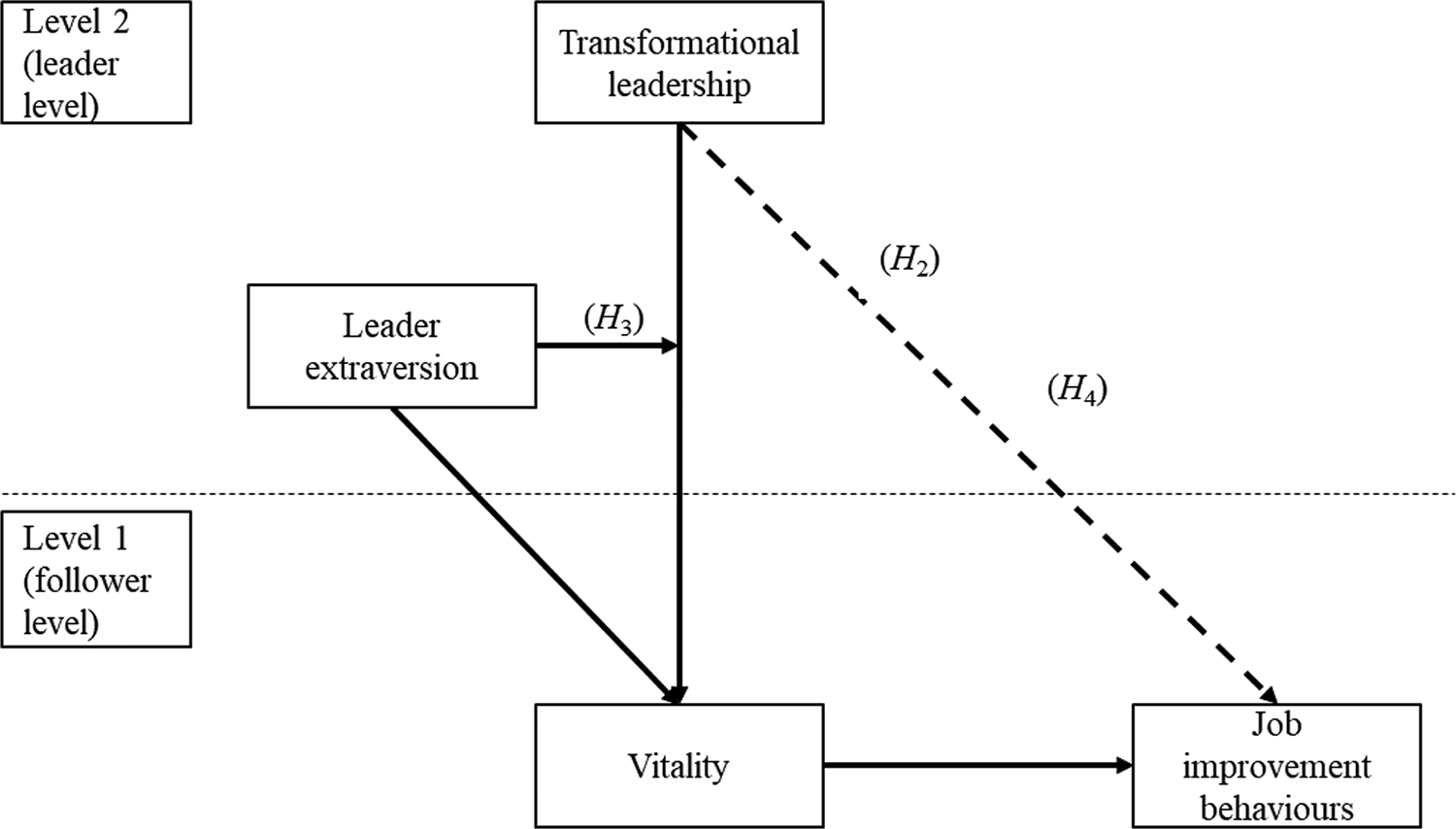
It should be noted that our data is multi-level (2–1–1, see Figure 1) and multi-source. Transformational leadership behaviors were assessed by the leaders’ subordinates (Level 2 or leader level), vitality and job improvement by individual subordinates (Level 1 or subordinate level), whereas leader extraversion was self-assessed by the leaders (leader level). We obtained permission to use proprietary measures used in this study. The questionnaire was presented in the same order for all participants and included variables that were specifically for organizational use. The first part of the questionnaire focused on employee perceptions of organizational and unit level practices, then on leader behaviors (including transformational leadership), then on behavioral involvement (including job improvement behaviors), then on various attitudinal and motivation-related variables (including vitality), and finally socio-demographic characteristics.
Research Model.

Transformational Leadership Behaviors
Transformational leadership behaviors were assessed with the French version of the MLQ–5X (Avolio & Bass, Reference Avolio and Bass2004). This scale has 16 items. A sample item is “My supervisor talks about their most important values and beliefs”. We did not include the Idealized Influence – Attributed scale, as that scale does not assess behaviors per se (Kark et al., Reference Kark, Shamir and Chen2003). Participants indicated the frequency of transformational leadership behaviors of their leader based on a 5-point rating scale (1 = Never, 5 = Frequently, if not always).
Vitality
Vitality was assessed with three items from Porath et al. (Reference Porath, Spreitzer, Gibson and Garnett2012) thriving at work measure. Porath et al. (Reference Porath, Spreitzer, Gibson and Garnett2012) suggest that thriving at work is defined by vitality and by the feeling of learning at work, show that a two-factor solution (with a second order factor) best fits the data. The original questionnaire presented five items for each dimension. As our organizational research partner wanted to keep the questionnaire as short as possible, we opted to keep three items that had high loadings in the factor analyses reported by Porath et al. (Reference Porath, Spreitzer, Gibson and Garnett2012), that were positively worded (only one item was negatively worded), and that we felt translated well. Items were translated in French and were back-translated to verify their translation. In their article, Porath et al. (Reference Porath, Spreitzer, Gibson and Garnett2012) show that thriving at work is related but distinct from positive affect, performance goal orientation, health, and burnout, amongst others. Participants indicated their agreement on 7-point scales (1 = Totally disagree, 7 = Totally agree). Items were preceded by the stem “At work…”, included items were “I have energy and spirit”, “I feel alive and vital”, and “I am looking forward to each new day”.
Job Improvement
Job improvement was assessed with three items from Boudrias and Savoie (Reference Boudrias and Savoie2006). Job improvement is one of five dimensions of the questionnaire developed by Boudrias and Savoie (Reference Boudrias and Savoie2006) to assess the behaviors of active and empowered employees. These empowered behaviors include for example conscientiousness in job tasks and organizational-level involvement). The questionnaire’s structure was validated in two further studies (Boudrias, et al., Reference Boudrias, Gaudreau, Savoie and Morin2009; Boudrias et al., Reference Boudrias, Rousseau, Aubé, Savoie, Duguay and Morin2010). Participants indicated the frequency with which they performed job improvement behavior on a 10-point scale (1 = almost never, 10 = almost constantly). The prompt is “In the last six months, at my work I…”, and the items are “implemented changes that improved efficiency in my tasks”, “tried to find how my work objectives could be better achieved”, and “applied my ideas to improve my work”.
Leader Personality
Leader personality was assessed by using the Occupational Personality Questionnaire, Ipsative Version (OPQ32i), which is a forced choice assessment of personality at work and is available in multiple languages. It presents 104 blocks of 4 items from which participants must chose which is most like them and least like them. While the OPQ is not strictly speaking a Five Factor Model (FFM) measure, we estimated a leader extraversion composite by combining the scales identified by the firm SHL (Bartram & Brown, Reference Bartram and Brown2005 – namely the outgoing, affiliative, socially confident, persuasive, controlling and emotionally controlled scales, the latter of which is reversed). Bartram and Brown (Reference Bartram and Brown2005) show a high degree of convergence between OPQ-estimated extraversion and other measures of extraversion (r = .82 with International Personality Item pool [IPIP] items and .52 with NEO Personality Inventory - Revised, Bartram, Reference Bartram2013). The leader extraversion composite includes personality facets conceptually related to both the enthusiasm and dominance aspects of extraversion; details regarding composite weights can be found in the OPQ32 technical manual (Bartman et al., 2006). We opted to use the OPQ32i as it offered the possibility of providing individualized personality reports to participants in return for their participation, thus providing an incentive to participate in this extra questionnaire. An example block is “I like to do things my own way”, “I recognize weak arguments”, “I take care to follow procedures”, and “I like to spend time with others”. In the OPQ32i, each scale is assessed by 13 items, and scale scores are calculated through Thurstonian IRT (Brown & Maydeu-Olivares, Reference Brown and Maydeu-Olivares2011), which permits the estimation of normative scores from forced-choice items.
Control Variables
We included two control variables in our analyses: Job tenure and education level of subordinates. Job tenure was assessed on a 7-point scale (1 = less than 6 months, 7 = over 15 years), and education was assessed on a 7-point scale (1 = High school or less, 7 = Masters or Doctorate).
Results
Preliminary Analyses and Data Aggregation
Using MPlus 7.4 software, we conducted a confirmatory factor analysis (CFA) on our data to assess our research model. This analysis excludes leader extroversion as we do not have item-level data. As our goal was to make an informed decision on the validity of considering transformational leadership, vitality, and job improvement as separate constructs, we tested different models in which these scores were either combined or separate. Table 1 presents the results of the CFA. None of the presented models have excellent fit to the data, but two models achieve acceptable fit. The best model (Model 4) is one where transformational leadership is separated in 4 dimensions, and where job improvement and vitality are two separate constructs. However, our theoretical expectations concern transformational leadership as a whole, rather than specific behaviors and the factor correlations between transformational leadership dimensions were very high (average of .92). We therefore opted for parsimony and present transformational leadership as a unique factor in our main analyses (Model 3). With that in mind, we note that the pattern of results remained the same when we tested our research model with individual transformational leadership behaviors in post hoc analyses.
CFA Results for the Measurement Model

Note. Model 1: All items load on a single factor; Model 2: Single leadership factor, vitality and job improvement combined in a factor; Model 3: Single leadership factor, separate factors for vitality and job improvement; Model 4: Four leadership factors, separate factors for vitality and job improvement. To claim good model fit, the χ² statistic should not be significant. However, it is practically always significant with large sample sizes. Researchers therefore use incremental fit indices to determine which theoretically plausible model presents the best fit with their data. Hard absolute thresholds are not recommended, but generally, RMSEA should be below .06, SRMR below .08, and CFI and TLI should be above .95 (Bandalos, Reference Bandalos2018, p. 378). For SABIC, the model with the lowest value should be preferred.
* p < .05.
Following this, we aggregated subordinates’ transformational leadership ratings for each leader to match the level of leader extraversion (which is inherently at the leader level). We assessed the adequacy of aggregating subordinates’ ratings of transformational leadership to the leader level by using the interrater agreement within teams (rwg index – i.e., average agreement within teams) and the intraclass correlation coefficients ICC1 (i.e., the variance of a variable shared at the group-level) and ICC2 (i.e., estimation of aggregate reliability) (Bliese, Reference Bliese, Klein and Kozlowski2000; James et al., Reference James, Demaree and Wolf1984, Reference James, Demaree and Wolf1993). Woehr et al. (2015) provide evidence showing that values for these aggregation indices close to benchmark values ought to be interpreted as evidence supporting data aggregation. The benchmark for rwg is a mean value of .84 (SD = .11), .21 (SD = .15) for ICC1 and .66 (SD = .18) for ICC2. Results indicate that the average rwg(j) is .81, the values of ICC1 and ICC2 are .22 and .73. Taken together, these results support the aggregation of individual subordinate’s transformational leadership scores to the leader level.
We also tested whether a potential endogeneity-related bias may influence the path estimates in our moderated-mediation model (Antonakis et al., Reference Antonakis, Bendahan, Jacquart and Lalive2010). The Hausman test (Hausman, Reference Hausman1978) indicated that the residuals of our variables did not significantly correlate: the estimates are .04 (SE = .04, p = .23) for the transformational leadership-vitality relationship, .06 (SE = .06, p = .31) for the leader extraversion-vitality relationship, .07 (SE = .05, p = .18) for the interaction term-vitality relationship, and .10 (SE = .15, p = .50) for the vitality-job improvement relationship. Those non-significant results indicate that path estimates in the moderated-mediation model were not likely to be influenced by the endogeneity bias.
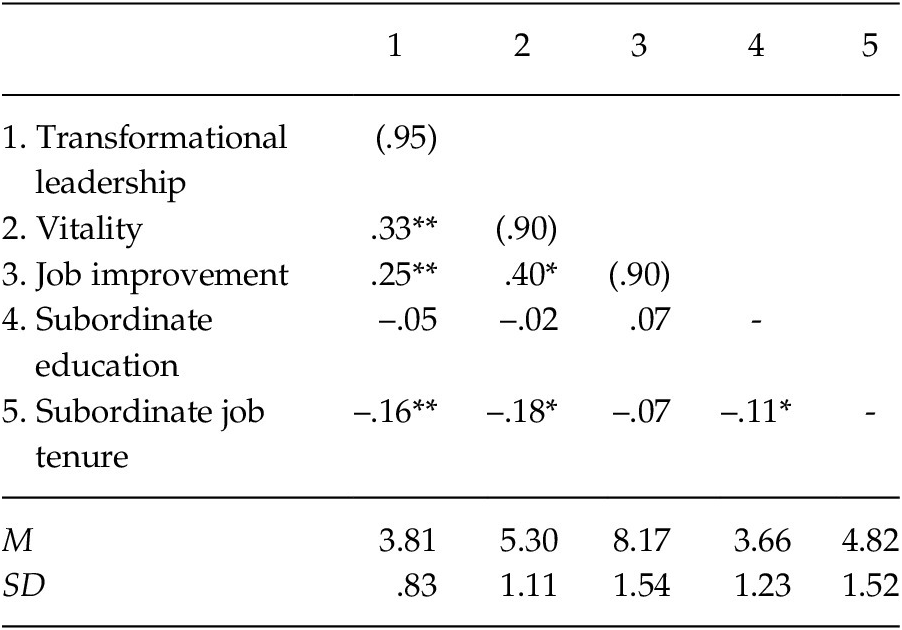
Table 2 presents descriptive statistics (means and standard deviations), reliability estimates, and correlations for the individual-level study variables as calculated using SPSS 27 software. The positive and statistically significant correlation between transformational leadership and job improvement confirms Hypothesis 1. The correlation between Level 2 variables (team-level transformational leadership and leader extraversion) did not reach statistical significance, r(99) = .19, p = .06.
Descriptive Statistics, Correlations, and Reliability Estimates for Individual-Level Variables

Note. *p < .05. ** p < .01.
Testing Hypotheses in the Moderated-Mediation Model
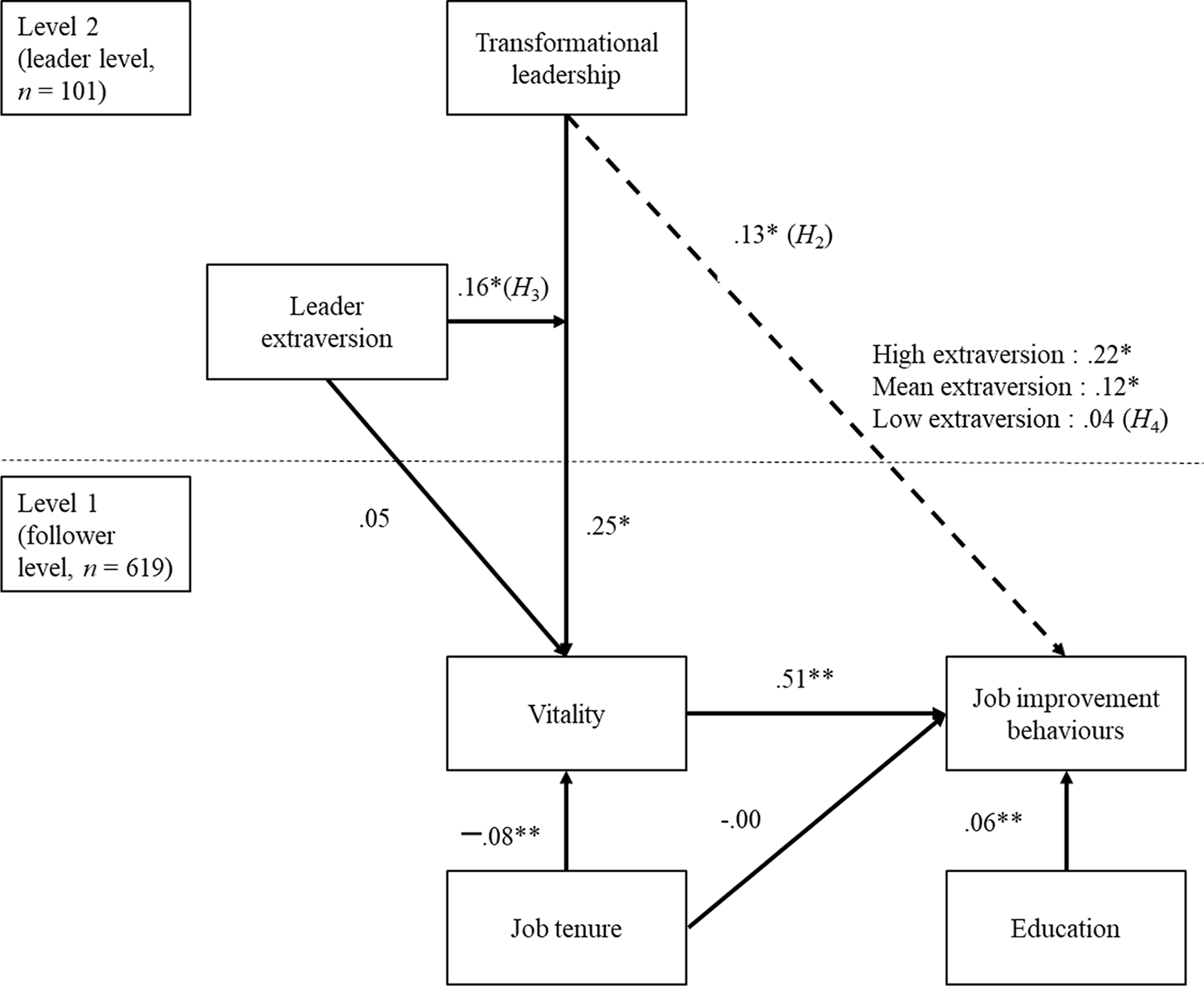
We tested the study Hhypotheses 2 to 4 by using Mplus 7.4 software with the maximum likelihood estimation with robust standard errors. The hypothesized model comprised direct paths from transformational leadership, extraversion, and the interaction term to vitality and a direct path from vitality to job improvement. Subordinates’ job tenure and education level were also included as control variables (i.e., directs paths from job tenure to vitality and job improvement, and from education level to job improvement – based on the pattern of correlation between these variables). The overall results of this path analysis model are presented in Figure 2.
Path Analysis Results.

Hypothesis 2 predicts that the relationship between transformational leadership and job improvement is mediated by the vitality of subordinates. The path estimates are significant for the relationships between transformational leadership and subordinate vitality (estimate = .25, p = .02) and between subordinate vitality and subordinate job improvement (estimate = .51, p < .001). The indirect effect in the mediation model was assessed by using a parametric bootstrap procedure based on 20,000 Monte Carlo replications to estimate a confidence interval around the indirect effects (Preacher et al., Reference Preacher, Zyphur and Zhang2010). Results show that the indirect effect of transformational leadership on job improvement is significant (estimate = .13, the 95% Monte Carlo confidence interval is from .02 to .24, p = .02). Taken together, these results support the mediation role of subordinate vitality.
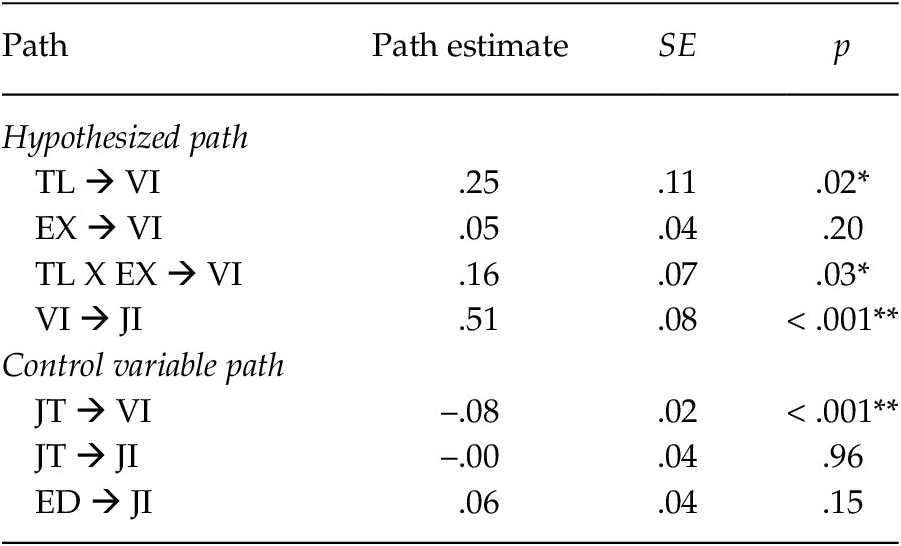
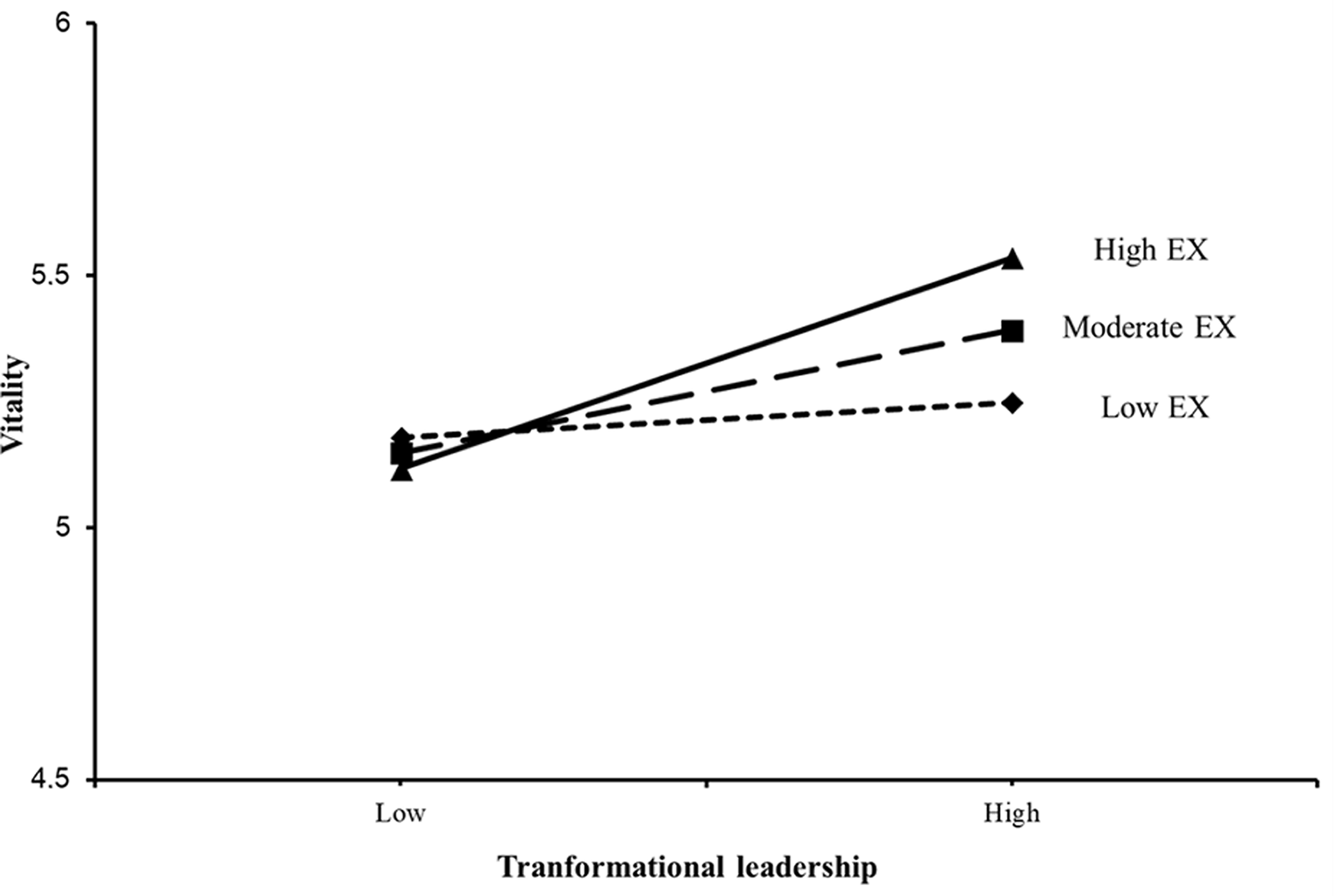
According to Hypothesis 3, leaders’ extraversion is likely to moderate the relationship between transformational leadership and subordinates’ vitality. To test this hypothesis, we created a cross-product interaction term involving transformational leadership and leader extraversion scores. We centered the scores of transformational leadership and extraversion in order to reduce the multicollinearity between these variables and the interaction term. Results show that the interaction term has a significant path estimate (estimate = .16, p = .03), which supports the moderating effect of leaders’ extraversion (see Table 3). In order to interpret the significant moderating effect, we made a graphical representation at three values of extraversion, namely the mean, one standard deviation below the mean and one standard deviation above the mean of the moderating variable (Cohen et al., Reference Cohen, Cohen, West and Aiken2003). Figure 3 reveals that the form of the moderation is consistent with Hypothesis 3. As expected, the relationship between transformational leadership and subordinates’ vitality is stronger when the level of leader extraversion is higher.
Results of Path Analytic Model

Note. Unstandardized path estimates are reported. TL = transformational leadership; VI = vitality of subordinates; EX = extraversion of leaders; JI = job improvement; JT = job tenure of subordinates; ED = education level of subordinates. N = 101 leaders and 619 subordinates.
* p < .05, two-tailed. ** p < .01, two-tailed.
Relationship between Transformational Leadership and Subordinates’ Vitality for Low, Moderate, and High Levels of Leaders’ Extraversion (EX).

Hypothesis 4 states that leader extraversion moderates the indirect effect of transformational leadership on job improvement through subordinate vitality. We calculated indirect effects at three values of extraversion (i.e., one standard deviation below the mean, the mean, and one standard deviation above the mean). Moreover, we used a parametric bootstrap procedure based on 20,000 Monte Carlo replications to estimate a confidence interval around the indirect effects (Preacher et al., Reference Preacher, Zyphur and Zhang2010). Results show that the estimates are significant at the mean (estimate = .13, the 95% Monte Carlo confidence interval is from .02 to .24, p = .02) and at the high level of extraversion (estimate = .22, the 95% Monte Carlo confidence interval is from .06 to .39, p = .006), but the estimate of indirect effect is not significant at the low level of extraversion (estimate = .04, the 95% Monte Carlo confidence interval is from –.08 to .15, p = .51). Therefore, the estimates of indirect effect are higher as the level of extraversion increases, which supports Hypothesis 4. We note that the inclusion or exclusion of the control variables from the analyses only changed path estimates at the third decimal and entailed no changes in the pattern of statistical significance found for any of the hypothesized paths.
Discussion
The results from the multi-level moderation analysis therefore support of our hypotheses: Leader extraversion moderates both the relationship between transformational leadership and follower vitality, and the indirect effect of transformational leadership on job improvement via vitality. Theoretically, this finding has impacts on our understanding of the role of leadership processes in the broaden-and-build view of employee creative and innovative behaviors and argues for a novel integration of leaders’ personality traits in this context.
Our study contributes to a deeper understanding of the Broaden-and-build framework (Fredrickson, Reference Fredrickson2001) in leadership processes. Firstly, our study corroborates the idea that vitality is a positive emotional experience that is correlated with pro-organizational creative involvement. To make full use of this information, it is important to determine how leaders might best foster vitality in a way that takes a holistic view of leadership (Hansen et al., Reference Hansen, Ropo and Sauer2007). The effects found in this study imply that leaders not only have to do positive actions to best foster vitality; they also should be a positive influence by anchoring their behaviors in a generally extraverted style. Future research could extend our findings by specifying which extraversion facet(s) best predict subordinate’s vitality. While positive affect and enthusiasm seems to be an obvious candidate (positive leadership behaviors done by a positive leader could positively influence employee positivity) we do not at this juncture exclude the possibility that dominant leaders might be perceived as particularly committed to the mission, enabling positive affect-as-information effects. Even if both of these mechanisms happened to be true, we currently lack the theory to determine if both might be necessary, or if one might compensate for the other. In the same vein, our research model, being based on broaden-and-build, emotional contagion, and affect-as-information, is well aligned in that there are clear links to positive affect in each of our research variables (transformational leadership, extraversion, vitality, and job improvement). On the other hand, certain studies have shown that analytical performance can be more related to negative affect than to positive affect (Schwarz & Bless, Reference Schwarz, Bless and Forgas1991). It is therefore likely that the moderated-mediation effect we report here will not transpose to every valued employee behavior and outcome.
Our findings can also be extended to impact broader leadership and personality study paradigms. Two of the most important leadership study paradigms have been the study of leader behaviors and of leaders’ individual characteristics (Derue et al., Reference Derue, Nahrgang, Wellman and Humphrey2011). Theorists interested in integrating these two paradigms have typically focused on the idea that who leaders are (i.e., leaders’ individual characteristics) influence what they do (i.e., leadership behaviors). Indeed recent theoretical models integrating these paradigms are quite sophisticated in their consideration of the leader’s traits, their situations, and their behaviors (Zaccaro, Green, et al., Reference Zaccaro, Green, Dubrow and Kolze2018). With the knowledge that moderation does not preclude mediation (or vice versa), our study offers a new bifurcation that opens the door to further exploration of potential moderating effects by personality traits with regards to leadership behaviors. For example, following the results of our study, it may not be too much of a stretch to imagine that leader agreeableness could positively moderate the relationship between leader consideration behaviors and employee general well-being or that the link between leader’s structuring behaviors and task performance could be higher when leaders are high in conscientiousness. In the event that these examples pan out, a theoretical base will need to be laid to understand which personality traits moderate which relationships between leadership behaviors and desired outcomes. Presumably, leadership behaviors will be moderated by leader personality to the extent that personality anchors the affective component of behaviors in a more general pattern for a leader (i.e., a leaders’ behavior should possibly “fit” their personality). Moreover, while our results specifically concern the leadership context, there is no reason why the idea that personality traits can moderate the outcomes of behaviors may not transpose to other settings. Our findings therefore point to an area of research in personality psychology that may be understudied as a whole.
On a more practical note, the fact that leader extraversion is linked to increased frequency of transformational leadership behaviors (Bono & Judge, Reference Bono and Judge2004; Derue et al., Reference Derue, Nahrgang, Wellman and Humphrey2011), but also, as this study shows, allows these behaviors to be more effective suggests that it may be even more advantageous for organizations wishing to leverage transformational leadership for creative involvement to select leaders on extraversion than has been previously thought. Indeed, any organization wishing to invest in transformational leadership development in the hopes of energizing their employees and increasing job improvement behaviors should be mindful of their leaders’ personal characteristics. While introverts could certainly benefit from training, there may be some cases where it may be best for introverted leaders to choose a different style of leadership behaviors. For example, the self-awareness component of authentic leadership (Neider & Schriesheim, Reference Neider and Schriesheim2011) may be favorable to the introspective introverts.
Of course, the correlational design of our study precludes conclusions pertaining to causation. While our mediation model is based on well-established research findings, the novel moderation that we found could be tested in a randomized controlled experiment (e.g., the effectiveness of a transformational leadership training program on subsequent employee vitality for groups of introverted and extraverted leaders could be compared). Additionally, while both vitality and job improvement are self-reported by employees and therefore subject to potential common variance bias, our model as a whole is multisource (transformational leadership was evaluated by teams of subordinates, and leader extraversion by the leaders themselves), and CFA analyses supported the idea that employee vitality and job improvement behaviors should be modeled separately. Common method variance should therefore not have a very important impact on our study. With that in mind, we must acknowledge that we were not able to include leader extraversion in our measurement model CFA, and that the fit of the model is not excellent. It may therefore be worthwhile to replicate our results while changing some measurement instruments (e.g., transformational leadership; van Knippenberg & Sitkin, Reference van Knippenberg and Sitkin2013). Future research could verify the role of specific emotional contagion mechanisms and affect-as-information interpretation for leadership behaviors by taking advantage of observatory ambulatory assessment practices (see for example Klumb et al., Reference Klumb, Elfering and Herre2009).
While leader personality has typically been considered as an antecedent to leader behavior, our results point to the possibility that leader personality traits can also moderate the effectiveness of leader behaviors for fostering creative involvement on the part of employees. As such, our findings suggest that a minimum of leader extraversion is necessary (boundary condition) to observe transformational leadership effects on follower vitality and job improvement. Future research could enlighten us with general guidelines as to what personality traits moderate what relationships between different types of leadership behaviors and outcomes, and under what circumstances.