Introduction
Cannabis use is widespread with an estimated 125–203 million users worldwide (Degenhardt & Hall, Reference Degenhardt and Hall2012). Initiation of cannabis use has been associated with increased risk of onset of psychotic symptoms, whilst continued use is associated with the persistence of such symptoms (Kuepper et al. Reference Kuepper, van Os, Lieb, Wittchen, Höfler and Henquet2011) and onset of a psychotic disorder (Moore et al. Reference Moore, Zammit, Lingford-Hughes, Barnes, Jones and Burke2007; Marconi et al. Reference Marconi, Di Forti, Lewis, Murray and Vassos2016). This is consistent with meta-analytic and independent evidence that continued cannabis use is associated with greater risk of relapse in those with a pre-existing psychotic disorder (Schoeler et al. Reference Schoeler, Monk, Sami, Klamerus, Foglia and Brown2016a, Reference Schoeler, Petros, Di Forti, Klamerus, Foglia and Ajnakinab) and that this association is more likely than not to reflect a causal effect of continued cannabis use on outcome (Schoeler et al. Reference Schoeler, Petros, Di Forti, Pingault, Klamerus and Foglia2016c). This convergence of evidence suggests that the persistence of use is a key determinant of the effect of cannabis use on outcome both in healthy and unwell cannabis users. Therefore, understanding what factors influence the persistence of use or indeed trigger cessation or a desire to quit is critical to developing effective interventions that may help limit harm from cannabis use.
Work to date has focused on established social constructs as predictors of cessation and has demonstrated that increasing age and maturity are associated with cessation (the ‘maturing out’ hypothesis) (Kandel & Logan, Reference Kandel and Logan1984), whilst social context, poor health and prior illicit drug use are associated with ongoing use (Kandel & Raveis, Reference Kandel and Raveis1989). Other work has also pointed towards peer involvement and school problems (van den Bree et al. Reference van den Bree and Pickworth2005) as well as psychological dependence and drug myths (Little et al. Reference Little, Spruijt-Metz, Pokhrel, Sun, Ann Rohrbach and Sussman2013) as associated with the persistence of cannabis use in young people.
Experiences during the transient intoxication state immediately following cannabis use, which can constitute both pleasurable and undesirable experiences, have also been examined to determine their effect on subsequent use. Both early and persisting pleasurable experiences have been shown to be associated with heavier use and dependence (Le Strat et al. Reference Le Strat, Ramoz, Horwood, Falissard, Hassler and Romo2009; Scherrer et al. Reference Scherrer, Grant, Duncan, Sartor, Haber and Jacob2009). However, evidence is equivocal about the effect of undesirable experiences on subsequent cannabis use patterns, with studies showing both association with decreased (Lyons et al. Reference Lyons, Toomey, Meyer, Green, Eisen and Goldberg1997; Zeiger et al. Reference Zeiger, Haberstick, Corley, Ehringer, Crowley and Hewitt2010) as well as heavier or problematic use (Grant et al. Reference Grant, Scherrer, Lyons, Tsuang, True and Bucholz2005; Scherrer et al. Reference Scherrer, Grant, Duncan, Sartor, Haber and Jacob2009). This may reflect the fact that existing literature examining the association between undesirable experiences during cannabis use and subsequent pattern of use have focused on a wide array of undesirable effects, including drowsiness, confusion and nausea rather than on effects such as ‘psychotic-like experiences’, which arguably are perhaps the most distressing and frightening experiences in someone expecting to enjoy a relaxing effect. Unlike the relatively rare occurrence of a psychotic disorder associated with cannabis use (Moore et al. Reference Moore, Zammit, Lingford-Hughes, Barnes, Jones and Burke2007; Marconi et al. Reference Marconi, Di Forti, Lewis, Murray and Vassos2016), psychotic-like experiences, such as paranoia, hallucinations or dysphoria, are not uncommon, reported by up to 15% of cannabis users in a community sample (Thomas, Reference Thomas1996). Whether the occurrence of undesirable experiences such as psychotic-like experiences in particular whilst using cannabis has an influence on subsequent cannabis use behaviour is therefore an important question to examine. However, to our knowledge, this has not been systematically examined to date.
Employing a well-validated (Barkus et al. Reference Barkus, Stirling, Hopkins and Lewis2006; Bianconi et al. Reference Bianconi, Bonomo, Marconi, Kolliakou, Stilo and Iyegbe2016; Quinn et al. Reference Quinn, Wilson, Cockshaw, Barkus and Hides2017) self-report questionnaire that has been used to record subjective experiences associated with cannabis use, previous and more recent exploratory factor analyses have shown that the immediate transient experiences associated with cannabis use cluster into ‘paranoid-dysphoric experiences’ and ‘pleasurable experiences‘(Barkus et al. Reference Barkus, Stirling, Hopkins and Lewis2006; Quinn et al. Reference Quinn, Wilson, Cockshaw, Barkus and Hides2017). Hence, in the present study, we sought to investigate whether experiences during cannabis use (both psychotomimetic and pleasurable) are associated with cessation of use or a future intention to quit in a non-clinical sample. We hypothesised that (i) psychotic-like experiences would be associated with cessation of cannabis use and a desire to quit, whereas (ii) pleasurable experiences would conversely be associated with continuation of cannabis use and a desire to continue. Furthermore, we triangulated analysis using a mixed-methods approach to qualitatively explore subjective reasons reported by users as being linked to continued use. We inductively coded qualitative data independently of the quantitative analysis in order to allow participants’ own views relating to changes in their patterns of use (continuation, escalation, more ‘measured’ use or complete cessation) to their reported cannabis experiences to emerge.
Methods
Ethical approval was obtained from the King's College, London Research Ethics Committee (REMAS). We have followed the STrengthening the Reporting of OBservational studies in Epidemiology (STROBE) guidelines for reporting of cross-sectional studies (von Elm et al. Reference von Elm, Altman, Egger, Pocock, Gøtzsche and Vandenbroucke2007).
A web-based modified version of the Cannabis Experiences Questionnaire (CEQ) was administered to an internet sample.
Sample selection
Participants were recruited through advertising on the study recruitment pages at King's College London, the London Cannabis Club, cannabis advocacy sites such as CLEARUK and social media including Facebook, Twitter and Tumblr. An internet domain name for the survey was registered and advertised (www.thecannabissurvey.com). Adults aged 18 years and above who had previously used cannabis were invited to complete the survey. A small-scale raffle (£10–£50 Amazon voucher for three participants on completion) was offered as an incentive. The survey ran over a 10-month period from December 2015 until September 2016. We aimed for a sample size of 1000 as this would be the largest population-derived sample assessed with the CEQ to date (Barkus et al. Reference Barkus, Stirling, Hopkins and Lewis2006; Bianconi et al. Reference Bianconi, Bonomo, Marconi, Kolliakou, Stilo and Iyegbe2016; Quinn et al. Reference Quinn, Wilson, Cockshaw, Barkus and Hides2017).
Measures
The CEQ was developed to investigate participants’ self-reports of experiences with cannabis (Barkus et al. Reference Barkus, Stirling, Hopkins and Lewis2006). It has demonstrated validity and reliability having been administered in student, online, non-clinical and clinical cohorts (Barkus et al. Reference Barkus, Stirling, Hopkins and Lewis2006; Barkus & Lewis, Reference Barkus and Lewis2008; Bianconi et al. Reference Bianconi, Bonomo, Marconi, Kolliakou, Stilo and Iyegbe2016; Quinn et al. Reference Quinn, Wilson, Cockshaw, Barkus and Hides2017). We have used the modified version previously in a clinical sample via face-to-face and telephone interview with demonstrable acceptability in collecting cannabis use data. We used a modified version previously administered in our centre (Di Forti et al. Reference Di Forti, Morgan, Dazzan, Pariante, Mondelli and Marques2009, Reference Di Forti, Iyegbe, Sallis, Kolliakou, Falcone and Paparelli2012; Schoeler et al. Reference Schoeler, Petros, Di Forti, Klamerus, Foglia and Ajnakina2016b, Reference Schoeler, Petros, Di Forti, Pingault, Klamerus and Fogliac). For brevity, and in order to facilitate data collection, the survey restricted itself to nine intoxication experiences and did not collect data on the after effects of cannabis use. Prior to this, we had not tested the modified version online, although other groups have administered alternative versions of the CEQ to electronic and online sample and reported acceptable psychometric properties (Barkus & Lewis, Reference Barkus and Lewis2008; Quinn et al. Reference Quinn, Wilson, Cockshaw, Barkus and Hides2017).
Predictor variables
The administered survey included six items focusing on psychotic-like experiences (fearfulness, feeling of going crazy, feeling nervy, suspiciousness, seeing visions and hearing voices) and three items on pleasurable effects (being full of plans, feeling happy, being able to understand the world better). These were scored on a Likert scale assessing the frequency of ever having experienced the specified effect using established anchor points (1 rarely or never, 2 from time to time, 3 sometimes, 4 more often than not, 5 almost always).
Outcome variables
Outcome variables were collected as dichotomous ‘yes/no’ answers (i) for all those who had ever used cannabis whether they continued to use; and (ii) in a further question restricted to those who continued to use cannabis, whether they intended to quit in the future.
Covariate variables
Socio-demographic variables collected were: age, sex (male, female) and occupational status. Additional parameters of cannabis, alcohol and other drug use collected included: age of first cannabis use, frequency of cannabis use (every day, a few times a week, a few times each month, a few times each year, only once or twice), other substance misuse history for tobacco, alcohol, cocaine, ecstasy and non-prescribed medication (used regularly, used frequently, used less than five times, never used). History of lifetime contact with mental health services or requiring treatment was collected as a dichotomous (yes/no) variable.
Qualitative data
Free-text fields were used for the collection of qualitative data with specific questions on: reasons for initiation, continuation and/or cessation of cannabis use, thoughts about future cessation or continuation of use, subjective reasons given for changes in the patterns of use.
Statistical analysis
CEQ scores for psychotic-like experiences and pleasurable experiences were calculated by simple summation of Likert scales as followed previously (Barkus et al. Reference Barkus, Stirling, Hopkins and Lewis2006). The range of total possible scores for psychotic-like experiences was 6–30, whereas pleasurable experiences score ranged from 3 to 15. Since psychotic and pleasurable experiences represent underlying continua, summed scores were treated as a continuous variable.
Descriptive statistics for the predictor, covariate and outcome variables were estimated as means and standard deviations (s.d.) for continuous variables (psychotic-like experiences score, pleasurable experiences score, age, age of first use of cannabis), and as frequencies and percentages for all other variables (sex, occupation, frequency of cannabis use, any prior mental health contact, history of use of: alcohol, tobacco, non-prescription medications, cocaine and ecstasy).
First exploratory analyses, including t tests for continuous variables and χ2 test for categorical variables, were undertaken to compare the cessation v. continuation user groups and further within continued users to compare those with future intention to quit v. those with no intention to quit. Multivariable binary logistic regression analyses were undertaken to examine the association between psychotic-like experiences and pleasurable experiences as predictors with cessation/continuation and future intention to quit/no intention to quit as outcomes. In order to account for potential confounders, the following measures were included in these models as covariates: age, sex, occupation, age of first use of cannabis, frequency of cannabis use, past drug history and contact with mental health services. All predictor and covariate variables were entered into the regression model simultaneously. Checking variation inflation factor (VIF) confirmed that there was no multicollinearity amongst predictor and covariate variables at a conservative threshold (VIF<2.5 in all instances).
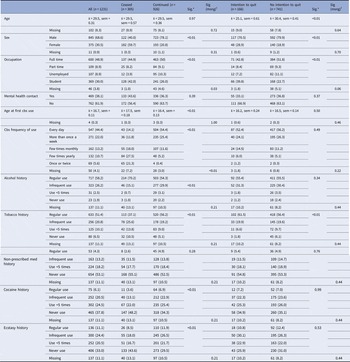
Missing data: Fisher's 2 × 2 exact test was undertaken to see if there was a significant effect of missing data between groups (continued v. discontinued and future intention to quit v. no intention to quit) for all covariates (age, sex, occupation, mental health contact, age of first use, frequency of first use, alcohol, tobacco, non-prescribed medication, cocaine and ecstasy history) (see Table 1). There were no significant differences in the rates of missing data between the groups for continued users who had intention to quit v. no intention to quit. There were furthermore no significant differences in the rates of missing data for continued v. discontinued users for all covariates except for occupation (4.6% v. 1.0%, p = 0.03) and frequency of use (3.0% v. 7.2%, p < 0.01); however, even in these two instances, the overall differences in the proportions of missing data between the groups were adjudged to be small and there was no evidence of systematic bias in missing data. Consequently, we undertook a complete-case analysis (where there were no missing data for all covariates specified above) to account for missing data (see online Supplementary material) in preference to imputation methods.
Demographic data

All data count (%) unless specified otherwise; x̄, mean; sem, standard error of the mean; cbs, cannabis.
* Significance using t tests for continuous variables, χ2 tests for proportions (infrequent categories combined if count <5).
† Significance for missing data – Fisher's exact test 2 × 2 contingency test.
Sensitivity analyses: We re-ran the statistical analyses with the complete-case data excluding participants with a history of psychotic or manic illness. Furthermore to ensure that those who reported discontinuation would be objectively considered to have ceased use, we re-ran the analysis with discontinued users restricted to the group who had reported last use of cannabis to be at least 6 months previously. To ensure that any relationships were not accounted for by infrequent or experimental users, we checked whether the relationship between experiences and discontinuation/future discontinuation survived across differing levels of use by running the logistic regression with data split by frequency of use. In this case, frequency of use was removed as a covariate from logistic regression models.
Statistical analysis was undertaken in SPSS version 20.
Qualitative analysis
Open-ended questionnaire responses to questions on reasons stated for discontinued cannabis use (experiences), descriptions of negative experiences, and stated reasons for changes in the patterns of use over time were transcribed, collated and inductively coded by an independent researcher who had not been involved in the design of the quantitative survey (CN). Following a thematic approach (Braun & Clarke, Reference Braun and Clarke2006), no a priori coding structure was applied, but themes were allowed to ‘emerge’ naturally from the data and were grouped in meaningful ways to assist with the interpretation of the data. Analysis was discussed and verified at regular team meetings. This analysis was undertaken independently but in parallel with the quantitative analysis.
Results
Demographics
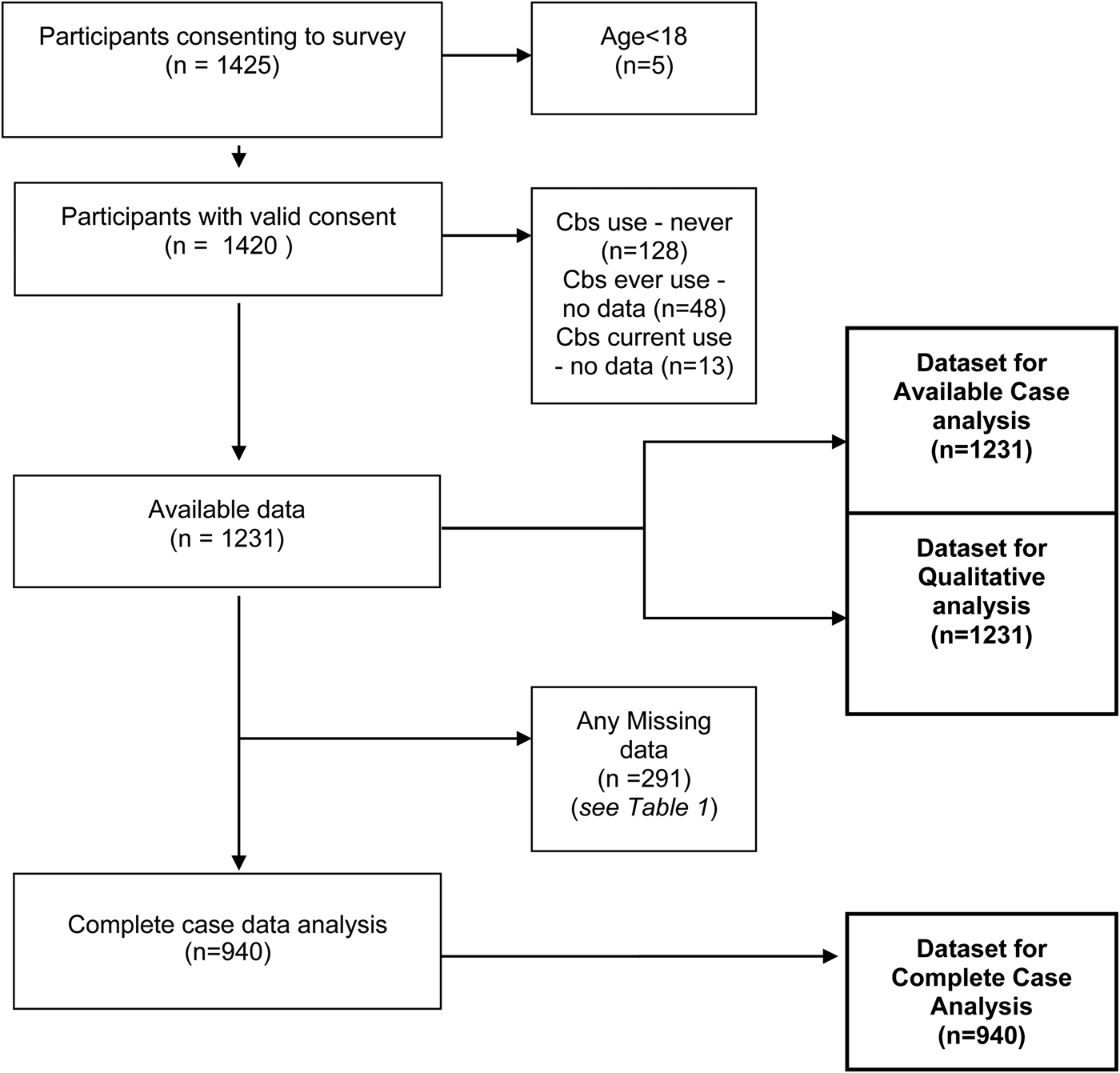
In total, 1425 participants responded to the survey. Five participants were excluded due to being under 18. Of the remaining, data were available for 1231 participants who had ever used cannabis (see Fig. 1). Complete-case data were available for 940 participants. Summary demographic and predictor, outcome and covariate data are reported in Table 1. In total, 845/1231 (68.6%) were male, whereas 375/1231 (30.5%) were female. Age ranged from 18 to 77 years (mean 29.5, median 26, standard deviation 10.3). Four hundred and sixty-nine (38.1%) of the respondents reported previous mental health contact. Whilst this was not quantified based on free-text information, this appeared to be mostly related to anxiety, depression or stressful experiences and involved treatment within the primary care setting or by counselling. Twenty-five out of 1231 (2.0%) participants included in the analysis referred to a diagnosis of psychotic or manic illness.
Participant flow chart. cbs, cannabis.

Although we did not routinely ask for country, 494/531 (93.0%) of those who agreed to a follow-up study gave their place of residence in the UK, with 23/531 (4.3%) responding from Sweden, although there were also a few responses from the USA, Brazil, Mauritius, Greece and Zimbabwe.
Cannabis use
Nine hundred and twenty-six out of 1231 (75.2%) participants continued to use the substance. One hundred and sixty-seven out of 907 (18.4%) continued users agreed that they would like to stop in the future. In all users, pleasurable experiences were more frequently reported than psychotic experiences. Age of first cannabis use ranged from 7 to 55 years (mean 16.7, median 16, s.d. 3.7).
Cannabis experiences
Pleasurable experiences exceeded psychotic-like experiences. Nine hundred and fifteen out of 1123 (81.4%) respondents in this sample reported that they experienced happiness either most or all of the times they used cannabis, whilst 66/1119 (5.9%) of respondents endorsed ‘feeling nervy’, the most common dysphoric experience. A considerable proportion of cannabis users had ever experienced psychotic or dysphoric experiences when using cannabis: feeling suspicious: 524/1117 (46.9%); feeling nervy: 491/1119 (43.9%); feeling fearful: 302/1123 (27.1%); seeing visions: 187/1118 (16.7%); feeling like going crazy or mad: 145/1121 (12.9%); and hearing voices: 100/1117 (9.0%).
Cannabis experiences cessation v. continuation
Psychotic-like experiences and pleasurable experiences scores by ceased and continued users are shown in Table 2. Those who had ceased reported greater frequency of experiencing psychotic-like experiences (t = 7.05, p < 0.001), whereas continued cannabis users were significantly more likely to report pleasurable experiences than those who had ceased (t = −16.67, p < 0.001). These findings remained when the complete data set was analysed and further when those with a history of psychotic or manic illness were excluded (see online Supplementary data).
Cannabis experiences mean scores by group: discontinuation v. continuation

Psychotic-like experiences: CEQ score psychotic-like experiences; pleasurable experiences: CEQ score pleasurable/pleasurable experiences. In boxes: mean score (SEM) number in group.
a Independent samples t test for cessation v. continuation. Positive t-statistic in the direction of cessation.
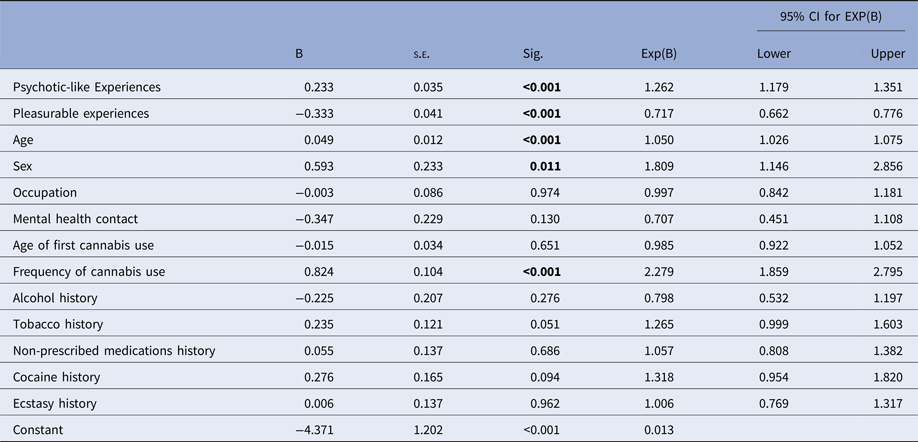
Results from a logistic regression analysis are summarised in Table 3. Cessation of cannabis use was significantly associated with psychotic-like experiences (higher score predicts cessation), pleasurable experiences (lower score predicted cessation), age (older age predicted cessation), sex (being female predicted cessation) and frequency of cannabis use (less frequent use predicted cessation). Tobacco use was also borderline significant (p = 0.51), indicating more frequent tobacco use predicted continuation.
Logistic regression for cannabis discontinuation/continuation by co-variate

Psychotic-like experiences: CEQ score psychotic-like experiences; pleasurable experiences: CEQ score pleasurable/pleasurable experiences. Positive Bs in the direction of cessation.
Cannabis experiences in continued users: no intention to quit v. future intention to quit
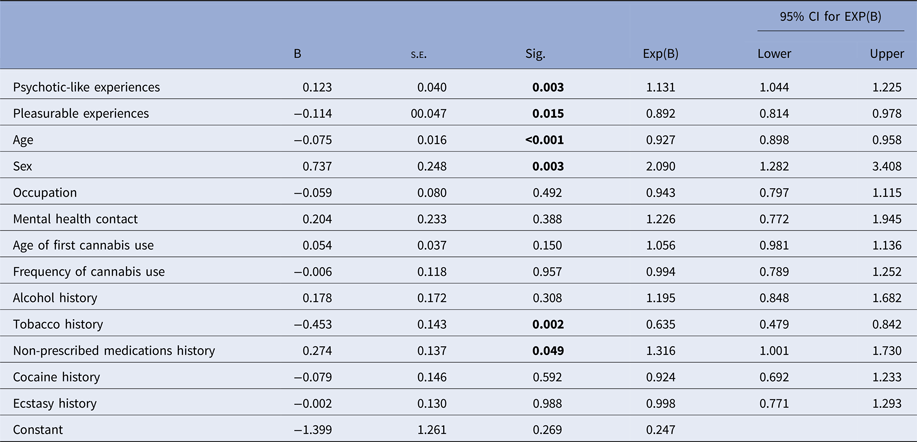
Within continued cannabis users, future intention to quit was significantly associated with greater psychotic-like experiences (t = 3.95, p < 0.001) and lower pleasurable experiences (t = −2.37, p = 0.017) (see Table 4). These findings were replicated when the complete data set was analysed (see online Supplementary data). Logistic regression (Table 5) analyses suggested that future intention to quit was significantly associated with psychotic-like experiences (higher score predicted future intention to quit), pleasurable experiences (lower score predicted future intention to quit), age (lower age predicted future intention to quit), sex (being females predicted future intention to quit) and history of tobacco use (more frequent use predicted future intention to quit). History of non-prescribed medication use was also borderline significant (p = 0.49, less frequent use predicted future intention to quit).
Cannabis experiences mean scores by group in continued users: future intention to quit v. no future intention to quit

Psychotic-like experiences: CEQ score psychotic-like experiences; pleasurable experiences: CEQ score pleasurable/pleasurable experiences. In boxes: mean score (SEM) number in group.
a Independent samples t test for future intention to quit v. no future intention to quit. Positive t-statistic in the direction of future intention to quit.
Logistic regression for future intention to quit/no intention to quit by co-variate

Psychotic-like experiences: CEQ score psychotic-like experiences; pleasurable experiences: CEQ score pleasurable/pleasurable experiences. Positive Bs in the direction of future intention to quit.
Sensitivity analyses
On sensitivity analyses, when the complete data set was analysed (i) with those with psychosis or manic illness excluded and (ii) restricted to discontinued users who reported last use of cannabis more than 6 months previously, psychotic-like experiences and pleasurable experiences significantly predicted cessation in the same direction. The same relationship between psychotic-like experiences and pleasurable experiences remained statistically significant when restricted to daily users (see online Supplementary data).
Qualitative analysis
In total, 1107 unique participants provided qualitative feedback. Three hundred and twelve unique ‘open’ codes were inductively derived from the data. Qualitative coding broadly identified the dominant themes of significant negative experiences as impacting on continued cannabis use (see online Supplementary data on coding ‘Why did you stop/negative psychological symptoms’). Within coding of responses to the question ‘Why have patterns of use changed?’, 121 codes were broadly categorised into individual-, interpersonal-, community-, organisational- and policy-level themes. Additional themes related specifically to the constituents of cannabis, the micro-context of use and the concept of ‘maturation’. Drawing on the subjective participant perspectives, negative experiences were linked to the type of cannabis used, particularly strong types of cannabis (skunk) and synthetic cannabis. Participants made clear links between their negative experiences, their cannabis use and their future intentions, such that negative experiences were considered to be somewhat protective of future cannabis use (see online Supplementary data on coding ‘Why have patterns of use changed/negative effects’). Indeed, our coding clusters are particularly around individual-level factors, suggesting that an experience at the individual level of perception and interpretation is critical in informing continued patterns of cannabis use. Those who did not report severe negative experiences also discussed future intention to discontinue cannabis use, but intentions in these cases were framed around ‘growing older’, moving away from cannabis use and discontinued use to match life events (notably getting married, starting a family, starting full-time employment) (see online Supplementary data on coding ‘Would you like to stop using cannabis one day/maturing out’).
Discussion
We investigated the impact of desirable and undesirable transient subjective experiences, such as ‘pleasurable’ and ‘psychotic-like experiences’, respectively, on subsequent cannabis use behaviour as indexed by cessation or continuation of cannabis use as well as future intention to quit in those who continue to use cannabis in a large internet-based participant survey. Our results from a combination of quantitative and qualitative analyses converge to demonstrate that psychotic-like experiences are strongly associated with both cannabis cessation and future intention to quit. These results survived controlling for potential confounding factors that may also be associated with these outcomes and is particularly evident in those who use cannabis most frequently.
Qualitative data further support these relationships such that those who have discontinued cannabis are more ready to clearly ascribe this to negative experiences. However, those who intend to stop using cannabis in the future do not necessarily ascribe intention to stop to anticipate negative experiences. Together, the significant association between negative subjective experiences and cessation may suggest that the elucidation of such experiences may form the basis of a therapeutic intervention for those who express a desire to quit.
Conversely, this study clearly demonstrates that pleasurable experiences are associated with continued use and lack of intention to quit. This is in line with the previous studies in this area (Grant et al. Reference Grant, Scherrer, Lyons, Tsuang, True and Bucholz2005; Scherrer et al. Reference Scherrer, Grant, Duncan, Sartor, Haber and Jacob2009). Cannabis is thus evidently experienced as a pleasurable drug and this would appear to account for its ongoing and continued use.
To date, there is no consensus in the literature as to whether adverse experiences are associated with reduced or heavier use (Lyons et al. Reference Lyons, Toomey, Meyer, Green, Eisen and Goldberg1997; Grant et al. Reference Grant, Scherrer, Lyons, Tsuang, True and Bucholz2005; Scherrer et al. Reference Scherrer, Grant, Duncan, Sartor, Haber and Jacob2009; Zeiger et al. Reference Zeiger, Haberstick, Corley, Ehringer, Crowley and Hewitt2010). To our knowledge, no prior studies have systematically looked to examine specifically the effect of cannabis-induced psychotic-like experiences on cannabis cessation. Two studies have however reported on incidental findings that support the direction of our findings. Whilst validating the CEQ, Stirling et al. noted continued cannabis users to report more positive and less negative experiences than past users (n = 185) (Stirling et al. Reference Stirling, Barkus, Nabosi, Irshad, Roemer and Schreudergoidheijt2008). Whilst testing whether psychotic-like experiences are a marker of psychosis proneness, Mason et al. noted that a greater acute psychotomimetic state effect was associated with less frequent cannabis use (n = 140) (Mason et al. Reference Mason, Morgan, Dhiman, Patel, Parti and Curran2009). Our data extend previous work by clearly indicating that psychotic-like experiences are associated with cessation and are attributed as one of the main drivers underlying cessation by those who have successfully stopped. Furthermore, by demonstrating an association between psychotic-like experiences and a future intention to cease, which is not consciously recognised as such by continued users, these results also suggest a potential intervention target. Given that our data show psychotic-like experiences in both continued and discontinued users, this may indicate that as pleasurable experiences are predominant, they may over-ride the occasional negative experiences, even if the experience is severe. However, the results of this study may have implications beyond this.
A central argument against the relationship between cannabis use and psychosis risk has been that whereas cannabis prevalence and potency has increased over the last four decades, there has not been a corresponding increase in the population-level incidence of psychotic disorders (Frisher et al. Reference Frisher, Crome, Martino and Croft2009) as would be expected if cannabis use were to be causally linked to psychosis risk. This has been argued to critically weaken the case for the association between cannabis and psychosis and remains an ongoing area of controversy (Hill, Reference Hill2015; Gage et al. Reference Gage, Hickman and Zammit2016).
There is now a growing body of evidence to suggest that psychotic-like experiences with cannabis use, such as have been measured in this study, may act as a tractable marker for identifying those at putative psychotic risk. In an independent study, patients with psychotic illness have been shown to experience more profound cannabis effects compared with healthy controls (HCs) (Bianconi et al. Reference Bianconi, Bonomo, Marconi, Kolliakou, Stilo and Iyegbe2016). Administration of δ-9-tetrahydrocannabinol, the major psychotomimetic constituent of cannabis, has been demonstrated to elicit an increased psychotomimetic response in individuals with a psychotic illness as compared with HCs (D'Souza et al. Reference D'Souza, Abi-Saab, Madonick, Forselius-Bielen, Doersch and Braley2005). Furthermore, increased schizotypy, a marker of psychosis proneness, predicts increased psychotic-like experiences in cannabis users (Barkus et al. Reference Barkus, Stirling, Hopkins and Lewis2006). A large patient–sibling and sibling–control design study has demonstrated increased sensitivity of sub-threshold psychotic experiences to cannabis use amongst sibling pairs of patients with psychosis as compared with controls (Kahn et al. Reference Kahn, Linszen, van OS, Wiersma, Bruggeman, Cahn, de Hann, Krabbendam and Myin-Germeys2011). Controlled experimental studies have demonstrated that variations in genes implicated in psychosis such as COMT, AKT1 and DAT1 may moderate greater sensitivity to the psychotomimetic effects of cannabis and its neurophysiological underpinnings in non-clinical populations (Henquet et al. Reference Henquet, Rosa, Krabbendam, Papiol, Fananás and Drukker2006; Bhattacharyya et al. Reference Bhattacharyya, Atakan, Martin-Santos, Crippa, Kambeitz and Prata2012). Taken together, increased sensitivity to cannabis-induced psychotomimetic experiences have been found in (i) patients with psychosis, (ii) those with psychosis proneness and (iii) those with family history and genetic liability to psychosis, as compared with the general population. Thus, the CEQ psychotic-like experiences score, as measured in this study, may give an indication of psychosis risk, although prospectively designed studies would be required to absolutely quantify this.
If individuals with cannabis-induced psychotic-like experiences (who are at a putatively higher risk of developing disorder) were to discontinue use, as our results suggest, this may off-set the greater risk of developing psychotic disorder associated with cannabis use. We suggest that this might in turn explain the relative stability of the rates of psychotic disorder over time despite the growing use of more potent forms of cannabis. Hence, we posit a discontinuation hypothesis leading to those at the highest risk of cannabis-induced psychosis self-selecting themselves out of a continued use, and hence protecting themselves from the risk of developing enduring psychotic disorders.
Such an explanation is consistent with the evidence that those at clinically high risk of psychosis discontinue cannabis use once breakthrough psychotic symptoms appear (Valmaggia et al. Reference Valmaggia, Day, Jones, Bissoli, Pugh and Hall2014) and an independent evidence in the general population that subthreshold psychotic experiences, measured using the Community Assessment of Psychic Experience (CAPE) questionnaire (as distinct from cannabis-induced psychotic-like experiences), predict cessation of cannabis use over 6 months to 5 years (van Gastel et al. Reference van Gastel, Vreeker, Schubart, MacCabe, Kahn and Boks2014).
These results are to be considered in light of certain limitations: the outcome measure reported that self-reported continued use (yes/no) may vary or wane over time. However, our findings remained in the same direction when we restricted the discontinued group to those who reported last use at least 6 months previously. Further, the cross-sectional nature of our study precludes conclusions regarding the precise nature of these relationships. Nevertheless, the associations reported survived adjustment for multiple potential demographic and substance misuse confounders and were consistent across two different outcome measures. Arguably, the pragmatic design that we have employed using a convenience sample, rather than a probability sample, also limits the generalisability of these results. Whilst this would have been expected to result in under-reporting of psychotic-like symptoms associated with cannabis use as our sample was drawn from advertisements on social media and cannabis campaigning platforms, this did not occur, with around 40% of the sample acknowledging that they have either felt suspicious or nervy at some point from cannabis use. Arguably, the online data acquisition design accorded anonymity allowing for more honest engagement with the survey as evident from the abundant qualitative data. Of note, a higher proportion of our sample (38.1%) reported a lifetime history of mental health contact than would be expected in the general population. Although we adjusted for mental health contact in our data, this did not include substance misuse treatment, which may be seen as a limitation. Further, we cannot completely exclude response bias or recall bias: those who have discontinued are likely to have used cannabis in the more distant past than those who continue use, and those who discontinue may be more likely to highly rate negative experiences. However, these biases are unlikely to have systematically affected the results as negative experiences are also rated similarly in those who continue to use but intend to quit in future.
Finally, one must also consider the items used and the construct validity of the CEQ for the experiences used and the sample studied. Principal component analysis of 55 different experiences (43 immediate, 12 after-effects) in a previous British non-clinical cohort using an electronic survey has demonstrated the nine experiences we administered to load significantly with factor loading >0.5 onto their respective subscales (psychotic-like experiences and pleasurable effects) (Barkus & Lewis, Reference Barkus and Lewis2008). A further analysis of all the original experiences showed the nine experiences we administered to load similarly onto distinct subscales with a factor >0.5 in the same manner, except for visual hallucinations which were not part of the solution (Stirling et al. Reference Stirling, Barkus, Nabosi, Irshad, Roemer and Schreudergoidheijt2008). A two-factor model for immediate experiences has recently been confirmed in independent non-clinical populations, although notably auditory and visual hallucinations were not part of the final 13-item solution (Quinn et al. Reference Quinn, Wilson, Cockshaw, Barkus and Hides2017). However, this latent structure has not been universally validated in clinical populations: in a recent US sample in a first-episode clinical population (n = 194), exploratory factor analysis using the original experiences identified four subscales amongst patients: distortions of reality and self-perception; euphoria effects; slowing and amotivational effects; and anxiety and paranoia effects (Birnbaum et al. Reference Birnbaum, Cleary, Ramsay Wan, Pauselli and Compton2017). This is similar, although not identical to another study involving both first-episode patients and controls (patients n = 252; controls n = 207), where a four-factor model was derived from 14 experiences namely: anxiety-paranoid experiences; cognitive experiences; enjoyable experiences and psychotic experiences (Bianconi et al. Reference Bianconi, Bonomo, Marconi, Kolliakou, Stilo and Iyegbe2016). One explanation for this could be that cannabis experiences maybe differentially experienced in clinical and non-clinical populations as suggested by the authors of both studies (Bianconi et al. Reference Bianconi, Bonomo, Marconi, Kolliakou, Stilo and Iyegbe2016; Birnbaum et al. Reference Birnbaum, Cleary, Ramsay Wan, Pauselli and Compton2017); hence, our results in a non-clinical sample cannot be generalised to patient groups, which would need to be studied separately.
Notwithstanding these limitations, using a well-validated measure, which has now been used across multiple non-clinical populations (Barkus et al. Reference Barkus, Stirling, Hopkins and Lewis2006; Barkus & Lewis, Reference Barkus and Lewis2008; Stirling et al. Reference Stirling, Barkus, Nabosi, Irshad, Roemer and Schreudergoidheijt2008; Quinn et al. Reference Quinn, Wilson, Cockshaw, Barkus and Hides2017) and a mixed-methods approach, we report converging evidence from a quantitative analysis controlling for potential confounders and an independent qualitative analysis that psychotic-like experiences may predict cannabis cessation, whereas pleasurable experiences may predict continued use as well as quantitative evidence that such experiences may also predict future intention to quit or continue cannabis use.
Together, these findings may suggest that psychotic-like experiences associated with cannabis use may have a protective effect on the risk of subsequent psychotic disorder by influencing future and continued cannabis use behaviour, and may go some way to explaining relative stability of rates of psychotic disorder over time. Prospective longitudinal studies are needed to definitively confirm or refute this possibility.
Supplementary material
The supplementary material for this article can be found at https://doi.org/10.1017/S0033291718000569
Declaration of interest
The authors declare no conflict of interest.
Source of funding
SB has been funded by the National Institute for Health Research (NIHR), UK through a Clinician Scientist award (NIHR-CS-11-001) and also supported by the NIHR Biomedical Research Centre for Mental Health BRC Nucleus at the South London and Maudsley NHS Foundation Trust and Institute of Psychiatry, Psychology and Neuroscience, King's College London. MS is funded through a Medical Research Council (UK) Clinical Research Training Fellowship. CN is funded through a Post-Doctoral Fellowship from the UK Society for the Study of Addiction.
Role of the funding source
The views expressed are those of the authors and not necessarily those of the NHS, the NIHR, the MRC, the SSA or the Department of Health. The funders had no role in the preparation, review or approval of the manuscript; and decision to submit the manuscript for publication. All authors have approved the final version of the paper.
Ethical declaration
The authors assert that all procedures contributing to this work comply with the ethical standards of the relevant national and institutional committees on human experimentation and with the Helsinki Declaration of 1975, as revised in 2008.