Introduction
The ecological niche (EN) concept expresses the relationship of an individual or a population to all aspects of its environment (Hutchinson Reference Hutchinson1957). Recently, the EN definition was refined and two distinct niche components, Grinnellian and Eltonian, were proposed (Soberón Reference Soberón2007, Stevens Reference Stevens2022a). Environmental conditions and climate heterogeneity determine the Grinnellian niche, whereas the Eltonian niche expresses the local interactions between consumers and resources (Stevens Reference Stevens2022a). EN theory also predicts that similar species will coexist in the same community if they exhibit differences on at least one niche dimension (Chase et al. Reference Chase, Abrams, Grover, Diehl, Chesson, Holt, Richards, Nisbet and Case2002, Geange et al. Reference Geange, Pledger, Burns and Shima2011, MacArthur 1958, Ruadreo et al. 2019), that is, period of activity (Mancina & Castro-Arellano Reference Mancina and Castro-Arellano2013), use of space (Castaño et al. Reference Castaño, Carranza and Pérez-Torres2018, Pearman et al. Reference Pearman, Guisan, Broennimann and Randin2008), or partitioning of food resources (Bolnick et al. Reference Bolnick, Ingram, Stutz, Snowberg, Lau and Paull2010, Faustino et al. Reference Faustino, Dias, Ferreira and Ortêncio Filho2021, Stephens & Krebs Reference Stephens and Krebs1986).
The partitioning of food resources, or dietary niches (DNs), plays an important role in decreasing interspecific competition, thus allowing the stable coexistence of functionally similar species at different temporal and spatial scales (Castaño et al. Reference Castaño, Carranza and Pérez-Torres2018, Clare et al. Reference Clare, Fraser, Braid, Brock Fenton and Hebert2009, Fleming Reference Fleming1991, García-Estrada et al. Reference García-Estrada, Damon, Sánchez-Hernández, Soto-Pinto and Ibarra-Núñez2012, Kunz & Parsons Reference Kunz and Parsons1988, Painter et al. Reference Painter, Chambers, Siders, Doucett, Whitaker and Phillips2009). This ecological mechanism is an important determinant in the structuring of the bat community, which in many cases consists of several ecologically and morphologically similar species (i.e. size, mobility, type, and form of foraging) that inhabit the same place (Bolnick et al. Reference Bolnick, Ingram, Stutz, Snowberg, Lau and Paull2010, Shipley & Twining Reference Shipley and Twining2020, Stevens Reference Stevens2022b). Example of this is the Phyllostomidae, most taxonomically diverse bat family both in terms of the number of genera and feeding strategies (Baker et al. Reference Baker, Hoofer, Porter and Van Den Bussche2003, Rojas et al. Reference Rojas, Vale, Ferrero and Navarro2012). This family stands out in having a wide distribution throughout the Neotropical Region and morphological diversification associated with heterogeneity in resource use among species (Freeman 2000, Stevens Reference Stevens2022b).
For fruit bats, DN partition is strongly influenced by three main factors: 1, the local diversity of plants (Fleming Reference Fleming1993, Lobova et al. Reference Lobova, Geiselman and Mori2009); 2, the changes caused by the fragmentation of the environment (Faustino et al. Reference Faustino, Dias, Ferreira and Ortêncio Filho2021, Muñoz-Lazo et al. 2018, Stevens Reference Stevens2022b); and 3, temporal changes in the availability of these resources (Fleming Reference Fleming1993, Stevens Reference Stevens2022b). The last two factors are probably the most influential in the diet of bats, given that in anthropogenically modified landscapes like the Brazilian Cerrado, plant species that bear fruit for long periods, or that bear fruit more than once a year, are the most consumed ones (Heithaus et al. Reference Heithaus, Fleming and Opler1975, Jacomassa & Pizo Reference Jacomassa and Pizo2010, Laurindo et al. Reference Laurindo, Gregorin and Tavares2017, Passos & Graciolli Reference Passos and Graciolli2004, Stevens & Amarilla-Stevens Reference Stevens and Amarilla-Stevens2021, Stevens Reference Stevens2022b).
Besides important families like Leguminosae, Myrtaceae, Melastomataceae, and Rubiaceae, calcareous rocks known as karsts range through the Cerrado (Pennington et al. Reference Pennington, Lehmann and Rowland2018, Pennington et al. Reference Pennington, Prado and Pendry2000). This Biome covers about 24% of the Brazilian territory (Ribeiro & Walter Reference Ribeiro and Walter2008) and more than 57% of the state of Minas Gerais (Machado et al. Reference Machado, Ramos Neto, Pereira, Caldas, Gonçalves, Santos, Tabor and Steininger2004). On areas of fertile soil, which are often associated with calcareous rock, tropical dry forests (TDFs) occur (Dexter et al. Reference Dexter, Pennington, Oliveira-Filho, Bueno, Silva de Miranda and Neves2018). These vegetation structures, adapted to the seasonality of the climate, show a leaf flush semideciduous and deciduous regime, resulting in a diversified and singular landscape that must be conservated (Dexter et al. Reference Dexter, Pennington, Oliveira-Filho, Bueno, Silva de Miranda and Neves2018). Nevertheless, the agrobusiness, livestock rising, city expansion, and mining activities represent potential drivers to shortening the length of the Brazilian Cerrado (Sano et al. Reference Sano, Rodrigues, Martins, Bettiol, Bustamante, Bezerra, Couto, Vasconcelos, Schüler and Bolfe2019).
We carried out a study to know the feeding habits of fruit bats of the Phyllostomidae family, in a karst region located in the midwest portion of Minas Gerais/Brazil, seeking to identify which items are present in their diet, and verifying dietary changes according to seasonal variation and if the coexistence of congeneric species pairs of bats is facilitated by DN differentiation based on seasonal variation. It is expected that with seasonal change, resource abundance will reflect on dietary diversity, with higher amplitude and overlap values during drier periods.
Methods
Study area
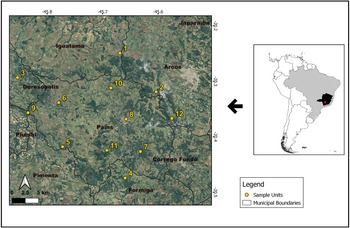
The study was carried out in the karst province of Alto São Francisco, also called karst of Arcos, Pains, and Doresópolis (Figure 1) (Menegasse et al. Reference Menegasse, Gonçalves and Fantinel2002). The region is located in the Cerrado domain, coinciding with the inland limits of the Atlantic Forest. The local native vegetation lies highly uncharacterised as most of it was converted into pastures, crops, and other cultures (e.g. corn, eucalyptus, and coffee) (Oliveira et al. Reference Oliveira, Ferreira and Araújo2012, Sano et al. Reference Sano, Rosa, Brito and Ferreira2010). Around calcareous outcrops in the Cerrado, deciduous stationary forest biotype (dry forest) remarkably characterised by the leaf flush deciduous and semideciduous regime is found (Melo et al. Reference Melo, Lombardi, Alexandre Salino and Carvalho2013). This vegetation is known as ‘Mata de Pains’, in the study area (Barbosa Reference Barbosa1961).
Map of sample collection points in the Midwest region of the state of Minas Gerais, Brazil.

The climate of the region, according to the Köppen classification system, is of the Cwa type, that is, a subtropical climate with dry and mild winters and humid and hot summers (Alvares et al. Reference Alvares, Stape, Sentelhas, Moraes, Leonardo and Sparovek2013). The average annual temperature is around 20°C, with a minimum average of 12°C in the coldest month and an average maximum of 30°C in the hottest month. The average annual rainfall is approximately 1,500 mm (Nimer Reference Nimer1989).
Sampling of Chiroptera fauna and use of food resource
Six field expeditions were conducted for 1 year in February, March, April, May, August, October, and November 2020, and February and April 2021, covering dry and rainy seasons, including 12 sampling sites (outcrops with the presence of caves as the centroid). Sampling sites are far at least 5 km. At each site, one 12 × 2.5 m mist-net was arranged in the cave entrance blocking it completely or most of it. Five 12 × 2.5 m mist-nets were arranged at the border of outcrops near the cave entrance. The nets were open for 6 hours from sunset totalling 1,080 m2h for each site and a total of 19,960 m2h for the areas as a whole. Bat identification was based on Díaz et al. (Reference Díaz, Solari, Aguirre, Aguiar and Barquez2016). All handling procedures followed the recommendation of Sikes et al. (2016).
Faecal samples collected during handling of animals in the net, and in the cloth bags, were placed in plastic microtubes containing 70% alcohol, labelled, and then taken to the laboratory for identification under a stereomicroscope. The material was separated into three categories (seeds, insect fragments, and pulp). The seeds were counted and identified to the lowest possible taxonomic level consulting the available bibliography (Bredt et al. Reference Bredt, Uieda and Pedro2012, Kuhlmann Reference Kuhlmann2018, Lima et al. Reference Lima, Nogueira, Monteiro, Peracchi, Rolim, Menezes and Srbek-Araújo2016, Lobova et al. Reference Lobova, Geiselman and Mori2009, Lorenzi Reference Lorenzi1992, Reference Lorenzi1998, Reference Lorenzi2009). The botanical nomenclature followed the Missouri Botanical Garden on the ‘Trópicos’ website (www.tropicos.org) (Tropicos.org 2021). Insect and pulp fragments were quantified when they were found in samples (Mello et al. Reference Mello, Schittini, Selig and Bergallo2004).
Data analysis
Analyses were carried out only with bat species with 10 or more samples (see Table 1). We initially analysed differences in food consumption by bats between the rainy and dry seasons using PERMANOVA, a Bray–Curtis multivariate permutation analysis of variance with 9,999 random permutations (Anderson et al. Reference Anderson, Ellingsen and Mcardle2006), followed by a PERMIDISP, to test whether the variation between seasons around its centroid was significantly different from each other (Anderson et al. Reference Anderson, Ellingsen and Mcardle2006).
Occurrence of food items in the diet of bat species of the family Phyllostomidae

R = rain; D = dry.
To calculate niche overlap among bat species, the Pianka index (Pianka Reference Pianka1973) was used, which ranges from 0 (no overlap) to 1 (total overlap). The observed overlap values were statistically compared to reference ones from null models, in which 5,000 permutations of the frequencies of food categories were performed for the Pianka index (Gotelli et al. Reference Gotelli, Hart and Ellison2015). Through randomisation of overlap in use of food resources, it is possible to identify whether there is a greater similarity between species of the community exploiting resources (greater overlap observed than expected by chance) or segregation in the use of resources (greater than the expected at random) (Gotelli et al. Reference Gotelli, Hart and Ellison2015). For these simulations, the randomisation algorithm number 3 (RA3) was used to exchange niche utilisation values between each row of the matrix (Gotelli & Entsminger Reference Gotelli and Entsminger2009). This algorithm was pointed out by Winemiller & Pianka (Reference Winemiller and Pianka1990) as the one that presents the best statistical properties to detect overlapping patterns of non-random niches (Gotelli & Entsminger Reference Gotelli and Entsminger2009).
To evaluate the species DN, we performed an analysis of niche marginality (Outlying Mean Index [OMI]), which is an ordination technique designed to explicitly take into account the niche of each species within a community and determine its marginality (Baldrich et al. Reference Baldrich, Pérez-Santos, Álvarez, Reguera, Fernández-Pena, Rodríguez-Villegas, Araya, Álvarez, Barrera, Karasiewicz and Díaz2021, Dolédec et al. Reference Dolédec, Chessel and Gimaret-Carpentier2000). For each taxonomic unit, the analysis returns three niche parameters: OMI (base of analysis), tolerance (Tol), and residual tolerance (RTol). The marginality (OMI parameter) of a species corresponds to its niche position in an n-dimensional space, where the OMI parameter is defined as the squared Euclidean distance between the average conditions used by a species and the average conditions of the sampled parameters (Baldrich et al. Reference Baldrich, Pérez-Santos, Álvarez, Reguera, Fernández-Pena, Rodríguez-Villegas, Araya, Álvarez, Barrera, Karasiewicz and Díaz2021, Dolédec et al. Reference Dolédec, Chessel and Gimaret-Carpentier2000, Karasiewicz et al. Reference Karasiewicz, Dolédec and Lefebvre2017). A high marginality value implies that the taxonomic unit is uncommon, or with few occurrences, compared to a low value, which indicates more common and abundant species. (Dolédec et al., Reference Dolédec, Chessel and Gimaret-Carpentier2000; Karasiewicz et al., Reference Karasiewicz, Dolédec and Lefebvre2017). For this analysis, we made two matrices: one with the abundance values of the collected bat species separated by sampling units and a second containing the amount of food resources consumed by bat species.
The OMI analysis provides information on niche breadth of species with the tolerance parameter (Tol). High and low tolerance values are associated with taxa that occur in broad ranges (generalists) and limited ranges (specialists) of the conditions (Baldrich et al. Reference Baldrich, Pérez-Santos, Álvarez, Reguera, Fernández-Pena, Rodríguez-Villegas, Araya, Álvarez, Barrera, Karasiewicz and Díaz2021), respectively. The residual tolerance (RTol) quantifies the information lost after dimensional reduction (Karasiewicz & Lefebvre Reference Karasiewicz and Lefebvre2022). This parameter evaluates the reliability of the variables used to define the species’ niche (Dolédec et al. Reference Dolédec, Chessel and Gimaret-Carpentier2000, Karasiewicz et al. Reference Karasiewicz, Dolédec and Lefebvre2017). The statistical significance of the OMI analysis was tested using Monte Carlo permutations by comparing the observed marginality with 10,000 simulated marginalities, which compare the marginality of observed species with the values from the null hypothesis, assuming species with different habits (Baldrich et al. Reference Baldrich, Pérez-Santos, Álvarez, Reguera, Fernández-Pena, Rodríguez-Villegas, Araya, Álvarez, Barrera, Karasiewicz and Díaz2021, Dolédec et al. Reference Dolédec, Chessel and Gimaret-Carpentier2000).
In the next step, we performed a niche decomposition analysis into subniches (within outlying mean indexes [WitOMI]). The decomposition helps to unfold niche dynamics, highlighting the influence of habitat conditions, such as seasonality on the species at a given time and/or space (Karasiewicz et al. Reference Karasiewicz, Dolédec and Lefebvre2017). The WitOMI indices use the space created by the OMI analysis and integrate new features that allow the division of niches into subniches, linked to temporal subsets. It promotes the comprehension of how community responds to changing environmental conditions at the individual scales (Karasiewicz et al. Reference Karasiewicz, Dolédec and Lefebvre2017, Saccò et al. Reference Saccò, Blyth, Humphreys, Karasiewicz, Meredith, Laini, Cooper, Bateman and Grice2020).
For example, the values of the marginality (OMI) and tolerance (Tol) parameters provided by the OMI may be negatively correlated, and as a result, we can expect that more common species (low marginality) will have broader niches (high tolerance), and uncommon species (high marginality) will have more restricted niches (low tolerance). However, when we perform the decomposition into temporal (seasonal) subniches of these species, this negative correlation may not happen, for example, we can find species with both low WitOMI and Tol values, that is, abundant but with a restricted niche.
For the niche overlap analysis and overlap simulations, ‘EcoSimR’ package was used (Gotelli et al. Reference Gotelli, Hart and Ellison2015). For OMI and WitOMI analyses, ‘ade4’ (Dray & Dufour Reference Dray and Dufour2007) and ‘subniche’ packages (Karasiewicz et al. Reference Karasiewicz, Dolédec and Lefebvre2017) were used, respectively. For the PERMANOVA and PERMIDISP analyses, ‘pairwiseAdonis’ (Martínez Arbizu Reference Martínez Arbizu2020) and ‘vegan’ (Oksanen 2020) packages were used. All analyses were performed using the R program (R Development Core Team 2021).
Results
Food resource
A total of 499 faecal samples were collected from 15 species of phyllostomid bats. C. perspicillata (N = 197) presented seeds belonging to five plant families, A. planirostris (N = 146) preferentially consumed fruits of plants from the Moraceae and Myrtaceae families, G. soricina (N = 35) consumed mainly Piperaceae, S. lilium (N = 31) feed on Cucurbitaceae, and P. lineatus (N = 29) showed a predominance of seeds from the Moraceae. Other species of bats had a low number of samples (Table 1).
Total samples analysed, 263 (52.7%) contained seeds, 216 (43.2%) contained pulp remains, and 20 (4.1%) had insect fragments. The seeds found in the faeces are distributed in nine families of plants, being Moraceae (31.5%) the most frequent, followed by Piperaceae (28.5%), Solanaceae (11.4%), and Urticaceae (4.5%) (Table 1). The PERMANOVA analysis showed no difference in food resource between the dry and rainy seasons (R2 = 0.01; F = 0.55; p = 0.59), and homogeneity of dispersions found some difference (rain = 7.786; dry = 9.527), but not significant (F= 0.12; p = 0.73).
DN analysis
Niche overlap values were higher between P. lineatus × A. planirostris (Øjk = 0.96), A. fimbriatus × S. lilium (Øjk = 0.94), and A. fimbriatus × P. lineatus (Øjk = 0.92). The smallest overlap found was between C. villosum × C. brevicauda (Øjk = 0.23) (see Table 1 of the supplementary material). During the analysis of different seasons, it was observed that the overlap values were higher in the dry season compared to the rainy seasons ones (Table 2). The community presented an overlap of 0.72, which is greater the expected by chance (Pobs > Pesp = 0.16, p < 0.01), revealing an overlap in the diet between the species in the area. Divided by season, the dry season showed greater overlap 0.76 (Pobs > Pesp = 0.10, p < 0.01) than rainy season of 0.51608 (Pobs > Pesp = 0.21, p < 0.01) (for more information, see supplementary material).
Niche overlap values for dry and wet seasons, shown above and below the diagonal, respectively

Ap = A. planirostris; Af = A. fimbriatus; Cb = C. brevicauda; Cp = C. perspicillata; Cv = C. villosum; Gs = G. soricina; Pl = P. lineatus; Sl = S. lilium.
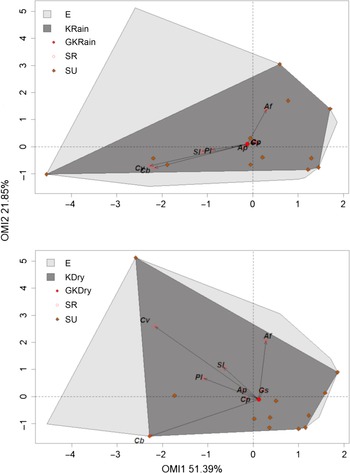
The first two axes of the OMI accounted for 73.23% of the explained variability (OMI1: 51.39% and OMI2: 21.85%). The mean marginality of the species was significant (p < 0.01), suggesting an influence of food resource (Table 3). Most taxa had low OMI values indicating common use of resources (OMI < 2). Artibeus planirostris (p = 0.05), C. villosum (p < 0.01), and P. lineatus (p = 0.05) presented a well-marked niche for the dry season. Carollia brevicauda had the highest marginality value (OMI = 6.80) followed by C. villosum (OMI = 6.10), and C. perspicillata and A. planirostris with the lowest values (OMI = 0.07 and 0.16, respectively). The high/low values of marginality indicate that the species are uncommon/common, respectively (Dolédec et al. Reference Dolédec, Chessel and Gimaret-Carpentier2000). We found higher values of niche breadth (tolerance parameter) for the dry season, these results indicate a niche expansion for this season (Figure 2), Glossophaga soricina and C. perspicillata had the highest tolerance values (Tol = 2.81 and 2.13), and P. lineatus and A. planirostris were the lowest (Tol = 1.43 and 1.45).
Result of OMI and WitOMI analyses

OMI = Outlying Mean Index; WitOMIG, marginalities from the average resources condition G; Tol = tolerance; Rtol = residual tolerance and average marginality.
*Bold values are statistically significant.
**Rtol = Residual tolerance represents the variance in the species dietary niche that is not taken into account by the marginality axis.
Distribution of bat species within the niche space realised, dry and rainy periods, respectively. For the rainy season, we have an overlap between C. perspicillata and G. soricina. Arrows represent the marginality of average resource conditions. Marginality measures the distance between the average conditions of the resources used by the species (species centroid) and the average conditions of the resources of the sampled areas (origin of the niche space). E = realised niche space, K = subniche, GK = average condition in each subniche, SR = realised subniche of each species, and SU = sample units. For more details on the niche indices, see Karasiewicz et al. (Reference Karasiewicz, Dolédec and Lefebvre2017).

The marginality values of the seasons presented C. perspicillata with the lowest value and C. brevicauda with the highest for the dry period; for the rainy period, A. planirostris was lowest and C. villosum was highest. Regarding the tolerance values, the highest was for S. lilium in the dry season and C. villosum in the rainy season, and the lowest for the dry season with C. brevicauda and rainy with A. planirostris. We also found higher values of the tolerance parameter for the dry season, indicating that the niche breadth is greater for this season (Table 3). On subniches (WitOMI)‘, we found significant values only for the dry season with A. fimbriatus (p < 0.05), C. brevicauda (p < 0.05), C. villosum (p < 0.05), and P. lineatus (p < 0.05). Regarding the most influential resources in the realised niches of the bats, Maclura tinctoria (p < 0.05) for the dry period and Gurania lobata (p < 0.05), Maclura tinctoria (p < 0.05), and Psidium ssp. (p < 0.05) for the rainy season have contributed more (see supplementary material).
Discussion
Food resource
Our results are consistent with those found in the literature, with the genera Artibeus, Carollia, Glossophaga, and Sturnira being more frequent in highly fragmented and anthropic regions and interacting with plants of the Piperaceae, Moraceae, Myrtaceae, Solanaceae, and Urticaceae (Fleming Reference Fleming1993, Lobova et al. Reference Lobova, Geiselman and Mori2009, Marinho-Filho Reference Marinho-Filho1991, Mello et al. Reference Mello, Schittini, Selig and Bergallo2004, Mikich Reference Mikich2002, Parolin et al. Reference Parolin, Bianconi and Mikich2016, Pellón et al. Reference Pellón, Rivero, Williams and Flores2021, Stevens Reference Stevens2022b). The fruits of these plants have characteristics that influence selection and consumption, such as accessibility, fruit position outside the foliage, and long stems, which protect the fruit from attacks by flightless animals (Fleming Reference Fleming1993, Muller & Reis Reference Muller and Reis1992). Samples containing only pulp may represent fruits with large seeds, and not ingested, or fruits where the bat ingests the pulp and spits out the seed, or even destroys the seeds (Nogueira & Peracchi Reference Nogueira and Peracchi2002).
Although overlap in diet composition was observed among bat species in the dry season, differences in the proportions of items consumed between species reveal a resource-sharing mechanism that allows species to co-occur (Brito et al. Reference Brito, Gazarani and Zawadzki2010). This sharing reflects variation in fruit diet according to the supply of resources in the environment (Passos et al. Reference Passos, Silva, Pedro and Bonin2003), but also complemented by insect consumption, for example (Aguiar & Marinho-Filho Reference Aguiar and Marinho-Filho2007, Gnocchi et al. Reference Gnocchi, Huber and Srbek-Araujo2019, Mello et al. Reference Mello, Schittini, Selig and Bergallo2004). Consumption of arthropods may be related to their high concentration of proteins (Orr et al. Reference Orr, Ortega, Medellín, Sánchez and Hammond2016).
Carollia perspicillata was more abundant during our field work, although this is not in agreement with other finds reported in the literature on bat feeding ecology (Faustino et al. Reference Faustino, Dias, Ferreira and Ortêncio Filho2021, Passos et al. Reference Passos, Silva, Pedro and Bonin2003, Pinto & Ortêncio Filho Reference Pinto and Ortêncio Filho2006, Silveira et al. Reference Silveira, Trevelin, Port-Carvalho, Godoi, Mandetta and Cruz-Neto2011). The dominance can be explained by the fact that C. perspicillata feeds on fruits of plants which occur in open areas such as forest edges (Reis et al. Reference Reis, Shibatta, Peracchi, Pedro, Lima, Reis, Peracchi, Pedro and Lima2011) and on various strata of vegetation (Faustino et al. Reference Faustino, Dias, Ferreira and Ortêncio Filho2021, Silveira et al. Reference Silveira, Trevelin, Port-Carvalho, Godoi, Mandetta and Cruz-Neto2011, Silveira et al. Reference Silveira, Tomas, Araújo Martins and Fischer2020). Futhermore, it takes different shelters and makes its way even through disturbed areas (Muller & Reis Reference Muller and Reis1992), as in the present study. The literature, as well as our study revealed that Glossophaga soricina feeded on insects and mainly on Piperaceae (Gnocchi et al. Reference Gnocchi, Huber and Srbek-Araujo2019; Martins et al. Reference Martins, Torres and Anjos2014; Munin et al. Reference Munin, Fischer and Gonçalves2012). Sturnira lilium is specialised for the consumption of Solanum (Jacomassa et al. Reference Jacomassa, Bernardi and Passos2021, Mello et al. Reference Mello, Kalko and Silva2008); but for the area, the largest number of samples was from the Cucurbitaceae family.
Our results on the number of samples per season did not show significant differences, and this is probably related to the lack of seasonality of consumed fruits (Fleming Reference Fleming, Estrada and Fleming1986), which led to similar amounts for both seasons, especially due to the two most abundant species, C. perspicillata and A. planirostris.
DN interactions
Our results indicate that there is a greater increase in niche overlap during the dry season, suggesting that there is potential competition among species, and for them to coexist in equilibrium, or that there must be differentiation in another dimension of the niche, not measured in this study (Lopez & Vaughan Reference Lopez and Vaughan2007, Faustino et al. Reference Faustino, Dias, Ferreira and Ortêncio Filho2021, Munin et al. Reference Munin, Fischer and Gonçalves2012). The high overlap during this season probably results from limited resource availability and anthropogenically modified landscapes (Stevens Reference Stevens2022c). In this sense, when resources are limited, niche differentiation plays a key role in species coexistence (Hardin Reference Hardin1960, Johnson & Bronstein Reference Johnson and Bronstein2019), for example, by decreasing niche breadth, mechanisms such as niche partitioning and complementarity facilitate coexistence between sympatric species with similar habitat preferences (MacArthur 1958, Pianka Reference Pianka1976, Shipley & Twining Reference Shipley and Twining2020) or show occasional specialisation in a smaller set of preferred resources (Bolnick et al. Reference Bolnick, Ingram, Stutz, Snowberg, Lau and Paull2010, Faustino et al. Reference Faustino, Dias, Ferreira and Ortêncio Filho2021).
This occasional specialisation in a smaller set of resources in seasonal times is important for the species because, in the face of more intense competition, bats restrict the use of a shared resource (Carvalho & Cardoso Reference Carvalho and Cardoso2020). This may give them an advantage in exploiting these resources over other generalist species (Carvalho & Cardoso Reference Carvalho and Cardoso2020, Muñoz-Lazo et al. Reference Muñoz-Lazo, Franco-Trecu, Naya, Martinelli and Cruz-Neto2019). Stevens (Reference Stevens2022b), in his study for the Atlantic Forest, warns that food seasonality together with habitat modification is the main driver of reduced specialisation and increased overlap of bat diets. We also expected higher values of niche breadth during the dry season, and our results show a niche expansion (see Figure 2), and this is in line with the optimal foraging theory, where individuals should specialise when resources are plentiful, but when faced with scarcity they tend to increase the number of items included in the diet (Muñoz-Lazo et al. Reference Muñoz-Lazo, Franco-Trecu, Naya, Martinelli and Cruz-Neto2019; Stephens & Krebs, Reference Stephens and Krebs1986).
We also observed C. perspicillata and A. planirostris with the highest values of niche breadth, indicating that their diet is not concentrated only on a few resources and that they coexist in great abundance (Faustino et al. Reference Faustino, Dias, Ferreira and Ortêncio Filho2021). For A. planirostris, we found low tolerance values Tol) in the rainy season and high values in the dry season, which may indicate that this species expands its niche when there is an ecological opportunity (high resource availability) (Carvalho & Cardoso Reference Carvalho and Cardoso2020). However, the low marginality values (WitOMI) show that it remains specialised on some number of items, which for our study may be its affinity for plants of the family Moraceae (Laurindo & Vizentin-Bugoni Reference Laurindo and Vizentin-Bugoni2020) or a bias created by the number of samples containing only pulp (39% of samples).
For C. perspicillata, even confirming its preference for plants of the genus Piper (Pellón et al. 2015), the low values of marginality, and the number of insect samples in their faeces, show a wide food spectrum with a characteristic close to omnivory (Gnocchi et al. Reference Gnocchi, Huber and Srbek-Araujo2019). Platyrrhinus lineatus and S. lilium had the highest tolerance values in the dry season, thus being considered generalists, while in the rainy season they presented low values, thus adopting a punctual specialist profile, as indicated by Faustino et al. (Reference Faustino, Dias, Ferreira and Ortêncio Filho2021), a restricted diet does not always indicate specialisation, and the species can be induced to consume a certain temporarily abundant food source.
The analysis showed greater overlap in bat diet than random expectation (Arriaga-Flores et al. Reference Arriaga-Flores, Castro-Arellano, Moreno-Valdez and Correa-Sandoval2012, Mancina & Castro-Arellano Reference Mancina and Castro-Arellano2013, Sánchez & Giannini Reference Sánchez and Giannini2018, Stevens & Amarilla-Stevens Reference Stevens and Amarilla-Stevens2021, Stevens Reference Stevens2022c), and two factors that may help to understand this result. First, plant phenological changes that concomitantly lead to seasonal changes in diet, forcing bat species to be more general in their resource utilisation (Stevens Reference Stevens2022c); second, habitat modification, which in turn can act in different ways, such as changing the density dependency that maintains a strong resource partitioning (Stevens Reference Stevens2022c) or also facilitating the presence of new resource items that are shared between consumers (Manlick & Pauli Reference Manlick and Pauli2020; Stevens Reference Stevens2022c). Although null models can be used to aid understanding whether the observed niche overlap is more or less than expected by chance, it is still difficult to infer what mechanisms are acting to create these patterns (Geange et al. Reference Geange, Pledger, Burns and Shima2011). It is also important to highlight that niche decomposition (OMI and WitOMI) proved to be an interesting tool to study bat DNs, showing details in the diets of the analysed species (Karasiewicz et al. Reference Karasiewicz, Dolédec and Lefebvre2017).
The observed results reinforce that the mechanisms that promote the high local diversity of fruit bats are probably a consequence of diet specialisation during high fruit abundance (Fleming Reference Fleming1993, Rex et al. Reference Rex, Czaczkes, Michener, Kunz and Voigt2010, Shipley & Twining Reference Shipley and Twining2020), leading to narrow niche breadth (Carlson et al. Reference Carlson, Rotics, Nathan, Wikelski and Jetz2021). The adoption of more general feeding strategies in times of low food availability, leads to wider niches (Carlson et al. Reference Carlson, Rotics, Nathan, Wikelski and Jetz2021, Sargeant Reference Sargeant2007, Shipley & Twining Reference Shipley and Twining2020). In addition, the composition of the diet (based mainly on pioneer plants) shows the degree of disturbance in the region, and the need for strategies to reduce anthropogenic actions.
Thus, our research yielded remarkable information on the seasonality of bats diet and on how it affects food overlap among bat species. Using parameters like marginality and tolerance (WitOMI), we identified subtle seasonal differences which may not be noticed by comparing diets traditionally, as shown above. These findings contribute to understanding how bats species coexist, and also in what way climate seasonality impacts on their diet and interactions. Besides, we highlight the necessity of carrying out further studies on TDFs, given that such environments have been scarcely explored and, consequently there is a lack of information on their ecology.
Finally, we shall state that, however, faecal analysis is a widely employed technique; it may have disadvantages when compared with DNA metabarcoding and isotopic composition investigation (Oliveira et al. Reference Oliveira, Pinheiro, Varassin, Rodríguez-Herrera, Kuzmina, Rossiter and Clare2022; Munoz-Lazo et al. Reference Muñoz-Lazo, Franco-Trecu, Naya, Martinelli and Cruz-Neto2019). These techniques show food items taken for long periods and not just those ingested during a unique consumption event (Schlautmann et al. Reference Schlautmann, Rehling, Albrecht, Jaroszewicz, Schabo and Farwig2021, Vizentin-Bugoni et al. Reference Vizentin-Bugoni, Sperry, Kelley, Gleditsch, Foster, Drake, Hruska, Wilcox, Case and Tarwater2021). Furthermore, the employment of additional methods, like direct observation and faecal sample collection where bats eat, as feeding roosts, may yield more data on consumption of fruit whose large seeds cannot be taken (epizoocoria). As a result, a broader understanding of the resources partition among bat species and their role on seed dispersion can be improved (Villalobos-Chaves & Rodrigues-Herrera Reference Villalobos-Chaves and Bernal Rodríguez-Herrera2021).
Supplementary material
The supplementary material for this article can be found at https://doi.org/10.1017/S0266467423000238
Acknowledgements
We are grateful to Gabriela Passos Vicente, Naiara Carvalho de Lima, Lucas Del Sarto, and Paulo Reis Venâncio for their assistance in data collection and field assistance, and Hernani Oliveira and Leopoldo Ferreira for their valuable contributions. We would like to thank the farmers and directors of the mining companies for permission to do fieldwork and Moacir and Rosana for their support with accommodations and facilities. We would also like to acknowledge the Universidade Federal de Lavras (UFLA).
Financial support
This study was partially funded by Fundação de Amparo à Pesquisa do Estado de Minas Gerais (FAPEMIG process CRA – RDP – 00079-18), Conselho Nacional de Desenvolvimento Científico e Tecnológico (CNPq process 304907/2019-7), and the financial support through the Programa Institucional de Bolsas de Iniciação Científica (PIBIC) of Universidade Federal de Lavras (UFLA) for LLO.
Competing interests
The authors declare none.
Ethical standard
This study was authorised by the Instituto Chico Mendes de Conservação da Biodiversidade (ICMBio), licence 74010-1, and Animal Bioethical Council of Universidade Federal de Lavras UFLA, protocol 002/2020.