INTRODUCTION
Evangelicals are an important constituency for the Republican Party at all levels and in all contexts. This is particularly the case in electoral politics as Evangelicals form a core of support for Republican candidates. In some states, Evangelicals make up as much as 40% of the population, providing a majority of Republican voters (Rozell and Wilcox Reference Rozell and Wilcox1995; Green, Rozell and Wilcox Reference Green, Rozell and Wilcox2003). Thus, the concerns of Evangelicals tend to play a significant role in Republican campaigns, particularly during primary elections. As a motivated minority, Evangelicals can and do make a difference in the low-interest arena of primary election politics. While Evangelicals have not traditionally been as important a constituency for Democrats, they are a growing factor in the party's calculations as it seeks to overcome its “God Gap” (Bolce and De Maio Reference Bolce and Maio2002).
Evangelical voters are driven by issues, particularly social issues, more directly than other groups of voters (Adams Reference Adams1997; Green and Guth Reference Green and Guth1988; Layman Reference Layman2001). They are very concerned with the stands candidates adopt on the issues that are important to them. And while it is clear that Evangelicals care about many of the same things that other voters do — the economy, healthcare, and education — Evangelicals are specifically motivated by abortion, same-sex marriage, and stem-cell research in ways that other groups are not. Because of their greater presence in the Republican Party, Republican candidates must take these things into account as they consider their primary election strategies. Evidence of this can be seen even in the 2008 Republican presidential nomination race. In the 2000 presidential election, John McCain referred to Jerry Falwell and Pat Robertson as “agents of intolerance” (Barstow Reference Barstow2000), and made statements that both distinguished his views from the front-runner, George W. Bush, and alienated many Evangelical and Christian Right voters. In the 2008 election cycle, however, McCain consciously sought to build bridges with Evangelical political activists.
Observers of the 2006 Congressional elections, however, began to see changes in the ways that Evangelicals approached political issues. Some described a growing frustration among Evangelicals with the Bush administration's handling of the war in Iraq and Hurricane Katrina, and saw this as a way for Democrats to make inroads into the Republican hegemony in Evangelical voting (Bendavid Reference Bendavid2006; Keeter Reference Keeter2006; Kirkpatrick Reference Kirkpatrick2004). In the years after the 2006 election, Evangelicals became even less supportive of the Bush administration (The Pew Forum on Religion and Public Life Survey Report 2008), and most particularly, younger Evangelicals seemed to be splitting with their older counterparts on specific issues such as the environment and same-sex marriage (Faith in Public Life 2008). This suggests that, as other issues like the war in Iraq, the economy, and the environment become more important, Evangelicals may no longer be defined primarily by their opinions on social issues. This would be a significant shift in Evangelicals' political commitments and would require that scholars rethink their understanding of Evangelical voters. In this article, I examine how Evangelical voters' issue opinions impacted their candidate choices in the 2008 presidential nomination campaigns. Using a unique sample of registered voters in Iowa contacted around the 2008 Iowa caucuses, I examine how Evangelicals' issue opinions differ from others' opinions and how those opinions, particularly on a variety of both social and non-social issues, impact their candidate choice in both the Republican and Democratic caucuses.
THEORETICAL APPROACH
Presidential nomination campaigns are good venues for political scientists to examine how particular issues impact the decisions of voters. The cleavages that traditionally divide the two major parties are less important in primaries and caucuses than in the elections themselves (Brams Reference Brams1978), but the issues that are important to primary voters in each party provide us with a window into the way issues matter to voters above and beyond partisan identity. There is a wide-range of scholarly opinion on the role of issues in determining people's votes in presidential primaries and caucuses. Some have suggested that issues are secondary, that name recognition and candidate appeal are the main influences on voters' choices (Gopoian Reference Gopoian and David1982; Marshall Reference Marshall1984; Norrander Reference Norrander1986; Abramowitz Reference Abramowitz1987), while others find that issues do indeed matter (Bartels Reference Bartels1985, Reference Bartels1988; Brady and Johnston Reference Brady, Johnston, Orren and Polsby1987). Some scholars further find that issues do matter, but only as signals between the candidates and the electorate within their own parties about the candidates' priorities (Aldrich and Alvarez Reference Aldrich and Alvarez1994). Other research has found that voters use a combination of issue preferences and assessments of a candidate's electability (Rickershauser and Aldrich Reference Rickershauser and Aldrich2007; Stone, Rapoport and Abramowitz Reference Stone, Rapoport and Abramowitz1992). And interestingly, research suggests that social issues in particular are important for how voters make decisions about which candidate to support (Highton Reference Highton2004). The bottom line is that issues seem to matter for primary voting in ways that they do not in general election campaigns. Examining the Iowa caucuses allows us to look at how issues are affecting vote choice very early in the nomination races. This should be interesting for both Republican and Democrat Evangelicals, because we can use these primary issue positions to understand better how their religious commitments translate into political commitments.
The Iowa caucuses are an interesting example of personal democracy. Since 1972, Iowa has been the first state in which presidential nomination contests occur for each major party. The contests take the form of caucuses, which are significantly different from primary elections. Caucuses are partisan gatherings of voters from each individual precinct (over 1700) to choose a presidential nominee for the party, among other things. These caucuses take place every two years, but receive the most attention during presidential election years. Caucuses for both major parties take place over several hours on one evening, usually a Tuesday night in January. Republicans simply poll attendees for their presidential candidate choice, while Democrats have a more complicated system that requires candidates to meet certain vote thresholds. The supporters of those who do not reach this threshold can then be lobbied by the supporters of other candidates before another round of balloting takes place. Caucus attendees can also propose resolutions to be included in each party's state platform and choose delegates to county and district conventions which eventually make decisions about party leadership. These functions, however, are largely overshadowed by the fact that the Iowa caucuses are the first time that individuals get to make their candidate preferences known.
Campaigns take the caucuses seriously, and successful candidates spend quite a bit of money and time in the state in the months before the caucuses. Unlike the nomination contests in many other states, the personal dimension of the caucus procedures produces voters who are not content to simply view television advertising or talk with candidate proxies. Many caucus participants have met several candidates face-to-face in small group settings. Candidates spend much of their time in Iowa in individual supporters' living rooms, meeting with groups as small as 20 people.
Iowans take their role as the first state in the presidential nomination races seriously. Evidence suggests that they are informed and engaged voters (Winebrenner Reference Winebrenner1998). Particularly useful for my purposes, there is a significant Evangelical population in the state and the Christian Right movement has held considerable sway over Republican politics for the past 20 years (Conger and Racheter Reference Conger, Racheter, Green, Rozell and Wilcox2006). The Evangelical population is mobilized to pay attention to politics and form opinions on current issues. Thus, while Iowa may be an outlier in terms of the attention and sophistication of its voters, it is a good place in which to test the idea that contemporary issues are newly important to the way Evangelicals make decisions because it is made up of voters who are paying attention to the issues.
To examine these issues, I first present data from a poll of registered voters taken in Iowa in November 2007 and January 2008 immediately after the caucuses, and analyze how issues impacted candidate choices for this sample of voters. Then I try to orient my results with the larger understanding of issues in primaries and Evangelical voting, and eventually find that, in fact, Evangelical voters appear to be concerned with issues within the context of their partisanship. Further, for Republicans, religious beliefs and social issues seem to play some part in candidate choice, primarily in the context of choosing to vote for one of their own, Mike Huckabee.
DATA AND METHODS
The data for this article come from a survey of voters in Iowa conducted before and after the Iowa caucuses in January 2008. More than 3,000 people were contacted by phone over a 12 day period in early November 2007, producing 1,204 usable interviews. Those who identified themselves as likely caucus attendees were re-contacted after the caucuses, which were held on January 3, 2008, to determine how many had actually attended caucuses. This process yielded the 474 respondents, all caucus-attendees, who are the group studied in this project. Respondents were asked a variety of questions to determine their candidate choices and their opinions on a number of issues important in the nomination races of each party, along with demographic questions. The respondents are fairly representative of the voting population in Iowa, with the only obvious bias being a sample with a higher median age than the voting population in the state.Footnote 1 The November wave of the poll was conducted early in the month, before the Huckabee and Obama surges; from the responses of likely caucus goers, it predicted a Romney win in the Republican caucuses and a Clinton win in the Democratic ones. Clearly, these predictions were incorrect and voters changed their minds before they got to caucus night. In the final group of caucus goers (who were those re-contacted from the November survey), Huckabee was the winner for the Republicans, but Edwards edged out Obama by a slight margin in the number of respondents who reported supporting him. Thus, some caution is in order when drawing conclusions from the results of this survey.
This survey represents a unique set of data because questions about religious preference were asked of both Republicans and Democrats. In most previous cases, only Republicans have been asked these questions, making it difficult to ascertain the role of religion in Democratic politics. Even primary election exit polling from 2008 did not ask religious preference questions of Democratic voters. This is particularly problematic given the increased focus on religious issues by Democratic candidates, and the widely held perception that some of the Democratic candidates are more comfortable with religion and thus more attractive to people of faith than others. The Iowa State Poll, however, asked the same religion questions of all respondents, giving the results a unique leverage in helping us answer how religious preference, particularly Evangelical identity, impacts the candidate choices of both Republican and Democratic voters.
In order to understand how various issues impacted voters' candidate preferences in the 2008 Iowa caucuses, I examined survey respondents' opinions on a number of issues salient in the nomination campaign. These included the war in Iraq, the economy, the environment, immigration, abortion, and same-sex marriage.Footnote 2 While a question was asked concerning healthcare issues, it concentrated on insurance options, not the full range of policy possibilities laid out by all the candidates. In addition, respondents were asked a battery of demographic questions, including their personal ideology and their religious preferences. For this article, Evangelical identity is operationalized in terms of a respondent being self-identified as being born-again. While this operationalization has limitations in that it can include people who are not fully a part of the Evangelical movement and subculture in the United States (Leege and Kellstedt Reference Leege and Kellstedt1993), it was the most feasible for the purposes of this survey. Because ascertaining the Evangelical identity of respondents was not the primary goal of the survey, asking more specific questions about denomination and church attendance would have made the survey instrument prohibitively long.
RESULTS
In order to grasp the differences among Evangelicals and other voters in the Iowa caucuses, we first look at the basic differences among issue positions and candidate choices. The Iowa caucus survey contains responses from 299 people who attended Democratic caucuses and 175 people who attended Republican caucuses. Approximately 55% of respondents were Protestant and 24% Catholic, while 4.3% self-identified as “Christian” and 13.2% as secular. Of these, approximately 32% identified themselves as “born again.”
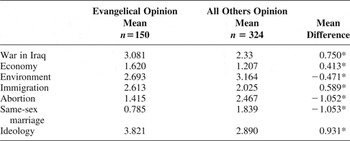
Leaving party identification aside for just a moment, born-again respondents had significantly different opinions from their non-born-again counterparts on a variety of contemporary issues. Table 1 demonstrates this clearly. On all tested issues, Evangelicals had significantly different views from non-Evangelicals. While Evangelicals' more conservative views on abortion and same-sex marriage are unsurprising, it seems possible that conservative views on the war in Iraq, the environment, immigration, and personal ideology are, at least in part, based on their Republican Party identity. I next disaggregated the sample to look at the differences among Evangelicals within the context of party identity.
Independent Samples t-tests of Differences between Evangelicals and Other Respondents
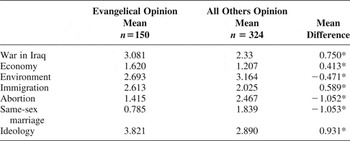
*p < 0.001; two-tailed.
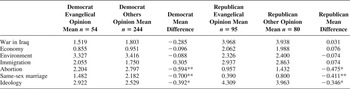
Among those who identified themselves as born-again, 95 were Republicans (over half of the total Republican sample) and 54 were Democrats (about 18% of the Democrats). So while the proportion of Evangelicals within the Democratic party is clearly smaller than in the Republican party (as it is all over the country), there were still enough born-again Democrats to draw some conclusions about their opinions in relation to other Democrats. As we can observe in Table 2, the patterns look very different from the full sample of Evangelicals. Evangelical Democrats do not differ significantly from other Democrats in their opinions about the war in Iraq, the economy, the environment, or immigration. They were, as we would expect, significantly more conservative on abortion and same-sex marriage (p < 0.001). However, they also identified themselves as significantly more liberal ideologically than their non-Evangelical counterparts. These results suggest that, at least for Democrats, Evangelical identity matters only for social issues, not for other contemporary issues, and decidedly not for self-reported ideology.
For born-again Republicans, the results are remarkably similar. There were no significant differences between Evangelical and non-Evangelical responses on the war in Iraq, the economy, immigration, or the environment. Only for abortion, same-sex marriage, and self-reported ideology were Evangelicals significantly more conservative (p < 0.001) than their non-Evangelical counterparts. Again, this suggests that social issues continue to distinguish Evangelicals from their partisan siblings.
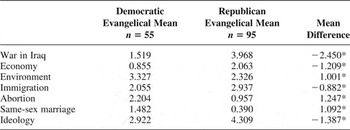
Table 3 demonstrates that there were significant differences among Evangelicals based on their party identification. Again using t-tests, we see that Democrat Evangelicals' opinions and ideology were uniformly and significantly more liberal than their Republican counterparts. Looking back at Table 2, we also see that Evangelical Democrats were considerably more liberal concerning abortion and same-sex marriage than are even the non-Evangelical Republicans. So, while Evangelicals were, across the board, more conservative on social issues, there still remain considerable cleavages among these co-religionists based on partisanship.
Independent Samples t-tests of Differences between Evangelicals and Other Respondents by Partisanship

*p < 0.01, **p < 0.001; two-tailed.
Independent Samples t-tests of Differences Between Republican and Democratic Evangelicals

*p < 0.001; two-tailed.
These results suggest that differences among Evangelicals can be tied to party identification and not necessarily to any differences in their religious beliefs. So while Evangelical Democrats were clearly more conservative than other Democrats on social issues, they were not choosing to change parties because of these differences. In fact, Evangelical Democrats claimed to be more liberal than other Democrats. It seems likely that these are people for whom other issues unrelated to the traditional “social issues” of abortion and same-sex marriage are important in their party and candidate choices.
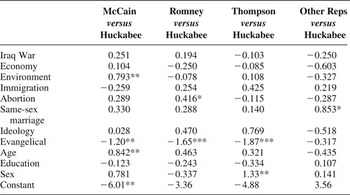
To understand how these group differences impact actual candidate choices within the party's presidential nomination campaigns, I now turn to an examination of the differences in issue opinions that may predict how a voter chooses a presidential candidate to support in the nomination race. I controlled for Evangelicalism (born-again-ness) in this analysis instead of analyzing only Evangelicals because approaching these groups' candidate choices individually would produce samples too small to be usefully analyzed. Approaching the data in this way tells us whether Evangelical identity had an impact on candidate choice, though it will not allow us to observe the varying importance of specific issues for Evangelicals.Footnote 3 In order to correctly control for the fact that, functionally, voters have to choose first whether they are voting in the Republican or Democratic nomination race, I split the respondents to the Iowa State Poll into two groups, self-identified Republican and Democratic caucus-goers. I then use current issues, ideology, Evangelicalism, and demographic characteristics to demonstrate the differences among voters choosing various candidates.Footnote 4 While these differences do not specifically demonstrate issue importance to candidate choice, they suggest that these are issues on which the candidates' supporters significantly differed. Using multinomial logit, I estimated the importance of these opinions and characteristics in predicting the difference in support among a range of candidate pairings.Footnote 5Table 4 reports the results of the analysis for Democrats, where Obama is the base category because he received a majority of the votes in the Democratic caucuses. Table 5 reports the results for Republicans, where Huckabee is the base category for the same reason.
Democratic Candidate Choice in the 2008 Iowa Caucuses: Multinomial Logit Model

*p < 0.05, **p < 0.01, ***p < 0.001; two-tailed; n = 299;
Log Likelihood: −345.284.
Pseudo R 2 = 0.124.
Note: The dependent variable is candidate choice among self-identified Democratic voters. Obama is the base category. The “Other Dems” category includes Biden, Dodd, Gravel, and Kucinich.
Republican Candidate Choice in the 2008 Iowa Caucuses: Multinomial Logit Model

*p < 0.10, **p < 0.05, ***p < 0.01; two-tailed; n = 175;
Log likelihood = −189.37.
Pseudo R 2 = .179.
Note: The dependent variable is candidate choice among self-identified Republicans. Huckabee is the base category. The “Other Reps” category includes Guilliani, Paul, Hunter, and Tancredo.
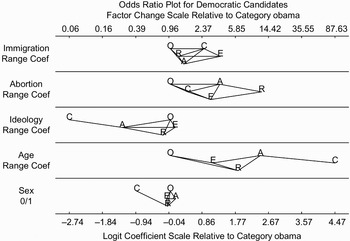
For Democrats, it is clear in Table 4 that Evangelical identity had no bearing on one's candidate choice. Further, there were few differences among the various candidates' voters based on issue opinions. There were some scattered significant differences among the various candidates, but nothing that denotes any kind of pattern. The main difference among these voters is in their demographic characteristics, particularly between Clinton and Obama. Clinton supporters were significantly older, more conservative, and female. These results are even more clearly displayed in the graph plot for odds ratios displayed in figure one. Figure 1 presents the graph plots for odds ratios for the independent variables where significant relationships existed between any of the candidates. The Clinton supporters are skewed in each of the important demographic variables. Edwards' supporters were significantly more supportive of immigration controls and Richardson's supporters were significantly more opposed to abortion regulation than were Obama's supporters. But these issue differences do not seem to form a general trend and are not as noticeably important in the odds ratio plots in figure one.
A = All other Democratic Candidates (Biden, Dodd, Gavel, and Kucinich), C = Clinton, E = Edwards, O = Obama, R = Richardson Plots generated in STATA 10 with S-Post (Long and Freese Reference Long and Freese2005).

These results seem to support the earlier findings of scholars that suggest that issues do not really matter in primary and caucus elections, that electability and candidate characteristics are the primary bases on which voters makes decisions. And clearly for Democrats, Evangelical identity does not matter. One caveat here is that on the Democratic side of the sample, there are more Edwards' supporters than there were in the actual outcome of the Democratic caucuses. Given the nature of Edwards' campaign, we would expect this to bias the sample in favor of issues being important; however, it clearly does not do this. This is particularly interesting because there are few discernible differences between Edwards' voters and those who voted for Obama, the eventual winner.
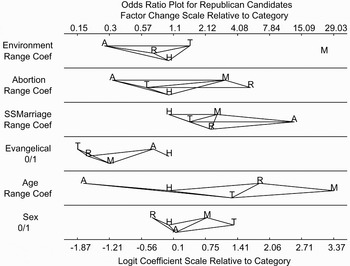
The results from the analysis of supporters of the Republican candidates are a bit more complicated, as Table 5 demonstrates. Issues seem to have had some impact, but Evangelical identity was clearly the deciding factor in citizens' choices between Huckabee and other candidates. Differences in opinions about the Iraq war, the economy, and immigration were not significant in any of the dyads, but opinions on the environment seem to be significantly different for McCain supporters. As demonstrated in Table 5 and Figure 2, the graph plots of odds ratios for the Republican candidates, McCain's supporters were vastly more supportive of federal government action to improve the environment. Abortion was significant in the opinions of Romney supporters versus Huckabee supporters. Romney supporters were significantly more inclined than Huckabee supporters to want to restrict access to abortion, and the odds ratios demonstrate that supporters of the other Republican candidates (Giuliani, Hunter, Paul, and Tancredo) were generally less supportive of abortion restriction. The views of supporters of other Republican candidates were also significantly more liberal on the same-sex marriage issue. But these issue opinions do not really add up to a pattern.
A = All other Republican Candidates (Guilliana, Paul, Hunter, and Tancredo), H = Huckabee, M = McCain, R = Romney, T = Thompson Plots generated in STATA 10 with S-Post (Long and Freese Reference Long and Freese2005).

Demographic characteristics, however, seem to have been definitive in the Iowa caucuses. Although we can identify Evangelical supporters for all the Republican candidates, Romney, McCain, and Thompson supporters were significantly less likely to be born-again than Huckabee supporters. Evangelical identity seems to have had a determinative effect on candidate choice, as Figure 2 demonstrates. Age and sex were also important for some combinations, and the graph plots of odds ratios demonstrates the significant differences between the age of McCain supporters and that of other Republican candidate supporters (likely driven by the young demographic of Ron Paul supporters).
One confounding factor in the analysis is that some observers believe that there were not significant differences among the candidates within each party on the important issues of the election. And because, as we have seen, there do not seem to have been systematic differences among voters' issue positions within the parties, it may not give us a strong enough test of the role of issues in specifically Evangelical candidate choice. Perhaps these Evangelicals for whom issues are important were not making decisions among candidates within a party, but were switching parties altogether. Given the recent history of Evangelical voting behavior, this is more likely to be a shift from Republican to Democrat. The sample used for this article was originally compiled using voter registration lists provided by the secretary of state's office, and Iowa has partisan registration. So we have information about those voters who were originally registered in one party and attended the caucus from the other party. Overall, there were 29 people who were registered Republican but voted in a Democratic caucus. Of these, only five reported themselves to be born-again. There are very few patterns among the switchers overall, except that a plurality (13), voted for Obama. There were no regularities for either the Evangelicals or the full sample concerning the most important issues in their vote choices. Thus, at least from this sample, it seems that Evangelical Republicans are not changing their partisanship for any reason.
DISCUSSION
While there are a number of intriguing results in this data analysis, the bottom line is that there seems to be no support for the idea that Evangelicals' frustration with the Bush Administration's issue positions made any difference in their voting choices, let alone pushing them to reconsider their political commitments. The data demonstrate that issues in general divide Evangelicals, with Evangelical Democrats seeking a quicker withdrawal from Iraq, more environmental regulation, and less immigration control, and perceiving a worse economic situation than their Republican co-religionists. Because issues in general seemed to have little effect on candidate choices within the parties, it is likely that these differences among Evangelicals are simply reflecting original party identification and not any type of wholesale change in political commitments. This idea is supported by the analysis of the differences between Evangelical Democrats and Evangelical Republicans; this demonstrates that they are more similar to their fellow partisans than to each other. This is particularly true given the significant differences between Evangelical Democrats and Evangelical Republican on all issues.
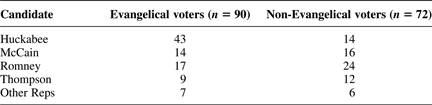
Further, it seems clear that at least Republican Evangelicals are still motivated by social issues in their voting choices, or perhaps simply by resonance on these issues with a demonstrably Evangelical candidate. Particularly interesting in this case is that in the pre-caucus version of these results, Romney was predicted to win the Republican caucuses. The Huckabee surge came in late November, and it seems that, when Evangelicals were given the choice to vote for a viable Evangelical candidate, that is precisely what they did. It may also have been the case that Huckabee's emergence — and Romney's subsequent need to defend his Mormon faith — may have highlighted the candidates' faith differences to the point of increasing Huckbee's appeal at the expense of Romney's. So, at least from analysis of data from the 2008 Iowa caucuses, there seems to be little change in the issues that Evangelicals find important in their vote choices. People who identify themselves as born-again do not seem to be changing their politics due to current issues. Republicans and Democrats were making decisions based on very different issue orientations, even among Evangelicals.
One of the other interesting results of this analysis is that in both parties, it seems that identities were more important than issues. Certainly, particular issues had resonance with particular groups of voters, but across the board, the Democratic race seemed to be defined by voters' age, sex, and political ideology, with Obama supporters being younger, more male, and more liberal than the supporters of Obama's primary rival, Hillary Clinton. For Republicans in Iowa, Evangelical identity seemed to have made an impact over and above almost any other factor. Because the Iowa caucuses are the first nomination contest, John McCain had not had time to refine his message to Evangelicals as he did later in the election cycle, and many Evangelicals seem to have chosen Huckabee based on his Evangelical credentials.
It is important to note that within the party nomination campaigns, the candidates varied on their positions on many of these issues in relatively small ways.Footnote 6 In 2008, the significant differences on contemporary issues were still seen primarily between the two parties, not within them. While we could hope to control for some of this inter-party agreement by analyzing those voters who switched parties in caucus voting, there are too few to have had any impact. This perhaps reflects the unique nature of the primary constituency in both parties, committed and politically sophisticated partisans who are looking for a party standard-bearer, not simply a package of their most favored issue positions.
Examining caucus-goers also necessarily ignores the Evangelical Republicans who are most likely to vote for a Democrat in a general election, those voters who are weak partisans or who tend to be independent of either major party. These voters are not likely to participate in primary elections or caucuses, and yet are the ones who generally hold the balance of the vote come fall. These caveats, while perhaps making non-results on the importance of the issues less noteworthy, do highlight the interesting, though perhaps not entirely unexpected, nature of the results finding large differences between Evangelical Democrats and Evangelical Republicans.
CONCLUSION
Contrary to the observations of some commentators after the 2006 Congressional elections, there seems to be no evidence that Evangelicals' opposition to the Bush administration's issue positions has caused them to change or even rethink their political commitments — at least for Evangelical caucus-goers in Iowa. Across the board, caucus-going Evangelicals are significantly more conservative on social issues than other voters. Evangelicals retained their differences from the rest of the membership of their respective parties only on social issues, and this made a small difference in how particularly Republicans approached their candidate choices. And while Evangelical Democrats and Evangelical Republicans were significantly different in their opinions on a wide variety of contemporary issues, these differences disappear once they are compared with their fellow party members. Overall, demographics and Evangelical identity seem to have had the biggest impact on vote choice in the 2008 nomination races in both parties.
These findings demonstrate that Republican Evangelicals remain committed to the importance of social issues — or at least to their Evangelical identity — in their voting choices. Evidence concerning Evangelical Democrats demonstrates very different decision processes at work and warrants further study. While these findings should be treated cautiously due to the lack of representativeness in the overall candidate choice in each party, they are pointed enough to allow us to feel confident that issue positions had little to do with candidate choice in the 2008 Iowa caucuses for any voter. Further exploration of this data, particularly of those voters whose candidate choices changed between November and January, and primary and general election data may shed more nuanced light on the dynamics of candidate choice and help us better understand how issues impact citizens' voting choices.
APPENDIX A
Iowa State Poll Questions
1. Which candidate did you originally plan to support when you went to the caucus?
1 = Biden; 2 = Clinton; 3 = Dodd; 4 = Edwards; 5 = Gravel; 6 = Kucinich; 7 = Obama; 8 = Richardson; 13 = Giuliani; 14 = Huckabee; 15 = Hunter; 17 = McCain; 18 = Paul; 19 = Romney; 20 = Tancredo; 21 = Thompson; 77 = RF; 88 = NA; 99 = DK
2. Which of the following options best describes what you think should be done about US troops in Iraq? Should the US…
1 = Withdraw troops within one year; 2 = Withdraw troops over next 2 years; 3 = Maintain troops in Iraq for the next 3–4 years; 4 = Maintain troops in Iraq for as long as it takes; 5 = None/Other
3. How would you rate the condition of the US economy today?
5 = Excellent; 4 = Very good; 3 = Good; 2 = Fair; 1 = Poor
4. Do you think that abortion should be …
4 = Legal in all cases; 3 = Legal in most cases; 2 = Illegal in most cases; 1 = Illegal in all cases
5. The federal government should do more to improve the nation's environment.
5 = Strongly agree; 4 = Agree; 3 = No opinion; 2 = Disagree; 1 = Strongly disagree
6. The federal government should build fences or other barriers to keep people from entering the country illegally.
5 = Strongly agree; 4 = Agree; 3 = No opinion; 2 = Disagree; 1 = Strongly disagree
7. Same-sex couples should be allowed to legally marry.
5 = Strongly agree; 4 = Agree; 3 = No opinion; 2 = Disagree; 1 = Strongly disagree
8. Generally speaking, do you consider yourself to be a Democrat, a Republican, an Independent, or something else?
1 = Democrat; 2 = Republican; 3 = Independent; 4 = Something else
9. How would you describe your views on most political matters? Would you say you are Very Liberal, Somewhat Liberal, Moderate, Somewhat Conservative, or Very Conservative?
1 = Very liberal; 2 = Somewhat liberal; 3 = Moderate; 4 = Somewhat conservative 5 = Very conservative
10. If Protestant or Christian, ASK: Do you consider yourself born-again?
1 = Yes; 2 = No
APPENDIX B
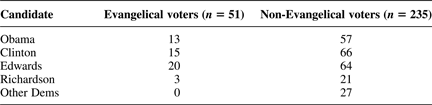
Respondent Candidate Choices by Party
For Democrats
For Republicans