About 20 years ago, Patterson, DeBaryshe, and Ramsey (Reference Patterson, DeBaryshe and Ramsey1989) and Moffitt (Reference Moffitt1993) formulated a taxonomy for the development of antisocial behavior that distinguished between trajectories of early-starting, life-course persistent antisocial behavior and late-onset, adolescent-limited trajectories of antisocial behavior. Life-course persistent antisocial behavior was characterized by the persistence of frequent physical aggression into middle childhood in contrast to its normative decline, followed by significant involvement in a range of antisocial activities during adolescence. Adolescent-limited antisocial behavior was characterized by the emergence of nonaggressive rule-breaking and risky behaviors during adolescence, without a history of persistent physical aggression during middle childhood.
More recent longitudinal research has replicated these trajectories and documented their applicability to girls as well as boys (Broidy et al., Reference Broidy, Nagin, Tremblay, Bates, Brame and Dodge2003; Moffitt, Reference Moffitt, Cicchetti and Cohen2006; Odgers et al., Reference Odgers, Moffitt, Broadbent, Dickson, Hancox and Harrington2008). Evidence indicates that individuals on these two trajectories can be differentiated by a variety of risk factors (Moffitt & Caspi, Reference Moffitt and Caspi2001). Factors associated with early-onset, persisting antisocial behavior appear to operate most potently during the toddler and preschool years and involve a combination of temperamental or neuropsychological difficulties and insensitive, ineffective, or diminished parenting (Lahey & Waldman, Reference Lahey, Waldman, Lahey, Moffitt and Caspi2003; Moffitt, Reference Moffitt, Cicchetti and Cohen2006; Shaw, Reference Shaw, Cicchetti and Gunnar2009). These risk factors interfere with the development of self-regulation and result in persisting and frequent physical aggression during childhood (Patterson & Fisher, Reference Patterson, Fisher and Bornstein2002). In contrast, risk factors associated with late-onset adolescent-limited antisocial behavior appear to involve the convergence of multiple social, cognitive, and biological (Dahl, Reference Dahl2004) changes associated with puberty and the transition to middle school. The likelihood of adolescent-onset rule breaking and risky behavior and the acceleration of the antisocial behavior of life-course persistent youths during adolescence are associated with low monitoring, premature autonomy seeking, and affiliation with deviant peers (Patterson, Dishion, & Yoerger, Reference Patterson, Dishion and Yoerger2000).
Recent research suggests there are a number of other trajectory classes of antisocial behavior, including a sizeable childhood limited/desisting class and a very sizeable group displaying little or no antisocial behavior after early childhood (Odgers et al., Reference Odgers, Moffitt, Broadbent, Dickson, Hancox and Harrington2008; Roisman et al., Reference Roisman, Monahan, Campbell, Steinberg and Cauffman2010). These studies also found a variety of social and child risk factors that differentiate youth in the early-onset/life-course persistent, adolescent onset, and childhood limited classes from those displaying little antisocial behavior after early childhood. However, risk factors that differentiate among the childhood limited, life-course persistent, and adolescent-onset classes have been less clearly identified. In addition, little is known about childhood risk factors associated with adolescent-onset antisocial behavior, especially for girls.
Most research on antisocial trajectories has focused on overt and aggressive antisocial behavior during childhood or has used a broadband definition of antisocial behavior including its overt and covert forms. Recent research suggests there are multiple forms of antisocial behavior, each with a distinct trajectory in terms of age of onset and change with age (Tremblay, Reference Tremblay2010). These forms include physical aggression, oppositional/disruptive behavior, and covert antisocial behavior. As such, trajectory classes defined solely by overt and aggressive antisocial behavior or by broadband definitions confound these distinct trajectories in a way that interferes with the identification of risk factors associated with vulnerability for antisocial behavior at different developmental periods (Tremblay, Reference Tremblay2010; Van Lier, Vitaro, Barker, Koot, & Tremblay, Reference van Lier, Vitaro, Barker, Koot and Tremblay2009).
The failure to differentiate overt/aggressive and covert antisocial behavior may also mask important sex differences in risk factors and trajectories for antisocial behavior. Very few girls display persistent aggression and overt antisocial behavior characteristic of the life-course persistent trajectory or engage in violent antisocial behavior during adolescence. This reflects sex differences in the developmental course for physical aggression beginning during early childhood (Tremblay, Reference Tremblay2010) and for disruptive behavior during middle childhood (Kroneman, Loeber, Hipwell, & Koot, Reference Kroneman, Loeber, Hipwell and Koot2009). In contrast, trajectories of covert antisocial behavior by girls relative to boys may start earlier and serve as an important precursor to late-onset antisocial behavior in adolescence (Tremblay, Reference Tremblay2010). Distinguishing between overt and covert antisocial behavior may provide a better account of the development of girls' antisocial behavior, particularly those who initiate and escalate antisocial behavior during adolescence.
Identification of the social–ecological and intraindividual risk factors associated with the appearance and growth in covert antisocial behavior during childhood is incomplete (Tremblay, Reference Tremblay2010). The trajectories for both physical aggression and covert antisocial behavior are dynamic during childhood, but most risk research has focused on physical aggression (with or without opposition and defiance). Family and peer relationship processes associated with appearance and growth of covert antisocial behavior during childhood may be different than those associated with the persistence of physical aggression and overt antisocial behavior during this developmental period. For example, research suggests that peer deviancy training may play a key role in the development of covert antisocial behavior during childhood (Snyder et al., Reference Snyder, Schrepferman, Oeser, Patterson, Stoolmiller and Johnson2005), complementing the contribution of peer rejection to risk for aggression and overt antisocial behavior (Snyder et al., Reference Snyder, Schrepferman, McEachern, Barner, Provines and Johnson2008). A systematic examination of risk factors associated with the development of covert antisocial behavior during childhood may be key to understanding adolescent-onset antisocial behavior, especially for girls (Kroneman et al., Reference Kroneman, Loeber, Hipwell and Koot2009).
Goals of This Study
This study attempts to address some of these issues. The first broad goal was to replicate the occurrence of deviant talk and play (peer deviancy training) by young children and to assess its additive contribution along peer rejection to the early development of covert and overt antisocial behavior. The second broad goal was to examine the degree to which childhood trajectories for overt and covert antisocial behavior during kindergarten and first grade are distinguishable and to assess their relative contribution to antisocial behavior 3 years later in fourth grade separately for boys and girls. The third broad goal was to test the additive and synergistic association of parenting processes and peer deviancy training with the childhood development of overt and covert antisocial behavior separately for boys and girls.
Background
Covert antisocial behavior
Covert antisocial behavior refers to a class of responses used to attain desired materials or activities that are normatively sanctioned and to do so in a manner that minimizes surveillance and avoids sanctions. Prototypes during childhood include stealing and cheating. These covert antisocial behaviors are accompanied by proactive concealment (e.g., secretiveness, truancy, running away, and breaking curfew) or retroactive concealment (e.g., lying, denial, feigned ignorance, and offering excuses; Snyder et al., Reference Snyder, McEachern, Schrepferman, Zettle, Johnson and Swink2006).
Although overt and covert forms of antisocial behavior are found to be highly correlated in cross-sectional and longitudinal studies, there is also support for their distinction. Separate dimensions of overt and covert antisocial behavior have been repeatedly identified in factor analyses of teacher and parent reports (Achenbach & Rescorla, Reference Achenbach and Rescorla2001; Frick et al., Reference Frick, Lahey, Loeber, Tannenbaum, VanHorn and Christ1993; Loeber & Schmaling, Reference Loeber and Schmaling1985) and in studies using multimethod (Hinshaw, Simmel, & Heller, Reference Hinshaw, Simmel and Heller1995) and observational measurement (Willoughby, Kuperschmidt, & Bryant, Reference Willoughby, Kuperschmidt and Bryant2001). The age of onset of overt antisocial behavior (especially physical aggression) is earlier than that of covert antisocial behavior, and the frequency of overt antisocial behaviors tends to remain stable or decrease during childhood whereas that of covert antisocial behaviors increases (Loeber, DeLamatre, Kennan, & Zang, Reference Loeber, DeLamatre, Keenan, Zhang, Cairns, Bergman and Kagan1998; Snyder, Schrepferman, McEachern, & Suarez, Reference Snyder, Schrepferman, McEachern and Suarez2010). Covert antisocial behaviors first occur at home and later at school. At school, covert antisocial behavior shows mean growth in frequency and variety and increases in prevalence. Once initiated, covert antisocial behaviors are quite persistent as they diffuse from home to school settings (Snyder et al., Reference Snyder, Schrepferman, McEachern and Suarez2010). There is evidence that overt antisocial behavior has a much higher genetic loading than covert antisocial behavior (Tremblay, Reference Tremblay2010). Overt and covert antisocial behavior may also be associated with different temperamental and cognitive characteristics, environmental opportunities, and peer and parenting processes (Hicks, Krueger, Iacono, McGue, & Patrick, Reference Hicks, Krueger, Iacono, McGue and Patrick2004). These various risk factors may operate at different periods of development and may be gender specific (Brennan, Hall, Bor, Najman, & Williams, Reference Brennan, Hall, Bor, Najman and Williams2003; Tremblay, Reference Tremblay2010).
Covert antisocial behavior may be an important precursor to adolescent and adult antisocial behavior, even in the context of overt antisocial behavior. Patterson and Yoerger (Reference Patterson, Yoerger, Reid, Patterson and Snyder2002) reported that growth in covert antisocial behavior from ages 10 to 16 years reliably increased risk for chronic juvenile and adult offending, after accounting for risk due to overt antisocial behavior. Growth in covert antisocial behavior fully mediated the impact of early onset overt antisocial behaviors on later offending. Self-reported offending at ages 19–20 years was incremented above its base rate only for individuals who displayed high rates of overt antisocial behavior from ages 6 to 12 years and covert antisocial behavior at ages 14–15 years. Using five longitudinal data sets, Broidy et al. (Reference Broidy, Nagin, Tremblay, Bates, Brame and Dodge2003) found that covert conduct problems during middle childhood added to the prediction of adolescent antisocial behavior over and above the trajectories for physical aggression for two of the three samples of boys and for one of two samples of girls.
In a similar vein, Snyder et al. (Reference Snyder, Schrepferman, McEachern and Suarez2010) tested whether the trajectories of teacher and parent reports of child overt and covert antisocial behavior during kindergarten and first grade were distinct and predicted a construct of teacher, parent, and youth self-reported antisocial behavior at the transition to fourth grade (age 10 years). There were significant mean levels of covert as well as overt antisocial behavior at kindergarten entry, reliable mean increases for covert antisocial behavior (about 20% over 18 months), and smaller but reliable mean increases (about 9% over 18 months) in overt antisocial behavior. The slopes of covert and overt antisocial behavior were moderately correlated (0.41), suggesting the trajectories for overt and covert antisocial behavior are distinguishable. Fall kindergarten overt antisocial behavior reliably predicted an age 10 multiple-informant construct for antisocial behavior, but the slope of overt antisocial behavior did not. Both fall kindergarten and the slope of kindergarten-first grade covert antisocial behavior were reliable predictors of the antisocial construct at age 10.
Several hypotheses related to the appearance and growth of covert antisocial behavior during childhood and its role in increasing risk for antisocial behavior at the transition to adolescence were tested in this report. (a) We posited that covert antisocial behavior appears by the transition to elementary school and grows during middle childhood, in contrast to the normative declines in overt antisocial behavior during this period. (b) We hypothesized the trajectories for kindergarten–first grade covert antisocial behavior would predict antisocial behavior in fourth grade, over and above the trajectories for overt antisocial behavior, and (c) that covert antisocial behavior would be an especially potent predictor for girls.
The critical role of peers during middle childhood
Children's systematic interaction with and exposure to a wide range of same-aged peers is a salient aspect of the transition to elementary school. The size of the peer group and the amount of time spent with peers increases. Peer interaction is less intensely and continuously supervised by adults as early as kindergarten (Rubin, Bukowski, & Parker, Reference Rubin, Bukowski, Parker and Eisenberg2006). As such, peers may powerfully affect childhood trajectories of antisocial behavior.
The important role of chronic peer rejection in the persistence of physical aggression and overt antisocial behavior is well documented (Miller-Johnson, Coie, Maumary-Gremaund, Bierman, & The Conduct Problems Research Group, Reference Miller-Johnson, Coie, Maumary-Gremaud and Bierman2002). Peer rejection and child overt antisocial behavior are transactionally related from kindergarten through fourth grade (van Lier & Koot, Reference van Lier and Koot2010). Child aggressive and antagonistic behavior elicits peer rejection and countercoercion that in turn increases child aggressive and antagonistic behavior (Dodge, Reference Dodge1983). Peer rejection also limits children's access to interaction with normative peers and diminishes opportunities to learn social and self-regulatory skills. Aggressive-rejected children are then left to interact with one another (Fabes, Hanish, & Martin, Reference Fabes, Hanish and Martin2003) or to actively seek out affiliations with other aggressive and disruptive peers (Hanish, Martin, Fabes, Leonard, & Herzog, Reference Hanish, Martin, Fabes, Leonard and Herzog2005) who are associated with increased physical aggression (Snyder, Horsch, & Childs, Reference Snyder, Horsch and Childs1997).
A second peer risk process, deviancy training, occurs during late childhood and adolescence following peer rejection (Dishion, Spraklen, Andrews, & Patterson, Reference Dishion, Spraklen, Andrews and Patterson1996). Peer deviancy training involves discourse about, rehearsal, and positive social evaluation of deviant acts. The developmental linkage of later deviancy training with earlier rejection occurs when children rejected by normative peers seek out affiliations with antisocial peers and then become involved in deviancy training. Deviant peer affiliation and deviancy training have been repeatedly found to be robust predictors of the rapid growth in antisocial and risky behavior during adolescence (Patterson et al., Reference Patterson, Dishion and Yoerger2000). Peer deviancy training appears to be a central process related to the persistence and escalation of antisocial behavior of youths who display frequent and persistent aggressive behavior during childhood (early starting, life-course persistent group) and to the appearance and burst of risky and antisocial behavior at the transition to adolescence (late-onset, adolescent-limited antisocial behavior group), especially in the relative absence of adequate monitoring by adults.
However, more recent research suggests that peer deviancy training may occur earlier in development, shortly after the transition to elementary school (Snyder et al., Reference Snyder, Schrepferman, Oeser, Patterson, Stoolmiller and Johnson2005). Coercion/rejection and peer deviancy training also appear to be distinct processes engendered by different social contingencies, to differentially predict covert and overt/aggressive antisocial behavior, and to be differentially associated with child verbal skills and frontal inhibitory control (Snyder, McEachern, Schrepferman, Just, et al., Reference Snyder, McEachern, Schrepferman, Just, Jenkins and Roberts2010). These studies also indicate early peer deviancy training is a key risk factor for the onset and growth of covert antisocial behavior during childhood. The appearance and growth of early covert antisocial behavior may also be associated with diminished parental monitoring in late childhood (Patrick, Snyder, Schrepferman, & Snyder, Reference Patrick, Snyder, Schrepferman and Snyder2005).
There are several unresolved issues about early peer deviancy training. First, its occurrence and impact on the development of covert (and overt) antisocial behavior prior to adolescence are primarily derived from one study (Snyder et al., Reference Snyder, Schrepferman, Oeser, Patterson, Stoolmiller and Johnson2005) and need to be replicated. Second, the manner in which deviancy training diffuses through the peer group is not clear. It is likely that a small subset of children in newly forming peer groups during early elementary school have more extensive knowledge about deviant activities as a result of exposure to deviant values, discourse, and activities in the home and neighborhood settings. These “precocious” children may then instigate and involve other more “naive” children in discourse and play with deviant content. Third, it appears that peer deviancy training is a risk process that develops as a part of interaction with a range of peers during early elementary school and complements risk for early antisocial development associated with peer rejection.
Several hypotheses about early peer deviancy training were tested in this study. (a) We hypothesized that the occurrence of peer deviancy training would be replicated in a new sample of children. (b) We hypothesized that the prevalence of deviant talk and play would increase across the school year and that involvement deviant talk and play would persist once initiated. (c) We hypothesized that peer deviancy training would be associated with growth in covert antisocial behavior and the persistence of overt antisocial behaviors during childhood, complementing the role of peer coercion and rejection. Each hypothesis was examined separately by child sex.
The ongoing role of parents
There is substantial evidence that parenting continues to play a role in the development of antisocial behavior during childhood. Burke, Pardini, and Loeber (Reference Burke, Pardini and Loeber2008) reported that “timid” discipline (parental avoidance of discipline encounters because of fear of the child's negative response) predict symptoms of oppositional defiant disorder over 1 year lags during childhood and that child symptoms of oppositional–defiant disorder reciprocally predict timid discipline, poor communication, and lower parental involvement. Using a similar longitudinal design, Pardini, Fite and Burke (Reference Pardini, Fite and Burke2008) found reciprocal associations between parenting and child conduct problems from ages 6 to 16 years. Specifically, physical punishment, poor parental monitoring, timid discipline, low positive reinforcement, low parental involvement, and poor parent–child communication predicted parent and teacher reported child conduct problems 6 months later, controlling for earlier conduct problems. Physical punishment had stronger effects at younger child ages. Child conduct problems predicted parents' physical punishment, poor monitoring, timid discipline, low positive reinforcement, low involvement, and poor communication 6 months later, controlling for earlier parenting. Monitoring was increasingly diminished as children got older. Hipwell et al. (Reference Hipwell, Keenan, Kasza, Loeber, Stouthammer-Loeber and Bean2008) found that low parental warmth and harsh punishment predicted girls' antisocial behavior measured at 1-year lags (controlling for earlier antisocial behavior) during the developmental period of 7 to 12 years of age and that girls' antisocial behavior predicted increases in harsh parental discipline at 1-year lags (controlling for earlier harsh discipline). McLeod, Kruttschnitt, and Dornfeld (Reference McLeod, Kruttschnitt and Dornfeld1994) reported parents' use of physical spanking at age 6 years predicted child antisocial behavior at age 8, controlling for child antisocial behavior at age 6. In turn, child antisocial behavior at age 6 years predicted parental spanking at age 8, controlling for child antisocial behavior at age 6.
These and other studies document the contribution of parenting processes to the development of antisocial behavior throughout childhood and the transactional relationship between parenting and child antisocial behavior. However, this research has primarily used broadband measures combining overt and covert antisocial behavior. Given the use of broadband measures, it is not possible to ascertain whether similar or different parenting processes are associated with childhood trajectories of overt and covert antisocial behaviors. Extant research typically examines parenting and peer processes as independent, additive factors contributing to risk for antisocial behavior during childhood. As noted by Bronfenbrenner (Reference Bronfenbrenner and Vasta1992), development throughout the life span is impacted by the multiple social settings experienced by individuals in a synergistic as well as additive manner. Dishion and Patterson (Reference Dishion, Patterson, Cicchetti and Cohen2006) noted the surprising lack of models that test both parent and peer contributions to the development of childhood antisocial behavior, and they suggested that models that simultaneously examine parenting and peer processes may provide a more powerful and flexible approach to developing preventive interventions.
This report examines the additive and synergistic relationships of skillful parenting and peer rejection and of skillful parenting and peer deviancy training to childhood trajectories of overt and covert antisocial behavior of boys and girls. (a) It was hypothesized that skillful parenting and each peer process would additively predict childhood trajectories of overt and covert antisocial behavior. (b) Skillful parenting was also hypothesized to partially mitigate the risk for antisocial behavior associated with peer deviancy training but not with peer rejection. (c) It was hypothesized that skillful parenting would be more strongly associated with reduced overt and covert antisocial behavior of girls than of boys.
Data Sources
Two independent samples were used to test the hypotheses enumerated in this review. The first sample in Study 1 used data collected in the “friends study.” Study 1 primarily focused on replication of previous research documenting the occurrence of peer deviancy training during early childhood, its diffusion in the peer group, and its association with the development of overt and covert antisocial behavior. The second sample in Study 2 used data collected in the “School Transitions Project (STP).” Study 2 extends previous research reports using this sample by explicitly focusing on sex differences in the development of overt and covert antisocial behavior during childhood and on the conjoint contribution of skillful parenting, peer deviancy training, and peer rejection to the development of antisocial behavior.
Study 1: The Friends Sample
Method
Participants
First grade children were recruited from two elementary schools in high crime, low socioeconomic status areas of a Midwest city (population = 350,000). Parents of 124 first grade children provided active consent for their children's participation. Over 80% of the children at each school qualified for free or reduced cost lunches. Recruitment rates were over 90% at each of the schools. Sixty-two boys and 62 girls participated. The mean child age was 6.5 years at the beginning of the school year. The parent-identified ethnicity of the children was 52% Caucasian, 41% African American, 2% Hispanic, and 5% biracial. Forty-nine percent of the children resided in households with caregivers who were married, 87% of the children had siblings (mean = 2.02), and of those with siblings 78% had older siblings in the household. Fifteen of the children changed schools prior to the beginning of school. The remaining 109 children provided data used in this report.
Procedure
Demographic information was obtained from parents in the fall of the school year. Parents and teachers completed ratings of the children's behavior problems, and children completed self-reports of their own problem behavior in the early fall and late spring of first grade. Children completed individual peer nomination interviews at the beginning and end of the school year. Each child's interaction with peers was observed on the school playground beginning in September and continuing to May of the school year. Each child's behavior and the reaction of peers to that behavior was microcoded using an array of categories on 12 separate occasions across the school year, each of 5-min duration. Observers also made a number of global ratings of the child's behavior and peer reactions at the end of each 5-min observation occasion.
Measures
Eyberg Behavior Inventory (ECBI)
The ECBI (Eyberg & Pincus, Reference Eyberg and Pincus1999) is a 36-item parent and teacher report measure of conduct problems of children ages 2 to 16 years. The items are rated on two scales. The intensity scale provides a summary score derived from ratings of the frequency of each behavior item on a scale from never (1) to always (7). The problem scale provides a summary score of the number of items perceived to be problematic by asking the respondent to circle “Yes” or “No” to the question, “Is this a problem for you?” The ECBI shows good internal validity and test–retest reliability. ECBI scores correlate with independent observations of children's problem behavior and discriminate between referred and nonreferred children.
Sociometric ratings for peer rejection
Participating students were asked to nominate three classmates who engaged in overt, physically aggressive behavior as indexed by four descriptors (e.g., hits other children, doesn't follow directions) and who engaged in covert, sneaky behavior as indexed by four descriptors (e.g., tells lies, cheats) using a picture sociometric technique (Asher, Singleton, Tinsley, & Hymel, Reference Asher, Singleton, Tinsley and Hymel1979). Nominations for overt and covert antisocial behavior were summed and standardized by classroom.
Child Self-Report of Antisocial Behavior (SRA)
An individual interview with each child was used to obtain data on the SRA (Loeber, Farrington, Stouthamer-Loeber, & Van Kammen, 1998). The SRA is a 23-item scale reflecting a range of behaviors such as stealing, aggression, being loud, running away from home, truanting, and destroying property. Children were first asked to indicate whether they engaged in the behavior during the previous 6 months. The sum of “yes” responses comprises the frequency scale of the SRA. For “yes” items in the initial query, children were then asked whether they engaged in that behavior 1 to 2 (scored as 1) or 3 or more times (scored as a 2) in the last 6 months. Items initially responded to with “no” were assigned a 0. The SRA intensity scale is the sum of the scores of 0, 1, and 2 for the 23 items.
Loeber, Farrington, et al. (Reference Loeber, Farrington, Stouthammer-Loeber and Van Kammen1998) have demonstrated that the SRA is well understood by first graders and has adequate item-by-item correspondence with parent report. Hinshaw and colleagues (1995) have established concurrent validity for the stealing and property destruction scales of the SRA. The alpha internal reliability of the SRA in the friends sample was 0.80 in the fall and in 0.77 in the spring. Children in the friends sample endorsed a mean of 2.4 items (SD = 2.9) on the frequency scale in the fall and a mean of 3.1 items (SD = 3.8) in the spring of the first grade.
Playground observation of peer deviancy training and child aggression
Children's interaction with peers on the school playground was measured by coding the occurrence of four behaviors of the focal child and peer responses to those behaviors, using the Expanded Child–Peer Observation Code (EC-POC; Schrepferman, Reference Schrepferman2005). EC-POC is a real-time 10-s interval coding system. The target child's behavior and peer responses to that behavior were coded using a time-driven, hand-held electronic device. The four EC-POC categories used in this report were deviant talk and play, physical aggression, verbal aggression, and relational aggression. These four categories can co-occur and be simultaneously coded during an observation interval.
The EC-POC was used to code several forms of deviant talk and play, including alcohol and tobacco, sex, aggression and property destruction, authority defiance, sneaky actions (e.g., stealing, cheating or lying), and gratuitous talk about gory subjects (e.g., bloody movie scenes). Discourse about gangs and gang membership and about being arrested or avoiding police detection, explicit conversations about sex and drugs, and graphic descriptions of violence were frequently observed. EC-POC also codes the response of peers to each display of deviant talk and play by the target child. These responses are coded dichotomously as positive (e.g., agreement, laughter, reciprocation of deviant talk and play) or as not positive (e.g., ignoring, distress, complaints, correction, disapproval, threats to tell an adult). At the end of each 5-min observation occasion, observers rated the degree to which the child engaged in deviant talk and play on a 0 (never) to 4 (very often) Likert scale. EC-POC also codes children's involvement as a perpetrator or victim of physical aggression (hitting, pushing), verbal aggression (verbal teasing, saying mean things), and relational aggression (threatening to exclude a child from play, saying mean things about a child to a third party).
Coders were trained to a criterion of 65% agreement on a code-by-code level in the fall and spring. Weekly recalibration meetings were held to minimize observer drift and to maintain coder reliability. The same coding team was used to collect data across the school year. Coder agreement was assessed on 15% of observation occasions. Overall κ agreement across observation categories was 0.77. The κ agreement for specific categories was deviant talk and play = 0.61, physical aggression = 0.74, verbal aggression = 0.60, and relational aggression = 0.70. The intraclass correlation of the rate per minute of deviant talk and play on each occasion generated by independent coding pairs was 0.84, physical aggression was 0.92, verbal aggression was 0.88, and relational aggression was 0.88.
Each child was observed on 12 occasions for 5 min each (30 consecutive 10-s intervals), 6 in the fall and 6 in the spring. Complete data were collected on 104 of the 109 participating children. Children's reactivity to observation was reduced in several ways. First, practice coding during the first 2 weeks of school allowed children to acclimate to the presence of observers. Second, observers were literally nonresponsive to child overtures for attention. Third, when children showed sustained reactivity (less than three 10-s intervals), observation was terminated and completed on another occasion.
Results
Deviancy training in young children
Replication of previous research about peer deviancy training among young children is addressed in four ways in this section. First, rates of observed deviant talk and play by boys and girls are described and compared to those previously derived from the STP (Snyder et al., Reference Snyder, Schrepferman, Oeser, Patterson, Stoolmiller and Johnson2005). The rates of deviant talk and play are compared to observed rates of physical, verbal, and relational aggression during peer interaction. Second, the persistence of deviant talk and play and its prevalence and diffusion in the peer group during the school year are examined. Third, the degree to which children's involvement in peer deviancy training is distinct from their involvement in physical, verbal, and relational aggression is examined. Fourth, the additive contribution of peer deviancy training and physical aggression to change in overt and covert antisocial behavior during the first grade school year is assessed.
Occurrence and gender differences in deviancy training
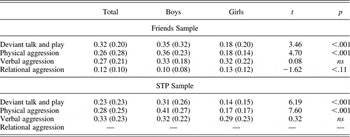
As shown in Table 1, the mean rate of observed deviant talk and play of first grade children on 12 occasions across the school year was 0.32 or about once every 3 min. This is slightly higher than the rates of observed deviant talk and play (0.23 or once every 4 min) in the STP kindergarten sample. In both samples, the rates of deviant talk and play by boys were about twice as high as those of girls and this difference was significant. Table 1 provides descriptive statistics for the rates of physical and verbal aggression in the friends and STP samples and of relational aggression in the friends sample. Physical aggression, verbal aggression, and deviant talk and play were observed at roughly comparable rates in the two samples. In the friends sample, physical aggression, verbal aggression, and deviant talk and play occurred at twice the rate of relational aggression. Boys engaged in physical aggression at 2 to 2.5 times the rate as girls. No sex differences were found for verbal aggression in either sample or for relational aggression in the friends sample.
Observed mean rate per minute of physical aggression, verbal aggression, and deviant talk and play

Persistence and spread of deviant talk and play
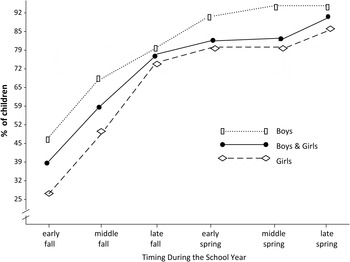
The prevalence and diffusion of deviant talk and play across the school year were examined by creating six observation periods during the school year (early, middle, and late fall and early, middle, and late spring), with each period consisting of two 5-min occasions of observation. The occurrence of deviant talk and play by each child was scored for each period, and the cumulative prevalence of deviant talk and play over the school year was calculated. As shown in Figure 1, 37% of the children were observed to engage in deviant talk and play during the early fall period, with higher prevalence for boys (47%) than girls (27%). For both boys and girls, the cumulative prevalence indicates deviant talk and play spread rapidly from the first (early fall) to the second period (middle fall), with nearly a 70% increase for girls and a 45% increase for boys. This spread continued into the third period (late fall) but at a diminished rate, with a 50% increase in cumulative prevalence for girls and a 16% increase for boys. Cumulative prevalence began to asymptote in the fourth period (early spring); about 75% of the children had engaged in deviant talk and play by the middle spring of the school year. Only 11% of all children (9% of boys and 14% of girls) were not observed to engage in deviant talk and play at any time during the year.
The cumulative percentage of children displaying talk and play with deviant content over the school year.

Prevalence rates of deviant talk and play across the six periods were fit to a growth curve model for the whole sample, χ2 (15) = 15.88, p = .39; comparative fit index (CFI) = 0.93, root mean square error of approximation (RMSEA) = 0.02. The model indicated a marginally significant positive mean slope (i.e., growth; (critical ratio [CR] = 1.67, p = .09) and significant between-individual variance in slope (CR = 2.05, p = .04). This model was also tested when grouped by child sex, χ2 (34) = 33.56, p = .39; CFI = 0.97, RMSEA = 0.001. Boys relative to girls had a higher mean intercept for prevalence of deviant talk and play during the early fall of the school year. There were no gender differences in slope means and variances for the occurrence of deviant talk and play, indicating similar rates of increasing prevalence for boys and girls.
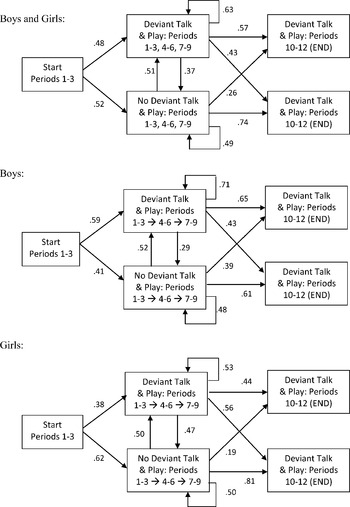
The degree to which deviant talk and play persisted once they occurred is also important. Figure 2 provides descriptive state transition diagrams for the occurrence and reoccurrence of deviant talk and play or their absence across four periods in the school year for the whole sample and for boys and girls separately. For the whole sample, once children become involved, deviant talk and play tended to recur (p = .63) rather than desist (p = .37) in subsequent periods. Contrasting the bottom two diagrams in Figure 2, initial involvement in deviant talk and play was stronger for boys than for girls (ps in Periods 1–3 or “start” was .59 for boys and .38 for girls). Once they occurred, desistence from deviant talk and play by boys (p = .29 from Periods 1–3 → 4–6 and 4–6 → 7–9) was less than that by girls (p = .47 from Periods 1–3 → 4–6 and 4–6 → 7–9). Noninvolvement or desistence during Periods 7–9 in the early spring was strongly associated with continued noninvolvement in the late spring (Periods 10–12) for boys (p = .61) and even more so for girls (p = .81).
State transition diagrams of children's involvement in talk and play with deviant content across the school year. Periods 1–3 refer to early fall, 4–6 to late fall, 7–9 to early spring, and 10–12 to late spring of the school year.

Relationship of deviant talk and play to other forms of antisocial behavior
The relationship of children's involvement in deviant talk and play to their involvement in physical, verbal, and relational aggression (as perpetrators or victims) was assessed by a factor analysis of the rates at which each of these behaviors were observed during peer interaction. Children's deviant talk and play and their endorsement of peers' deviant talk and play formed a single factor (with loadings > .90) that was distinct from their involvement as perpetrators or victims of physical, verbal relational aggression (all loadings < .30). This was the case for boys and for girls.
Relationship of deviant talk/play and physical aggression to change in overt and covert antisocial behavior
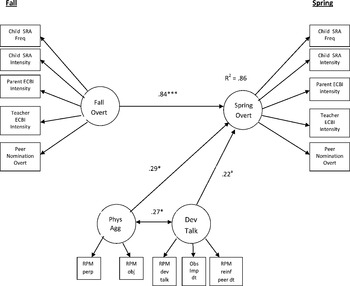
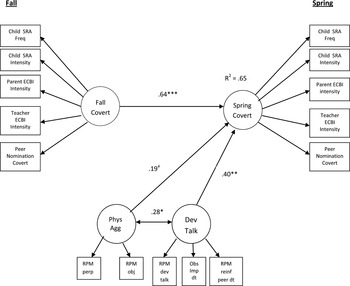
The association of children's deviant talk and play (engaging in deviant talk and play and responding positively to peers' deviant talk and play) and physical aggression (as perpetrator and victim) with children's multisetting overt antisocial behavior in the spring of first grade, controlling for overt antisocial behavior in the fall, was tested with structural equation modeling (SEM). As shown in Figure 3, physical aggression was a reliable predictor of spring overt antisocial behavior, with deviant talk and play making a marginally reliable additive contribution. A comparable SEM model for child covert antisocial behavior is shown in Figure 4. In this model, children's deviant talk and play was a strong and reliable predictor of covert antisocial behavior, with physical aggression making a marginally reliable additive contribution to covert antisocial behavior. Fall overt and covert antisocial behavior was unrelated to observed deviant talk and play, and fall overt (r = .33, p < .05) but not covert antisocial (r = .11) behavior was weakly related to observed physical aggression.
The relationship of child involvement in deviant talk and physical aggression to change in overt antisocial behavior. χ2 (50, 124) = 189.79, p < .001; χ2/df = 2.23; comparative fit index = 0.92, root mean square error of approximation = 0.10. ap < .10. *p < .05. ***p < .001 (all observed variables loaded reliably on their respective constructs, p < .01).
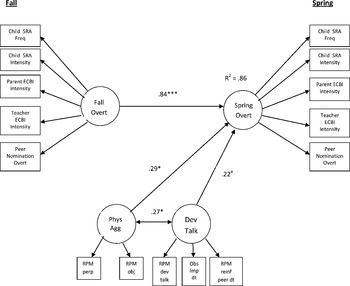
The relationship of child involvement in deviant talk and physical aggression to change in covert antisocial behavior. χ2 (50, 124) = 159.43, p < .001, comparative fit index = 0.94, root mean square error of approximation = 0.08. ap < .10. *p < .05. **p < .01. ***p < .001 (all observed variables loaded reliably on their respective constructs, p < .01).

Study 2: School Transitions Sample
Method
Participants
The participants were 133 girls and 134 boys whose mean age was 5.3 years at initial data collection (entry to kindergarten) and 9.3 years at the last data collection (entry to fourth grade). A community sample was obtained by recruiting all kindergarten children (n = 352, participation rate = 76%) enrolling in one elementary school over 3 consecutive years. The school served a low socioeconomic neighborhood in a city with a population of 350,000. Seventy-one percent of the children were European American, 19% African American, 5% Hispanic/Latino, 3% Native American, and 2% Asian American. At kindergarten entry, 43% of children lived in intact families with two biological parents, 28% in single parent families, 21% in blended family households, and 7% in other family configurations. Median per capita family income was $8,300, with 28% of families below the poverty line. Forty-six percent of the parents completed high school, 34% had education beyond high school, and 20% had less than a high school education. Seventy-five percent of two-parent families were dual wage earners, and 9% were without any employed adult.
Data collection continued after participants made school or residential moves. At least partial data were available for the 267 children assessed in the fall of kindergarten as follows: 97.3% in spring kindergarten, 96.9% in first grade, and 83% in fourth grade. Missing data were estimated in AMOS 4.0 (Worthke, Reference Worthke, Little, Shnabel and Baumert2000) using full information maximum likelihood estimation methods. Full information maximum likelihood does not delete cases missing from one or more waves of data collection nor does it delete cases missing one or more variables within a wave of data collection. This procedure avoids biased parameter estimates that are likely to occur if pairwise or listwise deletion is used to compensate for missing data (Worthke, Reference Worthke, Little, Shnabel and Baumert2000).
Measures
Peer Deviancy Training
A construct for peer deviancy training was derived from videotapes of peer interaction of each participating child, which were obtained on multiple occasions during the kindergarten year. Each child was involved as the target child on three occasions and a nontargeted coparticipating classmate on a minimum of six occasions. Combinations of same-gender classmates were sampled in a random fashion across occasions with some accommodation of children's availability. On each occasion, the target child and two same-gender classmates were engaged in two tasks. During the first 15 min, children played age-appropriate interactive games at a table. During the second 15 min, children engaged in free play, using an array of age-appropriate materials.
These multiple-occasion samples of peer interaction (90 min for each child) were coded using the Antisocial Content Code (ACC; Oeser & Schrepferman, Reference Oeser and Schrepferman2002). The ACC provides real time coding of discourse and play with six types of deviant content: alcohol and tobacco, sex, aggression and property destruction, authority defiance, sneaky actions (stealing, cheating, and lying), and “gross” body functions. It also codes responses of peers to each display of deviant talk and play by the target child as positive or as not positive. ACC coders completed Likert ratings after each 15 min of interaction to assess the target child's observation of the deviant talk and play and the positive responses to deviant talk and play among nontargeted children.
Coders were trained to a criterion of 65% agreement on a code-by-code level. There was random assignment to coders by target child and assessment occasion. Weekly recalibration meetings were held to minimize drift and maintain coder reliability. Coder agreement (masked) was estimated using 33% of the observation occasions. The percentage of agreement and κ indices of coder agreement for child deviant talk and play were 91% and 0.73, respectively. The percentage of agreement and κ coder reliability for peer responses to deviant talk and play were 77.1% and 0.60, respectively. Average intraclass correlations for Likert ratings of observed deviant talk and play and their reinforcement by peers was 0.76. Two indicators were used to define a peer deviancy training construct. The first was an odds ratio of the rate at which children's deviant talk and play relative to normative talk and play resulted in positive peer responses. The second was the mean rating of children's observation of nontargeted peers' deviant talk and play. Each indicator was standardized and then averaged to create the deviancy training construct.
Peer rejection
A construct for peer rejection was defined by three indicators. The first indicator was the average rate per minute with which peers directed coercive verbal and physical behaviors at the child during the 90 min of videotaped peer interactions described in the previous section. These videotapes were coded using the Family and Peer Process Code (FPPC; Stubbs, Crosby, Forgatch, & Capaldi, Reference Stubbs, Crosby, Forgatch and Capaldi1998). Six FPPC categories defined coercive peer behavior: negative interpersonal (e.g., teasing), negative nonverbal (e.g., negative gestures), coerce (e.g., verbal threats), verbal attack (e.g., denigrating name calling), physical aggression (e.g., pushing), and physical attack (e.g., vigorous hitting). The mean rate per minute of peer coercion was 0.39 (SD = 0.19). The percentage of agreement of FPPC coders ranged from 76% to 82% (κ = 0.64–0.66).
The second and third indicators defining the rejection construct were derived from ratings completed by FPPC coders after every 15 min of peer interaction. These ratings indicated the degree (on a 1–4 scale) to which target children were “scapegoated” (M = 1.22, SD = 0.37) and “accused of wrongdoing” (M = 1.25, SD = 0.36) by peers. The average coder agreement on these ratings as indexed by intraclass correlations was 0.72 and 0.76, respectively. The means of each item across rating occasions served as separate indicators of peer rejection. The three indicators were standardized and then averaged to create the peer rejection construct.
Skillful parenting
During kindergarten, 2-hr parent–child interactions were videotaped on each of two occasions. Structured tasks used to organize the interaction included problem solving, free play, planning an activity, practicing academic tasks, a snack, picking up toys, and reading. Interactions were coded using the FPPC (Stubbs et al., Reference Stubbs, Crosby, Forgatch and Capaldi1998) and the Specific Affect Coding System (SPAFF; Gottman, McCoy, Coan, & Collier, Reference Gottman, McCoy, Coan and Collier1996). Both coding systems provide coder global ratings of a variety of parenting behaviors as well as observed rates of parent behaviors directed toward the child. FPPC codes parents' behavior into 24 mutually exclusive and exhaustive categories. SPAFF codes parents' emotional displays into 19 mutually exclusive and exhaustive categories. Coders were trained to 80% agreement, with weekly feedback and recalibration. Two observers coded 10% (masked) of the interactions to estimate intercoder reliability.
Parents completed a parent social information processing (P-SIPI) interview. The P-SIPI presents eight verbal vignettes describing common child misbehaviors. Parents responded to two questions after each vignette: (a) “What happened in this situation?” and (b) “Why did the behavior occur?” Assessors recorded responses verbatim. Parents also rated the effectiveness of harsh discipline tactics in response to the vignettes on a scale from 1 (very ineffective) to 5 (highly effective). Ten indicators derived from the observational and interview methods, described in the subsequent sections, were used to define a construct for skillful parenting. The construct was created by standardizing each of the indicators and then taking their average.
Parent skilled teaching was defined by six coder rating items about parent behavior: used a consistent approach, used positive reinforcement, provided only as much assistance as the child requires, did the task for the child (reverse scored), motivated child by threatening punishment (reverse scored), and used a lot of directives (reverse scored). The alphas for these items across sessions for FPPC and SPAFF coders ranged from 0.59 to 0.72.
Parent skilled discipline was defined by seven coder rating items about parent behavior: reasoned with child, redirected child's attention, used time-out or other noncoercive punishment, praised and rewarded positive behavior, offered acceptable alternatives, used touch to redirect the child, and was firm and evenhanded. The alphas for these items across sessions for FPPC and SPAFF coders ranged from 0.55 to 0.79.
Positive parenting was defined by four coder rating items about parent behavior: was attentive and focused, was respectful and caring, was happy and excited, and was affectionate and warm. The alphas for these items across sessions for FPPC and SPAFF coders ranged from 0.65 to 0.86.
Parent tracking was defined by five coder rating items about parent behavior: was attentive and focused, attention was consistent, was attached to the child, was cold or distant (reverse scored), and was disengaged (reverse scored). The alphas for these items across sessions for FPPC and SPAFF coders ranged from 0.82 to 0.91. Parent responses to P-SIPI questions were coded for two facets of P-SIPI. The first assessed parent's accuracy in identifying information regarding child misbehavior described in the vignettes (cue detection) and was scored a 3 if fully relevant, a 2 if partially relevant, and a 1 if not relevant. The second assessed parents' attribution about the behavior described in the vignettes as either hostile or benign. Coder agreement for cue detection and attributions was 0.67 and 0.69, respectively. The coder ratings and P-SIP variates were each standardized and then averaged to define tracking.
Parent positive emotion was defined by the observed rate per minute at which the parent showed joy, humor, validation, interest, and enthusiasm during interaction, as coded in SPAFF. The intraclass correlation of the rate per minute of observed parent emotion displays across coders was 0.77.
Parent positive interaction was defined by observed rate per minute of the following parent behavior categories in the FPPC: positive talk, positive interpersonal, endearment, agreement with child, positive nonverbal display, and redirection. The alphas across coding categories for the two sessions were 0.62 and 0.53, respectively. The intraclass correlation of the rate per minute of parent positive interaction across coders (coder reliability) was 0.73.
Parent harsh discipline (reverse scored) was defined by seven coder rating items about parent behavior: reliance on negative affect; used ridicule and sarcasm; grabbed, hit, or pinched child; threatened negative consequences; was erratic or inconsistent; and was overly strict. The intraclass correlation of these ratings across coders was 0.81. The alphas for harsh discipline items across sessions for FPPC and SPAFF coders ranged from 0.77 to 0.81. Parental use of harsh discipline was also measured by parents' ratings of the effectiveness of harsh discipline tactics from the P-SIPI vignettes. The alpha for parent ratings across vignettes was 0.66. The coder ratings and P-SIPI variates were each standardized and then averaged to define harsh discipline.
Parent nattering and abusive behavior (reverse scored) was defined by the rate per minute at which parents were observed to direct aversive behavior toward their child. Aversive behavior was defined by the following FPPC coding categories: verbal attack, coercion, negative nonverbal behavior, physical aggression, and physical attack. The intraclass correlation of the rate per minute of observed parent nattering and abusive behavior across coders (coder reliability) was 0.87.
Negative reinforcement of coercive child behavior (reverse scored), which is an odds ratio, was calculated from observed parent–child interactions using the FPP to estimate the probability with which the parent gave in to aversive child behavior during conflict or discipline episodes.
Parent anger (reverse scored) was defined by the observed rate per minute at which the parent directed anger and contempt at their child, as coded using SPAFF. Coder agreement on parental anger and contempt was 83% (κ = 0.73).
Kindergarten–first grade overt and covert antisocial behavior
Child overt and covert antisocial behavior was assessed by parent and teacher ratings and by school playground observations, each obtained on four measurement occasions (fall and spring of kindergarten and fall and spring of first grade). The data from these three measures were combined into separate composites for overt and covert antisocial behavior at each occasion in the following manner. The data for the three measures were transformed to equivalent means in fall kindergarten. This same transformation function was then applied to the data from the three measures at the subsequent three measurement occasions. After these transformations, the three measures were averaged at each measurement occasion to create the composite construct. These composited indicators at fall and spring of kindergarten and fall and spring of first grade were used to estimate two linear growth models, reflecting kindergarten–first grade trajectories of overt and covert antisocial behavior in each of the three social ecologies.
Playground observations
An adaptation of the observation system described by Weiss, Dodge, Bates, and Pettit (Reference Weiss, Dodge, Bates and Pettit1992) was used to code children's behavior on the playground. This interval coding system classifies child behavior into mutually exclusive and collectively exhaustive categories every 10 s; the category used in the current research was the rate of target children's physical aggression toward peers. The behavior of participating children was observed on the school playground on a minimum of four separate occasions each in the fall (September–October) and spring (April–May) of the kindergarten and first grade years. On each occasion, the behavior of each child was observed and coded for 5 min (i.e., 30 consecutive 10-s intervals). The mean cross-occasion rate per minute of physical aggression at fall and spring kindergarten and first grade was calculated and used as one indicator in the growth model for overt antisocial behavior.
Coders made a 5-point Likert rating after each 5-min observation occasion about how much each “child engaged in sneaky behavior” on the playground. The mean of the Likert ratings for this item across occasions in the fall and spring of kindergarten and first grade was used as one indicator in the growth model for covert antisocial behavior. Coders were trained to a minimum κ agreement of 0.70 prior to data collection at each of the measurement occasions. Observer agreement was assessed on 10% of all occasions. Interval-by-interval coder agreement on physical aggression ranged from 65% to 69%. Intraclass correlations of the rate per minute of physical aggression (the metric used in the current analyses) generated by independent coder pairs ranged from 0.62 to 0.84 (all ps < .001). There were no statistically reliable variations in coder agreement by child gender, coder, or assessment occasion. More detailed information about the strategies and methods employed for making playground observations is available in Snyder, Schrepferman, Brooker, and Stoolmiller (Reference Snyder, Schrepferman, Brooker and Stoolmiller2003).
Parent report of child antisocial behavior was collected in the fall and spring of kindergarten and first grade using the Child Behavior Checklist (Achenbach & Rescorla, Reference Achenbach and Rescorla2001). The scale for overt antisocial behavior consisted of 23 items (e.g., argues, cruel/bullies, disobedient, teases, and tantrums). The internal reliability of the overt scale was α > 0.90 at each measurement point. The scale for covert antisocial behavior consisted of nine items (e.g., lies, steals, no guilt, and runs away from home). The internal reliability of the covert scale was α > 0.70 at each measurement point. These data were used as one indicator in growth models for overt and covert antisocial behavior during kindergarten and first grade.
Teacher report of child antisocial behavior was collected in the fall and spring of kindergarten and first grade using the Teacher Report Form (Achenbach & Rescorla, Reference Achenbach and Rescorla2001). The scale for overt antisocial behavior consisted of 26 items (e.g., argues, cruel/bullies, teases, disobedient, tantrums). The internal reliability of the overt scale was α > 0.93 at each measurement point. The scale for covert antisocial behavior consisted of 7 items (e.g., lies, steals, no guilt). The internal reliability of the covert scale was α > 0.60 at each measurement point. These data were used as one indicator in growth models for overt and covert antisocial behavior during kindergarten and first grade.
Fourth grade antisocial behavior
A latent construct for child antisocial behavior in fourth grade was defined by the reports of parents, teachers, and the children using the Child Behavior Checklist, Teacher Report Form, and Youth Self-Report instruments (Achenbach & Rescorla, Reference Achenbach and Rescorla2001). For each instrument, the sum of the rule breaking (covert) and aggression (overt) scales were calculated and used to define the construct indicators.
Results
Relation of early overt and covert antisocial behavior to risk for later antisocial behavior
Gender-specific trajectories for overt and covert antisocial behavior during kindergarten and first grade and their relation to antisocial behavior at the transition to fourth grade were assessed in an SEM model. As a preliminary step, dual trajectories for multiple-informant (parent and teacher reports and playground observation) overt and covert conduct problems during kindergarten and first grade were assessed in a multigroup (by child sex) model. The intercepts in the model were set between spring kindergarten and fall first grade, reflecting chronic overt and covert antisocial behavior during that period.
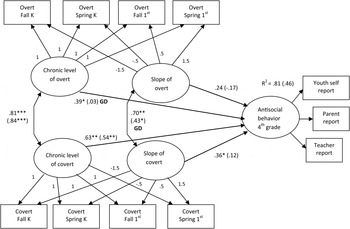
The multigroup, dual growth model (shown in Figure 5, but without the construct for antisocial behavior in fourth grade) fit the data adequately: χ2 (47, 267) = 70.19, p < .02, CFI = 0.96, RMSEA = 0.05. The correlations between the chronic levels of overt and covert antisocial behavior were significant for boys (r = .81, p < .001) and girls (r = .84, p < .001). The correlations between the slopes of overt and covert antisocial behavior were significant for boys (r = .70, p < .01) and girls (r = .43, p < .05), with a significant gender difference (p < .05). The means and variances of the chronic levels of overt and covert antisocial behavior were all significant for boys and girls (all ps < .001), indicating reliable levels and individual differences in those behaviors during kindergarten and first grade. The mean chronic level of boys' overt and covert antisocial behavior was nearly twice that of girls (p < .01). The mean slope of overt antisocial behavior was positive and significant for girls (p < .01) but not for boys. The mean slope of covert antisocial behavior was positive and significant for boys (p < .01) and for girls (p < .05); the mean slope for boys was twice that of girls, but there were no reliable gender differences. The variances of the slopes of overt and of covert antisocial behavior were significant for girls (ps < .01) and for boys (ps < .05), with no reliable gender differences. Significant slope variances indicate reliable individual differences in change in overt and in covert antisocial behavior over time.
The relationship of early trajectories for overt and covert antisocial behavior and their relationship to antisocial behavior at the transition to adolescence. χ2 (66, 267) = 100.54, p = .06, comparative fit index = 0.98, root mean square error of approximation = 0.03. *p < .05. **p < .01. ***p < .001. GD, gender differences at p < .05. Correlations between error terms for indicators of same-time aggression and covert antisocial behavior were freely estimated and significant.

In the next step, the degree to which trajectories of overt and covert antisocial behavior during kindergarten and first grade were prospectively associated with multiple-informant (parent, teacher, and youth self-report) antisocial behavior in fourth grade was tested in an SEM model. As shown in Figure 5, chronic levels of kindergarten–first grade covert antisocial behavior were reliable predictors of fourth grade antisocial behavior for boys (B = 0.63, p < .01) and girls (B = 0.54, p < .01). Chronic levels of overt antisocial behavior were reliable predictors of fourth grade antisocial behavior for boys (B = 0.39) but not girls (B = 0.03), and this sex difference was significant (p < .05). Slopes in overt and covert antisocial behavior were not reliable predictors of fourth grade antisocial behavior for girls. The slope of covert antisocial behavior was a reliable predictor of fourth grade antisocial behavior only for boys (B = 0.36, p < .05), but not reliably different than that of girls. Early covert antisocial behavior was the sole lead indicator of later antisocial behavior for girls. Early covert and overt antisocial behaviors were additive predictors of later antisocial behavior for boys.
This model was then tested again, but the paths from chronic level and slope of kindergarten–first grade covert antisocial behavior to fourth grade antisocial behavior were constrained to 0. This model marginally fit the data, χ2 (92, 267) = 152.46, p < .001, CFI = 0.94, RMSEA = 0.049, and did so less well than the model in which paths from early overt and covert levels and slopes (as shown in Figure 5) were freely estimated: χ2 difference (df = 4) = 13.61, p < .01. In the constrained covert path model, chronic levels of kindergarten–first grade overt antisocial were reliable predictors of fourth grade antisocial behavior for both boys (B = 0.64, p < .001) and girls (B = 0.58, p < .01). Note that these paths coefficients were reduced in size relative to those shown in Figure 5 when kindergarten–first grade covert antisocial behavior was added as a predictor of fourth grade antisocial behavior. The amount of variance in fourth grade antisocial behavior in the overt-only prediction model was 68% for boys and 34% for girls, less than that in the combined overt–covert prediction model shown in Figure 5.
Contributions of peers and parents to early trajectories for overt and covert antisocial behavior
Two multigroup (by child gender) models were used to assess the joint contribution of parenting and peer processes to the trajectories for early overt and covert antisocial behavior and fourth grade antisocial behavior: one for skillful parenting and peer rejection and one for skillful parenting and peer deviancy training. Separate models were tested because the constructs for peer rejection and deviancy training were not reliably correlated for girls (r = –.20, p = .08) or boys (r = .04, p = .69). Several questions were addressed in these models: (a) Do parenting and peer processes increase risk for overt and covert trajectories during kindergarten and first grade and for multisetting antisocial behavior in fourth grade? (b) Is the risk for antisocial behavior in fourth grade associated with parenting and peer processes mediated by trajectories of overt and covert antisocial behavior during kindergarten and first grade? (c) Do peer rejection and deviancy training play similar roles in risk for trajectories of antisocial behavior? (d) Does skillful parenting mitigate risk for antisocial behavior associated with peer rejection and peer deviancy training? (e) Are there sex differences in the association of parenting and peer processes with childhood antisocial behavior?
These questions were addressed by fitting two models, each representing the conjoint association of skillful parenting and peer rejection and of skillful parenting and peer deviancy training with child antisocial behavior: a mediated model and a direct association model. In the mediated models, the association of parenting and peer processes with fourth grade antisocial behavior and the indirect association of parenting and peer processes with fourth grade child antisocial behavior via trajectories of kindergarten–first grade overt and covert antisocial behavior were simultaneously assessed. In the direct association models, the associations of parenting and peer processes with fourth grade antisocial behavior were tested with the paths from kindergarten–first grade antisocial behavior to fourth grade antisocial behavior constrained to 0. To support the meditational model, two conditions must be met. First, the mediated models should fit the data better than the direct association models. Second, significant paths from parenting and peer processes to fourth grade antisocial behavior in the direct association models should be reduced in size and statistical reliability relative to those same paths in the mediated models. The constructs for skillful parenting, peer rejection, and peer deviancy training were each standardized (or centered); and the constructs for the interaction of skillful parenting and peer rejection and of skillful parenting and peer deviancy training were created by multiplying the standardized variable for skillful parenting with the standardized variables for peer rejection and for peer deviancy training. Sex differences were explicitly tested in the models.
Skilled parenting and peer rejection
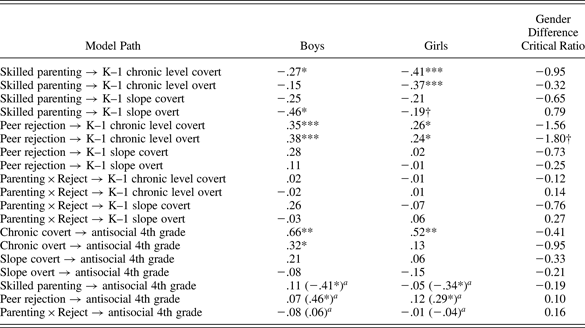
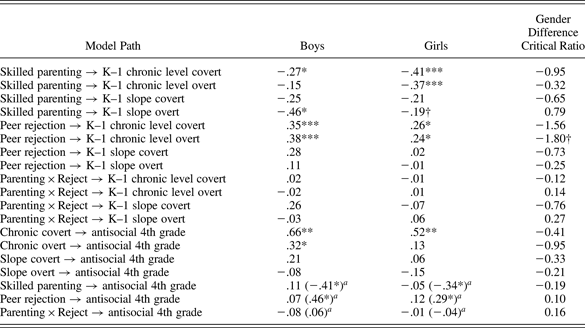
The fit of the direct association model of skillful parenting and peer rejection was marginal: χ2 (126, 267) = 204.43, p < .001, CFI = 0.93, and RMSEA = 0.05. The fit of the mediated skillful parenting and peer rejection model was adequate: χ2 (118, 267) = 145.78, p = .04, CFI = 0.97, and RMSEA = 0.03. The mediated model fit the data better than the direct association model: χ2 difference = 58.65 with 8 degrees of freedom (p < .001). Table 2 provides the path parameters (shown in standardized form) for the mediated model of skillful parenting, peer rejection, and their interaction separately for boys and girls. The parameters for the paths from skillful parenting and peer rejection to fourth grade child antisocial behavior in the direct association model are shown in parentheses at the bottom of Table 2. The estimated path coefficients from skilled parenting and peer rejection to fourth grade child antisocial behavior were small and reduced to nonsignificance in the mediated relative to direct association model for both boys and girls.
Path coefficients for models associating skillful parenting and peer rejection with trajectories of early antisocial behavior
aPath coefficients for the “constrained” model.
†p < .10. *p < .05. **p < .01. ***p < .001.
As shown in top four rows of Table 2, skilled parenting was negatively associated with chronic levels of covert antisocial behavior of boys and girls, with chronic levels of overt antisocial behavior of girls, and with growth in overt antisocial behavior of boys and girls during kindergarten and first grade. As shown in the next four rows of Table 2, peer rejection was associated with higher kindergarten–first grade levels of covert and overt antisocial behavior of boys and girls. The interaction of skilled parenting and peer rejection was not associated with chronic levels or slopes of overt and covert antisocial behavior for boys or girls.
As shown in the bottom portion of Table 2 (consistent with the results in Figure 5), chronic levels of covert antisocial behavior during kindergarten and first grade were significant predictors of antisocial behavior in the fourth grade for boys and girls, and chronic levels of overt antisocial behavior were marginally predictive of fourth grade antisocial behavior for boys. Chronic levels of covert antisocial behavior during kindergarten and first grade fully mediated the relation of skilled parenting and peer rejection to fourth grade antisocial behavior.
Skilled parenting and peer deviancy training
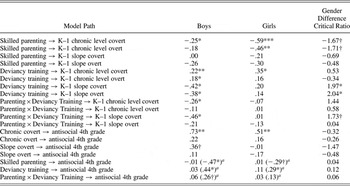
The direct association model for skillful parenting and peer deviancy training fit the data marginally: χ2 (126, 267) = 276.12, p < .001, CFI = 0.87, RMSEA = 0.07. The fit of the mediated model for skillful parenting and peer deviancy training was somewhat better: χ2 (118, 267) = 207.71, p = .01, CFI = 0.92, RMSEA = 0.05. The mediated model fit better than the direct association model: χ2 difference = 68.41 with 8 degrees of freedom (p < .001). Table 3 provides the path parameters (in standardized form) for the mediated model of skillful parenting, peer deviancy training, and their interaction separately for boys and girls. The parameters for the paths from skillful parenting and peer deviancy training to fourth grade child antisocial behavior in the direct association model are shown in parentheses at the bottom of Table 3. The coefficients for the paths from skilled parenting and deviancy training to fourth grade antisocial behavior were small and reduced to nonsignificance in the mediated relative to the direct association model for both boys and girls.
Path coefficients for models associating skillful parenting and peer deviancy training with trajectories of early antisocial behavior

aPath coefficients for the “constrained” model.
†p < .10. *p < .05. **p < .01. ***p < .001.
As shown in the top four rows of Table 3, skilled parenting in kindergarten was associated with lower chronic levels of covert antisocial behavior of boys and girls and with lower chronic levels of overt antisocial behavior of girls during kindergarten and first grade. Skillful parenting was marginally more related to lower chronic levels of antisocial behavior of girls than boys. As shown in the next four rows of Table 3, deviancy training during kindergarten was associated with higher chronic levels of kindergarten–first grade covert antisocial behavior of boys and girls and with less growth in covert and overt antisocial behavior of boys. This negative association may reflect the high negative correlations between chronic levels and slopes of both covert (r = .52) and overt (r = .49) antisocial behavior for boys but not for girls (r = –.28 and –.23, respectively). Boys with high chronic levels of antisocial behavior showed less growth than those with low chronic levels of antisocial behavior. The parameters for skilled parenting and deviancy training to fourth grade antisocial behavior in the direct association model are shown in parentheses at the bottom of Table 3. The coefficients for the paths in the mediated model were small and reduced to nonsignificance relative to those in the direct association model for boys and girls.
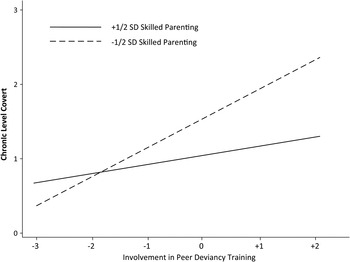
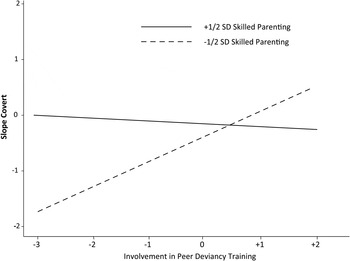
The interaction of skilled parenting and peer deviancy training was reliably associated with chronic levels and growth of boys' but not girls' covert antisocial behavior during kindergarten and first grade. Regression functions estimating the association of deviancy training with chronic levels and growth of boys' covert antisocial behavior during kindergarten and first grade were estimated at +0.5 SD above and –0.5 SD below the mean for skilled parenting. As shown in Figure 6, chronic levels of covert antisocial behavior were positively though modestly related to deviancy training (r = .20) for boys who experienced skilled parenting at +0.5 SD above the mean. For boys who experienced skilled parenting at –0.5 SD below the mean, chronic levels of covert antisocial behavior were more strongly related to deviancy training (r = .45). As shown in Figure 7, for boys who experienced skilled parenting at +0.5 SD above the mean, slopes of covert antisocial behavior were not related to peer deviancy training (r = –.11). For boys who experienced skilled parenting at –0.5 SD below the mean, slopes of covert antisocial behavior were positively related to peer deviancy training (r = .47).
The association between chronic levels of covert antisocial behavior and involvement in peer deviancy training for boys who experienced high and low levels of skilled parenting.

The association between the slope of covert antisocial behavior and involvement in peer deviancy training for boys who experienced high and low levels of skilled parenting.

Sex differences in skilled parenting, peer rejection, and peer deviancy training
Boys relative to girls showed significantly higher chronic levels of overt and covert antisocial behavior in kindergarten and first grade. Boys also had higher mean levels of antisocial behavior in fourth grade (all shown as standardized scores) on youth self-report (mean for boys = 0.17 and girls = –0.17, CR = –2.74, p < .01), parent report (mean for boys = 0.16 and girls = –0.13, CR = –2.32, p < .01), and teacher report (mean for boys = 0.32, and girls = –0.29, CR = –4.98, p < .001). Given that the associations of peer rejection, peer deviancy training, and skilled parenting to early trajectories for overt and covert antisocial behavior were not consistently different for boys and girls, it is possible that the degree of boys' and girls' exposure to these parenting and peer processes may account for sex differences in antisocial behavior in kindergarten, first grade, and fourth grade. In the models described in the preceding sections, boys relative to girls experienced (all shown in standardized form) marginally higher mean levels of peer rejection (mean for boys = 0.10, girls = –0.10, CR = 1.68, p < .10) and were more involved in peer deviancy training (mean for boys = 0.32, girls = –0.29, CR = 4.98, p < .001). There was no reliable gender difference in skillful parenting (mean for boys = –0.10, girls = 0.08, CR = –1.44).
Discussion
The first broad goal of this report was to use the friends study data to replicate the occurrence of deviant talk and play by young children and to assess its additive contribution along with peer rejection to the early development of antisocial behavior. Nearly comparable rates of deviant talk and play were observed in the slightly older, more ethnically diverse and higher risk children in the friends sample compared to rates previously reported from the STP (Snyder et al., Reference Snyder, Schrepferman, Oeser, Patterson, Stoolmiller and Johnson2005). This replication enhances confidence in the occurrence of peer deviancy training during childhood, especially given the observations in the friends sample were carried out in a naturalistic school playground setting. The relative independence of constructs for peer deviancy training and peer rejection in the friends sample replicates similar findings from the STP sample. Analyses of the friends data also document the conjoint value of deviancy training and rejection in predicting the development of antisocial behavior during a school year, consistent with findings from the STP (Snyder et al., Reference Snyder, Schrepferman, McEachern, Barner, Provines and Johnson2008). This provides support for the hypothesis that peer deviancy training serves as an important, independent risk factor for the childhood development of antisocial behavior more generally, and for covert antisocial behavior more specifically.
Several more novel findings about peer deviancy training were also apparent. Both in the friends data and in the reanalysis of the STP data, deviant talk and play occurred at higher rates and were more apparent early in the school year for boys than girls. This may reflect boys' greater exposure to conflict and other negative experiences in home and neighborhood settings (Kroneman et al., Reference Kroneman, Loeber, Hipwell and Koot2009). The friends data also suggest, for both boys and girls, a progressive diffusion of deviant talk and play by children during the school year. The data also suggest the persistence of deviant talk and play once they are initiated. This is consistent with a contagion process and with the notion that deviant talk and play may serve as an attractor state during peer interaction (Dishion & Patterson, Reference Dishion, Patterson, Cicchetti and Cohen2006). Given children's nearly universal interaction with a diverse set of peers in early elementary school, some of whom have precocious exposure to deviant activities and values, nearly all children may become involved in deviant talk and play during peer interaction. Early deviancy training may be a relatively common and potentially insidious peer process.
Even though deviant talk and play in the friends sample showed increasing prevalence and considerable persistence across the school year, some countervailing processes were also apparent. There were individual differences in susceptibility as indicated by the hazard to initially display deviant talk and play across the school year and by indications that desistence from deviant talk and play may lead to longer term resistance to coparticipation in deviancy training. This suggests it would be useful to search for factors that mitigate susceptibility to peer deviancy training, such as parenting practices, peer affiliations and networks, and child temperamental characteristics (Dishion & Patterson, Reference Dishion, Patterson, Cicchetti and Cohen2006; Snyder, McEachern, et al., 2010).
The second broad goal of this report was to use data from the STP to examine the degree to which childhood trajectories for overt and covert antisocial behavior during kindergarten and first grade are distinguishable and to assess their relative contribution to antisocial behavior 3 years later in fourth grade separately for boys and girls. Extant longitudinal research has not identified robust childhood behavioral antecedents of the onset and burst of antisocial behavior in adolescence. The occurrence and growth of covert antisocial behavior during childhood may serve as a “prime suspect.” Gender-specific analyses are important because boys show higher mean levels of overt antisocial behavior during childhood, and this behavior may serve as a stronger predictor of antisocial behavior during adolescence for boys than girls (Tremblay, Reference Tremblay2010). In addition, little is known about sex differences in covert antisocial behavior during childhood and the relative contribution of that behavior to risk for adolescent antisocial behavior.
The data presented in this report support the notion that childhood trajectories for overt and covert antisocial behavior are distinct (Tremblay, Reference Tremblay2010) and suggest that this is the case for both boys and girls. The slope correlations, especially for girls, were moderate in size, indicating some independence in the growth of overt and covert antisocial behavior at the level of the individual. There was no mean growth in overt antisocial behavior of boys, as might be normatively expected, but there was mean growth in covert antisocial behavior of boys and girls. These trajectory parameters indicate that early overt and covert antisocial behavior have different developmental dynamics. Consistent with past research, boys showed higher chronic levels of early overt and covert antisocial behavior than girls. Although relatively infrequent and limited in variety, covert antisocial behavior during kindergarten and first grade was clearly apparent and showed reliable individual differences, consistent with previous research on childhood trajectory classes for antisocial behavior (Tremblay, Reference Tremblay2010). Significant individual differences in the growth of covert antisocial behavior were observed for boys and girls, indicating increasing differentiation in the frequency or variety with which children engage in early covert acts.
Consistent with our hypothesis, the appearance and growth of covert antisocial behavior during childhood also appear to be an important antecedent to risk for antisocial behavior at the transition to adolescence. Chronic levels of covert antisocial behavior during kindergarten and first grade were strong and reliable predictors of a multiple-informant construct of antisocial behavior some 3 years later in fourth grade. This prediction applied equally to boys and girls, even in the context of overt antisocial behavior that, consistent with previous research, was also a reliable predictor only for boys. The importance of early covert antisocial behavior was also apparent in the contrast of a dual overt–covert prediction model to an overt-only prediction model. In the overt-only model, chronic overt antisocial behavior was a robust predictor of fourth grade antisocial behavior for boys and girls, consistent with theory and previous research indicating the importance of the persistence in childhood physical aggression and overt antisocial behavior for adolescent antisocial behavior (Broidy et al., Reference Broidy, Nagin, Tremblay, Bates, Brame and Dodge2003). However, the overt-only model accounted for less variance in fourth grade antisocial behavior and fit less well than the overt–covert prediction model. In addition, including early covert antisocial behavior as a predictor along with overt antisocial behavior diminished the prediction value of overt antisocial behavior for boys and even more so for girls.
Several sex differences in the childhood development of antisocial behavior were also apparent. Boys relative to girls engaged in more covert as well as more overt antisocial behavior across all measurement methods and developmental periods. This is consistent with previous research on overt antisocial behavior and physical aggression and on the prevalence of oppositional–defiant and conduct disorders (Kroneman et al., Reference Kroneman, Loeber, Hipwell and Koot2009). However, covert antisocial behavior was the only reliable behavioral predictor of fourth grade antisocial behavior for girls. This suggests that covert antisocial behavior may serve as a key early pathway to girls' antisocial and risky behavior in adolescence. The relatively lower mean level of early overt childhood antisocial behavior of girls and its lack of reliable association with fourth grade antisocial behavior (in the context of early covert antisocial behavior) is consistent with females' involvement in primarily nonviolent offending during adolescence and adulthood (Moffitt, Caspi, Rutter, & Silva, Reference Moffitt, Caspi, Rutter and Silva2001). Childhood trajectories of covert (and for boys, also overt) antisocial behavior accounted for substantial variance in fourth grade antisocial behavior, just prior to its frequent escalation and increasing prevalence in adolescence. The models accounted for nearly twice as much variance in boys' antisocial behavior, suggesting other variables during childhood or later in adolescence are also important for girls' risk for adolescent antisocial behavior.
The third broad goal of this report was to assess the additive and synergistic contribution of parenting and peer processes to the childhood development of overt and covert antisocial behavior separately for boys and girls. Peer rejection and peer deviancy training were examined separately because they appear to be independent processes (Snyder et al., Reference Snyder, Schrepferman, McEachern, Barner, Provines and Johnson2008; and replicated in the friends sample in this report). The association of peer rejection with overt antisocial behavior replicates well-established findings and appears to apply to both boys and girls. As described in previous research, this likely entails direct training in aggression, exclusion from constructive socialization opportunities with normative peers, and affiliation with deviant and aggressive peers (Rubin et al., Reference Rubin, Bukowski, Parker and Eisenberg2006). The relation of rejection to covert antisocial behavior, especially for boys, may reflect the same selective affiliation process and the increased sensitivity and susceptibility of rejected children to peer deviancy training (Dishion & Patterson, Reference Dishion, Patterson, Cicchetti and Cohen2006; Snyder, Schrepferman, et al., 2010).
Peer deviancy training was also associated with kindergarten–first grade covert antisocial behavior for boys and girls and, given the relative independence of deviancy training and rejection, appears to be an important additional peer risk process during childhood. Observation of peers' deviant talk and play and their social reinforcement of deviant talk and play may shape values, behavior intentions, and contingency expectations, leading to the increasing behavioral expression of deviant behavior (Dishion & Patterson, Reference Dishion, Patterson, Cicchetti and Cohen2006; Snyder, McEachern, et al., 2010; Snyder et al., Reference Snyder, Schrepferman, Oeser, Patterson, Stoolmiller and Johnson2005). Given the association of covert antisocial behavior during childhood with fourth grade antisocial behavior, deviancy training may contribute to sustained risk for adolescent antisocial behavior as mediated by its more proximal association with the appearance and shaping of covert antisocial behavior during childhood, especially for girls.
Consistent with previous longitudinal (Hipwell et al., Reference Hipwell, Keenan, Kasza, Loeber, Stouthammer-Loeber and Bean2008; Keenan et al., Reference Keenan, Hipwell, Chung, Stepp, Stouthammer-Loeber and Loeber2010; Moffitt & Caspi, Reference Moffitt and Caspi2001) and intervention research (Beauchaine, Stratton, & Reid, Reference Beauchaine, Stratton and Reid2005, Patterson, Forgatch, & DeGarmo, Reference Patterson, Forgatch and DeGarmo2010), parenting processes were also associated with the development of antisocial behavior during childhood, even in the context of peer rejection and peer deviancy training. A more novel finding in this report indicates skillful parenting was associated with lower levels of covert as well as overt antisocial behavior, a distinction that has received little attention since Patterson's (1982) summary of the research. A more fine-grained analysis is needed to examine whether specific parenting processes are differentially associated with covert and overt antisocial behavior. Parenting appears to be associated with childhood antisocial behavior in similar ways and to similar degrees for boys and girls, with only a few marginally significant differences indicating a slightly stronger association for girls (Kroneman et al., Reference Kroneman, Loeber, Hipwell and Koot2009).
In the context of the direct associations between parenting and childhood antisocial behavior, there was no evidence that skillful parenting mitigated the association between peer rejection and antisocial behavior. Once established, peer rejection appears to have a “life of its own.” This may be the case because of the powerful, ongoing reciprocal relationship between rejection and coercive peer interaction and the cascading, transactional relationship between rejection and deviant peer association.
In contrast, there was evidence that skillful parenting may mitigate the relationship between peer deviancy training and boys' covert antisocial behavior. Given the relative ubiquity of peer deviancy training, especially among boys, and the longer term risk associated with boys' early covert and overt antisocial behavior, effective parenting may play a key role in mitigating the potentially negative adolescent outcomes associated with early peer deviancy training. Comparable mitigation by skillful parenting was not apparent for girls. This further supports the notion that the relationship between peer deviancy training and a childhood pathway for covert antisocial development may be particularly important for girls. The reasons why skillful parenting does not mitigate risk associated with peer deviancy training for girls are not clear. We speculate that the lack of mitigation may reflect parents' (and other adults') difficulty in detecting peer deviancy training and covert antisocial behaviors by girls because such behaviors occur less frequently or may result from girls' execution of deviancy training and expression of covert antisocial behavior in ways that are more subtle and sophisticated.
Boys relative to girls showed higher levels of overt and covert antisocial behavior on all measures in kindergarten, first grade, and fourth grade; but there were few and often marginal sex differences in the associations of parenting and peer processes with antisocial behavior. However, boys relative to girls on average experienced more peer rejection and were more involved in peer deviancy training. Consistent with previous research (e.g., Moffitt et al., Reference Moffitt, Caspi, Rutter and Silva2001), this suggests that the higher levels of antisocial behavior of boys are not due to different social risk variables or that social risk variables operate differently by child gender, but rather that boys are exposed to or experience higher levels of those risk variables.
Gender differences in early antisocial behavior may reflect differences in the way boys and girls are socialized and in the early childhood maturational timetable for boys and girls. Girls' behavior may be more closely tracked and provided with clearer or different contingencies by parents (Keenan & Shaw, Reference Keenan and Shaw1997). Girls may be exposed to less adult conflict and deviancy in home and neighborhood settings (Keenan et al., Reference Keenan, Hipwell, Chung, Stepp, Stouthammer-Loeber and Loeber2010). Girls' verbal and inhibition skills also mature, on average, more rapidly than those of boys during early childhood, fostering more effective socialization in the family environment. Girls and boys interact primarily in same-gender groups during childhood; girls tend to engage in more supportive and cooperative dyadic relationships whereas boys tend to interact in larger groups characterized by competition, conflict, and sensation seeking (Maccoby, Reference Maccoby1998). These peer group environmental differences may result in the experience of more direct coercion and rejection by boys than girls. Boys may be more prone to engage in deviant talk and play as a result of experiences at home and as a means of generating peer attention and reinforcement. However, it may also be that many girls are left to express antisocial behavior in more subtle, covert forms, which as a result comprise a key pathway to later antisocial behavior. Girls' preference and capacity for covert antisocial behavior (as well as for its potentially related indirect form in relational aggression) may also be facilitated by their earlier maturation of verbal and inhibitory skills (Snyder et al., Reference Snyder, Schrepferman, McEachern, Barner, Provines and Johnson2008).
In summary, this report suggests that peer deviancy training is an important risk process during childhood and that childhood trajectories of covert antisocial behavior may be an important but relatively unrecognized pathway to antisocial and risky behavior during adolescence, perhaps especially for girls. The degree to which current preventive interventions focused on altering family, school, and peer environments effectively address peer deviancy training and covert antisocial behavior childhood is unclear; and the efficacy and effectiveness of current interventions may be enhanced by explicitly addressing their occurrence.
The design, methods, and analyses of the studies used in this report have several limitations. First, they involve relatively small, moderately diverse samples of children and families from one geographic location. This limits the generalizability of the findings and the results are in need of replication using other, larger samples. Second, measurement of peer deviancy training and covert antisocial behavior is challenging. Covert antisocial behavior is less frequent and by its nature difficult to measure accurately. Peer deviancy training, even more than aggression and rejection, is often subtle and may be subject to reactivity in observation. Even though several efforts were made to reduce bias due to reactivity, the increases in deviancy training over the school year found in this report may partially reflect reduced reactivity with repeated observation.
Third, the models described in this report are incomplete in several ways so that inferences drawn from the results need to be made with care. The developmental periods covered were relatively brief in duration. Longer-term adolescent outcomes of these childhood processes need to be assessed. The ongoing contributions of parenting and peer processes during childhood and adolescence need to be repeatedly assessed to better understand how these processes and trajectories for antisocial behavior unfold transactionally. A number of potentially important risk variables were not included in the models tested in this report, including child temperament, victimization by peers, and school environment processes other than peer relationships. Fourth and finally, even in the context of longitudinal design, strong causal inferences cannot be made in the absence of experimental manipulation of the risk processes described in this report, and variables other than those included in the models being tested may alter the strength and importance of those processes.
However, the data and models described here also reflect several design and measurement strengths. A multilevel approach was used to assess the additive and conjoint association of several key social processes with differentiated forms of antisocial behavior. Multiple-informant and multimethod measures were used to define key constructs and an effort was made to define adjacent constructs in models in a way that did not share common measurement methods. Intensive behavioral observations were used to measure key peer and family social processes, reducing potential bias in their definition. Substantial variance in child antisocial behavior was accounted for in the models, providing some increased confidence that these findings are practically significant and replicable.
This article underlines the potential importance of peer deviancy training and covert antisocial behavior as contributors to longer term risk for antisocial behavior into adolescence. Much recent research in developmental psychopathology and preventive interventions has focused on late childhood and early adolescence as a key transition (Dahl, Reference Dahl2004), and this emphasis has much empirical support. However, many of the developmental processes (e.g., deviancy training, adult monitoring, frontal executive processes) and trajectories for problem behaviors (e.g., covert antisocial behavior) may come “on line” much earlier than generally recognized and presage their full-blown expression in adolescence. The data in this report also indicate that it may be important to more fully differentiate the wide variety of behaviors labeled antisocial according to their function and topography, including physical, verbal, and relational aggression; oppositional and defiant behavior; and covert antisocial behavior (Tremblay, Reference Tremblay2010). The appearance and growth of each of these forms, although correlated at any one age, may have different developmental timetables, may be functionally as well as topographically different, and may be associated with somewhat different neurobiological and social risk processes.
It will also be important to distinguish the conditions under which some relatively ubiquitous social processes such as involvement in various forms of aggression and peer deviancy training reflect normative experiences, are time limited, and pose minimal risk. This will require a more thorough delineation of the environmental conditions and characteristics of individuals that moderate risk due to such involvement (Snyder, McEachern, et al., 2010). One such marker characteristic is child gender. More information about the preadolescent risk and protective factors associated with females' antisocial and risky behavior is needed; this may require greater attention to the different forms in which antisocial behaviors are expressed and to the nature of the social environments that provide the social functions that shape and support those behaviors.
The bottom line, however, involves intervention. It will be important to subject these and similar findings to rigorous experimental tests in longitudinal, randomized trial interventions to establish their causal status. These trials should also assess mediators and moderators of intervention in order to better understand how and for whom interventions work. In terms of the efficacy and effectiveness of family-based interventions, it may be useful to revisit and update the strategies and targets of parenting interventions to focus more on covert forms of antisocial behavior and on mitigation of exposure to deviant actors, attitudes, and actions in family, neighborhood, and peer environments, well before adolescence (Patterson, Reference Patterson1982). In terms of school or peer-based interventions, it may be useful to target peer deviancy training in playground or classroom interventions; this may be done by enhanced behavior tracking and monitoring, explicit contingencies for deviant talk and play, resistance skills related to deviancy training, and greater proactive attention to the aggregation of students at various levels of risk, as early as kindergarten and first grade.