1. The Background and the Problem
This paper examines a peculiar case of morphological variation in the strong paradigm of Gothic modifiers—including possessive, demonstrative, and indefinite pronouns, adjectives, quantifiers, and past participles—where the bare stem of the modifier competes with its pronominally inflected form in -ata. A distinctive property of the strong (indefinite) adjective paradigm in older Germanic is that in about half of all paradigm slots, the inflectional material of the adjective coincides with that of the demonstrative pronoun (compare Gothic neuter dative singular god-amma ‘good’ and þ-amma ‘that’). In the rest of the adjective paradigm, the inflections are the same as in vowel-stem nouns (compare Gothic feminine nominative singular god-a ‘good’ and gib-a ‘gift’, but so ‘that’). In Gothic strong adjectives, 13 (54%) out of 24 paradigm slots have pronominal desinences. The same is true in principle of the other older Germanic languages, though in each given language the data and distribution of pronominal inflections in the adjective paradigm are different in details (see Žirmunskij Reference Žirmunskij and Makaev1966:56–58 for a comparative overview of strong adjectives across older Germanic and a discussion of the principal similarities and differences).
A comparative examination of adjective morphology in older Germanic and other Indo-European languages indicates that the pattern of pronominal inflections in the strong adjective paradigm is a Germanic innovation. This new inflectional pattern follows the paradigm of the demonstrative pronoun, whereas the original inflection of adjectives was the same as that of nouns.Footnote 1 However, this traditional account of the development of the strong adjective inflection has recently been challenged by McFadden (Reference McFadden2004, Reference McFadden2009), whose view is reflected in Ringe Reference Ringe2006:169 and Speyer Reference Speyer2007:73. McFadden (Reference McFadden2004:124–125, Reference McFadden2009:56–58) hypothesizes that the strong adjective inflection was entirely pronominal in Proto-Germanic, following in every form the inflection of pronominal adjectives such as Gothic ains ‘one’, anþar ‘other, second’, meins ‘my’ and the like, which, in his view, were originally completely pronominal in their inflection. The issue of the history of the strong inflection is taken up again in section 3.6.
As noted above, a peculiar, and potentially diachronically significant, property of the strong adjective paradigm in Gothic is morphological variation in the inflection of neuter nominative and accusative singular adjectives, where the nominal bare stem competes with pronominal forms in -ata in the same paradigm slots: jugg versus juggata ‘young’. The discussion of this variation can be traced back at least to Jacob Grimm (Reference Grimm1822:719), who notes that the use or nonuse of -ata is independent of the consonant that precedes it. Grimm (Reference Grimm1837:470) further states that, whilst it is difficult to formulate a rule for the use of the two forms, the variation cannot be explained in terms of the original Greek, and the difference must be sought partly in the nature of the adjectives and partly in their “construction.” In the ensuing discussion, Grimm (Reference Grimm1837:470–472) surveys the evidence of neuter modifiers affected by -ata and attempts to explain the use and nonuse of the pronominal form in terms of the syntactic environment in which given modifiers occur, with -ata typically being observed in attributive environments and the bare stem having a wider syntactic distribution.
In their grammar, von der Gabelentz & Loebe (Reference Gabelentz and Loebe1846:74, note 5) note that -ata and the shortened bare-stem form (“abgekürzte Form”) are used interchangeably. Besides additionally speculating that adjectives with short stems or stems ending in vowels can only have the pronominal inflection (1846:75, note 2c), they do not explore the issue further. In a dedicated study of the adjective in Germanic, Meyer (Reference Meyer1863:2f.), surveying the evidence of the bare stem and -ata, concludes that the quantitative preponderance of the bare stem and the absence of a clear difference in use between the bare stem and -ata suggests that -ata was simply less favored, with no deeper significance. He also points out that, with a couple of exceptions, forms in -ata do not occur predicatively (1863:3).
The discussion of Gothic adjective morphology by 19th-century scholars seems to have laid the ground for much of the contemporary discourse on the variation between the bare stem and -ata, as it has commonly been suggested in treatments of Gothic grammar that the pronominal form in -ata is confined to attributive contexts (see Wright Reference Wright1954:187, Mossé Reference Mossé1956:108, Hempel Reference Hempel1966:58, Mastrelli Reference Mastrelli1967:170, Krause Reference Krause1968:178, Durante Reference Durante1974:81, Kubrjakova Reference Kubrjakova and Guxman1977:309, Braune & Heidermanns Reference Braune and Reiffenstein2004:115, or Rauch Reference Rauch2011:74).Footnote 2 Consider the following evidence:Footnote 3
(1)


In these examples, the adjective mikils ‘great, large’ is inflected in two ways. In 1a, it appears in the predicative role after a copula and has the shape of a bare stem; in 1b, it is the attribute of the noun kelikn ‘upper dining room’ and appears in a morphologically complex form with the pronominal inflection -ata. Thus, on the traditional account, in these slots the bare stem of the adjective seems to be in complementary distribution with the pronominal inflection, and the two forms of the adjective represent syntactically conditioned allomorphs. The choice of one allomorph over the other is governed by the syntactic environment—attributive or predicative—in which the modifier occurs.
Zinder & Stroeva (Reference Zinder and Stroeva1968:83, 92) and Braune & Reiffenstein (Reference Braune and Reiffenstein2004:218, 220) report evidence of similar alternations in Old High German, with competing forms attested in the singular nominative case across all genders (nominal bare stem versus pronominal masculine -ēr, neuter -aʒ, femenine -iu), as well as the neuter singular accusative (nominal bare stem versus pronominal -aʒ). Braune & Reiffenstein (Reference Braune and Reiffenstein2004:219) suggest that there is barely any functional difference between the variants and that both the bare stem and the pronominally inflected forms are equally to be expected (“gleichberechtigt”) in attributive environments; in the predicative position the nominal form is preferred, though pronominally inflected forms are also attested. According to Zinder & Stroeva Reference Zinder and Stroeva1968:96–98, the “shorter” nominal bare stem is typical in predicative positions, but it also dominates in attributive positions, so much so that there are no attestations of the “full” masculine or neuter pronominally inflected forms in Isidor, where the bare stem forms prevail (39 masculine and 17 neuter), and where only one of the seven feminine adjectives is pronominal, the remaining six being bare stems. In other Old High German records, the bare stem is also very common, even if not as overwhelmingly dominant (Zinder & Stroeva Reference Zinder and Stroeva1968:98).
Following the introductory discussion in the present section, defining the problem of the variation and situating it within the domain of the history of Germanic nominal morphology, section 2 presents the data on -ata as it is attested in Gothic and discusses the syntax of the different types of modifier with which it occurs. Set against the background of traditional views on the use and functions of -ata, in section 3.1 the quantitative evidence for the syntax of -ata and its distribution across the modifier lexicon is summed up, and the frequency effects of its use are examined against the evidence for the use of the bare stem. Building on the implications of the quantitative assessment, section 3.2 sets out to investigate the possible semantic and contextual factors at work in the alternation between the bare stem and -ata, followed by a discussion of grammatical factors in section 3.3 and metrical factors in section 3.4. Based on the knowledge that the surviving Gothic documents are the work of several hands, section 3.5 investigates whether the distribution of -ata across the Gothic corpus can be explained in terms of the individual preferences of different scribes. Section 3.6 introduces a diachronic dimension to the results discussed in the previous sections and offers an account of the development of the Germanic strong modifier inflection. Finally, section 4 sums up the discussion, reprising the main findings, and outlines some directions for further research.
2. The Data
2.1 Prototypical Adjectives
A search of Snædal's (Reference Snædal2005) Concordance to Biblical Gothic, which represents a full collection of Gothic biblical texts and relevant smaller fragments, has revealed that the evidence for -ata in adjectives and other modifiers is confined to the material of the Gothic New Testament, including the Gospels and the Epistles. No evidence of -ata (with the exception of the demonstrative þata ‘that’) has been found in the new Gothic fragments, recently discovered in Bologna (see Finazzi & Tornaghi Reference Finazzi and Tornaghi2013; Falluomini Reference Falluomini2014, Reference Falluomini2015:42).
There are a total of 15 prototypical adjectives in -ata, including single attestations of the adjectives daufs ‘hardened’ (Mark 8:17), hauhs ‘high’ (Luke 4:5), halbs ‘half’ (Luke 19:8), manwus ‘ready’ (Mark 14:15), mikils ‘large’ (Mark 14:15), swes ‘own, belonging’ (Galatians 6:9), wairþs ‘worthy’ (Luke 3:8), wans ‘lacking, wanting’ (Titus 1:5), and weihs ‘holy’ (Romans 7:12), four attestations of the adjective juggs ‘young’ (Luke 5:38, Mark 2:22, Mark 2:22, Matthew 9:17), and two attestations of the adjective niujis ‘new’ (Matthew 9:17, Luke 5:37).Footnote 4 It does not seem possible either to group these adjectives into smaller semantic sets or to find a generic semantic label for the set as a whole. As a result, the choice of -ata does not seem to have been influenced by any semantic considerations relating to the meaning of the adjectives. Besides, any such semantic argument is ruled out by the fact that forms in -ata are not confined to adjectives, but are also found amongst quantifiers, pronouns, and participles.
Let us consider the evidence from the syntax of the adjectives. The 15 attestations form three groups in terms of the syntactic roles the adjectives perform: attributive, predicative, and substantivized.Footnote 5 However, the analysis of some examples is rather problematic. The largest group of -ata forms consists of adjectives in attributive positions, with a total of 11 attestations. Here belong examples such as 1b above and 2.
(2)
The adjectives mikilata ‘large’ in example 1b and niujata ‘new’ in example 2 both occur in a modifier construction with their respective nouns (as indicated by the square brackets) with which they agree morphologically, and are hence their “attributes.”
Predicative adjectives (and other modifiers) in -ata are perhaps the most problematic group. Not only are they relatively very few in relation to -ata in other syntactic positions, but their syntactic reading can be debated. Consider the following:
(3)
In example 3, the status of the adjective daubata ‘hardened’ is ambiguous between attributive and predicative. A comparison of the example with the Greek version shows that the syntax of the clause and the pattern of agreement between the adjective and the noun hairto in Gothic are the same as in Greek, with the trivial difference that the Gothic adjective daubata translates into Greek as the participle pepōrōmenēn ‘having been calloused’. Thus, there is nothing that can be gained from the comparison in terms of identifying what was idiomatic in Gothic. Meyer (Reference Meyer1863:3), recognizing the possibility of a predicative reading, concludes that there is no predicative relation involved. Judging by his German translation of the example as Ihr habt ein verstocktes Herz (eures) ‘You have a hardened heart (your)’, his reasoning seems to be based on a preferential treatment of daubata ‘hardened’ to the exclusion of the possessive pronoun izwar ‘your’, and the surface linearization of the translation suggests an attributive reading. In theory it is possible, though unverifiable, that the same reasoning was followed by the Gothic translator, even if on the surface he was constrained by the necessity of following the word order of the original.
Alternatively, daubata can be interpreted as predicative. What matters here is that syntactically the adjective seems to function outside the noun phrase hairto izwar ‘your own heart’, which appears as the object of the transitive verb habaiþ ‘you have’ (compare Modern English I have [my heart] hard, but not * I have [my hard heart]). As a result, it is a secondary predicate in an object complement construction, predicating a property of the object noun phrase hairto izwar. Thus, although the interpretation of daubata in example 3 is not straightforward, the most reasonable way to read it is as predicative, a reading also favored by Krause (Reference Krause1968:178) and Braune & Heidermanns (Reference Braune and Reiffenstein2004:115, note 2).Footnote 6
The second example of a predicatively used -ata adjective reported in the literature (Jellinek Reference Jellinek1926:131, note 1; Krause Reference Krause1968:178; Braune & Heidermanns Reference Braune and Reiffenstein2004:115, note 2) is attested in Romans 7:12:
(4)
The adjective weihata ‘holy’ in 4 is perhaps the most unequivocal example of -ata in a predicative position. Similar to the few previous examples, the Gothic rendering of this sentence is an accurate word-for-word representation of its Greek original. The predicate (copula) is not overtly realized either in Greek or in Gothic, and the predicative reading of weihata, as well as the sequence of three other coordinated feminine adjectives, is therefore a question of interpreting the verse in light of the context of chapter 7—a reading that is in agreement with the tradition of Bible exegesis and translation.Footnote 7
Finally, adjectives in -ata can appear as substantivized, with a total of two attestations in this role: halbs ‘half’ (Luke 19:8) and wans ‘lacking, wanting’ (Titus 1:5):
(5)
In the examples in 5, the adjectives halbata ‘half’ and wanata ‘lacking, wanting’ rather than modifying nouns, act as heads of noun phrases in their own right. In both cases, the substantivized adjectives appear as direct objects of transitive verbs. As the use of these substantivizations is not warranted by the previous context (that is, the reference of the adjectives is not anaphoric), they are to be considered as substantivized adjectives proper and discussed as a separate class, rather than merely a subclass of attributive -ata adjectives.
2.2 Quantifiers
The only quantifier that has pronominal -ata forms is alls ‘all’, with a total of 38 examples: Mark 3:28, 10:27, 1 Corinthians 14:26, 2 Corinthians 4:15, 1 Corinthians 16:14, Luke 14:17, Matthew 5:29, 5:30, 6:22, 6:23, Mark 9:23, John 10:41, Mark 4:11, Matthew 5:18, Mark 13:23, Luke 2:39, 2 Corinthians 6:10, 1 Corinthians 10:31, Philippians 3:8, Luke 18:21, 1 Corinthians 13:7, Mark 7:37, Romans 14:2, 2 Corinthians 7:14, John 14:26, Luke 18:28, Mark 4:34, Ephesians 4:10, Mark 6:30, Luke 4:6, 5:11, 1 Corinthians 11:2, Mark 16:20, Luke 15:13, John 15:21, Ephesians 6:21, Mark 11:24, 1 Corinthians 13:7. In fact, the corpus of this quantifier has the greatest number of -ata forms of any modifier. For reasons of descriptive accuracy, it has been treated apart from other modifiers, as quantifiers tend to display strong pronominal properties and may thus contribute to a biased descriptive picture of the data by exaggerating the figures for a given class of examples.
Perhaps the most apparent finding in the allata corpus is the high incidence of substantivized forms in relation to attributive ones, as they make up as many as 30 instances out of the 38; there are no predicative examples. Consider the following:
(6)
The above examples illustrate the quantifier allata ‘all’ appearing as a head noun, albeit in different syntactic environments. In 6a, it acts as the subject of a clause, and in 6b, it performs the role of the object of a transitive verb. In the overwhelming majority of cases, the analysis of the data presents no difficulty; in a few instances, however, the reading of the examples is rather less straightforward. In particular, this applies to cases where the noun phrase is made up of a quantifier and a definite determiner. For the purposes of the present discussion, the important question concerns the syntactic status of the quantifier in relation to the determiner. Consider Mark 3:28:
(7)
In 7, the quantifier allata and the demonstrative determiner þata, both of which agree morphologically, appear in the subject slot of the clause. Now consider Mark 3:28 in the original Greek:
(8)
As is evident from the pattern of morphological agreement between the quantifier panta ‘all’, the determiner ta ‘the’, and the noun hamartēmata ‘mistakes, acts of sin’, here the quantifier is attributive, and the noun hamartēmata is the head of the noun phrase.Footnote 8 In Gothic, however, this noun appears as a partitive genitive adjunct, and with the complicating factor of the neuter gender obscuring the reference of the subject, either constituent—the quantifier or the determiner—might in principle be argued to be the head. Similar problems of analysis arise with respect to the phrase þata allata ‘that all’ in Luke 18:21 and John 15:21. The solution adopted here follows the approach of Payne & Huddleston Reference Payne, Huddleston, Huddleston and Pullum2002:356, 373–376, developed for modern English, according to which the quantifier allata is to be understood as a modifier in a fused-head construction, or in other words, the attribute of a “substantivized” determiner acting as the head of a noun phrase. As a result, the attestations of allata in Mark 3:28, Luke 18:21, and John 15:21 are regarded here as modifiers used attributively.
The remaining eight examples in the allata corpus are used attributively, as illustrated in 9.
(9)
The discussion of alls inevitably invites the question of whether the relatively high incidence of -ata forms of the quantifier was a consequence of the neuter nominative/accusative plural quantifier panta (or emphatic hapanta) ‘all’ being used in the original Greek; more specifically, whether the desinence of the Greek panta triggered the use of -ata on alls in Gothic. The evidence indicates that the Gothic allata translates the Greek panta (hapanta) in the majority, or 31 (82%), of the 38 attestations. The remaining seven (18%) instances of allata have four different Greek sources: the neuter nominative singular adjective holon ‘whole’ (Matthew 5:29, 5:30, 6:22, 6:23), the feminine accusative singular adjective hapasan ‘every, all’ (Luke 4:6), the adverb pantachou ‘everywhere’ (Mark 16:20), and a syntactic gap in Philippians 3:8, where Gothic innovates the quantifier, unattested either in Greek or in Latin. What is perhaps even more important is that there are a number of instances where the use of panta in Greek does not trigger allata in Gothic, the short form all being used instead (for example, John 16:15, Luke 4:13, 2 Corinthians 12:19, Luke 10:22, Philippians 4:7, Matthew 6:32, Colossians 3:20, 1 Thessalonians 5:21, John 15:15, etc.). The wide distribution of these examples across the Gothic corpus rules out any scribal preferences (see discussion in section 3.5), nor is there anything peculiar about the grammatical circumstances of these examples that would make them different from those where panta is translated as allata. Therefore, because the Gothic allata cannot be traced to the Greek panta to the exclusion of other forms and because panta does not translate into allata to the exclusion of all, a case for regular dependence between the Greek panta and the Gothic allata may not be posited with confidence. However, in view of the quantitative evidence, it is possible that the -ta of panta was a contributing perceptual factor in the high incidence of allata. Finally, it is noteworthy that the figures of syntactic distribution are equally compelling: 30 (79%) of the 38 attestations of allata are substantivized, which may have been the chief motivation behind the use of this pronominally inflected form (see section 3.1 for a more detailed discussion of quantitative evidence).
2.3 Other Attestations
In addition to prototypical adjectives and the quantifier alls, the pronominal desinence -ata is attested four times with the demonstrative pronouns jains ‘that’ (Luke 15:14) and swaleiks ‘such’ (Mark 7:13, 7:8, Matthew 9:8), 16 times with the possessive and indefinite pronouns meins ‘my’ (John 6:55, 1 Corinthians 9:1, John 7:8, Luke 7:46), seins ‘his’ (Luke 9:51, 15:13), þeins ‘your, thy’ (John 17:17, 17:6, Luke 5:24, Mark 2:9, John 17:26, 17:14, 17:6, 12:28), and sums ‘some, a certain one’ (Romans 11:25, 2 Corinthians 1:14), and once with the numeral/indefinite pronoun ains ‘one, alone’ (John 12:24).
The dominant group here is 16 attributive attestations, including all of the possessive pronouns, as well as two -ata forms in the demonstrative pronouns. Examples 10a and 10b illustrate the attributive use of a demonstrative and a possessive pronoun, respectively, albeit in different positions with respect to the head nouns they modify.
(10)
There are four attestations of the substantivized use of indefinite and demonstrative -ata pronouns, two of which are illustrated in 11.
(11)
Although the reading of sumata ‘some’ as a substantivized form in 11a is straightforward, the status of swaleikata ‘such’ in 11b, also attested in the same formula in Mark 7:13, is less clear. Because the noun phrase in 11b represents a string of four modifiers, all of which agree morphologically, it is unclear which one is to be regarded as the substantivized head. Semantically, the most likely candidates are the adjective galeik ‘similar’ and the demonstrative swaleikata ‘such’. The former is, however, typically attested in predicative use, and the latter is commonly observed to head noun phrases. As a result, swaleikata is assumed to be a substantivized form acting as the head of the noun phrase.
The only attestation of the numeral ains ‘one’ with the -ata inflection in John 12:24, illustrated in example 12, merits a separate discussion.
(12)
Here the simplest and most obvious way to analyze the form ainata is as a predicative adjective that predicates a property of the subject silbo ‘self’ through the copular verb aflifniþ ‘remains’, thereby adding another scarce predicative -ata form to the corpus. However, in theory at least, the positioning of the constituents of the clause also makes it syntactically ambiguous, as it is possible to read silbo ainata as a single constituent in the clause, followed by an intransitive verb, where the meaning of the head silbo is restricted by the quantifier ainata: [[It alone] remains]. The original Greek is of little help here, as in Greek the clause autos monos menei ‘It alone remains’ is also ambiguous: monos ‘alone’ may be similarly argued to restrict the meaning of autos ‘he’. However, the ambiguity may be resolved by the context of the situation: The focus is on the contrast between the grain being left on its own (fruitless) if it does not die, as opposed to the multiple fruit it will produce if it dies, but not on the ability of the grain to survive to the exclusion of others. As a result, the most reasonable way to interpret ainata in Gothic is as an adjective in predicative use.
In addition to adjectives, quantifiers, and pronouns, -ata forms are also attested amongst past participles. Jellinek (Reference Jellinek1926:131, note 131) points out two instances of -ata past participles: uskijanata (infinitival form uskeinan ‘to spring up, to grow up’) in Luke 8:6 and wagidata (infinitival form wagjan ‘to move, to shake’) in Matthew 11:7.Footnote 10 An additional search of Snædal's (Reference Snædal2005) Concordance suggests that the two are, in fact, the only attested instances of participles in -ata. Jellinek (Reference Jellinek1926:131, note 1) labels uskijanata as a “predicative attribute,” but offers no further discussion; no mention is made of the syntactic function of wagidata. Consider Luke 8:6:
(13)
In this example, the neuter subject anþar ‘other’ is an anaphoric substantivized quantifier that refers to the neuter noun fraiw ‘seed’ from the previous context in Luke 8:5 (urrann saiands du saian fraiwa seinamma ‘A sower went out to sow his seed.’) and has two predicates: gadraus ‘fell’ and gaþaursnoda ‘withered’. The participle uskijanata replicates the morphosyntactic features of the subject whilst expressing a secondary predication. Thus, this participle is, in fact, predicative and forms a nonfinite clause. In theory, it may also be possible to interpret uskijanata as a substantivized participle acting as the subject of the verb that follows. In practice, however, the context of the sentence, coupled with the tradition of interpreting this verse as reflected in the history of Bible translation, speaks to the predicative reading. Now consider Matthew 11:7:
(14)
The bracketed phrase in example 14 is the object of the transitive verb saiƕan ‘to see’ in the previous interrogative clause—hence the use of the accusative case. The participle wagidata ‘shaken’ is functionally similar to a relative clause in that both can be equivalent noun modifiers. On the surface, however, it appears in a modifier construction with the noun raus ‘reed’, with which it shares its morphosyntactic properties. It seems, then, that the simplest way to interpret the syntactic function of the participle wagidata is as a postnominal attribute to the subject raus.
Lastly, my material contains three attestations of neuter forms in -atoh, the ending representing a merger of the desinence -ata with the enclitic particle -uh. Footnote 11 The forms appear in the indefinite pronouns ainƕarjizuh ‘everyone, each’ (neuter accusative ainƕarjatoh in Mark 9:49) and ƕarjizuh ‘each, every’ (neuter nominative ƕarjatoh in Mark 9:49 and Skeireins 6:2). The three instances exhaust the attestation of these pronouns in the neuter, with no attested short (nonpronominal) variants. It is likely that, similar to the prototype demonstrative þata or the demonstrative hita ‘this, that’ (combining the pronominal stem hi- and -ata) and some others, the neuter forms of these pronouns were pronominal at all times and were not subject to variation. As a result, these attestations have not been counted toward the total of forms in -ata.
3 Discussion
3.1 Quantitative Evidence and Methodological Issues
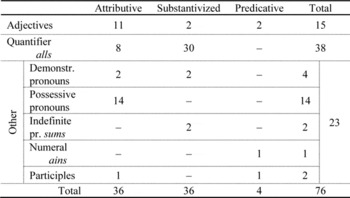
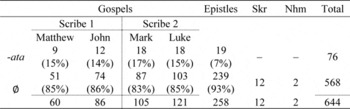
The above discussion of the data of attested -ata forms in Gothic draws on a corpus of 76 examples across several word classes, including prototypical adjectives, the quantifier alls, demonstrative, possessive, and indefinite pronouns, a numeral and two past participles. Thus, the competition of the bare stem with the pronominal -ata form in the neuter nominative and accusative singular does not merely apply to adjectives, but in fact affects all types of modifier capable of taking the strong inflection. Table 1 contains a summary of the basic findings.
Syntactic functions and quantitative distribution of -ata forms in Gothic.

The figures in table 1 generalize upon two dimensions in the use of -ata: distribution across the affected word classes and distribution across different syntactic environments. The data reported in the table indicate that, although a fair share (20%) of the total of -ata forms are attested amongst adjectives, the bulk (76%) is found amongst the quantifier alls ‘all’—a word that displays strong pronominal properties—and possessive, demonstrative, and indefinite pronouns.
At the same time, -ata forms are not the defining property of attributive modifiers to the exclusion of others: The evidence indicates that they are just as likely to become substantivized, the split being equal between 36 (47%) attributive and 36 (47%) substantivized forms. In addition, there are four attestations of what look like predicative -ata forms. It was suggested in the discussion of the data above that some examples—especially the predicative ones—may be analyzed as ambiguous. However, if the data are taken at face value, with the simplest and most obvious analyses assumed as correct, one must conclude that the attested -ata forms across all three syntactic environments suggest that they are not dependent on syntax and do not represent any syntactically conditioned allomorphy. Nor can they be predictably associated with attribution or substantivization in the sense that the default form in these environments is the bare stem. So, if grammatical regularity is to be understood as the existence of a motivated and predictable pattern, it must be concluded that the appearance of -ata on modifiers is syntactically unpredictable and therefore irregular, even if there is a tendency for the inflection to appear more often in some environments than others.
So far the discussion has been centered on -ata forms alone. However, an informed appreciation of whether or not the forms under analysis are motivated semantically or functionally is impossible without comparing them against bare (nonpronominal) neuter forms in the same paradigm slots. However, this is where the matter gets complicated, as it is not readily apparent what methodological principles should define data selection, and consequently, what items constitute valid material for analysis. Let us consider the implications of the discussion of -ata as given in Wright Reference Wright1954.
With regard to superlatives, Wright (Reference Wright1954:114) states that “the neut. nom. acc. sing in -ata does not occur, and perhaps was not in use.” Regarding the ordinal numeral anþar ‘second, other’, he says that, while it is declined as strong, “the nom. acc. neut. never ends in -ata” (1954:117). Further, regarding possessive pronouns, it is noted that “the possessive pronouns are declined according to the strong declension” but that “the possessive pronouns ending in -ar do not have the form in -ata in the nom. acc. sing. neut.” (1954:123–124).Footnote 12 The demonstrative pronoun jains ‘that, yon’ is said to follow the declension of blinds ‘blind’, a typical strong a-stem adjective, but its “nom. acc. sing. neut. is always jáinata” (1954:127). Lastly, the interrogative pronoun ƕarjis ‘which (out of many)’ follows the inflection of midjis ‘middle’, a typical strong ja-stem adjective, “except that the neut. nom. sing. always ends in -ata” (1954:129). The above can be restated in terms of the following three generalizations.
First, a grammatical category—the superlative—is exempted from the use of -ata. Second, some lexical items do not feature -ata. It is not clear whether this means that the inflection is simply not attested in such cases or that they are immune to it. However, if -ar is understood as a blocking factor, the latter is correct, and -ar should account for the absence of -ata not only in the possessive pronouns unsar ‘our’ and izwar ‘your’, but also in the numeral anþar ‘second, other’. Third, with some lexical items -ata is obligatory. What follows from this is that any items or classes of items that are inflected as strong adjectives but are resistant to -ata should not feature in the corpus of neuter forms because their inclusion would obscure the quantitative assessment of the alternation of bare-stem forms and -ata. However, how much of Wright's discussion is actually foolproof?
There are a total of 18 attestations of superlative neuter forms in the nominative and accusative singular, including 14 attestations of the superlative adjective frumists ‘first, foremost’ and one of the superlative adjective aftumists ‘last, aftermost’, two superlative forms of the adjective mikils ‘great’, and one of the quantifier/adjective leitils ‘little’. There are no attestations of -ata amongst the superlatives. Streitberg (Reference Streitberg1920:131, §189, note 1) suggests that the nonexistence of -ata in the superlative is due to the avoidance of the cluster *-tata. However, as noted by Sturtevant (Reference Sturtevant1947:92, note 4), the attested superlatives are used adverbially and therefore resist the attributive adjectival inflection. It must be pointed out that this proposal is based on an a priori assumption that -ata is inherently attributive—a notion that is in conflict with the evidence of substantivized and predicative use, as detailed above (see also section 3.3 for an explanation of the paucity of -ata in predicative environments). Although it is true that most of the 18 examples of superlatives, including all 14 instances of frumist ‘first’, are used adverbially, it is more important that there is not a single attributive instance of a superlative neuter nominative or accusative singular form.Footnote 13 Thus, there simply is no evidence upon which to conclude that the superlative as a category applicable to the adjective in every syntactic environment can be exempted from the pattern of alternations between the bare stem and -ata. In any case, 18 attestations of superlative adjectives, of which most are used adverbially and 14 are concentrated in one lexical item (frumist ‘first’), would be insufficient even to suggest a tendency.
The same can be said in principle about anþar ‘second, other’, unsar ‘our’, and izwar ‘your’: The neuter forms of all three pronouns are relatively well attested in the nominative and accusative singular (20, 11, and 20 times, respectively), but -ata simply does not occur with them. In the case of unsar and izwar, a tendency may be inferred, as the two pronouns may be seen to form a morphological set that is unaffected by -ata, as different from meins ‘my’, þeins ‘your’, and seins ‘his’, in which -ata is well documented. Anþar might then be thought to resist -ata because of its desinence, by analogy with unsar and izwar. Of course, the hypothesis regarding -ar possessives is unverifiable, as it is possible that the nonoccurrence of -ata in all the attested examples of either word is due to sheer chance. However, if viewed in terms of relative likelihood dictated by the figures of attestation, it is plausible.Footnote 14
The situation with the demonstrative jains ‘that’ and the interrogative ƕarjis ‘which (out of many)’ is even more problematic. There happens to be only one attestation of jains in the neuter accusative singular, there being no attestations in the nominative. Thus, no obligatory rule for the use of -ata can be inferred from the hapax accusative form jainata. The interrogative pronoun ƕarjis is not attested either in the neuter nominative or accusative, and Wright's (Reference Wright1954:129) assertion that its neuter nominative singular form always ends in -ata is therefore counterfactual. It is possible that Wright was mistakenly referring to the indefinite pronoun ƕarjizuh ‘each, every’, with only two attestations of neuter forms in the nominative (ƕarjatoh) and none in the accusative, as well as the hapax accusative form ainƕarjatoh ‘everyone, each’ (nominative ainƕarjizuh). As suggested above, these forms represent concretions of -ata and the enclitic -uh, and as such are not valid evidence of the alternation between the bare stem and -ata. In sum, then, the only verifiable generalization that can be gleaned from the Gothic evidence is that there are no attestations of -ata in the superlative; it is also probable that forms in -ar were incompatible with -ata. However, how does this relate to the problems involved in data selection?
Any discussion of -ata is normally predicated on the assumption that it is an exponent of the strong inflection, which is the system of inflection that encompasses adjectives in the positive and superlative degrees, some quantifiers, pronouns, etc. Surely then, in the interests of a full and consistent description, any item whose paradigm is affected by the strong inflection, including superlatives, the pronouns anþar ‘second, other’, unsar ‘our’, izwar ‘your’, and similar, should be unconditionally admitted into the corpus of data irrespective of whether or not they contain -ata in their attestation. However, this is where the question arises as to whether such a holistic approach is reasonable, because the existence of anþar, unsar, and izwar hints at the possibility that the (non)use of -ata may have been lexically or morphologically conditioned. Consider again Mark 14:15, illustrated in 1b above, and repeated here with more context:
(15)
In this example, the head noun kelikn ‘upper dining room’ in the bracketed noun phrase is modified by a string of three attributes with the same morphosyntactic properties, including two adjectives and one past participle. It is surprising that the past participle gastrawiþ ‘furnished’, surrounded by two adjectives in -ata with which it appears in the same environment, is a bare stem. The only possible explanations for this usage are that gastrawiþ was either simply incompatible with -ata (that is, was lexically conditioned not to be affected by the pronominal inflection), or perhaps -ata was in complementary distribution with the prefix ga- (though the prefix us- in the past participle uskijanata ‘sprung up’ does not prevent -ata from being used). Thus, example 15 suggests that lexical conditioning may be a factor to keep in mind in the assessment of the data.
In other words, it would probably be safe to assume that, because the interrogative pronoun ƕas ‘who’, documented only in the singular and inflected as a strong adjective, contains no -ata in its corpus of 174 neuter nominative and accusative singular attestations, it was lexically conditioned not to be augmented with -ata and could only appear as the bare stem ƕa in these paradigm slots. As a result, the absence of -ata in the neuter of ƕas is perhaps not an attestation gap, and the pronoun is irrelevant for the discussion of the alternation between the bare stem and -ata. In contrast, if the 174 instances of ƕa were to be counted toward the total number of neuter pronoun forms, it would have a serious impact on the quantitative assessment of the relative incidence of -ata in pronouns. It must also be pointed out that assuming the possibility of lexical or morphological conditioning is problematic for the treatment of adjectives, as the majority of attested adjectives in the neuter nominative and accusative singular are either hapax forms or are very poorly documented, making it impossible to judge whether the nonuse of -ata with them is motivated by any conditioning factors.
At the other extreme, it may be seen as “safer” to consider only the neuter forms of those items that contain -ata in their attestation. This, however, would be equally misguided methodologically: Given the very limited nature of the Gothic corpus, such an approach would at best generalize on the incidence of -ata within the attestation of individual lexemes, or small groups of lexemes, which would result in nonsensical or seriously distorted relative quantity values. For example, on this approach, the incidence of occurrence of -ata in participles would be 67%, where the percentage generalizes on the two attestations of -ata amongst three eligible tokens, but says nothing about the incidence of -ata in participles as a lexical class. This approach is therefore outright unacceptable.
Thus, there appears to be no single correct guiding principle for collecting data. As a result, in an effort to produce as accurate a description as possible given the nature and scope of the Gothic evidence, several practical decisions had to be made in assessing the suitability of data for quantitative analysis. The corpus of nominative and accusative neuter forms of adjectives and quantifiers only includes items in the positive degree; the superlatives were disqualified on the grounds that they are derived forms that make up paradigms of their own, including both strong and weak forms. The possessives in -ar, the numeral anþar, and the pronoun ƕas have similarly been excluded on the grounds discussed above. At the same time, items that cannot be ruled out on any formal grounds have been included irrespective of their frequency of occurrence.
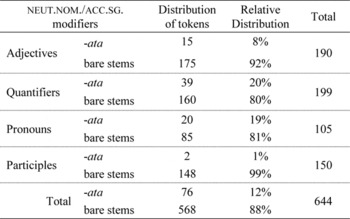
As previously noted, a parallel discussion of occurrence of -ata on the one hand, and the incidence of bare neuter nominative and accusative adjectives and other modifiers on the other will help shed light on the regularity in the use of -ata in relation to the more common bare stem. In the following discussion, the modifiers under analysis have been grouped into four broad classes: adjectives, including all kinds of qualitative, classifying, multiplicative, and other types; quantifiers, including the quantifier alls ‘all’, the numeral ains ‘one’, as well as the quantifiers leitils ‘little, few’, and manags ‘many’, the latter two traditionally classified as adjectives; pronouns, including the demonstratives jains ‘that’ and swaleiks ‘such’, the possessives meins ‘my’, þeins ‘your’, and seins ‘his’, and the indefinite pronoun sums ‘some’; and past participles. The results of the relative distribution of neuter forms are summed up in table 2 below.
Relative distribution of neuter bare stems and -ata.

Table 2 collates the quantitative data for the four types of neuter modifiers. It is evident that each type is attested in the data sufficiently frequently for reliable generalizations about the relative share that -ata has alongside bare stems in the same paradigm slots. The results generally confirm the quantitative tendencies in the use of -ata across word classes reported in table 1. The difference is that pronouns and quantifiers can be seen to have a nearly identical rate of incidence and that, at 1%, -ata participles are not simply few but are, in fact, relatively uncommon. Thus, three groups of lexemes are identifiable on the basis of the relative frequency figures: quantifiers and pronouns, defined by the highest rate of incidence, followed by adjectives and, at the very outskirts of the corpus, past participles.
Perhaps the most important generalization that emerges from table 2 is that, at 12%, the share of -ata in the corpus of neuter forms is rather small, but not as insignificant as might otherwise be supposed. Of course, the overall figure for the distribution of -ata in relation to bare stems is higher on account of the high relative values for quantifiers and pronouns. However, at 8%, the relative share of -ata in adjectives is not far behind, indicating that its appearance is perhaps not a mere accident of usage—the more so in view of the assumption that -ata may be applicable only to part of the attested lexemes within the heterogeneous adjective group, as suggested above with reference to lexical conditioning. If this were found to be the case, the actual relative figure for adjectives would be higher, though in reality the validity of this assumption cannot be ascertained. However, support for it may be sought in the fact that the much more homogeneous group of -ata quantifiers and pronouns has a significantly higher relative rate of incidence. Thus, an assessment of the distribution of -ata in relation to bare stems across different types of lexemes adds a quality dimension to Jellinek's (Reference Jellinek1926:130) and Kieckers's (Reference Kieckers1928:154) observation that “-ata forms are much rarer than endingless ones,” indicating that the appearance of -ata on modifiers is not only less rare than it seems at first sight, but its occurrence is in some way meaningful.
3.2 Semantic Factors and Contextual Variation
In discussing the variation between the pronominal -ata and nominal bare-stem neuter forms, it is common to look for semantic factors that might affect the choice of one form over the other. For example, Kieckers (Reference Kieckers1928:154) suggests that there is no difference in meaning between the nominal and pronominal forms. In contrast, Braune & Heidermanns (Reference Braune and Reiffenstein2004:115, note 2) state that, where the two forms appear in competition, the pronominal form performs a determining or anaphoric function. They supply two examples in support of this claim: halbata aiginis meinis ‘half of my goods’ in Luke 19:8 (see example 5a for a fuller context) and mel mein … meinata mel ‘my time’ in John 7:6 and 7:8, as illustrated below:
(16)
The form halbata ‘half’ in example 5a is one of only two attestations of this adjective, the other one, in Mark 6:23, being feminine (halba). The low occurrence of this adjective affords no room for discussion of competing forms, and it is therefore unclear on what basis halbata may be read as performing a determining function. In example 16b, the pronominal form meinata ‘my’ does indeed have the appearance of anaphoric use because it follows the nominal form mein ‘my’ from the previous context. However, this arrangement may simply be due to pure chance and therefore have nothing to do with anaphoric reference, as there are examples of contexts such as John 6:54, 6:55, and 6:56, below, in which no such regularities are observed:
(17)
Example 17b contains two neuter nominative singular instances of the possessive pronoun meins that may be seen to refer anaphorically to the previous context in 17a in the same way that meinata in 16b allegedly refers to mein in 16a. However, of the two possessives in 17b only the first one takes -ata. The possessives in 17c are a further counterexample, as here both instances of the possessive pronoun are bare stems in spite of any possible anaphoric reference to the two previous contexts, of which 17a is almost entirely identical to 17c.
Thus, any such semantic or functional motivations for the use of -ata may be ruled out based on examples of variation in similar or identical contexts. Consider two further examples from Luke 4:5 and Mark 9:2:
(18)
Although the examples in 18 illustrate two different situations, they share the phrase ana fairguni hauh(ata) ‘onto a high mountain’, used in similar circumstances. In neither case does the phrase refer to the previous context, so there does not seem to be any semantic or functional justification for the use of -ata in 18a over the bare form in 18b.
Similarly, the past participle wagidata ‘shaken’ from Matthew 11:7 in example 14 can be compared with the same context in Luke 7:24, in which the same participle appears as a bare stem wagid, with no evident semantic or functional difference: raus fram winda wagid? Perhaps an even more surprising instance of such vacillation involves the quantifier alls ‘all’ in substantivized use:
(19)
The syntactic context involving the quantifier alls ‘all’ in this sentence is the same; yet in the first two instances the quantifier has the pronominal inflection, as opposed to the other two, which are bare stems. This example illustrates a reverse pattern to the one suggested for 16a and 16b, as the pronominal forms here precede rather than follow the nominal bare-stem ones. So, the competition between the forms in 19 clearly does not involve any anaphoric reference; nor is there any sense of definiteness or determination, as the substantivized quantifiers express abstract and generic concepts. As an interim conclusion it may therefore be suggested that the use of -ata with adjectives or other modifiers does not have any autosemantic or functional import.
So far, any discussion of the competition between the bare stem and -ata has drawn either upon individual examples or pairs/sets of individual examples, without reference to the context of the situation in which the examples occur. What emerges upon examining the distribution of examples across the Gothic corpus is that there is an unusual concentration of five instances of -ata in one chapter of the Gospel of John, namely, John 17:6, 6, 14, 17, 26. Consider the following:
(20)
Between examples 20a and 20b there are three instances of possessives in -ata. What is distinctive about these forms, as well as the remaining two -ata possessives in John 17:14 and 17:26, is that all of them appear in a context where Jesus directly addresses God, referring either to the name of God (þeinata namo ‘your name’, namo þeinata ‘your name’) or the word of God (waurd þeinata ‘your word’). This set of examples clearly illustrates that -ata is contextually motivated, as the Gothic translator chooses the more iconic pronominal forms in direct address as a more proper, or formal, or emphatic, elevated, archaic-sounding, and perhaps, therefore, reverential mode of reference to what relates to God. This is further corroborated by the fact that, as a form that occurs in direct address to the actual or intended interlocutor, and one that therefore warrants a sense of formality, the 2nd person possessive þeinata, with eight examples, is better documented than either the 1st person possessive meinata (four examples) or the 3rd person possessive seinata (two examples). The latter form is also the least likely to have the pronominal inflection by virtue of its 3rd person address, devoid of the stylistic overtones of 2nd or 1st person reference.
This generalization regarding -ata being contextually motivated is confirmed by many examples in which it occurs within direct address, including Mark 8:17 in example 3 and Matthew 6:22 in 9, amongst others. The pattern in John 17 is in contrast to examples with bare-stem possessives such as mein waurd ‘my word’ and waurd mein ‘my word’ in John 8:37, 43, 51, 52, John 14:23, and John 15:20, where reference to one's own word does not warrant the use of the reverential form. To these could be added namo mein ‘my name’ in Mark 5:9 and Romans 9:17, as well as namo þein ‘your name’ in Mark 5:9 and Luke 8:30. The latter two are used in direct address to demons (Legion) rather than God, and the standard neutral form of the pronoun is therefore preferred.
As well as being associated with direct address, -ata is common in rhetorical contexts. Consider the following:
(21)
In 21, the sentence has the form of a question. However, in this case the question is the last of a series of four questions that deliver an emphatic message rather than elicit a response. The highly charged rhetorical circumstances in which the question is posed may be seen to trigger the use of the stylistically distinctive -ata form of the possessive pronoun meins ‘my’. The notion that -ata appears in stylistically charged rhetorical circumstances of various kinds is corroborated by contexts such as Romans 7:12 in example 4, Mark 10:27 in 6a, John 7:8 in 10b, and many others.
Although the generalization regarding the stylistic motivations of -ata as detailed above is generally straightforward, it does not apply universally. Compare the following:
(22)
In 22a, the use of the reverential form þeinata is in line with the circumstances of direct address that define the use of -ata in John 17. However, contrary to one's expectations in light of John 17, the example from the Lord's Prayer in 22b has the bare-stem possessive þein in a context where the reverential form with -ata might seem equally justified. One possible way to explain the use of the bare stem in 22b is as a stylistic variant used at the discretion of the translator, who opts for the lighter neutral form in a context designed for habitual recitation. Perhaps more importantly, the choice of the stylistically lighter form may have theological underpinnings. In particular, in teaching his disciples the Lord's Prayer, where God is addressed as Father (a metaphor only rarely used in the Old Testament), Jesus fosters a more personal and intimate relation with God than previously entertained. As a result, the more informal form þein is preferable in this context to the stylistically charged form þeinata. Footnote 15 In addition, a factor that may affect the form of the pronoun is the rhythmic composition of the opening to the Lord's Prayer, where the use of the short form þein helps avoid a cumbersome dactylic cadence and maintain symmetry between two pentasyllabic clauses (þu in himinam ‘You in heaven’ and weihnai namo þein ‘hallowed be Your name’), as well as a structural parallel with the clause-final monosyllabic form þeins in the following clause: Matthew 6:10 qimai þiudinassus þeins ‘Your kingdom come’.
Thus, in 22b the bare stem þein presents a divagation from the pattern observed in John 17. However, because this divagation can be explained in terms of individual circumstances of usage—whether theological, stylistic, or rhythmic—it does not undermine the generalization. As a result, although the set of examples in John 17 furnishes a robust generalization, the generalization does not translate into a prediction of where -ata forms should occur because they are not required by any rule in the grammar.
This, then, makes it clearer why there are instances of bare neuter forms competing with -ata in identical or similar contexts: Sometimes the translator feels the need to use the longer and more expressive form, but this does not mean that -ata has to be used in a similar context every time. Hence the vacillation between the bare stem and -ata in examples 17–18, wagidata in Matthew 11:7 (example 14), and wagid in Luke 7:24, and elsewhere. By the same token, Mark 2:9 (as well as the contextually similar Luke 5:24) is in contrast to Mark 2:11, as illustrated below:
(23)
Similar to the examples in John 17, þeinata in 23a (and Luke 5:24) appears within direct address. However, the contextually similar example in 23b has the bare stem in spite of the fact that both examples are located in close proximity in the Gospel of Mark (thereby also invalidating any claim to the anaphoric use of -ata). What is also interesting about example 23a is that the possessive pronoun þeinata ‘your’ postmodifies a noun already modified by the demonstrative þata (Greek ton krabbaton sou lit. ‘the pallet your’). This use of -ata may therefore be seen to echo the demonstrative þata in the same phrase. This, however, is not borne out by the evidence from Mark 2:11 in 23b, or other examples of the bare stem of the adjective being used alongside þata (for instance, see John 6:55, Matthew 5:29, 2 Timothy 1:12, etc.).
If -ata is understood as an element exploited for stylistic effect and used at the discretion of the speaker, this also eliminates the need to look for any complex explanations of the variation between the bare stem and -ata within contexts like John 6:55 in example 17b and 1 Corinthians 13:7 in example 19. Both examples illustrate a switch from -ata to the bare stem within sequences of eligible modifiers: leik meinata ‘my flesh’ to bloþ mein ‘my blood’ and allata ‘all’ to all ‘all’. The latter example, in particular, is peculiar because the switch occurs without any apparent conditioning factors. In all four instances of the variation, the forms allata and all appear in a repetitive sequence as direct objects of their respective verbs: allata þulaiþ ‘bears all’, allata galaubeiþ ‘believes all’, all weneiþ ‘hopes for all’, and all gabeidiþ ‘endures all’. The original Greek has the accusative form panta ‘all’ in all four instances, yet in Gothic, two pronominal forms followed by two bare stems are attested. It can only be speculated at this point that the Gothic translator is manipulating stylistic effects, and the emphatic nature of the repetitive structure in which the quantifiers occur calls for a stylistic contrast between the special pronominal and standard bare-stem forms. Finally, because in both John 6:55 (example 17b) and 1 Corinthians 13:7 (example 19) the -ata forms are sentence-initial, it may appear that the pronominal neuter forms are more likely to appear in sentence-initial positions. However, this is contradicted by the evidence from examples such as Luke 15:13 and 15:14, in which the forms seinata ‘his’ and jainata ‘that’ are sentence-final and clause-final, respectively.Footnote 16 At the same time, in Matthew 6:22 (example 9) -ata affects the second in a sequence of three eligible neuter modifiers. Consequently, -ata does not appear to be motivated by the position of the neuter modifier within the sentence.
In conclusion, it does not seem that the use of -ata with modifiers can be justified either on semantic or functional grounds. Instead, the evidence of the variation between the bare stem and -ata points toward the Gothic translator making individual stylistic choices.Footnote 17 These stylistic choices are manifest in possessive pronouns, and especially the second person possessive þeins ‘your’, whose use in direct verbal engagement warrants the use of the pronominal form. As suggested above, -ata may be associated with contexts such as reverential address, rhetorical declaration, and the like. This, however, should not be taken to mean that the inflection actually stands for the grammatical category of respect or is an exponent of any particular category or meaning. Rather, it is a form that tends to surface where the stylistic circumstances of the context, whether direct address, rhetoric, emphasis, formality, and the like, are such as to justify a higher degree of expressiveness. The main difficulty with -ata, especially in adjectives, is that in most cases the contexts and the words affected by it are different. Therefore, the words in which -ata occurs do not lend themselves to arrangement into a transparent pattern. As a result, the use of -ata appears erratic, and if each example is judged in isolation, there is indeed no apparent difference between the bare stem and -ata. What is important, however, is that the pattern in John 17 shows that -ata in possessive pronouns has contextual stylistic under-pinnings. By extension, this suggests that the use of -ata with adjectives and quantifiers is equally meaningful, even if as a non-native speaker of Gothic, one is insensitive to the inflection's stylistic coloring.
3.3 Grammatical Factors
In addition to being motivated contextually, -ata also seems to be occasionally triggered by different factors in the grammar. Perhaps the most compelling example of -ata being grammatically motivated is found in Philippians 3:8. Compare the Gothic rendering in 24a with the original Greek version in 24b.
(24)
A comparison of the above Gothic and Greek examples indicates that Gothic innovates the quantifier allata, unattested in Greek (or Latin), as a way to clarify the reference of the phrase domja smarnos wisan lit. ‘I deem rubbish to be’, as it is obscured by the fact that the quantifier alls in the previous clause occurs in the dative. In contrast, in Greek both occurrences of the quantifier are in the accusative, with the second panta serving as the object of both the verb ezēmiōthēn ‘I forfeited’ and the phrase hēgoumai skubala einai lit. ‘I am deeming refuse to be’. Thus, in translating the verse, Gothic inserts the object allata as a point of clarification, overtly realizing what in Greek is an object inferred from the previous clause.Footnote 18
As suggested in section 3.2, -ata is commonly observed in contexts that are either syntactically awkward or difficult to interpret—see discussion of examples 3, 4, 7, 11b, and 12. Of these, Mark 7:8 in 11b, as well as an almost entirely identical example in Mark 7:13 (jah galeik swaleikata manag taujiþ ‘And many such things you do’), illustrates -ata within a complex and potentially awkward string of modifiers, where it is hard to identify the head constituent. It is possible that the use of -ata here has a clarificational purpose, as the higher distinctiveness of the pronominal form marks it as the head. It is also possible that -ata identifies swaleikata as a substantivized form—after all, it is probably not an accident that substantivized modifiers amount to about half of the -ata corpus (see table 1).
The use of -ata in Luke 15:13, illustrated in example 25 below, is reminiscent of Philippians 3:8 in 24a.
(25)
In 25, Gothic uses the phrase brahta samana to translate the Greek participle sunagagōn ‘gathering together’. Similar to allata in Philippians 3:8, here the quantifier takes -ata in order to make it clear that it is the object of a transitive verb phrase, which is a more awkward structure than the single participle in Greek. The use of the pronominal inflection may additionally be motivated by the fact that here, too, allata is a substantivized form, and possibly one that is uttered with an emphasis on the completeness or inclusiveness of the notion denoted by the quantifier. Consider also the following:
(26)
Similar to 25, in the above example the phrase and allata lit. ‘over all; everywhere’ translates the Greek adverb pantachou ‘everywhere’. The same logic as above might also in principle be applicable in 26, where the preposition and governs the accusative case of its object marked by -ata. However, Mark 16:20 is in contrast to Luke 9:6, in which Gothic translates the Greek adverb pantachou as and all, that is, without -ata, in a syntactically similar environment. In the absence of a clear formal explanation of this variation, one can only speculate at this point that in 26 -ata is justified by the elevated tone of the context in which Mark 16:20—the final verse of the Gospel of Mark—occurs, as opposed to Luke 9:6, which is stylistically more neutral.
One more instance of -ata that may potentially be affected by considerations of grammatical transparency is in the translation of the Greek phrase apo merous ‘from part’. In 2 Corinthians 1:14 (example 11a above), it is rendered as bi sumata ‘in part’. Romans 11:25 has <bi> sumata, but the preposition bi here is an unattested editorial addition, suggesting a possible error of omission on the part of the Gothic translator. In contrast to these two renderings, 2 Corinthians 2:5 has the phrase bi sum ain lit. ‘in some unit/one thing’. Thus, the same Greek structure has three different renderings in Gothic, indicating that it was an awkward structure to translate. If ain ‘one’ in bi sum ain ‘in part’ is to be perceived as the head modified by sum ‘some’, then the use of -ata as a substantivizer in (bi) sumata ‘in part’ speaks for itself. As a result, in the former two examples, the translator may be seen as choosing the morphologically better characterized pronominal form in substantivizing the pronoun, as on its own the phrase bi sum might be expected to be followed by a nominal head. Of course, this is just a speculation. However, it is perhaps significant that all of the attested bare neuter nominative and accusative examples of sums ‘some’ are modifiers, whereas the two examples of sumata are substantivized.
Finally, essential to the discussion of -ata as a grammatically motivated form is the issue of the inflection's quantitative distribution between the two paradigm slots with which it is associated. Although -ata is traditionally reported to occur in the neuter nominative and accusative singular, an examination of the 76 examples reveals that the pronominal form is actually relatively uncommon in the nominative, with only 21 (28%) examples, compared with 55 (72%) examples of the accusative. In light of the syncretism that generally defines the morphological realization of singular neuter forms in the nominative and accusative across Indo-European (Szemerényi Reference Szemerényi1996:159, Fortson Reference Fortson2010:114, Beekes Reference Beekes2011:215), the tendency for -ata to dominate in the accusative in Gothic is indicative not merely of its status as a special form, but also of Gothic being unique in creating a distinction in the realization of these neuter case forms.Footnote 19
In addition, the distribution of -ata between the nominative and accusative, and in particular its preference for the accusative, furnishes a useful insight into its syntactic patterning. The bulk of the nominative attestations of -ata (14 examples out of 21) are in the quantifier alls ‘all’, of which 10 are substantivized forms acting as syntactic subjects and four are attributive modifiers. Generally, the substantial corpus of 119 neuter nominative and accusative singular forms of alls (including 81 bare stems and 38 attestations of -ata) does not contain a single predicative example. The evidence shows a clear tendency for this neuter quantifier to be used substantively, with 98 (82%) substantivized attestations (principally acting as syntactic subjects or objects) and 21 (18%) attributive attestations. If one considers the evidence of -ata amongst adjectives alone, the ratio is one nominative to 14 accusative attestations. Because, as a rule, predicative adjectives typically appear in the nominative case (except, perhaps, object complement constructions and the like), predicative attestations of -ata forms are then naturally quite rare. Thus, if the quantitative evidence of case usage is taken into account, the low incidence of -ata in predicative contexts, reported in table 1, does not make these predicative attestations exceptional and is simply a consequence of -ata being uncommon in the nominative.
In conclusion, this section has presented evidence for -ata being triggered by different factors in the grammar. Amongst the most important factors are considerations of clarity in syntactically awkward environments, where the more iconic, and morphologically more distinctive, pronominal form is appealed to as a way to resolve any potential ambiguities.Footnote 20 In addition, the high proportion of substantivizations in the -ata corpus suggests that the inflection may have been employed to mark substantivized forms. The inflection's prevalence in the accusative case corroborates its status as a special form; it also suggests that the rare occurrences of predicative -ata forms do not represent an exception. Naturally, these conclusions can only be presented as tentative, as there is no way to verify their accuracy from the point of view of a native speaker's intuitions. However, the collective attestation of potentially awkward contexts gives the appearance of being systematic rather than random.
3.4 Metrical Factors
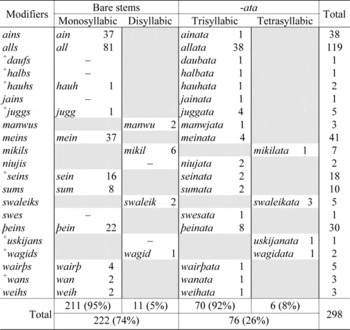
The variation between the bare stem and -ata generates not only different morphological forms but also different prosodic forms, suggesting the possibility that the former may correlate with the latter. Thus, the discussion of this alternation should make reference to prosodic morphology, namely, the notion that the output of form-affecting operations is linked to prosodic categories (Miller Reference Miller2014:144). It is well known, for instance, that some aspects of Gothic noun and verb stem morphology were sensitive to the prosodic and structural properties of root syllables. In particular, the -ja- stems of nouns and verbs show variation between -ji- and -ei- in some paradigm slots depending on such variables as the length and openness of the root syllable (see Wright Reference Wright1954:150, Guxman Reference Guxman1958:94, Jasanoff Reference Jasanoff and Woodard2008:196). It is also well established that prosodic considerations may be an important factor in sound change and, by extension, morphological change. For example, Miller (Reference Miller2010a:238–269) argues that words optimally tend toward duple timing, and that words of two short or two long syllables are stable; short monosyllables have a predisposition toward lengthening; words of three beats tend to be shortened in favor of being duple-timed.Footnote 21 Miller (personal communication) emphasizes, however, that monosyllables generally lack optimality—except when they are clitics—and tend to be avoided, whether they are duple-timed or not. With this in mind, it is important to investigate whether or not the variation of the bare stem and -ata in Gothic is driven by the avoidance of, or preference for, a given prosodic model of the word. Table 3 compares the syllabic structures of bare-stem and -ata neuter forms and their distribution in the relevant lexemes.
The two apparent aspects that emerge from table 3 are that in the corpus of 21 modifiers affected by -ata, the attested bare stems are predominantly monosyllables, and that -ata forms are predominantly trisyllabic, of which the majority are dactylic trisyllables. Overall, -ata is observed to augment 15 monosyllables, out of which there is no attestation of the bare stems of daubata, halbata, jainata, and swesata. The 11 attested monosyllables are all duple-timed  (two beats), including mostly trimoraic structures with either a long root vowel or a complex coda in the rhyme of the syllable such as ain, all, jugg, mein, wairþ, etc. and bimoraic ones such as sum and wan.
Syllabic structure of bare-stem and -ata modifiers.

The augmented output forms with -ata are mostly dactylic trisyllables  (four beats): ainata, meinata, etc. In each of the bare-stem monosyllables, the augmentation of -ata occasions a shift of syllable boundary, with the coda consonant of the monosyllable becoming the onset of the following syllable. However, in most cases, except sumata and wanata, this repositioning of the (final) coda consonant has no impact on the metrical output of the augmented forms. The initial syllables in al.lata, hau.hata, jug.gata, wair.þata, etc. remain heavy, and the augmented forms are duple-timed dactyls . Thus, duple timing is involved in both the heavy monosyllables and in their output forms in -ata, where the first long syllable counts two beats, followed by two beats of the two short syllables. The augmentation of sum and wan causes a shift of syllable boundary, dissecting the source monosyllable, and in this case the output forms su.mata and wa.nata are tribrachs ∞∞∞. Such trisyllabic formations are inherently unstable and subject to shifting to triplets by word compression (Miller Reference Miller2010a:239ff.), which renders them duple-timed.
The predominance of duple-timed dactylic forms in the -ata corpus raises the question of whether, in a morphologically ambiguous situation with two readily available alternatives, there was a preference for metrically sound dactylic forms in -ata over defective monosyllabic feet such as ains, alls, and the like.Footnote 22 Whereas the overall figures for the relative distribution of bare-stem and -ata tokens (74% versus 26%) indicate a clear preference for the bare stem, token frequency-based generalizations are too broad in that they presuppose compromising on control for possible confounding variables. For instance, the overall figures for token frequencies in table 3 generalize over such variables as attestations of -ata that have no bare-stem counterparts, as well as -ata trisyllables with unattested or attested disyllabic bare neuter counterparts. It would therefore seem more methodologically accurate to compare the figures for the better-attested lexemes, as laid out in table 4.
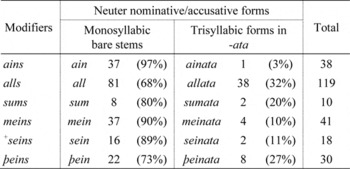
Distribution of monosyllabic and trisyllabic neuter forms in selected lexemes.

Table 4 reports two distinct tendencies in lexemes with a total of at least 10 attested tokens. The relative figures for monosyllabic bare stems and -ata suggest a clear preference for the bare stem—hardly a surprising finding in view of the fact that the bare stem is generally much more common than -ata (see also discussion in section 3.1 above). Far more important are the relative figures for trisyllabic modifier forms in -ata. The uneven distribution in the relative figures for the trisyllabics, with ainata at the bottom end and allata at the top end of the scale, presents a mixed picture of the use of -ata, highlighting an absence of internal consistency. The evidence from the possessive pronouns as a group of items with identical stem structures also shows a clear internal asymmetry between the pronouns meins and seins on the one hand, and þeins on the other, with þeins being nearly three times as likely to be affected by -ata as either meins or seins. This lack of alignment in the relative figures for -ata amongst items with the same metrical properties indicates that the use of -ata was unlikely to have been metrically conditioned, and some other factors were at work in the alternation.
As noted above, the concept of duple timing is applicable both to the dominant monosyllabic bare stems and their output dactylic -ata counterparts. In theory, if the duple timing of these monosyllabic bare stems were taken to suggest that they are stable forms that do not require lengthening, this would predict that they should not be subject to pronominalization with -ata. However, while there is clearly no tendency for the use of dactylic forms to be inferred from the sole attestation of ainata, this prediction is not borne out due to the significant relative numbers for allata (32%) and þeinata (27%). As a result, and contrary to expectations, duple-timed monosyllabic feet (two beats) appear in some competition with balanced dactylic forms (four beats), even if there is no case for quantitative preference for -ata to avoid monosyllabic feet.
In contrast, if monosyllabicity is the only criterion that makes the bare-stem forms defective and liable to be avoided irrespective of the timing of the monosyllable, this might help explain the augmentation of -ata on most monosyllables in table 4. However, in this case the well-documented quantifier ains ‘one’ stands in contrast to the other examples because, contrary to expectations, there is only one instance of ainata compared with 37 examples of the bare stem ain. Thus, it seems that the application of neither criterion generates satisfactorily consistent results, and synchronically a metrical argument exclusive of other criteria cannot be constructed with much confidence.
The use of -ata on disyllabic bare stems results mostly in tetrasyllabic forms such as mikilata ‘great, large’, swaleikata ‘such’, wagidata ‘shaken’, and uskijanata ‘sprouted’.Footnote 23 Disyllabic bare stems occasionally also generate trisyllabic forms such as manwjata ‘ready’. The disyllabic bare stems represent different types of metrical form, including the iamb swaleik (three beats), the trochee manwu (three beats), and the dibrachs mikil and wagid (two beats). The output forms involve a dactyl manwjata, three tetrabrachs mikilata, us-kijanata, wagidata, and even the metrically complex structure swaleikata , with five beats (a combination of a monosyllabic foot and a dactyl).
Thus, bare-stem disyllables generate different metrical types of output -ata forms. In general, the attestation of these forms is not reliable enough for quantitative generalizations, and no great significance should be attached either to the preference for the bare stem in mikils (six bare-stem forms versus one -ata) or the preference for -ata in swaleiks (two bare-stem forms versus three -ata). It is perhaps more important that, contrary to probability, -ata surfaces too frequently amongst such poorly attested forms, and that the metrical picture of the output forms is heterogeneous, with no preference for any given type of structure. This suggests that the appearance of -ata in Gothic is unlikely to be regulated by considerations of metrics or timing.
If there were a morphonological rule defined by metrical preference for dactylic forms over monosyllabic feet, the data would be expected to present evidence not only of alignment in the relative values generalizing on the use of -ata across different lexemes, but also of a quantitative preference for dactylic forms over monosyllables in the well-attested lexemes. The evidence discussed above seems to disagree with this hypothesis on both counts. In fact, the figures reported in table 4 suggest that in Gothic, monosyllables were the most stable and preferred forms, with 201 (79%) examples of monosyllabic bare stems compared with 55 (21%) trisyllables. Further, although bare-stem neuter forms are much more common than -ata neuter forms, both types represent hetero-geneous groups in terms of the metrical and timing properties of their tokens. The bare stems are mostly duple-timed monosyllables, but they can also be duple-timed disyllables. At the same time, -ata is promiscuous in that it associates with different types of output: -ata forms are mostly dactyls, but they can also count four short beats, etc.
The incongruities in the relative figures for -ata highlight the absence of an internal pattern. It would therefore be reasonable to conclude that the evidence from variation between the bare stem and -ata in Gothic neuter nominative and accusative modifiers provides little basis for an argument that -ata was employed as a remedy in avoiding any metrically less adequate alternatives. It also does not suggest that the bare stem alternant is a remedy for avoiding the augmented -ata form. At the same time, the evidence from variation in identical contexts, as in example 19 and the like, and the stylistic/contextual motivations in the use of -ata as discussed above (see section 3.2) would seem to rule out the existence of a metrically motivated mechanism governing the alternation.
However, as pointed out to me by D. Gary Miller, even if the above evidence from metrics and timing does not help establish a regular and predictable morphological pattern of alternation as attested in Gothic, this does not preclude the possibility that metrical factors were at work in the development of the alternation. To put it simply, metrical factors may not explain the use of -ata, but they may explain its existence. The most important piece of evidence here is the fact that -ata shows a clear preference for monosyllables: 15 (71%) out of 21 lexemes affected by -ata alternate between monosyllabic bases and dactylic trisyllables. These figures are unlikely to be accidental, and they should be factored in while plotting the development of the strong inflection (see section 3.6 for a discussion of diachronic implications).
Assuming the traditional starting point, where the original form in the neuter nominative and accusative singular is the bare stem, pronominal extensions are introduced into these paradigm slots as rhythmic variants, with a preference for defective monosyllabic bases. At the same time, the principles of increasing productivity and morphological regularization aid in the spread of -ata to bare-stem bases with other metrical properties. The eventual reanalysis of the longer pronominal variants as forms with specific stylistic applications reinforces the productivity of the bare stem as the stylistically neutral variant, preventing the pronominally extended forms from fully replacing the bare stem. Thus, the evidence from preference for dactylic forms in the -ata corpus suggests that metrics and timing may have been amongst several competing factors in the alternation of the bare stem and -ata, in addition to the ones discussed in the previous sections.
3.5 Scribal Preferences
Although it is well known that the surviving Gothic manuscript of the four Gospels is not by Wulfila's hand, it was generally assumed up until the late 1920s that the writing of the Codex Argenteus was the work of one person. This was also the assumption made by Friedrichsen (Reference Friedrichsen1926) in his study of the Gospels. Interestingly, based on his rigorous philological investigation, Friedrichsen (Reference Friedrichsen1926:240–244) concludes that the four Gospels represent two different types of Gothic text, where the Gospel of Matthew allies with the Gospel of John, and the Gospel of Luke with the Gospel of Mark. It was not until a reproduction of the Codex Argenteus was undertaken by von Friesen & Grape (Reference Friesen and Grape1927) and the individual pages were released from the binding and compared side by side, that it became clear that two scribes were involved in producing the Codex, one responsible for the Gospels of Matthew and John, and the other for Luke and Mark (see also Friedrichsen Reference Friedrichsen1930:189–192, Metlen Reference Metlen1937:244–245, Friedrichsen Reference Friedrichsen1939:259, Hunter Reference Hunter and Lampe1969:343ff., Munkhammar Reference Munkhammar2011:126–127). It is especially striking in this regard that the pairing coincides with Friedrichsen's earlier observations on the two types of Gothic text distinguished in the Gothic gospels, of which the pair Mathew–John represents “an older, more primitive, less developed text, and a more ingenuous workmanship,” whereas “Luke and Mark have had a more adventurous career” and display a greater amount of variant readings, with Luke exhibiting an especially high degree of variation (Friedrichsen Reference Friedrichsen1926:119, 241–242). The five Epistles containing attestations of -ata (Romans 1 and 2 Corinthians, Ephesians, Galatians, Philippians, and Titus) are chiefly confined to Codices Ambrosiani A and B, written by different scribes (Streitberg Reference Streitberg2000:481–482; see also Marchand Reference Marchand1957).Footnote 24
The fact that several different hands were at work in the production of the Codex Argenteus and the Codices Ambrosiani inevitably invites the question of whether the variation between the bare stem and -ata may be due to idiosyncrasies in the language of the individual scribes. The following is the distribution of -ata in relation to the bare stem across the four Gospels and the Epistles.
Distribution of -ata modifiers across the Gothic corpus.

The evidence in table 5 indicates that the incidence of -ata across the Gospels is virtually the same relative to the figures for the distribution of the bare stem. In particular, the figures for the Gospels of Matthew (15%) and Luke (15%), written by two different scribes, are identical. At the same time, the difference in the relative figures for -ata between scribe 1 (14.5%) and scribe 2 (16%) is too insignificant to postulate a case for a preference for -ata by scribe 2. The only figure that stands out is the incidence of -ata in the Epistles, which at 7% is roughly half that of either the pair Matthew–John (scribe 1) or Luke–Mark (scribe 2).
It follows from these data that the Gospels represent a more variable type of text than the Epistles, but the lack of internal variation amongst the four Gospels does not support Friedrichsen's (Reference Friedrichsen1926:241–242) notion that any one Gospel or pair of Gospels represented a more variable type of text. Consequently, the symmetrical distribution of -ata across the four Gospels indicates that the variation between it and the bare stem was not so much due to any idiosyncrasies of the individual scribes as it was a systematic and linguistically motivated phenomenon.
In view of the statistically reliable sample of the nominative and accusative singular neuter forms in the Epistles (258 examples, including the bare stem and -ata), the low relative figure of 7% for -ata is surprising. One may surmise that the explanation lies in the textual differences between the Gospels and the Epistles, as there may simply happen to be more contexts in the Gospels that warrant the use of -ata. An alternative argument, referring collectively to the linguistic differences observed between the Gospels and the Epistles, appeals to the problem of the authorship of the Gothic Bible translation, namely, the possibility that the surviving Gothic fragments may be the work of several original translators—a question that should be approached no less seriously than the mainstream Wulfilian dictum (see Friedrichsen Reference Friedrichsen1939:144; Metzger Reference Metzger1977:383–384).Footnote 25
3.6 Diachronic Implications
A number of the points discussed above and conclusions regarding the use and properties of -ata in Gothic translate into diachronically valuable generalizations, with much of the evidence pointing toward -ata being a form in specialized use. Amongst the most important considerations in support of this claim are the relatively low occurrence of -ata in relation to the bare stem of modifiers (12% versus 88%), its use in specific stylistic and rhetorical environments, the tendency for -ata to appear with the less commonly used lexemes, as well as grammatical considerations such as the use of -ata in grammatically awkward environments, its common occurrence in substantivization or in marking modifiers in the accusative case.
The evidence of the quantitative distribution of -ata across different types of modifier is especially interesting. The figures presented in table 2 (section 3.1 above) indicate that -ata shows a stronger preference for some types of modifier than others. In particular, -ata tends to occur mostly with pronouns and quantifiers (20% and 19%, respectively), is considerably less frequent with adjectives (8%), and is only marginally attested with past participles (1%). This gradualness in the percolation of -ata across the modifier lexicon furnishes a diachronic dimension to the development of the strong inflection. If the paradigm of the demonstrative pronoun (Gothic sa, sō, þata) is assumed to have been the original source of pronominal endings in the strong modifier inflection, it makes sense to say that Gothic supplies evidence of a lexical diffusion-type development, where the pronominal endings spread from the demonstrative through other types of pronouns and quantifiers with strong pronominal properties to adjectives.Footnote 26
Based on this evidence from variation between two elements, the bare-stem and -ata forms of neuter nominative and accusative modifiers present in themselves a correspondence set. In accordance with the customary procedure of internal reconstruction, the alternants that make up a correspondence set can be reduced to a single “original” prestructure (Fox Reference Fox1995:187, Bauer Reference Bauer, Jens and Olander2009:18–19). In particular, based on the fact that -ata is a relatively rare form used in stylistically charged environments and appealed to in contexts where a higher degree of semantic and morphological expressiveness is required, it is to be regarded as a residual (relic) form in attested Gothic and can be preliminarily reconstructed as the dominant form in the neuter nominative and accusative singular of modifiers at the very least in pre-Gothic (compare van Loon Reference van Jozef2005:98).
It is also worth pointing out in this connection that all of the Gothic attestations come from the Gothic Bible, and none are found in the Skeireins, which is a later text.Footnote 27 It is therefore conceivable that, as a residual form observed in specialized use, -ata had fallen out of use by the time the Skeireins was recorded. However, it is equally possible that the absence of such forms in the Skeireins is due to its relatively small size. As mentioned in section 2.3, the Skeireins contains the form ƕarjatoh ‘each, every’, which combines the -ata inflection and the enclitic particle -uh. As this pronoun (as well as the form ainƕarjatoh ‘everyone, each’) represents a concretion in which the -ata inflection does not alternate with the bare stem, it is to be regarded as a form that preserves evidence of older usage, where the pronominal inflection has been fixed in the word thanks to the enclitic that follows. As a result, such examples suggest that the use of the -ata form in the neuter nominative and accusative singular may have been more widespread before written Gothic.
It is a good question, though, whether—either in Gothic or Proto-Germanic—the pronominal form was ever the dominant or only form. As suggested in section 3.4 with reference to metrical factors, the clear preference for dactylic forms over other metrical types in the -ata corpus indicates that -ata never became productive enough to replace the bare stem completely. It should also be borne in mind that the reduction of variant forms to one “original” form as suggested above, resulting in a simpler and variation-free system, is a well-known limitation of the method of reconstruction. If at some point -ata was indeed the default form, it is unclear what could have motivated its gradual fall into disuse in favor of the bare stem, given the existence of its source neuter demonstrative þata ‘that’ and the morphological parallel of pronominally inflected forms elsewhere in the paradigm. It is equally strange that an erstwhile fully established pronominally inflected form should develop double exponence by severing the pronominal inflection at the morpheme boundary, as opposed to the inflection being gradually eroded in a word-final environment (-ata > +-ate » +-at, and so on).
In other words, the morphological nature of the variation between the bare stem and -ata is evidence of a development that was in progress for some time but never reached completion, with the neuter nominative and accusative forms never stabilized as pronominal. D. Gary Miller (personal communication) offers a possible explanation for the two outstanding forms: Pronominalization was completed in some paradigm slots earlier than others, with the most ambiguous forms fixed first, the important criterion being that animate (that is, masculine and feminine) forms take priority over inanimates (that is, neuters).Footnote 28 Forms in -ata never became productive enough to displace the bare stem (as suggested by the evidence of their diffusion in the Gothic modifier lexicon) because the relatively slower pace of their penetration into the modifier inflection led to their reanalysis as stylistically specific or formal. The newly acquired stylistic value of the morphologically heavier pronominal forms slowed down their productivity, and the bare stem was kept as the colloquial or neutral form. As a result, and contrary to recent convention, the reconstruction of these forms in Proto-Germanic should reflect competition between the nominal and pronominal variants (compare Bammesberger Reference Bammesberger1990:223, Ringe Reference Ringe2006:281, Hogg & Fulk Reference Hogg and Fulk2011:150).
Ringe (Reference Ringe2006:282) considers evidence of a similar alternation in Old High German (guot versus guotaʒ ‘good’) along with the fact that in Old Norse only the longer neuter form gott ‘good’ was attested (masculine góðr ‘good’; compare masculine hár versus neuter hátt ‘high’). He concludes that the difficulty of tracing the forms in the different languages to the same source, posed by the final vowel in -ata (+-atō), suggests that the development of the pronominal ending proceeded independently in the different branches of Germanic (see also McFadden Reference McFadden2004:130–131 and Reference McFadden2009:66ff.).Footnote 29
However, the collective evidence from the older Germanic languages in which some form of the pronominal ending is attested can suggest a different scenario of development. In particular, these pronominal forms can be seen to go back to an older protoform in the protolanguage; the differences between the attested forms in the daughters provide evidence of a later split whereby the forms were aligned with the individual developments in each given language. In any case, the final vowel in -ata being problematic does not necessarily mean that the reflexes of the inflection in the different Germanic languages have to be independent phenomena. As Jay H. Jasanoff (personal communication) points out, the difference between the Gothic masculine singular accusative form god-ana ‘good’ and Old High German guot-an has exactly the same status as -ata versus -aʒ, but this does not imply that the inflections result from independent developments.
All of the above considerations represent useful material in plotting the development of the strong inflection. As noted in section 1, the traditional account of the development of the strong adjective inflection has recently been brought into question by McFadden (Reference McFadden2004, Reference McFadden2009). On his reasoning, the strong adjective inflection does not come directly from the demonstrative (whose accretions it is generally believed to contain) or any other single pronoun, but rather pronominal adjectives, which originally followed some regular pronominal declension in the Proto-Indo-European system (McFadden Reference McFadden2004:124–125, Reference McFadden2009:57). These pronominal adjectives comprise words such as Gothic ains ‘one’, anþar ‘other, second’, alls ‘all’ and possessives such as meins ‘my’, unsar ‘our’, etc., their crucial feature being that they never take the weak inflection, with their inflection being identical to that of the strong adjectives. McFadden (Reference McFadden2004:125, Reference McFadden2009:57) hypothesizes that following the pronominal adjectives, which were originally completely pronominal in their morphology, the “Germanic strong adjectives adopted the fully pronominal inflection of the P-As wholesale, in every form” (emphasis in the original).
The main weakness of McFadden's hypothesis, interesting as it may be, is that it lacks comparative credibility. The assumption that the pronominal adjectives were originally (that is, originally in Proto-Indo-European) completely pronominal must be supported by evidence from the Indo-European daughter languages. However, although some forms such as Proto-Indo-European +ályod ‘all’ (Lat. aliud) are pronominal in the inflection (McFadden Reference McFadden2004:124, Reference McFadden2009:55; Ringe Reference Ringe2006:144), the pronominal argument does not apply to the possessive pronouns. Nor is there any evidence that the inflection of adjectives was either completely, or even partly (that is, to the same degree that it is in Germanic), pronominal in Proto-Indo-European. As a result, the hypothesis founded on the transition Proto-Indo-European pronominal adjectives→ Germanic completely pronominal adjectives → Germanic strong adjectives pronominal in every form involves a series of unverifiable assumptions, and the lack of consistent comparative evidence for completely pronominal adjectives in Proto-Indo-European seriously undermines McFadden's hypothesis. It is also not very clear on what basis McFadden draws a borderline between demonstratives and pronominal adjectives in claiming that the demonstratives were not the original source of pronominal endings for the strong inflection, as the inflections of the pronominal adjectives are uncontroversially the original inflections of the demonstratives.Footnote 30
By comparing adjective, nominal, and pronominal paradigms Schwink (Reference Schwink2004:83–84) similarly proposes that the Germanic strong adjective inflection was pronominal from the start, thereby strongly diverging from the classical Indo-European languages and serving as “evidence of Germanic having gone its own way from an early period.” Schwink attempts to explain the existence of nominal inflections in the adjective paradigm as innovations either motivated by homophony avoidance (the nominal -s in the masculine nominative singular replacing the potentially ambiguous pronominal -a) or by simply losing out to the nominal inflections, where the nominal and pronominal inflections are each a single phoneme (hence the nominal -a, but not pronominal -o, in the feminine and neuter nominative singular). The only outlier that does not fit in with these explanations is the nominal -ai, rather than pronominal +-aizai, in the feminine dative singular, which, according to Schwink (Reference Schwink2004:84), does not get in the way of the general argument because this slot is pronominal in the other older Germanic languages. As regards -ata, in Schwink's (Reference Schwink2004:83) opinion it represents an older layer that is being replaced by the newer nominal bare stem, which may have been analogically motivated by the nominal forms of the masculine and feminine nominative singular.
Similar to McFadden's hypothesis, Schwink's proposal appeals to the significant pronominal element in the attested adjective paradigm in contemplating a theoretical possibility that the original paradigm may have been fully pronominal. However, the lack of comparative support for such a hypothesis makes it similarly unsustainable. Futhermore, Schwink's proposal is uneconomical in that it targets the few different obstacles (that is, nominally inflected paradigm slots) to his hypothesis individually.
By contrast, assuming an originally nominal state in the inflection of the strong paradigm is not only comparatively legitimate, but all that is left to be explained in this case is the few unambiguously nominal slots in the paradigm. These admit a simple and natural explanation in terms of the single-phoneme desinences of the demonstrative in these slots not being sufficiently well characterized to replace the original nominal desinences, rather than the opposite, that is, the “newer” single-phoneme nominal desinences win over the “older” single-phoneme ones for inexplicable reasons. Nor does the proposal that the analogy between two nominally inflected paradigm slots motivated the severing of an established pronominal form at the morpheme boundary present a compelling explanation for the variation between the bare stem and -ata. Finally, it is conceivable that the feminine dative singular inflection -ai in the Gothic adjective is a simplification of the older pronominal form in +-aizai, the evidence of which is well preserved in the Germanic daughter languages.
As an alternative to McFadden's and Schwink's hypotheses, some useful evidence for understanding the development of the strong inflection comes from the Gothic data as discussed above. The evidence from Gothic -ata forms indicates that they occur more commonly amongst quantifiers and possessives (that is, “pronominal adjectives”), which suggests that, by virtue of having pronominal properties, these word classes were more susceptible to pronominalization. It is possible, then, that adjectives acquired their inflections from demonstratives via pronominal adjectives by lexical diffusion, but it is doubtful that the spread of pronominal desinences in the strong inflection was as neat as demonstratives → pronominal adjectives → adjectives.
Instead, it would make more sense to develop a hypothesis founded on multiple motivations and propose that a large-scale analogical process of pronominalization was underway in Proto-Germanic. The morphologically more iconic (that is, better characterized) inflections of the demonstrative pronouns were passed on to other modifiers (all word classes at the same time), with some word classes affected more strongly than others (see also Bahnick Reference Bahnick1973:82 and Žirmunskij Reference Žirmunskij, Desnickaja, Guxman and Kacnel'son1976:216).Footnote 31 Even if it is true that the pronominal adjectives were the first to be pronominalized, it was the tandem of the demonstratives and pronominal adjectives, boosting the productivity of the new pronominal system of inflection, that affected the inflection of regular strong adjectives but not the pronominal adjectives on their own. The alternation between the bare stem and -ata as it is attested in Gothic is testament to a process of pronominalization of the strong modifier inflection early in the development of Germanic that never reached completion (in this regard, compare Zadorožnyj Reference Zadorožnyj1960:203 and Burobin Reference Burobin, Ekaterina and Zeleneckij2011:192).
To conclude, the variation between the bare stem and -ata in Gothic presents in itself a historically significant artifact, whose main value resides in capturing a change in progress. The particulars that define the variation, coupled with the evidence for related developments in Old High German and Old Norse, allow the reconstruction of an earlier stage before or around the break-up of Proto-Germanic. According to the reconstructed scenario, during that stage the demonstrative pronoun started encroaching upon the inflection of other modifiers, with possessive pronouns and quantifiers serving as a bridge in the spread of pronominal inflections across the modifier lexicon.Footnote 32
4. Conclusion
Not much is left of the traditional hypothesis explaining the variation between the bare stem and -ata in the neuter nominative and accusative singular set out at the beginning of this paper. Not only is the variation not confined to any one conditioning factor, but it also cuts across a number of domains, including morphology, syntax, stylistics, prosody, etc. Let us review some of the basic arguments and findings.
The research reported in this paper set out with a dual goal of examining the circumstances that condition the variation between the bare stem and -ata in the Gothic data and assessing the historical value of the synchronic findings and generalizations. The corpus of 644 Gothic neuter nominative and accusative singular adjectives, quantifiers, possessive, demonstrative, indefinite pronouns, and past participles examined in this paper contains 76 (12%) examples of pronominally inflected forms in -ata, confined to the text of the Gothic New Testament. Although the relative figure of 12% does confirm that -ata was less common than the bare stem, it is statistically significant as it indicates a one-in-ten rate of appearance, suggesting a degree of regularity. The distribution of -ata across the modifier lexicon shows a preference for “pronominal” word classes, with 58 (76%) examples of different types of pronoun as well as the quantifier alls ‘all’. With a total of 15 (20%) examples, adjectives are a minority group. The taxonomic generalization that follows from this is that the strong modifier inflection in Germanic is not so much the “adjective inflection” as it is the inflection of pronominal classes of modifiers. A comparison of the Gothic evidence with Greek and Latin texts indicates that the variation attested in Gothic is independent of either Greek or Latin; nor can any of the scribes be implicated in showing a stronger preference for one form over the other. Judging by quantitative tendencies, it is possible, however, that the desinence of the Greek form panta ‘all’ is responsible for the higher occurrence of -ata with the quantifier all ‘all’.
The examination of the syntax of -ata modifiers helps dispel another traditional dictum, namely, that the variation between the bare stem and -ata is regulated by syntactic criteria, and that -ata is impossible or exceptional in predicative environments. The quantitative evidence indicates that -ata is equally likely to be found in attributive and substantivized environments, even if the evidence for the latter is mostly based on the copious attestation of substantivized forms in the quantifier alls ‘all’. Three of the four predicative examples of -ata may pose difficulties of interpretation and be analyzed as ambiguous, but the criteria of internal structure, semantics, and context of the sentences lend strong support to their predicative reading. In addition, the scarcity of these predicative examples is explained by the tendency of -ata to occur in the accusative case. Thus, the (non-)use of -ata in Gothic is not dependent on syntax to the exclusion of other criteria, and the variation between the bare stem and -ata is not subject to syntactically-conditioned allomorphy.
Perhaps the most compelling explanatory piece of evidence comes from the distribution of -ata in texts, and especially the clustering of the second person possessive pronoun þeins ‘your’ in John 17. On this evidence, the morphologically complex -ata form is shown to be stylistically charged and is observed in contexts that warrant a higher degree of expressiveness, as opposed to the shorter bare stem, which is stylistically neutral and therefore more common. The special scope of application of -ata is further confirmed by its use in grammatically awkward environments: By virtue of being better characterized, -ata aids in resolving syntactic ambiguity. It is perhaps this higher degree of characterization that also explains the tendency of -ata to appear in substantivized use.
The most important benefit of the variation between the bare stem and -ata is the diachronic insights it affords into the development of the Germanic strong modifier inflection. The different parameters that define the variation in Gothic, as discussed above, coupled with comparative Germanic evidence, suggest that -ata in Gothic is a relic form that can be traced back to pre-Gothic and, ultimately, to Proto-Germanic. The application of internal reconstruction to the forms in variation recovers a prehistoric stage of invariance, recommending the pronominal allomorph as the earlier default form—a reconstruction that can be corrected and refined by recourse to the specifics of the attested Gothic data. In particular, the evidence indicates that pronominal inflections spread from the demonstrative pronoun to other types of pronouns by lexical diffusion, activating an analogical mechanism of change, which eventually led to the pronominalization of the paradigms of adjectives and past participles. The process was never brought to completion, as suggested by the gradual percolation of -ata through the lexicon of affected modifiers and the metrical selectiveness of -ata. Additionally, the morphological nature of the variation between an inflectionless form and a well-characterized inflected form indicates that -ata is a residual element that was once gaining ascendancy but failed to completely displace the bare stem, rather than being a relic of a fully established older pronominal form that was truncated at the morpheme boundary.
The evidence of variation between the bare stem and -ata in Gothic presents a compelling case against the view that the Germanic adjective inflection may have been fully pronominal at some point in Proto-Germanic, helping to coherently place the morphologically innovative evidence of Germanic strong modifiers in the broader context of Indo-European. The results reported also suggest that the traditional view of the history of the strong modifier inflection is in need of some revision. In particular, a comparative examination of paradigm morphology across Germanic may further our understanding of the mechanics and timing issues in the development of the strong inflection. Ultimately, a fuller appreciation of the variation between the bare stem and -ata in Gothic, as well as the development of the strong inflection, requires a careful study of inflectional variation in the Old High German strong modifier paradigm—an issue which so far seems to have been largely confined to cursory statements of syntactically motivated variation in the grammars.