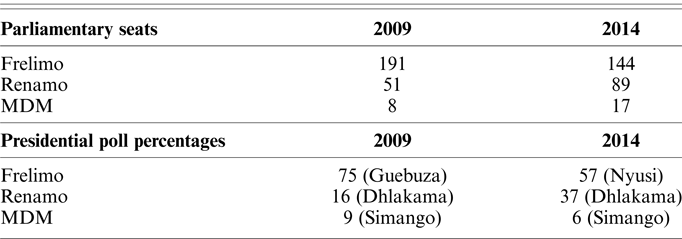
Clashes between the Mozambican security forces and fighters loyal to the Resistência Nacional de Moçambique (Mozambican National Resistance or Renamo) between 2013 and 2016 represented the first prolonged armed political violence in Mozambique since 1992, when the General Peace Accord (GPA) ended a sixteen-year war between Renamo and the state, as controlled by the Frente de Libertação de Moçambique (Mozambique Liberation Front or Frelimo), and established formal multiparty democracy. Renamo retained representation in parliament even while its ageing veterans returned to combat. Indeed, the violence prompted a resurgence in votes for Renamo in the 2014 general election (see Table 1) and has prompted Frelimo to consider seriously constitutional reforms that elements within the party had long resisted. The political attitudes of Renamo soldiers have attracted much scholarly attention since 1992 (Manning Reference Manning1998; Schafer Reference Schafer2001; Reference Schafer2007; Vines Reference Vines2013; Wiegink Reference Wiegink2015; Reference Wiegink2019). More recent work has situated the post-2013 violence in the context of the shortcomings of the 1992 settlement, which became manifest as political and economic change intensified elite competition over resource rents (Vines et al. Reference Vines, Thompson, Jensen and Azevedo-Harman2015; Macuane et al. Reference Macuane, Buur and Monjane2018; Darch Reference Darch2018). Renamo's relationships with civilian society after 1992, however, have been less studied.Footnote 1 The question of civilian support in the context of Renamo's return to arms is addressed in this article.
Election results, 2009 and 2014

My argument is based on interviews with civilians in southern Sofala, the region first affected by the violence, and seeks to explain widespread tacit and sometimes active support for Renamo in its armed opposition to the state in this region.Footnote 2 Non-state armed groups, like other political actors, ‘need to explain and justify their agendas and actions; they need material and moral support from communities’ (Schlichte and Schneckener Reference Schlichte and Schneckener2015: 410). Comparative studies of civil war associate conflict with the ‘tumult that arises from the simultaneous challenges of state-building and [postcolonial] nation-building’ (Henderson Reference Henderson, Nhema and Zeleza2008: 67), sharpened in Southern African cases by challenges to the ‘exclusive post-colonial legitimacy’ (Melber Reference Melber2002: 163) claimed by post-liberation party states.Footnote 3
I argue here that the legitimation of Renamo's return to violence rests on understandings of Mozambican nationhood and post-war politics that challenge the ideas underpinning Frelimo's hegemonic claims. These counter-hegemonic understandings have a history that predates Renamo, but Renamo uses them strategically. Renamo has benefited from grievance against Frelimo that originated during the anti-colonial struggle but which was deepened by the experience of the years following independence, and more recently by widening economic inequalities. Some interviewees had lived under Renamo control during the 1976–92 war and continued to identify actively with the party; their understanding of contemporary events can plausibly be attributed to this experience. The majority of interviewees who had never experienced Renamo control during that war also regarded the movement's current actions as legitimate. Renamo achieved this wider legitimacy by presenting its actions as the continuation of longer resistance against a repressive political system and a predatory Frelimo elite in a way that is consistent with popular narratives about the period of anti-colonial struggle and the years after independence.
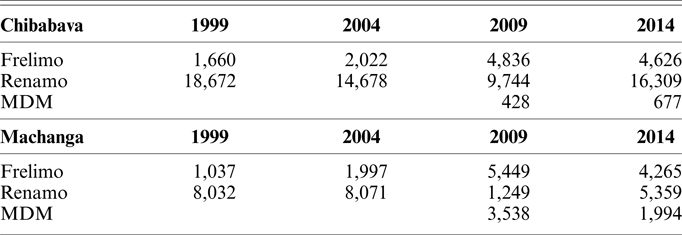
Renamo's relationship with society during and after the civil war varied between regions and locally (Gersony Reference Gersony1988; Schafer Reference Schafer2001: 217). Southern Sofala has a common history of proto-nationalism in the form of the Núcleo Negrófilo de Manica e Sofala, an Ndau-speaking cultural organization that existed from 1939 to 1953 (Cahen Reference Cahen2004: 16), but the experience of the 1976–92 war varied within the region. In some areas Renamo exercised control for extended periods and disseminated a political message, while elsewhere the population encountered Renamo only in the form of attacks and raids.Footnote 4 This article is based on research in two districts: Chibabava, where Renamo secured territory in a district where the government was confined to administrative centres; and Machanga, where government presence was limited but Renamo was also less firmly in control of territory. Renamo's electoral support was strong in both districts in the elections of 1994 and 1999, fell in the following decade, and recovered in 2014 (see Table 2). Interviewees in the two locations included people whose views had and had not been shaped by wartime politicization.Footnote 6
Parliamentary votes for Frelimo, Renamo and MDM in Chibabava and Machanga, 1999–2014Footnote 5

Field research was conducted from April to June 2015, during the truce that began in October 2014 and that was largely honoured until September 2015. I conducted thirty interviews and discussions in Machanga district and forty in and around Muxúnguè in Chibabava district. Interviewees included farmers with small landholdings, traders, schoolteachers, students and local representatives of Frelimo, the Movimento Democrâtico de Moçambique (Mozambique Democratic Movement or MDM) and Renamo. Most interviews were with individuals, but where families or neighbours preferred to engage collectively, our interaction comprised a group discussion.Footnote 7 The aim was not to gauge who supported which party but rather, given that the 2014 elections had indicated a revival of support for Renamo, to establish the terms in which attitudes towards Renamo, the state and the recent conflict were constituted. I consider these interviews thematically in relation to existing scholarship, before showing how Renamo's message concerning the return to violence is consistent with a more widely held critique of Frelimo rule.
Responses to recent violence
Central to this article's argument are people's responses to the events in 2013 and 2014, in and around Muxúnguè and along the 100 kilometre stretch of the national road EN1 south from Muxúnguè to the Save River, which marks the frontier with Inhambane province and is the conventional dividing line between southern and central Mozambique. Muxúnguè comprises a linear arrangement of small stores and markets along the road, with a hospital, the administrative post and the police station to the south. On the southern edge of town is the local Renamo headquarters: a few small adobe buildings next to the road. During March 2013, according to residents’ accounts, several hundred former Renamo combatants gathered there. The men ranged in age from their late thirties to over seventy, all old enough to have been soldiers before 1992. None wore uniforms and no weapons were visible.Footnote 8 They cleared the grass to expand the Renamo compound, and participated in ‘training exercises’, running or marching.
On the morning of 3 April 2013, the riot police known as the Força de Intervenção Rápida (FIR) fired teargas to disperse the men at the compound. A few were arrested, but most fled. At around 3.30 a.m. the next day, Renamo members attacked the police post and several members of the FIR were killed.Footnote 9 On 6 April, armed men shot at vehicles on the EN1 south of Muxúnguè. Further ambushes in the following months prompted the authorities to introduce military convoys to protect traffic, although Renamo largely honoured a policy of targeting only military or government vehicles. Renamo established a base in the bush near Muxúnguè, which was used during the attacks on the EN1.
Renamo and government representatives met on 12 April with a view to start negotiations and civil society mediators were appointed.Footnote 10 Talks continued inconclusively for over a year, as did ambushes by Renamo and Mozambican Defence Force (FADM) raids against Renamo bases. In response to Renamo's demands, some changes were made in the electoral law for the November 2013 municipal elections, allowing a temporary ceasefire, although Renamo boycotted these elections. By the time an informal truce took hold in July 2014, Renamo leader Afonso Dhlakama had raised a new demand concerning the government's armed forces, insisting that half the senior officers should be Renamo nominees.Footnote 11 This demand rested on the fact that the GPA had envisaged an FADM with equal numbers of soldiers from each of the pre-1992 armies at all ranks, but subsequent appointments and dismissals had ensured that Frelimo appointees dominated the force (Igreja Reference Igreja2015: 255). The government maintained that the parity requirement applied only to the founding members of the united army.
A provisional agreement in August 2014, intended to secure Dhlakama's participation in October elections, provided for the integration of Renamo's ‘residual forces’ into a national army.Footnote 12 Election results showed substantial gains at Frelimo's expense in parliament, while in the presidential vote Dhlakama gained at the expense of both the Frelimo candidate, Filipe Nyusi, and the MDM candidate, Daviz Simango, relative to the 2009 election results (see Table 1).Footnote 13 Renamo rejected the results, claiming fraud by Frelimo. Dhlakama demanded political concessions, first for a unity government and later for Renamo to take control of provincial government in provinces he claimed to have won, promising not to demobilize Renamo's men until his demands were met.
Following occasional engagements between Renamo and state forces during 2015, tensions escalated after Dhlakama survived an ambush near Chimoio on 25 September and was confronted at his house in Beira by security forces on 9 October. He fled to the wartime redoubt of Satungira in central Sofala, and conflict escalated soon afterwards across central Mozambique, including around Muxúnguè. The disclosure in April 2016 of over US$1 billion in secret loans underwritten by the Mozambican state damaged the government's international standing and intensified pressure on Frelimo to accept talks with Renamo. International mediation from July to December failed to find common ground on the issue of provincial devolution. However, subsequent telephone conversations between Dhlakama and Nyusi resulted in an informal truce. After Dhlakama died of an illness in May 2018, his successor, Ossufo Momade, continued the dialogue. The talks resulted in proposals for elected provincial government and electoral reform that were confirmed in an accord signed on 1 August 2019 – demands that Dhlakama had made after the confrontation in Muxúnguè six years earlier.Footnote 14
Interviewees’ accounts of the violence of 2013–14 were remarkable for how neither the government nor Renamo was seen as inherently more entitled to use violence than the other: the government attacked and Renamo was within its rights to retaliate. People consistently spoke about ‘os homens da Renamo’ but ‘a tropa da Frelimo’ – ‘Renamo men’ versus ‘Frelimo troops’ rather than ‘government troops’ – implying that government security forces were partisan. One interviewee insisted: ‘You can't have two armed parties in a democracy … one party in the bush, the opposition, and one party in the city, the government’Footnote 15 – a remark intended not to deny Renamo's right to bear arms but rather to challenge what he saw as the state security forces’ partisan behaviour. In such a view, Renamo as a parliamentary opposition party taking up arms is no more incongruous than a ruling party that can deploy state forces to partisan ends. For Renamo sympathizers, Frelimo's occupation of state institutions does not legitimize actions taken by a government that is synonymous with the party; instead, Frelimo's control of access to public goods and a perception of elections as mechanisms that endorse Frelimo sustain a conviction that the state is simply the tool of Frelimo.
Around Muxúnguè, people spoke of a Renamo military presence but were more fearful of reprisals from the government.
The problem is accusation. When we want to go [to sell produce in the market], accusation. The government accuses the people from here of being Renamo. Frelimo troops were always coming here.Footnote 16
This account from a teacher suggests that, while people were troubled by the presence of armed men from both sides, Renamo was the lesser threat:
Renamo had a base five or seven kilometres from the school. When government forces went [to the area], they would leave vehicles [at the school], distribute ammunition, then go into the bush. This endangered teachers and pupils [as] Renamo men would come to the school and question teachers because they had heard government troops were there. I'd say, ‘I didn't see government troops.’ … They thought the teachers were guarding government troops. It wasn't like that. When government troops came they would ask: ‘Where is the [Renamo] base? Do you know the [Renamo] troops?’ We would say they had passed by but we didn't know where they live … [Nevertheless,] Renamo behaved well towards people. They persuaded people not to be frightened of Renamo.Footnote 17
Farmers said that Renamo soldiers behaved respectfully, sometimes buying produce from them, and that they never took food by force.Footnote 18 Several sources confirmed that Renamo had a network of informers who monitored movements. Some civilians knew that Renamo fighters were secretly passing between Muxúnguè and their base, but they did not see this as a threat, emphasizing that Renamo was targeting the police and military. Interviewees claimed that Renamo soldiers remained in contact with their families through phone calls and visits: ‘They would go home to recharge their phones,’ one interviewee said.Footnote 19
The tacit or active support for Renamo's use of violence in and around Muxúnguè, alongside the mistrust of the state apparatus, is consistent with the findings of earlier scholarship that state legitimacy was always tenuous in post-war central Mozambique. This ‘crisis of authority’ (Alexander Reference Alexander1997: 20) was exacerbated by Frelimo's ‘urban disdain for those living in the bush’, an attitude that Renamo ‘capitalised on and further reinforced’ (Kyed Reference Kyed, Buur, Jensen and Stepputat2007; see also Buur and Kyed Reference Buur and Kyed2006), and was not resolved by Frelimo's instrumental recognition of chiefly authority in a modified version of colonial ‘indirect rule’ after 1992 (Florêncio Reference Florêncio2008). Reconstruction driven by donor prescriptions rather than by local needs (Cramer Reference Cramer2006: 245–78; Sabaratnam Reference Sabaratnam2017: 32) has further undermined the possibility of building a responsive state. Wiegink's identification of ‘Renamo's potential for renewed violence’ (Reference Wiegink2015: 883) linked to ‘the state's or Frelimo's differential, at times violent, treatment of certain citizens’ appears prescient in the light of the events since 2013. In the sections that follow I situate this distrust of the state within popular accounts of anti-colonial mobilization and the war, and within the ways in which people talk about dissatisfaction with the post-war state.
Fragmented nationalism
Questions to interviewees about the reasons for the recent violence evolved into conversations about the histories of the late colonial and early independence eras. While scholars concerned with party politics in Mozambique have examined how memories have been silenced or reshaped and deployed politically (Dinerman Reference Dinerman2006; Igreja Reference Igreja2008; Pitcher Reference Pitcher2006), the interviews I refer to here demonstrate that ideas about history are equally salient in popular understandings of power and, moreover, are congruent with contemporary narratives about a partisan state.
An overview of anti-colonial politics frames the local understandings of history that I present. A colonial state that was incoherent in terms of geography, cultural identity and economic development, and where African political activity was suppressed, offered no basis for united nationalist mobilization. Three anti-colonial movements emerged in the 1960s among exiles from distinct parts of Mozambique: Udenamo (União Democrâtico Nacional de Moçambique) in Bulawayo, Unami (União Africana de Moçambique Independente) in Malawi, and Manu (Mozambican African National Union) among Makonde emigrants in East Africa (Newitt Reference Newitt1995: 521). A separate group of émigré intellectuals from southern Mozambique coalesced in Europe and the US, including the later president of Frelimo, Eduardo Mondlane. The union of these groups to form Frelimo in 1962 was ‘a marriage of convenience … ultimately contributing to divisions within the country's independence movement’ (Cabrita Reference Cabrita2000: 5). The southern group that came to dominate Frelimo was drawn from a ‘micro elite’ that resented ‘all the manifestations of the social movement that it did not control, particularly when they came from other regions of the country’ (Cahen Reference Cahen1994: 242–3).
Interpretations differ on the nature of the rifts within the nationalist movement. Accounts sympathetic to the direction taken by Frelimo after 1969 see the division as ideological (Isaacman and Isaacman Reference Isaacman and Isaacman1983; Munslow Reference Munslow1983), while critics interpret the marginalization of people from central and northern Mozambique in favour of southerners as evidence of ethnic or regional prejudice (Opello Reference Opello1975; Simango Reference Simango1969; Ncomo Reference Ncomo2004). Of particular relevance to Sofala are events after Mondlane's assassination in February 1969. The heir apparent was the then vice-president Uria Simango, a protestant pastor from Sofala who had been among the founders of Udenamo. Simango's opponents, Samora Machel and Marcelino dos Santos, first formed a triumvirate with Simango, and later expelled him from Frelimo and subjected him to a show trial (Newitt Reference Newitt1995: 523–7; Cabrita Reference Cabrita2000: 81–3).
The expulsion and subsequent killing of Simango, the best-known nationalist figure from central Mozambique, continue to dominate local understandings of the region's relationship to the state. Interviewees emphasized the plural character of Mozambican nationalism and the later marginalization of political tendencies and nationalist leaders from central Mozambique:
Many intellectuals from the central region, their history has been hidden, although they were among the founders of Frelimo. Simango disappeared. The ones who remained in charge of Frelimo were from Gaza.Footnote 20
In addition to Simango, interviewees spoke of Lázaro Nkavandame, a Frelimo provincial secretary from Cabo Delgado who had supported Simango's accession to the Frelimo leadership (Cabrita Reference Cabrita2000: 55–62).
There were three movements: Manu, Udenamo, Unami. We knew Uria Simango, Lázaro Nkavandame. All the movements united to form Frelimo, one group … At the time of independence … we celebrated when they hoisted the flag … Then we became poorer, marginalized. Renamo and Frelimo were brothers. They fought the war of liberation together. Then Frelimo went back to Maputo … One part of the founders died. Renamo decided to form another group.Footnote 21
It is notable how this second extract assigns to ‘Renamo’ a role in the independence struggle, although Renamo was founded only in 1976. The remark was typical of a tendency to see Renamo as bearing the legacy of the regional movements that preceded Frelimo, and to conflate Renamo with any political tendency distinct from Frelimo, or at least distinct from the Frelimo represented by Machel.Footnote 22 Few people were old enough to remember the events of the 1960s, but this broad account of the period was widely repeated, emphasizing the multiple origins of anti-colonial mobilization in Mozambique, the regional character of the movements and the eventual dominance of southerners associated with Machel.
Accounts of independence and civil war
In addition to these accounts of anti-colonial struggle, interviewees also referred to their experiences of Frelimo policy after independence and during the 1976–92 war in explaining present-day politics. Frelimo's resolve to transform society was manifested in the decision to replace village chiefs with officials beholden to the party (Hall and Young Reference Hall and Young1997: 71; Newitt Reference Newitt1995: 547) and to resettle farmers in communal villages, from which the state distributed produce. These measures were ‘treated with great suspicion’ (Newitt Reference Newitt1995: 549) and generated ‘resistance and evasion’ (Hall and Young Reference Hall and Young1997: 85). The consequences of Frelimo policy for rural society after independence also fuelled scholarly debate concerning Renamo's relationship with society after it took up arms in 1976. The movement's behaviour and social relationships varied from place to place (Geffray Reference Geffray1990; Hall Reference Hall1990; Minter Reference Minter1994; Morier-Genoud et al. Reference Morier-Genoud, Cahen and do Rosário2018; Nilsson Reference Nilsson1993; Roesch Reference Roesch1992; Schafer Reference Schafer2001; Vines Reference Vines1991; Young Reference Young1990). Subsequent scholarship has confirmed Gersony's (Reference Gersony1988) proposition that Renamo's behaviour depended on its ability to take control of an area, which in turn depended on local discontent with Frelimo's policies.
Interviews in Chibabava support the conclusion that dissatisfaction concerning villagization and other Frelimo policies engendered active support for Renamo during the 1976–92 war. People who recalled having lived in Renamo-controlled areas, whether by choice or as a result of having been forcibly relocated, explained Renamo's actions as the consequence of Frelimo's villagization policies:
Most people refused to live in the villages. Even if they went there, afterwards they'd go back to their homes. There where they had to live in villages, they didn't have fields … Renamo would go and threaten the village because it didn't want people to stay in the villages … During the independence struggle, they weren't mentioned. This is why Renamo didn't want people to stay in the villages.Footnote 23
A widely held grievance about the villages was the forced redistribution of produce:
The theory was ‘what is yours is mine’! If you had a kilogram of maize, it was taken and distributed among others. We went to live with Renamo because Renamo insisted that the people should work, and everyone should have what was his own.Footnote 24
Significant for today's politics is that Frelimo explained its role in terms derived from Marxism-Leninism, even if the party's commitment to a Leninist programme was questionable. Critics of the government today characterize Frelimo's current practices, however inaccurately, as ‘socialist’. Understanding the meanings that have become attached to ‘Marxism’ and ‘socialism’ in Mozambique requires attention to practices that were adopted in the name of Marxism and the interests that they served. Cahen questions whether Frelimo pursued a socialist programme, arguing that the invocation of a variety of Marxism enabled a socially isolated elite to ‘imagine the Mozambican state in its own image’ (Cahen Reference Cahen1993: 50). However, because Soviet-inspired practices were adopted ‘without much thought as to whether they were appropriate for Mozambican realities’ (Hall and Young Reference Hall and Young1997: 68), the effect was to widen the gulf between the elite and society. Of particular relevance to Sofala is the fact that Simango's expulsion from Frelimo and later death marked the triumph of a tendency that defined itself by its commitment to socialism, and which dismissed Simango and anyone else not committed to an orthodox understanding of socialism as reactionaries (Isaacman and Isaacman Reference Isaacman and Isaacman1983: 97–8; Munslow Reference Munslow1983: 111–12).
Since the shift towards a market economy from 1983, and more so since the end of the war, Frelimo has sought to erase its socialist past (Pitcher Reference Pitcher2006), while ruling in a way that reveals continuities with the socialist (but also the colonial) era (Bertelsman Reference Bertelsman2016; Borges Coelho Reference Borges Coelho2015; Sabaratnam Reference Sabaratnam, Shandler and Sisk2013). This implies a consensus that the socialism of the past was an error, so, while Frelimo may wish to forget socialism, it is expedient for its opponents to remember it. The fact that Frelimo before 1990 framed controversial policies and actions in the language of socialism has allowed its opponents in central Mozambique to use ‘socialism’ as a shorthand for all that is wrong with Frelimo in the present as well as in the past. A man who had fought for Renamo in the civil war recalled its message as: ‘Let's bring democracy, free people from the hand of communism, establish democracy from the Rovuma to Maputo.’ In his understanding of the terms:
If someone has a field, communism means that the field belongs to a lot of people, not to him. Whoever has a car, it's a car that belongs to a lot of people. Democracy is putting an end to this system of joining everything together.
He recalled that, when the war ended in 1992, ‘We were glad because democracy was now close – I thought, “I will have work because of democracy.”’ But after successive fraudulent elections, ‘Renamo said, “We are tired.”’Footnote 25 This and similar articulations of past and present allow Renamo to claim continuity between its opposition to Frelimo during the civil war and today.Footnote 26
As was the case with the pre-independence divisions within Frelimo, historical interpretations differ regarding Frelimo's policies after assuming power. Some emphasize Frelimo's ambitions for social as well as political transformation (Newitt Reference Newitt1995: 546; Munslow Reference Munslow1983: 149), interpreting its aims as building socialism in order to counter the ‘obscurantism’ (a term applied to chieftaincy, religion and ethno-linguistic difference) that the elite associated with rural Mozambique. Other accounts attribute political difference to Frelimo's narrow social and regional base and distrust of others (Cahen Reference Cahen1994). Frelimo's claim to inclusiveness had the opposite effect since this made it ‘impossible to confront questions of ethnic, racial and regional origin’ (Hall and Young Reference Hall and Young1997: 83). Interviews that I have presented in this section suggest that political cleavage today is expressed primarily in regional terms in the sense that grievance continues to be understood in terms of regional resource allocation and domination by a southern elite, yet terms such as ‘socialism’ and ‘communism’ that hark back to the ideological reading of history also appear in popular understandings of the current government's motivations.
Accounts of present grievances
While government and Frelimo officials see their role as ‘organizing’ society to improve living conditions and foster national unity, those who have a more distant relationship with the state emphasize poverty and inequality, attributing these to corruption, maladministration and discrimination against the region by a state that serves the interests of a southern elite. People interviewed complained that the Local Initiative Investment Budget, a small enterprise development fund, benefited Frelimo members only.Footnote 27 In Muxúnguè, interviewees told of bribes extracted by the police on the main road, or by officials controlling supposedly free state services. Farmers spoke of police demanding bribes when they took their produce to the market. The word ‘impostos’ (taxes) is commonly used to refer to these bribes, in a way that links bribery by corrupt officials today to the taxes levied in colonial times and by the Frelimo government in the early years of independence.
The political potency of these everyday complaints derives not only from the content of the grievances, but also from the way in which people compared their reality in 2015 with stories about life in the past and about life in other parts of Mozambique. Older interviewees in particular claimed that in colonial times there were plenty of jobs, opportunities to market produce at a fair price, and a functioning police and justice system. Today, regular jobs are scarce. When one takes produce to market, ‘the buyer sets the price’ and the farmer receives a pittance. The police extort bribes from honest traders, while bandits rob with impunity. In addition to comparing the present with an idealized version of the past, people compared conditions in Sofala with how they imagined life to be in southern Mozambique. Interviewees were aware that Mozambique's wealth had increased as a result of coal mining and gas exploration. They contrasted this with their own poverty, interpreting it as discrimination by a southern elite against the people of central and northern Mozambique.Footnote 28
The assertion that life was better in the past negates Frelimo's claims to legitimacy as Mozambique's liberator from colonial servitude (Borges Coelho Reference Borges Coelho2015). People framed their grievances in a way that cast doubt on the freedom that Frelimo professes to have won. Typical remarks included ‘How can we be free when you can't walk out of your house at night without a bandit grabbing you by the neck?’ and ‘What independence is this when you have to pay a tax on a bicycle?’Footnote 29 At the same time, accusations of regional discrimination demonstrate the hollowness of Frelimo's claims to lead an undivided nation. What is more, when understood in the light of a longer history of divided nationalism, in which the principle of a united Frelimo was betrayed by a southern elite, narratives about discrimination against central Mozambique are useful fodder for a Renamo whose own foundational myths invoke a strand of nationalism that originated in the centre of the country and whose protagonists were cast aside by Frelimo (Macamo Reference Macamo2015).
While there was a broad consensus among interviewees regarding the events that preceded independence, there were differences in how people interpreted the implications of this historical understanding for political action in the present. The historical discourse provided a basis for scepticism towards Frelimo's exclusive claims to the heritage of the liberation struggle, and therefore an acceptance of the validity of Renamo's strategy in returning to arms, even among those who were not actively supporting Renamo. Some, however, interpreted and embellished this history in a way that logically translated into active support for Renamo's use of violence in 2013. Those who made this connection were those whose families had lived under the control of Renamo for all or part of the war. This version of history assigned an active role to Renamo as the successor to the strand of central Mozambican nationalism represented by Simango.
This evocation of Renamo's historical role may be heard, for example, in the account of a man old enough to remember the 1976–92 war, when he claimed that Renamo had justified its struggle by telling people to ‘fight for democracy, fight to feel free’. Referring to the recent violence, this man believed that such words were ‘worth more in the moment we are living in now’.Footnote 30
A woman in the same community, again talking about recent violence, added:
I heard what [Renamo] said: ‘We were fighting against Frelimo, war is bad, but we are fighting for people to feel free, to do as they wish, for us to live with democracy and to work. We fought against the Portuguese in order to live in freedom, but Frelimo threw this away and is doing things we don't understand.’Footnote 31
When I asked interviewees whether Mozambique enjoyed national unity, most argued that, while the country ought to be united, the reality was a divided nation. This division was expressed both in terms of the regional origins of Mozambican nationalism and southerners’ later domination of Frelimo, and in terms of what people perceived as southern privilege in present-day state largesse and economic development. A recognition of de facto division was used to explain aspects of both Renamo's political demands and its military strategy. Interviewees argued that Renamo's demand for provincial autonomy reflected an already divided Mozambique, and insisted that Frelimo had no right to rule in the provinces that it neglected. One interviewee spoke of Renamo having ‘occupied’ central and northern Mozambique, a reference to Renamo's electoral support being concentrated there.Footnote 32 They also pointed out the significance of the location of the ambushes of 2013–14: the Save River separates southern and central Mozambique, and by threatening traffic just north of the river, Renamo was enacting its conviction that Mozambique is already a land divided. The accusation that Frelimo is a divisive force is a trenchant challenge to the authority of a ruling party that, since independence, has presented its role as one of forging national unity and reining in the fissiparous effects of regional difference.
While scepticism towards the Frelimo state's claims to legitimacy was widely shared by interviewees, those more committed to Renamo insisted that Renamo was better at fulfilling certain criteria of statehood in which Frelimo was lacking: in their accounts, Renamo was rooted in anti-colonial struggle, and in wartime had sought to defend people against a predatory Frelimo. Those interviewees who were most closely associated with Renamo were also those who most explicitly articulated the connection between divided nationalism in the 1960s and ethno-regional discrimination in the present, and asserted a continuity between what they saw as Renamo's emancipatory role during the civil war and more recently.
From negotiated peace to renewed conflict
Historical grievance and popular rejection of state legitimacy do not necessarily lead to violence. To understand why violence became part of Mozambican politics two decades after the end of the war, this section revisits how the war ended and how the legacy of the peace agreement configured post-war politics, and how Renamo's leadership strategically framed events in the light of the popular understandings described earlier.
In the late 1980s, internal and international circumstances prompted Frelimo to seek a negotiated settlement to the war, which had reached a stalemate. Frelimo was changing from a vanguardist to a mass party with a more liberal understanding of the state, while economic weakness allowed creditors and multilateral institutions to press the government towards negotiation (Hall and Young Reference Hall and Young1997: 200–6). The lengthy negotiations and eventual compromise that characterized the GPA, signed in Rome in October 1992, reflected the fact that the two sides were evenly matched in military might and strategic leverage. The accord included provision for each party to maintain administration in zones it occupied, pending election results (Manning Reference Manning2002: 31). The peace plan was presented as pragmatic: the political settlement went ahead before demobilization, in the hope that the political accord might engender sufficient trust to allow the military questions to be resolved later (Longo and Lust Reference Longo and Lust2009).
The accord allowed Renamo to continue behaving less as a political party than as a military movement with aspirations to statehood (Cahen Reference Cahen1998; Reference Cahen2011). The settlement allowed Dhlakama to retain a bodyguard under his command regardless of the election result. A new national army (FADM) was to comprise 15,000 troops from each of the previous armies, even though neither side had sufficient soldiers to fulfil its quota (Messiant Reference Messiant, Messiant and Marchal1997). Dhlakama's demands in 2013–14 that he be allowed to appoint officers to the FADM appealed to this latter provision. A further group of Renamo soldiers was promised incorporation into the police. This never happened, and these ‘residual forces’ remained loyal to Dhlakama. The government, meanwhile, established the FIR, which has been deployed against political opposition since its inception (Kyed Reference Kyed, Buur, Jensen and Stepputat2007).
Another aspect of the GPA relevant in understanding recent violence is that the 1992 constitution was highly centralized (Forquilha Reference Forquilha2017; Manning Reference Manning2002: 32; Pereira Reference Pereira2016), something Renamo has sought to change. Having been declared the victor in every national election since 1994,Footnote 33 Frelimo controls provincial government, including in provinces where Renamo has a majority. Renamo increased its vote share in the 1999 elections but its support declined in subsequent elections until a reversal in 2014. Some explanations for this suggest that Renamo supporters had become disillusioned with the electoral process, because of fraud in 1999 (Cahen Reference Cahen2015) or because political centralization ensured that Frelimo would control provincial government no matter what (Ostheimer Reference Ostheimer2004). Renamo's attempts to compete with Frelimo in dispensing patronage have failed, faced with the ruling party's monopolization of state resources (Cahen Reference Cahen2011; Pereira Reference Pereira2016). Others have blamed Dhlakama for Renamo's losses, on the grounds that he failed to create sustainable party structures or to present a positive alternative vision for Mozambique,Footnote 34 so that by 2012 Dhlakama's leadership of Renamo was under threat. Some Renamo voters defected to breakaway parties, first to Raúl Domingos's Partido para a Paz, Democracia e Desenvolvimento (Party for Peace, Democracy and Development or PDD) and later, in greater numbers, to Daviz Simango's MDM (Vines Reference Vines2013).
Previous studies concur on the fragility of the post-1992 consensus. Frelimo and Renamo leaders have conducted politics by breaking rules and dealing with the consequences through ad hoc negotiations (Manning Reference Manning2002; Azevedo-Harman Reference Azevedo-Harman2015). In a sense, the post-2013 conflict reproduced this pattern, albeit with higher stakes. Changes in electoral laws after 1994 as well as electoral malpractice amounted to a ‘growing Frelimo monopoly on power’ (Manning Reference Manning2010: 151). After Armando Guebuza became president in 2004, he stopped the consultations his predecessor, Joaquim Chissano, had held with Dhlakama and began to use government structures ‘to neutralise the opposition’ (Morier-Genoud Reference Morier-Genoud, Mustapha and Whitfield2009: 162–3), including the removal of ex-Renamo officers from the FADM (Igreja Reference Igreja2015: 254–5). In 2009, the cracks in the elite consensus became clearer when Dhlakama left Maputo, claiming that he was in danger, and relocated to Nampula in northern Mozambique, where in March 2012 his bodyguards and members of the ‘residual forces’ exchanged fire with police. Relations between Dhlakama and the government worsened until, in October 2012, the Renamo leader and his retinue moved to Satungira, from where he presided over the violence of 2013 and 2014.
After the first confrontation in Muxúnguè, Dhlakama set out his position in an interview.Footnote 35 He emphasized that the GPA required both parties to surrender their weapons, and since Frelimo had not done so, there was no reason why Renamo should.Footnote 36 He declared that Renamo had the right to defend itself when attacked. Dhlakama's remarks implied that Frelimo and Renamo are equivalent forces, neither more legitimate than the other. Dhlakama insisted that he had made ‘twenty years of sacrifice’ for democracy and that Renamo was ‘tired of taking a beating’. He maintained that he had nothing against southern Mozambique, but Frelimo used ‘the southern region as their bastion to massacre the centre and north’.
Dhlakama's justification of his position was congruent with popular understandings of the recent violence offered during interviews. First, he claimed antecedence for Renamo in the anti-colonial struggle. Second, Renamo's actions since 2012 were part of a long struggle for democracy: a ‘democracy’ that, as we have seen, is defined in opposition to Frelimo's ‘socialism’, which itself was understood to mean communal villages, taxation and the subjugation of chiefly power to the state. According to this view, Frelimo had reluctantly accepted democracy only because of the war waged by Renamo. Electoral fraud was cited as further evidence of Frelimo's distaste for democracy, and interpreted as signalling Frelimo's rejection of the GPA, which forms the legal foundation of the post-war state. Third, Dhlakama presented Frelimo's neglect of Mozambique north of the Save River as testimony to Frelimo's domination by a southern elite, again echoing a belief rooted in popular understandings of history.
Finally, Dhlakama's interview recalled post-war history in talking about what he saw as Frelimo's failure to comply with the GPA by reducing the number of Renamo officers in the FADM. The assertion that the government was in breach of the accord meant, logically, that subsequent acts of violence by Renamo were therefore legitimate. This understanding recognized the original legitimacy of the post-1994 constitutional order, but asserted that it had been rendered invalid by Frelimo's supposed non-compliance. This takes Mozambique back to the logic that preceded the GPA, which saw Renamo and Frelimo as equivalent in status.Footnote 37
Conclusion
Renamo's relationship with rural Mozambican society was at the heart of debates about the 1976–92 war, yet, as noted at the outset, this question has received insufficient attention in research since 1992. This article has examined attitudes towards Renamo and towards the state in southern Sofala in the context of the 2013–16 violence in order to understand why Renamo's actions met with popular approval in that region – approval that was manifested in a revival in electoral support and made explicit in interviews. It has demonstrated the need to bring the insights of earlier scholarly debates on different phases of recent Mozambican history into our understanding of the present. These include debates over the multiple origins and fractious character of Mozambican nationalism and, more specifically, the marginalization of the regions north of the Save River from successive projects of nation building; Frelimo's and Renamo's relationships with rural society during the 1976–92 war; and the lack, particularly in central Mozambique, of a post-war state distinct either from society or from Frelimo.
The return to arms has underscored the need to examine Renamo's social relationships. To focus on political legitimacy is not to deny Dhlakama's personal ambitions, and nor is it to disregard how both the terms of the 1992 settlement and its flawed implementation helped create the conditions for a return to war. The GPA allowed Renamo to retain an armed force in the form of Dhlakama's bodyguards as an interim step to secure commitment to the agreement, and the failure to honour promises of police jobs for Renamo soldiers left the ‘residual forces’ under Dhlakama's command. Twenty years later, armed men remained Dhlakama's most potent asset as he found himself unable to participate meaningfully in a political system that reproduced Frelimo's control of the state. But Dhlakama's ambitions and the shortcomings of the GPA do not explain why Renamo's return to arms in Sofala won approval beyond the ranks of Renamo soldiers. To understand this requires attention to Renamo's relationship with central Mozambican society as it has evolved since 1992. This in turn demands consideration of popular understandings of history that predate the civil war, as well as subsequent political and economic change.
Macuane et al. (Reference Macuane, Buur and Monjane2018) have shown that recent events need to be understood not only in terms of Mozambique's transformation since 2004 into an energy economy but also in terms of the politics that determine access to the benefits from it: this interpretation echoes a shift in materialist understandings of civil violence away from ‘greed’ or ‘resource curse’ models to explanations emphasizing the politics of distribution (Ron Reference Ron2005; Cramer Reference Cramer2006). The findings of this present article demonstrate, furthermore, a need to scrutinize the intersection of politics and economics on the distinct levels of elite incentives and popular mobilization. While competition over resource rents intensified elite competition, inequality and poverty also created grievances that have deepened popular anti-government sentiment. Although inequality in itself is not a predictor of conflict, Stewart and others have observed that horizontal inequality – that is, when economic inequality coincides with another non-economic marker of difference – predisposes societies to strife (Stewart Reference Stewart2002). The repeated references by interviewees – ordinary citizens and Renamo officials alike – to discrimination by the government against central Mozambique and a perception that life was better in the south confirm that grievance becomes politically potent when narrated in a way that situates individual resentment within a collective experience of marginalization, oppression or exploitation.
The legitimation of Renamo's return to arms in 2013 rests on the strategic articulation of discourses about the present and the past. The interviews presented here have demonstrated that dissatisfaction with the present is widely understood as part of longer grievances common to central Mozambique. While it cannot be determined exactly how much of the popular discourse is the consequence of Renamo's politicization, what is clear is that Renamo's version of events is congruent with a discourse that exists independently of Renamo. It is through the articulation of past and present that Renamo is able to challenge three dimensions of the authority of the state: anti-colonial legitimacy, the legal legitimacy based in the GPA, and democratic legitimacy.
Like other Southern African liberation movements, Frelimo bases its postcolonial legitimacy on an exclusive claim to a legacy of undivided anti-colonial struggle. In reality, the anti-colonial struggle in Mozambique was riven by difference, expressed variously in terms of ideology, strategy, ethno-regional prejudice and interpersonal mistrust, which created a perception in central Mozambique that the region was marginal to Frelimo's interests. Frelimo's post-war state-building efforts also alienated sections of the population, particularly in central Mozambique. Renamo today is able to take advantage of memories of its role as an opponent of unpopular policies in the past. Renamo benefits from an elision in popular memory between divisions in anti-colonial politics in which Renamo played no part, and the contestation of state power from 1976 to 1992, in which Renamo was the main protagonist. In this way, Renamo can challenge Frelimo on a key pillar of its legitimacy: anti-colonial struggle – a challenge that resonates even with people who were not influenced by Renamo during the 1976–92 war.
The second pillar of Frelimo's legitimacy that Renamo challenges is that of the post-1992 constitutional order based on the GPA. Renamo supporters argue that Frelimo, in failing to honour the GPA, is no more entitled than Renamo to hold power. The third point also concerns constitutional legitimacy, but in this case the legitimacy conferred by electoral democracy. Debates continue around Frelimo's sincerity and efficacy in implementing a socialist programme in the past. However, the shift since the late 1980s from socialism to liberalism as a normative discourse has opened a space in which Renamo, however disingenuously, can challenge Frelimo on the basis of a democratic legitimacy that Frelimo now professes to endorse. Renamo does this by making a historical (albeit questionable) claim as the progenitor of democracy, and more credibly by pointing to flaws in the electoral process. All three challenges depend on interpreting the present in terms of a past that itself was reinterpreted in terms of the present.
Earlier studies have differed on whether Renamo's appeal rests on a rejection of the state or on the promise of a more socially responsive state. Geffray (Reference Geffray1990) observed that civilians who initially welcomed Renamo shunned it once they realized it had no distinct political vision, yet for Lubkemann (Reference Lubkemann2008: 155) it was ‘RENAMO's lack of political vision of the state or a program for its local articulation that gave it local legitimacy’. In the post-war period, Schafer notes that ‘many of those who expressed frustration at their exclusion from the benefits of Mozambican citizenship considered themselves citizens’, and that this ‘negative sense of citizenship’ raised ‘questions about the state's stability and foundational legitimacy’ (Reference Schafer2007: 170). Wiegink (Reference Wiegink2015) concludes that ex-soldiers identify with Renamo because they experience the multiparty system as a game in which Frelimo rewards only its supporters. Such ideas of negative belonging recall Cahen's (Reference Cahen1998) characterization of Renamo's constituency as a ‘coalition of marginalities’. Today, although neglect by the state is a key grievance that Renamo invokes, Renamo's legal position within the state system is not in contention. Adherence to Renamo no longer signifies a rejection of the state itself, but an acceptance of a transformative vision that Renamo claims it could implement, given a fairly functioning electoral system.
While presenting itself as a contender for power within the current constitutional system, Renamo also frames its challenge to the regime as consistent with a longer-term programme of action that has sought redress for regional marginalization. While present grievance is widely shared, it is by inserting itself into a historical narrative that undermines the past and present bases of Frelimo's legitimacy that Renamo legitimizes its challenge to the authority of the Frelimo party-state. Even if the ultimate effect of the conflict has been to perpetuate the asymmetrical bipartisan structure of Mozambican politics to the exclusion of newcomers (Morier-Genoud Reference Morier-Genoud2017), Renamo has been able to take up arms while enjoying approval from civilians in the conflict area because it has taken the opportunity to present an account of its historical and contemporary role that is consonant with already established understandings of past and present.
Across postcolonial Africa, cleavages created by regionally (sometimes understood as ethnically) based nationalist mobilization defined political competition for generations and were deepened with the widespread adoption of formal multiparty democracy in the 1990s (Cooper Reference Cooper2002; Berman et al. Reference Berman, Eyoh and Kymlicka2004; Geschiere and Jackson Reference Geschiere and Jackson2006). In the south of the continent, late decolonization has ensured that rivalry within multiparty politics has been framed explicitly in terms of claims to the legacy of anti-colonial struggles and challenges to such claims (Werbner Reference Werbner and Werbner1998; Melber Reference Melber2002; Southall Reference Southall2013). The particularly violent form that this challenge to power has taken in Mozambique since 2013 needs to be understood in terms of a particular national history: fragmented colonial state formation (Newitt Reference Newitt1995), the legacy of a war that dominated the period between independence and multiparty democracy, and a post-war settlement that failed to address adequately the question of state legitimacy and created the conditions for partisan violence on both sides. This regional case study has shown how a narrative about anti-colonial struggle and independence that contradicts the official version promoted by Frelimo serves as a vehicle for a popular critique of the regime. Popular acceptance of Renamo's recent challenge to the state rests on Renamo's ability to take ownership of this critique.
Acknowledgements
This research was funded by a Leverhulme Early Career Fellowship (grant number 74978), held in the Department of Politics and International Studies, University of Cambridge, and supported by a research associateship at St John's College, Cambridge. First, I thank those who agreed to be interviewed. For their help and hospitality, I am indebted to Dionísio Camacho, Fidel Salazar, José Luís, Andrzej Filip, Tom Bowker, Leigh Elston and Conceição Osório, and especially to Alberto Mudando. I am grateful to all who commented on earlier drafts, particularly Sara Rich Dorman, JoAnn McGregor and Eric Morier-Genoud, and to Carlos Fernandes for inviting me to a seminar at Eduardo Mondlane University at which Obede Baloi and others provided invaluable criticism. Devon Curtis and the Politics After War Network have provided steady support and collegiality.