Introduction
The base of the Silurian System is marked by the first appearance of the graptolite Akidograptus ascensus Davies, Reference Davies1929 (Williams, Reference Williams, Cocks and Rickards1988; Melchin and Williams, Reference Melchin and Williams2000; Rong et al., Reference Rong, Melchin, Williams, Koren and Verniers2008) at 1.6 m above the base of the Birkhill Shale Formation at the global stratotype section and point (GSSP) at Dob's Linn, Scotland, UK. This species and the related Parakidograptus acuminatus (Nicholson, Reference Nicholson1867) have extremely wide geographical distributions in lower Silurian rocks (Štorch, Reference Štorch1996; Rong et al., Reference Rong, Melchin, Williams, Koren and Verniers2008). In some places, both Akidograptus Davies, Reference Davies1929 and Parakidograptus Li and Ge, Reference Li and Ge1981 appear simultaneously (e.g., Štorch et al., Reference Štorch, Roqué Bernal and Gutiérrez-Marco2019).
Avitograptus avitus (Davies, Reference Davies1929) has long been hypothesized to be ancestral to Akidograptus and Parakidograptus (Davies, Reference Davies1929; Melchin et al., Reference Melchin, Mitchell, Naczk-Cameron, Fan and Loxton2011), although this has been disputed (Williams, Reference Williams1983; Zalasiewicz and Tunnicliff, Reference Zalasiewicz and Tunnicliff1994). Plausible intermediates between Av. avitus and akidograptines have not yet been described. In this paper, we describe two species of Avitograptus from the uppermost Ordovician of South China that represent morphological intermediates between Av. avitus and akidograptines.
Geological setting
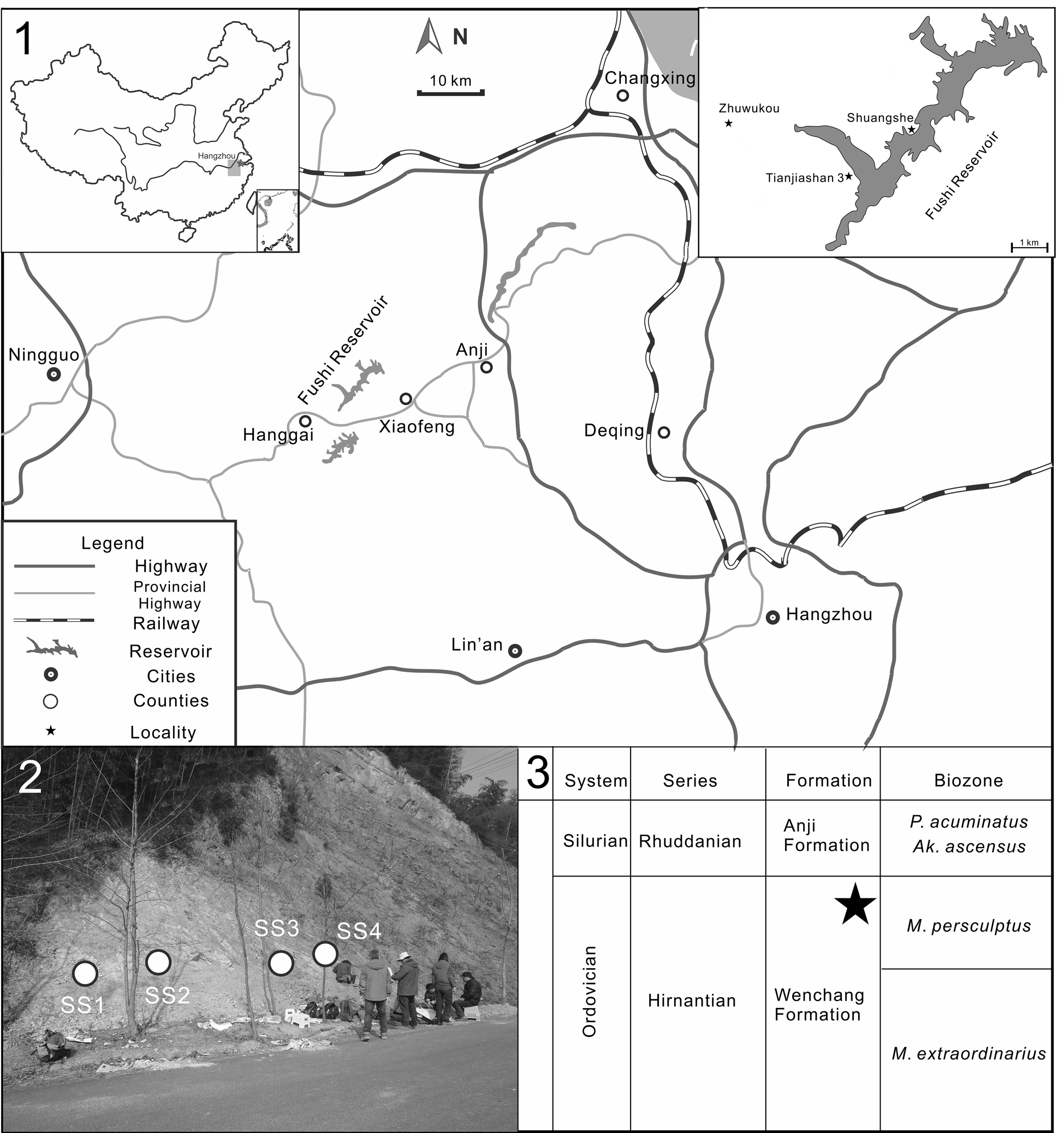
The graptolites described in this paper were collected from a mudstone interval within the sandstone-dominated Upper Ordovician Wenchang Formation in the area around the Fushi Reservoir, Anji County, Zhejiang Province, China (Fig. 1). The specimens were obtained from three localities: Shuangshe, spelled “Shuanshe” by Botting et al. (Reference Botting, Muir, Zhang, Ma, Ma, Wang, Zhang, Song and Fang2017a) (30°36.544′N, 119°27.156′E), Tianjiashan 3 (30°35.807′N, 119°26.080′E), and Zhuwukou (30°36.507′N, 119°22.712′E). Shuangshe is a roadside section beside the Fushi Reservoir, Zhuwukou is a roadside section, and Tianjiashan 3 is a short section along a farm track. Graptolites were collected from distinct beds at Shuangshe and Zhuwukou, but specimens from Tianjiashan 3 were not separated by bed. The mudstone interval is ~6 m thick at Shuangshe, but can be as much as 10 m thick at other sites within the area (Botting et al., Reference Botting, Muir, Zhang, Ma, Ma, Wang, Zhang, Song and Fang2017a). The graptolite assemblage and succession is consistent at all sites within the area. In addition to graptolites, the mudstone interval contains abundant, diverse, exceptionally preserved sponges (Botting et al., Reference Botting, Muir, Zhang, Ma, Ma, Wang, Zhang, Song and Fang2017a, Reference Botting, Zhang and Muirb, Reference Botting, Muir and Zhang2018a). The only other fossils discovered at Shuangshe, Tianjiashan 3, and Zhuwukou were rare orthoconic nautiloids.
(1) Location of the study area within China, of Fushi Reservoir within Anji County, and of the Shuangshe, Tianjiashan 3, and Zhuwukou localities relative to Fushi Reservoir. (2) Photograph showing the Shuangshe section. The white circles mark the beds from which the graptolite material described in this study was collected. (3) Stratigraphy of the Wenchang Formation. The black star indicates the approximate position of the study interval within the M. persculptus Biozone.

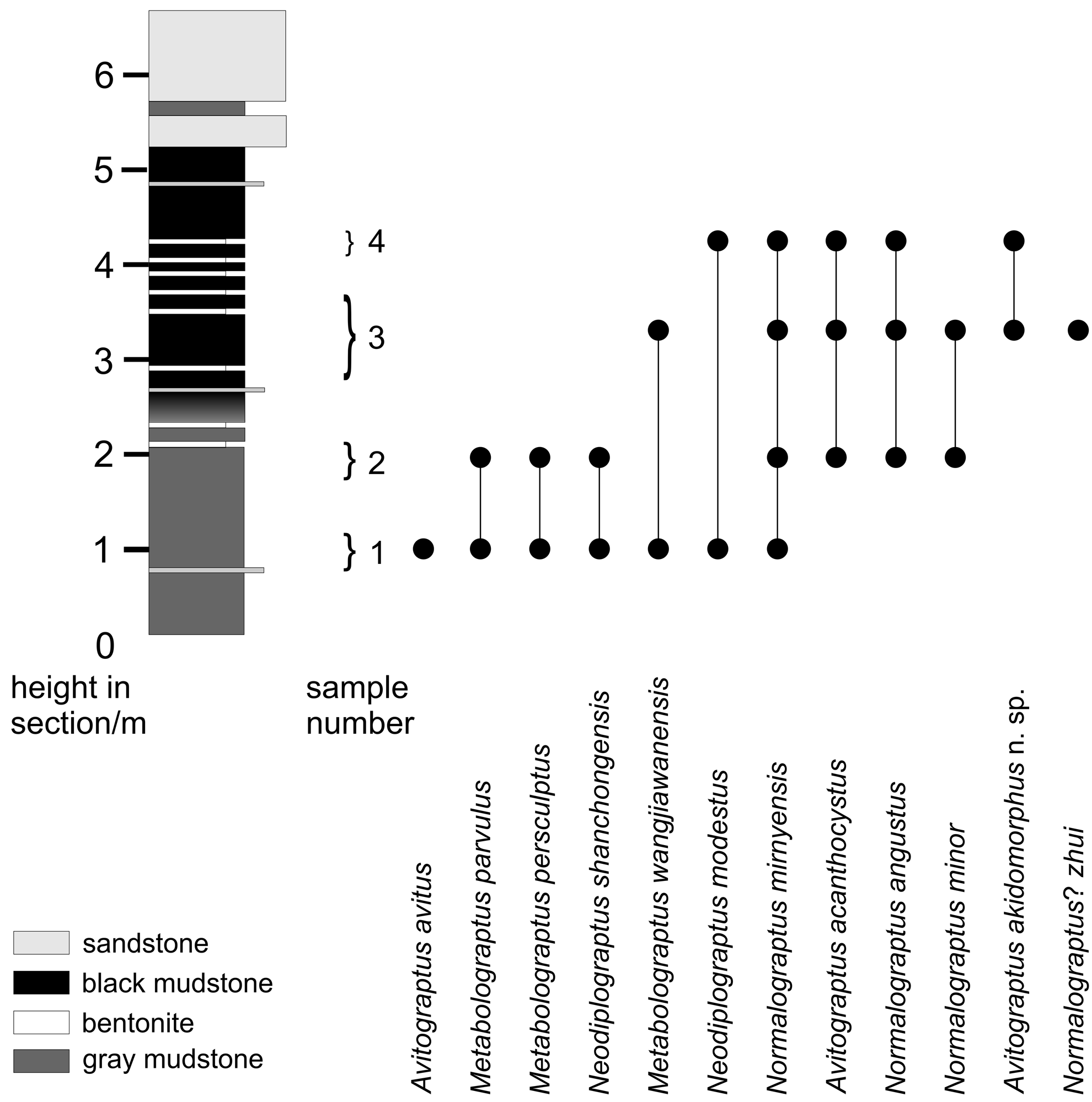
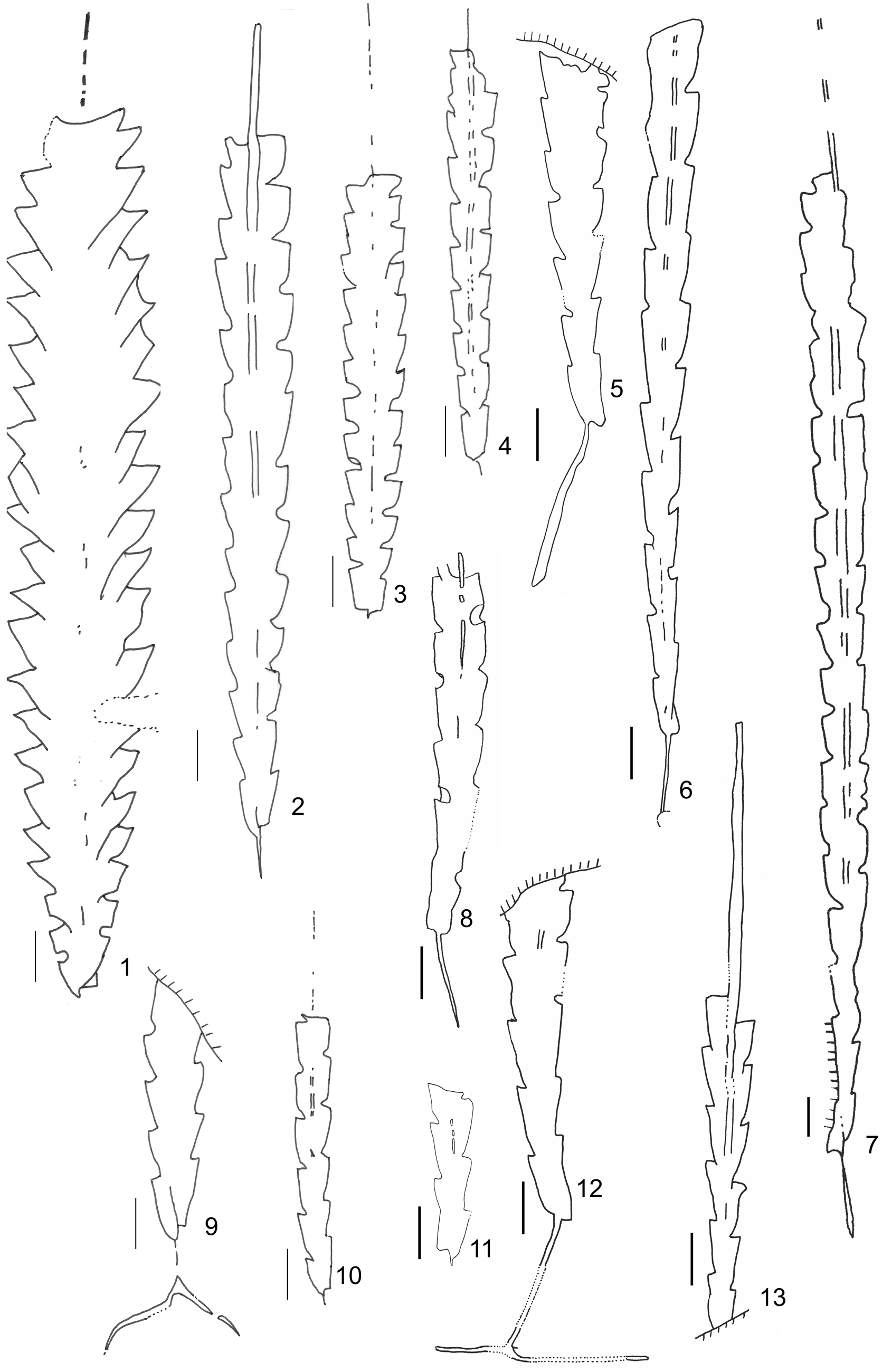
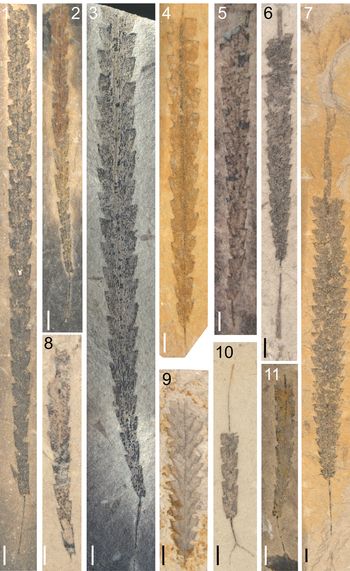
The graptolite fauna of the mudstone interval (Figs. 2–4) includes Avitograptus acanthocystus (Fang et al., Reference Fang, Liang, Zhang and Yu1990; Figs. 3.5, 3.8, 3.12, 3.13, 4.3, 4.5, 4.8, 4.11) n. comb., Av. akidomorphus n. sp. (Figs. 3.6, 3.7, 4.1, 4.2), Av. avitus (Davies, Reference Davies1929; Figs. 3.2, 4.4), Metabolograptus persculptus (Elles and Wood, Reference Elles and Wood1907; Fig. 4.9), M. parvulus (Lapworth, Reference Lapworth1900; Fig. 3.3), M. wangjiawanensis (Mu and Lin, Reference Mu and Lin1984; Fig. 4.6), Neodiplograptus modestus (Lapworth in Armstrong, Young, and Robertson, Reference Armstrong, Young and Robertson1876; Fig. 4.7), Ne. shanchongensis (Li, Reference Li1984; Fig. 3.1), Normalograptus angustus (Perner, Reference Perner1895; Fig. 3.10), No. minor (Huang, Reference Huang1982; Fig. 4.10), No. mirnyensis (Obut and Sobolevskaya in Obut, Sobolevskaya, and Nikolaev, Reference Obut, Sobolevskaya and Nikolaev1967; Fig. 3.4), No.? zhui (Yang, Reference Yang1964; Fig. 3.9), and some other taxa. A full description of the graptolite fauna will be published separately. Most of these species occur in the latest Ordovician M. persculptus and earliest Silurian Akidograptus ascensus and Parakidograptus acuminatus biozones (Chen et al., Reference Chen, Fan, Melchin and Mitchell2005; Loydell, Reference Loydell2007; Zalasiewicz et al., Reference Zalasiewicz, Taylor, Rushton, Loydell, Rickards and Williams2009). Normalograptus minor primarily occurs in the M. persculptus Biozone (Chen et al., Reference Chen, Fan, Melchin and Mitchell2005; Melchin, Reference Melchin2008; Štorch et al., Reference Štorch, Roqué Bernal and Gutiérrez-Marco2019), but has also been reported from the Akidograptus ascensus Biozone of Yunnan Province, China (Zhang et al., Reference Zhang, Wang, Zhan, Fan, Zhou and Fang2014, p. 41). Similarly, Normalograptus? zhui has been reported from the lower Rhuddanian of Hunan Province, China (Chen et al., Reference Chen, Zhang, Fan, Tang and Sun2012). Metabolograptus persculptus appears to be confined to the M. persculptus Biozone (Chen et al., Reference Chen, Fan, Melchin and Mitchell2005; Loydell, Reference Loydell2007). Although M. persculptus occurs only in the lower part of the mudstone interval at Shuangshe (Fig. 2), there are no unambiguously Silurian elements in the fauna; thus, we assign the assemblage to the Metabolograptus persculptus Biozone (Hirnantian, Upper Ordovician). Koren’ et al. (Reference Koren’, Ahlberg, Nielsen, Ortega and Aceñolaza2003) recognized a distinct Avitograptus avitus Faunal Interval containing (with other elements) No. minor and Av. avitus immediately above the M. persculptus Biozone in Sweden. We hence correlate the Anji assemblages with the middle to upper M. persculptus Biozone on the basis of the occurrence of both No. minor and Av. avitus.
Log showing the stratigraphic distribution of selected graptolites in the Shuangshe section.

Camera lucida drawings of graptolite taxa from Shuangshe, Wenchang Formation, Metabolograptus persculptus Biozone. (1) Neodiplograptus shanchongensis, NIGP 170578, Shuangshe bed 2; (2) Avitograptus avitus, NIGP 170568, Shuangshe bed 1; (3) Metabolograptus parvulus, NIGP 170579, Shuangshe bed 2; (4) Normalograptus mirnyensis, NIGP 170580, Shuangshe bed 2; (5, 8, 11, 12) Avitograptus acanthocystus n. comb., (5) NIGP 170575, Shuangshe bed 4, (8) NIGP 170572, Shuangshe bed 3, (11) NIGP 170571, Shuangshe bed 3, (12) NIGP 170573, Shuangshe bed 3; (6, 7) Avitograptus akidomorphus n. sp., (6) paratype, NIGP 170569, Shuangshe bed 3, (7) paratype, NIGP 170361, Shuangshe bed 3, note that the proximal end of this specimen is slightly damaged (location of damage indicated by short horizontal lines), resulting in th12 being obscured; (9) Normalograptus? zhui NIGP 170581, Shuangshe bed 3; (10) Normalograptus angustus NIGP 170582, Shuangshe bed 3; (13) Avitograptus acanthocystus? n. comb., NIGP 170574, Shuangshe bed 3. All scale bars represent 1 mm.

Photographs of graptolites from Shuangshe, Zhuwukou and Tianjiashan 3, Wenchang Formation, Metabolograptus persculptus Biozone. (1, 2) Avitograptus akidomorphus n. sp., (1) holotype, NIGP 170360, Shuangshe bed 3, (2) paratype, NIGP 170569, Shuangshe bed 3; (3, 5, 8, 11) Avitograptus acanthocystus n. comb., (3) NIGP 170577, Zhuwukou, (5) NIGP 170576, Tianjiashan 3, (8) NIGP 170570, Shuangshe bed 2, (11) NIGP 170572, Shuangshe bed 3; (4) Avitograptus avitus, NIGP 170567, Shuangshe bed 1; (6) Metabolograptus wangjiawanensis, NIGP 170583, Shuangshe bed 1; (7) Neodiplograptus modestus, NIGP 170584, Shuangshe bed 1; (9) Metabolograptus persculptus, NIGP 170585, Shuangshe bed 2; (10) Normalograptus minor, NIGP 170586, Shuangshe bed 2. All scale bars represent 1 mm.

South China was located at or near the equator during the Late Ordovician (Cocks and Torsvik, Reference Cocks and Torsvik2013; Zhan et al., Reference Zhan, Jin, Liu, Corcoran, Luan and Wei2015). During the latest Hirnantian, the study area was located in a deep-water basinal area between the Cathaysian landmass to the present-day south and graptolitic shales deposited in relatively shallower water to the present-day north (Botting et al., Reference Botting, Muir, Wang, Qie, Tan, Zhang and Zhang2018b). The shallower-water Yangtze platform was located to the present-day west (Botting et al., Reference Botting, Muir, Wang, Qie, Tan, Zhang and Zhang2018b). The main sediment input to the area was from the Cathaysian landmass (Botting et al., Reference Botting, Muir, Wang, Qie, Tan, Zhang and Zhang2018b). The graptolite- and sponge-bearing mudstone interval within the sandstones of the Wenchang Formation represents an interval of sea-level rise (Botting et al., Reference Botting, Muir, Zhang, Ma, Ma, Wang, Zhang, Song and Fang2017a).
Materials and methods
The specimens described in this study are preserved flattened in mudstone as black or brown films representing the remains of the original skeletal material. In some cases the periderm has weathered sufficiently to allow some details of the internal structure, such as the presence of a median septum, to be visible. The mudstone was originally black and in many samples has weathered to a whitish color.
Specimens were photographed using a Leica M125 microscope with a Leica DFC450C (Leica, Wetzlar, Germany). Measurements of graptolite specimens follow those of Štorch et al. (Reference Štorch, Mitchell, Finney and Melchin2011, fig. 13) and Loydell (Reference Loydell2007, text-fig. 7). Thecal spacing is given as two-thecae repeat distances (2TRD; Howe, Reference Howe1983). The term “tubarium” is used to describe the graptolite remains, rather than “rhabdosome,” following usage in the current version of the Treatise on Invertebrate Paleontology (Maletz et al., Reference Maletz, Bates, Brussa, Cooper, Lenz, Riva, Toro and Zhang2014a).
Repository and institutional abbreviation
All material is deposited in the Nanjing Institute of Geology and Palaeontology, Nanjing, China (NIGP).
Systematic paleontology
The high-level taxonomic classification used in this study is that of Maletz (Reference Maletz2014, Reference Maletz2017); diplograptid taxonomy follows Melchin et al. (Reference Melchin, Mitchell, Naczk-Cameron, Fan and Loxton2011).
Superfamily Monograptoidea Lapworth, Reference Lapworth1873
Family Dimorphograptidae Elles and Wood, Reference Elles and Wood1908, emend. Melchin et al., Reference Melchin, Mitchell, Naczk-Cameron, Fan and Loxton2011
Genus Avitograptus Melchin et al., Reference Melchin, Mitchell, Naczk-Cameron, Fan and Loxton2011
Type species
Glyptograptus (?) avitus Davies, Reference Davies1929, from Dob's Linn, southern Scotland, UK, by original designation.
Other species
Climacograptus acanthocystus Fang et al., Reference Fang, Liang, Zhang and Yu1990; Avitograptus akidomorphus n. sp.; Avitograptus aff. avitus of Melchin et al. (Reference Melchin, Mitchell, Naczk-Cameron, Fan and Loxton2011).
Emended diagnosis
Development presumed Pattern J (Melchin et al., Reference Melchin, Mitchell, Naczk-Cameron, Fan and Loxton2011, p. 289). Th11 upturned at level of sicular aperture, or slightly below or above level of sicular aperture, th12 arising from low within the upward-grown portion of th11. Thecae slightly to moderately inclined; geniculate proximally, geniculate or almost straight distally. First thecal pair elongated relative to subsequent thecae. Full median septum.
Remarks
Because isolated material is not available for any taxon assigned to this genus (Melchin et al., Reference Melchin, Mitchell, Naczk-Cameron, Fan and Loxton2011), the developmental pattern is not known with certainty, but seems likely to be Pattern J. The flattened specimens of Avitograptus akidomorphus n. sp. and of Av. acanthocystus n. comb. described herein are consistent with a pattern J development. The position of upturn of th11 appears to be variable in the species described herein and in material of Avitograptus from Dob's Linn (Melchin et al., Reference Melchin, Mitchell, Naczk-Cameron, Fan and Loxton2011, p. 295).
The three species described herein are a little like Rhaphidograptus Bulman, Reference Bulman1936, in that the dorsal margin of the sicula is completely obscured and the ventral margin is partly covered by th11. However, Avitograptus is biserial, whereas Rhaphidograptus is uni-biserial. In addition, the new material differs from Rhaphidograptus in the thecal form: Rhaphidograptus has climacograptid (strongly geniculate) thecae; the new species have sigmoidally curved thecae either throughout the tubarium or in the distal portion. Some species of the uni-biserial genus Dimorphograptus Lapworth, Reference Lapworth1876 have a similar thecal form to Avitograptus, but Dimorphograptus is uniserial proximally, whereas Avitograptus is entirely biserial (Maletz, Reference Maletz2017). In addition, th11 of Dimorphograptus consistently turns upward above the aperture of the sicula (Melchin, Reference Melchin1998), rather than slightly below, at, or slightly above the sicular aperture as in Avitograptus.
Avitograptus can be distinguished from Akidograptus and Parakidograptus by the development of the proximal end. In Avitograptus, th11 turns upwards below, at, or slightly above the aperture of the sicula, whereas in Akidograptus and Parakidograptus th11 consistently turns upward markedly above the sicular aperture. Distinguishing species of Avitograptus from species of Akidograptus or Parakidograptus thus is only possible in material in which the proximal end is preserved.
Avitograptus avitus (Davies, Reference Davies1929)
Figures 3.2, 4.4
- Reference Davies1929
Glyptograptus? avitus Davies, p. 8, fig. 2l.
- Reference Packham1962
Glyptograptus (?) avitis [sic]; Packham text-fig. 7a.
- Reference Williams1983
Glyptograptus? avitus; Williams, p. 625, text-fig. 7l.
- ?Reference Williams1983
Glyptograptus? avitus; Williams, p. 625, pl. 66, figs 8–10; text-fig. 7h–k, 9a–d, 10a–c.
- Reference Rickards1988
Glyptograptus? avitus; Rickards, fig. 1f.
- ?Reference Zalasiewicz and Tunnicliff1994
Glyptograptus? avitus; Zalasiewicz and Tunnicliff, p. 704, text-fig. 5m.
- ?non Reference Li1999
Climacograptus avitus; Li, p. 92, pl. 1, figs 3–5; text-fig. 1b–d.
- ?aff. Reference Underwood, Deynoux and Ghienne1998
Glyptograptus aff. avitus Underwood et al., fig. 5Y, Z.
- Reference Koren’, Ahlberg, Nielsen, Ortega and Aceñolaza2003
Normalograptus avitus; Koren’ et al., fig. 3.16, 3.17, 3.28, 3.32.
- ?Reference Masiak, Podhalańska and Stempień-Sałek2003
Normalograptus avitus; Masiak et al., fig. 4h, 7g.
- Reference Chen, Fan, Melchin and Mitchell2005
Normalograptus avitus; Chen et al., pl. 1 fig. 11, pl. 2, fig. 9, text-fig. 7D, G, J–L.
- ?Reference Chen, Zhang, Yu and Liu2007
Normalograptus avitus; Chen et al., text-figs 3N, O, 4I, J.
- Reference Melchin, Mitchell, Naczk-Cameron, Fan and Loxton2011
Avitograptus avitus; Melchin et al., fig. 6B.
- Reference Maletz2017
Avitograptus avitus; Maletz, fig. 5.1a.
Holotype
SM A10019 (Sedgwick Museum, Cambridge) from the Lower Birkhill Shales, Dob's Linn, Scotland, UK (Davies, Reference Davies1929, fig. 2l).
Occurrence
Avitograptus avitus has primarily been described from the UK (e.g., Davies, Reference Davies1929; Zalasiewicz and Tunnicliff, Reference Zalasiewicz and Tunnicliff1994; Zalasiewicz et al., Reference Zalasiewicz, Taylor, Rushton, Loydell, Rickards and Williams2009), China (e.g., Chen et al., Reference Chen, Fan, Melchin and Mitchell2005), and questionably from North Africa (Underwood et al., Reference Underwood, Deynoux and Ghienne1998). There have been a few reports from Europe (e.g., Koren’ et al., Reference Koren’, Ahlberg, Nielsen, Ortega and Aceñolaza2003; Masiak et al., Reference Masiak, Podhalańska and Stempień-Sałek2003; Maletz et al., Reference Maletz, Ahlberg, Suyarkova and Loydell2014b) and North America (Goldman et al., Reference Goldman, Mitchell, Melchin, Fan, Wu and Sheets2011; Loxton, Reference Loxton2017), but the species has not yet been recorded in Australia.
Description
Tubarium straight, expanding gradually. Dorsoventral width 0.9 mm at th1, 1.4–1.5 mm at th5, 1.6 mm distally (Table 1). Thecae glyptograptid with rounded genicula and small apertural excavations. Supragenicular walls slightly inclined outward relative to tubarium axis. Median septum slightly undulating and present from at least aperture of th21. Th11 grows downward along virgella. Both nema and virgella long, straight, and unbranched, extending in the same direction as the tubarium axis. 2TRD large throughout tubarium (1.6–2.1 mm proximally, at least 2 mm in the rest of the tubarium).
Measurements of specimens of Avitograptus avitus (Davies, Reference Davies1929) n. comb. Sicula dorsal length = length of exposed portion of dorsal margin of sicula, measured parallel to tubarium axis; aperture distance = distance from aperture of sicula to aperture of th11, measured parallel to tubarium axis; 2TRD = two-thecae repeat distance; DV width = dorsoventral width. All measurements in millimeters.

Materials
NIGP 170567, 170568 from Shuangshe bed 1.
Remarks
The virgella bifurcates close to the tubarium in some material assigned to this species by other authors (e.g., Zalasiewicz and Tunnicliff, Reference Zalasiewicz and Tunnicliff1994), but such branching was not observed in our material. Specimens with a bifurcating virgella identified as Av. avitus by Williams (Reference Williams1983) were assigned to Av. aff. avitus by Melchin et al. (Reference Melchin, Mitchell, Naczk-Cameron, Fan and Loxton2011); previously, Koren’ et al. (Reference Koren’, Ahlberg, Nielsen, Ortega and Aceñolaza2003) had assigned similar material to No. avitus (sensu Williams, Reference Williams1983).
Avitograptus acanthocystus (Fang et al., Reference Fang, Liang, Zhang and Yu1990) new combination
Figures 3.5, 3.8, 3.11–3.13, 4.3, 4.5, 4.8, 4.11
- Reference Fang, Liang, Zhang and Yu1990
Climacograptus acanthocystus Fang et al., p. 64 (Chinese text), p. 128 (English text), pl. 12, figs 12–14.
Holotype
Specimen number 50529, Department of Earth Sciences, Nanjing University, from the Diplograptus bohemicus Biozone (= M. extraordinarius Biozone), Lishuwo Formation, Wuning, Jiangxi Province, China (Fang et al., Reference Fang, Liang, Zhang and Yu1990, pl. 12, fig. 14).
Diagnosis
Avitograptus with gently curved proximal end and thecae with rounded genicula. Supragenicular walls slightly inclined relative to tubarium axis proximally, often becoming parallel to tubarium axis distally. Ventral margin of sicula entirely obscured by th11; dorsal margin partly covered by th21.
Occurrence
This species is only known from Hirnantian strata, having been reported from the Diplograptus bohemicus Biozone (equivalent to the M. extraordinarius Biozone) to the Climacograptus anjiensis Biozone (equivalent to the M. persculptus Biozone) of the Lishuwo Formation, Wuning, Jiangxi Province, China (Fang et al., Reference Fang, Liang, Zhang and Yu1990) and the M. persculptus Biozone of the Wenchang Formation, Fushi Reservoir area, Anji County, Zhejiang Province, China.
Description
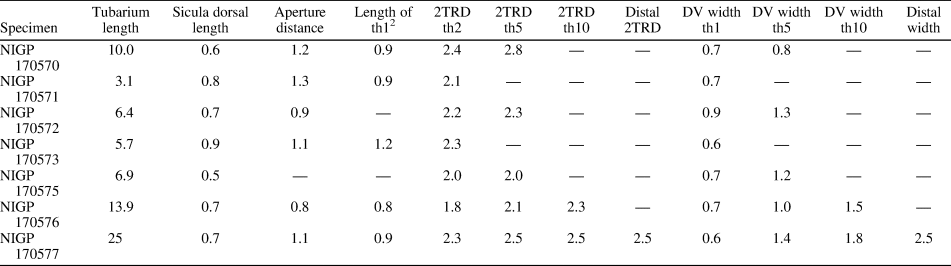
Tubarium with gentle proximal curvature, widening from 0.6–0.9 mm across th1 pair to 0.8–1.4 mm at th5 pair to 1.5–1.8 mm at th10 to 2.5 mm distally (Table 2). Median septum straight and present from at least the level of the middle of th4 (Fig. 4.3). The specimen tentatively assigned to this species (NIGP 170574) has a median septum visible throughout the preserved portion of the tubarium. Thecae with rounded genicula; supragenicular walls slightly inclined relative to tubarium axis proximally, often becoming parallel to tubarium axis distally. Thecal apertures generally horizontal. Apertural excavations shallow proximally. Thecae widely spaced: 2TRD 1.8–2.4 mm at th21, 2.0–2.8 mm at th51, 2.3–2.5 mm at th101, 2.5 mm distally (Table 2). Virgella, when preserved, long and robust. In one specimen (NIGP 170575), the virgella is initially in the same line as the axis of the tubarium (for a distance of 0.4 mm), then bends and widens, forming a spatulate structure that is 2.9 mm long (Fig. 3.5). In another specimen (NIGP 170573), the virgella bifurcates to form two horizontal branches 2.5 mm from the sicular aperture (Figs. 3.11, 4.11). Nema not preserved in most specimens. In the specimen tentatively assigned to this species (NIGP 170574), the nema is robust. Details of sicula not visible. Th11 covers the ventral margin of the sicula, extending slightly below the sicular aperture in two specimens (NIGP 170571, 170572) and growing upward from the level of the aperture in the other specimens. Dorsal margin of sicula free for 0.5–0.9 mm. Distance from sicular aperture to th11 aperture 0.8–1.3 mm.
Measurements of specimens of Avitograptus acanthocystus (Fang et al., Reference Fang, Liang, Zhang and Yu1990) n. comb. for which the proximal end is available. Sicula dorsal length = length of exposed portion of dorsal margin of sicula, measured parallel to tubarium axis; aperture distance = distance from aperture of sicula to aperture of th11, measured parallel to tubarium axis; 2TRD = two-thecae repeat distance; DV width = dorsoventral width. All measurements in millimeters.

Materials
NIGP 170570 from bed SS2 at Shuangshe, NIGP 170571–170573 from bed SS3 at Shuangshe, NIGP 170575 from bed SS4 at Shuangshe, NIGP 170576 from Tianjiashan 3, and NIGP 170577 from Zhuwukou. NIGP 170574 from bed SS3 at Shuangshe lacks the extreme proximal end and is questionably assigned to this species.
Remarks
In the holotype of the species, the virgella widens to form what Fang et al. (Reference Fang, Liang, Zhang and Yu1990) called an “acanthocyst”. Only one of the Anji specimens displays this feature (Fig. 3.5); other specimens have a long, relatively thin virgella, which branches in one specimen (Figs. 3.11, 4.11). Because the virgella varies within the population, it cannot be used as a species-defining characteristic. Elaboration of the virgella appears to be common in akidograptines (Štorch, Reference Štorch1983) and Avitograptus, although not all individuals exhibit this feature. For example, Williams (Reference Williams1983) illustrated specimens of Av. avitus (identified as Av. aff. avitus by Melchin et al., Reference Melchin, Mitchell, Naczk-Cameron, Fan and Loxton2011) with a bifurcating virgella with horizontal branches, and Zalasiewicz and Tunnicliff (Reference Zalasiewicz and Tunnicliff1994) reported a specimen with downward-pointing branches. The specimens of Akidograptus ascensus, Ak. cuneatus, and Parakidograptus acuminatus from Uzbekistan figured by Koren’ and Melchin (Reference Koren’ and Melchin2000) all display branching virgellae.
Avitograptus acanthocystus n. comb. can be readily distinguished from other avitograptid and normalograptid species. It is similar to Av. avitus in thecal form, but can be distinguished by the curvature of the proximal end, the greater 2TRD, and the greater dorsoventral width. Avitograptus acanthocystus n. comb. differs from Av. akidomorphus n. sp. in its more pronounced proximal curvature, the lack of sharp geniculation on the proximal thecae, and the greater dorsoventral width. Normalograptus minor, which characteristically bears a branching virgella, has a more slender tubarium and lower thecal spacing than Av. acanthocystus n. comb. In addition, the tubarium of No. minor is straight proximally rather than curved. Normalograptus rhizinus (Li and Yang in Nanjing Institute of Geology and Mineral Resources, 1983) has a spatulate virgella and proximal dorso-ventral width values similar to those of Av. acanthocystus n. comb., but the former has a straight tubarium and a smaller distal width.
Avitograptus akidomorphus new species
Figures 3.6, 3.7, 4.1, 4.2
- ?Reference Koren’, Mikhailova, Tsai, Apollonov, Bandelatov and Nikitin1980
Glyptograptus aff. avitus Davies, Reference Davies1929; Koren’ et al., p. 140, pl. XL, fig. 10, text-fig. 41.
- ?Reference Chen, Zhang, Yu and Liu2007
Normalograptus rhizinus; Chen et al., text-figs 3U, 4N.
Holotype
NIGP170360 (Fig. 4.1) from bed SS4 at Shuangshe, Fushi Reservoir, Anji County, Zhejiang Province, South China. Wenchang Formation, Metabolograptus persculptus Biozone, Hirnantian, Upper Ordovician.
Diagnosis
Avitograptus with strongly geniculate proximal thecae and weakly geniculate distal thecae. Tubarium straight, dorso-ventral width 0.4–0.6 mm at th1, maximum dorso-ventral width 1.2 mm. Ventral margin of sicula entirely obscured by th11; dorsal margin partly covered by th21. Complete median septum.
Occurrence
Only known with certainty from the type locality. The specimen of Koren’ et al. (Reference Koren’, Mikhailova, Tsai, Apollonov, Bandelatov and Nikitin1980) that is questionably assigned to this species is from the P. acuminatus Biozone (lower Silurian) of Kazakhstan. The specimen of Chen et al. (Reference Chen, Zhang, Yu and Liu2007) that is questionably identified herein as Av. akidomorphus n. sp. is from the Tangjia section (M. extraordinarius or M. persculptus Biozone; exact horizon not stated) of Lin'an County, Zhejiang Province, ~45 km south of Fushi Reservoir.
Description
Tubarium slender, very slightly curved proximally, widening from 0.4–0.6 mm across th1 to 0.8–0.9 mm at th5 to a maximum of 1.2 mm distally (Table 3). Proximal thecae (th2–4) with pronounced geniculum, geniculum less pronounced in distal thecae. Apertures horizontal or slightly introverted. Thecal walls slightly inclined relative to tubarium axis proximally, becoming parallel distally. Thecae widely spaced: 2TRD 2.0–2.5 mm at th21, 2.3–2.8 mm at th51. Distal 2TRD measurements are not available for the specimen with the greatest 2TRD value at th5 (NIGP 170569), but in the other two specimens 2TRD values are 2.1–2.4 mm at th101 and 2.1–2.4 mm distally. Median septum complete, very slightly undulating. Exact point of origin of th11 cannot be determined, but presumed to be low on the sicula (the ventral margin of the sicula is entirely covered). Th11 extends slightly below (Fig 4.1) or grows up from (Fig. 4.2) the level of the sicular aperture. Distance from aperture of sicula to aperture of th11 1.1 mm. Sicula partly obscured by th12, so sicula length cannot be determined. Dorsal margin of sicula free for 0.6–0.7 mm. Virgella robust, at least 2.1 mm long, projecting at a slight angle from the tubarium. In specimen NIGP 170361, the virgella is thickened; in specimen NIGP 170569, it appears to bifurcate 1.4 mm from the sicula. Only one specimen (NIGP 170361) preserves the nema, which extends beyond the last thecae and is quite slender.
Measurements of Avitograptus akidomorphus n. gen. n. sp. Sicula dorsal length = length of exposed portion of dorsal margin of sicula, measured parallel to tubarium axis; aperture distance = distance from aperture of sicula to aperture of th11, measured parallel to tubarium axis; 2TRD = two-thecae repeat distance; DV width = dorsoventral width; x = data not measurable. All measurements in millimeters.

Etymology
From Greek akis, thorn, and morphe, shape, reflecting the slender, pointed shape of the tubarium, and the similarity of the species to Akidograptus.
Materials
Paratypes NIGP170361 (Fig. 3.7) and NIGP 170569 (Figs. 3.6, 4.2) from bed SS3 at Shuangshe.
Remarks
This species is similar to species of Akidograptus in terms of thecal shape and slight tubarium curvature, but differs in the details of the proximal end. As stated above in the discussion of the genus, in Akidograptus the entire dorsal margin of the sicula and a portion of the ventral margin are free, and in Parakidograptus the ventral margin is also free, but the dorsal margin is partly obscured by th12. In contrast, in Av. akidomorphus n. sp., the ventral margin of the sicula is entirely covered by th11. Thus, Av. akidomorphus n. sp. cannot be assigned to Akidograptus or Parakidograptus, and is instead placed in Avitograptus.
Avitograptus akidomorphus n. sp. can be distinguished from Parakidograptus praematurus (Davies, Reference Davies1929) by its lower width at th5 (>1 mm in P. praematurus, 0.8–0.9 mm in Av. akidomorphus n. sp.) and lower maximum width (1.5 mm in P. praematurus, 1.2 mm in Av. akidomorphus n. sp.; Davies, Reference Davies1929; Štorch et al., Reference Štorch, Roqué Bernal and Gutiérrez-Marco2019). The thecal spacing is lower in most specimens of P. praematurus than in Av. akidomorphus n. sp. In addition, in P. praematurus, th11 turns upwards slightly, but significantly, above the sicular aperture (see for example Zalasiewicz, Reference Zalasiewicz2007), whereas in Av. akidomorphus n. sp., th11 turns upwards at or slightly below the sicular aperture.
Avitograptus akidomorphus n. sp. is similar to Av. avitus in the proximal thecal shape, in the elongation of the proximal thecae, and in the low point of origin of th11. The new species differs in its more pronounced thecal geniculation, slight proximal curvature of the tubarium, and the smaller tubarium width and larger 2TRD values.
Avitograptus akidomorphus n. sp. is similar in overall appearance to some previously described species of Akidograptus. Akidograptus longus Huang and Lu, Reference Huang and Lu1983, from the uppermost Ordovician or lower Silurian of Tibet, is strikingly similar to Av. akidomorphus n. sp. in overall form of the tubarium, but the two species can be distinguished on the basis of their proximal end development. In Ak. longus, th21 originates at the level of the middle of th12, leaving the dorsal margin of the sicula uncovered, whereas in Av. akidomorphus n. sp. th21 appears at about the level of the middle of th11 and partly covers the sicula. Akidograptus macilentus Chen and Lin, Reference Chen and Lin1978 is also similar in overall appearance, but re-examination of the holotype (specimen NIGP36053) has shown that in that species the dorsal margin of the sicula is entirely uncovered (LAM personal observation, 2018). These similarities confirm the close relationship between Av. akidomorphus n. sp. and Akidograptus species.
The specimen described as Glyptograptus aff. avitus from the Parakidograptus acuminatus Biozone of Kazakhstan by Koren’ et al. (Reference Koren’, Mikhailova, Tsai, Apollonov, Bandelatov and Nikitin1980) is similar to Av. akidomorphus n. sp., but a firm assignment is not possible because the proximal end is not preserved in the Kazakhstan material.
Climacograptus mirabilis Keller, Reference Keller1956 from the Pseudoclimacograptus scharenbergi Biozone (Sandbian, Upper Ordovician) of Kazakhstan (Keller, Reference Keller1956) is similar to Av. akidomorphus n. sp. in overall form; however, the two species can be readily distinguished by the slightly greater proximal tubarium width and lower 2TRD values of C. mirabilis. In the single C. mirabilis specimen illustrated by Keller (Reference Keller1956), the virgella has overgrown the sicular aperture, and so it is not possible to determine details of the proximal end development. Because only one specimen is illustrated, it is not possible to tell whether the virgellar overgrowth is a peculiarity of that specimen, or characteristic of that species. Such overgrowth is not present in the Anji material, so this may be another consistent difference between the species.
Discussion
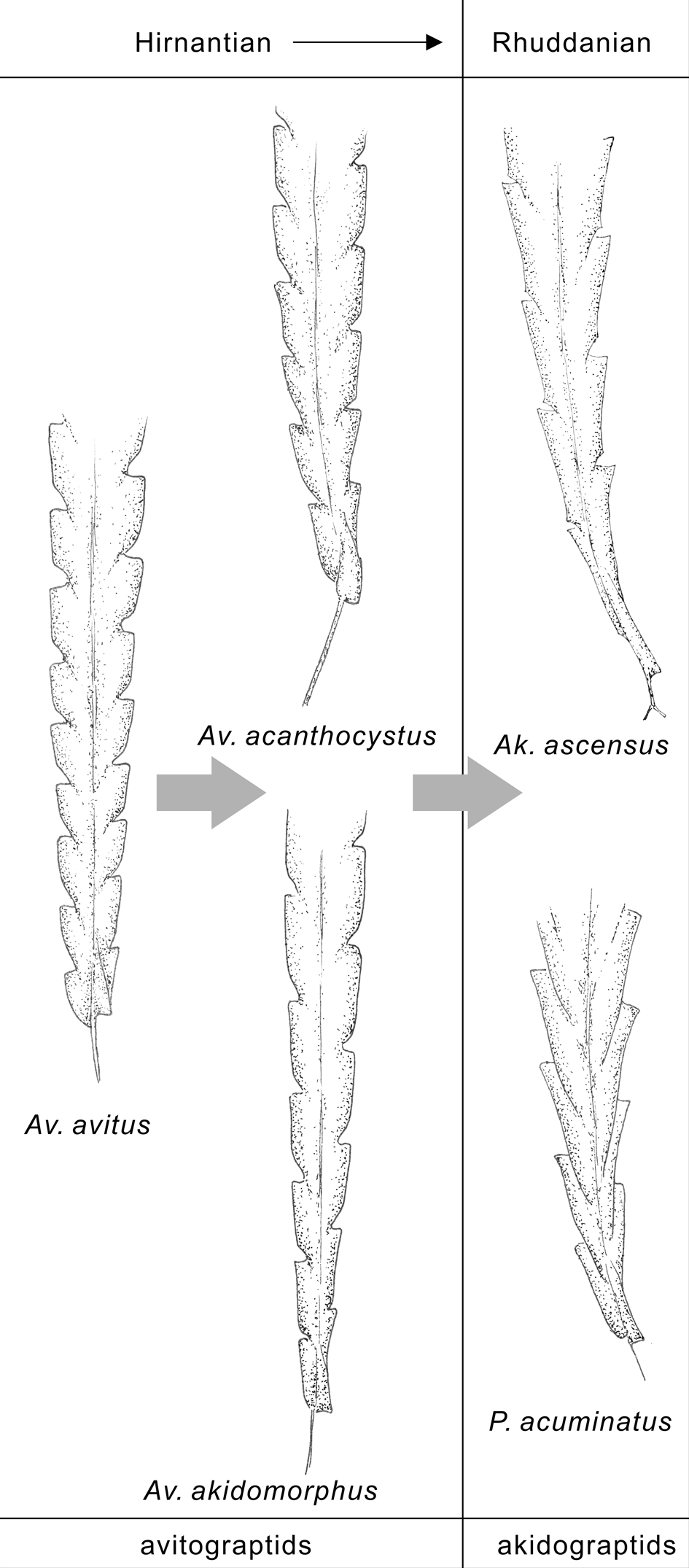
Melchin et al. (Reference Melchin, Mitchell, Naczk-Cameron, Fan and Loxton2011) hypothesized that the genus Avitograptus (to which they assigned two species, Av. avitus and Av. aff. avitus) represents an evolutionary intermediate between Normalograptus and Parakidograptus/Akidograptus, following the earlier suggestion of Davies (Reference Davies1929) that Av. avitus gave rise to Akidograptus and Parakidograptus. The discovery of Avitograptus akidomorphus n. sp. and Av. acanthocystus n. comb. supports this hypothesis. The evolutionary changes between Avitograptus avitus and Parakidograptus/Akidograptus involved distal movement of the origin of th11 and th12 (resulting in the dorsal margin of the sicula being entirely uncovered and the ventral margin mostly uncovered), thecal elongation, and greater outward inclination of the thecal walls (shown schematically in Fig. 5). Avitograptus akidomorphus n. sp. and Av. acanthocystus n. comb. represent morphological intermediates between Av. avitus and both Akidograptus and Parakidograptus in several parameters (Table 4). For example, the distance from the aperture of the sicula to the aperture of th11, measured parallel to the tubarium axis, is 0.8–0.9 mm in Shuangshe Av. avitus, 1.0–1.1 mm in Av. akidomorphus n. sp., 0.8–1.2 mm in Av. acanthocystus n. comb., 2.3 mm in the holotype of Akidograptus ascensus, and 2.4 mm in the holotype of Parakidograptus acuminatus.
Schematic evolution of akidograptids from Avitograptus during the Hirnantian–Rhuddanian boundary interval. The figure indicates grades of change rather than exact relationships. Av. = Avitograptus, Ak. = Akidograptus, P. = Parakidograptus.

Measurements from the literature of holotype or topotype specimens of Avitograptus avitus (Davies, Reference Davies1929) n. comb., Akidograptus ascensus Davies, Reference Davies1929, Parakidograptus acuminatus (Nicholson, Reference Nicholson1867), and P. praematurus Davies, Reference Davies1929. Sicula dorsal length = length of exposed portion of dorsal margin of sicula, measured parallel to tubarium axis; aperture distance = distance from aperture of sicula to aperture of th11, measured parallel to tubarium axis; 2TRD = two-thecae repeat distance; DV width = dorsoventral width. All measurements in millimeters. Measurements of holotypes from: Av. avitus, Davies (Reference Davies1929, fig. 21) n. comb.; Ak. ascensus, Rigby (Reference Rigby2000); P. acuminatus, Rong et al. (Reference Rong, Melchin, Williams, Koren and Verniers2008, fig. 1.3); P. praematurus, Zalasiewicz (Reference Zalasiewicz2007). Measurements of Av. avitus topotype from Melchin et al. (Reference Melchin, Mitchell, Naczk-Cameron, Fan and Loxton2011, fig. 6B). Note that the holotype of Av. avitus is slightly tectonized longitudinally, resulting in a decrease in the dorso-ventral width (Williams, Reference Williams1983) and possibly an increase in the 2TRD. All measurements in millimeters.

Acknowledgments
LAM's work in Nanjing was funded by a CAS President's International Fellowship Initiative (PIFI; grant no. 2018VCB0014). This study was also supported by grants from the Chinese Academy of Sciences (CAS) and the Ministry of Science and Technology of China (no. XDB26000000, no. 2013FY111000), and NSF of China (41772005) to ZYD. JPB's visit to Nanjing was funded by a CAS President's International Fellowship Initiative (no. 2016VEB006). The assistance on fieldwork of X. Fang, Y.-F. Hu, W.-J. Li, J.-Y. Ma, Y.-Y. Song, Y. Wang and X.J. Wu of the Nanjing Institute of Geology and Palaeontology and of L.-W. Wang and J.-F. Zhang of the Zhejiang Institute of Geological Survey is gratefully acknowledged. We thank the reviewers, D. Loydell and M. Melchin, and the handling editor, P. Štorch, for their detailed and constructive comments that greatly improved the manuscript.