INTRODUCTION
Environmentalism emerged as a global phenomenon in the late 1960s and early 1970s (Buttel Reference Buttel2002; Mertig et al. Reference Mertig, Dunlap, Morrison, Dunlap and Michelson2002). Since then, scholars have recognized the fundamental importance of exploring how knowledge, beliefs, and attitudes influenced human response to ecological degradation and pollution (Maloney et al. Reference Maloney, Ward and Braucht1975). This awareness led to less public support for the human exemptionalism paradigm (HEP), the notion that humans are free to do as they please because they are exempt from the laws of nature (Catton & Dunlap Reference Catton and Dunlap1978a; Dunlap & Michelson Reference Dunlap and Michelson2002). Endorsing the HEP implied thinking: (1) humans are separate from environments, (2) environments have only instrumental value, (3) environmental resources are inexhaustible, and (4) humans can control environments (Dunlap & Michelson Reference Dunlap and Michelson2002). Environmental sociologists suggested a new environmental paradigm (NEP) was emerging among the USA public (Catton & Dunlap Reference Catton and Dunlap1978b; Dunlap et al. Reference Dunlap, Van Liere, Mertig and Jones2000). This paradigm rejected the HEP by emphasizing limits to growth, anti-anthropocentrism, belief in future ecocrisis, belief in a fragile nature and rejection of human exemptionalism. Accepting the NEP was consistently related to pro-environmental behaviour (Buttel Reference Buttel1987; Dunlap et al. Reference Dunlap, Van Liere, Mertig and Jones2000).
Several sociodemographic factors may also be correlated with pro-environmental behaviour. Females are more likely to engage in pro-environmental behaviour due to cultural and social-structural factors that make them on average more aware of the interconnections between causes and consequences of environmental harm (Stern et al. Reference Stern, Dietz and Kalof1993; Hunter et al. Reference Hunter, Hatch and Johnson2004). More educated people are more likely to engage in pro-environmental behaviour because they are exposed to more information about environmental harm through schooling (Scott & Willits Reference Scott and Willits1994). The relationships between income, environmental attitudes and behaviour have been important topics within environmental sociology. Early research suggested a positive relationship between people's income and pro-environmental attitudes and behaviour because environmental quality was often considered a luxury good for which people have more degrees of freedom to emphasize when their material needs are well satisfied (Van Liere & Dunlap Reference Van Liere and Dunlap1980; Scott & Willits Reference Scott and Willits1994). However, citizens of poorer countries may have similar or even more pro-environmental attitudes (Brechin & Kempton Reference Brechin and Kempton1994; Dunlap & Mertig Reference Dunlap and Mertig1995; Brechin Reference Brechin1999), and may be willing to make similar or larger economic sacrifices for environmental protection partly because they more likely have direct experiences with the consequences of environmental degradation (Dunlap & York Reference Dunlap and York2008). Mixed results regarding the relationship between people's age and pro-environmental behaviour have also been reported (Scott & Willits Reference Scott and Willits1994; Stern et al. Reference Stern, Dietz and Guagnano1995; Tindall et al. Reference Tindall, Davies and Mauboules2003).
Cross-cultural and international research on the predictors of pro-environmental behaviour is critical for future conservation success but is, as yet, limited in scope (Schultz et al. Reference Schultz, Zelezny and Dalrymple2000; Leung & Rice Reference Leung and Rice2002). Globalization has made expanding this research into international and non-western contexts absolutely essential, and no place is more important for this research than China (Liu & Diamond Reference Liu and Diamond2005). China's economy has grown faster than in other major nations over the past three decades, fuelling unprecedented environmental degradation and pollution (Liu & Diamond Reference Liu and Diamond2005; Liu Reference Liu2010). China is already the world's largest contributor to atmospheric sulphur oxides and chlorofluorocarbons, as well as CO2 emissions (Liu & Diamond Reference Liu and Diamond2008), and acid rain fell on more than a quarter of Chinese cities during the 1990s (World Bank 2001; Feng et al. Reference Feng, Miao, Zhang and Huang2002). China is also the world's largest importer of tropical rainforest logs (ITTO [International Tropical Timber Organization] 2006), and accounts for 33% of global seafood consumption (Pauly et al. Reference Pauly, Alder, Bennett, Christensen, Tyedmers and Watson2003; Liu & Diamond Reference Liu and Diamond2005). Although China exerts a major environmental impact by virtue of being the world's most populous country, per person consumption is rising rapidly as well (Liu & Raven Reference Liu and Raven2010).
The state of environmental degradation in China warrants a close look at factors affecting environmental attitude and behaviour among Chinese citizens. Previous studies in China found that Chinese people tended to have anthropocentric viewpoints (Harris Reference Harris2006). People valued the environment for what it could do for them, and generally chose economic growth over environmental protection. There was also a pervasive lack of personal responsibility, as people tended to think it was the government's job to protect the environment rather than their own. Pro-environmental attitudes (such as those measured with NEP scores (Dunlap et al. Reference Dunlap, Van Liere, Mertig and Jones2000)) were more common among more educated, urbanized and affluent groups than those among more rural, less educated and less affluent groups (Hong Reference Hong2005; Harris Reference Harris2006; Hong & Xiao Reference Hong and Xiao2007), which reflected findings from western studies (Buttel Reference Buttel1987; Dunlap et al. Reference Dunlap, Van Liere, Mertig and Jones2000).
Less research has addressed predictors of pro-environmental behaviour than predictors of environmental attitudes in China, however, behaviour is the ultimate concern of conservationists. Recent studies found more educated people, younger people, females and those with higher NEP scores were the most likely to engage in pro-environmental behaviour (Hong Reference Hong2006; Gong & Lei Reference Gong and Lei2007), but most of these findings were obtained from bivariate analyses that did not control for correlations among attitudinal and sociodemographic variables. In addition, previous studies have often neglected occupational status, which is an important indicator of social class and may affect pro-environmental behaviour.
Further, little is known about the effects of urban size on pro-environmental behaviour in China, although people living in different size cities usually face different levels of environmental deterioration due to different stages in economic growth. This research gap reflects most previous studies using regional level data, without capacity for exploring effects of urban size that requires data at larger scale (such as nation level). Research in western contexts suggests urban residents exhibit greater pro-environmental attitudes and behaviour than rural residents because urban residents are often exposed to greater environmental degradation (Arcury & Christianson Reference Arcury and Christianson1990; Mohai & Twight Reference Mohai and Twight1987). Urban size may be especially important for pro-environmental behaviour in China given China's explosive urbanization and economic growth (United Nations 2004).
In this paper, we study relationships between pro-environmental behaviour and its sociodemographic predictors in urban China. In addition to the attitudinal and sociodemographic predictors that were used in previous studies in China and abroad, we also assessed the impacts of urban size and occupational status on pro-environmental behaviour. We used multivariate analysis to control for potential correlations among attitudinal and sociodemographic variables. Our findings provide important implications for managing environmental challenges in urban China, and the approaches we used may be applicable elsewhere.
METHODS
We used a recently released national dataset from the General Social Survey of 2003 administered jointly by the Survey Research Center of the Hong Kong University of Science and Technology and the Department of Sociology at Renmin University of China. Respondents were selected using a stratified random design with five strata. The strata were designed to eliminate double sampling any group of the population and facilitate comparisons between respondents living in cities of different sizes. Sample size was chosen to ensure an absolute sampling error of ≤3% at the 95% confidence level (n = 5073, 98.6% compliance rate). The first stratum included the 44 urban districts in Beijing, Tianjin and Shanghai (central municipalities). The second stratum included 175 urban districts in 24 provincial capital cities and Chongqing (a central municipality). Provincial capital cities were smaller and generally had lower gross domestic product (GDP) per person and lower percentages of non-agricultural population than central municipalities. Chongqing, the newly established central municipality, was sampled together with other provincial capital cities because it was demographically (for example as measured by GDP per person and % of non-agricultural population) more similar to provincial capital cities than to the other three central municipalities. The third stratum included the 611 city districts and counties in Beijing, Tianjin and Shanghai (excluding urban districts of Beijing, Tianjin and Shanghai), and five provinces in the eastern region (excluding urban districts of their provincial capital cities). The fourth stratum included 1136 city districts and counties in ten provinces in the central region (excluding urban districts of their provincial capital cities). The fifth stratum included 835 city districts and counties in ten provinces in the western region (excluding urban districts of their provincial capital cities). Tibet, Jilin, Guangdong and Taiwan provinces, and Hong Kong and Macao Special Administrative Regions were excluded from the survey due to logistic constraints (Hong & Xiao Reference Hong and Xiao2007). Survey data were collected through personal interview.
Measures
Respondents were asked if they engaged in one or more of six pro-environmental behaviours during the last year: classifying garbage (sort garbage), talking about environmental issues with relatives or friends (environmental-talk), recycling plastic packing bags (recycle bags), participating actively in education programmes about environmental knowledge held by the government or corporations (environmental education), participating voluntarily in environmental activities held by non-governmental organizations (environmental volunteer), and participating actively in appeal and prosecution processes about environmental issues (environmental litigation). Although participation in environmental litigation is low compared to other environmental behaviours in many countries (Blocker & Eckberg Reference Blocker and Eckberg1997; Barkan Reference Barkan2004), sociopolitical structures in China facilitate unusually high participation rates. Further, environmental litigation may be particularly important in many developing countries such as China, where people have been experiencing higher levels of environmental degradation than their counterparts in developed countries (Brechin & Kempton Reference Brechin and Kempton1994; Dunlap & York Reference Dunlap and York2008).
The NEP scale (Dunlap et al. Reference Dunlap, Van Liere, Mertig and Jones2000) was used to measure environmental attitudes. The NEP addresses five aspects of an environmental worldview with three statements for each: the realization of limits to growth, anti-anthropocentrism, belief in the fragility of the balance of nature, rejection of human exemptionalism, and belief in future ecocrisis. Attitudes are measured with five-point Likert type scales ranging from strongly disagree to strongly agree. Among these fifteen statements, there are eight positively (pro-environmentally) narrated statements and seven negatively narrated statements. Agreement with eight positively narrated statements results in higher measures, while measures of the seven negatively narrated statements are reversed so that disagreement with them results in higher measures. The NEP scale aggregates all fifteen statements and scores can range from 15 to 75. In this study, the scale had moderately high internal consistency (Cronbach's alpha = 0.71). Previous studies consistently found members of environmental organizations score higher on the NEP scale than do the general public or non-environmental interest groups (Dunlap & Van Liere Reference Dunlap and Liere1978; Widegren Reference Widegren1998; Dunlap et al. Reference Dunlap, Van Liere, Mertig and Jones2000; Dunlap & Michelson Reference Dunlap and Michelson2002). The NEP has shown significant, if weak, correlations with pro-environmental behaviour and intentions in many studies (Vining & Ebreo Reference Vining and Ebreo1992; Scott & Willits Reference Scott and Willits1994; Stern et al. Reference Stern, Dietz and Guagnano1995; Schultz & Oskamp Reference Schultz and Oskamp1996; Tarrant & Cordell Reference Tarrant and Cordell1997; Schultz & Zelezny Reference Schultz and Zelezny1998).
We used four demographic variables traditionally studied in association with NEP and pro-environmental behaviour (Scott & Willits Reference Scott and Willits1994; Tarrant & Cordell Reference Tarrant and Cordell1997; Gong & Lei Reference Gong and Lei2007): gender (female = 1, male = 0), age, education (years) and income (annual income of the respondent in the previous year measured in ten-thousands of Yuan [US$ 1 = 8.3 Yuan when the survey was conducted]). We also included two occupational variables: employment status (employed = 1, unemployed = 0) and employment rank (leadership position = 1, and 0 for others), because people's occupational status may represent differences in social classes that may influence pro-environmental behaviour (Van Liere & Dunlap Reference Van Liere and Dunlap1980; Ebreo & Vining Reference Ebreo and Vining2001). We evaluated effect of urban administrative level (0 for towns of counties, 1 for county level cities, 2 for non-capital cities above county level, and 3 for municipalities of the nation and capital cities of provinces) the respondent lived in. The urban administrative levels represent political power, but are related to population size, environmental degradation and influence concentration of resources (for example education resources and development funds) (State Bureau of Statistics of China 2003). We also included marital status (married = 1, unmarried = 0) because family responsibilities may reduce discretionary time available for participation in pro-environmental behaviour.
Analytical methods
We used logistic regression to estimate effects of respondents’ environmental attitudes (NEP) and sociodemographic attributes on each pro-environmental behaviour. In addition to the ordinary odds ratios which represent effects of a unit change of the independent variables, we also calculated the standardized odds ratios (X standardized), which represent effects of a standard deviation change of the independent variables. Standardized odds ratios allow intuitive comparisons among the effects of continuous independent variables (Long & Freese Reference Long and Freese2006). We conducted all statistical analyses with STATA 8.0 (software, STATA Corp., College Station, Texas, USA).
RESULTS
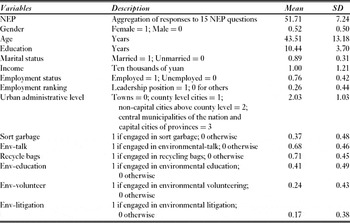
Respondents of the survey had a mean NEP score of 51.71 (Table 1). The sample was 52% female, mean age was 44, and the mean education level of 10.44 corresponded to a level between middle school and high school (Table 1). Most respondents (89%) were married and mean annual income was about 10 000 Yuan. Most respondents were employed (76%), and 26% held jobs with leadership positions. Less than half of the respondents (44%) lived in municipalities of the nation or capital cities of provinces. Among respondents in the sample, more than half reported engaging in environmental-talk (68%) and recycling bags (71%), while less than half of them reported engaging in sorting garbage (37%), environmental education (41%), environmental volunteering (24%) and environmental litigation (17%) in the previous year (Table 1).
Summary statistics of pro-environmental behaviours, environmental attitude and sociodemographic conditions of respondents. SD = standard deviation.

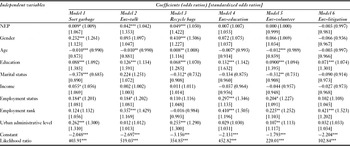
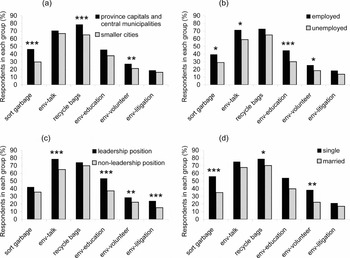
All independent variables were significant predictors of at least one pro-environmental behaviour (Table 2). A one standard deviation increase in NEP score increased the odds of environmental-talk 1.35 times and increased the odds of recycling bags 1.42 times (Table 2). Being female increased the odds of sorting garbage 1.26 times and recycling bags 1.51 times. Older respondents generally had lower odds of participating in pro-environmental behaviour (Table 2). A one standard deviation increase in education level increased the odds of environmental-talk, environmental volunteering and environmental litigation 1.59, 1.40 and 1.30 times, respectively (Table 2). Single respondents had higher odds of participating in sorting garbage, recycling bags, and environmental volunteering than married respondents (Table 2, Fig. 1).
Logistic regression of six pro-environmental behaviours on NEP, sociodemographic conditions and urban administrative levels. *p ≤ 0.05; **p ≤ 0.01; ***p ≤ 0.001; n = 5073.

Frequency of participation in pro-environmental behaviour among respondents with different (a) urban levels, (b) employment status, (c) employment ranking and (d) marital status. Significant differences indicated by regression analysis: *p < 0.05, **p < 0.01, ***p < 0.001.

In general, employed respondents had higher odds of pro-environmental behaviour than unemployed respondents (Table 2, Fig. 1). Holding a leadership position within employment generally increased the odds of participating in pro-environmental behaviour. The greatest impact was on environmental litigation, environmental-talk and participating in environmental education programmes where those in leadership positions had 1.52, 1.43 and 1.51 times higher odds of participation than those not in leadership positions, respectively (Table 2, Fig. 1). Respondents in more urban regions were significantly more likely to engage in sorting garbage, recycling bags, and environmental volunteering (Table 2, Fig. 1).
DISCUSSION
Our results identify employment status, employment rank and urban level as key variables to consider in future studies of pro-environmental behaviour. Both employed respondents and respondents holding leadership positions reported more participation in four of six pro-environmental behaviours than their counterparts (Fig. 1). Significant employment effects suggest that people may be exposed to the diffusion of environmental values through their employment (Brechin & Kempton Reference Brechin and Kempton1994). Further, many pro-environmental practices (such as environmental education and environmental volunteering) are organized by the employers (for example corporations) of respondents. People in non-leadership positions may engage less in pro-environmental behaviour because they perceive low levels of control over the behaviours and their outcomes (Ajzen Reference Ajzen1991). Employment effects on pro-environmental behaviours may also reflect the fact that Chinese people tend to place the majority of the responsibility for carrying out environmental conservation on people in powerful positions who they believe can influence policy (Harris Reference Harris2006). Harris (Reference Harris2004) noted that environmental policy making in China has been ‘top down’ with little involvement among the general public. In fact, the relationship between holding leadership roles in employment and participating in environmental litigation may reflect both fulfilment of a public role in society and higher levels of perceived control.
The more pro-environmental behaviour among more urban residents may reflect an aggregate of the same phenomenon observed at the individual level in terms of employment and leadership positions. In this case, larger cities with political power and jobs can afford to promote pro-environmental behaviour, while the smaller cities lacking jobs and political power are compelled to pursue economic growth even with high environmental costs. Ironically this difference in pro-environmental behaviour would relate to past decisions of sacrificing environmental protection for economic growth. Although more pro-environmental attitudes and behaviours may emerge as China and many other parts of the world continue to urbanize, urbanization may produce substantial environmental threats (Vitousek et al. Reference Vitousek, Mooney, Lubchenco and Melillo1997; Kalnay & Cai Reference Kalnay and Cai2003). In fact, the threats associated with urbanization in China (for example air and water pollution) may explain the link between pro-environmental behaviour and urban level found in this study.
While findings on effects of income on pro-environmental behaviour have been mixed (Scott & Willits Reference Scott and Willits1994; Chung & Poon Reference Chung and Poon2001), we found that in urban China income was a relatively unimportant predictor of pro-environmental behaviour. This difference may be explained in part by the inability of previous studies, using bivariate methods, to differentiate between correlated variables including education level, employment rank, employment status, urban administrative level and income. Weak correlation between income and environmental behaviour may also reflect the fact that respondents, regardless of their income levels, have been experiencing the effects of environmental degradation in China, hence may not consider environmental quality as a luxury good that otherwise may be correlated to income (Brechin & Kempton Reference Brechin and Kempton1994; Dunlap & York Reference Dunlap and York2008).
Our results reflect the findings of previous studies addressing pro-environmental behaviour in China by finding that highly educated, more urbanized, young, female and environmentally oriented Chinese demonstrated more pro-environmental behaviours than their counterparts (Harris Reference Harris2006; Hong Reference Hong2006; Gong & Lei Reference Gong and Lei2007). These findings largely match those from pro-environmental behaviour studies in Western countries (Howell & Laska Reference Howell and Laska1992; Scott & Willits Reference Scott and Willits1994; Tindall et al. Reference Tindall, Davies and Mauboules2003; Hunter et al. Reference Hunter, Hatch and Johnson2004). Education plays a key role because it may not only facilitate people's understanding of environmental issues, hence improving people's environmental knowledge, but also promote individuals’ realization of their own responsibility for the environment.
The age related impact of pro-environmental behaviour may be explained by the cohort effect (Buttel Reference Buttel1979), where younger Chinese have come of age during a period of intense environmental degradation. Our findings also indicate marital status should be considered in future environmental behaviour studies since single respondents generally demonstrated more pro-environmental behaviours than married respondents. The additional predictive power of marital status (single respondents were younger than married respondents) over age may relate to time constraints on pro-environmental behaviour imposed by family responsibilities. Environmental-talk (an easily multi-tasked behaviour) was the behaviour with smallest participation differences between single and married respondents (Fig. 1). Gender effects on pro-environmental behaviour may be explained by traditional gender roles in China, where women perform more domestic tasks than men, for example sorting garbage and recycling (Li Reference Li2003).
The positive relationship between NEP score and pro-environmental behaviour is not surprising since NEP reflects, in part, belief in future ecocrisis. The finding, however, has major implications in China where land erosion, flooding, drought and other natural disasters have boomed (Liu & Diamond Reference Liu and Diamond2005). In these contexts, perspectives reflecting the NEP may become more prevalent (Lo & Leung Reference Lo, Leung and Cheng1998; Harris Reference Harris2006). Our findings suggest pervasive views reflecting the NEP would correlate with more pro-environmental behaviour.
Efforts to promote pro-environmental behaviour in urban China could well target less educated people, those with low employment status (unemployed or low employment rank), and inhabitants of smaller cities, at least for the six behaviours analysed in this study. However, our study excluded some rural regions of China due to lack of data, thus these findings cannot be assumed to extend to those regions and a few provinces where the survey was not conducted. Although we identified potential mechanisms for explaining predictors of pro-environmental behaviour in urban China, future studies should test those mechanisms.
ACKNOWLEDGEMENTS
We thank the General Social Survey of China project for providing the data, and the editor and two anonymous reviewers for their constructive criticisms on an earlier draft of this paper. We gratefully acknowledge the financial support from NSF.