In the last four years there has been a dramatic change in Palestinian politics following the death of Yasser Arafat, the long-lived and omnipotent leader of the Palestinian Liberation Organization (PLO), in November 2004. After the Oslo Accords Arafat became the chairman of the Palestinian Authority (PA) and continued in this position until his death. Since that time, the Palestinians have been unable to come up with an alternative leadership to step into Arafat's position. General elections for the presidency took place among the Palestinian population in January 2005. Arafat's predecessor in Fatah, Abu Mazen, eventually won the presidential elections with more than 65 per cent support. General elections for the Palestinian Legislative Council (PLC) took place in January 2006. To the surprise of many, the radical Islamist party Hamas won a sweeping victory with 74 out of 132 seats in the PLC, and thus formed the new government.
Since then, the Palestinians have been unable to stabilize their political rule. The two main political factions, Fatah and Hamas, have descended into violence between themselves and the situation has deteriorated rapidly into a civil war, despite numerous attempts at reconciliation between the two camps – either directly or with the assistance of Arab states such as Egypt and Saudi Arabia. The peak of these events was Hamas's occupation by force of the Gaza Strip in June 2007, which actually divided the PA into two separate political entities: Fatah in the West Bank and Hamas in Gaza.
These events reflect the failure of the democratic campaign in the PA. Although the PA was meant to be a democracy according to the Oslo Accords, its institutions of democracy were – until their collapse – weak and marked by patronage, corruption, coercion and the de facto dictatorship of Arafat over its institutions. Ironically, a good role model for the Palestinians, and the only stable democracy in the region, is Israel.Footnote 1 While some significant differences between the two cases exist, they both share some striking similarities. First, the national movement emerged in diaspora. Second, the majority of the nation still lives in diaspora. Third, the creation of civil society in both cases took place under undemocratic military rule. Finally, over time, both societies experienced a shift of political weight from the diaspora to the territorial boundaries.
Based on these similarities, this article explores and compares the two democratic experiences from a historical long-term elite perspective. It analyses the main differences between Israel's democratization process, which allowed a relatively smooth transition to democracy after Israel's independence in 1948, and the Palestinian democratization process, which has so far failed to establish a stable, democratic system in the PA.
THE IMPACT OF POLITICAL ELITES ON DEMOCRATIZATION
This article investigates the following question: what is the role of political-elite formation on the success of transitions to democracy in the Israeli and Palestinian cases in particular, and in newborn states more generally?
In modern societies there are many different types of elites – political, economic, cultural, religious, academic, etc. Each elite has its distinct impact on social processes. The present article, however, focuses on political elites rather than elites in general. Political elites, or what Robert Putnam calls ‘proximate decision makers’,Footnote 2 are, to borrow Higley's and Moore's definition, ‘persons whose strategic positions in large and powerful organizations and movements enable them to influence political decision-making directly, substantially, and regularly’.Footnote 3
While a great deal has been written on the centrality of political elites in transitions to democracy, as well as on how their class affiliations and institutional backgrounds affect their preferences regarding the transition process, much less research discusses how the long-term process of political-elite formation influences transitions to democracy in different societies. In the ongoing ontological debate about the relative weight of agency and structure in determining social and political outcomes,Footnote 4 most of the existing literature on elites' impact on democratization emphasizes their pivotal role as agents of political change in the momentary critical juncture of the democratic transition. O'Donnell and Schmitter, the founders of the ‘transitions’ literature, make clear that their object of research is merely the transition period, which starts with divisions among the ruling elite, and ends with the first democratic elections.Footnote 5 In their project, neither the long-term circumstances that facilitate the transition nor the long-term relative success of the transition are discussed or researched.
Higley, Gunther and others, a group of sociologists who conducted vast research on the issue, also suggest that political elites are instrumental to the establishment and consolidation of democratic regimes.Footnote 6 They emphasize the need to reach a ‘consensual unity’ and the conditions and ways by which divided elites transform to allow this consensus to take hold. But they too take the formation, structure and identity of political elites as givens and do not ‘dig’ deep enough into their emergence and evolution over time.
Although this literature reveals a significant layer of the ‘democratic transition’ story, it overlooks structural long-term factors, which shape the behaviour and preferences of political elites during transitional moments. It does not explore the social setting that brings political elites to support or act against transitions to democracy, the underlying long-term social circumstances that influence elites to cooperate amongst themselves or compete with each other, or what influences their commitment to, and level of performance during, the transition process.
It is noteworthy that this article does not challenge the conceptual boundaries of the term ‘democratic transition’, nor does it attempt to stretch the temporal limits of its definition. Transitions to democracy take place in a relatively short and limited period of time that starts with divisions among the ruling elite and ends with popular elections. Yet, the innovative contribution of this study is the assertion that the relative success of democratic transitions can be understood only in light of prior gradual processes that start long before the beginning of the transition per se. By focusing on preceding political-elite formations, this article complements rather than contradicts the literature on democratic transitions and adds another layer to our understanding of this complex social phenomenon.
This piece argues that the type of political-elite formation and the nature of its interaction with its subordinates during the formation process and afterwards are central to the commitment, accountability and responsiveness of the elite, as well as to its ability to govern and perform, and thus has a strong impact on the success of democratic transitions. More specifically, this article asserts that political elites that emerge from within the domestic population in a gradual process, and are exposed to the same political environment as the general population, will be more committed to that population and will identify with its perceived needs and political expectations. Thus, they are more likely to perform better, to win legitimacy and support from the masses, and to pave the road to a stable and more successful democratization process. Conversely, political elites that emerge independently of the domestic population, in a substantially different political setting, will be less committed to that population, and are more likely to experience a gap of expectations in values and political behaviour vis-à-vis the domestic population. The result will be underperformance from above and dissatisfaction and frustration from below. Under these circumstances the likelihood of the political elite successfully leading a stable democratization process are slim.
This argument carries theoretical value because it complements the dominant ‘transitions’ literature and provides a more in-depth structural explanation to existing short-term, agency-basedarguments regarding the role of political elites in transitions to democracy. It unveils long-term social processes that bring political-elite agents to act and perform as they do during transitional events. By doing this, it goes against the dichotomy between agency and structure and links them in one coherent explanation. It is also important on the practical policy level because understanding the social roots of political elites can assist in predicting which transitions have more chances of succeeding and which are more likely to fail. Finally, by focusing on transitions to democracy in the Middle East, this study makes possible a more general theorizing of democratic transitions, a field of study that is traditionally dominated and developed by students of Latin America and southern Europe, and is based on cases from these regions.
ACCOUNTING FOR POLITICAL-ELITE FORMATION TYPE
There is a substantial difference between the emergence of the Jewish political elite in Mandatory Palestine before 1948 and that of the Palestinian political elite before the Oslo Accords in 1993. While the Israeli leadership had emerged from among the domestic Jewish population in Palestine in a very gradual process that took several decades, the dominant leadership of the Palestinians had emerged and was formed in diaspora, absorbing and developing different ideas and representing interests different to those of the domestic population in the Occupied Territories (OT). This leadership did not participate actively and directly in domestic Palestinian politics until the signing of the Declaration of Principles (DOP) in 1993. Then, after that dramatic move, it assumed the leadership of the population in the territories, while marginalizing the nascent domestic leadership that emerged under Israel's rule and during the first Intifada.
This difference in the emergence of the political elite in the two cases is a core cause for the different outcomes in the Palestinian and Israeli democratization processes. The process of political-elite formation can account for three combined consequences that influenced the transition's outcome. First, each political elite exercised different degrees of commitment, accountability and responsiveness to domestic populations, which influenced its legitimacy and performance – two basic components of a successful transition to democracy.Footnote 7 The Jewish leadership has been very committed, performed well and enjoyed high levels of legitimacy from below. By contrast, the Palestinian political elite has been less committed to the domestic population, performed poorly and has had to face growing criticism and frustration from below.
Second, the geographic proximity of the domestic population and the territorial location of political-elite emergence affected the transition's outcome. The Jewish political elite, which emerged in the domestic arena, adopted and shared the same political values and ideas as the general populace. Therefore, there was no gap in expectations about the future of the emerging polity between the political elite and the electorate. Conversely, the Palestinian political elite and the masses were influenced by very different political environments and values. The Palestinian population in the OT lived beside Israel and under its rule and thus absorbed many of its democratic values, while the Palestinian elite settled and operated in Arab countries (Jordan, Lebanon and Tunisia) and was never exposed to democratic culture and values.
Third, in the absence of coercive capabilities the Jewish community before 1948 was able to develop a vibrant civil society that set the foundations for the democratic regime and censored the use of force for internal political reasons. This reality enhanced pluralism and a strong civic culture and ultimately facilitated a smooth transition to democracy after independence. Similarly, the Palestinian population in the OT developed a vibrant civil society during the 1970s and 1980s. But the big difference was that the Palestinian leadership had not been exposed to it, nor had it taken an active part in it. Thus, once the PA was established and was entitled to use coercive force, it often exploited it to undermine threats to its rule. The PA frequently used its coercive capabilities to act against civil society and was not forced to negotiate with, accommodate or tolerate opposition groups, all of which are basic prerequisites for any strong democracy.
Before proceeding with the comparison, three caveats must be made. First, this article acknowledges the profound difference between Israel and the PA in terms of their political sovereignty during the democratic transition period. Israel was given full independence after 1948 while the PA is something less than a state, especially today, when large parts of its territory are reoccupied by Israel. Yet, this difference does not invalidate the comparison. Although the PA was never given full independence, the level of independence granted to it in the DOP would have allowed for the establishment of a democratic regime, with separate branches of government, a capable police force and autonomous governance over large parts of the territory. Hence the lack of complete independence is not the sole explanation for the Palestinian democratic failure and it is necessary to suggest alternative explanations for the phenomenon.
Second, this comparison is by no means intended to disregard the problematic nature of Israeli democracy, with its ethnocentric policies,Footnote 8 long-standing negligence of non-Jewish minorities and long-term occupation and often-aggressive military rule over the Palestinians. But in spite of these significant shortcomings Israel is nonetheless considered a free and democratic state by the accepted measures, and thus a comparison between the two cases can be fruitful.
Third, there are of course other factors that have influenced the political outcome in the Palestinian case. These include the Israeli demand that the PA be held responsible for Israel's security; the effects of long military governance and Israel's constant military actions in the OT; the harsh economic situation in the PA;Footnote 9 the traumatic effects of the first and second Intifadas;Footnote 10 the influence of Islamic factions;Footnote 11 the involvement of other Arab states in the conflict; the involvement of the superpowers in the region's feudsFootnote 12 and the role of Arafat's ruling style.Footnote 13 These factors are essential to understanding the contemporary political reality in the PA, but many of them are related to elite-formation processes and thus cannot be properly understood without being linked to the ‘elite factor’. Therefore, articulating the influence of political-elite formation-type on democratic transitions may be helpful for our understanding of the Palestinian democratic failure.
ISRAEL
Political-Elite Formation
The story of modern Israel starts with Zionism – a Jewish nationalist movement that was established in Europe in the late nineteenth century. The Zionist movement led to five waves of immigration (Aliya) to Israel before the Second World War, starting in 1882.
An integral part of establishing a Jewish polity in Palestine was that the leadership and political elites of the ‘Yishuv’ were formed within, and gained their political power from, the domestic population rather than the diaspora. Most of them came to Palestine in the second wave of immigration from Eastern Europe between the years 1904 and 1914, and emerged as leaders among their constituencies in Palestine. A good example for the emergence ‘from below’ of the leadership is the personal biography of David Ben-Gurion, the first prime minister of Israel, who immigrated to Palestine in 1906 and worked during his first years in agricultural settlements.Footnote 14 Only after a decade in Palestine did he become a recognized political leader, and only in 1932 was he nominated as the chairman of the dominant labour union in the Yishuv. From that time on, he held several key positions in the Yishuv's leadership over the years, before being nominated as the leader of Mapai (the proto-Labour Party) and the first prime minister of Israel.
The Yishuv's leaders who had made Aliya out of idealism gradually changed their occupation and way of living alongside their emergence as political elite. They moved from rural areas to urban centres, especially Tel-Aviv, and spent their time developing domestic Jewish politics, as well as establishing ties with international Jewish institutions and with the British authorities.Footnote 15
Accountability and Performance
The Jewish political elite had been developing for three decades before Israel's independence, and thus had gained significant political experience and solid legitimacy as an authentic representative of the pioneers. In 1919 this political elite established the first Jewish political organization in Palestine – Ahdut Ha-Avoda (United Labour Organization), and since then most of that organization's leaders have held the highest positions in the leadership of the Yishuv, as well as afterwards in Israeli politics. This group included, among many others, David Ben-Gurion, Moshe Sharet (the second prime minister), Golda Meir (the fourth prime minister), Yitzchak Ben-Zvi (the second president), Levi Eshkol (the third prime minister) and David Remez (the first minister of education).
Aside from the rare leadership skills of Ben-Gurion, this entire group served the country with commitment, and was able to overcome significant social challenges such as absorbing and integrating Holocaust survivors and refugees from Arab countries, and generating economic growth, as well as security challenges resulting from numerous clashes and four wars with neighbouring countries. Corruption was very rare and was condemned, and the political discourse, though very harsh at times, did not escalate to violence after the war of independence. The legitimacy granted by the population allowed Ben-Gurion to take some controversial political decisions and actions, such as dissolving militant factions and signing a compensation agreement with Germany (Shilumim) without destabilizing the political system.
The legitimacy of this group was so solid that it continued to rule over Mapai and the Israeli government long after Israel's independence, despite huge waves of immigration in the first decade after independence that tripled the Jewish population in Israel. It was not until 1977 that Mapai was voted out of office, with the victory of the right-wing Likud party.
Exposure to Democratic Culture and Values
Most of the Jewish political elite in Palestine came from Eastern Europe and held socialist ideas that praised collectivism and nationalization of the private sector as an economic vision. The Zionist movement did not accept the liberal stream of democracy, and at most adopted, in the early twentieth century, the ‘class democracy’ model that had been implemented under the Russian communist regime, in which only the proletariat enjoyed complete political rights. All the members of the main organizations of the Jewish community, Ahdut Ha-Avoda and Ha-Histadrut, were blue-collar workers and farmers, and only they had voting rights in these institutions. While the Zionists adopted a framework of general elections in the Yishuv's institutions, this framework put an emphasis on formal aspects of democracy such as majority rule, without adopting the liberal aspects of it, which focus on pluralism and minority rights.Footnote 16
Yet, as time passed under the British Protectorate, liberal democratic ideas were diffused from the British system to the Israeli political elite and to the wider population. The most important legacy of liberal democracy was the British-influenced legal system. That is, the legal system in Palestine was subordinated to the British one, and individuals were able to appeal to British courts to overrule domestic courts' decisions. As a result, the Jewish population absorbed the procedures and values of the British legal system.Footnote 17 This process was so deeply embedded that when Israel declared its independence it adopted the British legal system as a whole to prevent a legal vacuum, until it was able to develop its own legal method.
Additionally, Israel's multiparty system was facilitated by the British authorities and had been effectively in place during the pre-independence era. The British style of rule enabled the establishment of autonomous representation in Palestine thathas subsequently been the basis of the Israeli political system.Footnote 18 As a result the Jewish society became more open and pluralistic despite the socialist inclinations within Zionism.Footnote 19 The peak of Mapai's political power was in 1934, when it won 81 per cent of the votes to the Jewish elective body in Palestine, while before and after this year there was a plural political system in place with no less than six parties in every election. Furthermore, in the last pre-independence elections to the main Jewish workers' elective body – Ha-Histadrut – in 1945, Mapai received only 53.1 per cent of the votes, and was among seven other parties that participated in these elections.Footnote 20 This vibrant and effective political structure became the cornerstone for the creation of a strong democratic state in Israel after independence.Footnote 21
Both the population and the political elite were exposed to the same British legal system and style of rule for about three decades and developed a unified political culture. Hence after gaining independence there were no differences between the political elite's style of ruling and the populace's expectations. This overlap between political expectations and method of rule was undoubtedly a primary factor in consolidating the post-independence Israeli regime.
Civil Society and Use of Coercive Capabilities
The Jewish community in Palestine contained some very radical ideological groups that did not reject the idea of using force in order to enforce their ideal ‘truth’ on other groups in society. However, the inability of any one group to force others to adopt their party's ideas due to their lack of coercive capabilities under the British Mandate forced most of them to accept and respect democratic and pluralistic ideas, particularly with an eye to recruiting the support of the population and increasing their relative power in the community. Ben-Gurion once said: ‘I would not fear of using coercive force in order to fulfill the ideas of Zionism and Socialism, but we can not use coercive force to recruit the Jewish people in Palestine and all over the world. Thus, we need to find the key to their hearts and a common language.’Footnote 22
The Jewish parties in Palestine expanded rapidly and enjoyed high levels of institutionalization and recruitment capabilities that facilitated the efficacy of the political system in the pre-independence era. Without political sovereignty, the parties expanded their spheres of responsibility to such spheres as welfare, health care, media, education, labour and other services. They were able to create a vibrant civil society, led by the political leadership. Under these circumstances, of strong and expanded political parties but without a sovereign framework, the parties managed to cooperate and build common national institutions. After establishing these political institutions, the parties adjusted to the new political system and acted as mediators between the political system and the population for the purposes of supplying services and distributing goods.Footnote 23 This civic experience during the pre-independence era reinforced the democratic and peaceful nature of the political system. The absence of coercive capabilities enhanced the absorption and adoption of democratic values, free competition and toleration.
After the state was established, the treatment of coercive capabilities had changed and reflected the new independent status of Israel. Knowing the political value of monopolistic control over coercive capabilities, Ben-Gurion insisted on concentrating all coercive capabilities in one body, the Israeli Defence Forces (IDF), under the command of the executive authority. Attempts by the militant right-wing militias, Etzel and Lehi, to further arm themselves were repressed aggressively by the IDF. The most influential event in that regard was the case of the Altalena, a ship loaded with arms for the right-wing militias that was sunk by the IDF, acting under the direct order of Ben-Gurion, to prevent the distribution of arms to forces other than the IDF. Ben-Gurion understood the danger posed to state-building by competing armed forces and was willing to use force to remove this threat, even at the price of using lethal violence and causing Jewish casualties. This event made it clear that no violent challenge would be allowed in the territory of Israel and made the militias disarm and join the IDF.Footnote 24 Although the government had significant coercive capabilities at its disposal it did not use them unlawfully to prevent legitimate political competition but rather limited the use of them to protect the regime and the political order.
THE PALESTINIAN AUTHORITY
Israel's political performance made it a role model for the Palestinians. A survey from 1993 by the Centre for Palestine Research and Studies (CPRS) revealed that 74 per cent of the Palestinian population supported a ‘democratic political system or a system similar to that of Israel's’.Footnote 25 With such aspirations among Palestinians, it is disappointing that a decade later the PA is considered a democratic failure.
Although the idea of Palestinian national identity has been present in the Middle East for about a century, the Palestinian national movement only began to be effectively represented in 1964, with the establishment of the PLO. Since then, the PLO gained political power and international recognition, reaching its peak popularity after signing the DOP in 1993. This agreement saw Israel acknowledge the national and territorial rights of the Palestinian nation for the first time. The DOP was followed by a series of bilateral agreements between Israeli and Palestinian representatives that were intended to shape and define a new Palestinian political entity. The Interim Agreement (1994), transferred responsibility for the Gaza Strip and Jericho to the new Palestinian entity. This agreement described in detail the path to the establishment of a Palestinian political system and envisioned the creation of democracy in Palestine.Footnote 26 Following this agreement, the PLO apparatus immigrated to the territories and established the PA. They settled first in Gaza, but after the second Oslo Accord (1995) built their headquarters in Ramallah. Despite hopes among Palestinians for a new era of independence, democracy and prosperity, the last 14 years have failed to meet those expectations:
Indeed, the PA contributed to the suffering of the people it was supposed to represent. Through corruption, economic monopolies, authoritarianism, repression, disdain for democratic processes and judicial fairness,…nepotism, and other practices, PA policies exacerbated the fragmentation of Palestinian society, increased class and hamayel divisions, contributed to the growing economic impoverishment, and were largely responsible for the social disintegration that occurred during this time.Footnote 27
Evidence suggests that the reason for such a gap between the aspirations of the Palestinians in the OT and the spirit of the bilateral agreements on one hand, and the actual methods of governance in the PA on the other is rooted in the type of Palestinian elite formation.
Political-Elite Formation
The Palestinian leadership was divided in two in the pre-Oslo era. There was a scattered, weak and ineffective domestic leadership in the territories from 1948 to 1967 – the period of Jordanian governance – and from 1967 to the 1980s under Israel's rule. This leadership followed a pragmatic line of compromising with Israel and representing the domestic population's interests. In the 1980s, a new domestic leadership of grassroots activists emerged to fill the leadership vacuum; this group of young leaders led the population to the first Intifada.Footnote 28
The second political elite, which was made up of members of the PLO, was established in exile and was recognized in 1974 by the Arab League and afterward by the United Nations (UN) as the sole representative of the Palestinians. The PLO perceived itself as representing the entire Palestinian nation, including Palestinian refugees all over the world. It thus supported the accomplishment of long-term national interests, including a total liberation of Palestine and the implementation of the right of return. This attitude naturally led to it following a more uncompromising and militant line against Israel.Footnote 29
After its establishment the PLO leadership settled in Jordan. However, it soon began to threaten the stability of the Hashemite kingdom, which reacted with a brutal massacre of thousands of Palestinians in September 1970. The group was subsequently based in Lebanon from 1971 until the Israel–Lebanon war of 1982. During its time in Lebanon, the PLO operated out of the refugee camps, often harassing northern Israeli settlements with guerrilla and terror attacks.Footnote 30 After Israel launched the Lebanon war and forced the PLO out of Lebanon, the group's headquarters was moved to Tunisia, where it stayed until the mid-1990s. After the Oslo Accords were signed, the PLO leadership, now recognized by Israel, was permitted to immigrate to the territories, together with several thousands of its security forces. From there it worked to propagate Palestinian self-rule over the lands and population in the OT.
Accountability and Performance
The dual leadership of the Palestinians, each of which grew up in different societies and cultures, and was supported by distinct populations within the Palestinian nation,Footnote 31 created tensions between what many scholars term ‘insiders’ and ‘outsiders’.Footnote 32 After the Oslo Accords, the Palestinians in the territories had to subordinate themselves to a new leadership that had not been formed among them, and did not necessarily represent their interests in an authentic way. Moreover, since the ‘outside’ leaders had not grown up in the territories, they had weak connections with, and weak commitment to, the local population.
Low levels of responsiveness together with corruption and an intentionally weak enforcement of the rule of law became common among the new leadership under the command of Chairman Arafat, who consolidated his rule by neo-patrimonial counter-democratic methods.Footnote 33 In such a situation, very little trust between groups and individuals in society is possible, and the prospects for the emergence of a vibrant civil society and democratic institutions are very low.Footnote 34 Lack of commitment and low levels of institutionalism led to increased individualism, nepotism and protectionism instead of true representation of group or class interests.Footnote 35 Practices of patronage and individual profit-seeking became common among high-ranked PA officials. They assumed control over essential sectors of the economy through a system of monopolies and franchises that provided them with large profits. Without a transparent budget, these profits were often used for personal interests rather than to benefit the population. The population started to feel, after the initial euphoria, that ‘something is rotten in the Palestinian kingdom’, and that the new leadership was not performing in accordance with their interests and aspirations. As a consequence, the legitimacy of the new regime quickly eroded.Footnote 36
A further complicating factor was the dominant power of Arafat within the PA, which was beholden to his centralizing methods of governance.Footnote 37 Arafat was willing to recruit anyone to his administration as he acknowledged the need for a wide consensus, but the prerequisite for such recruitment was an unreserved loyalty to Arafat himself rather than a strong commitment to the interests of the Palestinian nation. Since Arafat came from abroad with his own loyal men, the inner circle of the Palestinian leadership was solely from Tunisia, while the internal leadership was marginalized and subordinated to the ‘outsiders’.Footnote 38 Although some positions in the new authority were given to ‘insiders’, it was hardly more than a gesture to appease the domestic population, and was certainly not indicative of a desire to truly include ‘insiders’.Footnote 39
These methods of ruling, particularly the exclusion of the insiders from government, created frustration among the young guard. It has even been argued that these were the primary reasons for the eruption of the second Intifada, and not, as many assumed, Arafat's interest in maintaining low levels of violence during the bilateral talks with Israel.Footnote 40
Exposure to Democratic Culture and Values
Palestinians in the OT lived for the first two decades after 1948 under Jordanian rule, but the three subsequent decades were under Israeli rule. Israel established military rule in the territories and no national rights were acknowledged nor granted to the Palestinians by Israel, other than municipal elections.Footnote 41
Nonetheless, because the Palestinians have a very underdeveloped economy and to a large extent depend upon Israel for economic opportunities, a close economic relationship of dependency has developed between the two communities.Footnote 42 As a result of this daily interaction Palestinians in the OT became familiar with Israel's political system, and began to perceive it as a role model for their future self-rule.Footnote 43 Even before the Oslo Accords, the leadership of the interior criticized the non-democratic practices of the PLO, and drew upon the Israeli model in demanding democratic reforms within the organization.Footnote 44
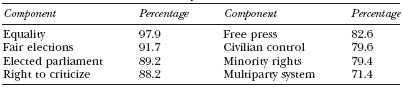
The CPRS survey from November 1993 shows that Palestinians in the OT strongly support the core elements of democracy: 77 per cent of the population supported general elections, and 66 per cent supported the freedom of the press.Footnote 45 In a more extensive survey from 1995, the results were even more supportive of democratic values. Table 1 shows the components of democracy, both procedural (elections, opposition) and qualitative (free press, equality, minority rights, etc.), that were considered important or very important by an outstanding majority.Footnote 46
Percentage of Respondents Considering Components of Democracy Important or Very Important

Source: The CPRS Project.
Even more impressive were the results on women rights. In a survey from April 1994, about 80 per cent supported the right of women to vote in general elections and 63 per cent said they were willing to vote for a competent woman candidate.Footnote 47 These results reflect the deeply rooted democratic values among Palestinians in the OT, and they raised many expectations for the first democratic rule in the Arab world. Unfortunately, the current institutions of the PA do not reflect this genuine quest for democracy. Although presidential elections took place in 1996 and then again in 2005 and elections for the legislative council took place in 1996 and 2006, there are many abuses of democracy in the PA, violations of human rights, constraints on the press, corruption and imposed limits on civic organizations.Footnote 48
The reason for the wide gap between aspirations and reality is rooted in cultural differences between the populace and its ‘imported’ government. The PLO apparatus had been hosted by Arab states and came across no democratic practices and values before their arrival to the territories in the mid-1990s. All the hosting countries rely on strong authoritarianism to preserve their rule.Footnote 49 Clear traces of these non-democratic methods of ruling can be found in the PLO institutions that were imported to the territories and became the platform for the PA. Azmi Shu'aybi, a former member of the PLC, who was forced to resign by Arafat after protesting against budgetary corruption, says:
The authority was supposed to build the institutions of the state…unfortunately, it is now clear that none of this occurred, and that President [Yasir] Arafat is conducting himself on the basis ‘I am the state and the state is me.’ This state of affairs has been accepted without the least protest. Of course, the tendency to accept without question was well established in the PLO institutions and was simply imported ready-made into the territories with the PA.Footnote 50
The practices of the new authority reflected the political elite's non-democratic values rather than those of the population. Arafat and his closest advisers relied on trust and loyalty rather than on transparency and organized institutions.Footnote 51 While strengthening his position, Arafat weakened the legislative and judicial branches, and subordinated them to the executive branch. Arafat used his presidential powers to ratify any new legislation and to hinder those that challenged his rule or curtailed the powers of the PA. The most striking example is the legislation of the Palestinian constitutional laws. Arafat was not willing to sign a draft of Palestinian Basic Laws (constitutional laws), and only after several years demanded, as a condition for his approval, a substantial revision in the laws. In 2002 public pressure finally forced him to ratify the laws, and it has been revealed that he made some revisions in the document without consulting or by merely notifying the legislative branch beforehand.Footnote 52
The judicial branch was also subordinated to the will and interests of Arafat. Instead of creating an active, professional and independent judiciary, Arafat did not hesitate to dismiss judges who criticized the PA and to replace them with loyal ones, even if the latter were unqualified for the task. Also, Arafat established a State Security Court in 1995, thus creating a judicial ‘detour’. This court was accountable to no one but Arafat, and was granted powers such as ordering arbitrary arrests and secret trials in the middle of the night without allowing the basic right of appeal. In the rare cases where the courts ruled against the PA, the PA steadfastly failed to execute the courts' decisions.Footnote 53
Civil Society and Use of Coercive Capabilities
The Palestinian experience with civil society is divided into two phases. Until Oslo the Palestinians had been actively involved in the formation of civil society. Associational activity had mushroomed in the territories, starting with the occupation in 1967, until the mid-1990s.Footnote 54 Many social associations and NGOs were formed and served the population in a wide spectrum of civil services. As the Jewish community did before independence, ‘The Palestinians during the 1980s succeeded in creating social, political, professional and popular civil institutions and NGOs that fulfilled many functions including those performed in normal circumstances by the state.’Footnote 55 This expanded political centre was based on high levels of participation and legitimacy without coercive capabilities. It fostered a vibrant civil society that founded the beginning of the Palestinian political system. After signing the DOP the Palestinians experienced severe regression in civic and political performance. A primary reason for the decline is the excessive coercive capabilities that were granted to Arafat's cadre in Oslo, without their having sufficient democratic background.
Attempts to wipe out domestic political opposition to the new regime had started before the PA's leadership emigrated from Tunis. During the period between the signing of the DOP and the actual arrival of the PLO leadership to Gaza, the latter took measures to undermine and depoliticize existing institutions in the OT.Footnote 56 When the PLO's leadership emigrated to Gaza they brought their own men and established a strong police force that, in all but name, acted as a military.Footnote 57 The first task of the PA was to build a functioning state and to strengthen the regime's stability and efficacy, and it took precedence over democratization efforts. Money for NGOs dried up, civil liberties were restricted and the PA took repressive measures against the press.Footnote 58 Arafat established no fewer than 11 different security services. The cost of public sector salaries was almost 70 per cent of the budget, more than half of which was spent on security services.Footnote 59 Extensive recruitment to the security apparatus was mainly used to co-opt opposition forces and provide them with income. With such powers, it was easier to establish an authoritarian and coercive state than a civic pluralistic one. Even if the original intention was to achieve a minimum level of public order and stability in the short run and allow more democratization in the future, the coercive nature of authoritarian regimes is hard to break.Footnote 60
Admittedly, the PA is less authoritarian than other regimes in the Arab world. Nevertheless, while criticism of the regime is allowed to some degree, newspapers that were too critical were closed.Footnote 61 In addition, Arafat did not hesitate to use coercive capabilities to signal his opposition once they crossed what he perceived as a dangerous borderline. For instance, at the funeral of an Islamic Jihad member in November 1994 the police restricted the gathering of the mourners and even shot into the crowd, killing 13 people. ‘Whether the killings were intentional or not, the message they conveyed was that Arafat's regime was determined to draw unequivocal limits to opposition and eliminate anyone posing a serious threat to his authority.’Footnote 62 More recent clashes between the security services and Islamic opposition groups took place following the failure of the Camp David talks in 2000, and during the second Intifada.Footnote 63
Also, although the PA established itself as the sole government in the OT, Arafat did not use his powers to disarm opposing factions, especially Islamic Jihad and Hamas. There were two reasons for tolerating armed militias in the PA. Politically, Arafat did not want to pay the price for going overtly against other groups in Palestinian society that enjoyed substantial popular support. Strategically, Arafat believed that this opposition network would serve him well during negotiations with Israel, and if the negotiations failed, would strengthen the capabilities of the Palestinians in a violent struggle against Israel.Footnote 64 This strategy compromised one of the most basic principles of modern states: that the state should have a monopoly on the capacity for force. While benefiting the PA in the short term, this policy sowed the seeds of its later collapse.
The shortcomings of the Palestinian political system have been exacerbated dramatically since January 2006 with the electoral victory of Hamas, and reached a low point with the violent takeover of the Gaza Strip by Hamas in June 2007. The inability of the incumbent leadership to accept the outcome of the elections, and the long-term reluctance of the PA to disarm the militant Islamic factions, created an uncontrollable situation that led to large-scale violence and a bifurcated rule over Palestinian territories and populations. Without embedded tolerance and pluralism the peaceful transfer of political power became an almost impossible mission. This situation posed serious challenges to the Palestinians, with a ‘de facto’ parallel existence of two Palestinian entities – one in the West Bank, the other in Gaza – each with a different government and distinct strategic considerations, as well as making it almost impossible to promote peace negotiations with Israel without a minimum level of national consensus.
CONCLUSIONS
While the outcome of the Israeli process is a democratic state, the outcome of the Palestinian process is still unknown, but is, at the least, in grave doubt. This research reveals some crucial differences between the two processes and provides some general lessons about democratization processes.
First, political-elite formation is an important factor in democratization projects. Democracy requires responsiveness and accountability. These are not feasible without a committed and reflective leadership. A political leadership needs to be composed of, or at least collaborate with domestic grassroots activists who have ‘grown up’ in society and are committed to it. No parachuting from above can overcome the need for an internal and gradual process of political-elite formation. In some respect, the meteoric political rise of Hamas is a kind of ‘correction’ to this failure in political-elite formation. Hamas won the 2006 election, not because of its militant ideology or religious appeal, but because it was led by domestic leaders with ‘clean’ reputation who promised to fix the malfunctioning of the PA.Footnote 65
Second, exposure to and absorption of democratic culture is crucial for the formation of newborn democracies. But the exposure of the populace alone is insufficient. It is essential that the leadership and the populace are exposed to the same political reality. Otherwise, instead of meeting the population's democratic expectations the new regime will most likely exercise the authoritarian methods it is familiar with, at the expense of democratic ones.
Third, substantial coercive capabilities should be given only to regimes that acquired some democratic experience in the past. This lesson qualifies Dahl's argument regarding the link between coercive capabilities and the emergence of effective opposition in transitional periods. The more embedded democratic values are among the political elite, the less likely it is that coercive capabilities – regardless of their scale – will be used unlawfully to undermine the creation or existence of political opposition.
Finally, the Israeli example shows a process ‘from below’, of civil society that transformed into a strong political system. The very same process started in the Palestinian case, but was interrupted by the Oslo Accords and the return of the external leadership. Unfortunately, there are no easy ways or shortcuts towards democracy. In order to allow successful transition to democracy, societies in transition should undertake a process of building a strong civil society and state institutions that are the building bricks of any solid democratic system.