As with gasoline, Coca-Cola, and heroin, global demand for major conventional weapons is both massive and hard to counteract. Moreover, one cannot understand any of these markets without acknowledging the crucial role played by the United States. This essay employs both of these insights to analyze the global production and sale of the principal tools of war, including fighter aircraft, armored vehicles, naval vessels, and the munitions they deliver.Footnote 1 In doing so, it argues that a power such as the United States—indeed perhaps only the United States—can develop an effective, if self-serving, international order for moderating arms transfers in a world of ongoing international competition, weak norms, fuzzy laws, and shallow institutions.
To paraphrase Harold Lasswell's famous definition of politics, international relations is largely a matter of who gets what weapons, when, and how. Exporting weapons remains the practice of many states and the ambition of many more. The pressures of international politics not only push states to defend themselves but also encourage economic nationalism and pride—the three primary justifications for a domestic arms industry and the exports to support it. On top of this, many countries believe, often incorrectly, that large economic and political gains result from selling weapons abroad. For these states, a healthy arms export business serves as both a signal of international power and a means of exercising it.
Proliferation of major conventional weapons (MCW) in larger numbers, at greater levels of sophistication, and to more actors is at best a waste of valuable resources and at worst fuel for more and bloodier conflicts.Footnote 2 Imported weapons are used to repress local populations as well as to fight international wars.Footnote 3 Beyond that, as much as 40 percent of the world's corruption has been associated with the arms trade.Footnote 4 Given this track record of violence, repression, and graft, norms against exporting weapons to active conflicts and human rights abusers, as well as norms in favor of transparency in weapons transfers, have grown more salient in recent years. The 2014 UN Conventional Arms Trade Treaty (CATT), for example, may appear to be a positive step in encouraging, if not enforcing, such behavior, but compliance with CATT and other, less formally expressed norms has been limited. As of mid-2017, ninety-two states have ratified or acceded to the CATT, but four of the most important market-makers in the global arms trade—Russia, China, India, and Saudi Arabia—have not signed the treaty. Indeed, observers actually complain of a recent decline in defense transparency through much of the world.Footnote 5
The limited effect of multilateral cooperation in a world of increasing arms transfers prompts this essay to suggest a counterintuitive means of limiting the spread of such conventional weapons. If one accepts that demand for weapons will remain high, that many countries aspire to provide them, and that reducing global arms sales is normatively desirable, then an uncompetitive market—where prices are higher, orders are lower, and less technology is transferred—will shape arms transfers in a positive way. Given the inelastic nature of this demand, a monopoly or, better yet, a cartel provides the most feasible means of moderating supply. Only one country has the capacity to create such a market.
The first two sections of the essay describe the United States’ distinctive position as a MCW supplier, both in terms of its market share and in terms of its unique portfolio of buyers. Sections three and four detail how the United States is already using its position to curb MCW exports to problematic regimes. The final two sections argue that although U.S. market dominance may be slightly eroding and its policy of “unilateral restraint” may be fading, the United States can still leverage its market power to create and lead an informal cartel of MCW exporters. Although such an arrangement may be motivated by pure self-interest, it will go a long way toward slowing MCW proliferation.
Increased Demand, Eager Entrants
After a remarkably brief dip following the end of the cold war, global expenditure on weapons has risen steadily. While much of the focus has rested on the efforts of China, India, and Russia to upgrade their hardware and expand their power-projection capabilities, arms races appear to be accelerating among smaller countries in Asia and the Middle East. Overall, the volume of international MCW transfers grew by 8.4 percent between the five-year periods of 2007–2011 and 2012–2016.Footnote 6 According to the U.S. State Department, nearly 1 percent of all global trade is in weapons.Footnote 7
The increasingly sophisticated nature of these weapons creates an important tension in their production. Even as demand rises, the development and construction of high-end MCW are sufficiently challenging that few countries and firms can produce them indigenously.Footnote 8 Consequently, nearly every country, including rising powers such as China and India, must import large portions of their arsenals. The few states that have the ability to manufacture and export weapons use this ability to advance a variety of international and domestic political goals. Accordingly, despite daunting barriers to entry, states as varied as Brazil, South Korea, and Turkey desperately seek to enter this tantalizing market.
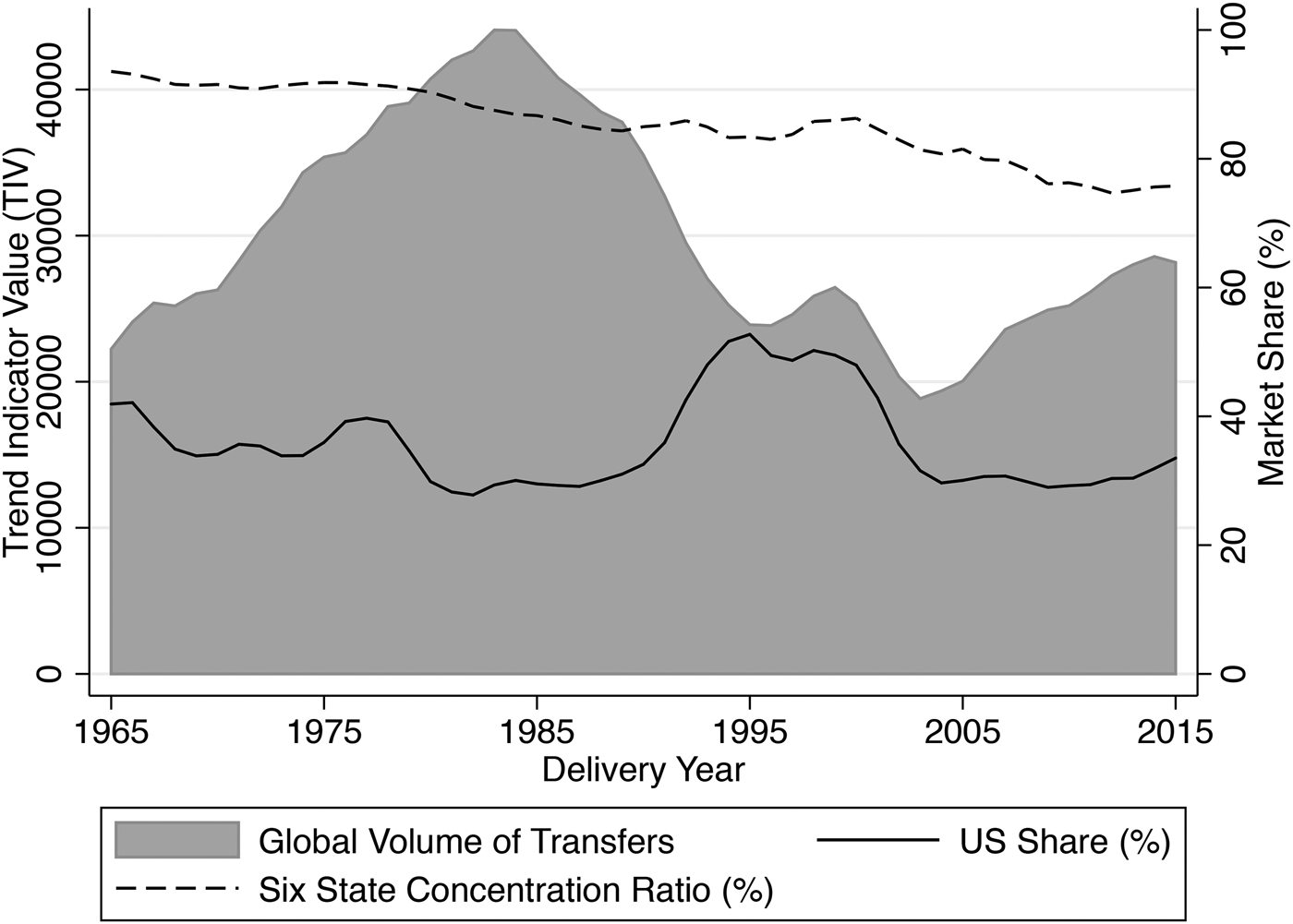
Figure 1 gives a snapshot of three trends in the global arms market using data from the Stockholm International Peace Research Institute (SIPRI) on weapons deliveries.Footnote 9 During the cold war the global arms trade settled into a relatively duopolistic market that reflected superpower politics, supplemented by competitive exports from major European states backed by relatively large amounts of domestic defense spending. Unsurprisingly, the gray area in Figure 1 shows the bottom falling out of this market as global defense spending retrenched following the cold war. However, total global arms transfers have risen steadily over the past decade.
Volume and market shares of global arms transfers, 1965–2015 (four-year moving averages)

The dashed line in Figure 1 shows trends in the “concentration ratio” of suppliers to the market by summing the market shares of the six traditionally largest sellers: the United States, Russia (Soviet Union), France, Germany, Italy, and Great Britain. Its consistently high value indicates that at the state level, global arms transfers have always been highly oligopolistic. Competition does vary, however; as the volume of transfers rose during the cold war, alternate suppliers emerged. Concentration, and thus the potential for competition, stagnated after the cold war as purchases dropped precipitously, but it has grown again as arms transfers have recovered more recently. The global arms market, while still highly concentrated, has not been this competitive since the end of World War II. Finally, the solid line shows that while the United States remains the global leader in the arms trade, its share as a percentage of the market has dropped to historically low levels. At first glance, then, the rise in arms transfers correlates to increased competition among suppliers, more broadly, and lower U.S. market share, more specifically.
Competition among Buyers vs. Competition among Sellers
Thanks to its large domestic consumption and numerous export deals, the United States is shielded from dependence on and demands by its clients in ways undreamed of by any other arms exporter. Other weapons-exporting countries rely on relatively fewer buyers, which means they enjoy less influence over clients, feel more pressure to transfer technology, and engage in more corruption to make sales. In his definitive book on the global arms trade, Keith Krause lays out the consequence of these forces on “second-tier producers,” which “are much more prone to sacrifice or dilute their technological lead in order to maintain their productive base, and are much more reliant upon export opportunities. They are therefore less likely to demand end-use restrictions, and hence reliance may not translate into dependence.”Footnote 10
Unsurprisingly, the United States has the most diverse export portfolio in the world. Its two biggest customers, Saudi Arabia and the United Arab Emirates, account for 13 percent and 9 percent of all U.S. arms deliveries since 2012, respectively. Another thirteen heterogeneous states account for 3–6 percent each. More surprisingly, Russia, despite being the second largest global supplier of weapons, sells weapons to a very small group of buyers. For example, 39 percent of its exports go to India, and 11 percent each go to Vietnam and China. Similarly, China sends 63 percent of its arms exports to only three countries: Pakistan, Bangladesh, and Myanmar. A shift of any one country away from Chinese or Russian imports would be devastating for its respective industry, leaving buyers largely in the driver's seat, demanding lower prices, more bribes, and larger technology transfer. In contrast, European suppliers have a relatively diverse group of client states, if not quite as broad as the United States. That said, nearly half of recent British exports have gone to Saudi Arabia.Footnote 11
Strong domestic demand generally mitigates the pressure on a country to export, and here again the United States dominates. From 2010 to 2015 the United Kingdom, France, and Germany all exported about half of their defense production, while Italy exported 82 percentFootnote 12 and Russia 39 percent.Footnote 13 In contrast, the United States on average exports only a quarter of the arms produced by its firms. It is this combination of strong domestic demand and a diverse portfolio of client states that makes the United States' market power vis-à-vis clients so strong relative to any other exporter.
“Obama Was the Rafale's Best Salesman”Footnote 14
U.S. market power results in lower levels of conventional weapons proliferation, technology diffusion, and corruption in contracting arrangements. This is not because the United States is a particularly responsible or moral country, but because it can afford to use its competitive advantage to restrict these nuisances while still taking care of its military, industrial base, and client states. Less powerful, second-tier exporting states are too constrained by the economics of production to effectively pursue many goals other than increased arms sales.Footnote 15
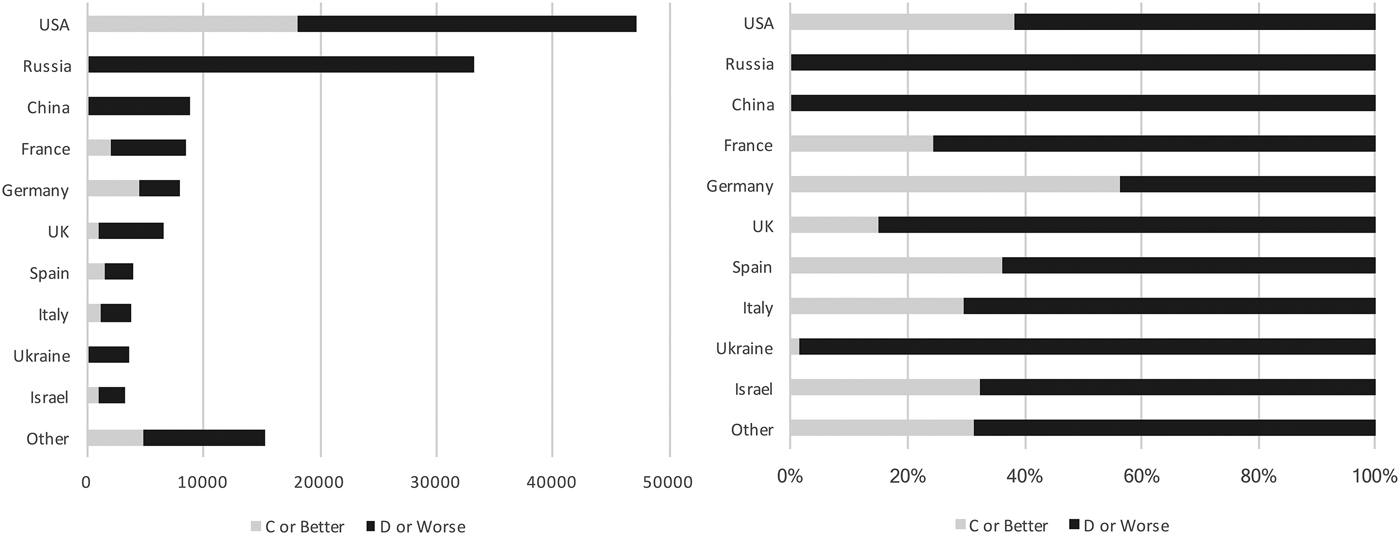
To show how market power can help mitigate some of the worst aspects of the global arms trade, we can consider the customer base of each major weapons exporter by its potential for defense corruption and observance of human rights.Footnote 16 Using Stockholm International Peace Research Institute data on arms deliveries from 2012 to 2016, Figure 2 splits each country's exports according to whether the recipient scored a “C” or better in Transparency International's (TI) Government Defence Anti-Corruption Index.Footnote 17 Figure 2(a) presents the absolute level of exports for each category, while 2(b) shows the two categories’ share of all exports.
Exports of Major Suppliers by Clients’ Defense Corruption Potential, as Total Exports and Percent of Exports

Before moving on to specific countries, we can see that the numbers confirm many of our worst fears about the arms trade: most interstate MCW transfers go to countries with very high potentials for defense corruption. In absolute terms, the United States has essentially cornered the market for exports to countries that are reasonably transparent in their acquisitions and security policy practices. Russia and China, the second and third largest exporters, transfer weapons almost exclusively to poorly scoring countries. France and the United Kingdom, the next largest, also sell a much higher percentage to low-scoring regimes compared to the United States.
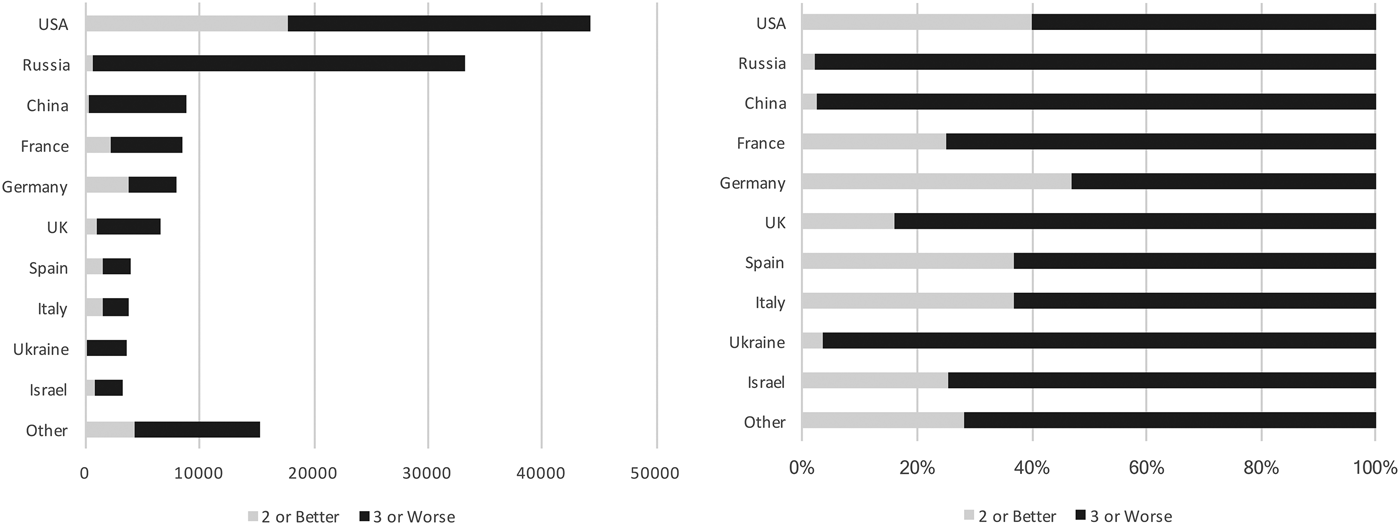
Turning to Figures 3(a) and 3(b), which divide importers by whether they score a “2” or better on the Political Terror Index, we see similar results.Footnote 18 Clearly, arms purchases remain mired in a nontransparent marketplace where the majority of weapons are imported by human rights abusers. The export portfolios of Russia and China, as well as those of France and the United Kingdom, rely heavily on countries with poor human rights records.Footnote 19
Exports of Major Suppliers by Clients’ Political Terror Rating, as Total Exports and Percent of Exports

Efforts by European states to increase their exports, coupled with the Obama administration's relative discretion in tying some exports to good behavior by clients, will likely increase this divide in coming years (even given the uncertain policy stances of the Trump administration). The divergences in Figures 2 and 3 grow larger when one examines the more future-oriented data on arms transfer agreements compiled by the U.S. Congressional Research Service. Consider, for example, the financial value of agreements with leading Near East arms importers—countries with which overall agreements increased by 36 percent between 2008–2011 and 2012–2015—all of which have high levels of corruption and poor human rights records.Footnote 20 While the value of agreements between these countries and the United States has dropped by 37 percent across these two periods, export agreements to the region by France, Germany, Italy, and the United Kingdom have tripled from their 2008–2011 levels. Both Russia's share and that of smaller European countries have climbed even faster, and are approximately 4.5 times those of the previous period.
The above evidence does not prove that the United States causes good behavior by its arms export policies. Countries that import weapons in appreciable amounts and meet high transparency and human rights standards tend to be (a) rich enough to buy the sophisticated weapons in which the United States specializes and (b) allied with the United States. Rather, the data show that, relative to any other state, the United States does not need its exports to problematic regimes to underpin the health of its arms industry. Moreover, any effort by second-tier states to increase their own exports will likely rely on regimes with high potential for corruption and human rights abuses.
Egypt, under limited U.S. sanctions after its 2013 coup and subsequent human rights abuses, starkly illustrates the behavior that a competitive arms market encourages in second-tier arms producers. While the U.S. response was fairly tepid, the United States did place real restrictions on arms transfers to the al-Sisi regime, delaying F-16 and other major platform deliveries and postponing military exercises.Footnote 21 The Obama administration announced that future Foreign Military Financing grants (of which Egypt is one of the largest recipients) may only be used to purchase new equipment specifically for counterterrorism, border and maritime security, and for patrolling Sinai.
Other states quickly attempted to fill this gap. In 2014, Russia signed a multibillion-dollar deal to supply attack helicopters and MiG-29 fighter aircraft to Egypt. France off-loaded Mistral helicopter carriers (originally intended for Russia but embargoed after the invasion of Crimea), sold four corvettes and a frigate, and propped up its Rafale fighter production line by making that plane's first export sale to Egypt. Germany agreed to supply two submarines to the Egyptian Navy in 2011 and two more in 2014. Overall, the export agreements of major European sellers to Egypt have gone up forty-seven-fold over the previous period.Footnote 22 A blistering Amnesty International report calls out nearly half of the European Union member states for “flouting” an EU-wide suspension of arms transfers to Egypt.Footnote 23
A competitive market not only encourages dealings with problematic buyers but also creates pressure for technology transfer. Indeed, the reluctance of the United States to export weapons production know-how means that technology transfer is a key competitive advantage, indeed a necessity, for even as sophisticated an exporter as France.Footnote 24 Turkey has methodically played European, Chinese, and Russian long-range air and anti-missile defense systems against each other in a bid not just to lower the price tag but especially to acquire advanced technology. The U.S.-made Patriot system was eliminated from consideration because most of its technology would not be given to Turkey. In announcing the deal with Russia, Turkey's presidential spokesman was frank: “Let's say the price difference could have been manageable. But the issue of technology transfer was more important. On this issue, our allies, including the United States, caused a big disappointment.”Footnote 25
Turkey explicitly seeks to enter the top echelon of arms exporters, and understands it needs foreign technology to do so.Footnote 26 Should it fail, like so many aspiring exporters do, it will have consumed enormous amounts of the country's resources to produce a product that could be bought easily from any number of existing producers. Should it succeed, it will join a very crowded field. Growing competition will lead to more proliferation, fewer scruples about corruption and human rights, and generous amounts of technology transfer to clients. The consequences of a desperate Russia's freewheeling export policies in the 1990s and early 2000s clearly helped fuel China's own increasingly successful international sales push.Footnote 27 Finally, transferring technology and production to the client can hinder human rights and anti-corruption efforts in more direct ways. For example, shifting production of sensitive components to third-party countries has allowed German defense firms to skirt their home country's export regulations.Footnote 28
And the entry of desperate second-tier suppliers shapes U.S. behavior in turn. The presence of alternate sources, also known as the “gray threat,” has an effect even on the United States, as shown by the recent U.S. decision to resume military aid and most sales to Egypt. Thailand presents a similar example. The United States, the Thai military's traditional supplier, largely ceased both arms sales and military assistance after that country's 2014 coup. Thailand accordingly procured weapons from relatively new suppliers, such as China, Russia, and Ukraine, and has strengthened ties with suppliers from Israel, Sweden, and other countries in Europe. The United States is now resuming much of its sales to that country.
With Great Market Power Comes Great(er) Responsibility
So far this essay has shown the pressures that most arms manufacturing countries feel to export abroad. It has described a growing market with increasing competition among potential suppliers. Finally, it has detailed how often most states export to corrupt governments that abuse human rights, as well as to those seeking to develop their own export capacity, further fueling proliferation. The question now is: What can be done to slow the rise in arms transfers?
The products produced by the “merchants of death” have traditionally been considered one of the great menaces of international life.Footnote 29 Yet, from the Second Council of the Lateran prohibition on crossbow use against Christians to Tsar Nicholas II's calling of the 1899 Hague Convention, efforts to control the spread and use of weapons have been sporadic and largely ineffective.Footnote 30 In the aftermath of World War I the arms industry received a great deal of blame for fueling the global slaughter, and disarmament underpinned the establishment first of the League of Nations and then, after World War II, the United Nations. The results of such institutional responses speak for themselves.
Nonetheless, there exists an order in the global exchange of weapons. It rests not on multilateral compacts among sovereign states but on the self-centered actions of one powerful market-maker. The unique economics of weapons production—substantial and rising fixed costs and potential for “network effects”—creates an environment favorable to a monopoly, and the United States can fill that role, as Ethan Kapstein laid out in 1994.Footnote 31 The traditional practice of a monopolist is to restrict supply, causing prices to rise and profits to soar. These profits, known to economists as “rent,” are generally financial in the world of commercial firms. Economists and regulators generally consider rent a social ill, as it comes at the expense of the consumer welfare arising from a more competitive market. But in a world of states, where the product is advanced weaponry, a reduction in the supply, and thus a rise in prices, is a market distortion akin to a “sin tax.” Rent can have a benign effect.
Moreover, instead of collecting this rent in the form of additional financial gains, the United States collects some of it in terms of political influence: restricting the supply of technology, cutting off some (but certainly not all) of the most odious regimes, enforcing stringent anti-corruption rules, and even occasionally encouraging the observance of human rights norms. The consequent reduction in the ills associated with a competitive arms trade does not result because the United States is a benign power; it is simply pursuing its own interests. But many of the interests it chooses to pursue remain aspirational for other states. As much as, or even more than, the United States, countries such as Canada or Sweden desire both a healthy defense industry and a reputation for international do-gooding. Unfortunately, they cannot afford both.Footnote 32
Historically, the United States has foregone exporting its highest-capability weapons to a region until a viable competing product emerges; for example, refusing to deliver Advanced Medium-Range Air-to-Air Missiles (AMRAAM) to Asian states until China purchased the Russian equivalent R-77 (dubbed the “AMRAAM-ski”).Footnote 33 The United States can also afford to cut off clients over policy differences, as it did when it crippled India's Tejas light combat aircraft program with sanctions in 1998 following that country's testing of nuclear weapons. U.S. policy explicitly links its market dominance of high-end weapons to a practice of “unilateral restraint” in its sales.Footnote 34
Not selling weapons to a regime is only one of the ways the United States exercises its market power to advance its political goals. U.S. weapons that are deemed exportable but sensitive—which includes major weapons but also “man-portable air defense missiles, cryptographic equipment, precise geo-locational positioning technologies, and airborne early warning and control systems”Footnote 35 —are sold almost exclusively through the Foreign Military Sales (FMS) program, rather than through the somewhat less regulated “direct commercial sales” (DCS) route.Footnote 36 With very few exceptions, all weapons purchased through U.S. foreign aid are also processed through this mechanism.Footnote 37 Indeed, FMS is an unheralded counter-proliferation program that also makes corruption relatively hard, as clients pay the same price as the United States military (plus 3.5 percent administration costs), and most of the contracting is handled by the Department of Defense. For U.S. arms deliveries from 2011 to 2015, FMS handled 76 percent of the financial value.Footnote 38
Relative to any other major arms supplier, the United States attaches many strings to its sales. It requires strict technology transfer controls, enforces relatively comprehensive anti-corruption standards for its companies (and other states’ companies through the Foreign Corrupt Practices Act), and makes onerous demands (including on-site inspections) of importing states to ensure weapons do not get transferred to third parties. One Russian observer writing for the United Nations noted that “U.S. End-Use Monitoring Programs represent an undisputable strength of the U.S. export control system (ECS) that no country can rival.” The same report rather drily notes a possible explanation for U.S. probity: “ECS is frequently used for influencing the end-user's foreign policy.”Footnote 39
The effect of U.S. market power is not absolute and is likely only to delay the spread of weapons. As the Egyptian case demonstrates, when the United States restricts weapons to punish what it considers bad behavior, other countries can fill the gap. The recent removal of many technologies from the United States Munitions List—a roster of products subject to controls under the Arms Export Control Act of 1976—was driven in part by the American arms industry convincing the government that it is losing competitive advantage abroad. Consequently, many weapons transfers may no longer be subject to rigorous human rights vetting and end-use monitoring by the State Department.Footnote 40 Eroding American market dominance of higher-end weapons makes it less likely that the United States will continue to exercise its traditional policy of “unilateral restraint” in their sale.Footnote 41
This process of delayed diffusion, and the delicate balance inherent to it, is clearly underway as the United States cautiously enters the now reasonably competitive unmanned aerial vehicle (UAV) export market (over the past five years Israel has delivered 53 percent of all drone exports, the United States 25 percent, and China 21 percent) while trying to manage the international proliferation of these products.Footnote 42 The U.S. military makes extensive use of armed and unarmed drones, and it would prefer to remain the only country doing so. Barring that, however, it would (for entirely selfish reasons) prefer to ensure that it maintains an insurmountable lead in terms of technology and capability. To this end, it has not only refrained from exporting most drones (particularly armed versions), it has at times leaned heavily on other suppliers, such as Israel, to restrain their exports. Further, the United States has, with minimal effect, attempted to introduce a code of conduct for drone exports. It is only with the clear rise of China as an alternate supplier that the United States has seemed willing to relax its export restrictions.Footnote 43 Nonetheless, even if the United States begins exporting UAVs more freely, if history is any indication, American drones will dominate the market and be subject to rigorous regulation relative to the competition. And the fact that the next most plausible competitor, Israel, is highly dependent on the United States suggests the possibility for bilateral and multilateral arrangements.
Elsewhere I have argued that the global market is developing along two tracks.Footnote 44 Looking again at Figure 1, while the concentration ratio has declined consistently over the past decade, U.S. market share has held remarkably steady. At the high end of the market, the United States remains largely unchallenged. The F-35, the principal fighter aircraft for the entire U.S. military for the next several decades, is a notoriously problematic plane, over budget and chock-full of performance compromises. But for all its well-known problems, it has never lost an international fighter competition.Footnote 45 The rising powers, even a determined China, will struggle to mount the cost curve for the most advanced weapons in a way that the United States does with relative ease. The other track, which involves less sophisticated but still deadly weapons such as diesel submarines and anti-ship cruise missiles, is another matter and will require the cooperation of other states to manage.
From Shrinking Monopoly to Growing Cartel?
Although the U.S. policy of “unilateral restraint” may relax in the face of increased competition, the United States still has the power to lead an informal cartel of like-minded MCW suppliers to exercise more multilateral restraint. Indeed, by further reducing competitive pressures and widening international interests, a U.S.-led cartel would be both less corrupt and deliver fewer and less sophisticated weapons to human rights abusers. It would also, not incidentally, make more money for cartel members.
The United States already employs an industrial policy with its smaller partners that strikes a crucial bargain: clients join an American-dominated global supply chain in return for cheaper weapons, larger orders of subcomponents from local firms, and access to leading-edge weapons technology. These smaller states, in turn, must reconcile themselves to surrendering to the United States much of their foreign and defense policies, including foregoing sales to regimes that threaten U.S. interests.Footnote 46 The process is characterized by hard bargaining and by a considerable degree of coercion and leverage by the United States, such as when it kicked Israel out of the Joint Strike Fighter program in response to that country selling UAV parts to China.Footnote 47
Two additional U.S. policies would help solidify this arrangement into an informal cartel. First, the United States must make a distinction between using its clout to advance its political ends versus economic gain. Israeli officials I have interviewed, for example, grudgingly defer to U.S. wishes on arms exports if they trust it is done for political rather than economic reasons. This may explain why Israel is extremely resistant to the international code of conduct that the United States advances for global drone exports. It is not simply because U.S.-made UAVs threaten to destroy Israel's commanding position in that global market, but because the United States is doing so for largely economic reasons.
Second, smaller members of the cartel must also benefit. In this spirit, the United States should liberalize its own defense acquisition. Though it has done poorly on this front in the past, the U.S. Air Force's current $16 billion fighter-trainer contract has been narrowed down to three candidates with foreign connections: a Lockheed Martin-Korea Aerospace Industries version of Korea's T-50; a new design from a Boeing-Saab team; and an entirely foreign offering from Leonardo. Winning such a contract will give one of three like-minded states (South Korea, Sweden, and Italy, respectively) a boost in international competitions elsewhere against less scrupulous dealers. And the United States can still shape these exports for its political interests, such as when it banned Korea's transfer of T-50s to Uzbekistan.Footnote 48
Client states need not like this arrangement. Indeed, one of the primary reasons to build an export market is to avoid dependency on a country like the United States for weapons. But modern defense economics make this infeasible for almost every country on the planet.Footnote 49 Moreover, the economies of scale available to a country with the military budget of the United States provide such an economic surplus that it can make an offer—including carrots and sticks—that is hard to refuse.
The most famous international cartel, OPEC, is notorious for both its menace and its ineffectiveness, and some might wonder whether an MCW cartel would earn the same reputation. However, this worry seems unfounded. Major conventional weapons are not commodities like oil or diamonds. Their export is relatively hard to hide, making cheating difficult. With its massive domestic budget, and its large network, the United States has a position in the conventional weapons market that Saudi Arabia could never dream of enjoying with oil. And the United States has the capacity to punish cheaters and reward those that play by the rules. Indeed, there are few other products as conducive to this sort of market control.Footnote 50
In areas where the United States does not compete, such as diesel submarines—largely because it has no interest in purchasing such products for its own military—competition will continue to grow. While not directly participating in this other market, however, the United States does have an interest in shaping it. And this is feasible given that NATO members, South Korea, Israel, and other allies of the United States are responsible for 29 percent of total global arms exports.
Where does this leave the two major arms exporters, China and Russia, which are unlikely to join such a U.S.-dominated cartel even in the improbable event they were invited? Keeping Chinese and Russian hardware out of as many large export markets as possible will inhibit the development of the economies of scale that the two countries require for a healthy and technologically advanced defense industry. And choking off the supply of technology that these countries continue to desperately need to maintain competitive products will further widen the quality gap between their products and those of the cartel.
“Two Cheers?”
When judging the effects of U.S. dominance on major conventional weapons proliferation, I have been careful to use qualifiers such as “relative.” The United States, pursuing what it considers to be its interests, may impede grander forms of international cooperation and perpetuate a certain type of warfare that suits its ends.Footnote 51 It was certainly no friend to the UN Conventional Arms Trade Treaty in its early stages of development.Footnote 52 As signed, the CATT is a pretty transparent effort to legitimate and spread existing U.S. practices.Footnote 53 But international politics as currently practiced does not allow for a more effective means of moderating the spread of weapons. Activists and U.S. foreign policymakers should also have realistic expectations that many of these steps will only delay proliferation and make it more expensive; they will not eliminate it altogether.
While a cartel of like-minded allies would cement U.S. influence over major conventional weapons proliferation, this essay has shown that the economic and political power of the U.S. market remains sufficiently high that it can unilaterally enforce higher ethical standards for vast swathes of the global arms market. Krause, in discussing the difference between first- and second-tier arms exporters, argues that market power is a prerequisite for a state to use arms sales to advance political, rather than economic, goals.Footnote 54 But what if a first-tier state is interested solely in the latter?
Largely in the name of supporting U.S. manufacturing jobs, but also due to a lack of interest in promoting liberal norms abroad, the Trump administration has already overturned several of the previous administration's decisions to hold up arms sales over human rights concerns for countries such as Bahrain, Nigeria, Saudi Arabia, and Thailand. But even if a monopolist collects its rent in cash instead of political gains, the supply of arms will be reduced. It remains easier to change the foreign policy position of one large state than shift an entire market. Finally, such an administration is unlikely to be interested in the Arms Trade Treaty either.
There is something ironic, perhaps even perverse, in labeling the world's largest arms dealer as the best hope for counter-proliferation. Such a market will be rife with hypocrisy as large sales continue to go to countries such as Saudi Arabia, and will give the United States tremendous leverage in influencing smaller states’ foreign (and domestic) policies. But it will also result in a less competitive global arms market, which will go a long way in slowing the proliferation of dangerous technology, reducing the resources spent in the developing world on weapons, stymieing the deadweight losses of corruption in the arms industry, and lowering the rewards for human rights abusers. While far from an ideal arrangement, one cannot let perfect be the enemy of the good.