INTRODUCTION
Biodiversity conservation, particularly in the tropics, remains a pressing environmental conservation challenge, with evidence that a humanity-driven sixth extinction crisis in the history of life on earth is underway (Bradshaw et al. Reference Bradshaw, Sodhi and Brook2009). The concept that community-based natural resource management (CBNRM) could address this challenge arose through a global trend to decentralized management in forestry, agriculture, water, fisheries and rural development (Brooks et al. Reference Brooks, Franzen, Holmes, Grote and Mulder2006; Tacconi Reference Tacconi2007). Initial CBNRM efforts delivered limited environmental and social outcomes, leading to robust critiques of the underlying frameworks based on ideals of democracy and harmony between local people and their environments (Agrawal & Gibson Reference Agrawal and Gibson1999; Nunan Reference Nunan2006; Fabricus & Collins Reference Fabricus and Collins2007). CBNRM theory and practice has since been transformed. Communities are now recognized as contingent and temporary outcomes of interactions between differentiated social actors; environments are dynamic, complex and variable over both space and time; and community/environment interactions occur through diverse evolving institutions at multiple scales (Leach et al. Reference Leach, Mearns and Scoones1999; Lane & McDonald Reference Lane and McDonald2005; Berkes Reference Berkes2007).
In Australia, CBNRM gained a major impetus in 2002 through a programme which devolved Australian and State governments’ responsibilities to organizations with community-based governance structures (Robinson et al. Reference Robinson, Lane, Taylor, Lane, Robinson and Taylor2009). While initially hailed as the solution to intractable environmental problems, subsequent analysis identified the need for improvements to address accelerating threats to the environment and ongoing community engagement challenges, including the marginalization of indigenous peoples (Auditor-General 2008; Hill & Williams Reference Hill, Williams, Lane, Robinson and Taylor2009). The Australian Government in 2008 refocused attention on leadership and accountability, setting national priorities which CBNRM groups must address to receive funding support (Australian Government 2008). Integrated landscape-scale approaches that link national environmental goals with community priorities, and ensure science integration in CBNRM are encouraged.
This paper reports on co-research to develop, apply and test the transferability and effectiveness of a new model and tools for biodiversity conservation based on recognition of the transformed concept of CBNRM in both the national and global discourses. We first present the theoretical foundations from which we interrogate transferability and effectiveness. After describing our study area and co-research methods, we present a results section detailing the collaborative design approach and relevant tools. We discuss the challenges in delivering a new generation of CBNRM models, and implications of this research for theory and practice in biodiversity conservation.
THEORETICAL FOUNDATIONS OF THE NEW CBNRM
The new multi-scalar dynamic conceptualization of both human communities and natural resources moves community-based approaches into the field of adaptive co-management (Armitage et al. Reference Armitage, Berkes, Doubleday, Armitage, Berkes and Doubleday2007). Context emerges as a key determinant; strategies that enhance enforcement capacity, as well as those that empower local residents and local livelihoods, have the potential to be effective in different contexts (Borrini-Feyerabend Reference Borrini-Feyerabend1996; Stern Reference Stern2008). Diverse historical, cultural, political and geographical contexts contribute to diversity in the theory and practice of adaptive co-management, and even disagreements on whether it can be forged through design or is an emergent property of complex systems (Berkes et al. Reference Berkes, Armitage, Doubleday, Armitage, Berkes and Doubleday2007). However, there is a strong focus on design in the biological sciences literature on conservation planning and action, arising from a perception of urgent threat (Pressey & Bottrill Reference Pressey and Bottrill2008; Salafsky et al. Reference Salafsky, Salzer, Stattersfield, Hilton-Taylor, Neugarten, Butchart, Collen, Cox, Master, O'Connor and Wilkie2008). As adaptive co-management, conservation planning and action are all relevant for community-based biodiversity conservation, we sought to interrogate our results drawing on standards across these fields. Such standards employ theory about root causes in the biodiversity conservation problem/solution space, and therefore provide a basis for considering the effectiveness of our model and likely transferability to other biodiversity conservation situations.
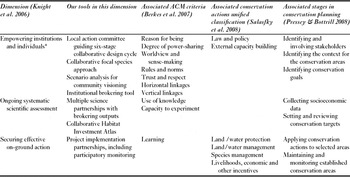
We encountered complex and contradictory analytical categories and standards, with multiple strategies, criteria, variables for diagnosis and design, inspired by common pool resource, governance and political ecology theories (Gibson Reference Gibson1999; Susskind Reference Susskind, Susskind, McKearnan and Thomas-Larner1999; Batterbury & Fernando Reference Batterbury and Fernando2006; Berkes et al. Reference Berkes, Armitage, Doubleday, Armitage, Berkes and Doubleday2007; Fabricus & Collins Reference Fabricus and Collins2007; Ostrom Reference Ostrom2007; Wilmsen Reference Wilmsen, Wilmsen, Elmendorf, Fisher, Ross, Sarathy and Wells2008; Pahl-Wostl Reference Pahl-Wostl2009; Sandström Reference Sandström2009). We identified four analytical frameworks as most relevant, namely (1) Berkes et al.'s (Reference Berkes, Armitage, Doubleday, Armitage, Berkes and Doubleday2007) ten criteria for adaptive co-management, (2) Pahl-Wostl's (Reference Pahl-Wostl2009) categories of institutions, actor networks and multi-level interactions, (3) the IUCN's (World Conservation Union) seven categories for conservation action design (Salafsky et al. Reference Salafsky, Salzer, Stattersfield, Hilton-Taylor, Neugarten, Butchart, Collen, Cox, Master, O'Connor and Wilkie2008) and (4) Pressey and Bottrill's (Reference Pressey and Bottrill2008) eleven stages for design of conservation plans (Table 1). Knight et al.'s (Reference Knight, Cowling and Campbell2006) three-dimensional conservation implementation model (empowering institutions and individuals, ongoing systematic conservation assessment and securing effective action) provides an overarching framework with capability to encompass all standards and address an identified implementation gap between science and conservation action (Knight et al. Reference Knight, Cowling and Campbell2006; Table 1).
Intermediate-complexity analytical framework, associated standards from previous research, and our collaborative design tools. *This component includes Pahl-Wostl's (Reference Pahl-Wostl2009) four categories of institutions, actor networks, multi-level interactions and governance modes.

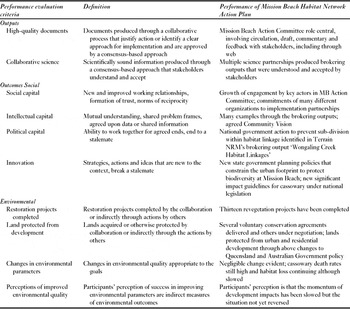
We also aimed to determine our model's effectiveness through evaluating the social and environmental outcomes. Mandarano's (Reference Mandarano2009) performance evaluation framework of eleven criteria for considering outputs, social and environmental outcomes enabled an integrated evaluation addressing gaps identified in previous evaluative studies (Table 2).
Qualitative performance evaluation using Mandarano's (Reference Mandarano2009) framework.

METHODS
Study area
The Australian wet tropical rainforests have high species diversity and remarkable levels of endemism, including over 30% of Australia's species of frogs and 60% of its bats, with some seventy-three species of vertebrates endemic to these rainforests (Moritz Reference Moritz, Bermingham, Dick and Moritz2005). World Heritage listing recognizes the international significance of these forests, including contributions to global understanding of both biological and human dimensions of landscape evolution (Stork & Turton Reference Stork and Turton2008). Rapid human population growth and peri-urban land-use intensification associated with sea-change and tree-change lifestyle choices continue to threaten forest integrity; these are highly contested landscapes (Stork et al. Reference Stork, Goosem, Turton, Stork and Turton2008). The tropical rainforests’ vulnerability to climate change has highlighted the urgent need for reversing habitat loss and improving habitat quality (Williams & Middleton Reference Williams and Middleton2008; Williams et al. Reference Williams, Shoo, Isaac, Hoffman and Langham2008).
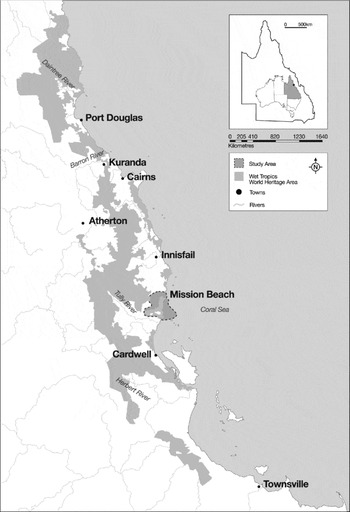
The study area at Mission Beach (Fig. 1) supports extraordinary levels of biodiversity in less than 30 000 ha (0.00004% of the Australian continent), and includes 36% of Australia's bird species, 13% of the remaining wet tropical lowland rainforest and 5% of all Australian vascular plant species. Mission Beach has significant irreplaceable biodiversity, including unique native grassland and rainforest communities on a coastal basalt headland (Chenoweth EPLA [Environmental Planning and Landscape Architecture] 2007). It is an important site for conservation of the endangered southern cassowary (Casuarius casuarius johnsonii), which is threatened by habitat loss, fragmentation and degradation, roads and traffic, dog attacks, hand feeding, diseases and natural catastrophes particularly cyclones (Latch Reference Latch2007). The 2006 Australian Census reported Mission Beach as having a population of 4103 residents and 1646 tourists. Residents live in several villages, on farms and in rural-residential blocks. Employment is primarily in tourism and agriculture, while construction, manufacturing and education are also important sectors (Williams et al. Reference Williams, Hill, Pert, Harding, O'Malley, Taylor and Long2009).
Mission Beach, the case study site in the Australian wet tropical rainforests.

Participatory co-research methods
The development, application and testing of our model and tools for CBNRM in biodiversity conservation occurred over a three-year period from 2006 to 2009. We used a participatory co-research approach, combining action research methods with bringing researchers and practitioners together in an equitable working relationship (Greenwood & Levin Reference Greenwood and Levin2007). Two-way negotiation of information and capacity between scholars and practitioners produced our new model and tools (Wilmsen Reference Wilmsen, Wilmsen, Elmendorf, Fisher, Ross, Sarathy and Wells2008).
We regarded participatory research as creating a long-term learning community, supporting a dialogic network to co-produce knowledge (Davidson & O'Flaherty Reference Davidson and O'Flaherty2007). Our core participatory co-research team included three people from Terrain NRM, a non-government organization mandated by the Australian Government to undertake CBNRM (Robins & Dovers Reference Robins and Dovers2007); and one social and two biological scientists. The Mission Beach Habitat Network Action Committee (hereafter the action committee) provided a forum for a wider dialogue with civil society, industry, scientific and government actors who had decision-making roles at local, regional and national scales. Data sources to underpin the research included biophysical and social data held by the core co-research team, policies, plans, media releases, annual reports, funding applications, budgets, terms of reference, minutes of meetings, consultation reports, historical essays, and data held by researchers and others represented on the action committee. Participant observation occurred at three community meetings each of approximately fifty people and in numerous smaller meetings with stakeholders held throughout the research. Validity was established through convergent triangulation between multiple data sources and the regular conduct of critically reflexive reviews; transferability and effectiveness were tested by applications of analytical and evaluative frameworks (Robinson Reference Robinson1998; Mandarano Reference Mandarano2009).
RESULTS
Collaborative design of CBNRM for biodiversity conservation context
The centre of our model was an adaptive collaborative design cycle for CBNRM which prepares the ground for effective ongoing investment in both regulatory and incentive-based biodiversity conservation (Sayer & Campbell Reference Sayer and Campbell2004). CBNRM is facilitated through an action committee whose members include representatives from civil society, government, industry and indigenous sectors to undertake decision-making, using multiple participatory tools and processes. The organization mandated with responsibility for CBNRM (in this case Terrain NRM [Terrain Natural Resource Management]) acts as bridging/boundary organization for the whole process, championing the action committee, the adaptive design cycle and associated multi-scale participatory tools and processes (Berkes Reference Berkes2009). Context determines the key design challenges, identified at Mission Beach as institutional fragmentation and uncoordinated decision-making, disparate stakeholder perspectives and knowledge systems, competing visions, competing priorities and poor science integration.
The design cycle produced through our co-research involved six stages: (1) exploratory analysis of the natural resources and human community; (2) facilitation of community ownership and a shared community vision, in this case using the collaborative focal species approach and scenario analysis tools; (3) identification and prioritization of strategies and projects, in this case using science brokering partnerships and collaborative habitat investment atlas tools; (4) forging of implementation partnerships, in this case through the institutional brokering tool and incentives (offsets, auctions, competitive grants, tenders) to secure habitat protection and restoration; (5) participatory monitoring to build common understandings of the efficacy of actions on biodiversity condition and other identified values; and (6) updating and refining that relies on social learning and empowerment.
Collaborative focal species approach to facilitate community ownership
Recognition of the multiple values held by people about biodiversity formed the starting point of efforts to address the poor community cohesion identified in the exploratory analysis (Stern Reference Stern2005). The action committee established the overall goal of developing an ecologically viable habitat network that protects community values. We undertook stakeholder analysis that identified community values centred on biodiversity, aesthetic/lifestyle and Djiru (aboriginal people's) cultural attributes. An assessment of the significance of each was undertaken (Chenoweth EPLA 2007; Falco-Mammone Reference Falco-Mammone2007; The Djiru Traditional Owners and Girringun Aboriginal Corporation 2007). The cassowary emerged as an icon of high significance from all three perspectives.
Djiru Traditional Owners considered the relationship with the gunduy (cassowary) to be integral to their identity and wellbeing as ‘rainforest people’ and the health of rainforest. For Djiru people, the cassowary is a ‘cultural keystone’ species, a culturally salient species that significantly shapes cultural identify, reflected in fundamental roles in diet, materials, medicine and spiritual practices (Garibaldi & Turner Reference Garibaldi and Turner2004). For the wider community, the cassowary is a flagship species that reflects the aesthetic and lifestyle values, and is important to the tourism economy (Simberloff Reference Simberloff1998; Falco-Mammone Reference Falco-Mammone2007). The cassowary is a unique disperser of forest tree species and is thus integral to their persistence (Westcott et al. Reference Westcott, Bentrupperbäumer, Bradford and McKeown2005). The cassowary conservation requirements are such that it can also be considered an ecological focal species; its ecological and habitat requirements must be protected to secure the future of multiple species and communities in the same area (Lambeck Reference Lambeck1997; Hugget Reference Hugget2007).
The term collaborative focal species encapsulates this combined capacity as an ecological focal species, a cultural keystone species and a flagship species, providing community ownership and a unifying focus for transformation of this linked social and ecological system. The success of the cassowary in providing this unification is evident through public and agency enthusiasm for numerous cassowary events during the period of this research, including a Cassowary Summit, an art exhibition ‘This is Cassowary Country’, a DVD ‘No wabu, no wuju, no gunduy (no rainforest, no food, no cassowary)’, a number of community-based cassowary surveys (Hardesty & Westcott Reference Hardesty and Westcott2008), and in adoption of the name ‘Cassowary Coast Council’ by the new local government authority.
Scenario analysis to facilitate a shared community vision
Scenario analysis is a useful systematic method for thinking creatively about possible complex, contested and uncertain futures (Peterson et al. Reference Peterson, Cumming and Carpenter2003). The co-research team initially proposed development of several scenarios to address conflicting community perceptions and generate options for interventions. However, the action committee viewed simplicity as the foremost requirement, directing that it would be most useful to understand the implications of current trends. Two scenarios were therefore developed, one depicting the current situation, and a business-as-usual scenario of the future in 2025 based on a projection from current trends in human population and land use change.
The scenarios were generated by defining focal issues, assessing the current ‘system’ including key drivers of change and uncertainties and investigating changes in land use and biodiversity impacts over the last five years. Forward projections for habitat based on these trends identified that by 2025, conversion of 470–528 ha of existing forested habitat to intensive land use, on top of the 2004 intensive land use area of 622 ha, would be required, an increase of 75–85%. The change in quality of vegetation cover was similarly dramatic with the clearing of a further 302 ha of remnant vegetation required, with the greatest losses being coastal forests, recognized as critically endangered habitat. Further degradation of native vegetation through agricultural land use is also projected within an important rainforest corridor for connectivity from the coast to the uplands in the wet tropics (Williams et al. Reference Williams, Hill, Pert, Harding, O'Malley, Taylor and Long2009).
As well as these changes to habitat quality and associated biodiversity impacts, the business-as-usual 2025 scenario highlighted striking changes to the cultural and lifestyle values, with urban strip development replacing the current pattern of villages in the rainforest. This scenario therefore highlighted threats to the values of all key interest groups, mobilizing community cohesion in resistance to these trends. Workshop participants uniformly agreed that their desired future differed vastly, and found common ground in an overall vision statement: ‘Mission Beach is a sanctuary for wildlife and habitat; its defining feature is a strong human community that acts to protect its special values. Mission Beach is an exemplar of sustainable living, both environmentally friendly and culturally diverse. Mission Beach has a tropical landscape character where urban, farming, and forest communities blend to maintain a harmonious setting with strong visual appeal.’
Science brokering partnerships and the collaborative atlas
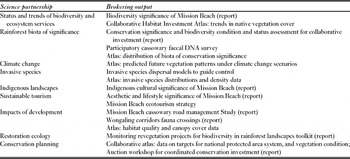
Scientific partnerships that deliver brokering outputs are effective in bridging the gap between scientists and practitioners, overcoming the significant barriers to uptake by conservation practitioners of the scientific literature (Gonzalo-Turpin et al. Reference Gonzalo-Turpin, Couix and Hazard2008). We co-produced the key science partnerships (supported through various Australian research institutions) and the associated brokering outputs (Table 3); cooperative production of these outputs between the action committee and the scientists through multiple rounds of engagement and comments on drafts ensured that the subsequent strategies and projects integrated the scientific findings.
Multiple science partnerships and associated brokering outputs (see URLs http://www.rrrc.org.au/ and http://www.terrain.org.au/programs/biodiversity/mission-beach.html).

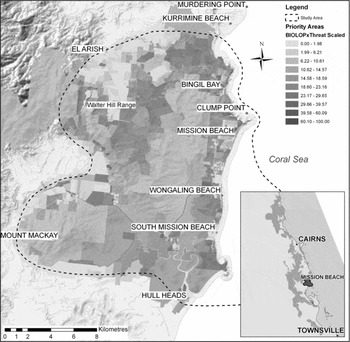
The collaborative habitat investment atlas provided a means of brokering information from multiple science partnerships into a highly visual and interactive platform (Table 3). The atlas was developed as a participatory tool to prioritize investment, recognizing existing optimization methods do not target multiple decision-makers at many levels (Joseph et al. Reference Joseph, Maloney and Possingham2009). Included in the atlas over time is information relevant to biodiversity value, costs of land for acquisitions, costs of incentives, protection available through land-use planning, land-owner willingness to be involved, levels of entrepreneurship, social capital and burnout in rural communities (Knight & Cowling Reference Knight and Cowling2007). The atlas promotes dynamic interaction among stakeholders through variables whose weightings in the analysis can be simply altered by use of a slider bar and formula-based dynamic attributes that are automatically updated as changes are made in the weighting of variables (Oroton Family Foundation and Placeways 2009). Once the model has been created, a colour code enables site suitability to be visualized spatially. The weights and attributes in the model can be altered in a stakeholder workshop, and the results displayed visually. The current atlas combines three relevant models: biodiversity sensitivity, level of protection and threat (Fig. 2).
Collaborative Habitat Investment Atlas: integrated model of biodiversity sensitivity, level of protection, and threat (BIOLOP). Scaled composite index: higher value areas are those with high biodiversity sensitivity, high threat, and low level of existing institutional protection.

Institutional brokering for implementation
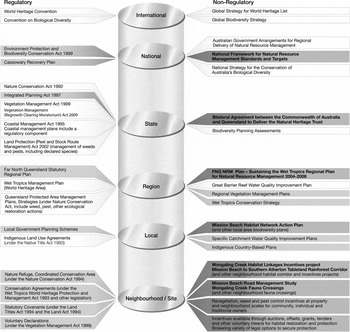
Our institutional brokering tool drew on recognition that management of boundaries between knowledge, planning and policy systems at different levels can overcome institutional fragmentation (Cash et al. Reference Cash, Adger, Berkes, Garden, Lebel, Olsson, Prtichard and Young2006). The tool combines an institutional brokering framework (Fig. 3), an officer employed to explicitly focus on cross-scale brokering and a set of brokering outputs (reports and submissions) produced by the co-research team.
Institutional brokering framework: instruments highlighted in dark grey represent spheres of direct action; those in paler grey represent key sites for brokering outputs; other instruments provide important context (after Peterson et al. Reference Peterson, Mcalpine, Ward and Rayner2007).

Much more effective alignment between institutions at local, state and national level has been achieved. Under the Environment Protection and Biodiversity Conservation Act 1999 (URL http://www.environment.gov.au/epbc/index.html), the Australian Government refused an application to develop a property identified as a key cassowary habitat and movement corridor in the Wongaling Creek Habitat Linkages report brokered by Terrain NRM into these higher level institutions. A new national policy with provisions for protection of cassowaries at Mission Beach has been released (DEWHA [Department of the Environment, Water, Heritage and the Arts] 2009). A new statutory plan under the Integrated Planning Act (1997) Queensland (URL http://www.dip.qld.gov.au/ipa), imposed rules that constrained the urban footprint at Mission Beach to minimize impacts on ecological and cultural values identified in a submission by Terrain NRM and other reports (Minister for Infrastructure and Planning 2009). Further mechanisms under relevant legislation, including master planning and strategic assessment for Mission Beach, are under discussion. Major government investments into incentives are also being sought.
Evaluation and analysis
We interrogated the adaptive co-management model and tools according to the analytical framework and associated standards from the scholarly literature (Table 1). The action committee and collaborative design process empowers institutions and individuals through power-sharing, building rules, norms, mutual trust and respect, horizontal linkages and stakeholder engagement. The collaborative focal species enables sense-making between individuals with different world views and values, for example scientific, traditional and local knowledge systems. Scenario-analysis for community visioning uses the capacity of threat to inspire community cohesion in resistance. The institutional brokering tool provides vertical linkages, addresses law, policy and external capacity building. Multiple science partnerships and the collaborative habitat investment atlas are powerful tools for ongoing knowledge integration, experimentation, collection of socioeconomic data and conduct of biodiversity conservation assessments. Project implementation partnerships take account of the standards for securing effective on-ground action (Table 1). The analysis demonstrated the model met standards arising from the literature on adaptive co-management, conservation planning and action.
The qualitative evaluation using Mandarano's (Reference Mandarano2009) performance criteria framework identified important outputs and outcomes, particularly in strengthening institutions (Table 2). However, the incentives for private habitat protection and restoration have been few, and the decline of biodiversity at Mission Beach is ongoing; cassowaries continue to die from vehicle strikes and, although the rate of habitat clearing and fragmentation has slowed, it has not yet stopped. A greater level of financial investment into incentive-based habitat strategies in parallel with the regulatory improvements would increase would strengthen the biodiversity conservation outcomes.
DISCUSSION
The new face of CBNRM as adaptive co-management, designed for the context, presents a significant challenge. The task involves multiple partnerships, knowledge systems, institutions, actors at many levels and considerable technical and social complexity in both the collaborative design process and the enabling tools. A brokering/boundary organization (Terrain NRM) facilitated this engagement of relevant actors at multiple scales into the design processes. Berkes (Reference Berkes2009) previously highlighted the role such boundary/bridging organizations play in knowledge coproduction, trust building, sense making, learning, vertical and horizontal collaboration, conflict resolution, catalysing cooperation between different levels of governance, and across resource and knowledge systems. Our identification of the collaborative design role reinforces the significance of bridging/boundary organizations. Multiple design dynamics emerge in CBNRM for biodiversity conservation, for example the urgency of the problem, a view that adaptive co-management can be forged rather than just emerge and an active rather than passive approach.
The Australian Government's new policy agenda with its emphasis on competition, whereby bodies previously mandated with carriage of CBNRM will compete with others for available resources and the public mandate, does not appear to take account of the time and resources required to build an effective boundary/bridging organization (Robinson et al. Reference Robinson, Lane, Taylor, Lane, Robinson and Taylor2009). Rather than enhancing the outcomes from CBNRM, the new policy risks creating a landscape that is crowded with multiple actors whose contributions and connections are confused and conflicting. Given the urgency of the biodiversity conservation challenge in the Australian tropical rainforests, this would be a regrettable outcome.
CONCLUSIONS
In Australia's globally-significant and highly threatened tropical rainforests, the new face of CBNRM is adaptive co-management, designed for specific communities and natural resources, recognized as linked multi-scalar phenomena. Design occurs in an adaptive cycle: (1) exploratory analysis; (2) community ownership; (3) strategies and projects; (4) implementation partnerships; (5) participatory monitoring; and (6) updating and refining. Effective tools, suited to the context, are required at each stage. In this case, exploratory analysis identified the key design challenges as institutional fragmentation and multiple decision-makers, disparate stakeholder perspectives and knowledge systems, competing visions, competing priorities and poor science integration. The cassowary as a collaborative focal species provided community ownership and a unifying focus for transformation of this linked social and ecological system. Scenario analysis for community visioning facilitated community cohesion on biodiversity goals. Multiple science partnerships that produced brokering outputs, and a collaborative atlas, facilitated strategies and projects with priorities underpinned by science integration. An institutional brokering tool, including a brokering framework, a local area planner/broker and a set of brokering outputs, has achieved significant institutional alignment and improvement of conservation outcomes.
An intermediate-complexity analytical framework drawn from the scholarly literature identified three dimensions, and associated diverse standards, for interrogating our model and tools, namely empowering institutions and individuals, ongoing systematic scientific assessment and securing effective on-ground action. Our analysis found that the six-stage collaborative design process, together with the set of tools applied, addressed multiple standards for success from adaptive co-management, conservation planning and conservation action literature. The model therefore focused on root causes identified in previous research and is likely to be transferable to other biodiversity conservation situations. The analysis reinforced previous findings about the importance of bridging/boundary organizations, focusing attention on their role in design. Evaluation using Mandarano's (Reference Mandarano2009) performance framework identified effectiveness in the achievement of many positive social and environmental outcomes, while highlighting the need for greater financial resources and the significant ongoing challenge in turning the tide of biodiversity loss in tropical rainforests.
Effective CBNRM lies in the outcomes from empowering multi-scale multi-actor collaborative design processes not, as originally conceived, in the power of devolution to local-scale governance. Bridging/boundary organizations are important in facilitating the process, and biodiversity conservation may benefit from investment in development and capacity of such organizations. Further research and development of theory and practice in collaborative design of CBNRM structures, functions, tools and processes for biodiversity conservation is recommended.
ACKNOWLEDGEMENTS
This research was supported by funding from the Australian Government's Marine and Tropical Science Research Facility, Terrain NRM and CSIRO. We acknowledge the foresight and vision of Nigel Weston and the late Professor Geoff McDonald, who identified the requirement for a new approach to CBNRM at Mission Beach in 2006. We also thank the many organizations and people who made the project possible for their invaluable support. Craig Miller, Tom Measham and two anonymous reviewers provided useful comment on earlier versions of this manuscript.