Clinical microbiologic diagnosis of Clostridioides (formerly Clostridium) difficile infection (CDI) remains a significant challenge in both adults and children.Reference Burnham and Carroll1 Frequent misuse of C. difficile diagnostic tests by healthcare providers leads to frequent misclassification of asymptomatic C. difficile carriers as having CDI.Reference Kociolek2 This leads to unnecessary CDI antibiotic therapy and inaccurate CDI surveillance, making interfacility comparisons of CDI rates a major challenge.
Because CDI is caused by secreted C. difficile toxins in the gut, diagnostic tests that detect toxins A and/or B in stool sample are highly specific for CDI. However, because of reportedly suboptimal sensitivity of stool toxin enzyme immunoassays (EIAs), many clinical microbiology laboratories no longer use toxin EIA as the primary method for diagnosing CDI. Stool nucleic acid amplification tests (NAATs), such as polymerase chain reaction (PCR) assay or loop-mediated isothermal amplification of the genes for toxins A and/or B (tcdA, tcdB), detect C. difficile strains that have the potential to produce toxins. However, because NAATs do not detect secreted toxin in stool, these tests do not differentiate asymptomatic carriage of C. difficile and CDI. Thus, compared to toxin EIAs, NAATs have poor diagnostic predictive value for CDI.Reference Kociolek2 As such, NAATs have the potential to misdiagnose CDI in asymptomatic carriers, particularly among patients with low likelihood of CDI. This includes patients without diarrhea, patients with a more likely diarrheal etiology (eg, viral etiologies, laxatives, etc), and children with high probability of carriage (eg, infants and young children).Reference Kociolek2 For this reason, many hospitals have adopted strategies for minimizing NAAT testing of patients with low likelihood of CDI, such as rejection of formed stools and/or stools from infants and/or young children. The objective of this survey was to determine the prevalence of CDI diagnostic practices in the United States as they relate to avoiding detection of asymptomatic carriage in children.
Methods
An 11-question survey (see Supplemental Materials online) was developed to explore current CDI diagnostic practices for pediatric patients and to determine whether any pediatric patient populations were tested for asymptomatic carriage of C. difficile. The survey was pilot-tested among a group of Emerging Infections Network (EIN) members and pediatric infectious diseases (PID) providers. The EIN, a provider-based emerging infections sentinel network through the Infectious Diseases Society of America (IDSA), distributed the survey to all 362 PID physician members in the United States and Canada via e-mail or facsimile in January 2018. Two reminders were sent to nonrespondents. A denominator of 345 active PID EIN members who had ever responded to an EIN survey was used to the calculate response rate, a standard methodology that has been used in previous EIN surveys.Reference Pillai, Beekmann, Santibanez and Polgreen3 Members who were not aware of their institutional policies for testing and management of CDI were allowed to opt out of the survey either online or by e-mail. Respondents were not required to answer every question; thus, denominators for individual items vary. Proportions were compared by χ2 test using Stata version 12.1 software (StataCorp, College Station, TX). A 2-sided P < .05 was considered statistically significant.
Results
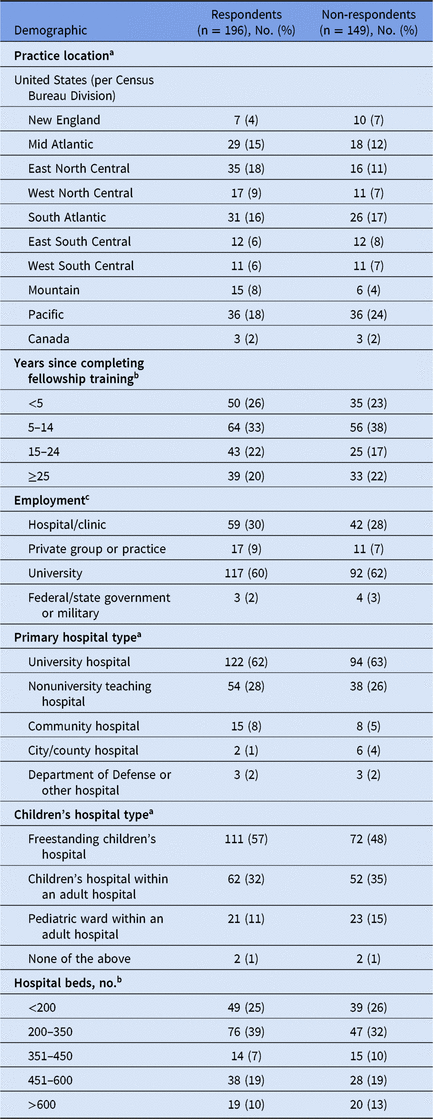
Among the 345 active PID EIN members to whom the survey was sent, 196 (57%) responded; 162 of these (83%) were aware of their institutional policies for CDI testing and management and completed the survey. Table 1 lists the respondent and nonrespondent demographics; there were no statistically significant differences between respondents and nonrespondents (P values ranged from 0.38 to 0.83 for all demographics listed in Table 1).
Survey Demographics of 196 Respondents and 149 Nonrespondents

a 0.3 < P < 0.4.
b 0.5 < P < 0.6.
c 0.8 < P < 0.9.
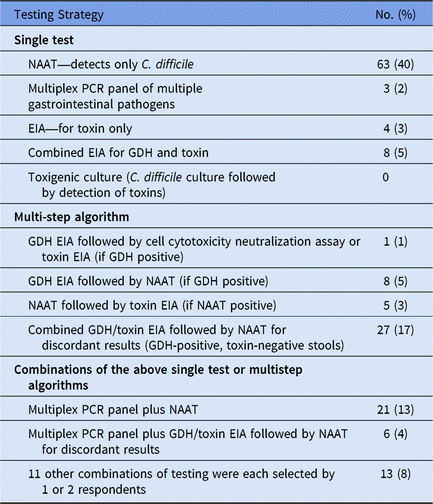
Table 2 lists the C. difficile testing strategies (ie, single test vs multistep algorithm and specific assays used) reported by the 159 of 162 eligible respondents (98%) who knew their institution’s CDI testing strategy. Irrespective of the specific strategy and assay used, 99 of 159 respondents (62%) utilize NAAT without toxin testing. Although 60 of 159 (38%) respondents utilize toxin testing, 36 of these 60 (60%) respondents initially test stool with a combined glutamate dehydrogenase (GDH, C. difficile common antigen) and toxin EIA but follow up with NAAT as an arbitrator of GDH-positive, toxin-negative stools. Thus, toxin EIA is utilized to rule in CDI, but NAAT is used to rule out CDI with this multistep algorithm. Among the 87 respondents providing information about their institution’s use of a multiplex PCR panel for diarrheal pathogens, 39 (45%) report that they always suppress the C. difficile PCR result from this assay. Among the 48 respondents whose institutions report the C. difficile PCR result from the multiplex PCR panel, 13 (27%) require the healthcare provider to specifically request C. difficile PCR results, whereas 35 (73%) report the C. difficile PCR result even if C. difficile testing was not specifically requested.
Clostridium difficile Testing Strategies at the Institutions of 159 Survey Respondents

Note. NAAT, nucleic acid amplification test; PCR, polymerase chain reaction; EIA, enzyme immunoassay; GDH, glutamate dehydrogenase.
Among the 153 respondents aware of symptom-based restrictions on C. difficile testing, 143 (93%) reported that only unformed stools were tested for C. difficile at their institution. Among the 151 respondents aware of age-based restrictions on C. difficile testing, 75 (50%) reported that their institution employed age-based restrictions. Testing was limited to patients older than the following: 3 months (n = 1, 1%), 12 months (n = 62, 83%), 24 months (n = 11, 14%), and 36 months (n = 1, 1%). Adoption of age-based restrictions was not associated with being a university-affiliated hospital (52% vs 45%; P = 0.43), a freestanding children’s hospital (53% vs 45%; P = 0.28), or a hospital with >350 beds (52% vs 49%; P = 0.69).
Testing restrictions and hospital characteristics (Table 3) were similar among respondents whose institutions utilize NAAT alone (either NAAT for only C. difficile or a multiplex PCR panel that includes C. difficile) compared to those whose institutions use toxin testing (either as a single test or part of a multi-step algorithm). Among the 143 respondents whose institutions have a neonatal intensive care unit (NICU) and are aware of C. difficile testing policies for NICU patients, 26 (16%) permit testing of these infants. Respondents reported that if a patient in the NICU tests positive, the patient is managed with contact isolation (n = 17, 65%), single patient room or patient cohorting (n = 5, 19%), and/or antibiotic therapy for CDI (n = 12, 46%).
Utilization of C. difficile Testing Restrictions and Hospital Characteristics Relative to Hospital C. difficile Testing Strategy

Note. NAAT, nucleic acid amplification test; PCR, polymerase chain reaction.
a Toxin test used either as a single test or part of a multistep algorithm.
b Used either an NAAT assay that only detects C. difficile, or a multiplex PCR panel that includes C. difficile, without initial or confirmatory toxin testing.
Only 1 respondent (1%) indicated that their institution routinely tests asymptomatic children to identify C. difficile carriage. This respondent reported that their institution tests for carriage in patients with a malignancy or bone marrow transplant. The only action that occurs when asymptomatic carriage of C. difficile is detected is enhanced environmental cleaning (eg, frequency and/or type of disinfectant). If a known asymptomatic carrier subsequently develops diarrhea, that patient receives empiric CDI treatment without repeat testing. Asymptomatic carriers are not reported to the National Healthcare Safety Network (NHSN).
Discussion
Updated clinical practice guidelines for CDI were recently endorsed by the IDSA and the Society for Healthcare Epidemiology of America (SHEA).Reference McDonald, Gerding and Johnson4 Compared to the previous 2010 guideline, the updated document included clinical practice guidance for pediatric populations. Although the guideline authors acknowledged the benefits and drawbacks of both toxin EIAs and NAATs, a single test was not wholly endorsed. NAATs (alone or as part of a multistep algorithm) were recommended only if the hospital had pre-agreed criteria for submitting stool specimens for C. difficile testing. The purpose of these prearranged criteria is to limit C. difficile testing in patients with low likelihood of CDI and avoid detection of asymptomatic carriage. In institutions without pre-agreed criteria for submitting stool specimens for C. difficile testing, stool toxin testing as part of a multistep algorithm was recommended. These survey data, gathered shortly before publication of the updated IDSA/SHEA guidelines,Reference McDonald, Gerding and Johnson4 provide information about the prevalence of CDI diagnostic practices in the United States as it relates to limiting detection of asymptomatic carriage in children. Thus, these data inform opportunities for improving C. difficile diagnostic stewardship, particularly among institutions utilizing NAATs for C. difficile diagnosis, in accordance with the recently updated guidelines. Because adoption of diagnostic stewardship practices is not associated with various hospital characteristics (eg, freestanding children’s hospital, hospital size or university affiliation), our data suggest that need for diagnostic stewardship practices is a relatively pervasive issue.
These data suggest that many PID physicians have an opportunity to advocate for institutional changes to C. difficile diagnostic testing practices that may reduce the misdiagnosis of CDI in asymptomatic carriers. Although routine testing for asymptomatic carriage is exceedingly uncommon, certain diagnostic stewardship practices, particularly IDSA/SHEA-endorsed age-based restrictions of testing, were reported by only half of respondents, irrespective of whether or not toxin or NAAT testing was being used in their institution. In addition, roughly one-third of respondents reported the use of a multiplex PCR to diagnose CDI, and nearly three-quarters reported that results were provided even if they were not requested by the clinician. Thus, these data suggest that asymptomatic carriage is likely commonly detected, particularly in patients in whom toxin testing is not performed.
Because antibiotics are not generally indicated for asymptomatic carriage, misdiagnosis of carriage as CDI leads to unnecessary antibiotic exposure. The antibiotic stewardship implications of judicious use of C. difficile testing are highlighted in this survey by responses regarding management of NICU patients tested for C. difficile. Despite strong evidence that C. difficile does not cause infection in neonatesReference Tamma and Sandora5 and American Academy of PediatricsReference Schutze and Willoughby6 (AAP) guidelines discouraging testing in this age group, roughly half of respondents who reported testing NICU patients for C. difficile provide treatment for CDI. The AAP-endorsed age-based restrictions of C. difficile testing were adopted by the updated IDSA/SHEA guideline.Reference McDonald, Gerding and Johnson4 Age-based testing restrictions, the uptake of which may be improved with electronic order entry messaging,Reference Kociolek, Bovee and Carter7, Reference Nicholson, Freswick and Di Pentima8 may improve testing decisions and reduce unnecessary antibiotic therapy for C. difficile carriage, leading to reduced healthcare costs.Reference Kociolek, Bovee and Carter7, Reference Truong, Gombar and Wilson9 However, reducing unnecessary testing in older children may be more challenging. Although the vast majority of respondents report that C. difficile testing is restricted for formed stools submitted to the laboratory, this does not prevent testing in children with clinically insignificant diarrhea (ie, 2 or fewer unformed stools in 24 hours) or diarrhea in patients who are unlikely to have CDI. In these cases, pediatric healthcare provider educationReference Kociolek, Bovee and Carter7 and/or leveraging the electronic health recordReference Truong, Gombar and Wilson9 to monitor frequency of diarrhea and recent laxative use may be effective. Notably, although this definition of clinically significant diarrhea has not been validated in children, this definition is recommended in the AAP CDI clinical care guidelines.Reference McDonald, Gerding and Johnson4
In addition to the antibiotic stewardship implications of CDI misdiagnosis, there are also other consequences. For example, misattribution of diarrheal symptoms to C. difficile may delay identification of the true diarrheal etiology, potentially leading to worse outcomes. We have observed diarrheal symptoms caused by conditions such as typhlitis, ulcerative colitis, and toxic shock syndrome initially mistakenly attributed to CDI because of positive tcdB PCR in these patients. Furthermore, CDI misdiagnosis leads to overestimation of hospital CDI rates, impairing accurate institutional CDI surveillance and limiting reliable interfacility comparisons of CDI rates. Healthcare-associated infection rates are an important hospital quality metric, and implementation and monitoring the impact of CDI prevention initiatives require accurate surveillance. The impact of overestimation of CDI rates may be even higher in populations at high risk for C. difficile carriage, such as hospitalized childrenReference Leibowitz, Soma, Rosen, Ginocchio and Rubin10 and children with cancer.Reference Dominguez, Dolan and West11 Furthermore, with the potential for hospital nonreimbursement for healthcare-associated infections such as CDI, hospitals have a financial incentive for accurately measuring and avoiding overestimation of CDI rates.Reference Fong, Fatica and Hall12 These consequences highlight the importance of developing diagnostic testing methods that reliably distinguish carriage and CDI, which has been a difficult task.Reference Kociolek2 Until that happens, diagnostic stewardship will remain an important strategy for optimizing utilization of C. difficile diagnostic testing.
Our study has some limitations. Although our 57% physician response rate was relatively high, and respondents are similar to nonrespondents regarding all practice variables examined, a response bias may still exist. Testing practices may have differed between respondents and non-respondents. Physicians elect to join the EIN, and this convenience sample may not be generalizable to all pediatric infectious diseases physicians. In addition, although respondents reported the prevalence of policies, hospital and provider compliance with these strategies could not be determined.
In summary, these data suggest that there are pervasive opportunities to improve CDI diagnostic stewardship practices in children and to develop institutional policies to align with recently updated IDSA/SHEA guidance, particularly in hospitals using NAATs alone for CDI diagnosis in children. However, even with implementation of these IDSA/SHEA-endorsed practices, provider education remains an essential component of diagnostic stewardship to assist providers in appropriately selecting patients for C. difficile testing. Future work should identify cost-effective, scalable, and sustainable strategies for CDI diagnostic stewardship.
Supplementary material
To view supplementary material for this article, please visit https://doi.org/10.1017/ice.2018.347.
Author ORCIDs
Larry K. Kociolek, 0000-0002-8756-3417
Acknowledgments
We thank Dr David Kuhar and Ronda Sinkowitz-Cochran for their input on the survey and comments that improved the manuscript.
Financial support
This publication was funded by the Centers for Disease Control and Prevention (Cooperative Agreement No. 1 U50 CK000477). Its contents are solely the responsibility of the authors and do not necessarily represent the official views of the Centers for Disease Control and Prevention or the Department of Health and Human Services. L.K.K. is supported by the National Institute of Allergy and Infectious Diseases at the National Institutes of Health (grant no. K23 AI123525).
Conflicts of interest
All authors report no conflicts of interest relevant to this article.