Introduction
In the last two decades, disasters and mass-casualty incidents (MCIs) caused over 1.2 million victims with an average of 60,000 every year. 1 According to the United Nations, 2 more than 1.5 billion people were affected by unexpected events which caused a considerable social, economic, and environmental impact. The analysis and understanding of these events can help governments and institutions to plan preventive strategies and to increase the preparedness for an adequate response.
Mass-casualty incidents and disasters are unexpected events challenging the entire socio-economic structure of the involved area. In particular, disasters overwhelm the response capabilities, while MCIs place a significant demand on the rescue systems. Reference Tintinalli3 The historical definition by de Boer differentiates disasters from accidents, reporting that “a disaster is a disruptive event that causes a discrepancy between the number of casualties and their treatment capacity,” while an accident is “a similar event without victims that does not cause this discrepancy.” Reference Bayram, Zuabi, McCord, Sherak, Hsu and Kelen4 In the last years, several authors proposed a formal approach to disaster medicine, developing theories, conceptual models, and scoring systems to weigh and classify accidents and disasters. Reference de Boer5–Reference Othman, Beydoun and Sugumaran7
Disaster models may be useful in quantifying and understanding disaster events by simplifying complex events and helping to distinguish between critical elements, thus facilitating the planning process. Reference Kelly8
However, the events generating MCIs and disasters may be notably heterogeneous in nature and may have different degrees of impact on the environment, patients, and rescue systems. Heterogeneity poses a unique challenge to rescue teams involved in the management of patients’ care in those complex scenarios.
A series of logistic factors, such as potential hazards, patients’ retrieval, local organization of the first aid, coordination between the rescue teams involved, distribution of patients, and information to the receiving hospitals should be considered for their potential key role during rescue operations.
Under-estimated logistic problems could significantly hamper the emergency operations, delay the definitive treatment of the injured patients, and even jeopardize the dispatched personnel’s safety.
In this context, it is important to identify useful tools for the initial evaluation of MCIs and disasters that can anticipate the clinical and logistical needs in order to appropriately tailor the rescue chain, taking into account the particular needs related to a specific event and therefore granting a strategic allocation of the available resources. Reference Asghar, Alahakoon and Churilov9
The early detection of logistic problems that could hamper the rescue operations (red flags) should grant better planning of the rescue operations during the early phase after MCIs and may also be useful for training and education and to provide a standardized classification and comparison for subsequent post-event analysis, debriefing, and data collection. Reference Hardy, Fattah, Wisborg, Raatiniemi, Staff and Rehn10
The Pareto Principle
The Pareto principle states that in any population that contributes to a common effect, a few account for the bulk of the effect, often following the 80-20 rule, which asserts that 80% of outcomes result from 20% of all causes for any given event. Reference Schumpeter11 This principle is widely used in decision making and risk management to assess the most important elements on which to intervene. Reference Mollah, Long and Baseman12 More recently, it became clear that not all models follow the 80-20 rule, however, the Pareto analysis is useful to breakdown complex outcomes into manageable chunks.
The main purpose of this study was to describe the most frequent logistic problems faced during the management of major Italian MCIs and disasters with a problem-based approach. In particular, the authors wanted to establish if the 80-20 rule is applicable to the logistic red flags found in MCIs and disasters and to identify the most important aspects.
Methods
All the consecutive MCIs and disasters occurred in Italy from 1944 through 2020 were initially considered for inclusion in this study. In order to analyze events posing at least a substantial challenge to both the rescue systems and the local health service, all the events with a Disaster Severity Score Reference de Boer5 (DSS) ≥ four and at least five victims involved were considered for inclusion. The DSS cutoff of four was chosen for continuity with previous literature about Italian disasters Reference Ferro13 who found DSS ≥ four in all the major events.
Study information was obtained from a local disaster spreadsheet (Microsoft Excel 2007; Microsoft Corporation; Redmond, Washington USA) set up in 1995 and updated monthly by the personnel of the 118 Bologna Dispatch Center (Bologna, Italy). The spreadsheet collects all mass-casualty and disaster events meeting the above-mentioned criteria and is based on data from the Civil Defense information service. Integrative logistics data were gathered from the interview of other dispatch centers involved, cartography, and local media information. The complete spreadsheet, as used in the study, is available as supplementary online material (Supplement Table 1; available online only).
The primary outcome measure was the number of logistic red flags detected by the analysis of the events.
Since no patient-related personal or confidential data or information were collected for the study, Ethics Committee approval was not requested.
Organization of Medical Rescue in MCIs and Disasters in Italy
The rescue maneuvers for an MCI or disaster could be sub-divided into two major phases: a “rapid response phase” where the first rescuers act with the immediately available resources and collect information for the coordinating centers, and a “delayed response phase” where the rescue maneuvers are progressively tailored on the basis of the specific needs related to the scenario.
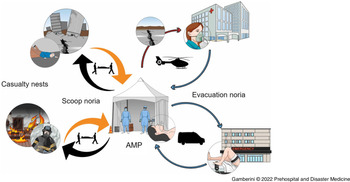
The organization model for medical rescue when facing MCIs and disasters in Italy 14 is adapted from the French model called ORSEC-NOVI plan. 15 This model distinguishes, within the disaster area, one or more casualty nests that need to be accessed in order to evacuate the victims to the nearest advanced medical post (AMP) or other first aid point (Figure 1). Casualty nests might conceal serious threats and are not necessarily accessed by the dispatched health personnel, which takes care of the victims in one or more AMPs or other first aid collection points, except for situations of immediate danger for life, once safety is ensured.
Organization of Medical Rescue in MCIs and Disasters in Italy. Abbreviations: AMP, advanced medical post; MCI, mass-casualty incident.

Casualty nests could have horizontal (eg, flood), vertical (eg, fire in a building), or mixed (eg, explosions or landslides) development on the basis of the different three-dimensional involvement of the area. Moreover, it is possible that casualty nests need to be secured if risks for safety are detected (eg, chemical, biologic, radiologic, nuclear [CBRN]; shootings), and this could furtherly limit the accessibility of victims even if no extrication is needed. Each of these characteristics, or the combination of them, requires a different approach and/or the involvement of specialized rescue teams, potentially delaying rescue interventions and increasing risks for both victims and providers.
The combination of operations needed in order to extricate and transport the victims to the AMP is called “scoop noria” while the operations related to their transfer to the receiving hospitals are called “evacuation noria.” Literally speaking, a noria is a hydro-powered wheel used to lift water into small aqueducts. As an analogy in the disaster medicine field, the word refers to the circle of patients and resources happening between the disaster scenes and the medical posts and hospitals (Figure 1).
Other professional rescue figures may be present on the scene such as law enforcement and personnel of the fire department, therefore, the medical director of the rescue operations needs to coordinate with the police and fire brigade directors and with the dispatch center in order to establish effective flows of victims to the receiving hospitals.
Logistic Red Flags
Logistics variables collected were established by a group of clinicians with experience in disaster medicine (SB, FDC, DC, PLI, MT, FM, MA, and LC) with a Delphi consensus method and consisted of twelve items that could be rationally collected early from the dispatch center or the rescue personnel on scene.
A value for each item was chosen as a red flag; in case of continuous variables, a cutoff point was arbitrarily chosen on the basis of a consensus among the experts. The items considered as red flags were:
-
1. Real or estimated number of victims (either died or injured): over 50 people involved;
-
2. Development of the casualty nest: vertical or mixed;
-
3. Setting of the operations: confined or isolated;
-
4. Number of casualty nests: over five;
-
5. Casualty nest area: over 2.5km 2 ;
-
6. Access to victims: difficult and/or risky;
-
7. Extrication of the victims: needed for over 30% of victims and/or risky;
-
8. Need for securement of the casualty nest from the law enforcement or the fire brigade before the beginning of patients’ evacuation;
-
9. Potential hazards present;
-
10. Weather conditions: adverse or prohibitive;
-
11. Beginning of the event during nighttime; and
-
12. Evacuation noria: over 20km from the nearest referral hospital.
Data Presentation and Statistical Analysis
Data are presented as numbers and percentages or median and interquartile range (IQR). A Pareto analysis was performed in order to highlight the most frequent red flags found in the evaluated MCIs and disasters, and subsequently, an Ishikawa diagram was built to identify their root causes. Finally, a Spearman correlation heat map was built considering the number of red flags found for each event and the different components of the DSS.
Statistical analysis was performed using Microsoft Excel 2019 (Microsoft Corporation; Redmond, Washington USA) and Stata/CI 16 (StataCorp; College Station, Texas USA).
Results
From January 1944 through December 2020, 138 events fulfilled the inclusion criteria and were subsequently reviewed and included in the analysis.
Table 1 shows the main characteristics of the collected events with regard to DSS score components, while Figure 2 shows number of events per year and the distribution of logistic red flags among the different types of MCIs and disasters. Supplement Table 1 shows the disaggregated details for each MCI and disaster considered.
Main Characteristics of the Italian Disasters Analyzed

Abbreviations: DSS, Disaster Severity Score; IQR, interquartile range.
Temporal Distribution of the Events Taken into Account and Median Number of Red Flags per Type of Event.Note: The box represents the median number of red flags and the 25-75 interquartile range; whiskers represent the minimum and maximum observed values. Orange boxes represent man-made MCIs and disasters, while gray boxes represent natural disasters. Abbreviation: MCI, mass-casualty incident.

Approximately one-half of the events (n = 78; 56.5%) were man-made, and most frequently consisted of traffic accidents and fire (n = 45; 32.6% and n = 20; 14.5%, respectively), while natural disasters and MCIs were most frequently related to earthquakes (n = 22; 15.9%) and floods (n = 29; 21.0%).
Most of the events involved more than 25 people and needed six to 24 hours for completing the rescue operations; finally, the median DSS was five [IQR 4 - 8] and the median number of red flags recorded was six [IQR 4 - 7]. Figure 2 shows the time distribution of the collected events and the median number of red flags and interquartile range for different types of disasters, classified following the DSS score categories. Globally, natural MCIs and disasters tended to show a higher median number of red flags, while man-made disasters were subject to a wider range of complexity despite lower median values.
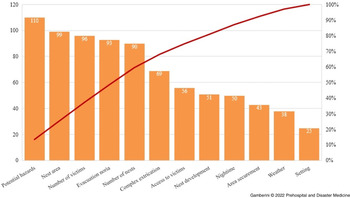
The Pareto graph is shown in Figure 3. Eight out of twelve red flags covered 80% of the problems reported; these were in detail: potential hazards, casualty nest area > 2.5km 2 , number of victims over 50, evacuation noria over 20km, number of nests > five, need for extrication, complex access to victims, and complex nest development.
Pareto Graph – Logistic Red Flags.

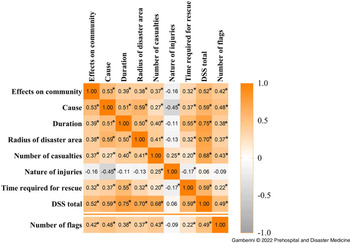
Figure 4 shows the heatmap of the Spearman correlations between the number of flags and different DSS components; the logistical complexity of scenarios revealed to be positively correlated with most of the components of the DSS score with rho values ranging from 0.23 to 0.49. Even the single components of the DSS score demonstrated significant positive correlations between one another.
Heatmap of the Correlations between the Number of Red Flags and Different DSS Component Scores.Abbreviation: DSS, Disaster Severity Score.

The fishbone diagram shown in Figure 5 identifies the major disaggregated root problems detected by the event-related sub-analysis of the most frequent red flags.
Fishbone Diagram Showing the Root Elements of the Most Frequent Red Flags.Abbreviations: AMP, advanced medical post; EMS, Emergency Medical Services; PPE, personal protective equipment.

Discussion
Logistic aspects are a fundamental issue to consider when managing MCIs and disasters. The problem-based analysis of this case series of Italian disasters and MCIs highlighted eight different red flags covering 80% of the events recorded, therefore signaling a high heterogeneity in logistical problems that don’t strictly follow the 80-20 rule of the Pareto principle. Reference Box and Meyer16
The global logistic complexity of the scenario evaluated by the number of flags was significantly correlated with the DSS, however, the entity of the correlation is weakly positive (0.49; 95% CI, 0.35 - 0.61) confirming that even minor events could sometimes result in difficult logistic management.
The key elements at the root of each of the eight most frequent red flags found in the Pareto analysis (Figure 5) will be analyzed in detail below.
Potential Hazards and Casualty Nest Area
When assessing mass-casualty scenarios, the immediate detection of potential hazards is a priority. Hazards could be environmental or patient-related. The former could have an impact on the safety of both patients and rescuers and requires a thorough evaluation of the structures involved and their related systems (eg, local traffic block or securement of an area) as well as public security and CBRN hazards. Patient-related risks are evolutive conditions that could not be fully managed on scene, such as intoxications, and could prompt a hastening in evacuation maneuvers.
The more extended the nest area, the more complex the retrieval and evacuation of the victims will be. Once safety is ensured, it should be evaluated if any health-related intervention within the nest area could be needed, and larger areas may require more AMPs or collection points.
In case that access to the nest areas from the health personnel is deemed necessary, it is possible that special equipment is needed, and this may be supplied on the scene.
Number of Victims and Evacuation Noria
The estimated number of people needing assistance is another key point in rescue planning. Particularly, the main nature of the injuries reported (eg, contusions, burns) has an important role in anticipating eventual need for supplies in loco and the subsequent hospital response for particular populations (eg, carbon monoxide intoxication could trigger the pre-alert of hyperbaric chambers outside of the region in order to grant surge capacity). Recent advances in technology have granted the possibility to summon rescuers among the general population through smartphone apps that could be subsequently recruited for the first response. Reference Jaffe, Dadon and Alpert17
Field triage is fundamental in order to establish the need for in-situ interventions and evacuation priority. More than twenty triage systems are available from actual literature, most of these share a basic clinical evaluation that can quickly assess the criticality of the victims and their priority. In special contexts of extremely limited medical resources, reverse triage could be chosen, therefore prioritizing the evacuation of the less injured victims. Reference Bazyar, Farrokhi and Khankeh18 Since field triage is one of the most explored chapters of disasters management, the full description of the different triage systems goes beyond the scopes of this work.
On the other hand, the organization of an evacuation noria is essential in order to establish the number and type of vehicles needed, such as helicopters or shuttles, for the multiple transfer of less injured patients. The routes towards the hospitals and access to the ambulance bay of the AMP should be well-established to avoid traffic congestion. As an example, the rescue maneuvers for a military jet plane crash on a school in 199019 were initially complicated by a not well-defined interface between the evacuation noria and the AMP so that ambulances carrying injured patients could not leave for the receiving hospitals because they got stuck in the traffic generated by the Emergency Medical Service (EMS) vehicles entering the ambulance bay.
The presence of multiple AMPs and the distribution of the patients between hub and spoke hospitals Reference David, Bouzat and Raux20 may demand for more than one evacuation noria. The management of evacuation needs also to consider the criticality of the patients as well as the specific competences and surge capacity of the receiving hospitals. In the last decade, different algorithms and applications such as the Severity-Adjusted Victim Evacuation (SAVE model) were developed in order to hasten the decisions based on clinical priority and distance from hospitals. Reference Dean and Nair21–Reference Kamali, Bish and Glick23
Number of Casualty Nests and Need for Extrication
Complex scenarios may include two or more casualty nests, all of which may have different developments and number of casualties and, moreover, the need for extrication of victims could retard their assessment and carry additional hazards for themselves and the rescuers. The definition of the number and location of AMPs, the design of scoop and evacuation norias, and eventual need for intra-nest interventions on the basis of the security evaluation of the fire and rescue forces are an integral part of the rescue planning. Medical interventions for patients requiring extrication maneuvers, such as analgesia during extrication, represent another critical issue because the health personnel employed in the nest are temporarily unavailable for other tasks.
Moreover, identification and tracking of the victims from different nests supports priority stratification and allows to avoid the dispersion of information. In this context, online victim tracing systems Reference Marres, Taal, Bemelman, Bouman and Leenen24 connected with personal identifiers, such as barcode wrists, Reference Haverkort, Bouman, Wind and Leenen25 could significantly foster data acquisition from the dispatch center as well as in-hospital paths of the patients.
Development of the Casualty Nest and Access to Victims
Vertical or mixed casualty nests, such as burning or collapsed buildings or explosions, are often more challenging to manage for the fire rescue and health care forces because of the potential multi-level distribution of both structural damage and victims, Reference Gamberini, Imbriaco and Flauto26 and this may be taken into account for both AMP and noria design. Moreover, access to victims for health personnel could be difficult independently from the need for extrication; this could happen for example in scenarios involving planes or trains. Reference Shultz, Garcia-Vera and Santos27
Incidents involving the release of CBRN substances add complexity to the accessibility because of the need for area securement, decontamination from toxic materials, and the use of adequate personal protective equipment (PPE). Reference Tin, Granholm, Hart and Ciottone28
The use of drones in MCIs Reference Konert, Smereka and Szarpak29 has recently emerged as a promising technology for both remote triage Reference Álvarez-García, Cámara-Anguita and López-Hens30 and first aid equipment delivery. 31
Transmission of Information and Response Plans
The intrinsic complexity of MCIs and disasters requires a structured transmission of a high volume of information from the field during the primary assessment. The most frequently used mnemonic acronym is called METHANE: Reference Lowes and Cosgrove32
M: Declare major incident;
E: Exact location of the incident;
T: Type of incident with brief details;
H: Hazards present and potential;
A: Access routes and potential rendezvous points;
N: Approximate number and nature of casualties; and
E: Emergency services present and those required, including specialist input.
This core set of information is, therefore, at the root of the development of rescue operations and requires strict coordination and communication between the different forces dispatched (police, firefighters, health personnel).
In Italy, the disaster response plan differentiates two possible scenarios on the basis of whether the effects overstep the response from local health structures which share a common immediate response. 14
The initial field organization provides the development of a Control and Command post where the director of sanitary aid interacts with the law enforcement officer and the director of the fire brigade. A director of triage and a director of transport collaborate with the dispatch center in coordinating the rescue maneuvers. Rescue personnel are sub-divided into rapid response teams that perform their activity in different sectors identified on the basis of topographic or functional criteria.
Advanced medical posts and sanitary rescue mobile units are then secondarily instituted and the full rescue structure becomes operational.
Limitations
The series of events described in this paper are related to Italy’s specific geological, meteorologic, and socio-cultural features and may not reflect the specific milieu of disasters and MCIs of other nations. Moreover, the large timespan considered (76 years) has been characterized by a profound technological innovation that invariably modified the type and magnitude of damages caused by MCIs and disasters. Reference Evans33 The cutoffs for most of the red flags were chosen on the basis of expert opinion and the review of actual literature in absence of a wide consensus available. Finally, different countries could rely on different organizational models for disaster response planning and management.
However, the authors believe that the core concepts identified may be considered generalizable and independent from the local organization of the response or the technological advancement.
Conclusion
Anticipation is crucial in emergency and disasters medicine, and the implementation of protocols for the management of different types of critical patients has shortened the time between the onset of symptoms and their appropriate treatment.
Mass-casualty incident and disaster scenarios are looming, and anticipation is inherently more difficult as these events are unexpected, heterogeneous, and require more resources, putting the whole system under significant stress from the very early phases.
This problem-based approach to the logistic red flags in this case series of Italian disasters demonstrated that the 80-20 rule is not respected for these scenarios.
Therefore, careful consideration of multiple red flags detected immediately after the beginning of the event could help in tailoring the best response to the scenario in the shortest time.
Conflicts of interest/funding
The authors declare that they have no conflict of interest. This research did not receive any specific grant from funding agencies in the public, commercial, or not-for-profit sectors.
Authors Contributions
LG, GI, PLI, SB, DC, LC, MT, FM, MA, AM, and FDC concepted and designed the work. DC, GI, CAM, AF, AM acquired and interpreted the data. LG performed the statistical analysis. LG, GI, and CAM drafted the article. PLI, CC, GG, and FDC substantively revised the article.
All the authors have approved the submitted version and have agreed both to be personally accountable for the author’s own contributions and to ensure that questions related to the accuracy or integrity of any part of the work, even ones in which the author was not personally involved.
Supplementary Material
To view supplementary material for this article, please visit https://doi.org/10.1017/S1049023X22000188