In Hamamatsu et al. (Reference Hamamatsu, Inoue, Watanabe and Umezaki2014), we reported that the number of births and marriages and the secondary sex ratio (SSR) in Japan decreased after the 2011 East Japan Earthquake. We attributed these demographic responses to stressful life conditions (i.e. worsening of economic situation, family separation, uncertainty regarding whether and how the Fukushima Nuclear Power Plant crisis would be resolved and broadcasts of pictures of the disaster). O'Donnell & Behie (Reference O'Donnell and Behie2014) proposed that the demographic response after the disaster can be interpreted from an evolutionary perspective. Specifically, they argued that the decrease in the SSR after the disaster can be understood in the context of a longitudinal increase in the sex ratio of fetal deaths in Japan for the last 40 years, which they attributed to the longitudinal increase in earthquake frequency during the corresponding period. Regarding marriage, O'Donnell & Behie (Reference O'Donnell and Behie2014) identified a possible increase in the marriage rate in 2012 in some disaster-stricken prefectures, which, they argue, reflects people's instinctive desire to reproduce when they encounter a life-threatening situation.
Sex ratio
Variation in the sex ratio can be connected to fetal conditions in the mother from conception to delivery. It has been reported that the occurrence of disasters, stressful life events and exposure to environmental chemicals are associated with a lower SSR (Fukuda et al., Reference Fukuda, Fukuda, Shimizu and Møller1998; Hansen et al., Reference Hansen, Møller and Olsen1999; Mocarelli et al., Reference Mocarelli, Gerthoux, Ferrari, Patterson, Kieszak and Brambilla2000; Alexopoulos & Alamanos, Reference Alexopoulos and Alamanos2007). Torche & Kleinhaus (Reference Torche and Kleinhaus2012) showed that stress exposure, particularly in early pregnancy, was associated with a lower SSR. Our finding that the SSR was lower than the expected range at 7 months after the 2011 earthquake (Hamamatsu et al., Reference Hamamatsu, Inoue, Watanabe and Umezaki2014) was consistent with previous studies. It suggests that experiencing an earthquake in months two or three of gestation may result in a significant decline in the SSR.
As an alternative view, O'Donnell & Behie (Reference O'Donnell and Behie2014) showed that the sex ratio of fetal deaths has increased over the last 40 years in Japan and that the SSR is therefore in a decreasing trend. They proposed that this trend could be attributed to the increasing frequency of earthquakes in Japan over the last 40 years. Our study focused on the change in SSR immediately after an acute stress exposure, i.e. the Great East Japan Earthquake, not on long-term chronological change in SSR. Therefore, our conclusions do not necessarily compete with the interpretation by O'Donnell & Behie (Reference O'Donnell and Behie2014).
Marriage
In our study, we evaluated the number of marriages from January 1997 to February 2012, which were the best available data at the time the analysis was conducted, and showed that the number of marriages decreased 7 months after the disaster irrespective of the locality in Japan. O'Donnell & Behie (Reference O'Donnell and Behie2014) noted the possibility of a small increase in marriage rates in 2012 in some disaster-stricken prefectures. To confirm their observation, we evaluated the total number of marriages in 2012 (10–21 months after the 2011 earthquake) in four different geographical areas: the whole of Japan, the disaster-stricken area, the non-disaster-stricken area and each prefecture (n=47), and performed a quadratic regression analysis, which was also used in Hamamatsu et al. (Reference Hamamatsu, Inoue, Watanabe and Umezaki2014).
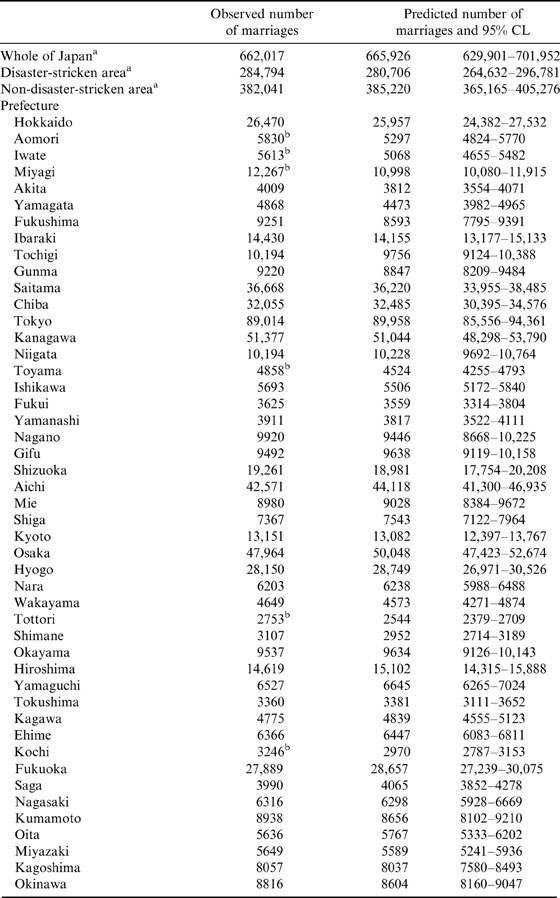
Table 1 shows that the total number of marriages recorded in 2012 fell within the range of the 95% confidence limits (CL) for the predicted mean number of marriages in the whole of Japan, the disaster-stricken area and the non-disaster-stricken area. Analysis at the prefecture level indicated that the number of marriages in 2012 was higher than the 95% CL in six prefectures: Aomori, Iwate and Miyagi in the disaster-stricken area, and Toyama, Tottori and Kochi in the non-disaster-stricken area. Although these results basically agree with O'Donnell & Behie (Reference O'Donnell and Behie2014), we wish to propose a different interpretation. First, we can assume the impact of a tempo effect (cf. Schoen & Canudas-Romo, Reference Schoen and Canudas-Romo2005) on marriages in the three prefectures in the disaster-stricken area, whereby couples affected by the earthquake probably postponed marriages that were planned in 2011 to 2012. We are not certain if this tempo effect also occurred in the prefectures outside the disaster-stricken area, although it is possible because the economic and psychosocial impact of the disaster was not limited to the disaster-stricken area. We should note that no significant increase in marriages in 2012 was observed in Fukushima prefecture, the prefecture most severely affected by the nuclear accident. We can assume that a tempo effect also occurred in Fukushima prefecture, but the population outflow from Fukushima prefecture to the neighbouring prefectures in the Tohoku region (Statistics Bureau of Japan, 2011) masked such an effect.
Comparison of the number of marriages recorded and the 95% confidence limits (CL) and the predicted mean number of marriages in 2012 for each geographic area of Japan

a The disaster-stricken area includes thirteen prefectures in the Tohoku and Kanto regions; the non-disaster-stricken area includes all other prefectures (n=34) in Japan.
b The number of marriages recorded in each geographic area was higher than the 95% CL.
Note: the number of marriages in the month of February in leap years (i.e. 2000, 2004, 2008 and 2012) was multiplied by 28/29.
We do not have sufficient evidence to determine the role of evolutionary factors proposed by O'Donnell & Behie (Reference O'Donnell and Behie2014). More case studies that include long-term observations of age-specific populations are needed to fully clarify the demographic responses after the disaster.