1. Introduction
Teleoperation systems play a crucial role in medical robotics, as they enable surgeons to control robotic instruments dedicated to medical applications. These teleoperation systems typically consist of two stations: a slave station and a master station, connected by a control unit. The surgeons manipulate the slave robots by using haptic devices placed in the master station. The haptic device captures gestures and movements and then converts them into commands that are subsequently sent to the slave robots.
Minimally invasive surgery (MIS) is a surgical technique that involves making small incisions in the body and inserting thin instruments and a camera to perform the operation. One example of a teleoperation system for MIS is the da Vinci Surgical System, which consists of a master console where the surgeon sits and manipulates two hand controllers and a slave robot that has four arms with various surgical tools and a camera. The movement of the surgical tool is defined by three rotations and one translation, which correspond to the roll, pitch, yaw, and the insertion of the tool. The prescribed workspace for the tool is a cone with an apex angle of
 $26^{\circ }$
[Reference Chaker, Mlika, Laribi, Romdhane and Zeghloul1].
Several researches have focused on the development of haptic devices [Reference Meskini, Saafi, Mlika, Arsicault, Zeghloul and Laribi2, Reference Xie, Hou and Wang3]. Many of them have been created for medical applications. One such haptic device is the PHANTOM OMNI [Reference Escobar-Castillejos, Noguez, Neri, Magana and Benes4]. It is frequently used in surgical training and simulation. It provides six degrees of freedom and has a serial structure; its force feedback allows three forces and three torques on a wrist. The Virtuose [Reference Garrec, Friconneau and Louveaux5] is a serial haptic device used in medical training for MIS providing force sensing. It is also applied in rehabilitation and teleoperation. A spherical parallel manipulator (SPM) has been developed by Chaker et al. [Reference Chaker, Mlika, Laribi, Romdhane and Zeghloul1] as a haptic device. It provides three rotations around a fixed point, and it is integrated into a robotic system designed to assist surgeons during minimally invasive procedures. In ref. [Reference Najafi and Sepehri6], Najafi et al. have developed a haptic device for remote ultrasound imaging, which has a hybrid architecture with four degrees of freedom: three rotations and one translation. All the haptic devices previously cited have different structures: parallel, serial, and hybrid. The serial structure has the advantage of a simple kinematic, direct control models, and a large workspace. However, it has a lower stiffness and lower rigidity compared to the parallel structure.
SPMs are a class of parallel robots that offer three degrees of freedom of rotation. SPMs are frequently used as haptic devices. For instance, a haptic device called “Shade” [Reference Birglen, Gosselin, Pouliot, Monsarrat and Laliberté7] was developed to allow a human operator to control the orientation of a distant “camera” while receiving force feedback. A new type of spherical parallel haptic device [Reference Han, Choi and Oh8] using electrorheological fluid has been developed for MIS applications. It can track well both torque and force, which are required for surgical operations.
However, SPMs present some problems, such as parallel singularities inside their workspace [Reference Khoshnoodi, Rahmani Hanzaki and Talebi9], limited self-rotation capabilities [Reference Saafi, Laribi and Zeghloul10], and a reduced workspace [Reference Khoshnoodi, Rahmani Hanzaki and Talebi9, Reference Saafi, Laribi and Zeghloul10]. To solve the problem of parallel singularities, various methods have been proposed based on: geometric optimization [Reference Saafi, Laribi and Zeghloul11–Reference Bai13] or redundancy [Reference Liu, Wu, Wu, Kuen and Li14–Reference Wang, Wu, Li and Liu20]. For instance, Saafi et al. [Reference Saafi, Laribi and Zeghloul21, Reference Saafi, Laribi and Zeghloul22] succeeded in eliminating singularities by proposing a redundant spherical SPM. Despite these various solutions, the problem of limited self-rotation remains unsolved. Achieving extended self-rotation is crucial for different medical procedures, including MIS, neurosurgery, tele-echography, and medical education.
A 3-RRR spherical parallel manipulator with coaxial input axes (SPM coaxial) has been developed with infinite self-rotation capabilities [Reference Tursynbek and Shintemirov23]. This manipulator is made of three legs sharing a common input axis of rotation. Despite the infinite rotation capability of the coaxial SPM, it presents several disadvantages: firstly, integrating direct drive motors proves challenging due to the shared axis of rotation. Additionally, the placement of absolute sensors is a complex task. The sensors are crucial for the implementation of feedback mechanisms for precise control. Moreover, to achieve a full rotation, the entire structure must fully rotate, introducing inertia-related issues that can affect the stability and control of the manipulator. For our proposed mechanism, each actuator and sensor are placed in a different axis with different direction. This facilitates the actuators and sensors equipment. In addition, to achieve a full rotation, only the moving platform performs a full rotation.
In this work, we propose a new redundant SPM (New SPM) with unlimited self-rotation capabilities. The New SPM is composed of two spherical five-bar mechanisms connected by the mobile platform. To achieve a unlimited rotation, only the moving platform performs a full rotation. Additionally, the kinematic models of this structure are less complex than the classical spherical parallel manipulator since the structure is composed of two simple spherical five-bar mechanisms. The redundant structure has allowed having a large free-singular useful workspace. An optimization based on the genetic algorithm is carried out to identify the optimal design parameters. In addition, we have studied the self-rotation capability within the workspace, proving its enhancement over the classic SPM.
This paper is organized as follows: In Section 2, the new kinematic of the spherical parallel robot is detailed. Section 3 presents the distribution of the dexterity of the New SPM. In Section 4, we discuss optimization methods and then compare the self-rotation performance of the classical SPM and the New SPM. The last section is dedicated to the conclusions and additional perspectives concerning this work.
2. The new spherical parallel manipulator structure
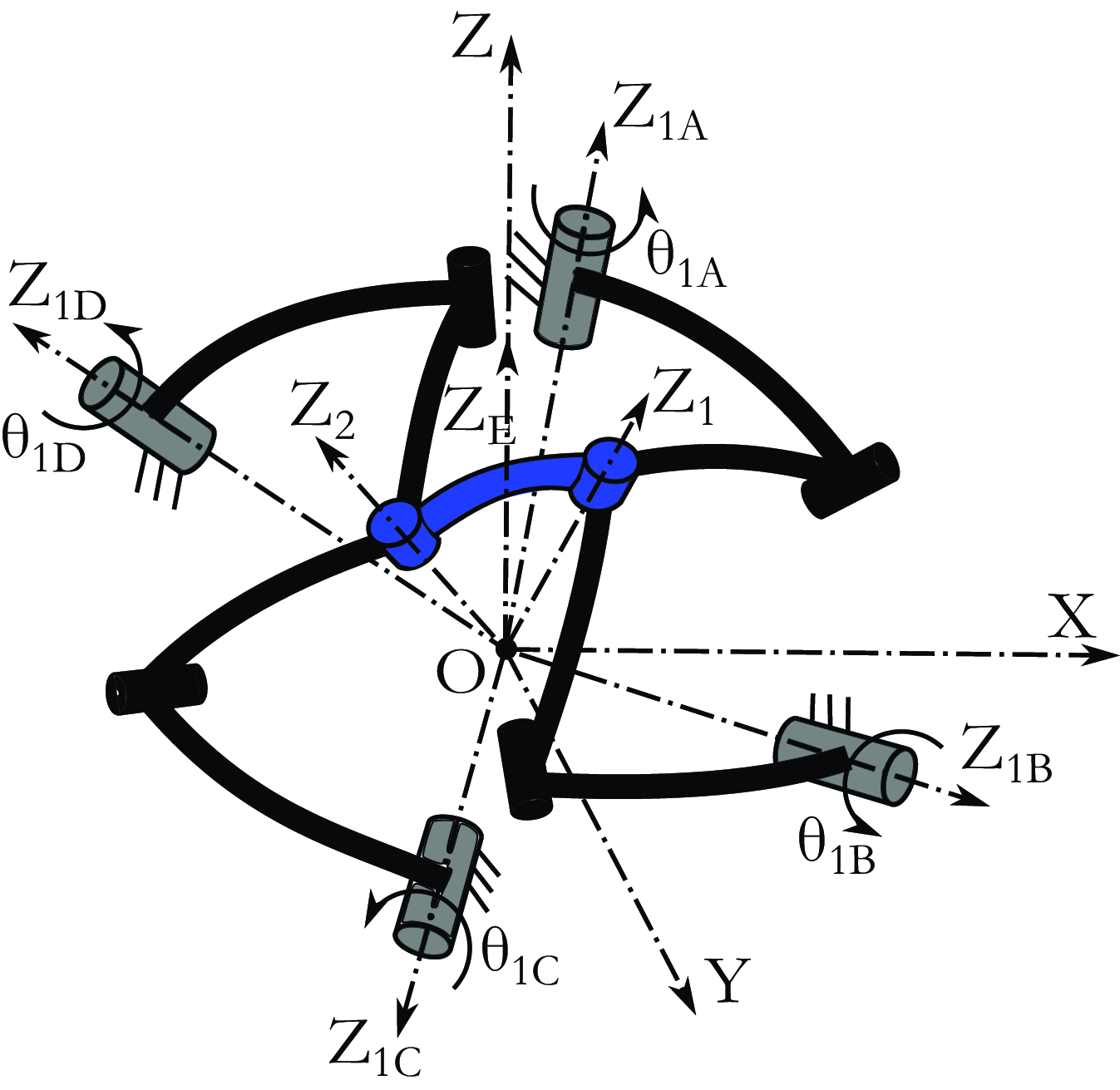
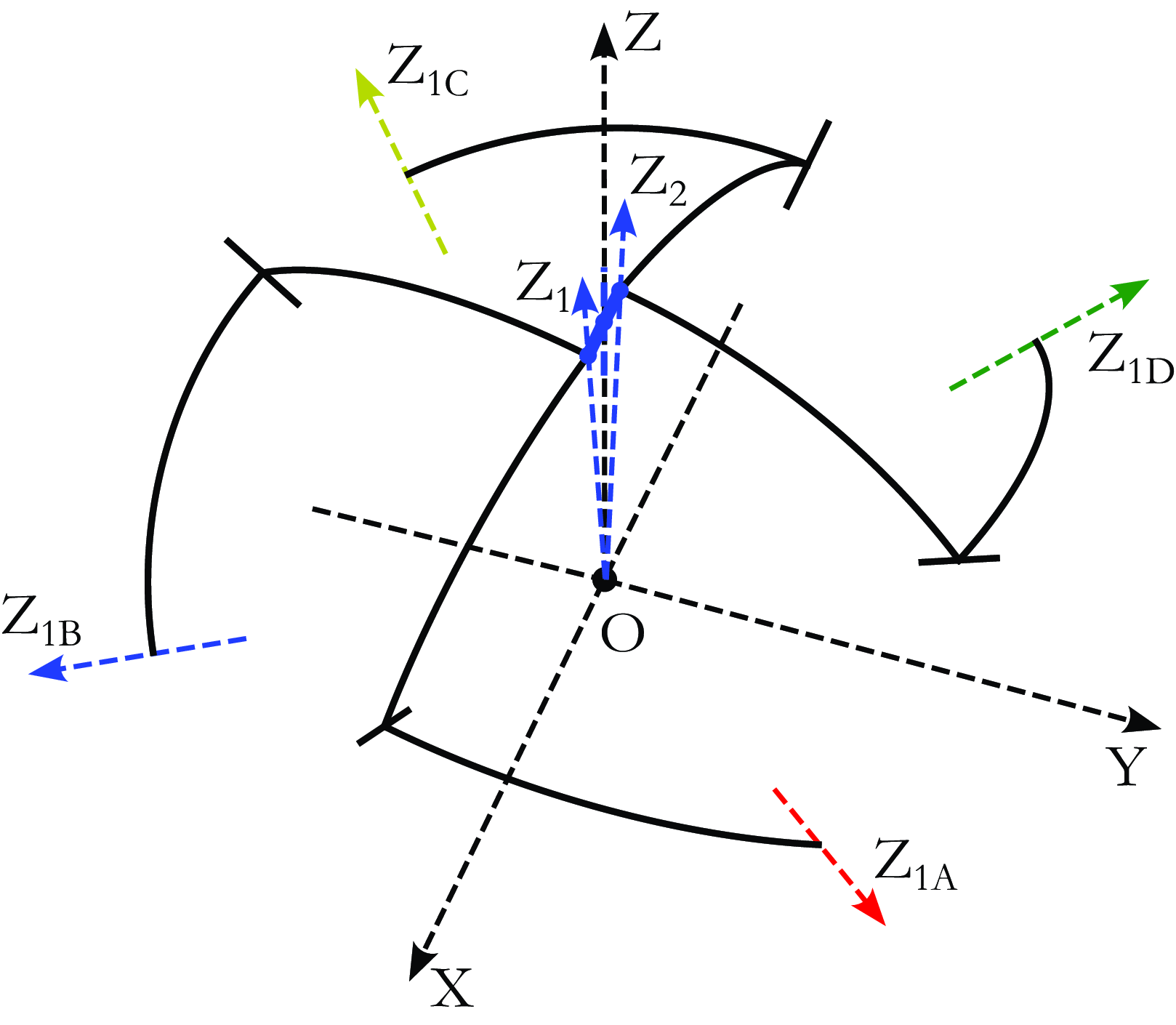
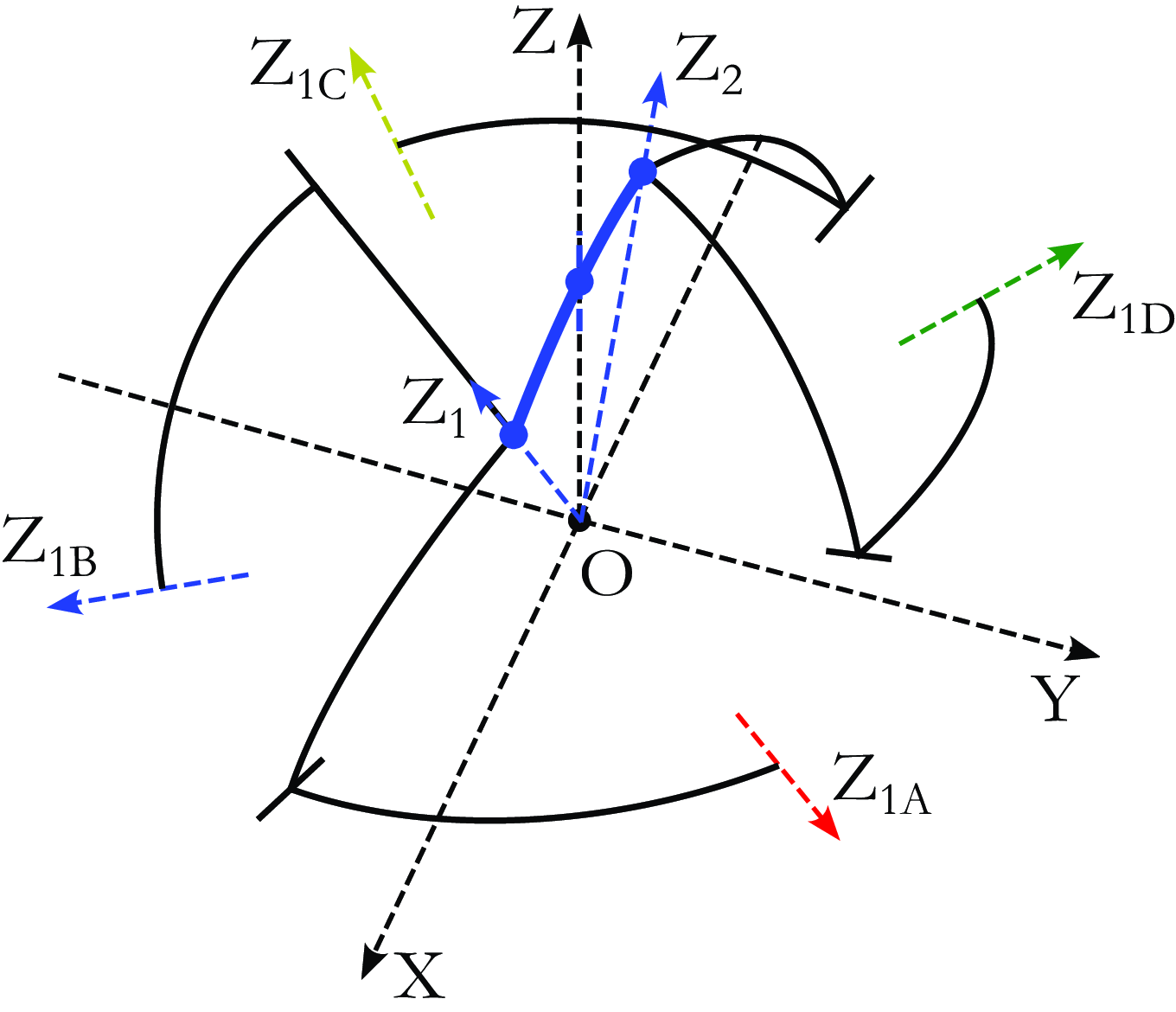
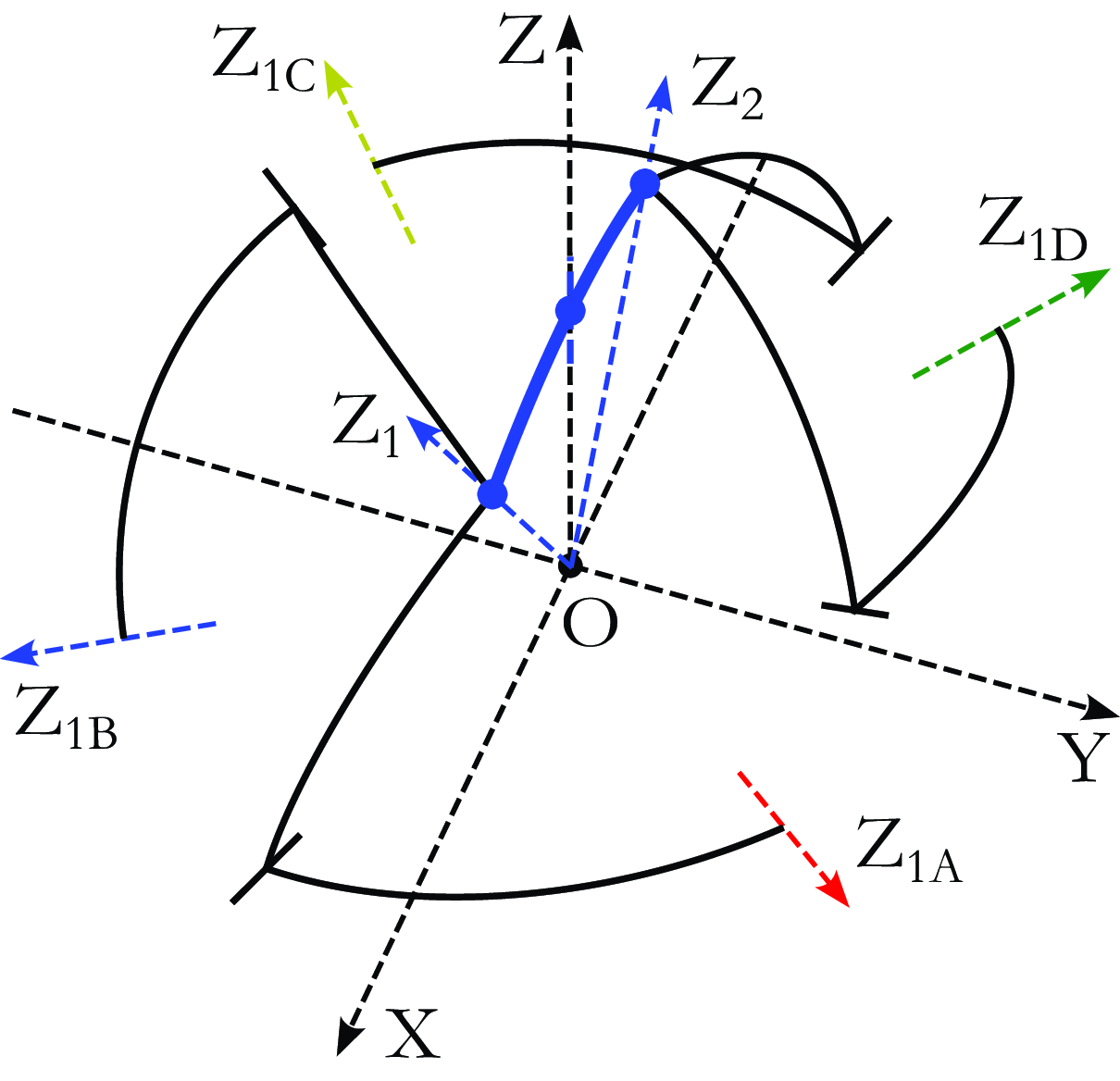
The New SPM has a spherical parallel architecture with three rotational degrees of freedom: two tilt rotations, and one self-rotation. The New SPM is made of two five-bar mechanisms connected by the mobile platform as shown in Fig. 1. The first five-bar mechanism is defined by the two legs A and B, and the second is defined by the legs C and D. Each five-bar mechanism is composed of four links and five revolute joints. All axes of the revolute joints intersect in the center of rotation (CoR). The four revolute joints linked to the base are actuated. These actuators will generate the force feedback to the manipulator. Since the number of actuators is greater than the degrees of freedom, the New SPM is defined as a redundant structure.
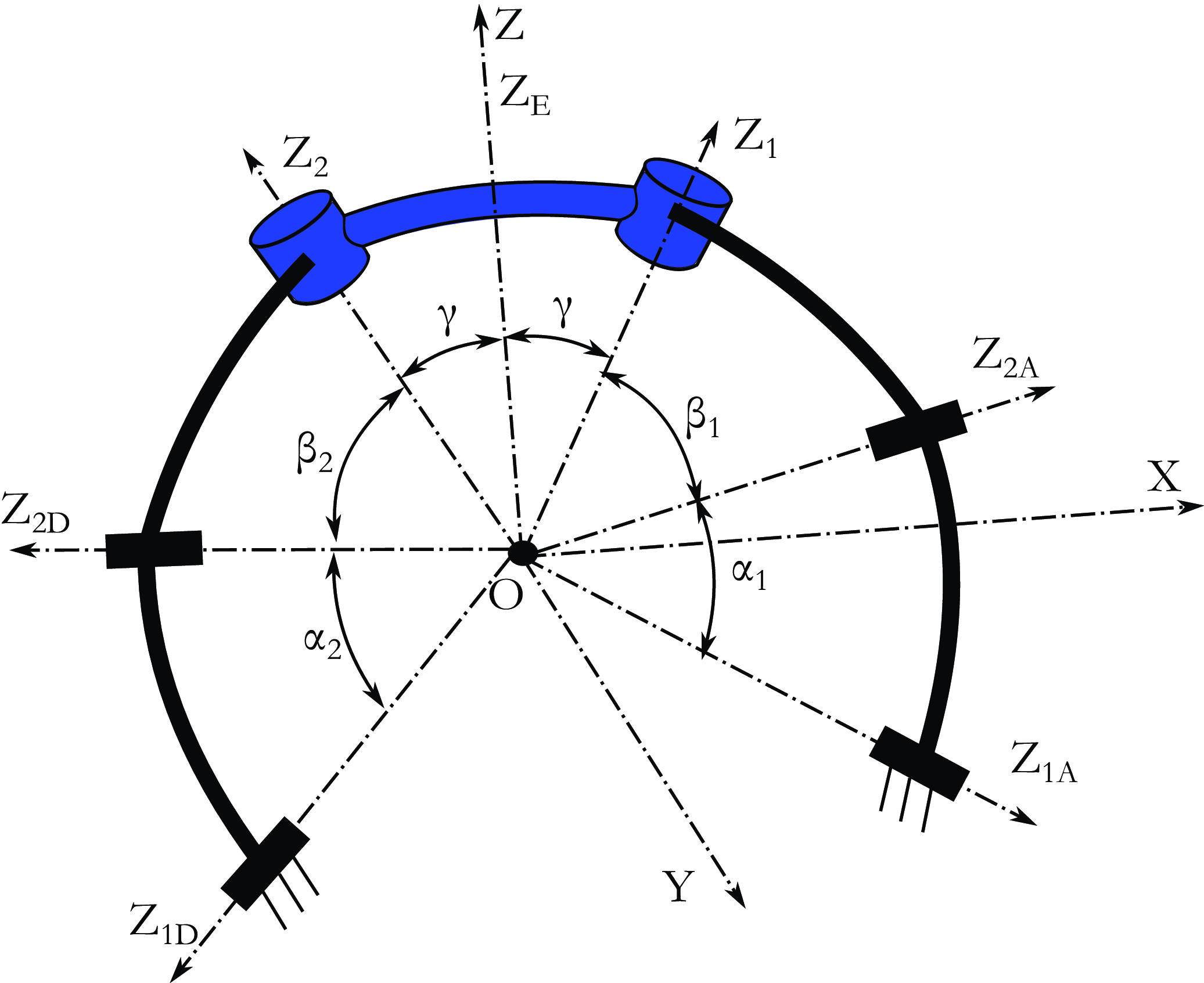
The size of each link is defined by the angle between its two revolute joints and its radius (see Fig. 2). The dimensions of the proximal links, connected to the base, and the distal links, connected to the mobile platform, are denoted by angles
 $\alpha _j$
and
 $\beta _j$
, respectively (
 $j=1$
for legs A and B and
 $j=2$
for legs C and D). The orientation of the axis
 $Z_{1k}$
with respect to the Z-axis is defined by the angles
 $\delta$
. The orientation of the mobile platform is described by the ZXZ Euler angles
 $\psi$
,
 $\theta$
, and
 $\varphi$
.
New redundant spherical parallel manipulator kinematic.

Parameters of legs A and D.

3. Kinematic behavior of the New SPM
The inverse kinematic model of the New SPM is expressed by Eq. (1):
 \begin{align} \left \{ \begin{array}{lcrcl} \mathbf{Z}_{2K} \cdot \mathbf{Z}_1 & = & \cos \beta _1 &,& K=A,B\\[3pt] \mathbf{Z}_{2K} \cdot \mathbf{Z}_2 & = & \cos \beta _2 &,& K=C,D\\ \end{array} \right . \end{align}
With,
 $\mathbf{Z}_{2k}=\textbf{Rot}(\textbf{Z},i\times \dfrac{\pi }{4})\cdot \textbf{Rot}(\textbf{X},\delta )\cdot \textbf{Rot}(\textbf{Z}_{1k},\theta _{1k})\cdot \textbf{Rot}(X_{1k},\alpha _j)\cdot \textbf{Z} \,\,\,, \text{for }\,\,\, i=1,3,5,7$
and,
 $\mathbf{Z}_{1}=\textbf{Rot}(\textbf{Z},\psi )\cdot \textbf{Rot}(\textbf{X},\theta )\cdot \textbf{Rot}(\textbf{Z},\varphi )\cdot \textbf{Rot}(\textbf{Y},-\gamma )\cdot \textbf{Z}$
 $\mathbf{Z}_{2}=\textbf{Rot}(\textbf{Z},\psi )\cdot \textbf{Rot}(\textbf{X},\theta )\cdot \textbf{Rot}(\textbf{Z},\varphi )\cdot \textbf{Rot}(\textbf{Y},\gamma )\cdot \textbf{Z}$
After developing and rearranging Eq. (1), we get the following Eq. (2):
 \begin{align} A_i \cos \theta _{1k}+ B_i \sin \theta _{1k} +C_i =0, \quad i=1,2,3,4 \end{align}
Where
 $A_i$
,
 $B_i$
, and
 $C_i$
(i = 1, 2, 3, 4) are variables that depend on the geometric parameters (
 $\alpha$
,
 $\beta$
,
 $\delta$
,
 $\gamma$
) and the Euler angles (
 $\psi$
,
 $\theta$
, and
 $\varphi$
).
The inverse kinematic model of the New SPM has sixteen possible solutions, obtained by combining the solutions of the angles (
 $\theta _{1A}$
,
 $\theta _{1B}$
,
 $\theta _{1C}$
,
 $\theta _{1D}$
). These solutions present the working mode of the manipulator. In a previous work [Reference Lahdiri, Saafi and Mlika24], we demonstrated that the working mode shown in Fig. 3 has the best dexterity distribution and less interference between the links. Therefore, this working mode has been selected.
The best dexterity’s working mode of the New SPM.

The kinematic model can be obtained by differentiating Eq. (1) as a function of time. The obtained equation can be written as follows:
 \begin{align} \left \{ \begin{array}{lcrcl} \dot{\mathbf{Z}}_{2K} \cdot \mathbf{Z}_1 +\mathbf{Z}_{2K} \cdot \dot{\mathbf{Z}}_1& = & 0 &,& K=A,B\\[3pt] \dot{\mathbf{Z}}_{2K} \cdot \mathbf{Z}_2 +\mathbf{Z}_{2K} \cdot \dot{\mathbf{Z}}_1& = & 0 &,& K=C,D\\ \end{array} \right . \end{align}
with,
 $\quad \left \{\begin{array}{lcl} \dot{\mathbf{Z}}_{2K}&=&\dot{\theta }_{1k}\cdot \mathbf{Z}_{1K} \times \mathbf{Z}_{2K}\\ \dot{\mathbf{Z}}_{1}&=&\mathbf{\Omega } \times \mathbf{Z}_{1}\\ \dot{\mathbf{Z}}_{2}&=&\mathbf{\Omega } \times \mathbf{Z}_{2}\\ \end{array} \right .$
Where
 $\mathbf{\Omega }$
is the angular velocity of the moving platform. The equations for the four legs are illustrated as follows:
 \begin{align} \left \{ \begin{array}{lcr} \mathbf{Z}_{1A} \times \mathbf{Z}_{2A} \cdot \mathbf{Z}_{1} \cdot \dot{\theta }_{1A} &=& \mathbf{Z}_{2A} \times \mathbf{Z}_{1} \cdot \mathbf{\Omega } \\[3pt] \mathbf{Z}_{1B} \times \mathbf{Z}_{2B} \cdot \mathbf{Z}_{1}\cdot \dot{\theta }_{1B} &=& \mathbf{Z}_{2B} \times \mathbf{Z}_{1} \cdot \mathbf{\Omega } \\[3pt] \mathbf{Z}_{1C} \times \mathbf{Z}_{2C} \cdot \mathbf{Z}_{2}\cdot \dot{\theta }_{1C}& =& \mathbf{Z}_{2C} \times \mathbf{Z}_{2} \cdot \mathbf{\Omega } \\[3pt] \mathbf{Z}_{1D} \times \mathbf{Z}_{2D} \cdot \mathbf{Z}_{2}\cdot \dot{\theta }_{1D} &=& \mathbf{Z}_{2D} \times \mathbf{Z}_{2} \cdot \mathbf{\Omega } \\ \end{array} \right . \end{align}
From Eq. (4), we deduce the kinematic model of the New SPM presented in Eq. (5):
 \begin{align} \mathbf{B}\dot{\mathbf{\Theta }}=\mathbf{A}\mathbf{\Omega } \end{align}
 $\dot{\mathbf{\Theta }}$
is the vector of the angular velocities of the active joints.
Matrix A represents a
 $4\times 3$
matrix known as the parallel part of the Jacobian matrix, and Matrix B is a
 $4\times 4$
diagonal matrix referred to as the serial part of the Jacobian matrix. Its expressions are as follows:
 \begin{align*} \mathbf{A}=\left [ \begin{array}{c} (\mathbf{Z}_{2A} \times \mathbf{Z}_{1})^T\\[3pt] (\mathbf{Z}_{2B} \times \mathbf{Z}_{1})^T\\[3pt] (\mathbf{Z}_{2C} \times \mathbf{Z}_{2})^T\\[3pt] (\mathbf{Z}_{2D} \times \mathbf{Z}_{2})^T\\ \end{array} \right ]\ \text{and},\ \mathbf{B}=\left [ \begin{array}{c@{\quad}c@{\quad}c@{\quad}c} \mathbf{Z}_{1A} \times \mathbf{Z}_{2A} \cdot \mathbf{Z}_{1} & 0&0&0\\[3pt] 0& \mathbf{Z}_{1B} \times \mathbf{Z}_{2B} \cdot \mathbf{Z}_{1}&0&0\\[3pt] 0&0&\mathbf{Z}_{1C} \times \mathbf{Z}_{2C} \cdot \mathbf{Z}_{2}&0\\[3pt] 0&0&0&\mathbf{Z}_{1D} \times \mathbf{Z}_{2D} \cdot \mathbf{Z}_{2}\\ \end{array} \right ] \end{align*}
Since the New SPM is redundant, matrix A is not invertible. Consequently, we must calculate the inverse of the Jacobian matrix, rather than the Jacobian matrix itself. The inverse of the Jacobian matrix of the parallel manipulators is defined by:
 \begin{align} \mathbf{J}^{-1}=\mathbf{B}^{-1}\mathbf{A} \end{align}
Dexterity is an evaluation criterion, which indicates the ability of a robot to perform movements around a point in its workspace [Reference Hernansanz, Amat and Casals25, Reference Wu, Wang, Li, Wang and Guan26]. Dexterity is often used to measure the efficiency with which a robot can reach a desired position while avoiding singular configurations. The expression of dexterity is as follows:
 \begin{align} \eta (\mathbf{J})=\dfrac{1}{\kappa (\mathbf{J})} \end{align}
Where
 $\kappa (\mathbf{J})$
is the condition number of the Jacobian matrix,
 $\mathbf{J}$
, given by
 $\kappa (\mathbf{J})=\|\mathbf{J}\|\cdot \|\mathbf{J}^{-1}\|$
.
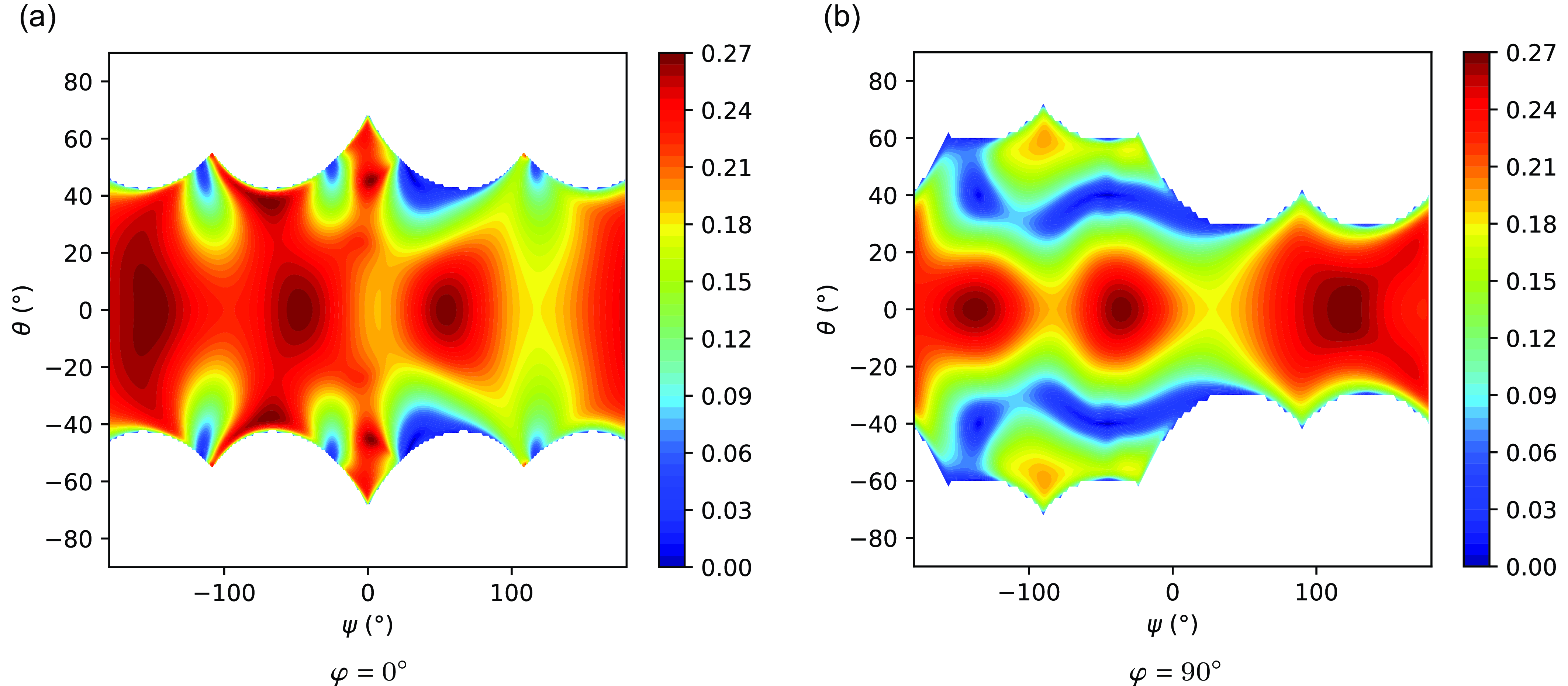
Dexterity distribution for (
 $\alpha$
,
 $\beta$
,
 $\delta$
,
 $\gamma$
)=(
 $50^\circ$
,
 $50^\circ$
,
 $55^\circ$
,
 $15^\circ$
).

When dexterity is equal to zero, the robot is in a singular configuration. For an arbitrary New SPM dimensions defined by (
 $\alpha$
,
 $\beta$
,
 $\delta$
,
 $\gamma$
)=(
 $50^\circ$
,
 $50^\circ$
,
 $55^\circ$
,
 $15^\circ$
), Fig. 4 shows that the dexterity is almost zero at the boundaries of the workspace for
 $\varphi =0^{\circ }$
, and at some points within the workspace for
 $\varphi =90^{\circ }$
, indicating the presence of parallel singularities. Although, as can be seen, the distribution of dexterity in the workspace is good, it is unfortunately low, not exceeding
 $0.27$
.
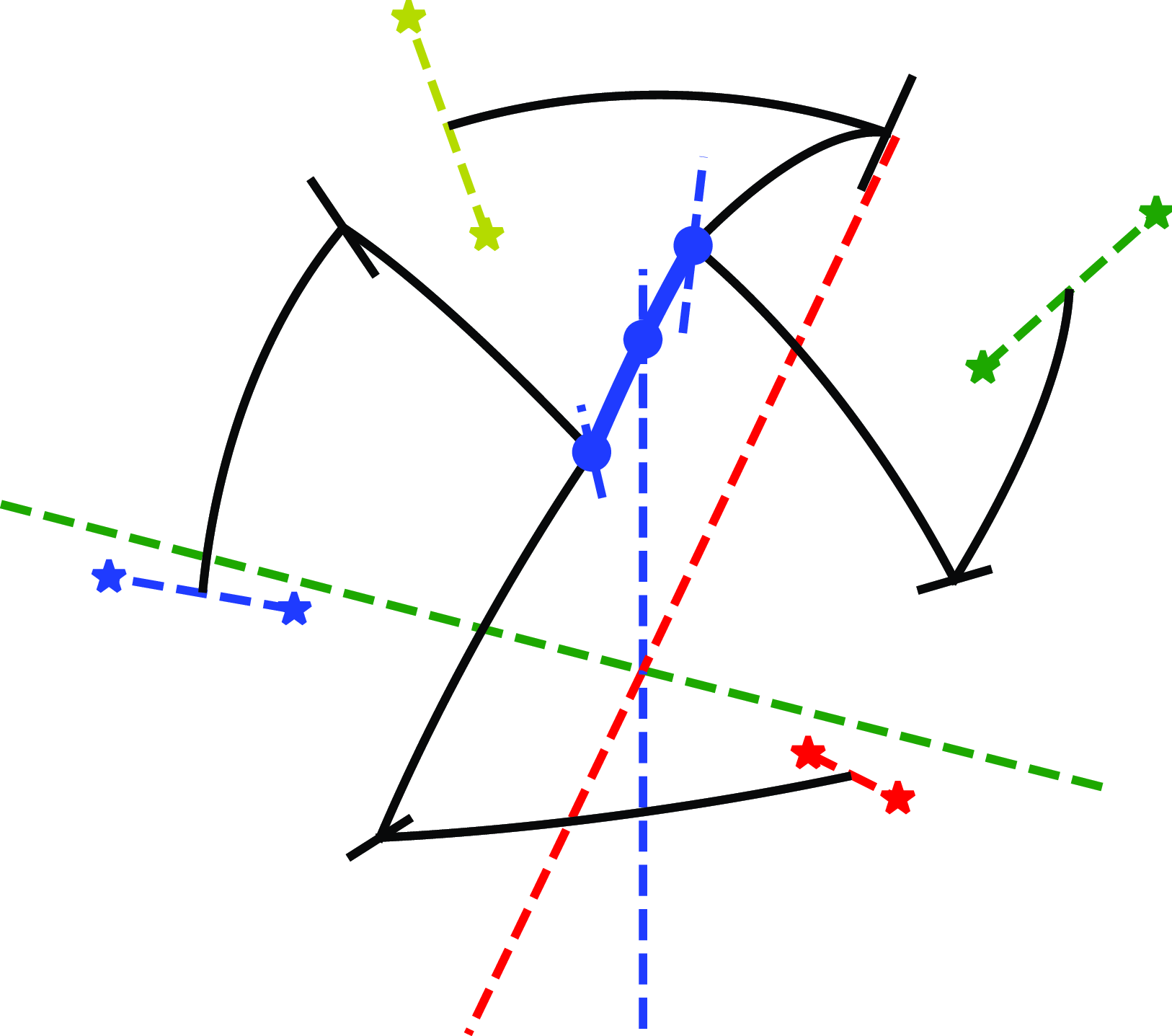
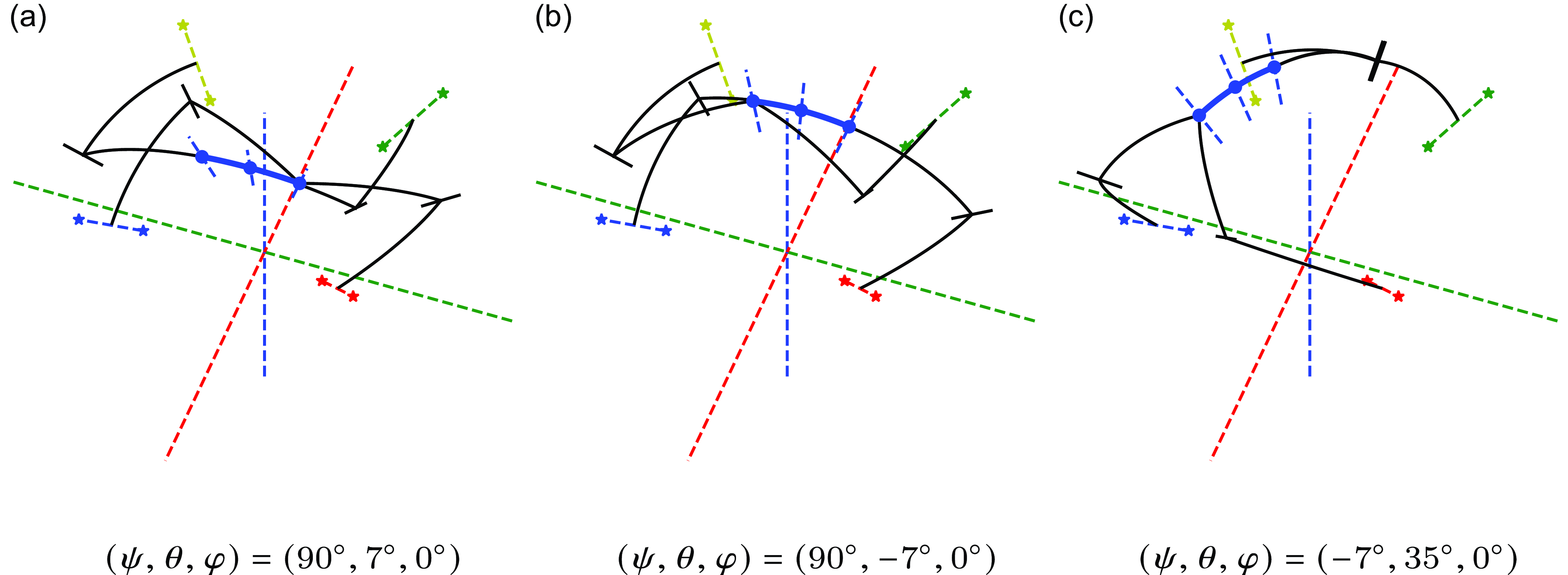
Figure 5 illustrates examples of parallel singularities occurring within the workspace. These singularities appear when the mobile platform and two branches of the same five-bar mechanism are aligned in the same plane. These singular positions are obtained for a New SPM with
 $\alpha _1=\alpha _2=45^{\circ }$
,
 $\beta _1=\beta _2=45^{\circ }$
, and
 $\gamma =10^{\circ }$
. The cases (a) and (b) are in the working mode 7 and the case (c) is in the working mode 3 (see ref. [Reference Lahdiri, Saafi and Mlika24]).
Some examples of singular positions for a New SPM with
 $\alpha _1=\alpha _2=45^{\circ }$
,
 $\beta _1=\beta _2=45^{\circ }$
, and
 $\gamma =10^{\circ }$
.

In the next section, we introduce an optimization approach for the New SPM. The main objective is to improve the dexterity of the New SPM and eliminate the singularities present in its workspace.
4. Optimization of the New SPM
Optimization consists of minimizing an objective function, which depends on parameters and is often subject to some constraints. To select the optimal geometric parameters for the New SPM, we employ optimization through genetic algorithms [Reference Laribi, Essomba, Zeghloul and Poisson27, Reference Enferadi and Nikrooz28]. The genetic algorithm is a stochastic search technique based on natural evolution. The genetic algorithm starts with an initial population of potential solutions (individuals), each representing a candidate solution to a problem. Over successive generations, genetic algorithms evaluate fitness, select individuals for reproduction, apply genetic operators (crossover and mutation), and create new offspring [Reference Katoch, Chauhan and Kumar29, Reference Stan, Manic, Balan and Maties30]. The process continues until an ending criterion is met, resulting in the fittest individual known as the optimal solution. These methods are chosen due to their several advantages, including the simplicity of their mechanisms, ease of application, and efficiency even when dealing with complex problems.
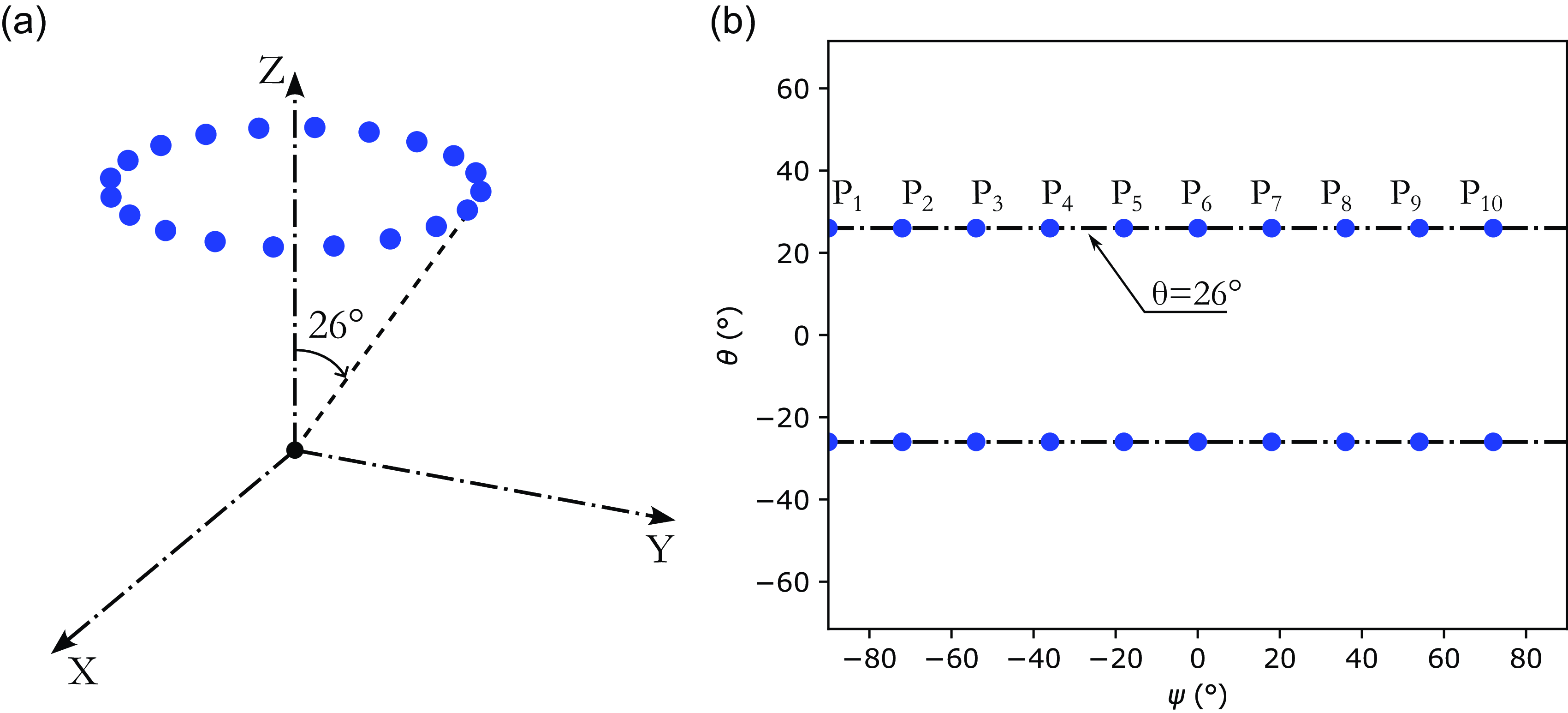
The optimization aims to improve dexterity and cover the desired workspace. We define the desired workspace as a cone with a
 $26^\circ$
apex angle. To make the optimization process easier, we only consider the workspace boundary in this work, as shown in Fig. 6.
The prescribed workspace border (a) in Cartesian space (b) in (
 $\theta$
,
 $\psi$
) plane.

The lower and upper bounds of the geometric parameters for the first optimization.

Structure of New SPM resulting from the first optimization.

Self-rotation distribution of the New SPM resulting from the first optimization.

Dexterity distribution of the New SPM resulting from the first optimization.

4.1. The first optimization
The first optimization aimed to minimize the geometric parameters in order to make the structure more compact, and ensure that the New SPM workspace covers the required workspace. In order to simplify the optimization procedure, a symmetrical structure is considered ( where,
 $\alpha _1=\alpha _2=\alpha$
and
 $\beta _1=\beta _2=\beta$
). We have optimized the geometric parameters defined by the design vector
 $\mathbf{X} = [\alpha, \beta, \gamma ]$
and set
 $\delta =70^{\circ }$
.
The optimization process is formulated as follows:
 \begin{equation*} \begin {aligned} & \underset {X}{\text {minimize}} & & F(\textbf {X})=\sum _{i=1}^3 x_i^2 \\ & \text {Subject to} & & x_i \in [x_{inf},x_{sup}]\\ & & &P_j \in WS(\textbf {X}), j=1..10\\ \end {aligned} \end{equation*}
Where
 $F(\textbf{X})$
represents the objective function, defined as the quadratic sum of the geometric parameters
 $\alpha$
,
 $\beta$
, and
 $\gamma$
. Minimizing
 $F(\textbf{X})$
allows us to optimize the New SPM structure.
 $x_{inf}$
and
 $x_{sup}$
denote the lower and upper boundaries of the geometric parameters, as indicated in Table I.
The lower and upper bounds of the geometric parameters for the second optimization.

Structure of New SPM resulting from the second optimization.

Dexterity distribution of the New SPM resulting from the second optimization.

To guarantee that all points
 $P_j$
are in the workspace of the robot, the following condition is evaluated for each point
 $P_j$
.
 \begin{align} CD(\textbf{X}, P_j)\,:\, \dfrac{C_i^2}{A_i^2+B_i^2} \leq 1 \quad i=1,..,4 \text{ and }j=1\ldots 10 \end{align}
The condition of Eq. (8) is evaluated for six different values of the self-rotation
 $\varphi$
. These values are
 $ \{0^{\circ },60^{\circ },120^{\circ },180^{\circ },240^{\circ },300^{\circ }\}$
.
The genetic algorithm successfully converged to an optimal solution that meets the desired workspace and the constraints. The optimal structure is
 $(\alpha, \beta, \gamma ) = (50^{\circ }, 50^{\circ }, 5^{\circ })$
, which is presented in Fig. 7.
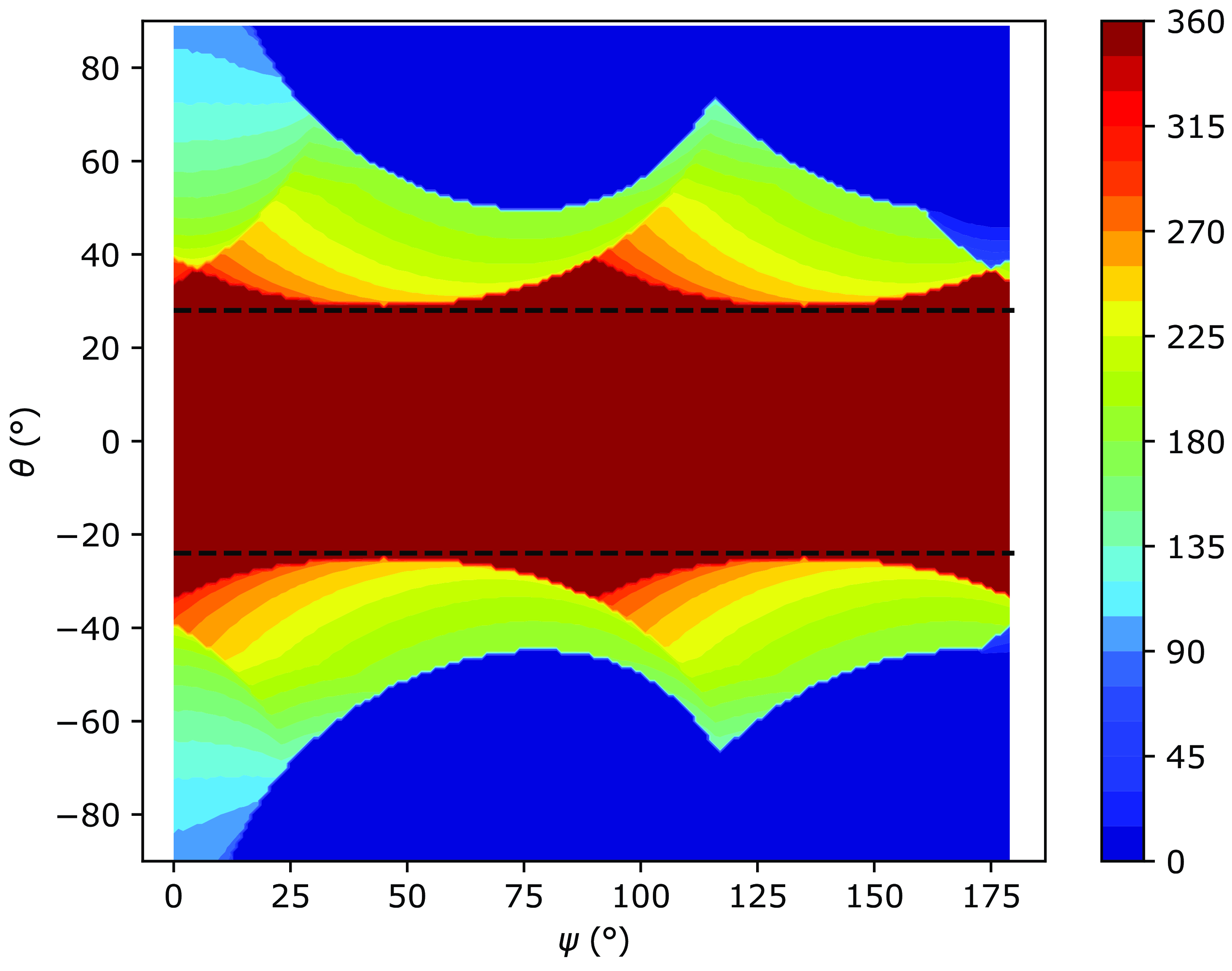
Figure 8 presents the capability of the New SPM to perform an unlimited self-rotation through its workspace. Thus, the optimal structure can achieve an unlimited self-rotation in the prescribed workspace.
The desired workspace is entirely contained within the New SPM workspace as shown in Fig. 9, which implies that the manipulator can achieve all the orientations required for the surgical tasks. However, the maximum dexterity value is below 0.1 for various values of self-rotation angle
 $\varphi$
. This dexterity value is too low and shows the poor precision of the manipulator.
4.2. The second optimization
To enhance the dexterity, we will impose another constraint on the optimization process, related to the condition number such that:
 \begin{align} CD(\textbf{X}, P_j)\,:\, \kappa (\mathbf{J}) \leq \kappa _{\max} \quad j=1\ldots 10 \end{align}
Where
 $\kappa _{\max}$
is the maximum acceptable value for the condition number, which is set to 25 (see, ref. [Reference Saafi, Laribi, Arsicault and Zeghloul31]) during the optimization process.
As the first optimization, a symmetrical structure is considered. In addition, the same objective function is kept, while the lower limit of the angle
 $\gamma$
is slightly modified, as indicated in Table II. This modification was necessary because a value of 5 for
 $\gamma$
is quite minimal and gives a weak dexterity distribution.
Figure 10 presents the new optimal structure of the New SPM, where the optimal values of
 $\alpha$
,
 $\beta$
, and
 $\gamma$
are
 $60^{\circ }$
,
 $60^{\circ }$
, and
 $22.5^{\circ }$
, respectively. We can easily see that the mobile platform angle
 $\gamma$
has increased compared to the first optimization. Consequently, we can say that dexterity depends on the size of the mobile platform.
Figure 11 shows a good distribution of dexterity in the workspace for different values of
 $\varphi$
, ranging from 0.3 to a maximum value of 0.4. This optimization resulted in a significant improvement compared to the result of the first optimization.
As shown in Fig. 12, the manipulator retains the ability to rotate
 $360^{\circ }$
within the prescribed workspace.
Self-rotation distribution of the New SPM resulting from the second optimization.

In the two previous optimizations, the two five-bar mechanisms are considered symmetric. In order to investigate an asymmetric structure, a third optimization is carried-out in the next paragraph.
4.3. The third optimization
The third optimization was applied to an asymmetrical New SPM, where the parameters of the first five-bar are defined by
 $\alpha _1$
and
 $\beta _1$
, while the second mechanism is represented by
 $\alpha _2$
and
 $\beta _2$
. The new design vector is
 $\mathbf{X} = [\alpha _1, \beta _1, \alpha _2, \beta _2, \gamma ]$
.
The lower and upper bounds of the geometric parameters for the third optimization.

Structure of New SPM resulting from the third optimization.

Self-rotation distribution of the New SPM resulting from the third optimization.

Dexterity distribution of the New SPM resulting from the third optimization.

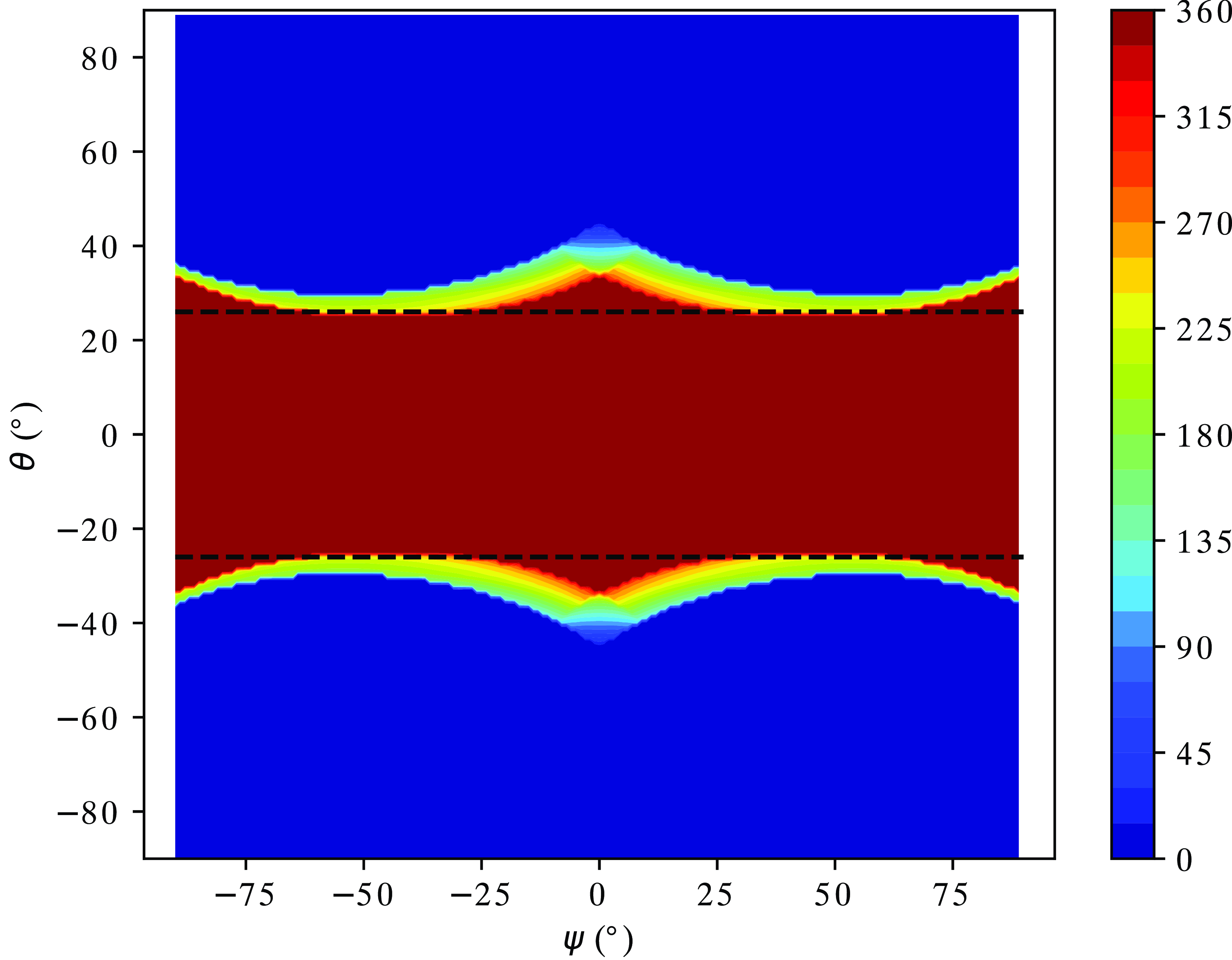
Self-rotation capability in (
 ${}^\circ$
) of classical spherical parallel manipulator.

The same criteria were used as in the second optimization and the objective function is formulated as follows:
 \begin{equation*} \begin {aligned} & \underset {X}{\text {minimize}} & & F(\textbf {X})=\sum _{i=1}^5 x_i^2 \\ & \text {Subject to} & & x_i \in [x_{inf},x_{sup}]\\ & & &P_j \in WS(\textbf {X}), j=1..10\\ & & &\kappa (\mathbf {J}) \leq \kappa _{max} \quad j=1\ldots 10 \\ \end {aligned} \end{equation*}
The boundaries values
 $x_{inf}$
and
 $x_{sup}$
are defined in Table III.
This New SPM optimization leads to the following vector of the design parameters :
 \begin{align*} \mathbf{X}_{op} = [\alpha _1, \beta _1, \alpha _2, \beta _2, \gamma ]=[60^{\circ }, 60^{\circ },62^{\circ },62^{\circ },25^{\circ }] \end{align*}
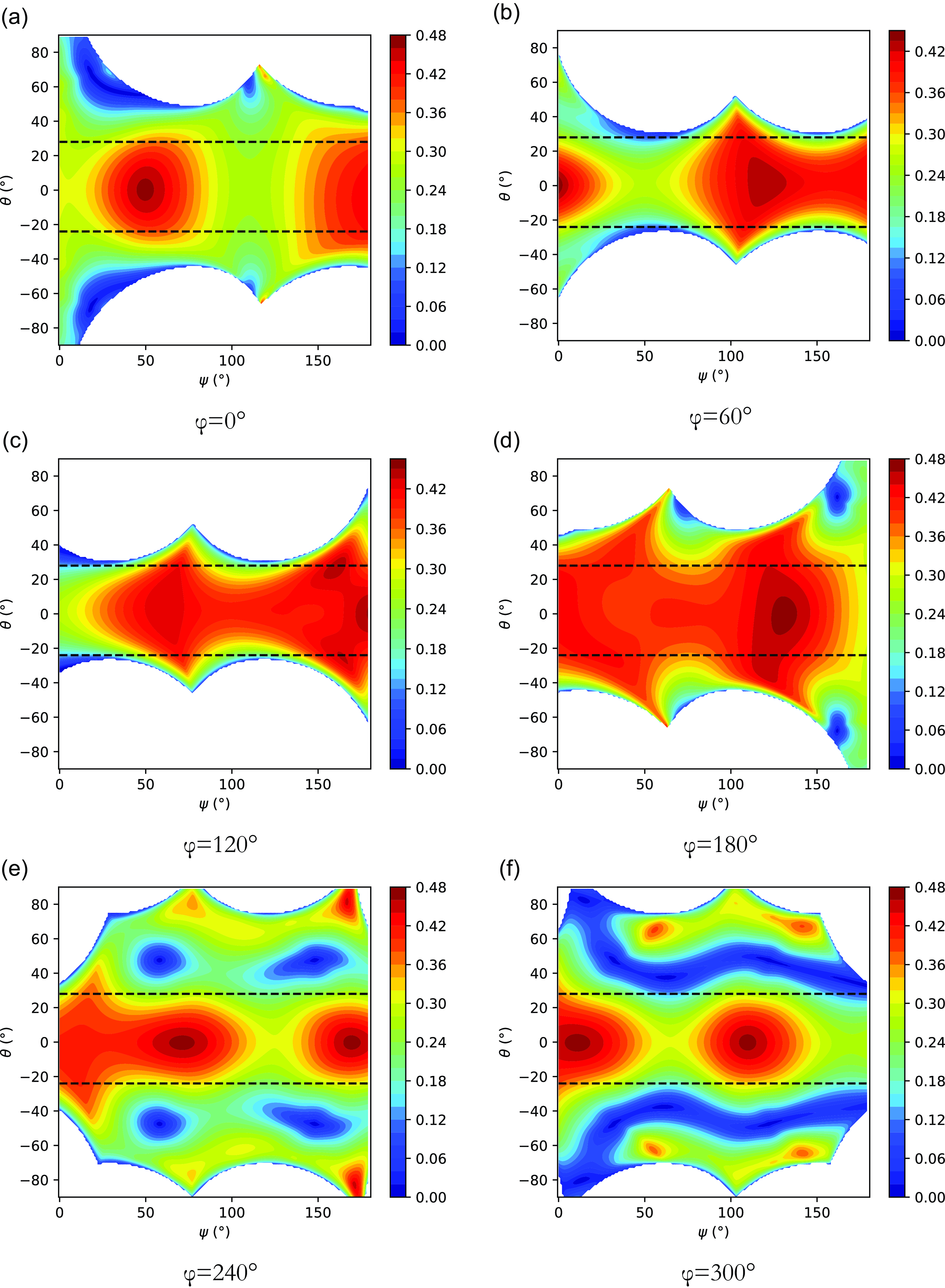
Figure 13 presents the optimal structure of the asymmetrical New SPM.
As shown in Fig. 14, the manipulator retains the ability to rotate
 $360^{\circ }$
within the prescribed workspace. Due to the asymmetrical structure, the workspace distribution is slightly shifted, that is, it is not symmetrical with respect to zero.
This manipulator ensures a significantly improved distribution of dexterity across the workspace, with a higher maximum value than the previous optimization. Consequently, we achieve a reasonable dexterity distribution in the workspace, ranging from 0.3 to a maximum value of approximately 0.5. A good distribution of dexterity of the optimized manipulator is presented for different values of the self-rotation angle as shown in Fig. 15. It can be stated that dexterity is better in an asymmetrical system than in a symmetrical one. Indeed, the asymmetrical structure involves five parameters instead of three. The resulting values provide two different sets of
 $\alpha _1$
,
 $\beta _1$
and
 $\alpha _2$
,
 $\beta _2$
, which leads to a better dexterity while maintaining the system’s compactness.
For all the optimized structures obtained, we have always preserved the ability of the robot to perform unlimited self-rotation within the prescribed workspace.
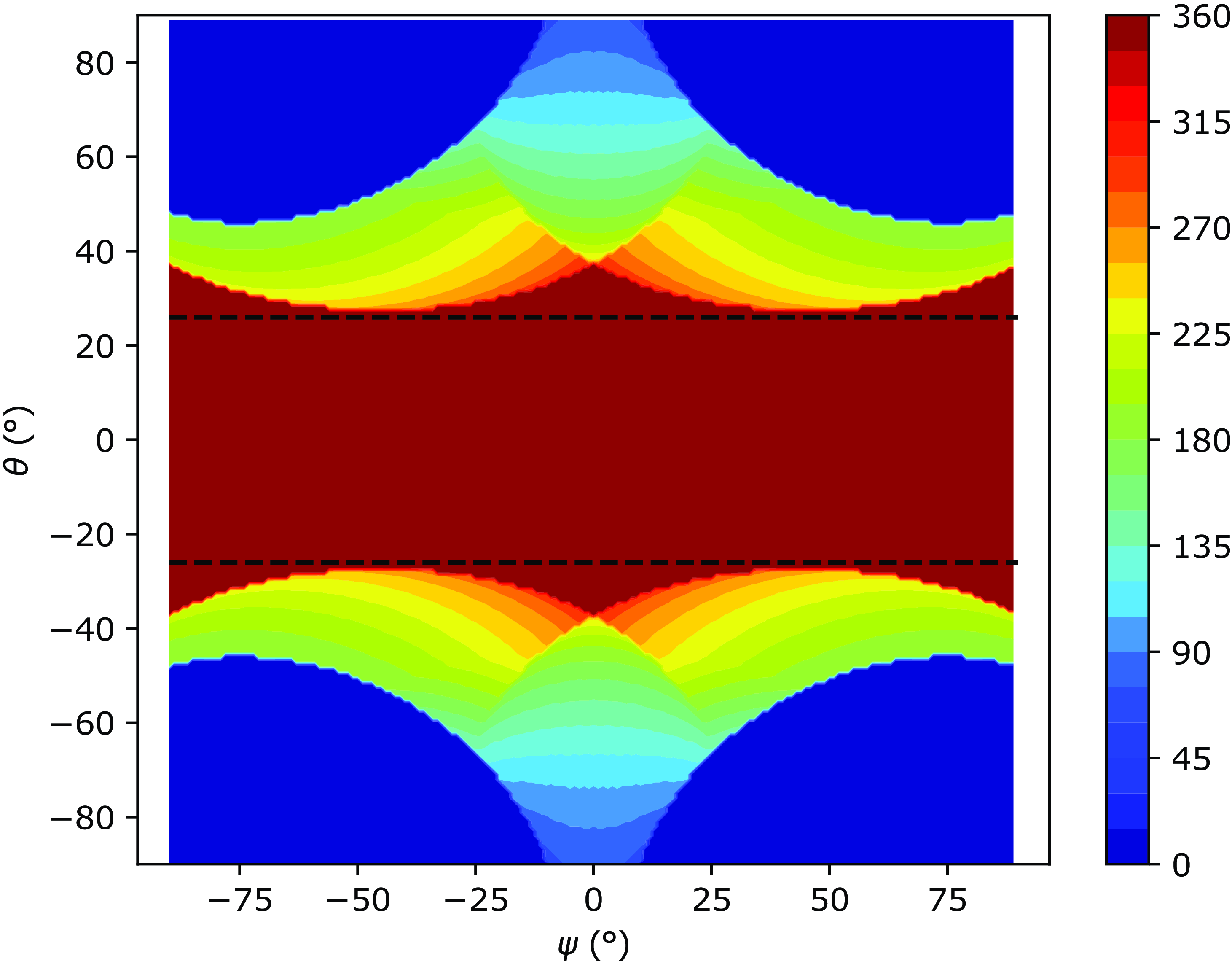
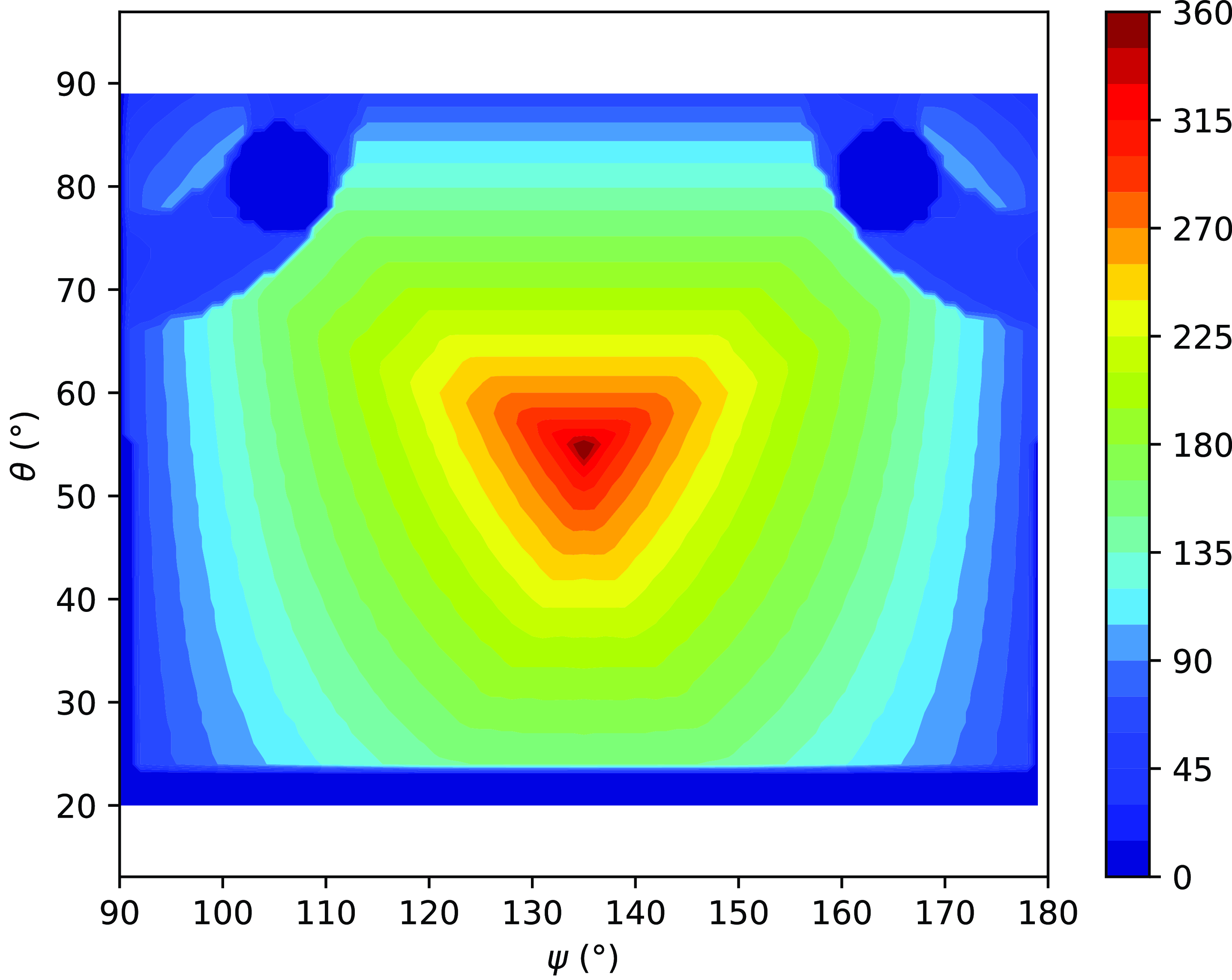
As shown in Fig. 16, the self-rotation capability of the classical SPM [Reference Chaker, Mlika, Laribi, Romdhane and Zeghloul1] is highly limited. This approves the advantage of the proposed new parallel spherical manipulator over the classical SPM in terms of self-rotation.
As shown in the three optimizations, the dexterity depends on the size of the moving platform defined by the angle
 $\gamma$
. When increasing
 $\gamma$
, the dexterity index increases. In this work, an optimal structure is obtained by defining an optimization procedure. This structure has an acceptable dexterity distribution with a singular-free useful workspace. In addition, an unlimited self-rotation capability is guaranteed in this useful workspace.
In ref. [Reference Lahdiri, Saafi, Mlika and Laribi32], the forward kinematic model (FKM) is studied. The FKM of the proposed structure has a simple close-form solution. This is one of the advantages of the proposed kinematic. Future work will focus on the haptic control model of this redundant structure.
5. Conclusion
In this paper, a new redundant spherical parallel manipulator, called New SPM, has been developed. The New SPM consists of two five-bar mechanisms linked by a moving platform and provides three degrees of freedom. This new architecture offers unlimited self-rotation capability compared with the classical SPM. This work is aimed to improve the dexterity of the New SPM by applying three optimization procedures based on the genetic algorithm method. The first and the second optimizations were carried-out on a symmetric structure, while the third one was applied to an asymmetric structure. The first optimization resulted in a compact structure, while the second optimization of the New SPM resulted in a notable improvement of the dexterity, which reached a value of 0.4. Finally, the third optimization of the asymmetrical structure resulted in a compact spherical parallel manipulator architecture while ensuring good dexterity with a maximum value of 0.48. In all three optimizations, an unlimited self-rotation capability is guaranteed in the useful workspace. In future work, a prototype will be made and experimentally validated. In addition, the proposed kinematics will be evaluated for tele-ultrasound application.
Author contributions
CL and HS conceived and designed the study. CL wrote the original draft. HS, AM, and MAL reviewed and edited the final manuscript. HS, AM, and MAL supervised the work.
Financial support
This research received no specific grant from any funding agency, commercial, or not-for-profit sectors.
Competing interest
The authors declare no conflicts of interest exist.
Ethical approval
Not applicable.