Background
Lumens of vascular catheters require hydraulic locking between uses to prevent air emboli from entering the bloodstream. The most common antithrombogenic lock solution to inhibit clot formation is heparin saline. Heparin acts by inhibiting thrombin activation thereby preventing fibrin formation. While heparin is effective in preventing catheter clotting, serious adverse drug effects have been encountered. One significant issue is immune-mediated heparin-induced thrombocytopenia and heparin has also been shown to stimulate biofilm formation of Staphylococcus and Candida spp in a dose-dependent manner.Reference Shanks, Sargent, Martinez, Graber and O’Toole1–Reference Shanks, Donegan and Graber3 Chelator-based lock solutions provide alternative antithrombogenic catheter locks avoiding the use of heparin.
Widespread adoption of safety bundles for reducing catheter infections have been effective in reducing contamination of external catheter surfaces with commensal skin organisms.Reference Pronovost, Needham and Berenholtz4, Reference Pronovost, Goeschel and Colantuoni5 Catheter lumens, however, remain vulnerable to contamination and can be sources of catheter-bloodstream infections.Reference Raad, Costerton, Sabharwal, Sacilowski, Anaissie and Bodey6–Reference Mermel9 Antimicrobial catheters with luminal antimicrobial surface treatments also help protect catheter luminal surfaces from microbial colonization but have important limitations such as the duration of their antimicrobial activity diminishing while the catheter is still in use.Reference Viola, Rosenblatt and Raad10 Catheter lock solutions with added antimicrobial agents present a durable bulwark that protects against luminally sourced infection because the lock solution can be replenished whenever lumens are accessed.
Chelators
Definition, types of chelators, and anticoagulant activity of chelators
Chelators can be defined as ligands that bind metal ions or molecules at 2 or more sites in the same ligand molecule.Reference McNaught and Wilkinson11 Chelators have been used intravenously to treat metal ion poisoning (eg, lead, iron, or hypercalcemia). Calcium is critical to clot formation through the extrinsic pathway by mediating binding between tissue factor and factor VII.Reference Davie, Fujikawa and Kisiel12 Citrate and EDTA are the most popular chelators used in catheter locks. They bind calcium and inhibit blood from clotting.
Antimicrobial/biofilm disrupting activities of chelators
Metal ions serve critical structural roles in stabilizing the extracellular matrix of microbial biofilms.Reference Flemming, Wingender, Griebe and Mayer13, Reference Flemming, Wingender, Szewzyk, Steinberg, Rice and Kjelleberg14 Furthermore, key microbial metabolic enzymes require metal ions to function properly.Reference Ma, Jacobsen and Giedroc15 Chelators can exhibit antimicrobial activity by depriving microbes of these essential metal ions, such as iron, cobalt, manganese, nickel, copper, and zinc.Reference Ma, Jacobsen and Giedroc15
Chelators used in catheter-lock solutions
Different chelators have been studied for use in catheter lock solutions. The use of citrate and ethylene diamine tetra-acetic acid (EDTA)–based antimicrobial lock solutions has been used most commonly. Others that have been assessed include n-acetyl cysteine and antibiotics with chelating propertiesReference Aslam, Trautner, Ramanathan and Darouiche16 including tetracyclinesReference Raad, Hanna and Jiang17, Reference Estes, Theusch, Beck, Pitrak and Mullane18 and quinolones.Reference Passerini de Rossi, Feldman, Pineda, Vay and Franco19 Chemical properties of EDTA and Citrate-based chelators, as well as studies utilizing them in catheter lock solutions for the prevention and treatment of catheter-related bloodstream infections (CRBSI), are summarized in the following sections.
EDTA-based catheter lock solutions
Each molecule of EDTA presents 6 cationic binding sites.Reference Harris20 The molecular geometry provides binding for cobalt, iron, nickel, copper, zinc, and other metal ions. Disodium EDTA, which has a pH in the normal blood range, binds calcium, is well suited to be a component of an antimicrobial catheter lock solution. Ionized EDTA first performs its antimicrobial inhibitory functions, and subsequently, the residual EDTA binds calcium and performs its anticoagulant function. Significant doses of EDTA can cause hypocalcemia and other severe toxicities.Reference Brown, Willis, Omalu and Leiker21, Reference Meltzer, Kitchell and Palmon22 In the Trial to Access Chelation Therapy, 1,708 patients with prior history of myocardial infarction were randomized to receive 40 infusions of a 500-mL high-dose chelation solution that included 3 g of disodium EDTA versus placebo for the reduction of cardiovascular events.Reference Lamas, Goertz and Boineau23 A total of 52 chelation patients (6.2%) and 30 placebo patients (3.5%) developed asymptomatic hypocalcemia (P = .008); only 1 patient developed hypocalcemia and muscle cramping. The presence of EDTA at safer, submicrobicidal or subinhibitory concentrations, or the presence of partially protonated EDTA (eg, the diacidic, disodium EDTA salt) although not fully microbicidal, can still provide anticoagulant activity and can synergistically impair biofilm and microbial function in combination with other potent antimicrobial agents.Reference Raad, Fang, Keutgen, Jiang, Sherertz and Hachem24, Reference Raad, Hachem and Hanna25 Several antimicrobial lock solution combinations have taken advantage of this synergy potential and have combined potent antibiotics with disodium EDTA.
More potent, fully deprotonated tetrasodium EDTA has also been studied as a combined single-agent anticoagulant-antimicrobial lock solution. At concentrations of 4%, it has antimicrobial effects, and it has been able to eradicate in vitro biofilms of Staphylococcus epidermidis, Pseudomonas aeruginosa, Escherichia coli, and Klebsiella pneumoniae following 21 hours of exposure.Reference Percival, Kite and Eastwood26, Reference Kite, Eastwood, Sugden and Percival27 Several antibiotic EDTA combination catheter lock solutions have been studied. Minocycline-EDTA (M-EDTA) has demonstrated in vitro activity against S.epidermis, S. aureus, and CA: Candida albicans biofilms with exposures of 24 hours.Reference Raad, Chatzinikolaou and Chaiban28 However, we have found that in many cases, it is not possible to reliably remove lumens from service for >2 hours for disinfection by locking. Therefore, low concentrations of ethanol (25%) were added to M-EDTA catheter lock solutions to accelerate disinfection of catheter surfaces. This lock solution demonstrated the ability to rapidly (within 2 hours) eradicate biofilms of MRSA, vancomycin-resistant Enterococcus faecium (VRE), P. aeruginosa, Acinetobacter baumanni, and Candida spp, while prescribing an ethanol concentration below the 60% threshold to avoid mechanical damage to the integrity of the catheter polymer, and below the 28% threshold reported to cause protein precipitation in blood.Reference Raad, Rosenblatt, Reitzel, Jiang, Dvorak and Hachem29
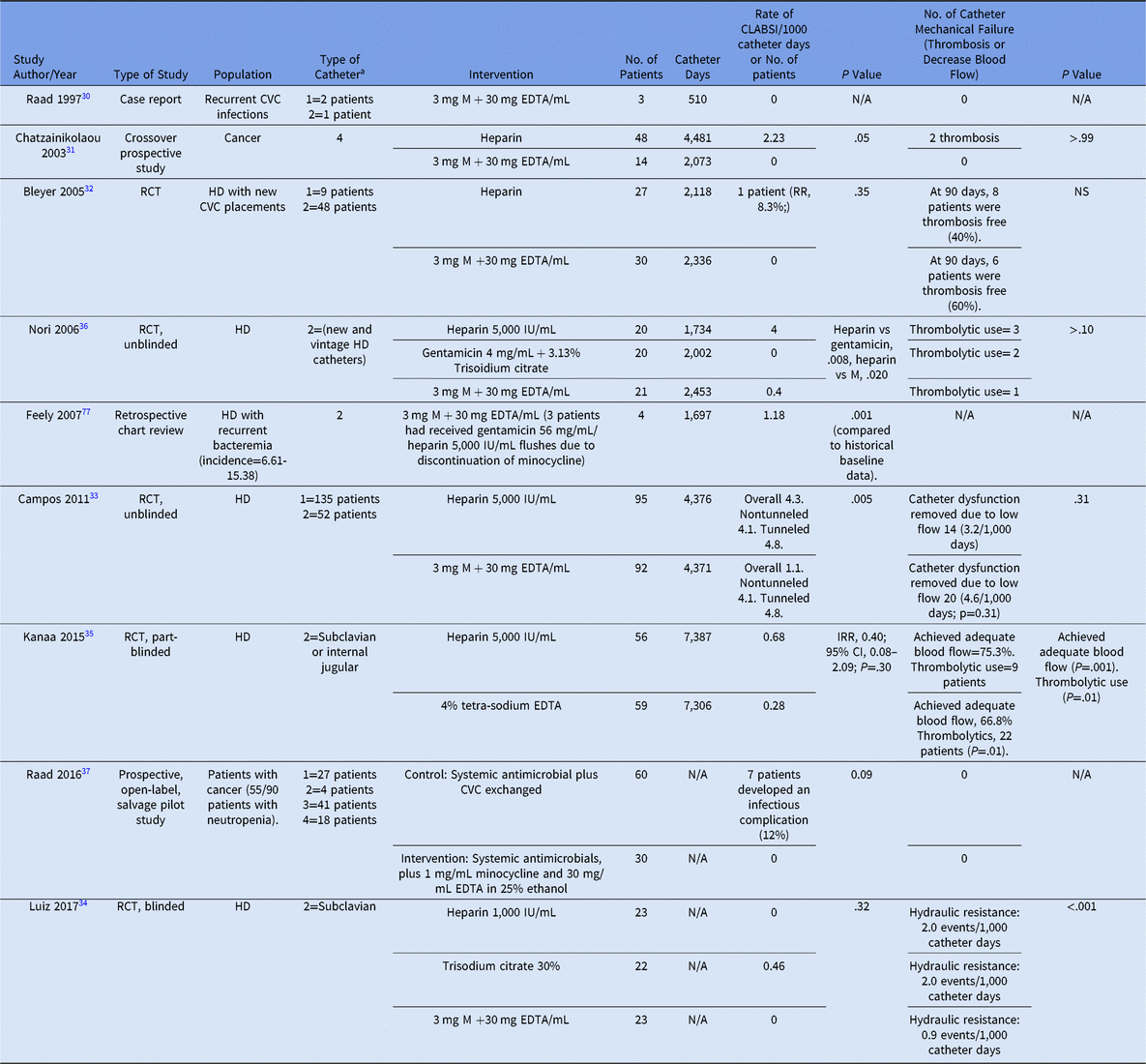
The first successful use of the M-EDTA lock solution (Table 1) for the prevention of central venous catheter (CVC)–related infections has been reported in 3 patients with recurrent bloodstream infections.Reference Raad, Buzaid and Rhyne30 A cumulative of 40 CVC-related infections occurred in these 3 patients during the pre–M-EDTA lock follow-up period of 76 months, while the infection rate decreased to zero in the subsequent 17 months of the M-EDTA intervention period (P = .01). Subsequently, Chatzinkolau et alReference Chatzinikolaou, Zipf and Hanna31 developed a prospective crossover study in which 48 pediatric control patients with cancer who received heparin flushes were compared to 14 children who received M-EDTA lock solutions. All patients were followed for 6 months and had an implantable venous-access port systems. The M-EDTA group had more predisposing risk factors for infection compared to the heparin group: higher rate of hematological malignancies (P = .05), longer duration of neutropenic (P = .03) and longer duration of catheter placement (P = .001). None of the patients in the M-EDTA group had any complications, whereas 10 infectious episodes occurred in the heparin group (2.23 infections per 1,000 catheter days).
EDTA Chelator-Based Antimicrobial Catheter Lock Solutions for the Prevention or Treatment of Catheter-Related Infections

Note. EDTA, ethylene diamine tetraacetic acid; CLABSI, central-line–associated bloodstream infection; CVC, central venous cathether; HD, hemodialysis; RR, rate ratio; IRR, incidence rate ratio; M, Minocycline; N/A, not applicable; NS, nonsignificant.
a 1, nontunneled; 2, tunneled; 3, peripherally inserted central catheters; 4, port.
Bleyer et alReference Bleyer, Mason, Russell, Raad and Sherertz32 performed the first ramdomized controlled trial (RCT), comparing 27 patients to receive heparin versus 30 patients to receive M-EDTA lock solution. At 90 days, the rate of newly placed catheter survival for hemodialysis was higher in the M-EDTA compared to the heparin group (P = .07), mainly due to thrombosis. Only 1 patient belonging to the heparin group developed a CVC-related infection with Entrobacter aerogenes. Although ≤52% of the patients had a surveillance blood culture or CVC culture at the time of removal, the rate of catheter colonization was much higher in the heparin group, with 9 of 14 cultured catheters being colonized versus only 1 of 11 catheters in the M-EDTA group (P = .005). Campos et alReference Campos33 proceeded with another unblinded RCT in which 95 hemodialysis tunneled or nontunneled catheters locked with heparin was compared to 92 catheters locked with M-EDTA. The CRBSI rates were 4.3 per 1,000 catheter days in the heparin group (19 cases) and 1.1 per 1,000 catheter days in the M-EDTA group (5 cases; P = .005). That is, the 90-day CRBSI-free survival was 91.3% in the M-EDTA group and 69.3% in the heparin group.
Subsequently, João Luiz et alReference Luiz, Scavone and Tzanno34 led a double-blinded RCT comparing heparin, trisodium citrate 30%, and M-EDTA locks. All included 68 patients on hemodialysis, had less hydraulic resistance while on the M-EDTA locks (0.9 events per 1,000 catheter days), than the trisodium citrate (2.0 events per 1,000 catheter days), or with the heparin locks (9.2 events per 1,000 catheter days; P = .001). Except for 1 case of CRBSI in the trisodium citrate group, no other bloodstream events or adverse reactions occurred. Notably, Kanaa et alReference Kanaa, Wright, Akbani, Laboi, Bhandari and Sandoe35 compared the sole use of heparin versus EDTA lock solutions in a population undergoing hemodialysis. This RCT revealed a significant improvement in the catheter colonization rate from 0.14 per 1,000 catheter days in the EDTA group to 1.08 per 1,000 catheter days in the heparin group (IRR, 0.13; 95% CI, 0.003–0.94; P = .02). The CRBSI rate was relatively similar with a 0.28 incidence rate in the EDTA group, and 0.68 in the heparin group (P = .30). Thereafter, Nori et al,Reference Nori, Manoharan, Yee and Besarab36 compared in an open label, RCT, the use of heparin, M-EDTA, and gentamicin plus trisodium citrate antimicrobial lock solutions. The demographics of patients requiring tunneled hemodialysis catheters and thrombolytics were similar (P > .10); however, the rate of CRBSI was higher in the heparin group than the other 2 groups, which were similar: 4, 0.4, and 0 episodes per 1,000 catheter days, respectively.
Raad et alReference Raad, Chaftari and Zakhour37 developed the first therapeutic pilot trial utilizing systemic antimicrobials plus M-EDTA in 25% ethanol lock solution, administered for only 2 hours, for the salvage of infected CVCs. In total, 30 enrolled patients were compared to a historical well-matched control group of 60 patients treated with systemic antimicrobials plus CVC removal. Although the antimicrobial lock group (median, 11 days) received a shorter duration of appropriate systemic antimicrobial therapy than the control group (median, 16 days; P = .0001), and the time between onset of bacteremia and starting intervention (catheter removal [median, 2 days] vs lock therapy [median, 4 days]) was significantly different (P = .0002), the rate of infectious and mechanical complications favored the antimicrobial lock group (0 vs 18%; P = .014).
Citrate-based catheter lock solutions
Citrate is naturally present in human blood at levels of ~0.1 mM.Reference Martin38 Like EDTA, citrate has the ability to chelate a range of metal ions including calcium, iron, magnesium, nickel, cobalt, and zinc.Reference Martin38–Reference Glusker40 Citrate has been reported to form both bidentate chelation complexes (with iron, nickel, and zinc ions) and tridentate chelation complexes (with cadmium and copper ions).Reference Joshi-Tope and Francis41 At a concentration of 4%, it sequesters the calcium ions needed to activate clotting. Citrate binds calcium more weakly than EDTA (pK, 3.3)Reference Meyer42 and binds iron more strongly than it binds calcium (pK, 7.7) but more weakly than EDTA binds iron.Reference Lanford and Quinan43 Citrate has concentration-dependent antimicrobial activity. At a concentration >0.5%, citrate has been reported to inhibit staphylococcal biofilm formation; however, at concentrations <0.5%, it has been reported to stimulate SA biofilm formation.Reference Shanks, Sargent, Martinez, Graber and O’Toole1 A concentration of 4% sodium citrate is able to fulfill the anticoagulant function of a catheter lock solution, but it requires concentrations >15% to be able to also provide antimicrobial activity.Reference Weijmer, Debets-Ossenkopp, Van De Vondervoort and ter Wee44
Catheter lock solutions comprising citrate have been widely studied with concentrations up to 46%.Reference Luiz, Scavone and Tzanno34, Reference Hermite, Quenot and Nadji45–Reference Weijmer, van den Dorpel and Van de Ven50 Antibiotics that have been tested in combination with citrate as catheter lock solutions include gentamicin, ciprofloxacin, tobramycin, vancomycin, and telavancin.Reference Nori, Manoharan, Yee and Besarab36, Reference Moran, Sun, Khababa, Pedan, Doss and Schiller51–Reference Justo and Bookstaver55 Citrate has also been combined with other nonantibiotic antimicrobial agents in catheter lock solutions including ethanol, ethanol and glyceryl trinitrate, taurolidine, and methylene blue plus methyl and propyl parabens.Reference Filiopoulos, Hadjiyannakos and Koutis52, Reference Klek, Szczepanek, Hermanowicz and Galas56–Reference Takla, Zelenitsky and Vercaigne68
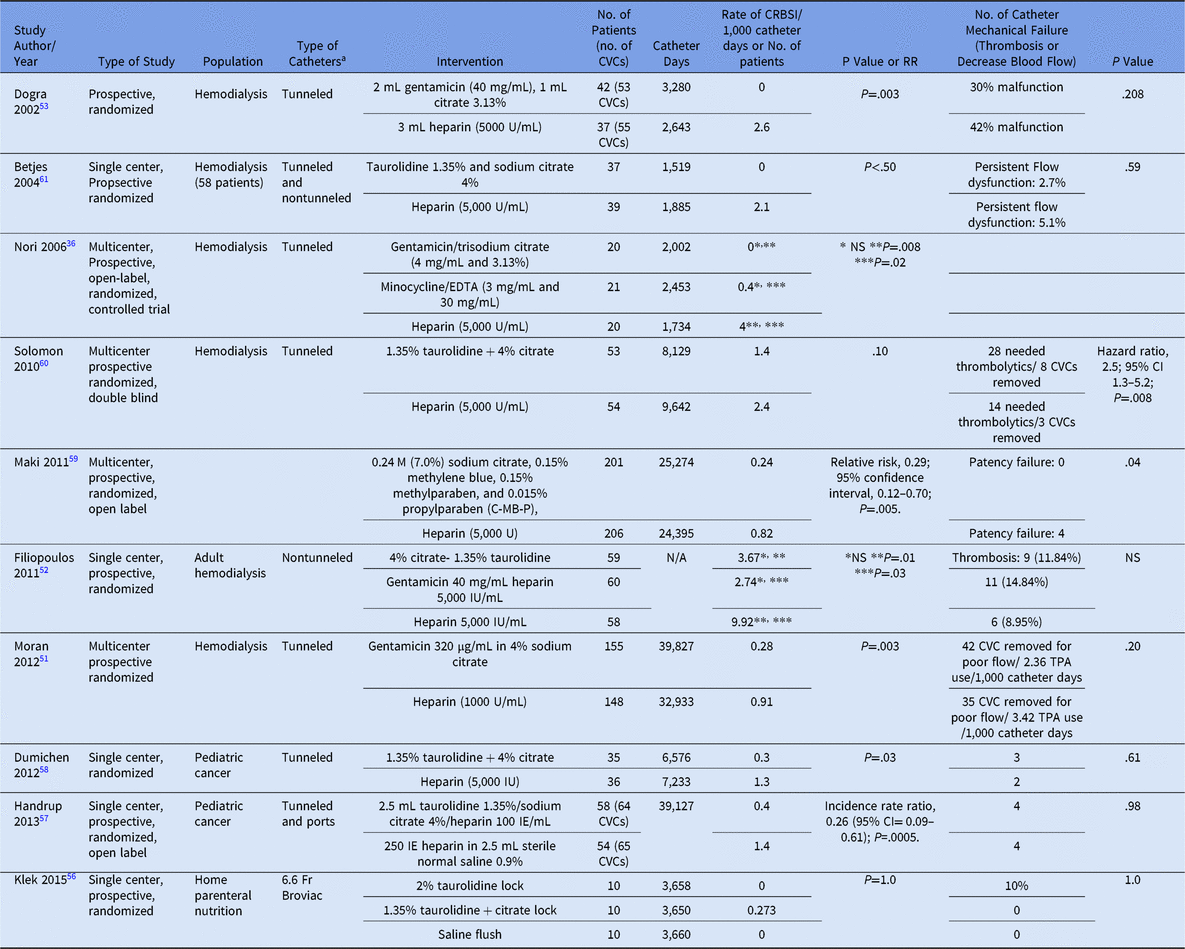
The literature search on clinical trials using citrate-based catheter lock solution revealed a total of 79 studies, of which 21 consisted of clinical trials with 17 randomized studies. Several prospective RCTs comparing citrate containing lock solutions in combination with antimicrobials to either heparin or saline locks are summarized in Table 2. We only included studies that reported the incidence of CRBSI with a clear definition of the infection.
Citrate Chelator-Based (up to 7%) Antimicrobial Catheter Lock Solutions for the Prevention of Catheter-Related Infections

Note. EDTA, ethylene diamine tetraacetic acid; CI, confidence interval; CRBSI, catheter-related bloodstream infection; CVC, central venous cathether; NA, not available; NS, not significant.
a 1, nontunneled; 2, tunneled; 3, peripherally inserted central catheter; 4, port.
Several concentrations of citrate have been used as a component of lock solutions. The use of high citrate concentrations (up to 30%–46.7%) have been used with promising results.Reference Luiz, Scavone and Tzanno34, Reference Hermite, Quenot and Nadji45–Reference Weijmer, van den Dorpel and Van de Ven50 A multicenter, double-blind, RCT comparing high citrate concentration (30%) to heparin (5,000 IU/mL) in the Netherlands and Belgium showed that citrate may reduce the risk of catheter-related infections by 75%, may prevent premature CVC removal, and may decrease the risk of heparin-related bleeding complications.Reference Weijmer, van den Dorpel and Van de Ven50 Another double-blinded RCT in Brazil comparing heparin 1,000 IU/mL to trisodium citrate 30% or minocycline 3 mg/mL in EDTA 30 mg/mL showed that citrate and EDTA were safe and effective for catheter patency compared to heparin.Reference Luiz, Scavone and Tzanno34 Similarly, there was less catheter malfunction when hemodialyis CVC were locked with high concentrations of citrate (46.7%) compared to saline.Reference Hermite, Quenot and Nadji45 In contrast, Power et alReference Power, Duncan and Singh47 showed a significant higher rate of catheter thrombosis with the use of 46.7% citrate compared to heparin 5,000 IU/mL (8 per 1,000 catheter days vs 4.3 per 1,000 catheter days; P < .0001).Reference Power, Duncan and Singh47 The most commonly reported adverse events with the use of high concentrations of citrate include metallic taste during lock instillation.Reference Correa Barcellos, Pereira Nunes and Jorge Valle46, Reference Power, Duncan and Singh47, Reference Weijmer, van den Dorpel and Van de Ven50 as well as facial and peripheral paresthesia.Reference Power, Duncan and Singh47, Reference Weijmer, van den Dorpel and Van de Ven50 High concentration of citrate may cause fatal heart rhythm disruption, seizures, or bleeding due to hypocalcemia. Sodium citrate in a concentration of 46.7% has been related to unexpected death, which led the US Food and Drug Administration (FDA) to mandate the recall of the high 46.7% concentration of citrate from the market.69
Citrate in 4% solution is safe and available in the United States; it is noninferior to heparin 10,000 IU/mL in maintaining catheter patency.Reference Grudzinski, Quinan, Kwok and Pierratos70 Citrate 4%, when used in combination with taurolidine, decreases the rate of catheter-related infections in hemodialysisReference Solomon, Cheesbrough and Ebah60–Reference Allon62, Reference Murray, Deighan, Geddes and Thomson64 as well as in cancer patients.Reference Handrup, Moller and Schroder57, Reference Dumichen, Seeger and Lode58 Few studies have reported an increase in the rate of catheter dysfunction and an increase in the rate of thrombolytic use to maintain CVC patency when citrate is used in combination with taurolidine.Reference Solomon, Cheesbrough and Ebah60, Reference Allon62
Citrate in combination with low-dose gentamicin was shown to be safe and effective for the prevention of CRI in hemodialysis patients.Reference Nori, Manoharan, Yee and Besarab36, Reference Moran, Sun, Khababa, Pedan, Doss and Schiller51, Reference Dogra, Herson and Hutchison53 However, concerns exist for the emergence of antimicrobial resistance with the prolonged use of antimicrobials.Reference Landry, Braden, Gobeille, Haessler, Vaidya and Sweet71, Reference Abbas, Haloob and Taylor72 A nonantibiotic lock solution containing sodium citrate 0.24 M (7.0%) in combination with methylene blue 0.15%, methylparaben 0.15%, and propylparaben 0.015% (C-MB-P) was also shown to be safe in hemodialysis patients. It had similar intraluminal thrombosis prevention and significantly decreased the risk of CRI compared with heparin.Reference Maki, Ash, Winger and Lavin59
A novel, nonantibiotic, nonheparin, lock consisting of 15 or 30 μg/mL of nitroglycerin in combination with 4% sodium citrate and 22% ethanol was used in 60 patients with hematologic malignancies who had peripherally inserted central catheters (PICCs) and showed promising results for the prevention of CRBSI. This lock solution was flushed after 2 hours and was well tolerated. No serious related adverse events or episodes of hypotension was reported. Two patients experienced mild possibly related adverse events (1 headache and 1 rash) that were both transient and reversible.Reference Chaftari, Hachem and Szvalb73
Furthermore, several systematic review and meta-analysis of prospective RCTs found a significant reduction in the rate of CRBSI. A meta-analysis showed that prophylactic use of antimicrobial lock solutions led to a significant reduction in the rate of CRBSI (69%) compared to heparin.Reference Zacharioudakis, Zervou, Arvanitis, Ziakas, Mermel and Mylonakis74 Another meta-analysis of RCTs showed that the combination of citrate with antimicrobials in a lock solution was superior to heparin for the prevention of CRBSI, whereas citrate alone was similar to heparin.Reference Zhao, Li and Zhang75 The same study showed that citrate used in small (1.04%–4%) and moderate concentrations (4.6%–7%) was superior to heparin for CRBSI prevention whereas higher citrate concentration (30%–46.7%) was not.Reference Zhao, Li and Zhang75
Although the use of these lock solutions seems to be promising for the prevention of CRBSI, studies have shown conflicting results for catheter dysfunction and catheter patency.Reference Power, Duncan and Singh47, Reference Allon62, Reference Chapla, Oza-Gajera, Yevzlin, Shin, Astor and Chan76 In a prospective nonrandomized study in hemodialysis patients, the rate of catheter-related bacteremia decreased from 5.7 per 1,000 catheter days with heparin to 0.59 per 1,000 catheter days with a catheter lock solution containing 1.35% taurolidine with 4% citrate. However, the catheter patency decreased from 76% to 32% (P > .001).Reference Allon62
Other chelator-based catheter lock solutions, such as n-acetylcysteine and chelating antibiotics (tigecycline, quinolone), have been used in combination for their synergistic activity in biofilms with limited safety and efficacy results.Reference Aslam, Trautner, Ramanathan and Darouiche16 Therefore, given the heterogeneity across the studies regarding the patient population (patients characteristics), the selection of the drug, the specific drug combination, the dose, the duration, and the type of catheter, there is a need to conduct more uniformly designed, large, prospective RCTs to draw robust evidence-based conclusions.
In conclusion, antimicrobial catheter lock solutions are expected to play an increasingly significant role in combatting luminally sourced CRBSIs, and they are expected to continue to be actively tested in clinical settings. Chelators have emerged as a valuable component of antimicrobial catheter lock solutions because of their dual benefits of anticoagulation as well as biofilm disruption and antimicrobial activity. Additionally, chelators can potentiate antimicrobial activity of other antimicrobial agents in catheter lock solutions by stressing microbes through deprivation of key metal ions. As a result of these properties, as well as their record of safety when used at modest concentrations, chelators should play an increasingly role in the development of antimicrobial catheter lock solutions used for the prevention as well as the management of CRBSI. Citrate concentrations <10% appear quite safe and capable of performing the anticoagulant function of catheter lock solutions, but concentrations >10% require further robust studies to establish their safety. The low-cost and wide availability of trisodium citrate and EDTA are expected to continue their use as the predominant chelators in antimicrobial catheter lock solutions. However, safety considerations and regulatory precedents will likely limit their concentrations and will necessitate inclusion of other antimicrobial agents to provide broad-spectrum antimicrobial activity. We expect more novel chelators to continue to be subjects of research as components of antimicrobial catheter lock solutions for the prevention of CRBSI, as well as the part of therapeutic arsenal for salvaging the infected vascular catheters. Large, multicenter, clinical RCTs evaluating the efficacy and safety of chelators used as components of the lock are underway. The development of new FDA-approved cathether lock solutions will have a major impact in the prevention and management of these serious life-threatening healthcare-associated infections.
Acknowledgments
We thank Ms. Salli Saxton at The University of Texas MD Anderson Cancer Center, for helping with the submission of the manuscript.
Financial support
No financial support was provided relevant to this article.
Conflicts of interest
I. Raad and J. Rosenblatt, University of Texas MD Anderson Cancer Center, are coinventors of the minocycline-EDTA-ethanol lock solution technology and the nitroglycerin-based catheter lock solution technology licensed by Novel Anti-Infective Technologies, LLC, in which they and the UTMDACC are shareholders. All other authors report no conflicts of interest relevant to this article.