


Introduction
In recent years, a growing number of scholars have looked to mythological analysis to better understand how people interact with their natural and constructed historic landscapes (Amin Reference Amin, Tylor and Lennon2012; Degroot 2012; Stark Reference Stark2006). Consideration of mythology can enlighten our understanding of connections between the built historic landscape (i.e., heritage) and certain aspects of ethics and morality. In this article, I provide a case study of this analysis in a Southeast Asian context, where local myth and mythology have a long and widespread history of practice. Particular focus is given to a story from a historic town in the Wiang Nong Lom area of the Chiang Saen Basin (thirteenth-fourteenth century), which relays how the town was destroyed by the naga—a giant river serpent—after the King became irresponsible and acted immorally. Instead of abandoning the region and relocating, the local people chose to rebuild the town nearby, and the community continues to live there to this day. The naga myth remains a prevalent story, familiar to local people throughout the region. As argued here, elements of the myth are also embedded into people's daily activities and utilised as an interactive learning tool, which ultimately influence landscape modification and building patterns. The reviewed evidence suggests that the naga myth may have played an important role in temple patterning and composition, especially prior to the fourteenth century, and has had considerable effects on the location, orientation, and composition of the temples. These patterns (referred to here as “mythscape”) were common practices prior to the enactment of religious reforms that swept through the region during the late fourteenth century (Sarassawadee Ongsakul Reference Ongsakul2009: 150; Wyatt Reference Wyatt2003).
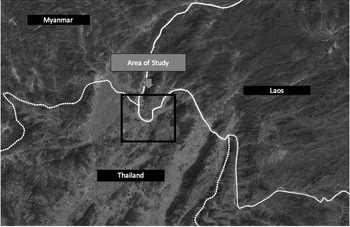
The Chiang Saen Basin was selected as the primary area for this research due to its rich and robust history of local myths and folktales, including the naga myth, as well as the diversity of religious practices that relate to its landscape. To connect the ideas of landscape and myth, I conducted a field survey in the summer of 2016 in the Chiang Saen Basin using two main methodological approaches: cultural anthropological and archaeological. The Basin covers the entirety of the Chiang Saen district in the Chiang Rai province of Northern Thailand and some parts of Laos (Figure 1). Field surveys and small-scale excavations were carried out on the Thai side and comparative material from settlements on the Lao side was also gathered. Two tasks were conducted to collect research data, both following different approaches. By applying the two methods together, the relationship between the landscape and myth becomes apparent. First, I conducted an archaeological survey and gathered artefacts from many sites in Wiang Nong Lom and its neighbouring areas. Additionally, I gathered over 65 archaeological reports on Wiang Nong Lom settlements and Chiang Saen from surveys conducted by the Fine Art Department of Thailand in 2009 and 2010. These reports also included a survey from a settlement in Laos, Suwannakomkam, which provided data that could be used for a comparative analysis with Wiang Nong Lom, since the two settlements likely emerged in the same time period (thirteenth - fourteenth century). In addition to the archaeological survey, I searched museum collections for artefacts related to the naga myth, as well as historical documents and local chronicles to confirm the influential beliefs that have appeared in the Chiang Saen Basin. Second, I conducted 21 semi-structured interviews about the naga myth at temples and houses in the Chiang Saen Basin, the majority of which took place at the Wiang Nong Lom settlement, where the naga myths seem to be particularly influential. I categorised the informants into three main groups: monks, local intellectuals (people who have knowledge and experiences related to the naga myth or who are considered teachers within the community), and laypeople who know and participate in rituals and tell naga stories that connect to the cultural landscape.
The studied area is in the white frame, which covers the district of Chiang Saen, Chiang Rai, Thailand, and Bokaew province, Laos PDR (modified from Google Maps).

Before discussing how building patterns were formed in the Chiang Saen Basin, we must investigate these building patterns in relation to ideas and ideologies connected to Buddhist thought. Often, scholars have thought about Buddhism as a rigid set of doctrinal concepts, but recently it has been noted that certain practices in many local communities in Thailand and across Southeast Asia suggest another point of view for how Buddhism is understood and practiced (Bautista and Reid Reference Bautista, Anthony and Bautista2012; Cassaniti Reference Cassaniti2015; Eberhardt Reference Eberhardt2006; Holt Reference Holt2009; McDaniel Reference McDaniel2014; Pattana Kitiarsa Reference Pattana2005, Reference Pattana2012; Swearer Reference Swearer1995; Tambiah Reference Tambiah1970, Reference Tambiah1977). In Southeast Asia, Buddhist traditions tend to be mixed with animist practices, as can be seen from the popular practice of phi (spirit) as medium, magic, and other forms of spiritual activities and religions (McDaniel Reference McDaniel2014; Pattana Kitiarsa Reference Pattana2005; Tambiah Reference Tambiah1970). This article will be invoking what I call conventional Buddhist ideologies to refer to how states suggest Buddhism should be followed, or what one might call state-sponsored religion (Pattana Kitiarsa Reference Pattana2005: 462). These ideologies are very much a part of everyday life and religious belief in Thailand; however, from an anthropological point of view it ought to be recognised that in Northern Thailand, people incorporate the naga myths into Buddhist cosmology. This results in a blending of ideas for religious practices that conventional Buddhist ideologies alone cannot explain. The building patterns and cultural landscape of the Chiang Saen Basin appear to partially follow these blended concepts, which I will refer to as nonconventional Buddhist ideologies. If we look only at conventional patterns as a way to interpret the building patterns in the Chiang Saen Basin, we would be led to conclude that the layout of the area is random or unstructured. However, if we understand the layout as a kind of nonconventional pattern we will gain clarity on how people organised their lives in the region, and potentially in the larger cultural landscape of mainland Southeast Asia.
The historical settlements in the Chiang Saen Basin are among the most important and well-researched in Northern Thailand, due to the continuous record of habitation in the area beginning in the prehistoric period, c. 13,000 BC (Nootnapang Chumdee Reference Chumdee2006; Sawang Lertrit Reference Lertlit1997). The name ‘Chiang Saen’ was mentioned in a number of local chronicles and legends as the birthplace of the Mangrai dynasty, who established the Lan Na Kingdom and developed it to become one of the most powerful political and religious centres in the region (Sarassawadee Ongsakul Reference Ongsakul2009: 150–153; Wyatt Reference Wyatt2003). Nevertheless, very little of this research has focused on the patterns and development of settlements (Nootnapang Chumdee Reference Chumdee2006: 3). Most importantly, although the naga myth appears repeatedly in many local chronicles and folklore regarding the settlement pattern, researchers have so far failed to adequately discuss and incorporate the myth into their studies of its development. As such, this consideration of how the contexts of myth can enhance our understanding of historical settlements is pertinent. People make sense of places by spending time and living within the landscape and its dwellings (Ingold Reference Ingold1993; Wallis Reference Wallis2008). In this article, I utilise archaeological evidence and ethnographic data to argue that elements of the naga myth have influenced northern Thai people's worldview and understanding of place as they have built, rebuilt, and modified their landscapes. Moreover, I address how people's worldview and understanding of the myth have affected the cultural landscapes, how the myth is used as reference knowledge when landscapes are transformed, and how it is incorporated both monumentally and communally.
The Mythscape
Taking a phenomenological approach to the naga myth allows us to better interpret and contextualise changes to landscape management in Northern Thailand. Despite invaluable archaeological contributions from studies of material artefacts and other evidence related to the cultural landscape of the region, scholars have not fully explained how this landscape emerged and was formed during the early historical period. Furthermore, scholars who rely on the study of artefacts alone have overlooked important aspects of local myth and folklore, which influence how communities interact with their landscape. The existing archaeological data does not give a full picture of how people use space, nor does it inform us of their perceptions of it. Ethnographic interviews, however, enhance our interpretation of such topics and move us away from the static nature of empirical data. Of course, it is a challenging endeavour for scholars to retrieve such notions from our contemporary subjective views (Van Dyke 2008: 8). However, should we surrender to this limitation of empiricism, ignore the experiential approach, and discount phenomenological contemporary accounts if they can be a useful tool to understand these places and landscapes? The answer depends on the importance we place on such an approach and our ability to overcome biases and apply critical perspectives to our research. This article introduces the term mythscape as a new and more nuanced way to interpret the formations and meanings of early historic cultural landscapes, using both archaeological and contemporary ethnographic accounts. To this end, mythscape means the ways in which people understand their surrounding landscape through myths.Footnote 1
In his essay “The Temporality of Landscape”, Tim Ingold argues that the combination of materials in landscapes make a picture for its people to see and appreciate, not because they can distinguish various shapes from the whole scenery, but because the connectedness of all shapes makes it scenic (Ingold Reference Ingold1993: 155–156). In this sense, landscapes not only refer to physical landscapes but also environmental perceptions, cartographic views, and the essence that emerges from the place. Thus, landscapes include the sounds, smells, and sceneries people experience within that particular landscape. This definition incorporates people engaged in various activities, which he calls “attached to” and “gathered from” the landscapes (Ingold Reference Ingold1993: 155). Consequently, Ingold's concept of taskscape explains the activities that take place within the landscape because “the landscape is an array of related features, so—by analogy—the taskscape is an array of related activities” (Ingold Reference Ingold1993: 158). This concept refers to activities that emerge from beliefs that provide agency for local people to act and dwell, in this case the naga myth. I find these theoretical approaches useful for moving beyond the archaeological artefacts and evidence to create new conceptualisations of landscapes. Moreover, the information we gather from the archaeological evidence can never represent a whole or complete picture of past human activity (Clarke Reference Clarke1973; Hodder Reference Hodder1982, Reference Hodder1995). Thus, in discussing cultural landscape, we are not just referring to morphological features of the landscape, but the way it determines and is determined by social process and structures (Hiller and Hanson Reference Hillier and Julienne1984). This article does not aim to isolate material cultures or archaeological artefacts, nor focus only on the intangible force of the myth on the landscape. Rather, by combining an analysis of the two, it encourages scholars of Southeast Asian studies to rethink how material culture should be explored and researched in order to fully understand the cultural landscape (Olsen Reference Olsen2003: 90).
The Naga and Phi Ngeuak: A Historical Background
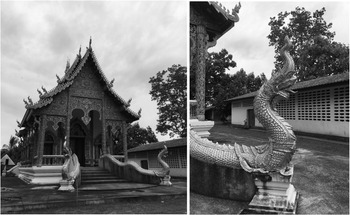
In the chronicles of Chang Saen, the naga frequently appears and plays a major role in stories, especially stories involving the birth and collapse of towns. The origin story of Chiang Saen depicts a prince having a conversation with the lord naga, disguised in human form, who later helps the prince build the town of YonokFootnote 2, which the prince names after the lord naga (Figure 2). After five hundred years of prosperity, the town is destroyed by actions of the same naga, in response to the unthoughtful and immoral deeds of its king (Manit Valibhothama Reference Manit1973; Phra Lakkhawutthajan Reference Phra1973; Phraya Prachakitkorachak Reference Phraya1973; Sarassawadee Ongsakul Reference Ongsakul2009). This kind of story has become embedded in the lives of people in the Chiang Saen Basin, particularly concerning activities related to the landscape and environment. One of my informants, Phor Boonsong (Interview with Phor Boonsong July 2016) told me that “nagas live around this area since the beginning [of time] and look after land, rivers and ‘us’, their children.”
The naga staircase in front of the main temple hall at Wat Sob Kok in Chiang Rai province, Thailand

The naga (or nak in Thai) myth has firmly infiltrated the social and communal contexts of the Chiang Saen Basin; its people have developed a communal belief in the mythical serpent and created unique local versions and narratives. Many oral traditions are believed to have emerged from spiritual beliefs prior to the introduction of Buddhism. Some argue the naga was one of the beliefs practiced by locals long before Buddhism arrived in the region (c. 200 BC, The Abbott of Wat Phrachao Lanthong, June 2016). Others believe the naga may have emerged from cultic serpent worship (Prompon Pakkham Reference Pakkham2007: 12). The term naga developed later, when people attempted to describe the mythical serpent in a Buddhist context (Mayoury Ngaosīvat and Pheuiphanh Ngaosrivathana Reference Mayoury and Pheuiphanh2009: 4–5), but the people of the Chiang Saen Basin have also known the naga as phi ngeuakFootnote 3 (‘river spirit’) (Phor Boon Song, July 2016) and the same term is commonly used by Tai ethnic groups, the major ethnic groups in mainland Southeast Asia (Mayoury Ngaosīvat and Pheuiphanh Ngaosrivathana Reference Mayoury and Pheuiphanh2009: 5). Nevertheless, the naga is now strongly attached to the Buddhist tradition, which is exemplified by the number of naga figures in most Buddhist temples and their appearances in many Buddhist texts, not least the Buddha's past life stories, or Jatakas (Mayoury Ngaosīvat and Pheuiphanh Ngaosrivathana Reference Mayoury and Pheuiphanh2009; Prompon Pakkham Reference Pakkham2007). In one story, the naga plays a central role in protecting the Buddha after he reached enlightenment, and later the naga is said to have become a guardian of Buddhism (Prompon Pakkham Reference Pakkham2007: 33–38). The naga is also considered sinless and hence equated to the Buddha (Prompon Pakkham Reference Pakkham2007: 25). One story depicts a naga who wished to enter Buddhahood and ordain as a monk but was refused by the Buddha because naga is not human (Mahachulalongkorn Rachawitthayalai Reference Mahachulalongkorn1997). Having been refused, the naga asked the Buddha to allow whoever wished to ordain as a monk to use the name ‘nak’, referring to the liminal period a person undergoes prior to the ordination ceremony (Mahachulalongkorn Rachawitthayalai Reference Mahachulalongkorn1997). The belief in naga is seen as an animistic and dynamic form of belief, like those held in many other areas, such as nat in Myanmar or phi (ghosts or spirits) in most Tai communities, which is a common belief still held today in mainland Southeast Asia (Cassaniti Reference Cassaniti2015; Cassaniti and Luhrmann Reference Cassaniti and Tanya M.2011; Eberhardt Reference Eberhardt2006; Johnson Reference Johnson2019; Pattana Kitiarsa Reference Pattana2005; Swearer Reference Swearer1995; Van Esterik Reference Van Esterik1982). In fact, believing in phi is strongly embedded in all aspects of daily life in Southeast Asian communities. Phi are seen as agents who offer guidance and referential knowledge for individual and communal understanding of the life course (Eberhardt Reference Eberhardt2006). Historically, phi (i.e. the belief of spirit) has partly become a cosmological concept for people in Southeast Asian communities (Pattana Kitiarsa Reference Pattana2005: 471-472). In some cases, it has survived political upheavals and become integrated into revived Buddhist practice (Holt Reference Holt2009: 16). The belief in phi might represent a process of collecting memories, which is also true of belief in the naga. These memories function as a stabilising mechanism for the people, helping them to cope with changes. Relatedly, spirit mediums played a significant role in annual harvest ceremonies, predicting and forecasting better weather and fortune for local farming. Religious amulets that connected Buddhism to spiritual beliefs became a common way to start conversations among local people in both the monastic and lay communities (McDaniel Reference McDaniel2014: 3–4; Pattana Kitiarsa Reference Pattana2012: 478–479). The combination of spirituality and Buddhism, and the syncretic form of religious ideas, has become strongly integrated into the daily activities of local communities. This trend of religious practice manifests as spirit shrines and houses in local households and Buddhist temples, belief in the naga in the Chiang Saen Basin, and depictions of phi in the Lao temple mural painting (Cassaniti and Luhrmann Reference Cassaniti and Tanya M.2011; Eberhardt Reference Eberhardt2006; Holt Reference Holt2009; Pattana Kitiarsa Reference Pattana2005, Reference Pattana2012; Swearer Reference Swearer, Premchit and Dokbuakaew2004; Tambiah Reference Tambiah1970; Tannenbaum Reference Tannenbaum, Keyes and Tanabe2013). These ideologies are very much a part of everyday social life and religious belief, encompassing everything from individual rites of passage to communal well-being in the region (Swearer Reference Swearer1995: 46). From an anthropological point of view, it ought to be recognised that people also incorporate the belief of phi, or the naga in this case, into a cosmological worldview in which they use to navigate, negotiate, interact, and understand their social spaces and the world around them (Piyawit Moonkham Reference Piyawit2019: 77–79). While the canonical Theravada Buddhist ideas concentrate on impermanence and letting things go, the phi, on the other hand, represent stability. They allow people to hold on to tradition and attempt to keep memories while they negotiate the uncertainty of life (Cassaniti 2006; Karlström Reference Karlström2009: 196–198).
Although most Southeast Asian communities today practice Theravada Buddhism, belief in phi and the naga is seen as a significant component of the communities’ daily lives along with Buddhism. Even though most temple sites in the Chiang Saen Basin tend to illustrate Buddhist cosmology, appearances of the naga myth strongly prevail. This is important because, in addition to traditional Buddhist beliefs about the naga, the people in the Chiang Saen Basin have various stories that are intricately connected to the spatial relationships of community structures, such as temples and house construction. These are in turn connected to local folktales that people tell their children to convey the sacredness and power of the naga. “I tend to not eat them [eels] and release them when I caught them on the [fishing] net because it might be one of the naga's children, and you might offend them if you do that,” Phor Lah (Interview with Phor Lah 2016) recounted when I asked about appropriate behaviours around the areas of Wiang Nong Lom. As Phor Lah's story demonstrates, most Tai communities living in modern mainland Southeast Asia and southwestern China, especially around the Mekong River, strongly believe in this mythical serpent (Johnson Reference Johnson2019; Sumet Chumsai Reference Sumet1997; Tambiah Reference Tambiah1970). The belief in naga is engrained in daily communal activities; they serve as a special symbol of water and a guardian of the lands, rivers, rains, and aquatic resources (Sumet Chumsai Reference Sumet1997: 21–23; Tambiah Reference Tambiah1970: 298–304). Therefore, people habitually perceive all activities and changes involving the lands, weather, and climate as naga-related actions. Thus, the ways in which people interact with their landscape through mythology still significantly pervades communal life.
The Tale of Two Patterns
A study of the pattern of historical buildings and forms illustrates the role of the naga myth on the pattern, orientation, and characteristics of the Chiang Saen cultural landscape. Some scholars have argued that the physiology of an area played a role in determining the kind of buildings that were constructed in historical times (Ng et al. Reference Ng, Wood and Alan D.2015: 2248; Rattha Ritthisorn Reference Ritthisorn1998: 26–28). In the Chiang Saen Basin, however, such physical preconditions must be balanced by the spiritual landscape. Hence, we must also tend to spiritual landscapes where people tend to “imagine spirit forces and energies to emerge from or be connected to places, and to the attitudes that people may have to the ‘hidden’ or mysterious realms lying beyond, behind or immanent within the visible earth” (Allerton Reference Allerton2009: 236). In other words, the places people think have spirits or supernatural powers are equally important as particular physical formations when constructing buildings. Various stories and folktales suggest that people in ancient communities had a similar understanding of cultural landscape modification and management to what we see in present-day communities (Manit Valibhotama Reference Manit1973).
The conventional building pattern
Many art historians have argued that the function of the space and form of the main hall within temple complexes in Northern Thailand represent a Buddhist cosmology (Rattha Ritthisorn Reference Ritthisorn1998: 26–28; Worarun Boonyasurathana Reference Boonyasurathana1992). This conventional building pattern is understood to play an important role in the construction of buildings, especially in the orientation and composition of the main hall (vihan) and stupa. The construction of temples is frequently influenced by concepts of Buddhist cosmology from a number of manuscriptsFootnote 4 that were written during the fourteenth century after the Buddhist reform, including chakkawanthipani, lokkathipasan, traiphumi chabap lanna (Penth et al. Reference Penth, Phanphen and Silao1997; Phra Sirimangkhalajan Reference Phra1980; Rattha Ritthisorn Reference Ritthisorn1998; Sarassawadee Ongsakul Reference Ongsakul2009; Wyatt Reference Wyatt2003). The details of these manuscripts mainly discuss ideas of cosmological entities and the universe of all being (Phra Sirimangkhalajan Reference Phra1980, Rattha Ritthisorn Reference Ritthisorn1998: 26). The manuscript also discusses the meaning and symbolism of the location of each building and construction within the temple complex, which has been thoroughly discussed in the works of Worarun Boonnayasurathnana (Reference Boonyasurathana1992), Rattha Ritthisorn (Reference Ritthisorn1998), and other Thai art historians (Jirasak Dejwongya Reference Jirasak1996). Furthermore, the manuscripts focus on natural landscapes as important components of cosmology. This is important because it demonstrates that later temple constructions depict the ideas laid out by these manuscripts, while temple patterns prior to the late fourteenth century seem to have more variations in both composition and orientation.
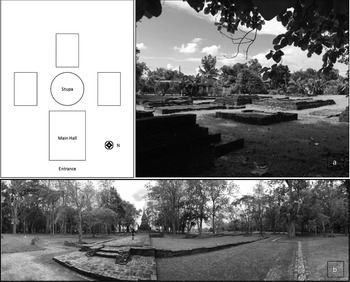
We can identify a number of elements that accord to these conventional patterns throughout many archaeological sites in the Chiang Saen Basin, particularly the monastic temples (Fine Art Department [FAD] 2009, 2010). Each temple complex normally consists of two main buildings: a stupa and a main hall. The main hall either connects to the stupa or is separate from it; the positioning varies from one period to the next, depending also on the political and economic developments of the region. Nonetheless, the conventional building pattern consisted of a stupa which was situated in the centre of the temple area, a main hall located on the east side of the stupa (which also indicated the main orientation and composition of the temple), and other halls situated in the other three cardinal directions. The stupa, in this regime, is the centre of the universe in which many gods and Bodhisattvas reside, with the enlightened statehood at the top (Rattha Ritthisorn Reference Ritthisorn1998; Worarun Boonnayasurathna Reference Boonyasurathana1992). The main hall in the east is understood to represent the human continent or realm; this building is also used for all kinds of Buddhist ceremony-related activities. The other three halls represent the three continents where different kinds of human beings reside (Rattha Ritthisorn Reference Ritthisorn1998; Waranan Sowannee Reference Sowannee2009: 21). These three halls can, in some cases, host other sacred Buddha statues and amulets. The temple complexes are dependent on their sponsors’ wealth—sponsors ranged from kings, royal families, and nobles to local communities (Bowie 1998: 473; Worarun Boonayasurathna Reference Boonyasurathana1992: 36). This layout appears to be, what I call, a conventional pattern of temple construction and composition found in the Chiang Saen settlements in the late fourteenth century, and found in abundance in present-day communities (Figure 3 and 5). Archaeological evidence also indicates that many temple sites in the inner part of Chiang Saen town appear to have this kind of pattern, including examples such as Wat Chedi Luang, Wat Pasak, and Wat Sangkhakaewdonthan.
The layout of the conventional building pattern and temple sites in the historic town of Chiang Saen (a, Wat That Khiew; b, Wat Pasak)

The nonconventional building pattern
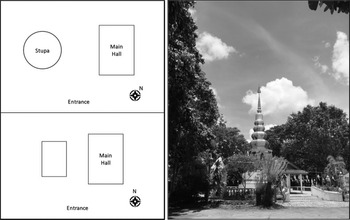
The nonconventional building pattern of a temple complex is one where the composition does not fully follow the concept of the Buddhist cosmological universe. The stupa and hall that is supposed to be at the centre of the temple to represent the centre of the universe and human realm, is instead located in any area within the temple complex. Halls are sometimes located at the centre of the temple to mark the centre of the universe instead of the stupa. Some temples appear to have one or two halls and no stupa. This kind of pattern seems to have more variations than the conventional one, and the main buildings sometimes face directions other than east, such as southeast, northeast, west, or north (Figure 4 and 5). Often, the hall and the stupa are not attached to one another and are built far apart, an example of which can be found at Wat Pamaknoh, near Wiang Nong Lom. The temple's main hall faces the lake where the ancient town of Yonok used to be located. The stupa was built on the spot where local people believed the entrance to the naga realm existed, which was especially important during the rainy season. Unlike temples that follow the conventional pattern, this temple has no physical boundary to demarcate its grounds. Even though many temples were built according to conventional patterns, this nonconventional building pattern can be found in many other places. Archaeological evidence and Fine Arts Department reports (FAD 2009, 2010) suggest that the temple site at Wiang Nong Lom, Suwannakomkam (present-day Laos) and certain sites in the modern Chiang Saen town follow these nonconventional patterns. There are no written documents that can help us trace when such patterns first emerged or how they flourished (Figure 6 and 7).
The layout of the nonconventional building pattern at Wat Pamaknoh in Wiang Nong Lom, Chiang Rai, Thailand

The two spatial systems in Chiang Saen. A) Site 8 represents the nonconventional system in which the layout does not depict the Buddhist cosmological worldview. B) Site 10 represents the conventional system in which the layout partially depicts the Buddhist cosmological worldview (Modified from FAD 2009).

Map showing all the temple sites in the three main settlements of Wiang Nong Lom (WNL), Suwannakomkam (SKK), and Chiang Saen (CS). The tips of the arrows represent the orientation of each temple site. The locations of the temple sites are only visual representations of the actual locations of the sites (n=162).

Chart showing the conventional and nonconventional patterns among the three main settlements: Wiang Nong Lom (WNL), Suwannakomkam (SKK), and Chiang Saen (CS), (n=162).

The Naga Myth as Part of Cosmology
“This temple was built on top of the naga's land…that's why people chose to build it here at this location,” said Phor Nan Inn (Interview with Phor Nan Inn 2016), a layperson of the Wat Phrathat Phangao, when discussing the ritual ceremonies related to the naga myth. Today, Phrathat Phangao is a sacred place that gains its importance from the naga-related land it was built upon. Based on my investigations in Chiang Saen, I have identified four types of connections between the naga myth and landscape-related activities: first, disasters and flood; second, rivers and waterways; third, weather and rain; and fourth (and most important for my argument), landscape and building patterns. Through these connections, the naga myth plays various direct and indirect roles in many landscape-related activities and influences local cosmological ideas of the landscape.
Regarding the first connection, people in the Chiang Saen Basin tend to think the naga is responsible both for any kind of water movements and unusual feelings from the ground, e.g., shaking, jarring, earthquakes, and flooding. One might wonder how these landscape changes relate to the naga's actions. When he was visiting his hometown, the Abbot of Wat Sob Ruak told me that an earthquake that happened in Shan State, Myanmar in 2011 was due to the naga. “I visited my hometown in Shan State (Myanmar) many years ago…I heard my neighbours talked about one night during the earthquake, how he saw a big serpent moving on the ground so quickly…that was the reason why the land and everything was shaking…” (Interview with the Abbot of Wat Sob Ruak 2016). A number of stories from other informants indicate similar thoughts about the serpent or naga. Local people in the Chiang Saen Basin believe that all flooding relates to the naga's actions and that if someone in their community does something to offend the naga, a severe flood will follow.
As for the second connection, people in Chiang Saen Basin believe that all rivers, waterways, and lands, are either under the protection of or were created by the naga. This also relates to the first connection, because as land cracks and divides due to destructive forces, waterways and rivers appear. People believe that after the rivers and waterways are created in such violent rifts, the naga tend to live around those locations or at least use them to get in and out of their underworld. Hence, the naga act as protectors of these places. The rivers meander like snakes through the land after a flood or rain, which is partly why stories of the naga are often related to the rivers and waterways, or activities nearby rivers. “Some rivers are the ways of the naga, like Kham River, people believe that is the way for the naga to swim to Mekong rivers” (Interview with Phor Nan Inn 2016). Similarly, Phor Boonpan said that new roads that were built by the government outside the town of Chiang Saen had blocked the naga's waterways. Thus, he believed that the road construction had angered the naga and caused many unstable water movements and floods during the rainy season and drought during the summer (Interview with Phor Boonpan 2016).
In a similar vein, people believe that the naga is a protector of particular rivers, according to whichever naga created that waterway. Indeed, the names of places are mostly borrowed from people or mythical creatures who put effort into creating the geographical feature. However, the Abbot of Wat Phrachao Lanthong informed me that to know, say, or in any way use the name of the naga is offensive to them if it has not been allowed. Thus, most river names around the Chiang Saen Basin depict incidents related to the naga, e.g., Kham (meaning ‘gold’), Rak (meaning ‘to drag’), Kok (meaning ‘to kill’), and Lua (meaning ‘to clean’), without actually mentioning their names. This perspective allows us to see how local knowledge has been transferred from generation to generation. These stories also illustrate the ways in which modern communities incorporate intellectual lessons into their communal spaces in order to learn how to dwell and live within the landscape (Wallis Reference Wallis2008: 240–242).
The third connection mostly concerns the weather, especially the rain and amount of water people encounter each year. The local communities’ livelihood in the Chiang Saen Basin strongly relies on wet rice farming. Most people are rice farmers or agricultural-based farmers who rely on significant amounts of water and rains for their wet rice, corn, and other kinds of tropical vegetable agriculture. As such, naga stories concerning rain mostly relate to the annual lunar calendar or yearly predictions of water and rain. Every year during the month of April, people perform ceremonies worshipping the naga, in hope of plentiful rain in the year to come (Interview with the Abbot of Wat Sob Kok 2016). Therefore, people depict the naga as a predictor and powerful controller of rain. Geographically, it might seem that the Chiang Saen Basin has plenty of water resources, however, this region is also affected by drought from time to time (Bell et al. Reference Bell, Cook, Anchukaitis, Buckley and Edward R.2011; Buckley et al. Reference Buckley, Palakit, Duangsathaporn, Sanguantham and Patsi2007, Reference Buckley, Anchukaitis, Penny, Fletcher, Cook, Sano, Nam, Wichienkeeo, Minh and Hong2010). Thus, all water resources are vital to the people in the Basin. Mae Khwan, a local farmer and spirit medium of the naga, told me her story when I asked about her experiences. “The villagers came to ask me if it's going to rain this year…or how much rain we will get…At that time when I was still a medium for the naga…and it was like what I told the villagers, when it's going to rain, then it rains” (Interview with Mae Khwan 2016). Many stories from other informants also suggest the naga's ability to control the weather, especially the rain. Moreover, it is not just during April that people hold ceremonies for the naga. In fact, most religious festivals and ceremonies for the naga are held throughout the year across most villages in the Chiang Saen Basin, as their agriculture is dependent on yearly rainfall. Although some ceremonies relate to Buddhist festivals, the naga remains at the core of most important rituals for Chiang Saen communities.
The fourth connection relates to activities concerning the buildings and lands, through which the naga is either depicted as the protector or owner of the lands. People in the Chiang Saen Basin tend to ask for permission from the naga before they start to build private houses, temples, or any kinds of buildings. Certain ritual ceremonies must be performed prior to putting the first pole in the ground, and the house's structure must follow the patterns of naga movements and positions (Interview with Phor Nan Sawat 2016). For example, every March to May, according to local stories, the naga will lie down on their side and turn their head toward the west. The first house pit must therefore be dug on the south-eastern side of the central area of a new house. The bodily movements of the naga change every three months, year after year (Silao Ketphrom Reference Silao2001: 111). As for temple construction, local communities tend to incorporate any signs or dreams about the naga into their plans when building structures within the temple. The Abbot of Wat Sob Kok told me that “…Later the head of layman of this temple had a dream about two nagas, and that under the ground there is the way to enter the world of the naga…After that people built a new hall on top of it and erected the figure of the naga on the staircase…Before, this temple had no figure of the naga at all until then” (Interview with the Abbot Wat Sob Kok 2016). Stories suggest that belief in the naga in the Chiang Saen Basin reflects some sense of interconnectedness to the surrounding world; people see themselves as part of a larger unknown space which produces unlimited and unpredictable changes or uncertainty. Thus, to put themselves in the right place within this unknown vast space, their stories allude to a larger narrative in which the naga myth is a part of the dynamic cosmological understanding, in order to control their land and live their lives in harmony.
However, ritual activities concerning the naga do not only take place in areas close to the river (Sumet Chumsai Reference Sumet1997). For instance, the housing ceremony ritual, described by Phor Nan Sawat above, is practiced by northern Thai people in many parts of the region (Siloa Ketphrom Reference Silao2001). “People are still practicing it; I still perform the ritual if they have a housing ceremony” (Interview with Phor Nan Sawat 2016). Furthermore, the naga myth also offers referential knowledge and understandings of space and place related to temple construction. In contrast to the Buddhist cosmological concepts used in deciding how the entire temple complex or small buildings within the temple should be built, my conversations with people in the Chiang Saen Basin indicate that they often refer to or consult the naga myth regarding where to construct certain buildings and temples. Lands or pieces of land that have connections to stories about the naga are considered sacred places.
The Naga Mythscape: A Discussion
“… I think it is possible that the temple is facing the river in order to pay respect to the naga”, said the Abbot of Wat Sob Kok. Like the abbot, many of my informants told me similar stories about how naga myths have influenced temple construction. These ideas not only appear in modern temple constructions, they can also be found in the building patterns of three historical settlements—Wiang Nong Lom, Suwannakomkam, and Chiang Saen. Geologically, five main rivers run through the Chiang Saen Basin: the Mekong, Kok, Lua, Kham, and Ruak rivers, from which various naga myths have originated. The Mekong River today demarcates the border between Thailand and Laos; these three historical settlements exist along both sides of the river. More than one hundred archeological sites have been identified across the three settlements, most of which are Buddhist temples.
Regarding the temple sites, there are two dominant paradigms that are mainly used for interpreting temple patterns: state-sponsored Buddhist ideology and traditional archaeology (material-based approaches). Both paradigms tend to ignore or overlook the belief in phi and the naga, which in this region plays a significant role in the interaction between local communities and their landscapes. In order to understand the first paradigm we need to look prior to the late fourteenth century, when local communities in the region practiced Buddhism alongside their belief in phi and spirituality (Cassaniti Reference Cassaniti2015; Eberhardt Reference Eberhardt2006; Holt Reference Holt2009; McDaniel Reference McDaniel2014; Sumet Chumsai Reference Sumet1997; Swaerer et al. Reference Swearer, Premchit and Dokbuakaew2004). There is no doubt that the practice of phi was embedded in the social and religious life of local communities. As discussed earlier, this dynamic form of Buddhism does not incorporate both practices equally into a single form but rather creates a hybrid form, as Pattana Kittiarsa (Reference Pattana2005) has discussed. However, after the year 1369 AD, the region experienced several waves of Buddhist religious reforms (Sarassawadee Ongsakul Reference Ongsakul2009: 150–168; Wyatt Reference Wyatt2003). During these reforms, many Buddhist manuscripts, including chakkrawanthipani, lokkathipasan, and traiphum chabap lanna were produced by monks in order to perpetuate the new Buddhist ideologies to the public (Penth et al. Reference Penth, Phanphen and Silao1997; Sarassawadee Ongsakul Reference Ongsakul2009). Concepts from these manuscripts were used as guidelines for local artists during the early historic period to construct temples according to this conventional building pattern (Phra Sirimangkalajan Reference Phra1980; Rattha Ritthisorn Reference Ritthisorn1998; Worarun Boonyasurathana Reference Boonyasurathana1992: 46). The concepts were perpetuated on national, regional, and local levels via state sponsorship since the late fourteenth century, and were spurred on by regional historical and political transformations such as the establishment of the sangha—the Buddhist monastic order (Sarassawadee Ongsakul, Reference Ongsakul2009; Wyatt Reference Wyatt2003). In the process, the beliefs and practices of phi started to be seen as separate entities from state-sponsored Buddhism (because they were non-canonical practices). Although Buddhist practices in this region encompassed popular religious beliefs and rituals from time to time, these practices were still classified as ‘continuities and transformation’ within Theravada Buddhism (Pattana Kittiarsa Reference Pattana2005: 462). This canonical view also influences much of the research on Buddhist architecture and temple patterns which follow the forms established in the manuscripts. These patterns have been privileged in research at the expense of non-conventional patterns influenced by phi and the naga myth.
Regarding the second paradigm, many earlier archaeological projects in Northern Thailand, especially in the Chiang Saen Basin, concentrated on the Chang Saen historical settlement due to its historical importance and the abundance of archaeological artefacts and structural remains that were unearthed (FAD 1991). Many major Buddhist temples in Chiang Saen were discovered and excavated by archaeologists from the Fine Arts Department of Thailand in the late 1970s (FAD 1991). Most temples that were discovered during this early period of research appear to have been constructed in the conventional pattern. Therefore, much of the later research on Buddhist temples has tended to use the conventional pattern as a key model for understanding temple patterns throughout the region. Although many newer temple sites have now been discovered, including those at Wiang Nong Lom and Suwannakomkam, the explanatory model of the conventional pattern still dominates the field.
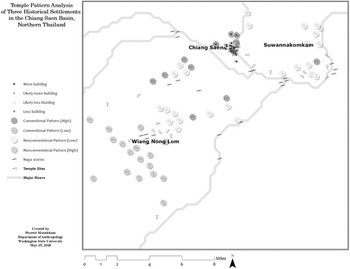
However, some temple sites at Wiang Nong Lom and Suwannakomkam appear to have more variations to the pattern regarding composition and orientation. In Wiang Nong Lom, the 77 temple sites appear to be scattered across the area and seem to have no apparent pattern in the distribution of their locations. The temples appear to host a large number of associated communal building structures, such as kilns, wells, walls, and small canals. Furthermore, the orientation of the temple sites here is not only limited to facing the east; more than half of the temples and buildings were constructed to face other directions, such as northeast, south, and southeast. The composition of one temple complex appears to have a single hall or stupa, or both, in a separate location. A similar pattern also appears at Suwannakomkam, where all 29 temple sites are located in a large-scale area on the east side of the Mekong riverbank at Ban Don That in Laos (Lorrillard Reference Lorrillard2000: 62). The orientation of most temples is consistent in only one main building, either the stupa or the hall. The temples seem to be oriented toward the west and the northwest where the Mekong River is passing through. The associated communal buildings like wells and small walls appear abundantly in many parts of the town. As such, the characteristics of the temple sites found in Wiang Nong Lom and Suwannakomkam are similar. Furthermore, according to archaeological evidence and historical documents they are contemporary, dating to approximately the thirteenth century (FAD 2009, 2010; Lorrillard Reference Lorrillard2000). If we apply a conventional view from the two paradigms above to interpret and understand how temples were constructed and laid out, few temples in these two historical settlements would be clearly comprehensible. Indeed, most temples here appear “chaotic” in orientation and composition compared with Chiang Saen, where most of the 59 sites are temples and there are fewer communal buildings to be found. In these clusters, there is often more than one building in the temple complex, either more than one stupa or hall. The composition of most temples appears to have the stupa and hall attached to one another and almost all temples are oriented toward the east, regardless of their location. Thus, many sites in Chiang Saen seem to be near-perfect illustrations of conventional temple patterns, unlike the temple sites at Wiang Nong Lom and Suwannakomkam (Figure 8).
Map showing the spatial pattern analysis of temple sites in the Chiang Saen Basin, Northern Thailand. The cluster and outlier analysis indicates two different kinds of spatial pattern relationships: conventional and nonconventional. The temple sites on the map are not the actual locations, they are visual representations of the sites on the map.

From the discussion above it can be concluded that the conventional view, illustrated by the temple sites in the Chiang Saen Basin, might prevent us from fully understanding the temple patterns that appear in Wiang Nong Lom and Suwannakomkam. Yet, if we incorporate the presence of the naga myth and the stories told by local communities into our analysis, we are able to create a fuller picture of most temple sites at Wiang Nong Lom and Suwannakomkam. Although the temples at Chiang Saen have different building patterns, some temples still share similar orientations and compositions with Wiang Nong Lom and Suwannakomkam. The sites of the three historical settlements have both conventional and nonconventional building patterns, as suggested in Table 1. Having said that, the historical settlements of Wiang Nong Lom and Suwannakomkam were, I argue, more community-based landscapes than those in the Chiang Saen settlement. This is reflected through the variations in building patterns, including differing orientations and compositions. As such, these localities demonstrate that community-based activities were associated with religious building structures. They further indicate a closer relationship between Buddhist monastic institutions and lay communities, reflected by the greater number of communal buildings associated with the temples in Wiang Nong Lom and Suwannakomkam. This presentation of building patterns at both historical settlements is indicative of the mythscape that continues to be understood and practiced by present-day communities.
Spatial features and properties of all temple sites in each historical settlement

There are two main theoretical and methodological ways of understanding the mythscape phenomenon in the Chiang Saen Basin. First, as Ingold has highlighted, academic research has tended to separate humans from their landscape, either naturally, physically, or momentarily, and often presents humanity and landscapes as distinct from each other. Yet, we are never truly separate from the landscape. Instead, we live in it, and the landscape “becomes a part of us, [just] as we become a part of it,” or in other words, “whereas the order of nature is explicated, the order of landscape is implicated” (Ingold Reference Ingold1993: 154). As such, to understand the process of dwelling within the mythscape in the Chang Saen Basin, we should also look at the experiences of people living and dwelling in these places. This brings us to consider the role of ethnographic accounts of people's perceptions and understandings of landscapes. From that, we can better understand how the nonconventional building patterns occurred in the early settlements. “I was working there at Wat [Phrathat] Phangao, when the naga possessed me…before I had nothing, no parent, no one… I was suffering…after that many people in this village came to ask me about a lot of things, like to see if somebody ill or sick, to tell that if it's going to rain or have a lot of water for the farming…many people came…If it wasn't for the [spirit of] naga, I might have died already, I was so poor and had nothing” (Interview with Mae Khwan 2016). The story of Mae Khwan demonstrates the influence of the naga myth on her learning, thoughts, and conceptualisation of life, regardless of where the knowledge came from and how she came to know about the naga. Possession by the spirit of the naga gave her a space to negotiate the uncertainty of her social life and landscape. I emphasise this matter to show how the myth and people's understanding of it allow them to create their own space and stories, which they then use to negotiate and communicate their position within a larger social narrative. Only through an appreciation of the engraved relevance of the naga myths in personal and social lives can we understand how influential it has been in the configuration of the physical landscapes of the region.
Second, when approaching the temple patterns, many scholars tend toward over-reliance on one idea, one particular artefact, or one place when they interpret a cultural landscape, such as a main structure, settlement centre, topographical feature, or the conventions of Buddhist ideologies (Amin Reference Amin, Tylor and Lennon2012; Evans et al. Reference Evans, Fletcher, Pottier, Chevance, Soutif, Tan, Im, Ea, Tin, Kim, Cromarty, De Greef, Hanus, Bâty, Kuszinger, Shimoda and Boornazian2013; Fletcher and Evans Reference Fletcher, Damian H. and Haendel2012; Hendrickson Reference Hendrickson and Haendel2012; Rattha Ritthisorn Reference Ritthisorn1998; Southworth Reference Southworth and Haendel2012). In doing so, they risk neglecting other details and information relevant to the complex conglomerate of the cultural landscape, which might be useful for their interpretation. As an illustration, we can look at the three historical settlements in the larger Chiang Saen Basin. If we look at the temple construction without consideration of the naga mythscape, we would perceive their plans and construction as a result of Buddhist cosmology or topographic necessity. Hence, we would lack possible interpretations for the nonconventional patterns that appear in every place that the naga myth exists. Like Stark (Reference Stark2006: 410) has argued, most landscape archaeological research, and archaeological research in general, seems to ignore the context of location. I agree with Stark and argue that the ideas of mythscape that this article develops could help us to look more clearly at this archaeological problem. In doing so we can better understand the ways in which early communities and historical settlements were actually mobilised from within, and how the ancient inhabitants of the Chiang Saen Basin might have perceived their cultural landscape.
Conclusion: Further Thoughts
The main question of the research that led to this article was whether or not the naga myth had any impact on early settlement and building patterns in the Chiang Saen Basin. Through an analysis of building patterns and gathering of ethnographic information, I can conclude that indeed it has. It can be very challenging for us archaeologists to understand ancient people's thoughts. When situations occur that are different from those most archaeologists encounter today, ethnographic accounts can be useful for interpreting and understanding them. Through this analytical combination, the article's findings conclude that the naga myth has played, and still plays, an important role in the orientation of both historic and contemporary buildings and temple site compositions in the Chiang Saen Basin. Certainly, many factors might have caused these apparently nonconventional patterns to occur. Nevertheless, the findings of this article suggest that the naga myth has a considerable impact on people's perceptions and thoughts, and hence also on the way they have interacted and continue to interact with their natural landscape.
A provocative hypothetical thought derived from these observations is that the early settlements in the Chiang Saen Basin may not only have consisted of devoted Buddhist communities. Certainly, many buildings were Buddhist temples. Yet, if we incorporate perspectives from present-day communities into our analysis of the Chiang Saen Basin, as well as their narratives regarding religious activities and the cultural landscape at large, the nonconventional patterns make more sense and we access a more comprehensive understanding of these communities and their landscapes. From this observation, we can possibly say that Buddhism in the times of the Lan Na kingdom (prior to the early fourteenth century) coexisted with the naga myth and the two belief systems supported one another in communal perspectives on cultural landscape construction. This is also demonstrated by the way the Abbot of Wat Sob Kok and Phor Nan Inn tell their stories of the naga. However, since the mid-fourteenth century, a more clustered and hegemonic temple pattern became prevalent, with specific conventions regarding composition and orientation. We see this pattern in most sites in the Chiang Saen settlement, where the temples combine the stupa and halls and tend to be oriented toward the east. I argue that this phenomenon is a reflection of the Buddhist religious reforms after the late fourteenth century, as the observed shift occurs at the same time that the Lan Na Kingdom adopted a Sinhalese Buddhist tradition and became more centralised, in the hope of establishing a Buddhist education centre.
A final consideration: when studying myth and landscape in mainland Southeast Asia and other places around the world, landscape patterns might appear nonconventional or chaotic but this does not necessarily mean there is “no pattern” in those places. The concept of mythscape challenges us to rethink our understanding and reconceptualise our definition of the term ‘pattern’ to appropriately address each cultural landscape context. As for the naga myth in Chiang Saen, it is a lucid illustration of the ways in which local people in both ancient times and present-day use their mythological knowledge and practices to interact with and create a sense of control over their unpredictable and changing landscape.
Acknowledgement
I am deeply grateful to Dr. Julia Cassaniti and Dr. Shannon Tushingham for their invaluable comments, suggestions, and advice. I am also grateful to Dr. Nam C. Kim and Dr. Oona Paredes for their kind encouragement and the opportunities they have given me. I would like to thank Dr. Tiffany Fulkerson and William Damitio for their ideas and effort in reading the very first draft of the manuscript.