In January 1950, the fishing village of Ahlbeck was in a state of “unease” (Beunruhigung).Footnote 1 No fewer than eight fishermen from this Baltic Sea town at the eastern edge of the German Democratic Republic (GDR) had been arrested by Polish authorities over the previous twelve months for allegedly trespassing into Poland's territorial waters—and, alarmingly, none of them had returned yet. Eyewitnesses insisted that the fishermen had been on the German side of the border in the sea, but none could prove it: the water border was entirely unmarked, and its actual location would long remain an object of dispute and confusion.
More than three decades later, it was Ahlbeck's Polish neighbor, the port town of Świnoujście, for whom the question of the sea border's location had become a source of “unease” (niepokój).Footnote 2 On January 1, 1985, East Germany extended its territorial waters into waterways claimed by the Polish People's Republic (PRL) that were vital to navigation into Świnoujście and the inland port of Szczecin. The East German navy, the Volksmarine, harassed boats passing through the area to such an extent that shipping seemed endangered. As the conflict escalated in the final years of state socialism, the Polish opposition accused the GDR of making the Baltic into a “burning border,” enacting an “Anschluss” of Polish ports, and engaging in the kind of territorial “revisionism” usually associated with West Germany rather than East Germany.Footnote 3 The Polish foreign ministry (MSZ) itself speculated that East Germany might be defending “all-German” (ogólnoniemieckich) interests in pursuit of rapprochement with West Germany.Footnote 4
A conflict over territorial waters ran counter to the interests of the GDR and Poland: the countries were allies, and the dispute revolved around their shared border, a highly sensitive matter fundamental to the legitimacy of each state. Moreover, the issue involved the application of modern, Westphalian notions of sovereignty to an overwhelmingly unmarked boundary within a literally fluid space. Borders everywhere are social constructs whose physical manifestations can be flown over, swum through, burrowed under, ignored, or otherwise undermined by human and nonhuman animals alike.Footnote 5 However, water environments such as rivers or seas greatly magnify fundamental problems of determining, marking, and enforcing boundaries. On the Baltic Sea, sovereignty was claimed in relation to a series of evolving abstractions in international law designed to govern different water uses, ranging from fishing to navigation to mineral extraction. Though remarkably intangible, the boundaries in question nevertheless had powerful consequences for fishermen and ship captains who found themselves caught between the competing claims of the East German and Polish states.
The border in the water was an improvised extension of the new German-Polish border laid down by the Allies in the Potsdam Agreement of August 2, 1945. At Stalin's insistence, the Allies had redrawn Poland's western border so that it mostly followed the Oder and Lusatian Neisse Rivers. Poland was thus to be “compensated” with formerly German territory in the West for lands taken by the Soviet Union in the East. On the ground, millions of Poles and Germans lost their homes and were forced to resettle. In the Federal Republic of Germany (FRG), organizations of West German expellees continued to contest the so-called “Oder-Neisse line” for decades. East Germany, which styled itself as the anti-fascist German state, made recognition of Poland's western border a touchstone of its international politics as well as a taboo domestically, distancing itself and its citizens from the alleged revanchism of the FRG. In Poland, communist authorities staked their domestic support on obtaining and settling the new “Western Territories” east of the Oder and Neisse. The maritime border took on symbolic importance well beyond the communities within its immediate vicinity precisely because of how disputes over the border might call into question the broader post-1945 settlement. The “normal” relations that both communist states desired were ones that kept the unresolved tensions of the immediate postwar period out of view, hiding them mostly behind claims to bloc solidarity within the Cold War. That, in turn, depended on the border between them being accepted as clear and unchangeable, even along its invisible and unsettled segment in the Baltic Sea.
The territorial waters dispute has thus far attracted little attention outside political and diplomatic history, though it is also part of the larger story of central Europe's territorial reconfiguration. Social historians have extensively analyzed the experiences, discourses, and memories associated with the forced migration of Germans and Poles.Footnote 6 Studies of several Cold War borderlands in Europe have underscored the impact of postwar population movements on the environment and examined the specific “transboundary natures” that develop in border zones.Footnote 7 Others have examined the power politics that led to the so-called “Oder-Neisse line” in the first place and the enduring controversies surrounding it in West Germany.Footnote 8 Though East Germany formally recognized the Oder-Neisse border in June 1950, it remained a source of tension in East German–Polish relations, which have been described as a “forced friendship” (verordnete Freundschaft) or, less generously, a “Cold War in the Soviet Bloc.”Footnote 9 One recent study has examined the land and water borders of socialist states in relation to everyday life as well as security issues, though it notes only in passing the lack of clarity over the Polish–East German water border in the early postwar period.Footnote 10 The handful of studies that have specifically examined the territorial waters conflict have tended to focus on the 1980s and to approach it from the perspective of political or diplomatic history, explaining the dispute in terms of nationalism (Jackowska), economic competition (Ślepowroński), or a series of diplomatic escalations (Olschowsky).Footnote 11
This article attempts to offer a new perspective on the territorial waters dispute between East Germany and Poland by looking at its environmental dimensions and social consequences in connection with the diplomatic record. In so doing, it will show that practical problems of competing water uses within a shared environment lay at the heart of the conflict, as interests in navigation and resource extraction clashed between socialist allies. It will also show that the conflict's intractability had at least as much to do with East-West competition between the two Germanys as with the history of German-Polish animosity. Finally, when Poland and East Germany finally reached agreement in 1989, they did so not because of “top-down” pressure from the Soviet Union but as a result of “bottom-up” pressure from border towns such as Ahlbeck and Świnoujście.Footnote 12
Drawing primarily on files from the East German and Polish foreign ministries, the article will focus on three phrases: the problems of fishing along an unmarked, uncertain border in the early postwar period; diplomatic wrangling over the border's location in relation to competing water uses thereafter; and the drastic escalation and sudden resolution of a conflict over navigation in the second half of the 1980s. In doing so, the article will also show that the history of the territorial waters conflict exemplifies dynamics that shaped the GDR as it struggled to consolidate itself in the 1950s, achieve international recognition in the 1960s and 1970s, and prevent the collapse of communism in eastern Europe in the 1980s.
Unsettled Waters: Fishing along the Baltic Border, 1945–1951
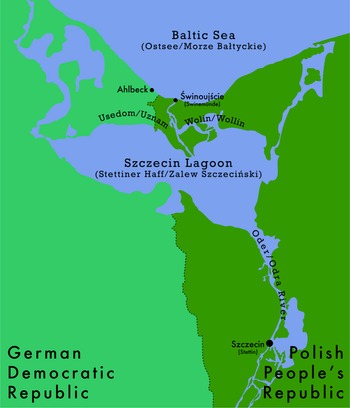
From July 17 to August 2, 1945, the leaders of the Soviet Union, United Kingdom, and United States met in Potsdam to discuss the occupation of defeated Germany and plans for postwar Europe. The resulting Potsdam Agreement included a decision on the western border of Poland, which would, “pending the final determination” at an expected (but unrealized) future peace conference, run “from the Baltic Sea immediately west of Swinemunde, and then along the Oder River to the confluence of the western Neisse River and along the western Neisse to the Czechoslovak frontier.”Footnote 13 Even before the Allies agreed on this inexact formulation, Soviet actions on the ground ensured that Poland obtained control of Szczecin (formerly German Stettin), a strategically valuable port at the mouth of the Oder.Footnote 14 Szczecin's geographic position complicated the delimitation of the border, with a ripple effect all the way into the Baltic Sea (see Figure 1). First, the new German-Polish border on land was drawn west of the city so as not to divide Szczecin itself at the river.Footnote 15 Szczecin lies at the edge of a lagoon rather than directly on the coast, with travel to and from the sea passing between the islands of Usedom (Polish: Uznam) and Wolin (German: Wollin) at the much smaller port of Swinemünde. In order to guarantee Szczecin's access to the sea, the island of Usedom was also divided “west of Swinemunde” between the now-Polish port (renamed Świnoujście) and the still-German fishing village of Ahlbeck. However, ships bound for either Polish port could only approach Świnoujście from the Baltic Sea via sufficiently deep waters that formed the existing navigation route. Parts of these waterways lay closer to Ahlbeck than to Świnoujście, thus setting the stage for a conflict that would resurface repeatedly for four decades.
Map of Polish-German border waterways by Stettin/Szczecin (by Andrew Tompkins).

In 1945, Polish communists attempted to secure their claims to the port and its navigation infrastructure, partly in order to fulfill historic nationalist demands for direct access to the sea.Footnote 16 Already during the war, Polish representatives had lobbied the Allies for control of Szczecin, arguing that it was economically vital to the rest of Poland.Footnote 17 Polish representatives within the mixed border commission that marked the new border in September 1945 tried to convince their counterparts from the Soviet Military Administration in Germany (SMAD) to place “the entire navigation route for Świnoujście within the limits of Poland's territorial waters.” With no guidance from Moscow, however, the commission decided that the maritime border lay outside its remit, and so took no decision on it.Footnote 18 The water border may have been an afterthought for the Allies, but Polish authorities were aware of what was at stake. Within a month, the head of Poland's ports administration was complaining that “the current border in the area of Świnoujście enables the Germans to wield control over the trade and economic traffic of Szczecin port.” He argued that the division of Usedom and the border's proximity to Ahlbeck were “particularly unfavorable to us” and that Poland should “concentrate all energies on acquiring the entire island of Usedom,” which was “extremely important [arcyważnej] to Polish interests.”Footnote 19 A member of the Maritime Board went even further, calling for Polish control of a ten- to thirty-kilometer-deep strip of the entire German coastline up to and including Rügen island.Footnote 20 After hopes for such sweeping revisions evaporated, Polish officials continued to propose minor border changes near Świnoujście “on the basis of geological research” that could be interpreted in their favor.Footnote 21 By the time SMAD turned over control of its occupied zone of Germany to a new GDR administration in October 1949, the matter of the water border was still unresolved and, indeed, already in dispute.
From 1945 to 1949, Polish authorities sporadically arrested German fishermen up and down the border between Poland and the Soviet-occupied zone of Germany, from the Baltic Sea to the Szczecin Lagoon and the Oder River.Footnote 22 In the run-up to the GDR's creation, an unusually high concentration of such arrests occurred on the Baltic Sea. On January 4, 1949, Karl A. and his son HansFootnote 23 were arrested as they returned home to Ahlbeck after a day of fishing. Polish authorities arrested them close to shore and impounded their boat in neighboring Świnoujście. For six months, their family heard nothing of their fate. Only in July 1949 was Karl able to send a first sign of life to his wife, Luise: in a short note, he explained that the two men had been brought via “Swinemünde” to “Misdroy” (Międzyzdroje) before being taken to “Stettin” and then on Stargard prison, from whence they had just been released. Unusually, though, they had not been deported back to the Soviet zone but were now performing agricultural labor on an estate in “Pansin” (Pęzino), with no idea when they might be able to return home.Footnote 24 Karl A.'s use of German place names was no accident, as both he and his son had been born in formerly German towns east of Świnoujście. The two men might have been caught using fishing grounds that they knew well from before the war—even though these now lay in Polish waters.Footnote 25 In appealing to SMAD and GDR authorities for help, however, Luise A. insisted that the men had not “committed a punishable crime. If they really did come too close to the border while performing their work, they did so out of ignorance [Unwissenheit], since there are no border markers on the water and no one knows where Germany ends and Poland begins.”Footnote 26
A similar fate soon befell other fishermen from Ahlbeck, who were likewise accused of illegally crossing the invisible border in the water. Friedrich B. and Walter C. set out from Ahlbeck at 4:00 a.m. on May 29, 1949, but were arrested by Polish authorities shortly thereafter, reportedly while still within the territorial waters of the Soviet-occupied zone. They too were towed to Świnoujście, tried for illegal border crossing, and sent off to serve six-month jail sentences. B.'s wife, Gertrud, having been informed by an “acquaintance coming from Poland” (likely other German expellees) that her husband was imprisoned in Stargard, posted a letter to him there. Knowing him to be in poor health, she was alarmed when her letter was returned to sender with the laconic note “not here.”Footnote 27 Unbeknown to her, the men had by then been released from prison but were performing agricultural labor like Karl and Hans A. According to a letter from C.'s wife, Irma, the fishermen had been taken to a farm so they could “wait for a transport.”Footnote 28 All four fishermen may thus have disappeared from the criminal justice system only to land in the larger, slower repatriation bureaucracy: instead of being deported back to Ahlbeck as foreigners who had served their jail sentences, they appear to have been treated as ethnic Germans being expelled from postwar Poland.
On August 22, 1949, four more fishermen from the Soviet zone, including Paul D. and Otto E., were likewise picked up while allegedly within Polish waters. Some of their colleagues who returned safely to shore reported that the men had been a full kilometer west of Polish waters and thus “indisputably” on German territory.Footnote 29 Fishermen in Ahlbeck clearly felt that these arrests were arbitrary, and they may well have been so: SMAD had chastised Polish authorities for at least six separate cases of “illegal arrests” of German fishermen in the first three months of 1949 alone.Footnote 30 A low-risk show of force against foreign fishermen might even have served several purposes for Polish authorities in Świnoujście: they could assert control over the indeterminate water border, send a message to Germans still living in the port town, and reassure would-be Polish settlers who were otherwise reluctant to move to this remote outpost.Footnote 31 These actions thus served to erase the pre-1945 history of the region and “normalize” the new Polish-German border.
In a summary report the following year, the GDR's Ministry of Industry refrained from accusing Polish authorities of wrongdoing, noting that “although at our prompting the fishermen of the border region have repeatedly and explicitly been reminded of their duty to observe strictly the border regulations … such incidents keep occurring.” German fishermen, many of whom had been expelled from the now-Polish coastline, were “very familiar [gut vertraut]” with the eastern Baltic, particularly from Stolp (Słupsk) and Danzig (Gdańsk) to former East Prussia, where some of the most productive fishing grounds were to be found. Nevertheless, GDR fishermen claimed to avoid the region precisely because they could expect difficulties in the area, even outside Polish territorial waters. According to the ministry, the problem was that “independent of the fact that there are no barrels or beacons marking it, border conditions [Grenzverhältnisse] are also otherwise unclear,” and to such an extent that it was creating problems for “our young state-owned [volkseigene] fishing fleet.”Footnote 32
During the transition from Soviet occupation to East German statehood in 1949, the location of power was almost as unclear as that of the water border. The families of the arrested men approached every conceivable authority in an attempt to get the fishermen released. The wives spoke with the German border police and pleaded their husbands’ cases at the local SMAD headquarters. Luise A., the wife and mother of the first arrestees, contacted the Red Cross Tracing Service in Hamburg and wrote to the International Committee of the Red Cross in Geneva. She also visited the Polish Military Mission in West Berlin as well as the Polish consulate in East Berlin, which forwarded her paperwork to the central repatriation office in Łódź.Footnote 33 Two fishermen's wives, Berta D. and Erna E., approached a CDU representative from the National Front to lobby for their case, who in turn wrote to his fellow party member, Georg Dertinger, the GDR's foreign minister.Footnote 34 The district administrator (Landrat) of Usedom personally delivered a report on the arrested fishermen to his own former colleague, Hans Warnke, a member of the ruling SED who had recently been promoted from the Mecklenburg Ministry of the Interior to deputy minister (Staatssekretär) at the national level. Warnke himself had also previously discussed the matter with SMAD.Footnote 35 The local professional association of fishermen alerted its regional counterpart in Mecklenburg, which in turn wrote to the Ministry for Trade and Provision. This trial-and-error pursuit of a responsible authority was frustrating. After contacting multiple different authorities to no avail, Irma C. wrote, “I find it unfortunate that not a single office [nicht eine Stelle] can stand up for this case.”Footnote 36 During the transition from Soviet occupation to GDR statehood, East Germans struggled to locate a center of power within the fledgling administration that was both willing and able to intervene on their behalf.
The families’ concerns ultimately found their way to the new Ministry for Foreign Affairs (MfAA), both indirectly, through the channels noted previously, and directly, through letters the fishermen's wives wrote to the Ministry and to Dertinger personally. Berta D. and Erna E. sent a joint letter to the MfAA before Christmas 1949 to inform it that their husbands, though “innocent” of any crime, had already been held for four months.Footnote 37 Over the holidays, each woman followed up with her own separate message, asking the MfAA to deliver an enclosed letter to her husband in Poland. These “private” letters were likely written as much for the MfAA's consumption as for their husbands’. Berta D.'s letter (a copy of which remained in the ministry's files)Footnote 38 emphasized the poverty of life without a breadwinner, noting that friends and extended family had donated most of the Christmas dinner she shared with her children. Nevertheless, she wrote, “I had to sell four new [fishing] nets, there was no longer any other way.” Much of the rest of her letter was given over to communicating the feelings evoked by her husband's absence: “How hard Christmas Eve was for us. I've probably never cried so much in my life as I did that evening. You, my dear [Paul], will also have cried bitter tears. Life is so hard … We kept hoping you, my dear husband, would be home with us then.”Footnote 39
Other wives sent in additional letters to the MfAA during the same period, some of which similarly emphasized gendered narratives of incomplete families suffering through a husband's absence. Such letters echo the “war stories” of other German women, including expellees from east of the Oder-Neisse line and the wives of men in Allied POW camps. In West Germany, such stories became constitutive of a national narrative of victimhood at the hands of foreign powers in the aftermath of defeat.Footnote 40 This distinctly “postwar” victimhood narrative was also present in the East, though it enjoyed far less open support from the GDR's anti-fascist leaders, who preferred to propagate a forward-looking emotional regime associated with reconstruction.Footnote 41 Some of the letters to the MfAA appealed precisely to this hopeful discourse, even framing it in the emerging “Cold War” language of socialist solidarity. Gertrud B., for example, wrote that “considering the growing [sich anbahnenden] German-Polish friendship, the men must be brought back to Germany in order to be able to help energetically with the reconstruction of our Democratic state.”Footnote 42 During the transition associated with the founding of the two German states in 1949, “postwar” and “Cold War” discourses overlapped. Indeed, a letter from Luise A. invoked both narratives as well as the associated, entangled emotions of sadness and hope in order to appeal to the MfAA for help: on the one hand, she emphasized her “desperation” at not knowing “to whom I should turn. Because I've been sitting with my three kids here for a whole year without a breadwinner.” On the other hand, she expressed the hope that “with the current German-Polish friendship, it shouldn't be too difficult” to help the men “in their sad situation.”Footnote 43
These appeals seem to have had the desired effect on GDR authorities. On January 5, 1950, the MfAA issued a diplomatic note to the Polish Military Mission, detailing the cases of all eight arrested men. Ominously, the MfAA remarked that “these cases [have] called forth a certain unease within the border coastal region.”Footnote 44 An intense diplomatic exchange ensued, and on February 4, 1950, the first four men were handed over to East German police. The others followed approximately a month later. The MfAA's intervention did not end with the men's release, though: having finally found a responsive institution of government, several fishermen subsequently wrote to request the ministry's help in getting back their confiscated boats. Like their wives, they had learned to “speak Bolshevik”Footnote 45 and frame their demands in relation to fulfilling fish delivery quotas to the GDR: “Because we want to and must fulfill our quota [Soll]. But if we have no boat, we aren't able to do so.”Footnote 46 Intervention by the MfAA on behalf of East German citizens helped establish the state's authority not only internationally, but also domestically.
The headaches created for the state by minor fishing violations were large enough to affect ongoing GDR-Poland negotiations. Most significantly, Foreign Minister Dertinger asked that the border be marked not just on land but also on the sea, “to avoid the danger that German fishermen keep entering Polish sovereign territory,” as they were “unmistakably” doing out of “convenience for catching fish.” He insisted that onshore markers alone were insufficient and that the waters would have to be marked with buoys. “I draw attention to the fact that such a water demarcation is internationally not customary. The exceptional circumstances make such a measure appear vitally necessary though as a form of self-help.”Footnote 47 East Germany and Poland thus later signed a separate protocol on border markers on the waters.Footnote 48
Indeed, helping German fishermen constituted a first step toward the GDR's full statehood by clearing up concrete border problems only a few months before the signing of a border treaty with Poland. On July 6, 1950, East Germany and Poland signed their “Treaty … on the Demarcation of the Fixed and Current [festgelegten und bestehenden] German-Polish state border” in Zgorzelec, the Polish half of the formerly German city of Görlitz that was now divided by the Oder-Neisse line. The Treaty of Zgorzelec/Görlitz constituted the GDR's first significant diplomatic act, and both states regularly celebrated anniversaries of the document and its proclamation of an “untouchable [unantastbare] border of peace and friendship.”Footnote 49 As historian Hermann Wentker points out, GDR negotiators had practically no room for maneuver when it came to modifying the border laid down by the prior Polish-Soviet commission. MfAA representatives were even rebuffed by their Polish colleagues for suggesting a delay to allow clarification of the border's location in the vicinity of the navigation route for Świnoujście.Footnote 50
That decision was deferred to the mixed Polish-East German border commission created by the treaty, which was confronted with a dilemma. Polish officials argued that the land border “west of Swinemunde” created by the Potsdam Agreement meant the Allies had granted Poland control of the “complex of ports at the mouth of the Oder together with their entire technical infrastructure and territorial base [zapleczem], whose integral part is constituted by the waterway approach [podejściowy tor wodny] to Świnoujście situated on areas of the high seas.”Footnote 51 East German representatives argued that the Allies had said nothing whatsoever about the border in the Baltic Sea, and for nearly forty years the MfAA would consistently deny that Polish claims to the navigation route were rooted in the Potsdam Agreement.Footnote 52 When the commission completed its work in January 1951, both sides effectively agreed to disagree: the Act of Frankfurt an der Oder gave Poland de facto control over the navigation route without requiring the GDR to acknowledge any historical, political, or economic justification for it. Instead, they defined the border in relation to a coordinate point six nautical miles from shore, resulting in a borderline that veered slightly west so as to place the shipping lanes up to that point under Polish jurisdiction (even though they were closer to the East German coast than the Polish one).Footnote 53 Poland thereby controlled the navigation route not only within its own territorial waters (up to three miles from shore), but within an additional “extension zone” that it patrolled beyond them in international waters (to the sixth nautical mile). Germans would therefore have no way to strangle the ports of Szczecin and Świnoujście by cutting off any part of the navigation route.
This was true, though, only as long as each country's territorial waters extended no more than six nautical miles from shore, since there was no agreed principle for determining where the border lay beyond that point.Footnote 54 Even in 1951, this was more than just a hypothetical problem: the Russian Empire had enforced fishing and customs zones twelve nautical miles from shore, so there was reason to suspect the Soviet Union itself would back efforts to extend territorial waters at least this far.Footnote 55 At a series of UN conferences that took place starting in the 1950s, this is precisely what the Soviet Union and its allies did.
Changing Legal Norms, Changing Water Uses
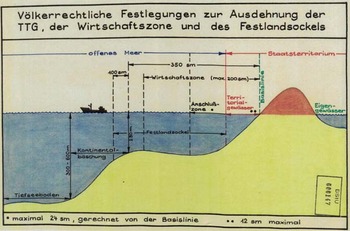
The international norms of the first half of the twentieth century underwent significant revisions on all fronts after World War II, including in relation to transnational spaces like the world's oceans. The United Nations Conferences on the Law of the Sea that took place in Geneva in 1958 and 1960 began to codify new legal regimes for governing water bodies in a series of conventions (UNCLOS I and II) related to particular uses. These governed principally the “territorial sea” and, beyond it, the “high seas” and the “continental shelf.” A further regime for “exclusive economic zones” (i.e., protected fisheries) on the high seas was created during the negotiations that started in 1973 for a much more comprehensive treaty, UNCLOS III (see Figure 2). Even before UNCLOS III concluded in 1982, states began staking claims to such zones and the resources they contained. These new legal frameworks impacted how Poland and East Germany (re-)defined their border in the Baltic Sea in the 1960s and 1970s, ultimately leading to open disagreement by the 1980s, as both countries’ interests in fishing, shipping, drilling, and security clashed.
International Arrangements for the Extension of the Territorial Sea, Exclusive Economic Zone, and Continental Shelf.Footnote 56 The diagram shows the respective delimitations (from right to left, above water) of state territory, territorial waters, the contiguous zone, and economic zone as well as (below water) of the continental shelf, its embankment, and the seabed.

According to UNCLOS I, “territorial seas” were waters adjacent to the coast in which a state could exercise its sovereignty.Footnote 57 However, neither the 1958 conference nor its 1960 follow-up reached consensus over how broad territorial seas could be. The United States pushed for territorial seas to be limited to only the first three or at most six nautical miles from shore so that its strong navy could move unimpeded in international waters—something several South American and postcolonial states were keen to prevent.Footnote 58 The Soviet Union argued for wider territorial waters of twelve nautical miles precisely in order to limit the activities of NATO ships.Footnote 59 Like most countries (including West Germany), the GDR and Poland continued to enforce their laws within the first three nautical miles from shore. The 1958 conventions also permitted a “contiguous zone” (like Poland's “extension zone”) beyond the territorial sea, in which a state might act to prevent or punish “infringement of its customs, fiscal, immigration or sanitary regulations within its territory.”Footnote 60 Between neighboring states, the boundary of territorial waters (and any associated contiguous zone) was ordinarily to be drawn at a “median line” equidistant from the nearest points along the coast of each state, except “where it is necessary by reason of historic title or other special circumstances” to do otherwise.Footnote 61 The west-veering border between East German and Polish waters drawn up to the sixth nautical mile in 1951 represented just such an exception to the “median line” principle, but one for which no explicit justification had been provided in the Frankfurt Act.Footnote 62
Beyond the territorial sea (and its possible extension) were the “high seas,” international waters in which all states enjoyed freedoms of fishing and navigation.Footnote 63 No state had sovereignty over the high seas, but all were obliged to adopt measures for “conservation” of the seas’ living resources—defined not in terms of protecting ecosystems, but rather as “rendering possible the optimum sustainable yield from those resources so as to secure a maximum supply of food and other marine products.”Footnote 64 Freedom of navigation on the high seas was guaranteed by international law, but Polish communists worried that direct access to the high seas could be impeded if the shipping lanes to its westernmost ports crossed into foreign territorial waters on the approach to Świnoujście and Szczecin. They continued to argue that the “logic of Potsdam” meant that the Allies had granted them such rights,Footnote 65 but also took action to create facts on the ground: already in the 1950s, they built a second anchorage for Świnoujście-bound ships, placing part of it on the high seas four nautical miles from shore—but in an area closer to the GDR than to Poland, and just beyond East Germany's existing, three-mile-long territorial waters.Footnote 66
UNCLOS I also created a legal regime for the “continental shelf,” which included “the seabed and subsoil of the submarine areas adjacent to the coast but outside the area of the territorial sea.”Footnote 67 The convention thus established a framework for exploiting and extracting undersea mineral resources well beyond a state's immediate jurisdiction, paving the way for offshore oil drilling as it is known today.Footnote 68 Neighboring coastal states were encouraged (but not required) to demarcate their respective portions of the continental shelf using the same “median line” principle that applied to territorial waters.Footnote 69 However, the two were not the same thing: the continental shelf itself did not lie within territorial waters, and rights over it explicitly did not extend to the waters (or airspace) above them. East Germany had been excluded from the 1958 and 1960 UNCLOS conferences, but West Germany signed both conventions. In 1964, the FRG asserted its “exclusive sovereign right” to research and exploit undersea resources “beyond the German seacoast.”Footnote 70 As the GDR pointedly reminded Poland and the Soviet Union, the Federal Republic's understanding of “German” usually referred to the borders of the pre–World War II German Reich.Footnote 71
As East German diplomats scrambled to consolidate GDR maritime claims in response, they sought to strengthen their case through swift agreement and compliance with the very convention from which they had previously been excluded.Footnote 72 On October 22, 1968, the GDR signed a joint Declaration on the Continental Shelf of the Baltic Sea together with Poland and the Soviet Union (which other states were invited to join), followed only a week later by a bilateral agreement with Poland.Footnote 73 The latter fixed the boundary of the continental shelf beyond the sixth nautical mile in strict accordance with the “median line” principle recommended by the 1958 convention.Footnote 74 Whether Polish officials agreed to this out of solidarity, pragmatism, or carelessness, the bilateral treaty established a new German-Polish border on the high seas—one that gave the GDR control of the continental shelf below certain portions of the navigation route to Świnoujście.
An additional layer of complexity was added to the water border with the introduction of “exclusive economic zones” farther at sea, eventually enshrined in UNCLOS III. Within such zones, states would ultimately possess “sovereign rights for the purpose of exploring and exploiting, conserving and managing the natural resources, whether living or non-living, of the waters superjacent to the seabed and of the seabed and its subsoil” in an area of the high seas, effectively giving them the power to license, limit, police, and control fishing.Footnote 75 Even before UNCLOS III negotiations began, though, numerous states began declaring protected fishing zones as far as 200 nautical miles from shore, a limit that corresponded to the long-standing demands of coastal and island states such as Peru and Iceland that depended economically on fishing.Footnote 76 However, such a broad limit was ill-adapted to the confined space of the Baltic Sea, where neighbors began racing one another in the 1970s to stake out fishing claims in anticipation of future changes to international law. In 1970, the Polish parliament, the Sejm, passed domestic legislation establishing a protected fishing zone on the high seas. However, it did so according to a straight-line extension of the six-nautical-mile border rather than following the “median line” of the more recent continental shelf agreement.Footnote 77 This meant that in a certain portion of international waters, East Germany ruled over the seafloor while Polish law governed the fish above it. The Sejm redrew the fisheries zone in 1977, but the new boundary likewise failed to align with that of the continental shelf.Footnote 78 In addition to encroaching on potential GDR claims, these measures blocked East German access to traditional Baltic Sea fishing grounds.Footnote 79 GDR fishermen were, however, not the only ones to suffer, as similar measures were enacted by Sweden (January 1974), the Soviet Union (May 1977), East Germany itself (January 1978), and also West Germany (May 1978), effectively carving up the already-overfished Baltic into competing national zones.Footnote 80
The multiplication of legal regimes governing water use had led Poland and East Germany to stake different claims along different boundaries, reintroducing confusion over the border's location in the water. In order to resolve the discrepancies, GDR diplomats from 1971 on insisted that Poland would have to change its laws to bring the different borders into alignment. According to them, only a “median line” boundary would do: anything else might set a legal precedent that the FRG could exploit on the GDR's western border to shut off access to the Bay of Lübeck.Footnote 81 East Germany was also keen to avoid conflict over the so-called “cadet trench,” a shallow but heavily trafficked passage on the high seas between Denmark and the GDR used by both NATO submarines and Soviet warships.Footnote 82 Given the sensitive East-West issues involved, GDR diplomats argued that their insistence on the “median line” was not a matter of “harping on principles [Prinzipienreiterei].” The GDR could reach an acceptable agreement with western neighbors “only on the basis of the median line principle” and needed a precedent with Poland in order “to use agreements with socialist states in this struggle against the FRG.”Footnote 83 As with the continental shelf treaty, GDR negotiations with Poland over the water border were guided by competition with West Germany and framed in terms of the security of the entire socialist bloc.
A final complication arose as ongoing UNCLOS III negotiations led to a new consensus by 1977 that territorial waters could extend up to twelve nautical miles from shore (as opposed to the three to six miles that many Baltic states had previously practiced).Footnote 84 As with protected fishing zones, states began declaring extensions to their territorial waters well before these changes were even formally integrated into the Law of the Sea in 1982. The GDR had considered doing so in 1971 and 1975 but decided to hold off, partly in the hopes of developing a coordinated strategy with Poland and the USSR (as well as avoiding conflict with western neighbors).Footnote 85 When the Sejm redrew Poland's fishing zone boundaries in December 1977, it also extended territorial waters from six to twelve nautical miles—again following a border that did not align with that of the 1968 continental shelf treaty.Footnote 86 In so doing, Poland laid claim not only to the fish but to full sovereignty within a portion of the open seas that the GDR had hoped to claim for itself. As before, Polish actions were apparently motivated by concern about the Szczecin-Świnoujście port complex. In the late 1970s, Polish leaders invested heavily in maintenance and modernization of the port, which was becoming an important transshipment point for North–South trade in Europe. Modernization measures included not only improvements to southbound rail links but also the deepening of the navigation route's waterways (based on geological characteristics of the Baltic Sea, without reference to existing or potential GDR claims in the area).Footnote 87 Another element was the establishment of a new anchorage on the high seas for heavy container ships, which port authorities began using on an informal basis in 1976.Footnote 88
For East Germany, Świnoujście's Anchorage Nr. 3 lay in exactly the wrong place: west of the shipping lanes rather than in Poland's own territorial waters to the east; less than twelve miles from shore and thus in an area East Germany was entitled to claim as territorial waters; and within a maritime bombing range used by the East German military. Perhaps most importantly, though, it lay on the GDR's continental shelf. In preparation for publishing the location of the anchorage to international seafarers, Polish authorities requested permission from East Germany in 1984 to conduct a mine sweep of the GDR's continental shelf as a final safety check.Footnote 89 MfAA lawyers were alarmed: if the GDR allowed the Polish anchorage to be internationally recognized, East Germany would never be able to claim for itself the area, which was “of particular interest to the GDR from a military perspective (training area for naval and air forces) and for economic reasons (natural gas deposits).”Footnote 90 At the end of December 1984, the Council of Ministers took the highly confrontational step of extending the GDR's territorial waters from three to twelve nautical miles—following the “median line” rather than Poland's declared boundary or any bilaterally agreed boundary.Footnote 91 Beginning January 1, 1985, both states thus claimed exclusive sovereignty over an overlapping area of the Baltic Sea that included vital navigation infrastructure as well as important marine and mineral resources. In order not to provoke West Germany and NATO, the GDR opted to apply the extension of territorial waters fully in the East but only partially in the West. As a result, East Germany was now treating its own ally worse than its mortal enemy.
The Territorial Waters Conflict: Escalation and Resolution
At first, neither side publicly acknowledged the brewing conflict, and both worked to keep up appearances. The two ruling communist parties even celebrated the thirty-fifth anniversary of the Zgorzelec Treaty on July 6, 1985, with a regional gathering in Ahlbeck (of all places). Within view of Świnoujście's contested shipping lanes, some 10,000 Polish and East German citizens listened to speeches by leaders of the Socialist Unity Party (SED) and the Polish United Workers’ Party (PZPR) praising the shared “border of peace.”Footnote 92 Behind the scenes, however, the diplomatic exchange grew increasingly hostile. After the GDR declared its territorial waters extension, Poland issued a diplomatic note in February 1985 refusing to recognize the claim.Footnote 93 In September 1986, Poland opened Świnoujście's Anchorage Nr. 3 for general use. The GDR responded by ordering the Volksmarine to prevent ships from using the anchorage.Footnote 94 The dispute over territorial waters spilled over to other issues, with Poland threatening to halt the return of Prussian State Library holdings to East Germany while the GDR dragged its feet on loosening travel restrictions for Polish visitors. In April 1987, a personal adviser to General Wojciech Jaruzelski publicly admitted that Poland's bilateral relations with East Germany were worse than with any other socialist country.Footnote 95
What began as a diplomatic dispute between legal experts soon escalated into an open conflict affecting ship captains, fishermen, and others who lived and worked along the Baltic Sea.Footnote 96 The Polish foreign ministry (MSZ) lodged formal or informal protests with the MfAA regarding a dozen separate incidents involving the Volksmarine between December 1986 and October 1988, representing only some of the most egregious cases of intimidation against sporting boats and large tankers.Footnote 97 It never protested GDR aggression toward fishing boats, though it may simply not have had to: even the occasional presence of gunboats was probably enough to intimidate smaller vessels into avoiding the area. Rumor did the rest. In 1988, Świnoujście's private fishermen worried that the dispute would mean “the end for all of Polish fishing on the western coast.” To the consternation of GDR authorities, the fishermen shared their views with a West German television crew, thereby revealing the disunity that existed between socialist allies. They told a reporter that “for security reasons,” they made sure to stay in touch with Polish patrol boats along the port's waterways. They had heard rumors of “a Polish sailboat” that had “ended up in GDR waters and was immediately shot upon with flares from a helicopter.”Footnote 98
Sailboats, yachts, and other sporting boats were in fact a constant nuisance to GDR authorities. Between April 1985 and August 1986, East German authorities recorded some 425 violations of GDR territorial waters by foreign sporting boats—of which more than half (236) had been committed by Polish vessels.Footnote 99 Many of these alleged violations took place nowhere near Świnoujście's contested waterways, but they were part of the same dispute. Because Polish authorities refused to acknowledge or publish information about the GDR territorial waters extension, captains using official Polish navigation documents regularly continued to pass too close to the East German coast much farther west, especially around Rügen.Footnote 100 Because the water border itself was largely invisible, seafarers depended on accurate, published coordinates to identify the boundary and situate themselves.Footnote 101
A particularly notorious incident involved the ship Navigator, which GDR border guards found anchored in the Bay of Wismar with three fishing rods out on July 5, 1987. According to an “informal complaint” by the MSZ over the “inhumane” treatment of the Navigator crew, Kalashnikov-toting East German officers boarded the ship and forced the captain to sign a protocol in German before evicting him from GDR territorial waters. Twenty minutes after releasing the ship, the same patrol boat returned, having discovered that Navigator was already wanted for a previous offense. This time, officers “occupied” the ship and forced it to dock in Wismar, where the crew was held under surveillance for six hours before the captain was compelled to pay a 300 Mark fine.Footnote 102 These measures were exceptional, but the Volksmarine reported that it had expelled no fewer than sixty other Polish yachts for similar violations throughout the summer months.Footnote 103 The following year, the GDR's aggressive enforcement led to a dramatic reduction in such violations (to only thirteen), but Polish boats were still the most frequent culprits (six cases).Footnote 104
While rumor about such incidents spread quickly, East German activities toward Polish and foreign container ships created more serious problems for international shipping. In December 1986, the Volksmarine's 6th Coastal Border Brigade sent a patrol boat to evict two Polish ships from the anchorage. The ship captains reluctantly complied, despite being instructed by Polish authorities to ignore Volksmarine commands along the navigation route.Footnote 105 However, large ships could and did get away with simply ignoring East German patrol boats: on January 5, 1987, the captain of Generał Prądzyński disregarded GDR orders to leave the anchorage, insisting that his ship's draught was too deep to anchor anywhere else.Footnote 106 The Volksmarine was similarly powerless to stop the Bełchatów, loaded down with 60,000 tons of iron ore, from laying anchor in June.Footnote 107 The East German navy continued to stop these and other Polish ships throughout the summer of 1987, even as negotiations between GDR and Polish leaders took place.Footnote 108 By the end of July, patrol boats were also stopping Świnoujście-bound ships from Cyprus as well as NATO member Turkey.
Similar confrontations continued the following year, becoming ever more dangerous. When a Volksmarine patrol boat attempted to block the Cypriot ship Panagiotis L. Perivolitis from using the anchorage, the 76,000-ton tanker failed to stop or turn in time, leading to a collision. No one was hurt, but both ships suffered damage and Polish rescuers had to be brought in to help the Panagiotis after it ran aground in nearby shallow waters.Footnote 109 An incident of this magnitude had to be reported directly to SED leaders, including Erich Honecker.Footnote 110 Perhaps in consequence, the number of incidents diminished thereafter, though not without a dramatic finale: in July and August 1988, three tankers and a ferry were witness to explosions as the East German military performed exercises in the bombing range near Anchorage Nr. 3. The MSZ opted not to issue a formal protest but warned that the use of mines or live ammunition near a shipping route would be hard to keep quiet. Furthermore, it told the GDR's embassy that information about the incident “has spread quickly in the Szczecin/Świnoujście area,” with “certain forces” sowing rumors that “the GDR wants to put pressure on Poland to get its way regarding the sea border.”Footnote 111
In the absence of open discussion or even official acknowledgment of the dispute, the populations of Świnoujście and Szczecin were incredulous as to why the GDR was behaving with such hostility toward ships in supposedly Polish waters. Port workers and city residents complained to state and party officials, and the East German consulate received copies of some of their letters. A ship captain working on land in Szczecin harbor cited rumors circulating among his colleagues and noted that the local cargo operator, the port captaincy, and “users of the port” were all well aware that GDR authorities were evicting cargo ships from Świnoujście's deep-sea anchorage. Ship captains were put in a serious bind by the contradictory instructions they received from the port and from GDR patrol boats: “On the one hand, a captain has no choice, since there is no other safe anchorage for his [sic] ship. On the other hand, he finds himself close to an armed warship that can force him to leave the anchorage on command.” The fact that it was Poland's military ally rather than an enemy state acting this way complicated the matter further, making both states’ claims of friendship and solidarity appear hollow. “I don't need to add anything about what is said among my colleagues and in ship crews about the ‘border of peace.’”Footnote 112
Others stressed precisely their positive outlook toward East Germany in order to articulate discontent. One man wrote a letter emphasizing his commitment to friendship with East Germany and consequent “concern” over the “many unpleasant remarks” he heard related to the dispute. Though he had always welcomed the “meaningful, positive fact of the formation of the German Democratic Republic,” this conflict was a serious matter: “It is about the state border—and I think among Poles there are no differences of opinion on this matter.” Footnote 113 The director of a local school, a pillar of the local PZPR, wrote that young people too were discussing the conflict, especially after the Maritime University's training ship Navigator had been boarded by GDR authorities. “We train Poland's young generation for internationalism, [with] respect and friendship towards our western neighbors…. We do not want the misunderstanding that has been created by the GDR's incorrect behavior to destroy the friendly relations that have existed up to this point.” For the local party faithful, the territorial waters dispute was an important matter—and an embarrassment—“for Poland and the entire socialist bloc.”Footnote 114
Others with less establishment-friendly credentials also took up the issue. Władysław Daniszewski had been the head of TV Szczecin in 1980 but lost his post when General Jaruzelski cracked down on the independent trade union Solidarność in 1981. Daniszewski addressed a sharply worded letter about the territorial waters conflict to Jaruzelski personally, playing on the latter's military career in the port city. Subsequently published in the opposition paper Obraz, the letter asked whether the general, whose “closest frontline friends” were buried in a war cemetery along the Oder, had forgotten how Poland struggled to obtain, defend, and rebuild the Western Territories after World War II.Footnote 115 Diplomatic inaction in the face of Szczecin's “unease” (niepokój) was a “shame for the PZPR” that “tarnish[ed] the legitimacy of authorities who themselves list the Western Territories on their CV.”Footnote 116 Within Poland, the territorial waters dispute had led to open attacks on Jaruzelski, the party, and communist Poland's basis of legitimacy in having secured border areas like Szczecin.
Foreign policy toward an ally should perhaps have been the least of Jaruzelski's problems in 1988, as Poland's economy crumbled and a new wave of strikes shook the country. Instead, workers themselves linked these problems together: in a letter addressed to Jaruzelski on August 25, 1988, strikers in Szczecin wrote that the GDR's measures had been met “with astonishment and the greatest disquiet [niepokójem]” and that they posed a threat to “the most vital interests of the country, the Pomorze Zachodnie region and the port of Szczecin.”Footnote 117 The loyal communist youth organization promptly denounced the strikers by arguing that “only a strong state—economically and in terms of domestic order—has a favorable negotiating position.”Footnote 118 Oddly, though, it seemed that the Polish state's very weakness ultimately became its most powerful argument for forcing a resolution.
At a meeting between Foreign Ministers Oskar Fischer and Marian Orzechowski in May 1988, the latter argued that the conflict had become a public problem that was stirring up anti-German sentiment in Poland—and attracting the attention of the West German press. The apparent double standard the GDR applied in extending its claims into Polish waters but not into West German waters was particularly infuriating. Putting the lie to four decades of carefully orchestrated propaganda, Orzechowski told Fischer that “only an idealist could believe that all Poles differentiate between Germans from the GDR and the FRG.” As if that weren't bad enough, he argued, “opposition, anti-socialist and clerical groups in Poland are using this question as a tool against the PZPR.”Footnote 119 The SED was already worried about the weakness of the PZPR and the rising influence of both the church and the opposition in Poland.Footnote 120 In February 1988, the GDR consulate in Szczecin reported that an opposition group had drawn up a petition to take East Germany to the International Tribunal for the Law of the Sea in the Hague and that it had approached the local bishop to obtain his signature.Footnote 121 In June, the embassy in Warsaw relayed Polish fears that the bishop would soon speak from the pulpit about the issue.Footnote 122 The PZPR's growing domestic problems in Poland led the SED to accelerate efforts to find a solution in order to shore up its ally.
The invisible border on the water had become the subject of a very visible conflict that threatened the image of “normal” relations between socialist allies. By 1988, Polish and East German negotiators had been debating the location of their water border in diplomatic notes, verbal protests to one another's embassies, expert discussions, high-level party delegations, and meetings between foreign ministers, heads of state, and first secretaries of their respective communist parties for ten years; confusion arising from overlapping water use claims had existed for at least twice as long, and fundamental uncertainties about the water border's location had plagued both communist states throughout their existence. Indeed, the supposedly immutable nature of the German-Polish border was one of the reasons for the GDR's existence. SED leaders increasingly recognized that the border conflict needed to be resolved, lest it cast doubt on socialist solidarity or (as the party's head of international affairs put it) “raise questions that history has already resolved. No one should be given the opportunity to depict developments since 1945 as a historical mistake.”Footnote 123 An exchange of letters between Jaruzelski and Honecker in October 1988 led to a rapid increase in the tempo of negotiations.
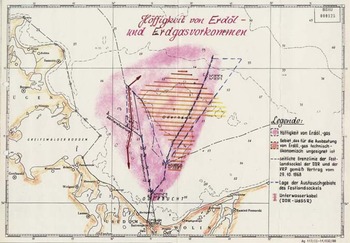
Nevertheless, it took another six months to fully resolve differences. In addition to the disjuncture between their declared water borders, both countries pursued incompatible interests in terms of water use. Poland's primary interest was navigation into Szczecin. The peculiar geography of the region meant that the farthest stretches of the indeterminate water boundary constituted a serious vulnerability for Szczecin's economy. In the four decades after World War II, Poland's communist leaders invested some 28 billion złoty in modernizing and deepening the navigation route to Świnoujście.Footnote 124 The combined Świnoujście-Szczecin port complex accounted for 45 percent of the goods handled in Polish ports, including two-thirds of the country's deep-sea fishing capacity. With a transshipment capacity of 26 million tons annually and major highway and railway connections, it was a significant artery for trade between Scandinavia and the rest of Europe, including to landlocked Czechoslovakia, Hungary, and Austria (not to mention West Berlin).Footnote 125 East Germany was largely unconcerned about navigation in the contested waters because its own ports were located farther west.Footnote 126 What it decidedly did want was resources, both fish and mineral. The GDR refused Polish proposals to move the border west of the Szczecin-Świnoujście navigation route because doing so would deprive it of 2,000 to 5,000 tons of herring annually, worth an estimated 12 to 30 million Mark.Footnote 127 More importantly, energy-poor East Germany had a growing interest in offshore mineral deposits, especially after the Soviet Union had abruptly stopped selling it crude oil at below-market rates in 1980.Footnote 128 The East German Ministry of Geology had conducted its own survey of potential mineral deposits in 1984–1985, the results of which fed into MfAA negotiations (see Figure 3).Footnote 130 And while most of the Baltic Sea was distinctly unpromising from a geological point of view, the contested area constituted an exception where significant undersea oil reserves were expected.Footnote 131
Expected oil and natural gas deposits in the Baltic Sea.Footnote 129

As Poland's navigation interests collided with East German demands for resources, both also ran up against environmental hurdles. East Germany proposed that Poland simply move the anchorage together with the navigation route into Polish territorial waters, and even shared geological expertise showing that only 3 to 4 kilometers of the waterways would need to be deepened.Footnote 132 However, internal East German material acknowledged that there was clear potential for sedimentation to drift into the proposed area.Footnote 133 Poland rejected the proposal, reiterating its longstanding argument that “the geographic situation of the Szczecin-Świnoujście port complex as well as the shape of the seabed in the Pomeranian Bay” left it with no other option than to use the existing waterways and anchorages.Footnote 134 When Poland offered to compensate the GDR for the navigation route with oil-rich mineral deposits on its own continental shelf, East Germany rejected the proposal because the chosen area would be technically difficult to exploit.Footnote 135 In the end, Polish diplomats promised that the GDR “would have the possibility to choose pretty much any area [beinahe jedes Gebiet] that suits it” for both fish and minerals. At the same time, they unofficially communicated that “it is very important not to leave this problem for the next generation of (Poland's) politicians.”Footnote 136 The GDR might not get such a favorable offer if it waited until after the semi-free elections set for June 4, 1989.
On April 10, 1989, a basic agreement was reached. Both sides were forced to drop politically contentious demands in order to achieve a practical compromise adapted to environmental realities. East Germany had always refused any changes to the 1951 border, arguing that doing so risked calling the entire Oder-Neisse border into question. In the end, it accepted just such a revision, redrawing its water border 0.6 nautical miles farther west of the shipping lanes.Footnote 137 Poland too was forced to drop its demand for a treaty text that referred explicitly to the line drawn at Potsdam in 1945; the GDR was adamant that a borderline “west of Swinemunde” did not guarantee Polish control of the shipping lanes in the Baltic.Footnote 138 The new border was drawn according to neither the “median line” so precious to East Germany nor the “straight-line” extension that Poland would have preferred. In the end, the continental shelf and fisheries zones (on the high seas) were redrawn according to a single boundary based loosely on the “median line,” but territorial waters were divided along a separate line. The GDR ceded to Poland a portion of its territorial waters but obtained in return the right to exploit an additional 160 square kilometers in resource-rich international waters previously claimed by Poland for its exclusive use.Footnote 139
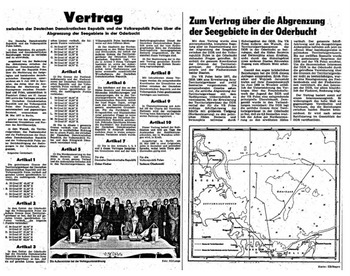
Following the agreement, PZPR officials sent a telegram thanking the GDR for its “great help in the current situation and with a view toward the upcoming elections.”Footnote 140 When negotiations were wrapped up on April 24, 1989, Foreign Minister Oskar Fischer happily reported to Honecker that “for GDR fishing, a significant improvement of conditions was achieved through an exchange of areas for the fisheries zone and the continental shelf.”Footnote 141 The agreement was signed on May 22 and publicized the next day (see Figure 4). Less than two weeks later, Poland held elections in which the PZPR lost 160 of 161 available seats in the Sejm. As Poland cautiously transitioned to liberal democratic structures over the following months, East Germany swiftly collapsed into the waiting arms of the Federal Republic. In 1990, united Germany had to settle all outstanding questions related to the Oder-Neisse line. The border in the water, however, was no longer a matter of debate: the SED's last-minute agreement with the PZPR was absorbed into the new Polish-German border treaty.Footnote 142
Treaty text and map, Neues Deutschland, May 23, 1989, pages 3–4.

Conclusion
Confusion over the water border between East Germany and Poland effectively lasted from 1945 to 1989. Lack of clarity over postwar decisions made by the Allies thus persisted for nearly the entirety of the Cold War. The water border's location was ultimately a question for international lawyers to solve, but its uncertain status had a real effect on the lives of water users and borderland residents, who found themselves caught between the conflicting demands of two allied, socialist states.
In the early postwar period, the water border's impact on everyday life was tied to the larger history of the forced migration of Germans and Poles. Many of the East German fishermen arrested in the 1940s were refugees or expellees from nearby parts of the coast who had lost access to traditional fishing grounds when these areas became Polish. The new postwar Polish state policed their activities with such vigor precisely out of a need to consolidate control over the formerly German territories to which refugees from Poland's own lost eastern territories had fled. With the conclusion of the Treaty of Zgorzelec and the Frankfurt Act, the boundary at sea came to be treated as an integral part of the Oder-Neisse line and therefore just as “untouchable” (unantastbar) as the rest of the “border of peace and friendship” between East Germany and Poland. As a result, it became wrapped up in fundamental questions of legitimacy for each state.
Further layers of complexity accumulated over time. In the 1960s, the GDR pushed through an agreement with Poland on the continental shelf, insisting on a strict interpretation of international law as part of its effort to achieve international recognition and compete with West Germany. The border on (or rather under) the high seas did not align with the boundary of a fishing zone Poland declared in 1970, and it cut through the navigation route into Świnoujście. East Germany consistently rebuffed efforts to renegotiate these different layers of water borders, however, claiming that it could not make concessions to its Polish ally what it wished to deny to its West German enemy. The GDR thus sought to imbue the otherwise highly technical question of the “median line” principle for demarcating the water border with a systemic significance to East-West conflict in the Cold War, making the dispute more intractable.
Both socialist states then exercised the “nuclear option” of expanding their territorial waters along conflicting lines in accordance with different preferences: Poland defended navigation interests while East Germany focused on resources. Within as well as outside the overlapping areas of the sea, sailors and ship captains bore the brunt of the consequences, as East Germany sent its navy to fend off Polish yachts and container ships bound for Szczecin-Świnoujście. The ensuing conflict did real damage to the always paper-thin “Polish-German friendship”—and to the already weak position of the PZPR. East Germany thus found itself compelled to patch up the conflict in order to pacify public opinion in a neighboring country. Bottom-up pressure from abroad forced resolution of a problem that had been created—and frequently reinforced—from the top down.
The nature of the Baltic Sea itself as a transnational space within a water environment also greatly complicated the border work of both states, from delineating and marking it to enforcing law and controlling space. Eels and herring swam from one jurisdiction to the next, and they cared little about which passport their pursuers held. The location of oil reserves under the sea was the result of geological processes, not political negotiations. Boats can travel only where waters reach a certain depth, irrespective of who claims the seabed where they might lay anchor. Though all environments are dynamic and thus present problems for borders that are supposed to be fixed in space, modern notions of territorial sovereignty developed mostly in relation to land and not water. In the forty-five years following World War II, the Baltic Sea changed constantly, not only through the flow of its waters or the migration of its marine life but also through human activities, from overfishing and oil prospecting to the deepening of waterways. These human interventions often had negative consequences that were exacerbated by competition among states to claim resources for themselves.
The territorial waters dispute is a classic case of how the presence of a highly sensitive border can amplify otherwise mundane problems.Footnote 143 The conflict over territorial waters was thus always about much more than just fish and ships. Indeed, all the questions connected with the “Oder-Neisse line” in general were also asked in relation to this most distant, abstract extension of it: Would Poland consolidate control over the “Western Territories”? Would Germans accept the postwar settlement or pursue revanchist border revision? Was the anti-fascist East German state really any different from West Germany when its interests were at stake? In the water, the uncertainties connected with the entire German-Polish border appeared in distorted form, magnifying the challenges of everyday life in this corner of the Baltic Sea.
Acknowledgments
The author wishes to thank the DAAD for the funding that made this article possible as well as the B/orders in Motion Center at the Europa-Universität Viadrina for vital assistance in conducting the initial research.