Introduction
Large hosts tend to have more species and more individuals of ectoparasites than small host species (Cotgreave and Clayton Reference Cotgreave and Clayton1994; Rózsa Reference Rózsa1997a, Reference Rózsa1997b; Clayton and Walther Reference Clayton and Walther2001). These studies were perhaps compromised, however, by the differing and sometimes ineffective methods used to assess louse (Phthiraptera) abundance, as well as small sample sizes of hosts. Nevertheless, clear relationships were detected between louse abundance and host body size. Given the importance of these observations in supporting a central evolutionary hypothesis about ectoparasite diversity and abundance, further tests of the hypothesis are warranted. In a recent study, we examined the diversity and abundance of seven species of chewing lice (Phthiraptera: Amblycera, Ischnocera) on five woodpecker (Aves: Piciformes: Picidae) species using a consistent and effective sampling procedure for lice, with large samples of hosts, and found a similar relationship between louse abundance and host body size, although no effect of body size on louse diversity (Galloway and Lamb Reference Galloway and Lamb2017). Moreover, in some species, larger individual birds tend to have larger populations of ectoparasites than smaller ones (Lee and Clayton Reference Lee and Clayton1995; Durkin et al. Reference Durkin, Luong and Bird2015; Galloway and Lamb Reference Galloway and Lamb2017), providing further support for the abundance–host size hypothesis.
Here, we further tested the generality of the hypothesis that large hosts support a higher diversity and population size of chewing lice than small hosts, using a phylogenetically distinct family of host birds and different communities of chewing lice: eight species of owls (Aves: Strigiformes: Strigidae) hosting 12 species of lice (Phthiraptera: Amblycera, Ischnocera). The owls are: northern saw-whet owl (Aegolius acadicus (Gmelin), n = 15), boreal owl (Aegolius funereus (Linnaeus), n = 13), short-eared owl (Asio flammeus (Pontoppidan), n = 63), long-eared owl (Asio otus (Linnaeus), n = 43), great horned owl (Bubo virginianus (Gmelin), n = 208), snowy owl (Bubo scandiaca (Linnaeus), n = 52), great grey owl (Strix nebulosa Forster, n = 88), and northern hawk owl (Surnia ulula (Linnaeus), n = 11). The chewing lice are: Kurodaia acadicae Price and Beer, Kurodaia magna Emerson, and an undetermined species of Kurodaia Uchida (Phthiraptera: Menoponidae) and Strigiphilus acadicus Emerson and Price,Strigiphilus barbatus (Osborn), Strigiphilus ceblebrachys (Denny), Strigiphilus crenulatus (Giebel), Strigiphilus cursor (Burmeister), Strigiphilus oculatus (Rudow), Strigiphilus pallidus (Giebel), Strigiphilus remotus (Kellogg and Chapman), and Strigiphilus syrnii (Packard) (Phthiraptera: Philopteridae). The owl species were selected from a larger group of owls, retaining species with more than 10 specimens of known mass. Infestation parameters for the lice on these owls were described previously (Galloway and Lamb Reference Galloway and Lamb2019). The 508 owls with 88 570 lice in the current study were collected from various locations across Manitoba, Canada, from 1994 to 2017.
Materials and methods
Owls were mostly salvaged from rehabilitation hospitals at the Wildlife Haven (Manitoba Wildlife Rehabilitation Organization, Île des Chênes, Manitoba, Canada) and Prairie Wildlife Rehabilitation Centre (Winnipeg, Manitoba, Canada). A small number of owls was received from Manitoba Sustainable Development (formerly Manitoba Conservation). All birds were from southern Manitoba, an area of tall and mixed grass prairie in the south and west merging into aspen parkland to the north and boreal forest to the east. Birds were handled and processed in the hospitals and laboratory as described by Galloway and Lamb (Reference Galloway and Lamb2014). Lice were collected by washing birds twice in warm soapy water and once in clean water (Mironov and Galloway Reference Mironov and Galloway2002), a method that removes nearly the entire infrapopulation of lice infesting the host (Clayton and Drown Reference Clayton and Drown2001; T.D.G., personal observation). Lice were identified to species by T.D.G., using the appropriate keys and descriptions for each genus (Price and Beer Reference Price and Beer1963; Clay Reference Clay1977; Clayton and Price Reference Clayton and Price1984; Clayton Reference Clayton1990). Voucher specimens of lice were processed onto microscope slides (Richards Reference Richards1964) or preserved in ethanol and deposited in the J.B. Wallis/R.E. Roughley Museum of Entomology, University of Manitoba (Winnipeg, Manitoba, Canada).
Our data are presented with the caveat that we assume, but cannot prove, that hosts represent a random sample in relation to the mass of the host and to the abundance of lice in the wild population. Birds submitted to rehabilitation hospitals are often dehydrated and their body mass may be reduced as a result. This effect should be consistent among species, and no compensation has been made for possible dehydration in our analyses. The mean intensity of lice on some of the host birds was high, in comparison with the few other studies of lice on owls. The high counts might be explained by the fact that the birds were mostly submitted by the general public after being found injured or in poor health, usually the former. It is possible that louse populations increased while in the rehabilitation centres, although the injuries suffered by most of the birds were such that they could not be rehabilitated and were euthanised quickly. Nevertheless, some birds may have had higher louse populations than normally occurs in nature, particularly the small proportion of individual birds that had many hundreds or over a thousand lice (Galloway and Lamb Reference Galloway and Lamb2019). The high mean counts of lice might also be the result of the efficient washing procedure used to extract lice, a procedure not used in other studies of owl lice. Therefore, we retained all host birds in the analyses, except for chicks and young juveniles without full subadult plumage.
The following data were recorded for each individual bird: its mass, number of lice of each species, number of adult females and males, and number of nymphs. Terms for infestation parameters follow those recommended by Bush et al. (Reference Bush, Lafferty, Lotz and Shostak1997).
Linear regression was used to quantify the relationship between mean abundance (untransformed because normally distributed) of all lice for each owl host and the mean mass of that host (SYSTAT Software 2009). We did not control for the phylogenetic relationships among species, because of the relatively small number of host species. The contribution of mean intensity and prevalence to mean abundance and their relationships to host body size were assessed using Pearson product moment correlations (SYSTAT Software 2009). Next, linear regression analyses were used to determine whether the relationship between louse abundance and host mass applied to both genera of lice. Finally, the effect of the mass of individual host specimens on louse intensity (the number of lice on an infested bird, log-transformed to normalise data) was investigated by linear regression separately for individual host species.
Results
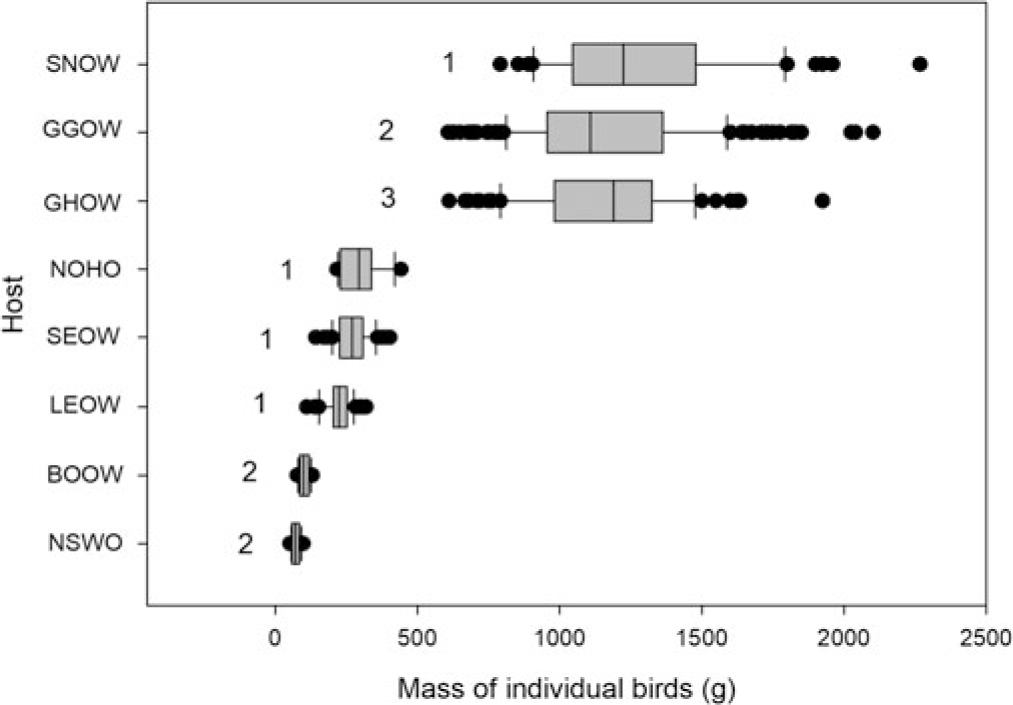
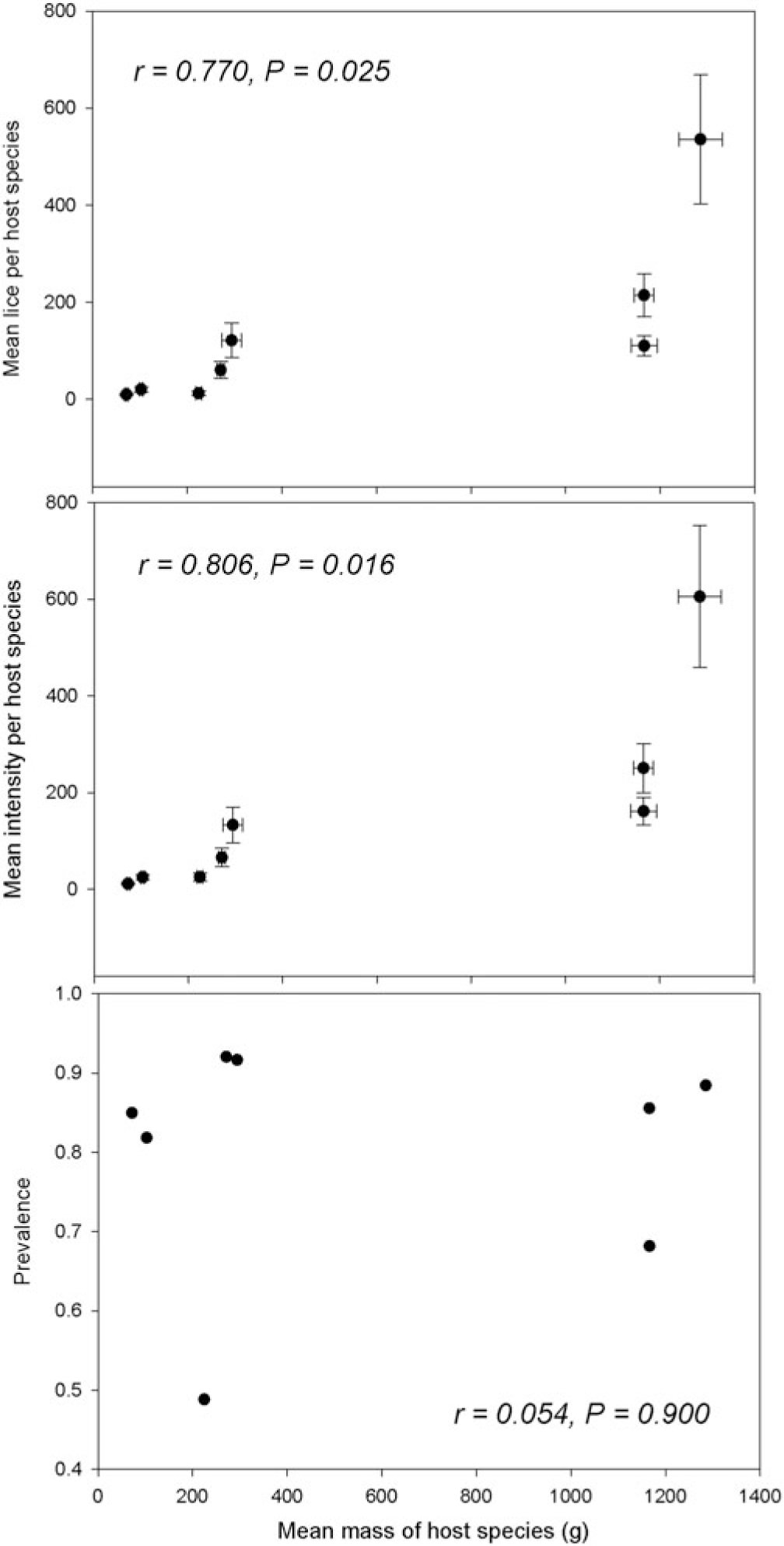
The number of species of lice inhabiting each of the eight host species varied from one to three and was not related to the mean body mass of the host (Fig. 1). The mean abundance of all lice (regardless of species) on the owls increased with the mean mass of the host species, although this relationship was due primarily to the abundance of S. ceblebrachys on snowy owls (the largest host) (Fig. 2). Eliminating snowy owls from the regression reduced the slope of the relationship by one half (Table 1).
The distribution of mass for eight species of owls (Bubo scandiaca (SNOW), Strix nebulosa (GGOW), Bubo virginianus (GHOW), Surnia ulula (NOHO), Asio flammeus (SEOW), Asio otus (LEOW), Aegolius funereus (BOOW), and Aegolius acadicus (NSWO)), and the numbers of species of lice occurring on these hosts. Acronyms for common names according to the Institute for Bird Populations (2014).

The relationships between the mean mass of eight owl species and the mean abundance, mean intensity, and prevalence of lice (all lice regardless of species) on those owl species. Correlation coefficients (r) for the relationships are provided.

Linear regression (Y = a + bX) of mean louse abundance or mean intensity (Y) (all lice regardless of species) and mean host mass (X) for eight species of owls, in comparison with that for seven species (excluding snowy owl).

SE, standard error.
Mean abundance equals mean intensity multiplied by prevalence (Bush et al. Reference Bush, Lafferty, Lotz and Shostak1997), and so, mean abundance can be partitioned into these two components. Mean intensity had a slightly higher correlation with mean body mass (explaining 59% of the variation) than mean abundance (explaining 52% of variation) (Fig. 2). No relationship was evident between louse prevalence and mean body mass (Fig. 2). For owls, any relationship between mean louse abundance and mean host body mass was due entirely to the relationship between mean intensity and mean body mass.
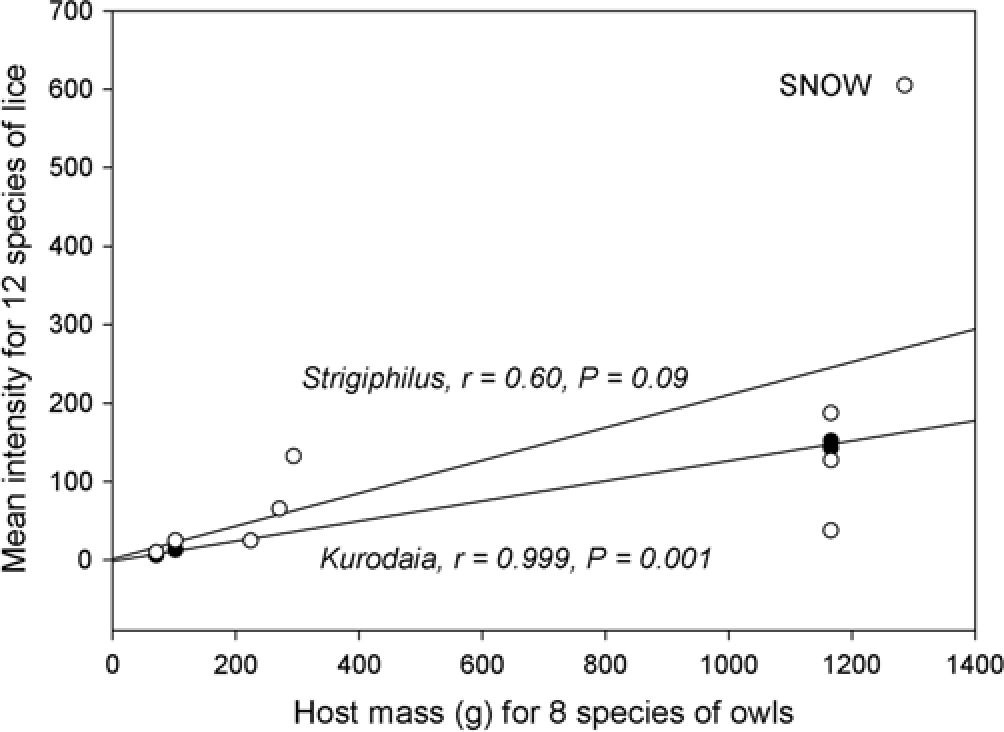
The relationship between mean intensity of lice and mean host body mass arose from the contribution of 12 louse species in two genera (Fig. 3). The slope of this positive relationship was reduced by almost one-half when the louse on snowy owls was removed from the analysis (Table 2). The slope of the linear regression analysis for mean intensity against mean body mass for species in the genus Kurodaia was also positive (Table 2), but due to one species, K. magna, which occurred on two of the three heaviest species of owls (Fig. 3). No significant or consistent relationship was detected for nine species of Strigiphilus, particularly if S. ceblebrachys on snowy owls was deleted from the analysis (Fig. 3, Table 2). No significant linear regression relationship (P > 0.33) between prevalence and host body mass was detected for the species in either genus of lice, and the regressions explained < 18% of the variation (data not shown).
The relationships between the mean mass of eight owl species and the mean intensity of two genera of lice (Kurodaia – filled circles; Strigiphilus – open circles) on those species. Correlation coefficients (r) for the relationships are provided.

Linear regression (Y = a + bX) of mean intensity of lice (Y) on mean body mass of their hosts (X) for individual species of lice and two genera that occur on owl hosts (species and genera analysed with and without snowy owls).

SE, standard error.
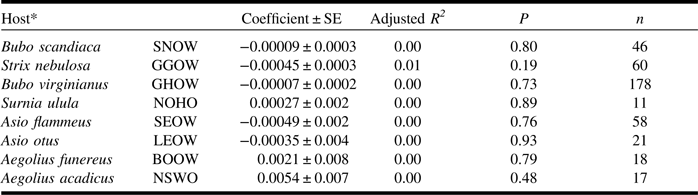
The mass of individual birds ranged from 52 g for the smallest northern saw-whet owl to 2268 g for the largest snowy owl. Within owl species, the ranges in mass among birds were also substantial (Fig. 1). Louse intensity on individual birds (pooled intensity for all louse species present) was log-transformed to normalise residuals and regressed against the mass of an individual bird. For none of the eight species of owls did the number of lice increase with the mass of individual birds, explaining little or none of the variation in intensity (Table 3).
Linear regression of louse intensity (all lice regardless of species, log-transformed) on the mass of individual birds for owls, Strigidae (arranged in the order of host body mass) collected in southern Manitoba, Canada (eliminating birds with no lice).

* Acronyms for common names according to the Institute for Bird Populations (2014).
Discussion
The mass of the eight species of owls varied by more than an order of magnitude, as was the case for woodpeckers (Galloway and Lamb Reference Galloway and Lamb2017), although the largest owls were much heavier than any of the woodpeckers. The largest owl species supported no more species of lice than the smaller owls, from one to three louse species, and no more than the smaller woodpeckers (two to four species) (Galloway and Lamb Reference Galloway and Lamb2017). For these two families of birds, species diversity of chewing lice does not increase with the body size of their host species.
The abundance of lice on owls did increase with the body size of the host. This increase was due to increasing mean intensity with host mass, and prevalence was unaffected by host body size. This pattern is similar to that observed for woodpeckers, although the relationship between intensity and host body size for owls had a slope about half that for woodpeckers (Galloway and Lamb Reference Galloway and Lamb2017). The slope of the relationship for owls was reduced by half again if snowy owls were excluded. Three Kurodaia species did have mean intensities that increased with host mass, although the relationship was due entirely to one species, K. magna, which had a higher mean intensity than the other two species and occurred on two of the heaviest owl hosts. There were no Kurodaia species infesting any of the three species of owls of intermediate size. Three of nine Strigiphilus species deviated from a weak and non-significant positive relationship between mean intensity and host size: S. syrnii, on great horned owls; S. crenulatus, on northern hawk owl; and particularly S. ceblebrachys on snowy owls. Strigiphilus syrnii was rare and had low intensity with only five owls infested with this louse, and S. crenulatus, although prevalent, was found on only 11 owls. The small sample sizes of these hosts may have affected estimates of intensity. The very high intensity for S. ceblebrachys was based on a sample of 46 snowy owls; this relationship begs a biological explanation. Snowy owls in this study were all collected outside their breeding range, when they flew south in search of food which was probably scarce in the north. These birds might well have been a biased sample of young and hungry birds.
Although mean intensity for the total population of lice (regardless of louse species) on owls did exhibit the expected increase with the mean size of host species, albeit weakly, the body size of individual birds explained none of the variation in louse intensity for any of the eight hosts. This was true although generally a wide range of body mass was observed for each of the species, usually a two- to threefold difference between the lightest and heaviest birds. In contrast, the body size of individual birds explained about 75% or the variation in louse intensity for woodpeckers (Galloway and Lamb Reference Galloway and Lamb2017). Louse abundance on owls was less sensitive to variation in host body size, both size differences among species and among individual birds, than was the case for lice on woodpeckers.
The body surface of each individual bird is the habitat for the populations of chewing lice infesting that bird. Lice may spend generations in this habitat, and have limited capacity to disperse to a new habitat except when hosts are in close proximity. The factors that influence the ecology and evolution of lice when the surface of the host bird is the habitat are potentially consistent with the theory of island biogeography (MacArthur and Wilson Reference MacArthur and Wilson1967). This theory posits that as islands increase in size, the number of niches available to colonists increases, and therefore, the number of species that can colonise the islands increases with island size. So, the number of species of chewing lice that can co-exist on a host should increase with the body size of that host, a view that has found support for ectoparasites including chewing lice on birds (Cotgreave and Clayton Reference Cotgreave and Clayton1994). For example, Rózsa (Reference Rózsa1997a, Reference Rózsa1997b) hypothesised that a larger host body size would lead to a more complex surface architecture within which to escape host-grooming activities. However, both for the eight species of owls studied here, and for five woodpeckers (Galloway and Lamb Reference Galloway and Lamb2017), the expected relationship between host body size and the diversity of louse species does not exist. Clayton and Walther (Reference Clayton and Walther2001) reached a similar conclusion for 52 species of Neotropical birds. For owls, perhaps the species diversity of lice within this one family of birds is constrained by the phylogenetic relationship between host and lice. For example, there are only three genera of lice that infest owls, Kurodaia, Colpocephalum Nitzsch (Phthiraptera: Menoponidae), and Strigiphilus. Therefore, the maximum species of lice to infest any species may be limited by this phylogenetic relationship. Great horned owl is somewhat anomalous with four species of Strigiphilus infesting it throughout its range, two in Manitoba; however, great horned owl has the greatest north–south range, which may have played a role in speciation in Strigiphilus.
Although chewing lice on birds are thought to partition the surface of their host (Johnson and Clayton Reference Johnson, Clayton, Price, Hellenthal, Palma, Johnson and Clayton2003), into what might be considered separate niches, the number of such niches is limited and dependent on the types of areas on the surface of a bird. Perhaps the number of niches changes little from species to species as host body size increases – a wing, a breast, or the back of a neck are present on all birds. This view of how chewing lice partition the host surface is consistent with our observation that the number of chewing lice species does not necessarily increase with body size in owls, or in woodpeckers (Galloway and Lamb Reference Galloway and Lamb2017).
Even if the number of niches remains relatively stable as host body size changes, the size of those niches increases in area, as host size increases. Larger host species provide more surface area for occupation than smaller species, resulting in potentially larger louse populations in the larger habitat with more resources (Rózsa Reference Rózsa1997a, Reference Rózsa1997b). This hypothesis is consistent with the differences in louse mean intensity among woodpeckers, and also for the trends in louse intensity with mass for individual birds within species (Galloway and Lamb Reference Galloway and Lamb2017). Although the mean intensity of louse populations also increased with the mean mass of owl species, the slope of the relationship was less than half that for woodpeckers; three of the species of lice on owls deviated widely from the relationship; and the intensity of lice on individual birds did not show this relationship for any owl species. Populations of lice on owls must be subject to ecological factors, as yet unknown, other than the body size–mean intensity relationship. Similar studies to ours are needed from other parts of the world and including a wider range of species of owls and their lice before we may understand the nature of this relationship.
Acknowledgements
We thank the staff at the rehabilitation hospitals of the Wildlife Haven and the Prairie Wildlife Rehabilitation Centre for the care with which they handled the birds for this study before they reached our laboratory; thanks also to Jim Duncan and Ken DeSmet from the Manitoba Sustainable Development for specimens of owls and for their continued support. Special thanks go to Dave Holder, Lisa Babey, Chérie Dugal, and the many students who helped by washing birds. We thank Manitoba Sustainable Development (formerly Manitoba Conservation) for issuing scientific permits to carry out this study. This research was funded in part by Discovery Grants to T.D.G. from the National Sciences and Engineering Council of Canada and by Manitoba Conservation (Sustainable Development Initiatives Fund). The continued support of the Department of Entomology and the Faculty of Agricultural and Food Sciences at the University of Manitoba is greatly appreciated.