The prevalence of age-related health problems is an important public health issue. Projections show that by 2050 the number of individuals aged 60 or more will grow to approximately 2 billion and will account for 22 percent of the world's population. It is also estimated that 35.6 million people worldwide are living with dementia and that this figure will almost double every 20 years, reaching 115.4 million in 2050 (Reference Mathers and Loncar1). In “Facts about Ageing,” the World Health Organization notes, “the number of older people who are no longer able to look after themselves in developing countries is forecast to quadruple by 2050. Many of the very old lose their ability to live independently because of limited mobility, frailty or other physical or mental health problems. Many require some form of long-term care, which can include home nursing, community care and assisted living, residential care and long stays in hospitals” (2) The approach adopted by the e-DENT project is to use teleconsultation as an effective and cost efficient (Reference Kimble3) method to improve dental care for marginalized groups, such as the dependent elderly, who find it difficult to have regular consultations with a dentist (Reference Sanchez Dils, Lefebvre and Abeyta4). Moreover, previous research found that increasing dependency and decreasing cognitive ability are translated into worsen oral health and consequently an increased need for treatment (Reference Zenthoefer, Cabrera, Hassel and Rammelsberg5) for the elderly in nursing homes.
BACKGROUND
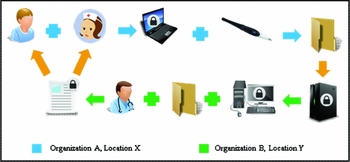
The e-DENT project is based in the Languedoc-Roussillon region, France; it was started in 2014 and involves the Montpellier University Hospital and the company ORAL-B (Procter & Gamble); it is supported by the Regional Health Agency. The project is based around an asynchronous teleconsultation of patients by a geographically remote dentist. The dentist is assisted by a healthcare professional, a nurse, who remains with the patient. This process is summarized in Figure 1. Beginning at the top left of the diagram, the nurse takes pictures and videos of the patient's mouth and teeth with the Soprocare® intraoral camera, which uses different LED light spectrums to reveal dental caries, new and old dental plaque, and gingival inflammation, without the need for dye solutions. The camera is connected to a laptop that runs the e-DENT software in which the nurse creates the patient's file that holds the images, the videos and all patient-related information.
Asynchronous oral teleconsultation process.

When the laptop is connected to the Internet, the data are sent to a server at the Montpellier University Hospital. These data are accessed by the hospital's dentist, who adds a diagnosis to the file and proposes the type of dentist and intervention that is needed (Reference Giraudeau, Valcarcel and Tassery6). The nurses used the camera twice for each patient, with a gap of 4 to 6 months between assessments to highlight changes in the patient's dental status.
Assessing Technology Acceptance in the e-DENT Project
The system used for oral teleconsultations in the e-DENT project is an experimental prototype; consequently, patient acceptance is crucial to allow the technology to move beyond the prototype stage and enter everyday use (Reference Broens, Huis in't Veld, Vollenbroek-Hutten, Hermens, van Halteren and Nieuwenhuis7). Dentistry is an area with a known problem of odontophobia, or more simply a fear of dentists; thus, the acceptance of novel technologies in dentistry may pose a particular problem. Measuring acceptance of such technologies in the context of e-DENT raises a further problem. Elderly patients, particularly the dependent elderly, are more likely to have some degree of cognitive impairment. Almost all of the previous research on technology acceptance has relied on the subject's ability to reason, answer questions, and respond to questionnaires. This raises the question of how can one assess the patient's acceptance of a medical procedure when this is not the case?
AIMS
The overall aim of the e-DENT project is to provide access to an oral consultation for the elderly in France. Our more immediate objective is to evaluate the acceptability of the technology used in the e-DENT project with the type of patients that the project is designed to address. This study presents the initial results of a study to evaluate the acceptability of the system used in the e-DENT pilot project using up to 800 subjects spread across sixteen sites: 600 elderly people, 100 prisoners, and 100 frail people, from twelve long-term care facilities, three specialized nursing homes, and a prison medical department (Reference Giraudeau, Valcarcel and Tassery6). To do this, we use the technique of direct observation by nurses to assess the patient's perception of the oral teleconsultation procedure.
METHODS
Adherence can be defined as the “active, voluntary, and collaborative involvement of the patient in a mutually acceptable course of behavior to produce a therapeutic result” (Reference Delamater8). There has been a great deal of research on adherence related to medication (Reference Osterberg and Blaschke9) and many different methods for measuring it have been proposed. These methods may be broadly categorized as being either direct or indirect (Reference Osterberg and Blaschke9;Reference Chen and Chan10); indirect measures rely on self-reporting, such as interviews or questionnaires, direct methods rely on independent observation by the provider, such as direct observation of the patient.
Cognitive Disability and Impairment
Our study involves elderly people, people with various physical and/or cognitive impairments, as well as people subject to psychosis. Such disabilities have a negative effect on cognitive abilities as well as language, motor, and socialization skills (2). There have been few studies of technology acceptance in the area of teleconsultations among older people, and even fewer that deal with people with cognitive impairments (Reference Chen and Chan10). The level of cognitive impairment in our sample limits the use of indirect measures, a technique that is widely used in technology assessment, as patients may not be capable of accurate self-reporting or understanding a questionnaire.
Pain and Affect
Observation of patients by nurses, however, is common practice in healthcare settings such as intensive care units, geriatrics, nursing homes, and psychiatry. This approach relies on the fact that patient/nurse interactions tend to occur more often than patient/doctor interactions (Reference Inouye, Foreman, Mion, Katz and Cooney11). Various concepts have been deployed in the direct observation of patients. Some researchers observe the patient's quality of life (Reference Gerritsen, Steverink, Ooms, de Vet and Ribbe12); others observe pain (Reference Aubin, Verreault and Savoie13;Reference Aubin, Giguère, Hadjistavropoulos and Verreault14) or the patient's mood (Reference Watson and Clark15).
Observational measures, such as PACSLAC-F (Pain Assessment Checklist for Seniors with Limited Ability to Communicate) (Reference Aubin, Verreault and Savoie13), or Elderly Pain Caring Assessment (EPCA) (Reference Morello, Jean, Alix, Sellin-Peres and Fermanian16), have been developed for older adults with severe cognitive impairment. In recent research, mood, or affect, observation has also been used to address the issue of a patient's emotional experience (Reference Watson and Clark15). Watson et al. (Reference Watson, Clark and Tellegen17) developed the Positive and Negative Affect Schedule (PANAS), which consists of two 10-item scales, one for positive affect (PAS) and one for negative affect (NAS). These two scales account for three-quarters of the common variance in mood terms (Reference Watson and Clark18). The resulting PANAS scale provides a measure of mood using several words and phrases that describe different feelings and emotions.
For this study, the patients’ behavior and mood were observed by the nurses whilst using the intra-oral camera during an oral teleconsultation.
The Sample
The sample includes patients from eleven of the sixteen sites taking part in the pilot project. This includes nine long-term care facilities for the elderly and two specialized facilities for adults with severe intellectual, motor, or somatic disabilities. The sample consisted of 135 patients who signed, or for whom their families signed, a written consent form to undergo an oral teleconsultation. The teleconsultations were made between August 28, 2014, and January 27, 2015.
The sample was fairly well balanced between men and women, 45 percent and 55 percent, respectively. Age was not recorded on 18 percent of the forms; however, 59 percent of the patients in the sample were 65 years old or older, 15 percent were between 64 and 45 years old, while 8 percent were between 44 and 20 years old. All patients in the sample, with the exception of one, were recorded as belonging to one of the following groups: autonomous (19 percent), semi-autonomous (33 percent) and dependent (47 percent). The three groups have a different proportion of psychotic patients: 62 percent for the autonomous group, 31 percent for the semi-autonomous group, and 17 percent for the dependent group.
Data Collection
A protocol and an observation form were created to assess how patients react during the teleconsultation procedure. The form (Supplementary Figure 1) focused on two major areas: the patient's behavior and the patient's mood during the procedure. For behavior evaluation it included the following: fear of the electric toothbrush (FET), tendency to bite the camera (BC), difficulties in keeping the mouth open (DKMO), opposing (OPP), and cooperating (COOP); these were chosen as they represent potential inhibitors of the successful completion of the procedure. FET was included for two reasons. First, because the protocol for the teleconsultation included an oral hygiene phase in which the nurse used an electric toothbrush to clean the patient's teeth before using the intra-oral camera, and, second, because the intra-oral camera looks like an electric toothbrush. BC and DKMO were observed because this behavior can have an adverse impact on the teleconsultation.
For the mood evaluation, a reduced and adapted PANAS scale (Reference Watson and Clark15) was used. The original PANAS scale is composed of 10 items relating to “positive” feelings, such as enthusiasm, interest, and determination and a further 10 items corresponding to “negative” feelings, such as fear, sadness, anxiety, and hostility. In this study, due to the difficulty of evaluating some of the items in the context of a teleconsultation, only four positive variables: attentive (ATT), enthusiastic (ENT), interested (INT), and proud (PRD); and four negative variables: scared (SC), nervous (NR), agitated (AG), and hostile (HST) were used. All variables were assessed on a 5-point Likert scale.
The nurse conducting the teleconsultation filled out the paper form based on what she/he observed during the procedure. The data from the forms were entered into an Excel spreadsheet by a researcher. To eliminate potential errors, an automated input form was used which included all the rules governing the values in the observation form.
Data Analysis
For data analysis, a combination of Microsoft Excel 2007 and IBM SPSS Statistics version 22.0 was used. As our goal was simply to identify general trends and potential flaws in the process, the statistics presented here are mainly descriptive. For the analysis, a derived variable, PA-NA (positive affect/negative affect), was added which represents the difference between the sum of the PA and the NA variables (Reference Watson and Clark18). It should be noted that the difference between the two sums is not strictly a measure of the mood of the patient, but it does serve as an indicator of the patient's overall mood during the procedure.
RESULTS
According to protocol, the nurse can stop the procedure at any point if the patient refuses to cooperate. For the sample as a whole, ten patients (7 percent), six men and four women, refused the procedure and in one additional case, the information concerning whether the patient accepted or refused the procedure was missing. Of the ten refusals, four had no observations recorded, meaning that the refusal came before or immediately after starting the procedure. The remaining six refusals were made at some point during the procedure as some data had already been recorded. Refusals included one patient from the autonomous group, four patients from the semi-autonomous group and five patients from the dependent group. Seven of the ten refusals were psychotic patients.
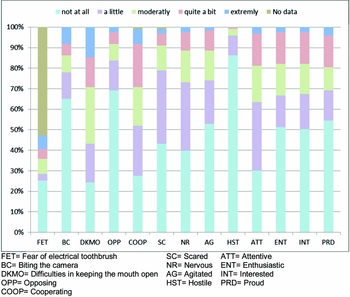
Of the 135 patients who gave consent for the procedure, 124 (92 percent) completed the procedure. However, there were no data recorded for one patient who accepted the procedure; consequently, the results below are for the remaining 123 patients. Further details of the distribution of observations can be found in Figure 2.
Distribution of the observed values for each variable.

Observation of Patient's Behavior
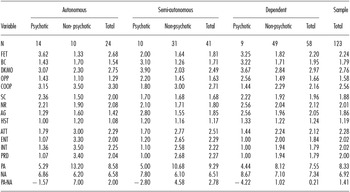
Table 1 shows the averages for the patients who accepted the procedure broken down by patient category. FET was the variable with the lowest returns as it was obtained from only 47 percent of the patients. The average value for FET is 2.24, although this figure was strongly influenced by the responses of the psychotic patients, who had an average FET of 2.96 compared with the nonpsychotic patients’ average of 1.61.
Averages of Each Variable by Patient Category

AG, agitated; ATT, attentive; BC, biting the camera; COOP, cooperating; DKMO, difficulties in keeping the mouth open; ENT, enthusiastic; FET, fear of electric toothbrush; HST, hostile; INT, interested; NA, negative affect; NR, nervous; OPP, opposing; PA, positive affect; PRD, proud; SC, scared.
BC was evaluated for all patients with 65 percent not biting it at all. Psychotic patients tended to bite the camera more than the nonpsychotic patients. An increase in biting can also be observed when moving from autonomous to semi-autonomous to dependent patients.
DKMO was evaluated for all patients, with 76 percent presenting some level of difficulty. Again, psychotic patients tend to have more difficulties than nonpsychotic patients. Dependent patients have the most difficulties followed by autonomous and semi-autonomous.
OPP was evaluated for all patients with 69 percent not opposing at all during the procedure. On average, men were perceived as opposing less than women. Psychotic patients tended to oppose more than nonpsychotic patients. There is a slight increase in the average from autonomous to semi-autonomous to dependent groups.
COOP was not evaluated for one patient; 28 percent did not cooperate with the nurse during the procedure, although they completed it. On average, men cooperated more than women. Psychotic patients tended to cooperate less than nonpsychotic patients. There was a slight decrease of the average from the autonomous to semi-autonomous to dependent patients.
Evaluation of Patient's Mood
As before, the detailed figures for these observations can be found in Table 1.
Negative Affect Variables
SC was not evaluated for one patient. The procedure did not scare 43 percent of the patients. There were no marked gender differences, while psychotic patients tended to be more afraid than nonpsychotic patients.
NR was evaluated for all patients, with 40 percent not being nervous during the procedure. There is a slight difference between genders, men were less nervous than women. Psychotic patients tended to be more nervous than nonpsychotic patients.
AG was evaluated for all patients; 53 percent were not agitated during the teleconsultation. There was a slight difference between genders, with men being less agitated than women. Psychotic patients tended to be more agitated than not psychotic patients.
Finally, HST was evaluated for all patients with 86 percent perceived as not hostile during the procedure. There was a slight difference between genders; men were less hostile than women.
Positive Affect Variables
ATT was evaluated for all patients and 30 percent were considered as not being attentive. Men were more attentive than women, and psychotic patients were less attentive than nonpsychotic patients.
ENT was evaluated for all patients with 51 percent not being enthusiastic while undergoing the procedure. On average, men were more enthusiastic than women, and psychotic patients were less enthusiastic than nonpsychotic patients.
INT was evaluated for all patients, with 50 percent perceived as not interested. Men were more interested than women, and psychotic patients were less interested than nonpsychotic patients.
Finally, PRD was evaluated for all patients with 45 percent perceived as being proud for having undergone the procedure. Men were prouder than women, and psychotic patients were less proud than nonpsychotic patients.
Derived Variable PA-NA
The PA-NA variable has descriptive value as an overall indicator of the patient's mood during the procedure.
The average PA-NA for the whole sample was 1.41 but with a visible difference between genders: the average for men, 2.22, was considerably higher than for women, 0.78. All of the averages for the psychotic patients were negative; the autonomous group had the highest average (−1.57), followed by the semi-autonomous (−2.80) and the dependent (−4.22). For the nonpsychotic patients, the autonomous group had the highest average (7.00), followed by the semi-autonomous (4.58) and the dependent (1.02).
PA-NA is negative for 46 percent of the patients for the whole sample; PA-NA was negative for 43 percent of the men and 49 percent of the women. PA-NA was equal to zero for 6 percent of the patients for the whole sample (11 percent of the men and 3 percent of the women) and positive for 47 percent of the patients for the whole sample (46 percent of the men and 48 percent of the women).
DISCUSSION
Two points are immediately apparent from the results.
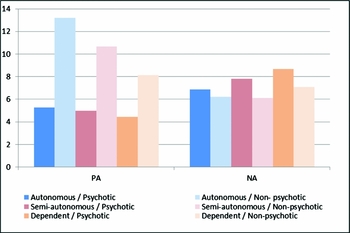
First, the analysis shows that psychotic patients perceived the teleconsultation more as a negative than a positive experience. Nonpsychotic patients had an overall positive experience, which became less pronounced as one moved from autonomous to semi-autonomous and on to dependent patients. Compared with nonpsychotic patients, the overall negative score for psychotic patients was more influenced by the absence of positive affect values than by the presence of negative affect values, this is consistent throughout the patient categories as shown in Figure 3.
Sum of average positive and average negative affects by patient category.

In the sample as a whole, the negative affect was influenced mainly by fear (being scared) and nervousness. This may be related to technology anxiety (Reference Venkatesh19). Research focusing on the acceptance of technology by the elderly identifies technology anxiety and dispositional resistance to change as key features of this group (Reference Guo, Sun, Wang, Peng and Yan20). These factors are also present in our study, with anxiety being observed in the negative affect scale and a dispositional resistance to change as part of the opposing behavior.
Second, it should be noted that anxiety in this case was not related specifically to the use of technology but to the procedure as a whole. Fear of dentistry or fear of receiving treatment, known as dental phobia, odontophobia, dental anxiety, or, more recently, posttraumatic dental-care anxiety (Reference Stefan, Vega and Vega21), is highly specific to dentistry. This means that toothbrush phobia, camera fear, and dentist fear play an important role in the overall experience of the patient.
Limitations
The main limitation of this study relates to the use of nurses to collect observational data.
First, human error affected the quality of the data that was collected. The reliability of the data depends on the level of the professionalism and engagement of the medical personnel involved; unfortunately, in some cases, data was missing and the form was only partially completed. Second, although the patient–nurse relationship is valuable for eliciting information, this relationship could also be a potential source of bias.
Although the nurses’ observations have not been validated by comparing them with either the patients’, or a researchers’, assessments, the findings of previous research indicate that the use of nurses to collect data is valid. For example, De Jong et al. (Reference De Jong, Baartmans and Bremer22) used nurse administered pain behavioral scales to assess young children with burns. Similarly, Manne et al. (Reference Manne, Jacobsen and Redd23) found that behavioral coding of child, parent, and nurse ratings were all significantly correlated when comparing assessments of acute pediatric pain. In the field of psychiatric medicine, Ely et al. (Reference Ely, Inouye and Gordon24) used two specially trained nurses to perform assessments of delirium based on the Confusion Assessment Method while Burrows et al. (Reference Burrows, Morris, Simon, Hirdes and Phillips25) found that screening by nursing staff in nursing homes proved to be a valid approach to identifying depression.
A second limitation concerns the generalizability of the results. As indicated, the immediate goal was to evaluate the acceptability of the approach used in the e-DENT project with the type of patients the project was designed to address; consequently, the generalizability of our results was a secondary concern. However, there is no obvious reason why our findings would not be applicable to similar teledentistry projects or, with certain qualifications, to other forms of teleconsultation involving cognitively impaired patients.
The e-DENT project used thirteen variables, five for pain/behavior assessment and eight for affect/mood evaluation; of these, only three are specific to the e-DENT project and/or teledentistry procedures: FET, DKMO, and BC. FET is highly specific to the e-DENT pilot project. BC and DKMO would be relevant to other teleconsultation projects that use an intra-oral camera, although “biting” and “having a hard time to keep the mouth open” are relevant for teledentistry in general. The remaining variables could be applied to any project involving cognitively impaired patients and teleconsultations that involve the sharing of tasks between clinicians and nurses.
In this case, using only the general variables would have led us to the same conclusions for the limitations of the protocol but would not have helped us to understand some of the underlying causes. Using a mix of specific and general variables allowed the project to identify potential problem areas and adapt the approach for the remaining members of the target population. The reliability and relevance of the data produced is expected to increase as the research expands to cover more of the 800 patients who will eventually participate in the project.
Future Perspectives
The observation form will become part of the teleconsultation software to improve reliability of the observations in future research. This way, once a teleconsultation is finalized, the corresponding observation form will no longer be editable, thus a nurse will need to fill in the observation form during each teleconsultation.
As indicated above, validating our approach would be the next logical step; to do this, two separate paths could be considered. The first, which is already under way, is to collect the data from the same sample of patients in a second teleconsultation and to evaluate the changes between visits. The second is to validate the accuracy of the nurses’ evaluation by comparing it to a self-reported evaluation by the patient. Clearly, this approach can only be used for patients who do not present cognitive impairment. An alternative would be to compare the nurses’ evaluation with that of an external researcher who would accompany the nurse and observe the patient during the procedure.
CONCLUSIONS
An ageing of the population and the rapid evolution of technology are part of the reality of the developed, modern world. The elderly have an unusual relationship with digital technology because they have witnessed its growth and have made a conscious choice to use it, or not. Healthcare is one of the few domains where the elderly will be required to be subjected to new technologies and the associated medical procedures if they wish to be treated. In light of this, we believe there is a need to improve the evaluation of technology acceptance by the elderly to help move the technology development process in a direction that will improve the patient's experience and increase adherence.
In our work, we found very little research that focused on the experience of cognitively impaired subjects during new medical procedures that involve the use of technology. We believe that there is a need to assess the patients’ acceptance of the procedures they are subjected to; direct observation of behavior and mood is an effective technique to achieve this, particularly with the elderly and/or cognitively impaired. An approach based on observations made by nurses has been tested as part of the e-DENT project; despite the complications caused by fear of dental treatment, and the fact that the use of an intra-oral camera is an invasive procedure, the initial results appear promising, both in terms of the specifics of the e-DENT project and in terms of method.
SUPPLEMENTARY MATERIAL
Supplementary Figure 1: https://doi.org/10.1017/S0266462317000319
CONFLICTS OF INTEREST
The authors have no relevant affiliations or financial involvement with any organization or entity with a financial interest in or financial conflict with the subject matter or materials discussed in the manuscript. Dr. Nicolas Giraudeau is the initiator of the project and project manager of the e-DENT pilot.