IntroductionFootnote 1
East Africa’s minority Indian populations have received considerable historical attention.Footnote 2 Following the processes of decolonization, a growing body of literature has emerged that has addressed the social, cultural, economic and professional development of Indian settlers within the Indian Ocean realm.Footnote 3 Yet, despite this there remain several areas worthy of further inspection. The first of these areas relates to the relative paucity of historical information concerning the early history of Indian settlements in East Africa. As observed by Robert Gregory: “since very little remains to chronicle this early relationship,” scholarship pertaining to initial Afro-Indian interactions has proved difficult to come by.Footnote 4 Although Gregory makes particular reference to early trade relations, the same can be said for early twentieth-century diasporic encounters when, as argued by Isabel Hofmeyr, notions of African Indian citizenship were constructed within the boundaries of Empire.Footnote 5 Thus, while some aspects of revisionist literature have documented the political and economic dimensions of Indian immigration - especially in the 1920s and the late colonial period - little emphasis has been placed on the processes of identity formulation and the negotiation of diasporan boundaries during the earlier period. As a result, it can be argued that the significance of the “era of liminality” has not only been overlooked, but continues to compete with the contemporary imagination of pre-1920s East Africa in which the narrative of Indians as “coolies” and the myth of man-eating lions hold prominence.Footnote 6
Second, there has been a tendency, particularly amongst nationalist and colonialist texts, to examine the history of Indian communities in East Africa in terms of territorially bound categories such as the nation state. In an attempt to present and construct African national histories, the nuances of “self-representation” and minority cultures have therefore been neglected in favor of nationalist caricatures.Footnote 7 Similarly, by choreographing the development of Indian communities according to their relationship with the colonial powers, complex layers of belonging amongst diasporic global networks have been obscured. Instead, what is then presented by these discourses is a reductive account of “an exploitative and exclusive Indian privileged minority.”Footnote 8
These differing schools of thought not only present us with a peculiar paradox: one that interchangeably labels Indians as both “coolies” and “an exploitative and privileged minority,” but they also stress a need to further probe the inner lives of the migrant – especially in the context of connectedness between the “global” and the “local.” Moreover, in a broader sense, what this problematic highlights is the methodological unsuitability of historical periodization. By isolating pockets of indenture and later stages of economic dominance by Indian elites, these discourses display a reluctance to examine the continuities; transitions and ruptures associated with diasporic exchange. In sum, the current body of literature fails to shed light on the long and complex history of interaction between Indian Ocean cosmopolitanisms, as well as the nuances of self-representation and identity formulation amongst diasporan groups.
There are two ways in which we can address this gap in the existing historiography. First, recent literature has demonstrated that East Africa’s Indian population favors a transnational approach. Transnational histories seek to transcend the boundaries of the nation state in order to generate new, expansive understandings of the history of peoples, ideas and cultures.Footnote 9 While transnational frameworks are not a recent development they have, nonetheless, been employed by a number of contemporary historians in order to examine “the intimate encounter of universalisms.”Footnote 10 For instance, Sugata Bose’s A Hundred Horizons sets out to “avoid the high degree of abstraction that characterizes so much of global, oceanic, interregional, and comparative histories in which real human beings and their agency vanish from view.”Footnote 11 By discarding linear narratives, Bose examines the space between societies, and in doing so redefines “both the ‘spatial boundaries’ and ‘temporal thresholds’ of Indian Ocean history.”Footnote 12 Along these lines, it is possible to reconstitute and reshape the way in which diasporic networks can be understood. A transnational optic can therefore be a particularly useful tool that can help to de-territorialize sites of self-representation and identity formulation.
Second, an examination of the public sphere can shed light on how culture and politics have been mediated within a diasporic social setting. This is because, according to Habermas, social spaces not only crucially serve as a training ground for public reflection but they also nurture the art of critical-rational debate.Footnote 13 Although East African society during this period does not fit easily with Habermas’ preconditions of a bourgeois public sphere, the importance of its analysis, as set out by Craig Calhoun, nonetheless “lies in its potential as a mode of social integration.”Footnote 14 In recent years a growing body of literature on East Africa’s diasporic populations has examined social spaces in this context. For example, Ned Bertz’s “Indian Ocean World Cinema” and Sana Aiyar’s “Anti-Colonial Homelands across the Indian Ocean” demonstrate how public spaces can become sites for transnational exchange.Footnote 15 They reveal how migrant groups use diasporic cultural and political expressions to create and maintain long distance networks and ties.
In order to address issues of self-representation and historical specificity, the above review of colonial and postcolonial discourses thus suggests a need to revisit and historicize existing sources so as to fully understand the rich tapestry of Indian Ocean identity politics. The Indian Voice of British East Africa, Uganda and Zanzibar, a newspaper published from 1911 to 1913, provides a unique vantage point from which this interactive flow of networks and ideas can be observed.Footnote 16 Published by the Oriental Press, the Indian Voice was one of the earliest non-European newspapers to appear in Kenya. While it is impossible to provide an accurate number, there appear to be three volumes and 155 issues in total - 113 of which remain.Footnote 17 Printed in both English and Gujarati, the bilingual publication – the first of its kind in Kenya – emerged when “a need for a community-oriented press carrying news of events in South Asia and East Africa” arose.Footnote 18 At a time when “Indian” immigration intensified within the Indian Ocean realm, the newspaper aspired to promote, protect and give voice to the interests of Indians overseas. Lasting for a total of three years, its editors strived to “carefully collate trustworthy local intelligence” within an “up-to-date (...) efficient and truthful” journal.Footnote 19 By providing a platform for its Indian writers to articulate a mosaic of social and political currents, the publication was one of the very first sites for Indian self-representation.
Despite the importance of the Indian Voice for both East African individuals and collectivities, scholarly analysis of the newspaper is almost non-existent, and what does exist fails to recognize its value as a historical source. The current body of secondary literature, including Gregory’s Quest for Equality, labels it as “insignificant” in the wider context of Kenya’s militant press.Footnote 20 This can be attributed to a number of factors: very little remains to document the cultural and intellectual genealogy of its contributors, it is difficult to obtain reliable sales and circulation figures, and the newspaper itself had a modest lifespan.Footnote 21 As a result, the Indian Voice has all too frequently been overlooked by academics that instead draw on later publications, such as the East African Chronicle, of which more historical information is available, and which was published when Indian “settlerdom” in East Africa was more pronounced. While providing an instructive commentary on counter-hegemonic anti-colonial networks in the later colonial era, it can be argued that in doing so these studies pass over the complicated trajectories of migrant populations whereby fragile settler communities negotiated new identities alongside new social, class, gender, racial and imperial hierarchies.
Thus, in order to understand the plurality of social interactions, as well as the internal cleavages of twentieth-century East African society, this article evaluates the transformative impact of the public sphere through the analysis of Indian Ocean public spaces – in this case print publics and, more specifically, the Indian Voice. As an important tool for discovering, exploring and analyzing the nature of racial hierarchies, diasporic identity, and belonging, the first section of this article begins by historicizing the Indian Voice. It does so to examine the ways in which it can be used to understand how new kinds of self-representation both emerged and dissolved in early twentieth-century East Africa. The second section then examines the extent to which the Indian Voice was used as a platform for self-positioning. In doing so it highlights issues relating to the public sphere, self-representation, the deliberation of norms, and settler politics. Section three then turns to the complicated nature of identity formulation. Examining the double-location of identity in terms of the “local” and “global,” it assesses the shifting boundaries of belonging alongside the performative strategies of imperial race making. In all, by demonstrating how the Indian Voice offers an invaluable means of generating new insights into the complexities of self-representation and diasporic identity formulation, this article contributes to remapping the historical perspective of East African Indians within the early colonial period.
The Indian Voice, 1911–1913
The Indian Voice began circulation during a period of rapid and fundamental change. With the colonial partition of the region, British imperial interests established their presence and declared British East Africa as a protectorate in the 1890s. Over the following decades a changing social, economic and ethnic landscape emerged. Above all, the early twentieth-century witnessed a shift in migratory patterns, whereby European colonists and Indian workers were actively encouraged to settle inland. Previous to this Indian migrants initially made temporary contact, or comprised small, dispersed settlements mostly in the coastal regions. After 1890 this transformed into a mobility of transnational networking. Migrant networks included families of mercantile adventurers, railway workers, dukawallas (shopkeepers), traders, accountants, clerks, civil servants, soldiers and bodyguards. This shift saw the development of more established Indian communities, and stimulated a wider, international debate concerning the role of Indians in Africa. The contentious “Indian Question” elicited comment from across the social and political spectrum, including Indian nationalists, white settlers and governments in both India and Britain from roughly 1910 onwards. The Indian Voice adds to this discussion, and sheds light on a number of issues that affected settler communities during this period.Footnote 22 Providing a minority perspective, it reveals the complex set of relationships both amongst and between Indian settler populations, the colonial government and more indigenous elements of East African society.
Each issue of the Indian Voice clearly stated its maxim: “The hope of all who suffer, the dread of all who wrong.” Taken from John Greenleaf Whittier’s The Mantle of St. John de Matha, these two lines, which appeared on the editorial page, summarized the paper’s policy and revealed its purpose as a communicative medium that expounded social justice.Footnote 23 Marketed as a journal representing the interests of Indians resident in British East Africa, Uganda and Zanzibar, the paper vowed that: “it will conscientiously fill its mission for which it was really founded, viz, the treatment of all alike, without prejudice.”Footnote 24 A “cosmopolitan organ in a cosmopolitan country,” the Indian Voice was subsequently described by its contemporaries as “quite a moderate evangelistic warrior” that had the potential to “help others consider the Asiatic as a broad-gauged and fair minded individual.”Footnote 25 In principle, therefore, the Indian Voice set out to displace prejudicial attitudes.Footnote 26 Set against a backdrop of anti-immigration coverage found in the European press during this period, it self-styled as a cosmopolitan journal.
With subscribers consisting of those “In Nairobi. Outside Nairobi. And Overseas,” the weekly catered for a diverse range of reading publics, helping to connect British Indian, Goan, African and European audiences.Footnote 27 This was reflected in its layout, which usually began with advertisements for local businesses; an editorial page detailing local and “national” concerns; a section on the Goan community; updates from around the world; and news from India.Footnote 28 Circulated every Wednesday, the Indian Voice was priced at 25 cents, registered at the General Post Office, and was relatively easy to gain access to.Footnote 29
The publication was propped by support from an active audience of local Indian businessmen.Footnote 30 From the numerous pages of advertisements we can see that a number of successful Indian merchants, including the likes of Allidina Visram, Suleman Virji and A.M. Jeevanjee, paid for advertising space and in doing so kept the newspaper’s finances afloat. In the context of early East African print media; this financial backing was important because, as noted by Bodil Folke Frederiksen, “publishing enterprises and print workshops were unstable. In fact, many newspapers came out infrequently, disappeared and were re-launched under new names, or were short-lived.”Footnote 31 Based on Victoria Street, Nairobi, were a newly established cluster of Indian businesses emerged, the Indian Voice secured commercial interest as opposed to state-support, and thus set out to be “the first truly independent journal in British East Africa.”Footnote 32
In terms of print organization, the Indian Voice was very much a collaborative project amongst print elites: its headquarters were housed by the Goan Union, it employed Indian journalists who spoke and wrote in English, and at its helm was its editor H.C. Smith, a white settler. Smith had previously worked at the Globe-Trotter and was respected by European and Indian communities.Footnote 33 His experience, coupled with his liberal, cosmopolitan outlook, both helped the publication conform to the standard print template, as well as validate the newspaper as a serious news organ.Footnote 34 In so doing, the Indian Voice deviated from the European norm by espousing a message of cosmopolitism and multi-racialism within colonial society.
In the context of Indian Ocean print networks, the linkages facilitated by the newspaper were highly visible. At a local level, this developed as a result of inter-textual dialogue between East African print media. For instance, the Indian Voice took a keen interest in the African Standard, its “local contemporary,” and would regularly provide a critical commentary of what was deemed imperialist propaganda. On the other hand, the Indian Voice was engaged in wider, transnational networks. Articles thought to be of note, such as those found in the Times, The Times of India, The Indian Review and other forms of global media, were frequently reprinted in the Indian Voice.Footnote 35 Similarly, periodicals, including South Africa’s Indian Opinion, commented on and reprinted a number of Indian Voice news items. Describing the Indian Voice as “our vivid contemporary,” the Opinion drew on the publication for its “East African Notes.”Footnote 36 It can subsequently be found reiterating the Indian Voices’ call for racial harmony in East Africa particularly within discussions relating to the status of Indians as either subjects or citizens of Empire.Footnote 37 In this way, the Indian Voice was demonstrably embedded within a mature “alternative print network” that enabled cross-regional dialogue between diasporic settler communities.
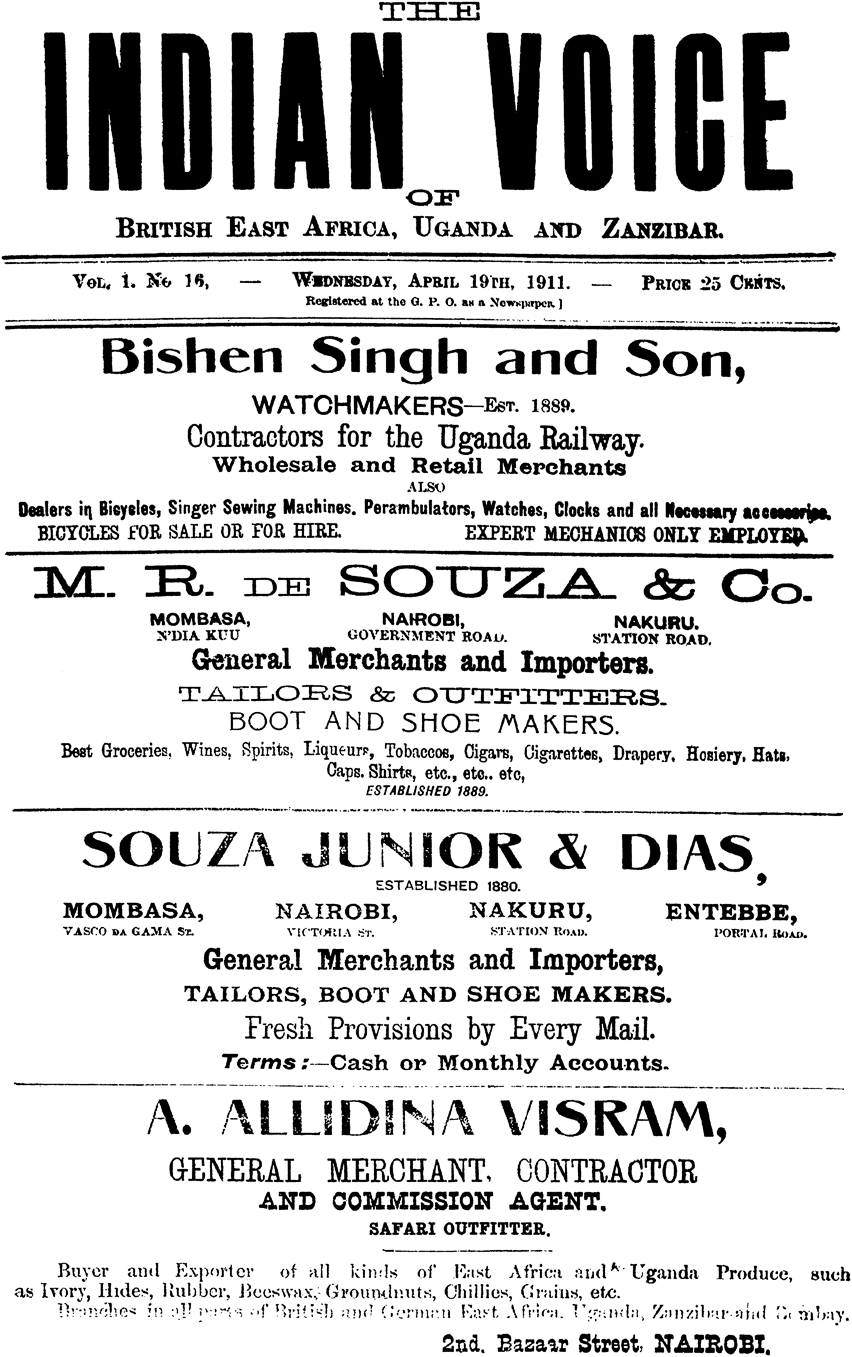
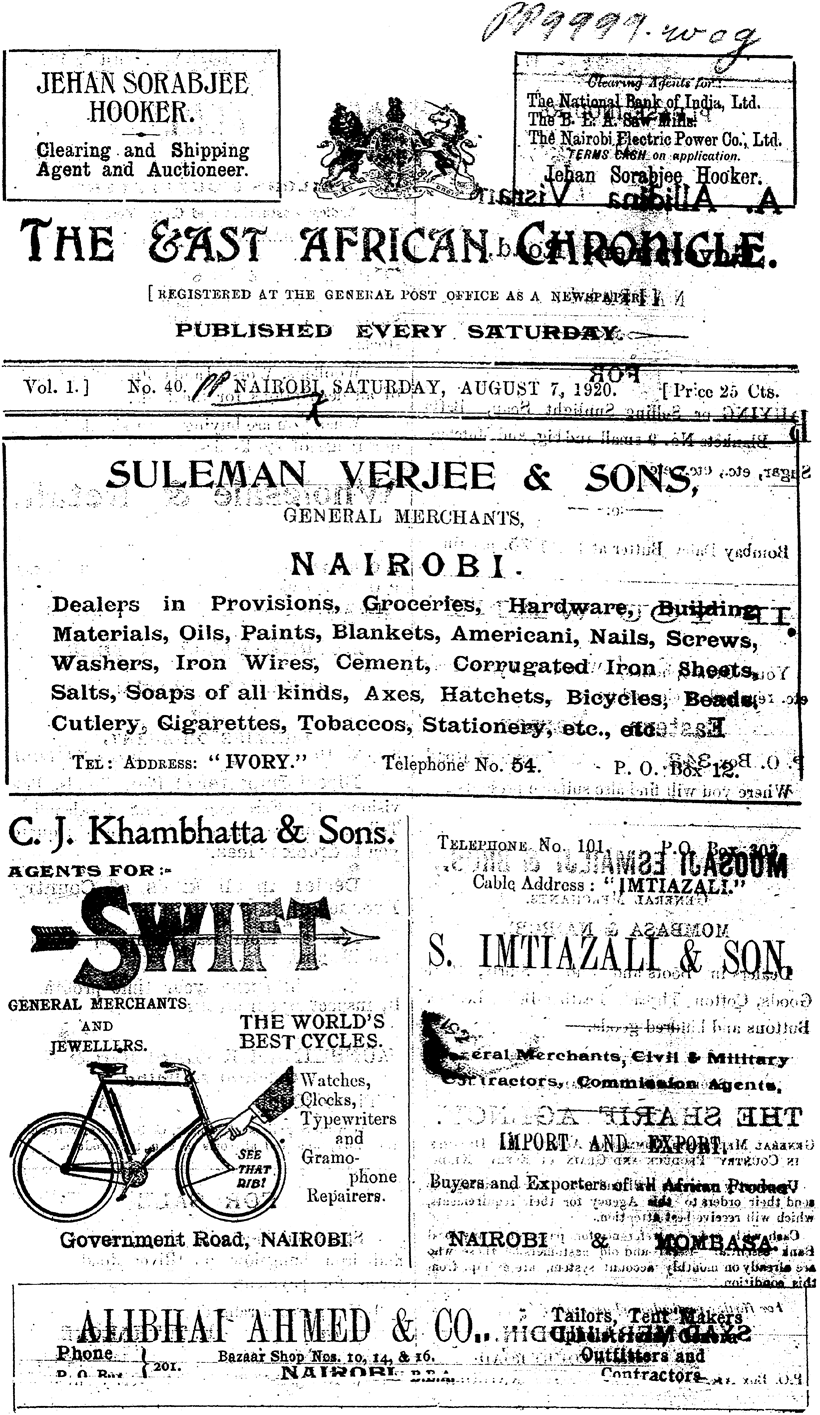
This connectivity, coupled with the Indian Voice’s overarching purpose to represent Indian interests, ensured that with its eventual dissolution in 1913 the legacy of the Indian Voice nonetheless endured. In 1920, the East African Chronicle began publication; continuing the work of the Indian Voice as the primary news organ of the East African Indian population, its structure and news layout was strikingly familiar (see Figure 1). Although the editor of the Chronicle, M. Desai, arrived in East Africa in 1915 and could not have worked on the Indian Voice, it is likely that members of his staff had. The Chronicle, as documented by a number of contemporary historians including Sana Aiyar, played a significant role in the development of Asian and African politics. At one point its offices served as the headquarters of Kenya’s first nationalist leader, Harry Thuku.Footnote 38 Furthermore, the resurrection of the Indian Voice, in a somewhat different form, appeared in The Daily Advertiser, a Gujarati Asian newspaper printed in Mombasa.Footnote 39 The Advertiser included the Indian Voice as an English print counterpart in 1931. The blossoming of these newspapers indicates that when the Indian Voice eventually ceased publication a new print network emerged that had modelled itself on its predecessor. This not only served to expand the reach of these news publications, but also hints at the ongoing legacy of the Indian Voice, as well as the impact it had on Indian reading and writing publics. In light of this, the next section of this article critically examines the Indian Voice as both a medium for self-representation and a forum for counter-publics.
Figure 1. The front cover of the Indian Voice of British East Africa, Uganda and Zanzibar, and The East African Chronicle.

Indian Self-Representation
Founded on Indian capital and printed by its proprietor, D.K Bhutt, the Indian Voice can be considered as an alternative, parallel press that operated within a European-dominated market.Footnote 40 This is because the twentieth-century witnessed a flourishing of East African print media, which began with the African Standard in 1901. Based in Mombasa, the Standard was the forerunner to several later publications. Although founded by the prominent Indian businessman, A.M. Jeevanjee, the newspaper failed to focus on Indians interests.Footnote 41 Jeevanjee assigned the editorship to an Englishman, William Henry Tiller, who subsequently employed a European workforce. Frequently referring to British East Africa as a “white man’s country,” the paper catered for a European, imperial audience and was eventually taken over by its new European owners, A.M. Anderson and F. Mayer, in 1905.Footnote 42 It was later renamed the East African Standard. Footnote 43 Despite this initial setback to the idea of representative journalism, however, an expansion of Indian print media ensued.Footnote 44 Gregory suggests this need for an Indian print public rose out of discontent with the European press, which many felt focused on the European communities and failed to represent minority interests.Footnote 45
As one of the very first sites for Indian self-representation, the Indian Voice therefore offered a platform for a multiplicity of contested voices. New sites for public engagement, such as the “Letters to the Editor” section, provided a forum for the expression of local as well as transnational concerns. A letter to the newspaper dated 27 September 1911, for instance, discussed the revival of Indian Associations in Kenya.Footnote 46 Others deliberated on the role of Indians within East African society and set out to negate anti-Indian prejudice, which was then symptomatic of colonial power structures. For example, on the 30 October 1912, the President of the East African Indian Association, T.M. Jeevanjee wrote:
In the interest of the Indian Community of Mombasa, whom I represent, I consider it necessary and highly imperative to refute, in so far as it relates to the Indians, the Article which appeared in the African Standard under the heading “DANGEROUS AGITATION.” (...) the gathering of the Indians was quite orderly and there was not a single act of truculence from anyone.Footnote 47
Referring to a peaceful gathering in Mombasa that had been depicted by the Standard as a worrying example of Indian unrest, the piece shows how print media was used by community leaders to address multiple audiences. In this instance, Jeevanjee states that the gathering in question was attended by the “Heads of the Indian communities” in relation to the progress of the smallpox epidemic. Speaking to the Indian population he refers to the objectives of the gathering, i.e. the “treatment of persons after death from small pox, and the segregation of the sick and their families” - the existing policy of which, Jeevanjee considered, required further clarity.Footnote 48 More importantly, however, when trying to reinforce their law-abiding nature, Jeevanjee creates a public voice for these Indian communities and provides a minority perspective on the “Indian Question.” Directly addressing a non-Indian audience, he confronts anti-Indian prejudice in his aim to “disabuse the mind of the general public who may have been misled by those evidently trying to get the Indian Community into unpleasant odour with the Government by unwarrantable and audacious accusations.” As both a merchant of news and dealer in public opinion, the piece thus articulates some of the newspapers core objectives: to enhance readers’ agency, and to protest against the calumny of white, imperial journalistic practices to a multi-faceted, wider Indian Ocean public.Footnote 49
Moreover, articles outlining land rights; the availability of plots for British Indians; imperial restrictions; the Highlands; and neighborhood concerns, served to not only inform audiences of current affairs but also provoke conversation and critical commentary.Footnote 50 This meant, for example, that when plague broke out in 1911 the newspaper offered hygiene advice, as well as regular updates on the severity of the disease and the impact it had on the Indian population. It attacked the European press for “reducing the causes of the plague to the conditions of the Indian bazaar,” and protested against its closure, however temporary.Footnote 51 The newspaper therefore functioned as an important channel for collective governance. Since the Indian population in no sense represented a monolithic community, the Indian Voice can, in this way, be seen to provide a distinctive Indian voice, or indeed a collection of distinct Indian voices, for East Africa’s minority migrant populations.Footnote 52
Settler Politics and the Deliberation of Norms
As a means for self-positioning, the Indian Voice can be used to understand the maelstrom of East African intra-settler politics. The following editorial, for example, communicates the deliberation of social and political norms between competing settler groups:
HOW very amusing, yet withal instructive, it is, to read the proceedings of the so called Colonists’ Convention. (...) Mr. Bunbury is reported to have made the statement in the meeting - an emphatic statement - that B.E. Africa is a white man’s country. (...) NOW this is what we are going to fight against. We do not want, nor is it necessary to have, racial antagonism in this country. If (sic) will be fatal to the best interests of the country. (...) It is not diplomatic, it is not even common sense, it is not practical nor will it be tolerated by the Home Government, who at least have no axes to grind and on whom we can and do rely for just and equitable treatment.Footnote 53
The author begins by immediately making reference to the Colonists’ Convention; a meeting held by the Colonists’ Association (1902) on behalf of the colonial office in Kenya. As a constituent member of the Convention of Associations (1910) the Colonists’ Convention challenged the position of Indians in East Africa by marking out the territory as a “white man’s country.” The author “boldly” refutes this and sets out to challenge anti-Indian rhetoric he considers to downplay and devalue the Indian community’s contribution to East Africa.Footnote 54 The author particularly focuses on the benefits of Indian labor, which during this period helped to maintain the Uganda Railway, establish retail enterprise along the coast and in remote villages, and included a class of artisans and “professional gentlemen.”
In so doing, the editorial demonstrates how, in the early twentieth-century, diasporic space was negotiated by “liminal men.”Footnote 55 This negotiation took place between members of the Indian population who attempted to challenge hierarchies of difference that were so deeply embedded in the racial politics of empire, and “empire-builders” - that is, members of the European community such as Mr. Anderson, the editor of the local contemporary The Standard, Mr. Banbury, Mr. Grant, and perhaps even the president of the Convention of Associations himself, the well-known imperialist, Captain E.S. Grogan.Footnote 56 In contrast, the author clearly identifies the Home Government as one that had “no axes to grind.”Footnote 57 Here, white settler interests are set apart from the policies of the Colonial Office. This illustrates the complexities of racial hierarchies in pre-1920s East Africa, which were in fact contested by competing diasporic groups, as opposed to static and grounded in hegemonic colonial power relations.
The Indian Voice navigated this complex socio-political landscape, and, as suggested by its name, strived both to represent and be representative of Indians abroad. Literary journalism was used to convey a desire for greater civil liberties and political representation. For instance, an editorial dated 25 October 1911 discussed the nominal character of Indian political representation. Titled: “Asiatic Representation” the piece states:
The last census figures show that we have in this country 3,175 Europeans against 11, 886 Asians. These figures ought to entitle, in my opinion, the latter section to better representation than what they possess in Government and popular councils in the Colony.Footnote 58
Here, the author makes particular reference to the distinct lack of representation on the Legislative Council, Municipal Council and the Chamber of Commerce. At the time there was only one Indian member in any one of these councils (A.M. Jeevanjee). Doubts surrounding the expiration of his term were echoed by the editorial, which, in turn, went on to demand greater political pluralism: “It would be expedient that Asiatic representation in the Legislative Council be increased so as to render it effective.”Footnote 59
Through the medium of self-representation, the Indian Voice not only functioned as the journalism of print elites, but also as a sphere for counter-publics. In the context of a contested dialogic space and the absence of formal political representation, it was as much a site for public activism as it was for indirect social and political action. The relatively independent newspaper campaigned for personal and political freedom, challenged structures of inequality and thus offered an alternative to what Habermas has termed as “representational culture.”Footnote 60 The participatory democracy of the newspaper hence enabled a space for Indian agency and self-representation; as well as the construction of an (albeit imaginary) unified Indian identity - as will be discussed below.
Identity Formulation
The Indian Voice highlights the performivity of identity, as well as the complex contours of African-Indian citizenship. Locally, it emphasized unity, awoke an Indian ethnic consciousness and created space for an “all-India” forum. At a transnational level, however, it relied on its imperial subjectivity, and constructed notions of citizenship within the boundaries of Empire. This, in turn, can be used to question the nature of racial politics, imperial hierarchies and claims of cosmopolitanism as played out in the publication as well as society more generally. Before it is possible to do so, however, it is first important to note the remarkable heterogeneity of Indian settler communities.
East Africa’s Indian population could be differentiated from one another by a number of markers: area of origin in the Indian subcontinent, religion, occupation, language, caste, sect, and in some cases, sub-sect. In terms of territorial origin, these communities drew largely from Gujarat, the former Portuguese colony of Goa, and the Punjab (particularly Karachi). As for their religious make-up, the Indian population consisted of Hindus, Muslims, Christians, Sikhs, Jains and other minorities. Within these categories, sub-sects could be found. The Gujarati Hindus ranged from Patels, Lohanas, Brahmins and Shahs; the Punjabi Sikhs from Jats, Ramgharias and Nandlanis; and the Muslims from Ahmadiyas, Sunnis and Shias (these were further sub-divided into the Ismaili Khojas, the Bohras, and the Ithnashri Khojas).Footnote 61 Additional to these groupings, there was also a Roman Catholic Goan population and small settlements of Parsis. In terms of the spoken word, Gujarati, Punjabi, English and Konaki were spoken. Moreover, kinship and caste ties, along the lines of the Brahmana, Vaishya and Shudra castes served to further diversify the Indian population.Footnote 62
These diverse groups fulfilled a great variety of roles within the African labor force. In relation to their commercial activities, Indians carried out the role of clerks, entrepreneurs, artisans and shop owners.Footnote 63 On the other hand, Indian professionals introduced a new tier to the workforce. As doctors, lawyers, teachers, journalists and engineers, an Indian professional elite emerged from roughly the 1910s onwards. The variety of employment categories occupied by Indians reinforces the view, as set out by Pascale Herzig, “that contrary to popular misconceptions, Indians in East Africa did not arrive all at once as ‘coolies’, or as cheap labor.” Owing to the diverse contexts of migration, including a great tradition of maritime exchange, imperial mobility and mercantile adventurism, the Indians settled at different times and in different capacities.Footnote 64 Indian settler communities were, therefore, as varied in its membership as they were diverse in their commercial activities and reasons for emigration.
This heterogeneity, as well as the communal organization along complex and often overlapping categories, demonstrates how the Indian population in no sense represented a homogenous, singular community. Instead, it can be said that the Indians constituted various communal populations who retained not only local ties but also long-distance transnational ones too. Although new homes and new lives were built in the African “hostland,” this did not mean that all contact with the “homeland” diminished. Indeed, owing to the close proximity between East Africa and India, Indian migration to the east coast was somewhat unique in the sense that it so easily enabled circular migration.Footnote 65
Convening Publics: Encouraging “Unity in Diversity”
At a local level, the Indian Voice served to unite these “displaced and dispersed” communities. It did so through regular features such as “Ancient India.” Covering its past glories and cultural traditions, such as the poetry of Ramayan and Mahabharat, the publication offered an “all-India” forum from which nostalgic and romanticized attachments to the “homeland” were expressed.Footnote 66 By celebrating “Indian” qualities and values rather than the politics of place and a sense of Indian Territory, this served to de-territorialize “Indianness,” and maintain a collective cultural and ethnic identity in diaspora.Footnote 67 This performance of group identity paraded an “Indian” solidarity, which itself was undefined and experimental, and thus emphasized the growth of a diasporic Indian ethnic consciousness. This ethnic consciousness can be used to explain why the publication referred to an Indian voice, rather than a collection of Indian voices.
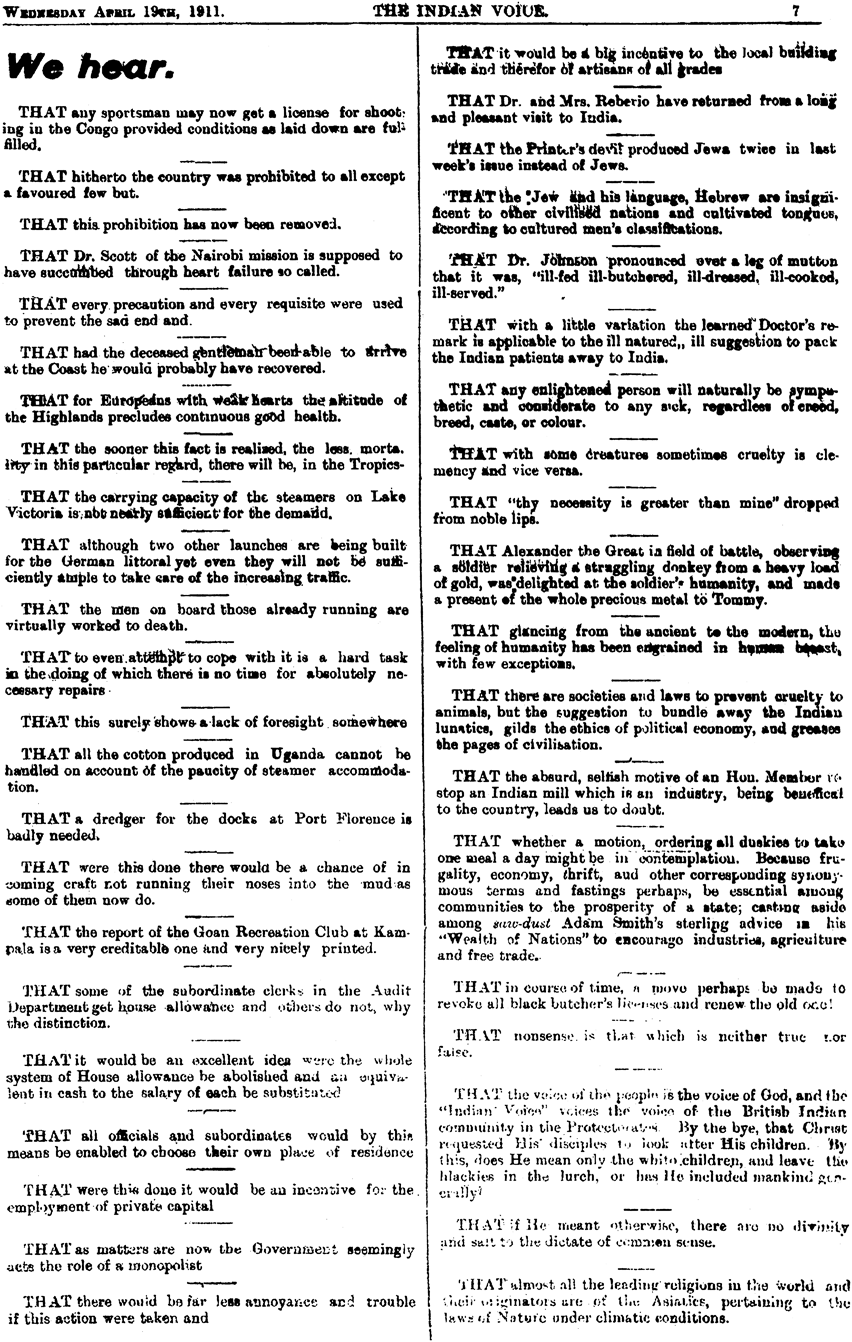
Moreover, the Indian Voice helped to convene multiple publics by collating and presenting local intelligence.Footnote 68 Its news agenda included updates pertaining to all aspects of East African social life, including regional associations and gatherings; cultural and religious festivals; national holidays; sporting activities; and the development of religious institutions. The diversity of East African society was, in this way, reflected in both the newspaper’s composition and readership. By placing Sikh, Hindu, Muslim, Christian, Jewish, Guajarati, Goan, and Punjabi interests alongside one another the Indian Voice championed a “unity in diversity” as expressed on the physical page.Footnote 69 This demonstrated a desire for inter-faith, inter-cultural and inter-ethnic dialogue and exchange [see Figure 2].
The Indian Voice column “We Hear” which includes information concerning the Nairobi Mission, the Goan Recreation Club, the Hebrew language, and the Asiatic religions of British Indians.
Despite the internal cleavages of East Africa’s Indian population the publication nevertheless drew on common experiences, values and traditions. It gathered items relating to all kinds of minority issues, and hence encouraged a “unity in diversity” in order to render public an identity of interests. In so doing, the publication, as noted by Martin Conboy, “functioned to create public identities for social groups.”Footnote 70 In the case of the Indian Voice, it shows how public spaces were used to construct an elected sense of belonging to local communities as well as new environments.
The article “Jinja Notes” further communicates this idea of localized belonging. The article, which announced plans to establish a new Indian society, states: “A meeting of local Indians was convened yesterday to consider a long felt want of sports and library amongst the local members of the community. (...) The Club was named “THE INDIAN RECREATION CLUB.”Footnote 71 Directed by a managing committee consisting of the well-known philanthropists, Messrs. A. Allidina Visram and Abdul Hussein Kaderbhoy, the article reports that donations were collected and a discussion on religious and famine funds took place. By creating awareness of local associations and the expanding amenities available to all groups across the population, “Jinja Notes,” and other articles like it, helped to organize communal affairs. Acting as a nodal point for community connectivity and civic participation, it promoted a sense of social cohesion and connectedness through civic engagement.
Imperial Citizenship, Race and Belonging
Although local connections informed processes of identity formulation, it can be also argued that Indian settlers invoked transnational networks in order to exercise a flexible form of citizenship. This meant that Indians also drew on their imperial subjecthood when negotiating diasporic space. This double-location of identity is reflected in the following editorial:
It is the British subject, the British Indian, who is suffering from these disabilities and restrictions, the man from (...) any other place (...) has privileges granted him which are not allowed to the loyal British Indian. What an anomaly.Footnote 72
The editorial highlights the ways in which Indian settlers attempted to define and determine their diasporic status. Labeling themselves as “British subjects,” it shows that when ethnic categories were called into question, Indians were able to draw on their imperial citizenship in order to distance themselves from “alien” or “undesirable” migrants. This gave way to the construction of an East African Indian imperial citizenry where expressions of belonging were renegotiated from one periphery to another. In contrast to Gandhi’s South African printing presses, this citizenry was not as well defined; instead it was an experimental form that projected evolving ideas of community and allegiance.Footnote 73 Hence, a mixture of terms, including “British citizen,” “British Indian,” and “British subject,” routinely featured in the newspaper to describe the Indian population. With “citizen” implying a quasi-national identity, “Indian” an ethnic identity, and “subject” a pan-imperial identity, the publication demonstrates how multiple markers of “self” were constructed and manipulated by fragile settler communities.Footnote 74
Here, the historical specificity of the Indian Voice is central in helping to understand the selective strategies of Indian identity formulation. As observed by Isabel Hofmeyr in connection to Indians in South Africa, prior to the anti-colonial struggles of the later colonial period, Indians in East Africa constituted their identities within the boundaries of Empire.Footnote 75 “Indianness” was thus intimately connected to the imperial project, and a double-location of identity persisted. On the one hand local allegiances to place and community were expressed in terms of civic participation. On the other hand, a version of “India-in-Empire” was invoked by Indians in the hope that it would “deliver its promise of equal rights for all.”Footnote 76 Notions of Indian citizenship therefore must be viewed within the transnational boundaries of empire - after all, the publication was essentially an imperial one, which as its name indicates, immediately excluded German East Africa from its forms of address.
These shifting boundaries of identity and belonging can ultimately be used to question the newspapers claims to cosmopolitanism as well as its policy for multiracialism. This is because it is important to note that while the Indian Voice championed equality in East Africa it did so on a certain set of terms. While the newspaper defended African interests, it nonetheless strategically positioned the Indian population within a “colonial sandwich,” or, to use the words of Anthony Lemon, on “a middle tier of a compartmentalized colonial society.”Footnote 77 This saw Europeans occupying the top tier and Africans the bottom. Consequently, the newspaper frequently emphasized the contribution of Indians towards the development of Africa and its peoples:
It is an undoubted fact that the Indian trader with his small or large stock of trading goods has been the greatest factor in the development of the outlying districts, far from the Railway (...) The British Indian community contributes so largely to the revenue of the country [and so] should see that their rights are protected.Footnote 78
Despite its cosmopolitan outlook calls for greater equality in the Indian Voice were, on closer inspection, not all encompassing. The newspaper expressed a desire for the “… equitable treatment amongst all British subjects, whether British or Indian” rather than the wholesale adoption of anti-discrimination.Footnote 79 As a repository for Indian achievement, this self-archiving demonstrates how the taxonomies of imperial race making tinged notions of citizenship with a paternalistic, civilizational dimension. Africa, notes Hofmeyr, acted as a boundary from which Indians measured their status: India, and my inference, Indians were deemed more developed and hence more civilized than the “African native.”Footnote 80
The Indian Voice did not, therefore, completely abandon or displace negative racial stereotypes of the “native,” whom it describes as “naturally thoughtless and thinks not of the future.”Footnote 81 This positioning reveals the complicated nature of social and racial hierarchies in East Africa as it illustrates a desire for anti-communalism but certainly not anti-racism. As a subject of Empire, the Indian Voice wanted to assert its authority in East Africa on an equal footing with the imperial powers but not necessarily with the African audiences it, at times, looked down on.Footnote 82
In all, the Indian Voice offers important insight into the complex expressions of Indian settler identities. While items such as “Ancient India” reveal an attempt to construct a common past through everyday literature, this played out alongside public expressions of East African belonging and imperial citizenship, and suggests that in an age of multiple migrations identity was constructed in a hybridized form. As colonized subjects abroad, Indians drew on multiple vectors of identity that oscillated between the “local” and the “global” in order to negotiate their place in a world that was both new and full of opportunity. Situated at a crossroads of Indian Ocean cosmopolitanisms, the historical experience of Indian migration thus complicates the dynamics of the homeland/hostland dichotomy, as well as traditional perceptions of national belonging. These diasporic narratives instead point to a complex system of migrant networks and global linkages by which strategies of identity formulation provide a sense of continuity and inclusion within various sets of global, transnational communities.
Conclusion
Despite its relatively moderate stance within the milieu of twentieth-century print communities, the Indian Voice was, nonetheless, an important channel for communicating Indian cultural and political identities. As one of the very first sites for Indian self-representation, the publication offered a unique perspective on both the interaction of publics as well as the complex identity strategies employed by Indian populations during an “era of liminality.” On the one hand, the newspaper strived to maintain long distance ties by crafting a “unity in diversity;” whilst on the other hand it also sought to negotiate social space. In doing so, the newspaper paved the way for public engagement and served to nurture local as well as transnational networks. The Indian Voice should not, therefore, be overlooked by contemporary scholars who wish to understand both the internal cleavages of twentieth century East African migrant populations as well as the shifting boundaries of Indian Ocean cosmopolitanism more generally.
Saima Nasar is a PhD student at the University of Birmingham. Her thesis Citizens, Subjects and Refugees: East African Asian Identities in the Age of Decolonization and Nation-Building examines the complexities of transnational migration and migrant linkages. E-mail: sxn721@bham.ac.uk