Introduction
On June 11, 1912, the US Patent and Trademark Office issued a patent entitled “Picture Book” to Frank Wagner (Wagner 1912, 1). The invention was a book that had a cut-out circle that was stamped throughout each page of the book and could be used to complete a picture located at the back of the book. The inventor, Frank Wagner, is not important to our conversation. What whets my curiosity, however, is the drawing of the invention that accompanies the written disclosure of the invention.Footnote 1 The picture depicts an African American couple conducting a cakewalk, a dance that proved formative to representations of African American culture as the United States entered its hegemonic twentieth century.
This curious drawing points in so many different directions. Some questions are simple ones: Why did the illustrator include this drawing in the patent? Other questions, though, are more complex. What does this drawing reveal about the role of patent law in constructing social identity (Bartholomew Reference Bartholomew2010)? What does this drawing reveal about how intellectual property law replicates preexisting cultural practices (Arewa Reference Appelman2005)? How does the drawing reflect changing modes of information transmission that occur as a result of intellectual property protection (Pottage and Sherman Reference Owens2010)?
An ideal conversation always starts with one simple thing: curiosity, a lively interest in another person, subject, or thing. In this essay, I share my curiosity and seek to start a conversation between two legal fields—intellectual property and legal history—that have shown little interest in each other, often to their collective detriment. US legal history has often ignored intellectual property as an independent subfield. A recent survey of twelve syllabi of American legal history classes finds only one professor who assigned any readings on intellectual property.Footnote 2 Likewise, a recent of overview of comparative perspectives on teaching legal history lacked any discussion on intellectual property law (Jarvis Reference Jarvis2014, vi–x).
What explains this disciplinary neglect? The technical subjects at the heart of intellectual property law perhap seem impenetrable, but law is, after all, law; indeed, other highly technical subjects like antitrust law, environment law, and products liability law have been the subject of consistent inquiry in legal history. Moreover, historians themselves have not ignored intellectual property law. For instance, the work of Zorina Khan (Khan Reference Karshtedt2005) and Christine MacLeod (MacLeod Reference Kronstein1988) have proven to be highly influential in our understanding of the relationship between intellectual property law and its institutions in economic development in nineteenth-century England and the United States, respectively.
Fault for this disciplinary neglect may not lie with legal historians. It may have another origin: intellectual property scholarship itself. Intellectual property scholars interested in history have not always engaged in critical assessment of their diverse methods, although some exceptions do exist. For example, Kara W. Swanson has outlined the complementary relationship between the technological materiality of a corset and the corset as a “narrative object within judicial opinions” so as to analyze the relationship of gender, sexuality, and patent law (Swanson Reference Swanson, Woodmansee, Jaszi and Biagioli2011c, 62–67). Swanson's rare interrogation of her methods deserves to be commended as too often intellectual property scholars have not grappled with how a given method may impact conclusions reached about how law and legal institutions are shaped in this area.
This essay, then, asks one fundamental question: How can intellectual property scholars join in a welcome conversation with general legal history? In this essay, I will argue that intellectual property law needs to embrace its own historiography. Developing curiosity about the “history of IP legal history” will help invigorate the relationship between mainstream legal history and the narrower subfield of the legal history of intellectual property and, indeed, may suggest new avenues for that conversation. I will identify three historiographical strategies—narration, context, and formation—that I argue should be used to study how history is practiced in intellectual property scholarship. As I do so, I will explore how Swanson's Banking on the Body: The Market in Blood, Milk and Sperm in Modern America offers an illustrative example of how to deploy these techniques going forward.
The Tools of the IP Historiography: Narration, Contest, and Formation
What does it mean to engage in a self-conscious practice of the history of intellectual property? It might mean that an intellectual property scholar would fully appreciate the complex origins of historical practice in the field; it might mean that the scholar would be attentive to how recurrent ideological conflicts over the doctrinal content of intellectual property law have shaped practice in this subfield; it might mean that the scholar would have to contend with broader debates in legal history over the relationship between actors and institutions in forming the doctrinal content of the law. We have not done so, and to paraphrase Joan Wallach Scott's Against Eclecticism, in failing to fully describe and assess the diverse methods of intellectual property law history, we are failing to foreground “conflict and contradiction in our work,” failing to interrogate the “foundational premises of our disciplines,” and failing to ask “how meaning is constructed and what relations of powers it supports” (Wallach Scott Reference Wallach2005, 115).
Reckoning with all these inadequacies would be a substantial undertaking; instead, I will focus on three historiographical strategies—narration, contest, and formation—that could transform how we see the legal history of intellectual property law. The first strategy, historical narration, is, of course, central to historical practice. As I discuss below, narration in intellectual property law organizes itself around at least five narrative structures that have increased in sophistication over time. The second strategy, contest, examines how intellectual property is impacted by recurrent contests over its doctrine and legal institutions. Specific narrative structures have developed in response to this contest and, consequently, historical inquiry itself may be compromised by this contested nature. The third strategy, formation, reflects the need for intellectual property historians to engage with broader questions raised by legal history's own internal debate about the relationship between informal social institutions and actors and subsequent doctrinal expressions of the law.
While these broad historiographical strategies could be used to evaluate any area of intellectual property law, I will narrow this essay in two ways. First, I will narrow my discussion to patent law, although these issues apply in copyright, trademark, and trade secret law as well. Second, I will consider these historiographical strategies in light of Swanson's Banking on the Body: The Market in Blood, Milk and Sperm in Modern America. Banking on the Body, widely acknowledged for its sensitive investigation of the ways products in blood, milk, and sperm have been exchanged through donative and market exchange, has been examined in different legal contexts. For instance, Natalie Ram used Swanson's historical treatment of body banks to explore how to manage the relationship between clinical treatment of patients and basic medical research (Ram Reference Prager2015, 508), while I. Glenn Cohen has examined the way the book confronts the questions of broader commodification within property regimes (Cohen 2015, 991–1005).
I suggest, however, that we can also situate Banking on the Body in the developing tradition of intellectual property history. Of course, Banking on the Body is not a book deliberately situated in intellectual property scholarship at all insofar as its subject—the medical techniques that were used to develop “banks” in body products—are usually seen as entirely excluded or only partially covered by intellectual property regimes.Footnote 3 Banking on the Body, however, should be used by intellectual property historians to explore its basic premises. This is primarily because in her intellectual property scholarship, Kara W. Swanson has widened the scope of patent historical inquiry by identifying new sources in patent law, including early patent petitions submitted to the Patent Office (Swanson Reference Swanson, Woodmansee, Jaszi and Biagioli2011a, 45), patent advice literature directed toward independent inventors (Swanson Reference Swanson, Woodmansee, Jaszi and Biagioli2011a, 46), and early patent examination manuals (Swanson Reference Swanson2009, 525). Moreover, Swanson has introduced key historical readings of gender as a central relationship in intellectual property law (Swanson Reference Swanson2015, 182–84) and highlighted the unexpected interdisciplinary content of the intellectual property regime as juxtaposed against other legal regimes like food and drug law (Swanson Reference Swanson, Woodmansee, Jaszi and Biagioli2011b, 367–82). Banking on the Body, when added to Swanson's previous innovations, offers us an instructive map forward.
The Tool of Narration
The primary goal of historical inquiry, notes Carlos Ginzburg, is that it orients us in time, using different “threads” of narration (Ginzburg Reference Fiske2012, 1). In a practical sense, tracing “threads” of historical narration is simple: for example, a micro historian may evaluate a text differently than would a political historian. There are, however, much broader categories of historical consciousness; what Jörn Rüsen has described as memory, the experience of dimensionality in past, present, and future as well as continuity, the ability to plausibly connect the experience of time to “human intentions and expectations” (Rüsen Reference Robinson2005, 11).
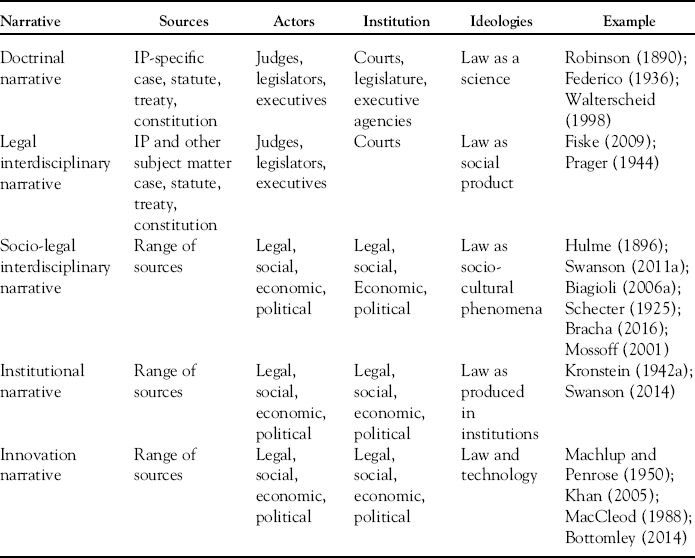
A crucial task, then, of the historiography of intellectual property is to identify and analyze the relevant “threads” of historical narratives that orient us. I suggest that five narratives of intellectual property history are present: doctrinal narratives, which use standard legal texts to trace evolving legal doctrine; socio-legal interdisciplinary narratives, which use diverse historical techniques to trace the evolving legal doctrine as established by different actors and institutions; legal interdisciplinary narratives, which compare legal texts from different legal disciplines, different countries, or different preexisting legal traditions to texts from different fields to trace evolving legal doctrine; institutional narratives, which tie intellectual property law to broader political economy frameworks; and innovative narratives, which tie evolving intellectual property law to broader economic theories of innovation. Each historical inquiry pivots on four analytical categories: sources, actors, institutions, and ideologies.Footnote 4 A typology of historical narratives in intellectual property history is presented in Table 1.
Typology of Historical Narratives: Intellectual Property History

| Narrative | Sources | Actors | Institution | Ideologies | Example |
|---|---|---|---|---|---|
| Doctrinal narrative | IP-specific case, statute, treaty, constitution | Judges, legislators, executives | Courts, legislature, executive agencies | Law as a science | Robinson (Reference Ram1890); Federico (1936); Walterscheid (Reference Walterscheid1998) |
| Legal interdisciplinary narrative | IP and other subject matter case, statute, treaty, constitution | Judges, legislators, executives | Courts | Law as social product | Fiske (2009); Prager (Reference Pottage and Sherman1944) |
| Socio-legal interdisciplinary narrative | Range of sources | Legal, social, economic, political | Legal, social, Economic, political | Law as socio-cultural phenomena | Hulme (Reference Hamilton1896); Swanson (Reference Swanson, Woodmansee, Jaszi and Biagioli2011); Biagioli (Reference Biagioli2006a); Schecter (Reference Rüesn1925); Bracha (Reference Arewa2016); Mossoff (Reference Machlup and Penrose2001) |
| Institutional narrative | Range of sources | Legal, social, economic, political | Legal, social, economic, political | Law as produced in institutions | Kronstein (Reference Khan1942); Swanson (Reference Swanson2014) |
| Innovation narrative | Range of sources | Legal, social, economic, political | Legal, social, economic, political | Law and technology | Machlup and Penrose (Reference MacCleod1950); Khan (Reference Karshtedt2005); MacCleod (Reference Kronstein1988); Bottomley (Reference Biagioli2014) |
Identifying a typology of narratives yields a variety of insights. Contrast, for instance, the historiographical strategies employed by the two major figures of Progressive Era patent history, William Callyhan Robinson, a professor at the Yale Law School and later the first Dean at the Catholic University School of Law in Washington, DC, and the author of the three-volume patent treatise, The Law of Patents for Useful Inventions (The Law of Patents), and Edward Wyndam Hulme, a librarian of the then Patent Office of Great Britain and an author of at least six major patent law articles, written between 1890 and 1917 (Hulme Reference Hamilton1896, 141–45; Reference Hodgson1898, 313–18; Reference Hulme1898, 42–55; Reference Hulme1900, 44–56; Reference Hulme1902, 280–88; Reference Hulme1917, 63–75). Even though it probably would have not occurred to them at the time, these two men would play a formative role in the development of intellectual property law during the twentieth century, as each offered keenly different perspectives on the practice of history in intellectual property law.
It is easy to overlook how innovative The Law of Patents is; indeed, Robinson was described at his death as “not a genius or a thinker of great originality” (Jackson Reference Hulme1951, 48). If, however, Robinson's The Law of Patents is compared to contemporaneous treatises, his innovations are clear.Footnote 5 Robinson (like his colleagues at Yale Law School) argued that studying the “history” of patent doctrine allowed scholars to understand basic “scientific” principles that underlined the evolving field of patent law. This “scientific” study of patent law would be achieved through the technique of the close reading of legal source material such as federal and state case law, statutes, and constitutions. In this sense, Robinson reflected the importance of a scientific method encouraged by Charles Langdell, which refined earlier US theoretical methods that relied on natural science principles to guide study in areas such as economics and anthropology. Specifically, Langdell argued that legal study was a type of experiment, and cases were “specimens for classifications” (Schweber Reference Schecter1999, 458).Footnote 6 By adopting the doctrinal narrative technique, Robinson sought to impose order on patent law by codifying preexisting constitutional, statutory, and common law into baseline principles. History for Robinson was primarily the history of doctrine rather than of legal institutions, people, or events.
The scientific study of legal principles could lead to didactic absurdity. Robinson insisted that a legal inquiry into invention had to be divided into seven categoriesFootnote 7 and each of these subsections was blessed with its own subsection. But these taxonomies, which resemble nothing so much as “Casaubon's Key to All Mythologies” (Eliot [1871] Reference Dousa1906, 126), proved influential in the development of the modern patent regime. For instance, Robinson's influential claim that invention resulted from the “mental acts” of the inventor, which was largely a subjective inquiry, was the driving impulse behind the Patent Act of 1952's insistence that the non-obviousness of an invention should be based on an objective inquiry into whether a person having ordinary skill in the art can practice the relevant art in the given field of invention.
By contrast, Edward Wyndham Hulme should be seen as the primary progenitor of the socio-legal interdisciplinary narrative in patent law. Unlike Robinson, Hulme identified new sources of law by examining archival sources, including the Records of the Privy Council, the primary advisory council to the Regent in the seventeenth and eighteenth century, as well as the Patent Rolls, the primary administrative records of the British monarchy from the medieval era onward. Hulme was a key figure in developing classification systems used by modern library systems and, by the end of his career, the primary librarian at the British Patent Office (Dousa Reference Cook2018). Given Hulme's expertise, it might be useful to study the ways library classification systems are linked and, perhaps, prefigure current patent classification systems.
Hulme's work resulted from the professionalization of history in the late nineteenth century with its focus on an objectivity achieved through methodical review of archival material as well as a close reading of such discovered archival material (Rüsen Reference Robinson2005, 63). The use of the methods of a socio-legal interdisciplinary technique may have led to Hulme's then provocative readings of modern patent law that stressed that executive administration of the Privy Council was crucial in developing modern patent law.
Directly comparing Robinson's and Hulme's narrative techniques underscores how different techniques produced different results. Consider the ways Robinson and Hulme examined how the law of monopolies in England impacted the development of patent law in the United States. Robinson focused on doctrinal legal sources such as the Statute of Monopolies and common law cases such as Turner v. Winter and Liardet v. Johnson, which both claimed that the inventor had to publicize the patent in order to ensure monopoly protection. Based on these sources, Robinson concluded that under English common law, patents were distinct from other monopolies since a disclosed patent offered access to the public through its specification to a given invention. For Robinson, the history of patent law pivoted around one key institution: the common law courts of the eighteenth century. Robinson believed that the case law produced by such courts could be studied scientifically to discern the basic principles of patent law. By contrast, Hulme stressed that the administrative records of the Privy Council should be understood to “yield material for a history of Patent Law from the Statute of Monopolies to Dolland's case (1766), this being a period almost barren of Common Law decisions” (Hulme Reference Hulme1917, 63). Consequently, the interdisciplinary nature of Hulme's work directly challenges Robinson's robust claim of centrality of the common law adjudication in Anglo-American patent law.
Why does identifying different narrative techniques matter so much in the legal history of intellectual property law? It may be sufficient that comparing narrative techniques helps us test causal attributions (e.g., What is the relationship of English institutions to similar institutions in the United States?), or to test for useful patterns or generalizations (e.g., the basic relationship between judicial, executive, and legislative authority in patent law).
More importantly, comparing different narrative technique to the study of intellectual property law may complicate how we see the basic terms of persuasive argumentation in intellectual property law generally. We have to ask hard questions; for instance, whether Hulme's socio-legal historical interdisciplinary narrative is more capable of satisfying the demands of persuasive argumentation because of its reliance on archival sources than more traditional doctrinal narrative championed by Robinson.
This debate matters because Robinson's and Hulme's disagreement over the relationship between common law adjudication and executive administrative authority in defining the patent monopoly formed a significant element of the Supreme Court's recent holding in Oil States Energy Services v. Greene's Energy, LLC (2018), which considered whether the US Patent and Trademark Office's ability to administer inter partes proceedingsFootnote 8 after the issuance of a patent violates the Seventh Amendment right to a jury trial. Notably, during briefing of Oil States numerous briefs cited Hulme and Robinson. For example, in amicus briefing, Dmitry Karshtedt cited The Law of Patents to support his claim that ownership of a patent was a private right and thus subject to jury trial at common law, (Karshtedt Reference Jarvis2017, 25), while H. Tomás Gómez-Arostegui and Sean Bottomley cited Hulme to support their claim that patents were subject to executive administrative review after the issuance of a patent in the eighteenth century (Gómez-Arostegui and Bottomley Reference George2017, 35). The opinion itself also reflected this tension. The majority opinion cited to Hulme (but not Robinson) in support of the claim that inter partes proceedings were similar to vacation of patents by the Privy Council.
Finally, if we analyze “narrative structure” it also points out the ways craft can be deployed to increase persuasion. Broadly, as I discuss in more detail below, Swanson's narrative practice in Banking on the Body can be described as a multi-institutional narrative technique; here, I want to highlight her craft in building that multi-institutional narrative. Banking on the Body demonstrates a literary or filmic quality. Swanson builds her institutional narrative by subtly cueing the reader at the beginning of each chapter to follow a different actor as each enters into the social world of another body banking institution. We follow Dr. Fritz Talbot into the world of “milk stations” (Swanson Reference Swanson2014, 15–18), Dr. Bernard Fantus and Bernice Hemphill into the world of “blood banks” (Swanson Reference Swanson2014, 49–51, 84–88), Jeanne Fergans (Swanson Reference Swanson2014, 159–61) into the world of “milk banks,” and Jerome Sherman into the world of sperm banks (Swanson Reference Swanson2014, 212–14). Swanson's craft here operates as a kind of Martin Scorsese “Steadicam” shot (e.g., Goodfellas) as we follow the actors as each engages with the relevant institution. We can admire this technique as much as we admire Scorsese's steady stroll through a restaurant kitchen, as both strategies immerse us into very specific institutions in such a way that we can comprehend the whole. Craft, here, builds the narrative persuasion of Swanson's technique.
The Tool of Contest
The second strategy—contest—appears to be a rather opaque tool compared to the concrete work of identifying different narrative techniques. Here, however, is where the specific subject of intellectual property exerts its own shaping disciplinary force. Alexandra George, in Constructing Intellectual Property (George Reference Federico2012, 92), contends that intellectual property law derives its internal disciplinary force from one question: How can the law protect an imaginary thing? Actors will struggle over what “imaginary things” should be delineated as “intellectual property” and then struggle once again over whether such “imaginary things” should be blessed with concrete legal rights.
If, as historians, we orient this recurrent conflict in time, we may be able to more sharply perceive how it arises from specific cultural, social, political, and economic mores. This recurrent contest over these “imaginary things” shapes historical inquiry in two key respects. Initially, historians need to attend to the ways “contest” shapes intellectual property law in specific periods, no matter what narrative technique is employed. Additionally, it also suggests a necessary skepticism in understanding how historical technique is used in intellectual property law given these recurrent contests.
We can test this claim by examining the recurrent ideological contests that occurred during the New Deal Era in the United States (1933–1945). Patent law in the New Deal Era underwent significant contest over the shape of the modern patent regime between different political groups. On the one hand, a committed epistemic patent community emphasized that patent law fostered innovation by rewarding creative inventors. In this perspective, patents were seen as a private right of ownership that generated conflict between the patent owner and competitors; consequently, the role of courts was to manage disputes between these private competitors and so, simply, administrative agencies were there to perform basic ministerial functions.
On the other hand, academics, legislators, and judges challenged the claim of the private ordering of patents by stressing that patents were closer to public rights since patents were granted by governmental authority and, therefore, inextricably intertwined with antitrust, consumer protection, and public health regimes. Ideological conflict between these two perspectives during the New Deal Era centered around the US Supreme Court's jurisprudential discomfort with the common law revival in patent law during the late nineteenth century, the patent community's significant resistance to inclusion in modern administrative law (Murray Reference Mueller2008, 45–54), and the emergence of new administrative entities like the National Institute of Health, which provided that the government could retain significant ownership of rights in patents obtained through the funding of outside inventive entities such as universities (Shakir Reference Schweber2013, 147–49).
The work of the Temporary National Economic Committee (TNEC) became a particular site of ideological contest. Led by Joseph C. Mahoney of Wyoming and composed of a unique structure of members from the legislative and executive branches,Footnote 9 the TNEC conducted hearings that took place between December 1938 and April 1941 and published forty-three monographs that discussed the committee's findings.Footnote 10 One of the committee's major impacts was in offering a distinct view of the institutional design of patent law that supported a broader role for administrative agencies.
The activities of the TNEC were troubling to the patent community; specifically, the ultimate recommendations contained within Patents and Free Enterprise (Hamilton et al. Reference Ginzburg, Tedeschi and Tedischi1941), drafted by Walton Hamilton with the aid of three others, Elmer Batzell, Boris Bittker, and Henry Kohn, Jr., prompted a furious reaction from the patent community. Anthony William Deller, the then editor of a major treatise, Walker's on Patent,Footnote 11 wrote a pithy—and vitriolic review—of Hamilton's monograph in which Walker declared that Hamilton had “injected his own view on a subject for which he has shown no particular qualification, experience or knowledge”Footnote 12 and, further, “this monograph is a vivid example of the results of contemporary zeal for regulation and reform, based upon incomplete data and preconceived purposes.”Footnote 13 And, finally, “to the unwary, it also obscures the real purpose—the impairment and ultimate destruction of the American patent system.”Footnote 14
New historical narrative techniques—the legal interdisciplinary narrative, the institution narrative, and the innovative narrative—emerged during this ideological ferment. It can be difficult to tell if the ideological ferment encouraged new historical narratives or whether the ideological ferment itself was produced by diverse narratives. The legal interdisciplinary narrative, the mildest deviation from previous techniques, introduced comparative archival sources and legal sources from different legal systems or other countries. For instance, Frank Prager, an important patent historian during the modern era of the patent regime, challenged those “many modern writers,” like William Robinson, who claimed the Statute of Monopolies “as the only important antecedent of existing patent law” during the constitutional era. Prager, instead, compared the constructional patent regime to other contemporaneous administrative patent regimes, such as those of France and Venice, to understand the comparative context in which the constitutional protection of patents emerged (Prager Reference Pottage and Sherman1944, 711).
Two other techniques, institutional narratives and innovation narratives, even more so than the legal interdisciplinary narrative, reflected the contested politics of the New Deal Era. Both narrative techniques were linked to theories of institutional economics, which rested on five basic claims about economic theory: (1) it should have “practical relevance” to policymakers; (2) it should be interdisciplinary; (3) it should study institutions as central to a functional modern economy; (4) it should study the economy as effected by technological changes and social, cultural, political, and power relationships; and (5) it should not should assume that individuals were not utility-maximizing agents (Hodgson Reference Hamilton2000, 318). International economists, such as Walton Hamilton, reshaped patent law during the New Deal Era by emphasizing governmental control of patent law and its respective administrative institutions.
As a specific narrative technique, institutional narratives refused to focus only on formal legal institutions and instead claimed that social, corporate, and political institutions were central to the doctrinal development of patent law. These narrative techniques highlighted how social, corporate, and political actors attempted to negotiate both formal legal institutions and informal legal norm in the making of patent law. Heinrich Kornstein, for instance, in early institutional narrative, examined how informal practices by German corporations impacted the formal patent law in interwar Germany (Kronstein Reference Khan1942, Reference Kronstein1942). Institutional narrative techniques were closely allied with sociology since institutional narratives explored how the social process of invention received legal definition through the formal mechanisms of patent law.
As I discuss earlier in this essay, Swanson in Banking on the Body employs an institutional narrative technique, what she terms a “medical history,” that seeks to analyze “the decisions of individual doctors treating patients and the collective actions of medical societies seeking to advance professional goals through the medical literature, popular press accounts, and when possible, the papers and records of individual doctors, hospitals, and body banks” (Swanson Reference Swanson2014, 5). Swanson's innovation is that hers is a story of multiple institutions, not simply one institution. This is a considerable advance in institutional narrative technique as it aids in Swanson's recovery of the different ways social, political, and legal actors confronted one challenge: how to think about exchange in body products. As Swanson demonstrates, multi-institutional narrative technique is a useful method because it provides a way to interrogate how a singular, legal concept such as “invention” is experienced in multiple institutional contexts. This complexity in institutional narrative technique is even more useful as patent historians have begun to incorporate insights from other disciplinary fields, such as sociology, anthropology, and philosophy, as they interrogate the relationship between invention as a social construct and the response in the law to that social construction.
Also tied to the field of institutional economics, innovation narratives linked patent law to broader production and distribution of technical knowledge.Footnote 15 A seminal use of the innovative narrative technique can be seen in Fritz Machlup and Edith Penrose's The Patent Controversy in the Nineteenth Century (Machlup and Penrose Reference MacCleod1950). The Patent Controversy in the Nineteenth Century used economics literature to challenge the claim that protecting patents was the most effective way to achieve widespread dissemination of knowledge and, more controversially, that patents were not at all necessary to foster a system of knowledge innovation. Machlup and Penrose framed their work as a direct challenge to a “writer of a history of the patent monopoly” who asserted that “there has never been, until the present time, any criticism of this new type of exclusive privilege” (Machlup and Penrose Reference MacCleod1950, 1). Machlup and Penrose highlighted contest as an explicit historiographical strategy of decentering “patent law” as the primary focus of innovation theory. Machlup and Penrose's work prefigured the work of economic historians who have investigated the relationship to innovation to patent law (Cook Reference Bright and Blandy2014), as well as mainstream historians, who are investigating the relationship between “old technology,” “new innovation,” and patent law (Edgerton Reference Deller2008).
Acknowledging contest as a historiographical strategy may reinvent how patent scholars approach historical texts that bolstered the modern patent regime (a period between 1952 and 2011, which can be said to ended with the passage of the America Invents Act of 2011). Particularly, it means that the historical claims, for example, the claims of P. J. Federico and Giles Rich, the primary authors of the Patent Act of 1952, need to be read carefully. First, it is not clear that Rich and Federico would have conceived of themselves as historians in the first place, which matters because neither fully explained or articulated a relevant method. Second, Rich and Federico's works need to be treated as works of counter-reaction to the ideological ferment of the 1930s and 1940s. These works of counter-reaction often sought to answer the interdisciplinary, innovative, and institutional narratives that questioned whether the legal protections embodied in patents fostered innovation. Of the two men, Federico wrote more frequently as to historical subjects and emphasized two key themes in his historical work. First, in his outline of early colonial history in patent law, he continued to stress that the patent regime of the United States had its origins in the common law adjudication of the eighteenth century (Federico Reference Edgerton1929). Second, he emphasized the primacy of the individual inventor in prompting the innovative culture of the United States (Federico 1945). Consequently, Federico's narratives often ignored how institutional and innovative narratives complicated the role of patent law in innovation policy.
We need to pay attention to the techniques of historical counter-reaction because they have played an outsized role in modern conceptions of patent law. Counter-reaction works have impacted more sophisticated treatments of patent law. Edward C. Walterscheid's To Promote the Progress of Useful Arts: American Patent Law and Administration, 1787–1836 (Walterscheid Reference Walterscheid1998) is the most influential history of patent law as it has been cited by the US Supreme Court in at least four cases and by the US Court of Appeals for the Federal Circuit in at least nine cases. The book has numerous innovations that explain its popularity, such as Walterscheid's reading of the IP Clause in light of patent customs in England and state law (Walterscheid Reference Walterscheid1998, 12–13) as well as his comparative treatment of patent administration under the Patent Act of 1790, which provided for a registration system, and the Patent Act of 1832, which provided for an examination system (Walterscheid Reference Walterscheid1998, 18–19). Despite these innovations, To Promote the Progress is an inherently conservative work. Walterscheid relied on doctrinal sources such as cases, statutes, and constitutions to present a relatively insular view of the evolution of patent law. Its conservatism is apparent when compared to Hulme's claim that the patent law needed to be understood in light of the imperial administration of the British Empire, a view that suggests a perspective that situates patent law in a trans-Atlantic exchange between the colonial center and its peripheries.
The historiographical strategy of contest, thus, highlights the ways the historical conversation is shaped through a dialogical process of action and reaction. In Banking on the Body, Swanson highlights this dialogical process through her interest in the metaphor of the bank. While the term “bank” for Swanson initially serves to describe “how the first body products to be banked in an organized and widespread way, that is blood, breast milk, and semen, from the nineteenth-century experiments that made such medical therapeutics” (Swanson Reference Swanson2014, 5), it also serves an additional purpose of permitting Swanson to navigate the historiographical strategies of contest.
For Swanson, the “bank” embodied in its very name the fact of recurrent contest over the best way to structure body product exchange. As Swanson notes (Swanson Reference Swanson2014, 6), referring to body product exchanges as “banks” suggests that, on the one hand, we should “think of body products in terms of money and markets.” Swanson contends, on the other hand, that actors such as Dr. Bernard Fantus (the creator of the “blood banks”) saw body exchanges as “civic property,” a concept that links “private property and private interests to the polity as a whole, spanning the rhetorical divide between private and public” (Swanson Reference Swanson2014, 13). Thus, for Swanson, the metaphor of “the bank” literally embodied a contest between differing legal rules that could apply to body product exchange.
A next step in the analysis would be to extend the discussion of the bank as a metaphor to explore its relevance to intellectual property law. Swanson's unique position as an historian whose work spans both property and intellectual property law suggests that she would be an ideal person to explore the ways in which the metaphorical influence of the bank in property law may have also have been the reason why intellectual property regimes have often proven reluctant to protect medical techniques and medical treatments. Swanson's thinking in Banking on the Body could usefully contribute to ongoing debates over whether intellectual property law should rightfully be considered an extension of “property” law. Notably, it would be interesting for Swanson to explore whether intellectual property itself has incorporated broad claims of civic property. This is particularly relevant in light of the Supreme Court's ruling in Oil States that a patent is a franchise, a classification redolent of property that is imbued with significant public consequence.
The Tool of Formation
Formation, the final historiographical strategy, attempts to capture a broader debate in legal history, namely: how historians and legal historians should study legal change. Mainstream historians as well as legal historians no longer simply study formal legal institutions and their respective products (cases, statutes, treaties, etc.). For instance, legal scholars such as Reva Siegel and Robert Post (Siegel and Post 2007, 374) have proposed the term “democratic constitutionalism” to explain how constitutional law is legitimized by formal and informal social practices. Likewise, mainstream legal historians such as Christopher Tomlins have explored this relationship through what he terms “legalities,” which is an attempt to describe the relationship between “the symbols, signs and instantiations of formal law's classificatory impulse, the outcomes of its specialized practices, the products of its institutions” and more informal “social products generated in the course of virtually any repetitive practice of wide acceptance within a specific locale, call the result rule, custom, tradition, folkway or pastime, popular belief or protest” (Tomlins and Mann Reference Tomlins and Mann2001, 3).
In my own work (Murray Reference Murray2015, 911), I have suggested the use of a mediating technique, doctrinal formation, to address the difference between informality and formality in legal history. Doctrinal formation is composed of two elements: the doctrinal content of the law, which can be expressed in many forms, including international, constitutional, statutory, and common law, and doctrinal formation, which describes the means by which the doctrine is formed, whether through legislative, administrative, judicial, or popular means. I use the word “doctrinal formation” to help us think through what I term the discursive space between the formal legal institutions and informal social practices. Doctrinal formation refers both to the endpoint—the legal object—and the process of making the legal object. How we study formation, then, remains an important analytical tool in the historiography of intellectual property law by connecting the specific field of intellectual property history to broader trends in legal history.
Interrogating this discursive relationship between formal and informal meaning in the law has not been a primary concern in intellectual property law. More recently, however, there has been a flourishing of socio-legal interdisciplinary techniques in intellectual property law that attempt to parse the relationship between formal and informal institutions in the law, including intellectual history (Bracha Reference Arewa2016, 7–8), economic history (MacLeod 1988, 1; Khan Reference Karshtedt2005, 19), socio-cultural history (Biagioli Reference Biagioli2006b, 11–30), labor and employment history (Fisk 2009, 13), histories of publication and print (Pottage and Sherman 2010), the history of print and instruments (Biagioli Reference Biagioli2006b), and feminist history (Swanson Reference Swanson, Woodmansee, Jaszi and Biagioli2011c, 105–08). These works can be broadly categorized as socio-legal in nature since they share broadly a perspective that claims “law as a field or aspect of social experience which can be examined and theorized using methods and tools drawn from a range of social science disciplines” (Bright and Blandy Reference Arewa2016, 167) and, moreover, self-consciously draw from a wider range of sources including the text itself of patents, copyrights, and trademarks, the text of registrations and examinations, letters, patent treaties, general audience books, political publications, and speeches. This richer set of sources allows historians to ask a wider range of questions about doctrinal formation in this area.
Banking on the Body is a careful treatment of “how legal and lay understandings” shaped doctrinal formation in the law (Swanson Reference Swanson2014, 5). A primary question in doctrinal formation is: How do we connect the lived experiences of actors within a certain social institution to the formal expressions of legal culture, such as cases, statutes, and treaties? Swanson's claim is that the pervasiveness of shared social metaphors of “the bank” can help shape the resulting legal norms in body product exchange. Swanson's technique in Banking on the Body demonstrates a way for shared social metaphors to become crucial links in doctrinal formation. Swanson tracks how the medical profession introduced and invested the term “blood bank” with social meaning as a kind of civic property, “which each unit treated as equal in value and allocated by need” (Swanson Reference Swanson2014, 66). She then considers how ongoing debates over the marketization of blood banks during the Cold War shifted the terrain away from the normative commitment to civic property to a market-based approach embraced by privatized community bank institutions such as the Red Cross (Swanson Reference Swanson2014, 90, 118).
After Swanson carefully examines the emerging shared metaphor of the bank, she explores how a pervasive social metaphor can influence how legal claims are crafted. For example, she recounts how the shared social metaphor of a civically constituted “blood bank” was used to defeat product liability claims in which patients claimed that a hospital had sold them unsafe blood in the 1950s and 1960s. The pervasive belief in “the blood bank” of civil property inured to the medical profession's benefit since blood transfusion was treated as a medical treatment rather than a good supplied by the hospital and, thus, initially provided medical practitioners with immunity from product liability claims (Swanson Reference Swanson2014, 126–30). Although product liability claims were eventually extended to blood (Swanson Reference Swanson2014, 130), Swanson is able to show how this shared social metaphor was central to the early legal debates. Glenn Cohen has argued that “law had little role to play in the story” of Banking on the Body (Cohen 2015, 983). However, Swanson's treatment of the constitutive relationship between a socially created shared metaphor and subsequent legal claims perceives a more fluid relationship between sociality and law in creating legal meaning.
Conclusion
By becoming conscious of the tools of narration, contest, and formation, intellectual property scholars will become more conscious of their own traditions and, thus, it will become more likely that legal history will be able to respond and incorporate the particular lessons that emerge from a fuller understanding of intellectual property history. Both these new directions will demonstrate why further conversations should be welcomed in the future.