Scholarship on penal colonies is currently flourishing. Traditionally, the dominance of Australia-centred investigation has limited the scope and perspective of the critical literature; as the legal historian Lauren Benton has noted,
emphasis on the history of Botany Bay as the quintessential penal colony has tended to eclipse the study of convict transportation as a global phenomenon, while it has also encouraged a focus on the logic and expectation of a transition from penal colony to the territorial sovereignty of settler states.Footnote 1
But in recent years, scholars have sought to expand and enhance our understanding of the myriad ways in which penal colonies have functioned, over many centuries and in all corners of the globe. The ambition of this intellectual project may be exemplified in the work of the ‘Carceral Archipelago’ team led by Clare Anderson, which aims to produce the ‘first global history of penal colonies’, by investigating ‘how convict transportation and penal colonies intersect with larger histories of imperialism, unfree labour, coerced migration, confinement and incarceration’.Footnote 2
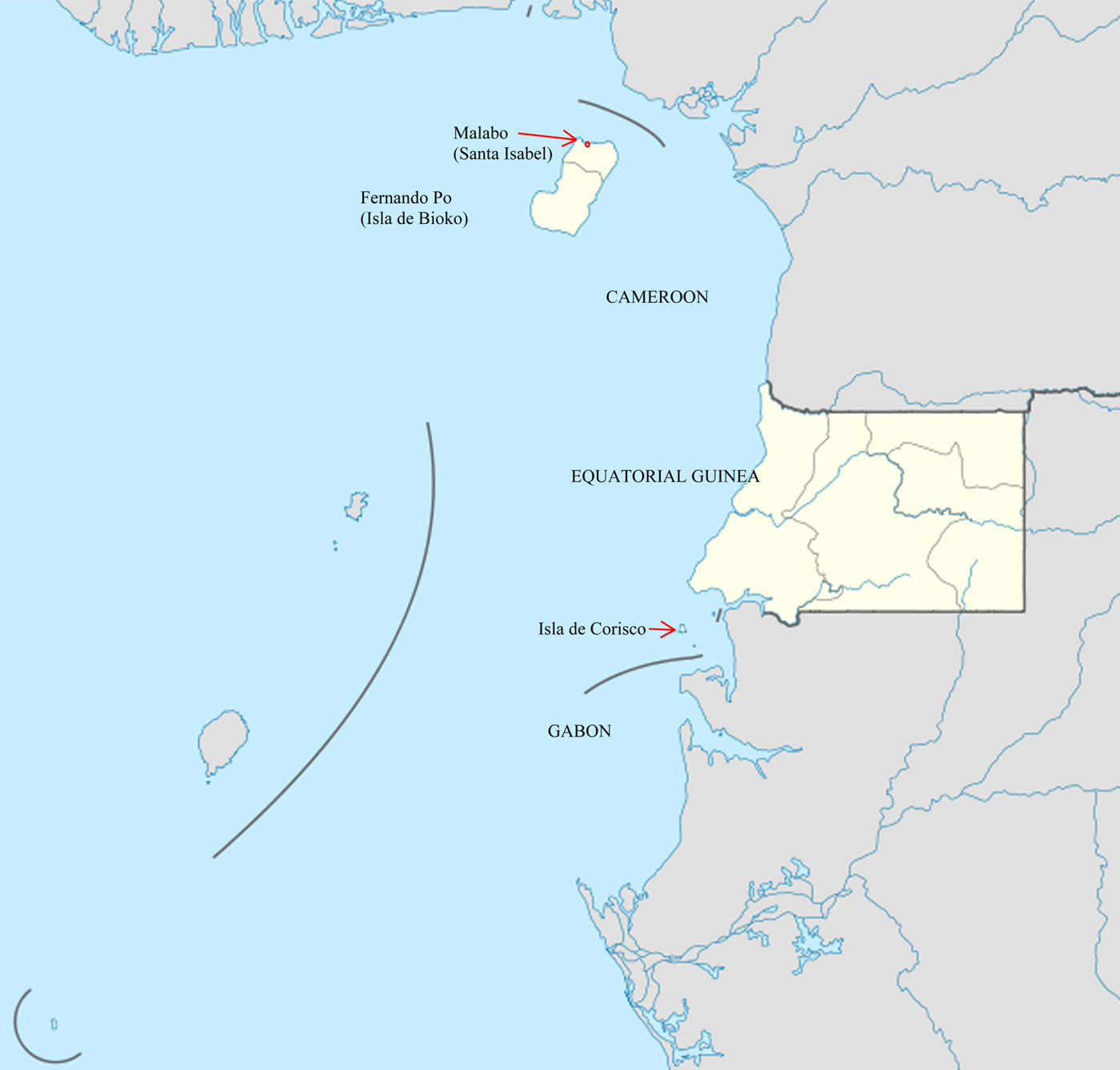
One area impacted by the integrated analysis of regimes of deportation, imprisonment and forced labour is Spanish empire studies; indeed, since 2010, important books and essays on the subject by Benton, Eva Maria Mehl, Stephanie Mawson, Christian De Vito, Ricardo Salvatore, Carlos Aguirre and others have revealed new perspectives on the spatial configurations of imperial power, and on the exchanges between, and agency of, a diverse range of colonial subjects.Footnote 3 While much of this work has concentrated on the seventeenth through to the long eighteenth century, the later nineteenth century is also a fascinating era in the development of Spain's far-flung carceral institutions. During this time, de facto penal colonies not only functioned to ‘disappear’ sectors of the imperial population deemed undesirable, but they also reflected a desperate effort to stave off disappearance: to prolong indefinitely the large-scale regimes of slavery that were falling away elsewhere, and to postpone the end of the Spanish empire itself. Although these aims led Spain to operate a number of penal facilities in its remaining overseas territories in North Africa (Ceuta, Islas Chafarinas, Melilla, Alhucemas and Peñón de la Gomera) as well as in the Pacific (Islas Marianas and the Philippines), in this article I will centre my attention specifically on the island of Fernando Po, which at the time was a Spanish possession off the coast of modern-day Cameroon (within what would come to be known as ‘Spanish Guinea’), now part of the nation of Equatorial Guinea (see Figure 1).Footnote 4
The Island of Fernando Po (Isla de Bioko) and the Nation of Equatorial Guinea

There are substantial archival sources regarding the use of Fernando Po as a site of penal deportation in the Archivo Histórico Nacional (Madrid), in the Archivo General de la Administración (Alcalá de Henares), and in the Archivo Nacional de la República de Cuba (Havana), some of which I will draw upon here. My main focus, however, will be the remarkable corpus of narratives published by Cubans who were sent to Fernando Po in the late 1860s and then again at the end of the nineteenth century, which scholars have begun to mine for historical and linguistic information, but which has not yet been treated to in-depth textual analysis. I shall undertake a close reading, centring intensively on deportees’ own representations of their experiences, in harmony with the alternative approaches that other scholars have adopted to study penal deportation in the Australian and Indian Ocean contexts.Footnote 5 While my research thus far suggests that the Cuban texts I examine provide the most sustained and detailed accounting of Fernando Po deportation practices, their authors’ rhetorical strategies are also revelatory. I seek to contextualise and interpret their pointed reformulations of the Black Legend – the claim that Spaniards’ colonial practices revealed their unique and ‘natural’ cruelty – and of Middle Passage (transatlantic slave voyage) discourses. I will also consider their more circumscribed contributions to another Iberian ‘master trope’: convivencia, or the presumed peaceful coexistence or even ‘brotherhood’ of diverse ethnic and religious groups during particular periods of peninsular/colonial Spanish history. My discussion will highlight the ways in which the Cuban deportees condemned Spain's perpetuation of the slave trade and other forms of coerced labour, even as they struggled to negotiate their own precarious positioning within the racially-stratified practices of late-imperial space. All too frequently, those negotiations exacerbated the traditional divisions between different communities that were promoted and exploited within the Spanish colonial system. At the same time, I will suggest that in some instances the deportees’ encounters with citizens and colonised subjects from distant territories may have bolstered and expanded intra-imperial identification and solidarity.
The De Facto Penal Colony of Fernando Po
Benton has argued that by the late eighteenth century Spain, like other European nations, had worked to fortify island outposts and coastal enclaves in order to counter external threats to its empire. Convict labourers were transferred in an ad hoc fashion from one point of the globe to another to work on construction projects designed to protect Spain's vulnerable colonial possessions from British or French attacks. Benton does not hesitate to refer to these sites of transported and forced labour as ‘penal colonies’, even though Spanish law did not characterise them as such.Footnote 6 For his part, and foregrounding in particular the Latin American borderlands context, De Vito has explored the role of presidios (fortified military settlements) in the elusive task of protecting a vast frontier region from European, indigenous and (in the post-colonial period) neighbouring state incursions, and he has also explained how the presidio sites evolved from military outposts to mixed-population penal institutions and penal colonies, bringing diverse groups of people (including soldiers, military and civilian convicts, vagrants, slaves and indigenous people) into contact within forced-labour regimes in which treatment could be differentiated by class and race.Footnote 7 Mawson and Mehl have each examined the transportation of convicts from New Spain (modern-day Mexico) to the Philippines in the seventeenth and eighteenth centuries, a criminal justice measure designed not only to supply a work force to support the Spanish imperial project in the Pacific, but also to effect what Mawson terms ‘social cleansing’ in the deportees’ points of origin, where they were deemed a threat to colonial domination.Footnote 8 As internal challenges to imperial power continued to motivate deportations, I would argue that the transportation practice was more intensively politicised, a phenomenon that is especially notable in the early nineteenth-century Latin American context, when independence advocates and insurgents were shipped to remote sites within the region, or to peninsular jails and North African presidios,Footnote 9 as well as during the later Cuban and Philippine liberation movements. In his study of the global networks of anticolonial and anarchist activists that arose in the final decades of the nineteenth century, Benedict Anderson mentions that Spain's Pacific and African possessions were used ‘to exile political troublemakers’.Footnote 10 As I will show here, the island of Fernando Po would become a particularly fascinating nodal point within this evolving spatial and political dynamic.
Fernando Po had been transferred by treaty from Portugal to Spain in 1778, but the territory was long neglected by the Spanish crown. After outlawing the slave trade, Britain leased the strategically-located island from Spain from the late 1820s to the early 1840s in order to monitor ship traffic in the Gulf of Guinea, and also to extend its economic interests in the region. While Spain had recently lost all of its American mainland colonies, during this time period the nation launched a new imperial campaign in Africa, and eventually reclaimed Fernando Po from Britain. However, a series of initiatives to establish a successful colony on Fernando Po with pioneers recruited from the Iberian Peninsula, as well as with emancipated slaves from Cuba, ultimately did not prosper, in large measure due to a lack of resources and insalubrious conditions on the island.Footnote 11 Throughout the 1860s, for example, a small handful of Spanish military health professionals stationed on Fernando Po struggled to respond to the endemic malaria and dysentery, as well as to periodic epidemics of other diseases such as yellow fever, and the Spanish press registered concerns regarding the inadequacy of the island's medical infrastructure and staff, and the scarcity and wretched quality of the food. A group of 128 colonisers, mostly Valencians, who arrived in Fernando Po's capital Santa Isabel in 1859, quickly succumbed to disease, overrunning the small hospital. Those who survived were returned to the Peninsula, and this disastrous experience led to the temporary suspension of colonising initiatives involving Spaniards. Notwithstanding this episode, in 1869 another group of 85 Spanish colonial settlers reached the island, and within two weeks nearly all were struck down by disease and had to be repatriated. For their part, the 200 Cubans of colour who arrived in 1862, involuntarily and under conditions similar to those extended to Chinese indentured labourers in Cuba, initially made important advances in road clearing and construction projects, but they were significantly affected by an 1864 epidemic of smallpox on Fernando Po, which took the lives of hundreds of black residents of the city.Footnote 12 During this decade, then, the previously little-known outpost came to be associated with deprivation, disease and death.
By the late 1860s, the fate of the island was also caught up in the political agitation that spread throughout the remnants of the Spanish Empire, as pro-democracy uprisings on the Peninsula and independence movements in Cuba and the Philippines rose to the fore. An impassioned polemic arose in Spain over the legitimacy of the penal colony as a form of punishment. After the Revolution of 1868, Spanish legislators undertaking the revision of the nation's Penal Code called for the establishment of penal colonies on Fernando Po, as well as on the Islas Marianas. The Code itself, which went into effect in 1870, did not mention either site, but did call for four graded stages of forced exile, ranging from expulsion from the convict's hometown or region, to overseas transportation.Footnote 13 In 1875, the Royal Academy of Moral and Social Sciences sponsored an essay competition in which entrants were asked to weigh the merits of founding a penal colony akin to Britain's Australian settlement on either Fernando Po or the Marianas; the Academy awarded the celebrated writer and activist Concepción Arenal the top prize. Arenal argued forcefully against the penal colony option, emphasising the expense and cruelty of the measure; in her estimation, Spain lacked adequate ‘moral and material means’ for such a project. She also expressed concern over the likelihood that political prisoners would be drawn into the system, as had happened in the British and French cases. Moreover, reflecting and reaffirming Fernando Po's negative reputation, Arenal devoted six pages to quoting from sources documenting the exceptionally high rate of mortality from various diseases among those Spaniards, including explorers, missionaries and military personnel, who had spent time on the island, which she termed a ‘cemetery for whites’ (cementerio de blancos).Footnote 14 Yet while the essays of Arenal and other entrants in the competition deploy the conditional tense and the subjunctive mood to refer to penal colonies in Fernando Po and the Marianas in presumably hypothetical terms, textual aporias appear to betray their awareness that the reality was otherwise. Tucked into Arenal's text, in one of the quotes concerning fatalities on Fernando Po, is a reference to the Spanish insurgents who had fought for land reform and democratic rights in the Loja Uprising, and were deported to the African island in late 1861; many died of fever. Another footnoted aside in Arenal's essay mentions that a foreign ship had been compelled to come to the rescue of deportees in the Marianas who were dying of starvation.Footnote 15 Ironically, while polite society in Madrid debated the pros and cons of the proposed establishment of penal colonies – a measure that was never officially instituted through law – during this time period prisoners were in fact being transported throughout the Spanish empire to remote colonial outposts, where they typically met a grim fate.
In the case of Fernando Po in particular, beginning in the 1860s and continuing on until century's end, boatloads of political prisoners from Spain, Cuba and the Philippines were routinely sent there, and governmental officials periodically made half-hearted and ultimately fruitless attempts to convert the deportees into a colonising force.Footnote 16 With respect to Cubans, deportations to Fernando Po peaked during periods of insurrection: at the beginning of the Ten Years’ War (1868–78), when the planter Carlos Manuel de Céspedes declared the Republic of Cuba in the eastern part of the island and advocated for abolitionism, marshalling blacks alongside creoles to fight for the independence cause; during the Guerra Chiquita, or Little War (1879–80), when those who were dismayed by the inadequate terms of the Zanjón Pact that had ended the Ten Years’ War, especially still-enslaved as well as free Cubans of colour, sought to press on with the armed struggle under leaders such as José Maceo, Guillermo Moncada, Quintín Bandera and Calixto García; and during the Spanish–Cuban–American War (1895–8), when celebrated Afro-Cubans (such as Antonio Maceo and Juan Gualberto Gómez) joined forces with creole and other separatists (including José Martí and Máximo Gómez) to head up the broad-based final battles for independence from Spain.Footnote 17 The earliest known published narratives date from the March 1869 deportation ordered by Cuban Captain General Domingo Dulce, who shipped a group of 250 Cubans, many of them hailing from the elite classes, to the island at the beginning of the Ten Years’ War. The severity of this punishment was evident, as it followed closely upon the August 1866 transportation of 166 ‘incorrigible’ criminals – 66 white, 21 mulatto and 79 black Cubans accused of multiple infractions – to the West African outpost. Dulce's predecessor Francisco Lersundi had sought to justify the ‘grave’ and ‘extraordinary’ measure to the Overseas Minister by noting that ‘neither the presidio nor even death frightens or restrains such people, only banishment to Fernando Po, because of the forced labour and because it is impossible to escape’.Footnote 18 Fernando Po's reputation as a fate worse even than death probably figured in Dulce's own decision two and a half years later to round up presumed conspirators and send them, without trial, to the island. Although the Spanish Regent Francisco Serrano y Domínguez eventually ordered that the 1869 group be removed from the island, throughout the remainder of the century Spanish government officials continued to use deportation to Fernando Po to siphon off Cuban rebels.
The six published narratives to which I now turn offer detailed accounts of the deportation experience.Footnote 19 All were written by white Cubans; most are openly separatist or even virulently anti-Spanish, and are clearly intended to bolster the independence movement, or, in the case of the two that were published at the end of the Spanish–Cuban–American War, celebrate its (nominal) victory. Four of the authors were among the group of 250 expelled by Dulce, arriving on Fernando Po in May of 1869. Francisco Javier Balmaseda, a distinguished literary and scientific author, philanthropist and statesman, and Miguel Bravo Sentiés, a medical doctor, each published accounts of their experiences at the end of 1869 in New York City. Like others of their station, both men had used their considerable financial resources to arrange to be smuggled off Fernando Po, first to the West African coast, and from there to Liverpool and then on to New York. Each subsequently served Céspedes’ rebel government during the Ten Years’ War, Balmaseda as a ‘secret agent’ while exiled in Colombia,Footnote 20 and Bravo Sentiés by holding important posts, including chief medical officer, within the insurgent eastern sector of the island (although at the end of the war the latter abandoned separatism to advocate instead for a more conservative autonomist position).Footnote 21 By publishing their deportee texts in New York at the beginning of the war, Balmaseda and Bravo Sentiés could quickly reach a key readership of anticolonial Cubans exiled in the United States, who were eager for testimonials in support of their separatist campaign. Balmaseda's first edition of 4,000 copies appears to have circulated quite widely, including (more surreptitiously) in Spain and Cuba.Footnote 22
Two other survivors of the 1869 deportation published narratives of their experiences in Cuba decades later, in the early 1890s. By this time period, the independence struggle had been taken up by a broad range of Cubans, many of whom might identify with the less-privileged circumstances of these authors. Juan Saluvet and Hipólito Sifredo y Llópiz, who hailed from the middle classes, lacked sufficient means to lighten the burden of their fate, and both were forced to remain on Fernando Po until the Spanish government ordered that the Cubans be transferred. Neither was fortunate enough to win a lottery slot (or pay the necessary bribe) to travel on the first ship out of Fernando Po in August of 1869, and their writings emphasise the much greater hardships and personal tragedies they faced as a result; indeed, Sifredo y Llópiz asserts in his Preface that his version functions to correct the misrepresentations of other accounts, probably alluding to those of Balmaseda and especially Bravo Sentiés.Footnote 23
Two additional texts were published at the turn of the century by men subjected to the deportations that proliferated during the Spanish–Cuban–American War; they were part of separate deportee groups, but coincided on Fernando Po. These authors were quite literate, but hailed from a far more modest socio-economic background, reflecting the less-elite condition of most of the deportees of the 1890s, hundreds of whom were also Cubans of colour. Manuel Miranda, a self-described atheist who worked in a cigar factory, was a leader in the Cuban anarchist movement, and his return home from Fernando Po was delayed for a year because the general amnesty for deportees at war's end initially excluded anarchists (as well as many black Cubans).Footnote 24 Miranda had been one of the speakers at Havana's first May Day celebration in 1890, reciting a poem exalting anarchism, and he had published political essays in anarchist periodicals, along with a horrifically graphic novel highlighting the violence suffered by slaves, as well as other types of injustice, in Cuba. He counted Afro-Cuban leaders such as Juan Gualberto Gómez and Martín Morúa Delgado, as well as anarchists from elsewhere in the Caribbean, among his friends, and his deportee narrative may have found a ready audience among a variety of groups inside and outside of Cuba.Footnote 25 For his part, Emilio Valdés Ynfante was an electrician who at the time of his arrest was working as a projectionist in one of the earliest film screenings in Cuba. Valdés Ynfante's text is the only one of the six to incorporate illustrations, including five prints from photographs taken by him ‘in dreadful conditions’ on Fernando Po.Footnote 26 Since these two narratives were published at the end of the Spanish–Cuban–American War, and in the early period of US occupation, their authors’ attitudes also reflect the challenges that Cubans faced as they sought to build an independent nation. During this time, the second edition of Balmaseda's narrative was also published, and his work and the other earlier deportee accounts were cited by Cubans eager to document, memorialise and understand their lengthy struggle to achieve freedom.Footnote 27
In penning their accounts, the Cubans drew upon a variety of established genres and tropes. As is common in carceral literature, their texts evince a marked preoccupation with, and mission to denounce, the atrocious living conditions as well as the constant exposure to violence and the extended condition of unfreedom. At the same time, the Cubans’ confinement involved enforced movement. Transported to an unfamiliar geography, they interacted with a wide array of peoples from other cultures, and for that reason their texts often resemble travel, adventure or even ‘discovery’ narratives. This melding of the carceral and the travel genre was perhaps most familiar within Ibero-American letters in captivity narratives, which Lisa Voigt, among others, has studied with great acuity. Voigt asserts that captivity played an important role in the production and circulation of knowledge and authority; whether they might be viewed as subverting or upholding hegemonic regimes of power, captives shared information and perspectives across borders and learned to ‘traverse and mediate cultural differences’.Footnote 28 While the Cubans were certainly not imbued with authority within the existing power structure, they present themselves as uniquely well suited, given their experiences, to speak to others who were seeking effectively to unite against the Spanish empire and/or to work to create a new post-colonial society.
In their efforts to build bridges within and beyond imperial boundaries, the Cubans take up a number of tropes that would have been quite familiar to diverse sectors of their audience. These include three rhetorically potent ‘master narratives’: the Black Legend, the Middle Passage, and convivencia. In the pages that follow, I will engage in a detailed analysis of deportees’ mobilisation of these tropes, working to understand their resonance within the complex historical conjunction of debates over independence, coerced labour, transportation and identity in the waning Spanish empire.
Cuban Deportees’ Appropriations of the Black Legend
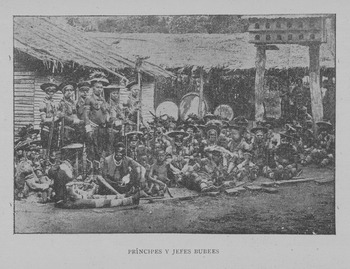
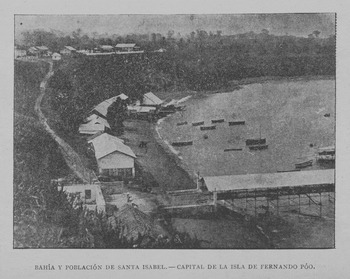
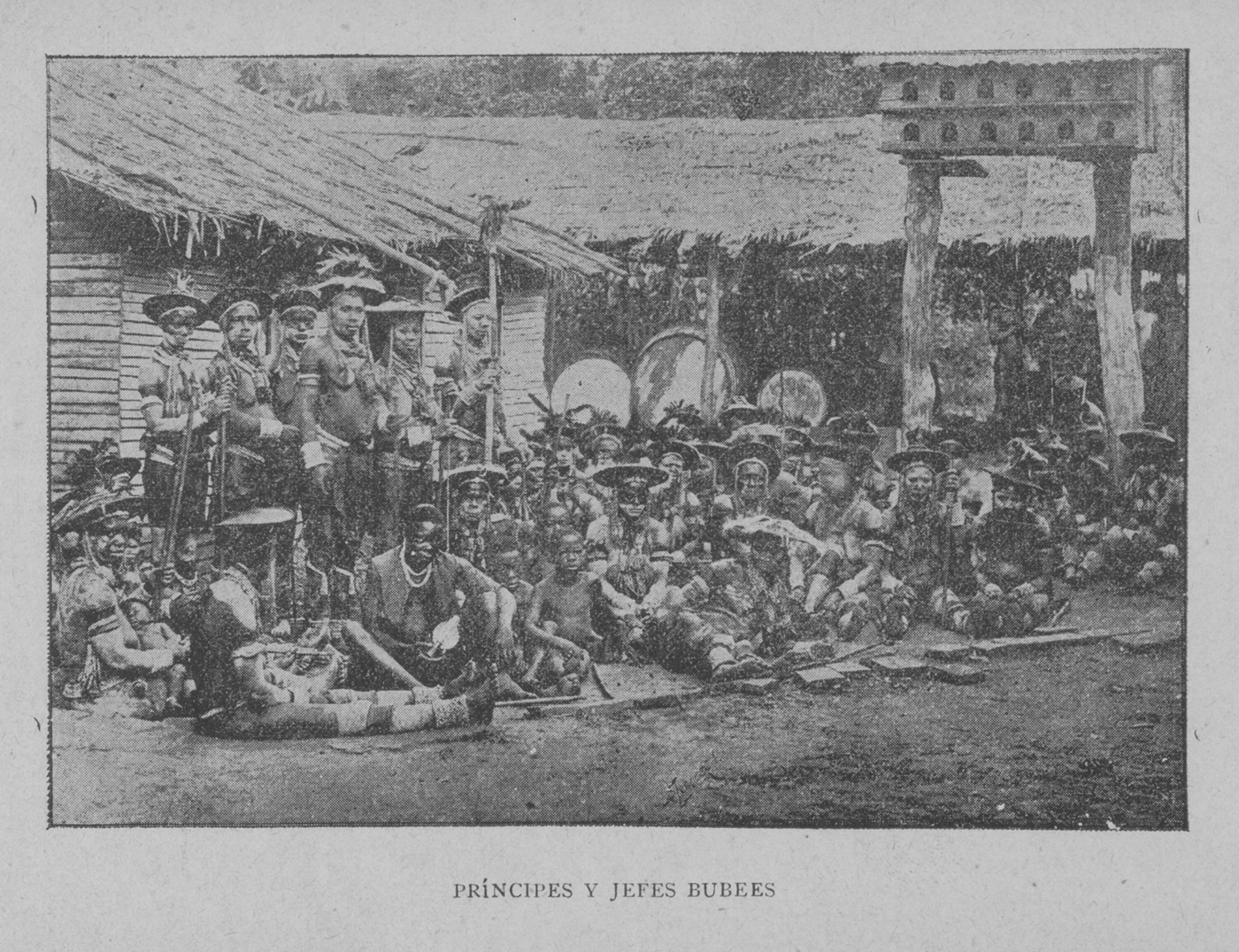
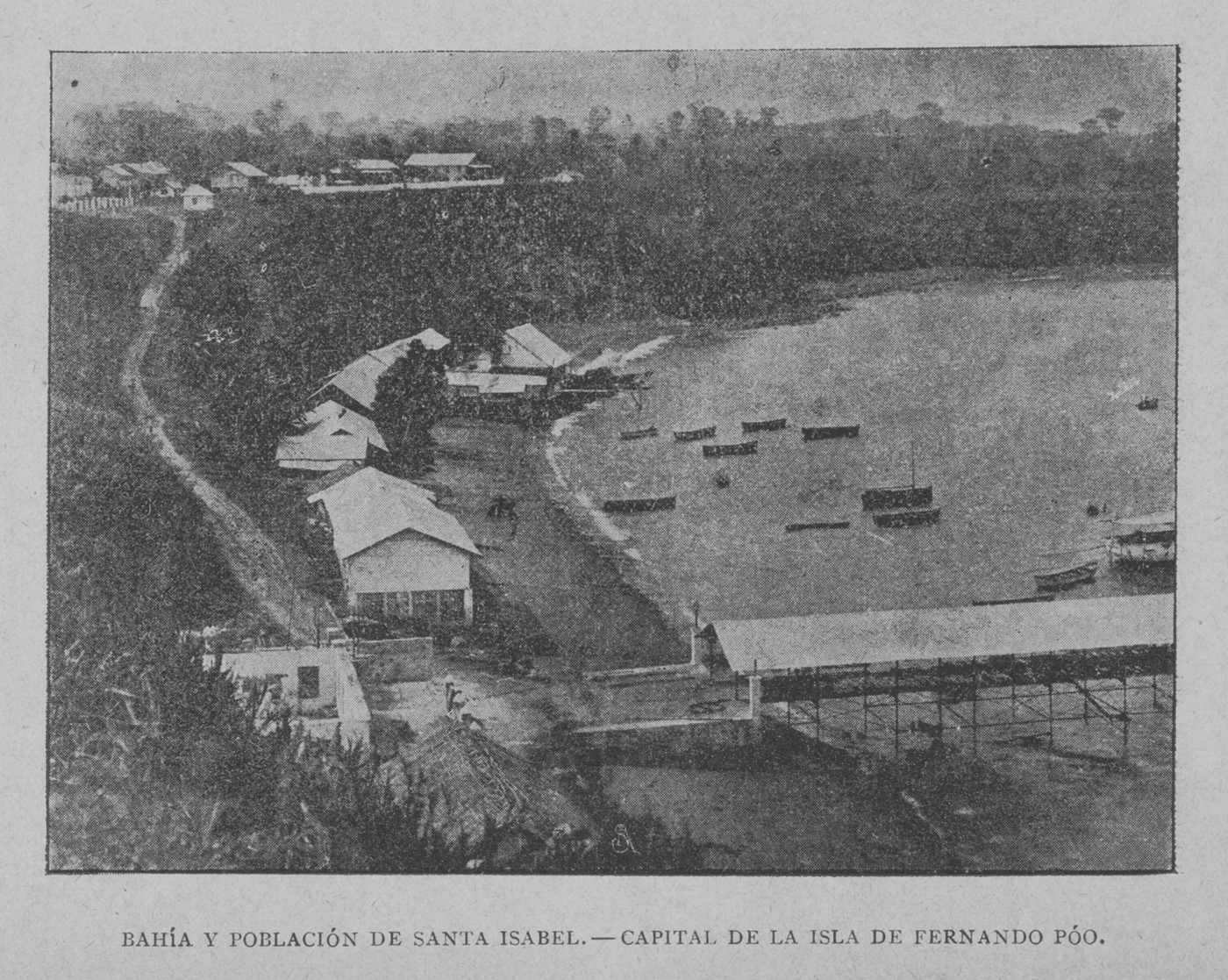
Although France's nineteenth-century penal colonies might fall into the ‘bureaucratization of violence and dereliction’, as Miranda Spieler has so resonantly described the legal structure in Guiana,Footnote 29 the French ostensibly sought to manage the lives of deportees in a ‘rational’ manner so that they would contribute to the advancement of imperial interests. According to Stephen Toth, in the outposts at New Caledonia and Guiana French authorities quickly numbered and measured newly-arrived prisoners, who were subjected to medical exams, classified by status, and assigned a uniform, living quarters and a specific job. The nature and quantity of food rations were precisely laid out, and local doctors protested when – as was typically the case – those under their care lacked adequate nutrition.Footnote 30 However, since Fernando Po was never ‘officially’ declared a penal colony, and the necessary resources were never allocated to its development as such, prisoners of the Spanish Empire disembarked onto an island that completely lacked the organised means to feed, clothe or house them, let alone make consistently productive use of their labour power. When the 1869 deportees arrived at the port city of Santa Isabel, the population was likely less than 800, with some nine Englishmen, 83 Spaniards (including two women and several Jesuit missionaries), 150 black Cubans remaining from the 1862 group of freed slaves (referred to as ‘Congos’) as well as from the 1866 deportee group, 224 Fernandinos (the local black elite, many of whom had originated from British West Africa and/or from liberated slave settlements), and a variety of other communities hailing from different West African locales. The majority of the estimated 30,000 or more residents of the island were indigenous Bubis, who maintained their traditional rural lifestyle (see Figure 2). The head of the small naval outpost commanded some 40 troops and also served as the colonial governor.Footnote 31 The wealthiest of the 1869 deportees were taken in by British and Fernandino residents of the city, and some of the former helped them to escape; the rest of the Cubans crowded into stables or ramshackle barracks, supplementing the meagre governmental rations with fruit supplied by members of the Bubi community. By century's end, the colony had grown, as additional territories were explored, Santa Isabel expanded to 1,500 residents, and plantations, including one run by the burgeoning contingent of Claretian missionaries, were established outside the city.Footnote 32 But later deportee accounts do not register any improvement in conditions. In the photograph of the port included in Valdés Ynfante's text – the only image showing the colonial infrastructure (see Figure 3) – a distanced high-angle framing visually diminishes the small groupings of modest, even rickety, structures, supporting the author's assertion that ‘in over half a century […] it seems incredible that Spain hasn't advanced a whit in that fertile land’.Footnote 33 Deportees continued to be decimated by malnutrition and illness, and fall victim to seemingly random acts of torture; Valdés Ynfante recalled, for example, that each day the Spanish authorities beat a number of men into digging sufficient fresh graves to keep up with the demand.Footnote 34
Bubi Community Leaders of Fernando Po. Of the five photographs that Valdés Ynfante included in his book, three are of Bubis.
Valdés Ynfante's Photograph of Santa Isabel, Capital of Fernando Po.
Scholars studying penal colonies have noted Michel Foucault's relative lack of attention to the phenomenon in Discipline and Punish, which traces out the evolution from spectacular forms of public torture and execution to presumably more enlightened policies of corrective detention as exemplified in Jeremy Bentham's Panopticon.Footnote 35 As Peter Redfield explains, within this framework penal colonies appear as curious hybrids, representing a more ‘modern’ form of punishment that nonetheless betrays ‘the legacy of spectacle at a colonial distance’. According to Redfield's apt metaphor, the penal colonies are situated ‘in the shadows of the bright light of the Panopticon’.Footnote 36 In the Cubans’ representations of the Spanish case, however, dark shadows envelop all possible traces of post-Enlightenment illumination. Here again, the hypothetical tenor of Concepción Arenal's discussion of Spanish penal colonies is belied by the existing testimonial literature. In her 1875 essay Arenal claims that ‘one needs a fertile, feverish, and lugubrious imagination to consider what could happen in the penal establishments we might establish on the other side of the ocean’.Footnote 37 Yet six years before her essay was penned, several Cuban deportees had already revealed lugubrious details concerning the workings of a Spanish penal colony.
The Cuban narratives are in fact remarkable contributions to the centuries-old Black Legend discourse. The Black Legend had functioned to racialise and cast Spaniards as barbarians, in part for their longstanding associations with the African continent, but also for their persecution of non-Catholics and their treatment of indigenous peoples during the conquest of the New World. The discourse, which proliferated in northern Europe in the late 1500s and was revived by Spain's colonial rivals throughout the nineteenth century, culminating in its propagation during the Spanish–Cuban–American War, typically emphasised Spaniards’ presumed propensity for inflicting torture, as evidenced in records from the Inquisition, and the infamous descriptions of the genocide of American Indians published by the Spanish missionary Bartolomé de las Casas. Scholarly work on the Black Legend has largely focused on texts produced outside of the Spanish Empire, and less often highlights the agency of Spanish imperial subjects who appropriated the discourse for their own purposes. But as Jeremy Adelman has noted, ‘the Black Legend deeply imprinted the way in which creole writers understood Spanish colonialism, especially as creoles embraced the idea of Spanish tyranny to justify their cause’.Footnote 38
Some recent scholarly work has shown how Cuban rebels in particular sought to commandeer the Black Legend to further their interests. Rodrigo Lazo notes that Cuban exiles publishing in the United States from the late 1840s until the end of the century underlined the cruelty of the conquerors; Pedro Santacilia, for example, compared them to hyenas, while venerating Las Casas. The exile authors linked the nineteenth-century repression of their compatriots to Spaniards’ earlier destruction of indigenous populations, and likened heroic resisters of the past such as Hatuey to Cuban insurgents who opposed Spain's rule.Footnote 39 Benedict Anderson touches on a later nineteenth-century example of pro-Cuban Black Legend rhetoric in his discussion of Havana-born anarchist Fernando Tarrida del Mármol, who published articles condemning the depredations of the Cánovas regime in Spain and the terrible conditions in Barcelona's Montjuïc prison, where he had been jailed with political prisoners from across the empire. After his fortuitous release, Tarrida went first to Paris and then to London where, as Anderson notes, ‘accounts of the doings of the “New Inquisition” found ready ears’.Footnote 40 One text that Anderson does not treat but that is of particular interest here is Tarrida's 1897 article ‘Les Cubains au bagne de Ceuta’ (The Cubans in the Ceuta Penal Colony), in which the author asserts that ‘The most savage inquisition is taking place in the African presidios, particularly in that of Ceuta, where nearly five hundred Cubans are ill.’Footnote 41 This extension of Black Legend rhetoric to Spaniards’ treatment of Cubans in African deportation sites also features in earlier, as well as later, Fernando Po narratives.
Indeed, a number of the deportees explicitly reference the abuses of the conquest and Inquisition, comparing them to Spanish practices in both Cuba and the West African island. For example, in his discussion of the 1844 La Escalera Rebellion in Cuba, Balmaseda condemns the fact that those accused of conspiring against Spain, slaves and free men of colour whom he characterises as ‘extremely worthy of esteem’, suffered worse torture even than that of the Inquisition. Balmaseda states unequivocally on several occasions that ‘The current-day Spaniards [are] the same as those of the era of the conquest of America.’Footnote 42 Similarly, when Bravo Sentiés discusses the January 1869 Villanueva Theatre massacre in Havana, he insists that the Voluntarios – the pro-Spanish militia – who opened fire on men, women and children were the ‘direct descendants’ of Castilians who massacred an entire tribe of indigenous Americans before a horrified Las Casas.Footnote 43
With respect to Fernando Po, Balmaseda compares Spain's arrival on that island to Columbus’ journey to the New World with three ships he characterises as ‘filled with criminals’, exclaiming ‘What a seed the Spaniards took to America and Africa to plant in virgin soil!’Footnote 44 Valdés Ynfante and Miranda, who arrived in Fernando Po a quarter-century after Balmaseda, found even more examples of conquest and Inquisition-worthy atrocities. Valdés Ynfante employs the word ‘inquisition’ or ‘inquisitorial’ on a number of occasions in his text, but it is when he turns his attention to Fernando Po's prison that he pauses to underline the connection. Describing the various instruments of torture routinely used in the facility, the author asserts, ‘well into the nineteenth century, we had there, in miniature, the inquisition with its procession of horrors’.Footnote 45 To substantiate their claims, both Valdés Ynfante and Miranda provide gory accounts of the fatal or crippling public beatings doled out to the deportees, in many cases on order of the governor, Adolfo de España – whom Miranda compares to a Mexican conqueror excoriated by Las Casas – and at the hands of his henchman Corporal José Fernández, who operated with impunity on Fernando Po. Fernández thrashed one man until his eye popped out of its socket, and then locked him in the stocks for five days, until all of his wounds were swarming with worms and he finally died. The corporal beat and whipped another man with a studded strap, before ripping his beard out from the roots; later, he was thrown to the sharks.Footnote 46 Miranda, who befriended a number of the deportees from the Philippines, also records the harrowing screams of a Filipino woman who was raped by Fernández after her husband died.Footnote 47
The Cubans sometimes single out the appalling treatment of Africans, and on several occasions Balmaseda uses the evocative neologism negrófagos (black-eaters) to refer to Spaniards.Footnote 48 In the Cubans’ narratives it is the Spaniards, rather than the Africans, who are most frequently condemned for cannibalistic and other ‘primitive’ practices.Footnote 49 Some of their tales of Spanish savagery rival the most lurid colonialist representations of Africans, running parallel to older Black Legend accounts of the New World ‘encounters’ in which Spaniards are shown to be far more barbaric than their indigenous subjects.Footnote 50 For example, after his escape from Fernando Po Balmaseda interacts with a number of local communities along the West African coast, and he does not always approve of their customs. But his carefully measured descriptions of practices such as the preservation of skulls from the Duala king's coronation sacrifice in Cameroon are quite different in tone from his treatment of Spanish atrocities. Balmaseda includes a sensationalistic depiction, for instance, of Spaniards’ desecration of the bodies of US soldiers who had attempted to annex Cuba in 1851 (led by Narciso López and William Crittenden). In his narrative, Balmaseda claims that after their mass execution of the soldiers, Spaniards mutilated the cadavers and carried off body parts, drinking champagne from the skulls – still covered with flesh and hair – and preserving their testicles in alcohol as war trophies.Footnote 51
For several of the Cuban deportee authors, the nefarious Spaniards of their vivid anecdotes embody the Spanish national character. However, in the two narratives published in Cuba in the early 1890s – after Spain had granted greater political rights to Cubans, but during a period in which censorship still would have prohibited publication of obvious anti-Spanish tracts – the authors hasten to signal that the Spaniards they denounce are not representative. Even so, both Saluvet and Sifredo y Llópiz painstakingly document their treatment at the hands of Spanish villains, including Governor Joaquín de Souza, who sent them for a time to the same shark-infested island inhabited by the 1866 deportees,Footnote 52 and Ricardo Bermúdez, the rapacious and sadistic captain of the Pinta, the ship that transported them out of Fernando Po. According to Saluvet, Bermúdez kept them at sea for months longer than necessary, caged them below decks and denied them food, water and proper medical treatment, and as a result 21 of the 48 deportees on board perished during the journey. Saluvet's characterisation of the captain as ‘vile to the point of savagery’, and his repeated references to him throughout many pages as ‘perverse’, an ‘ogre’ and a ‘monster’, ultimately function to bolster the Black Legend discourse that is more directly articulated in the other deportees’ narratives.Footnote 53
Cuban Deportees’ Reversals of Middle Passage Narratives
The deportees link their accounts of Spanish savagery to an exposé of Spain's persistent support of slavery, and its promotion of alternative kinds of contract and unfree labour that in practice resembled slavery. They were first-hand witnesses to the evolution of convict transportation, which according to Benton ‘fit into a pattern of proliferating forms of coerced labor and formed part of a wider imperial project of moving forced laborers around the globe’.Footnote 54 Balmaseda, writing just after the official end of the slave trade to Cuba in 1867, and during a period of fervent debate among a variety of abolitionist and pro-slavery factions on the island and in the metropolis,Footnote 55 denounces Spain's history of trafficking of Africans in violation of international treaties. He also calls contemporaneous Chinese indentured labour in Cuba ‘a simulated slavery’,Footnote 56 revealing an awareness that, as Rebecca Scott and other historians have argued, these workers were often ‘indentured by force or deceit’, and ‘had almost the same effective legal status as a slave’.Footnote 57 Many of the authors also condemn the forced labour of Cuban, Filipino and African prisoners on Fernando Po. But it is the two men who were deported after the 1886 abolition of slavery in Cuba who are most pointed in their excoriation of what they view as Spain's now-covert enslavement of Africans, that is to say, the practice of ‘neoslavery’, as the scholar Ibrahim Sundiata terms it, which they witnessed first-hand.Footnote 58 Valdés Ynfante explains how contract labourers from all along the African coast were captured against their will or conned onto steamships. Once in Fernando Po these ‘Krumen’ quickly became indebted to their masters and were unlikely to regain their freedom after the requisite three years; ‘of course they are slaves’, he concludes.Footnote 59 In his opening note to the reader, Miranda indicates that his goal is to provoke ‘horror at the cruelty with which “colonisers” martyr the wretched Africans who moan under the yoke of a disguised slavery’.Footnote 60 By placing the word ‘colonisers’ in quotes, Miranda suggests that Spaniards’ claims to be engaging in the modern colonisation of Africa are simply a ‘cover’ for the ongoing enslavement of Africans.
Moreover, the politically-motivated deportations of Cubans were linked to polemics over the use of slave labour in Cuba. Many of the 1869 deportees were either genuine abolitionists, or allied themselves for strategic reasons with Cuban political parties that viewed the elimination of slavery as necessary to the bid for independence from Spain. They had been rounded up in Cuba and guarded on their sea journey to Fernando Po by the brutal Voluntarios, a militia that was led and financed by (among others) the inveterate slaver Julián Zulueta, who hailed from one of the wealthiest families in all of the Spanish Empire.Footnote 61 Zulueta owned a number of the ships that transported the Cuban political prisoners to Africa, and he was also under government contract to provide Fernando Po with supplies; he thus profited directly from the practice of penal deportation. In at least one documented case, after dropping off the 1866 Cuban deportees on Fernando Po, Zulueta's ship took on an illegal cargo of slaves for transport back to Cuba.Footnote 62 Zulueta, together with other shippers of Cuban deportees, was also involved in West African and Asian labour trafficking, and in 1847 he had initiated the trade in Chinese indentured servants to Cuba.
This state of affairs, together with the deportees’ geographical routeing and the nature of their experiences, facilitated their implicit or explicit comparison of themselves with slaves. While it was common for Europeans and American creoles of the era to refer metaphorically to their experiences as subjects of undemocratic or colonial regimes as forms of enslavement – a rhetorical gesture that Susan Buck-Morss and David Luis-Brown problematise – many of the figurative strategies of the Cubans are, relatively speaking, more grounded in lived material circumstances.Footnote 63 Their prolonged characterisations of the horrific transatlantic journey, for example, could not but resemble Middle Passage accounts. The Cubans describe wrenching leave-taking scenes in Havana, where many of them were bound or chained together and marched from their holding cells in the dungeons to the port as their tearful family members looked on helplessly, and violent pro-Spanish mobs called for their immediate execution. They detail the abominable trip by sea from Cuba to Fernando Po, emphasising the stocks and cramped metal cages they were consigned to in the ship's hold, the utter lack of hygiene, the dearth and contamination of the food and water, and the abusive treatment by their captors, who are insistently referred to as negreros (slavers/traffickers of blacks) in their texts. Extraordinarily large numbers died on board: because there was no economic incentive to deliver the cargo alive, the mortality rate of deportees during transit could be much higher than that on slave ships – as high as 44 per cent on the Pinta. When the 1869 deportees found themselves literally blackened after they were coated by the dust from coal loaded onto the ship, Balmaseda did not hesitate to articulate a resonant analogy: ‘we all became black as Ethiopians’.
Notwithstanding their affirmations of abolitionism, however, the white deportees are sometimes plagued with racial panic as they perceive themselves as reduced to the status of black slaves. This is most evident in the narrative of Bravo Sentiés, who claims to battle for progress under an abolitionist flag (‘our flag reads: equality, liberty, fraternity, abolition of slavery’), but who studiously avoids Balmaseda's ‘black as Ethiopians’ metaphor when describing the coal incident, opting instead to associate the deportees’ appearance with that of charcoal workers. Of the inhumanly cramped ship quarters, Bravo Sentiés observes that the space was ‘a little less than a sixth of what the regulations mandate for each Asian indentured servant [colono] brought to Cuba’; the reference to the more recent trade in Chinese labourers allows him to avoid the far more obvious comparison with transatlantic slave accommodations. His pointed efforts to avoid any identification with blackness – even as the traces of that identification are ever present in his text – are also evident in the description of his escape from the island of Fernando Po, which demanded ‘the skill, shrewdness, and finely-tuned senses that Indians possess’. Bravo Sentiés’ comparison is startling, given the fact that the guides that enabled him to escape – and the people who routinely traversed the terrain in question – were of course Africans, not Indians.Footnote 64
Bravo Sentiés’ text also makes clear that class- and race-based stratifications determined which deportees would experience conditions even remotely akin to those of African slaves. Wealthy white Cubans were allowed to carry personal effects and large amounts of cash with them, which considerably attenuated their suffering. Bravo Sentiés appears astonishingly insouciant when he describes how different forms of coerced labour contributed to his personal comfort and appearance of respectability. For example, while a number of the authors recall the moments of embarkation from Havana and disembarkation on Fernando Po as especially difficult to bear, Bravo Sentiés provides an alternative view by noting that some members of the group travelled across the lengthy Cuban pier in an open rail carriage supplied by a genteel friend and pulled by ‘black house slaves’ (negros de la casa); the burden of arrival on the island of Fernando Po was lightened by African porters who carried their trunks from the dock up the long and steep road to the city.Footnote 65 Bravo Sentiés, Balmaseda and other deportees with the resources to do so found relatively comfortable lodgings with British and Fernandino residents. While Bravo Sentiés was able to insulate himself from others’ experiences, failing to perceive the significant misfortune some of his compatriots faced, Balmaseda by contrast acknowledges that the poorer among them, who had no opportunity to practise their diverse trades for pay in the then-stagnant colony, struggled to survive in the communal barracks.Footnote 66 This was the case for Saluvet as well as for Sifredo y Llópiz, who notes that the destitute Cubans from the 1869 group – 40 in total – were organised into work crews to fetch water from a distant river, gather firewood, and prepare meals from the scanty governmental rations.Footnote 67
As the years wore on and the deportees increasingly hailed from less-privileged classes, with fewer opportunities to escape their cruel fate on Fernando Po, it was perhaps even more tempting for them to draw parallels between their own experiences and those of slaves. By the end of the century, the colony had grown and so had the need for workers. The hundreds of deportees in the barracks were still required to haul water and firewood in exchange for rations, but they were also likelier to be drawn into more onerous types of forced labour, such as lugging in the coal shipments that were dumped offshore. When they were allowed to seek out paid occupations on their own, toiling in tobacco, coffee, or cacao fields or clearing brush, conditions could be dreadful. Miranda landed an ostensibly less taxing post in one of the city's commercial establishments, but couldn't withstand the 17-hour days of non-stop physical chores. Ironically, he secured his first-ever supervisory experience on Fernando Po, overseeing two African workers in the household of a plantation owner who had fallen ill; the author proudly notes that his employer chided him for never punishing the workers. In his final months on the island, Miranda also attempted to establish his own tobacco business. For his part, Valdés Ynfante sought to support himself by setting up a makeshift clock repair stand on the street.Footnote 68
Transformations in local practices at the end of the century prompted an emphasis on a new ‘reversal’ in the appropriated Middle Passage narrative. Even though Miranda registers frequent shock at the heinous violence directed towards blacks in particular,Footnote 69 both he and Valdés Ynfante also appear profoundly disturbed by what they perceive as an inversion of traditional racial hierarchies, as what they deem to be covert regimes of enslavement multiply. Miranda underscores this phenomenon by continually punctuating his narrative with the phrase ‘for the first time’. For example, detailing how the deadly beatings of whites as well as blacks were now perpetrated by black patrolmen, he affirms that the islanders ‘were astonished, since for the first time they saw a black policeman punishing a white man’. Of the extension of forced labour to white Cubans, he notes, ‘For the first time the people of Fernando Po saw two white men working on the road, with shackles on their ankles, pushing a cart uphill, carrying sticks and bricks just like them, the [African] contract workers’.Footnote 70 Similarly Valdés Ynfante describes how blacks such as the Fernandino planter Daniel Kinson led barefoot white Cubans off in irons and chains to engage in hard labour, under the whip of a black overseer. He, too, observes that the Cubans were treated like the West African contract labourers, ‘to whom we were compared’.Footnote 71
Here the complexity of the island's hybrid colonial history, its class and racial hierarchies, and the variety of forms and degrees of unfreedom suffered by many of its residents, emerges. It may have been the case, for example, that the British-identified Fernandinos viewed Spaniards as well as Cubans through the lens of ‘Anglo-Saxon superiority’. At the same time, however, the Fernandinos lived in a society in which, according to Sundiata, ‘the “educated African” could fully exploit his natural environment and his fellow Africans’. In fact, while Spanish and other European colonisers were also known for their harsh handling of ‘Krumen’, some Fernandino planters gained particular notoriety for mistreating their workers. Sundiata explains this as stemming in part from the challenges that many of them, as smaller-scale landowners, faced in competing for labourers and profits with the large plantations that were rising to dominance on the island.Footnote 72 While, from the white Cubans’ viewpoint, it was clearly of racial significance that they had been incorporated into the chain gangs of the local black elite, for the latter the deportees may have simply represented an alternative source of subalternised labour. Here, Clare Anderson's call to ‘view subalternity as a socially-contingent process’, one that might also prompt the emergence of a ‘critical perspective’ on the complexity of relationships within colonial contexts, is particularly resonant.Footnote 73 According to Valdés Ynfante the situation was untenable, for the more the Cubans were degraded in the eyes of the Fernandinos, the more ‘the latter reckoned that they [the Cubans] were quite inferior to them, consequently trying, for their part, to oppress them even more’ – a tendency that he claims the colonial authorities occasionally sought to check.Footnote 74
Ann Stoler has explained how European colonial regimes instituted policies designed to uphold the illusion of white superiority, and the racial consequences of penal deportations registered as a preeminent concern among some Spanish authorities as well as among the white deportees.Footnote 75 In 1866, the governor of Fernando Po, José Gómez de Barreda, had expressed his opposition to converting the island into a penal colony precisely because of the potential threat to white authority: ‘it would be extremely regrettable to be obliged to impose severe punishments here on those of our race, given the fact that we find ourselves in a country where the moral prestige that [our] race exercises over the people of colour who inhabit it constitutes a large part of our power’.Footnote 76 Redfield has noted a similar concern with respect to French Guiana, citing the sarcastic comments of a rare nineteenth-century critic of race-based objections to penal colonies (M. Forestier): ‘The white caste clings most singularly to the nobility of the epidermis; it cannot consent to place before the eyes of a Negro a tableau of the degradation of a white […] A bad joke would suggest that we dye our convicts black before embarking them.’Footnote 77 Of course within the Spanish empire – as within the French as well – there were many black deportees, and a diverse range of Spain's colonial authorities were no less preoccupied by the impact on established or desired racial hierarchies of their presence in and movement through their territories.
From Racial Stratification to Visions of Convivencia
During the nineteenth century, the deportations of black Cubans in particular were related to ongoing whitening campaigns, prompted by post-Haitian revolution fears that demographic imbalances on the island would lead to insurrection. For much of the nineteenth century, blacks had outnumbered whites in Cuba, and immigration policies sought to counter this by encouraging the arrival of white workers and their families while forbidding entry to free people of colour.Footnote 78 Correspondence from Cuban Captains General Dulce and Lersundi makes clear that political or ‘criminal’ deportation of blacks was also conceptualised as a means of managing Cuba's ‘race problem’.Footnote 79 The arrival of black Cubans in other points of the empire, however, could provoke concerns that racial classifications and hierarchies common within, or imposed upon, local populations might be challenged. For example, in 1867 the Governor General of the Philippines José de la Gándara y Navarro (who previously had served in equivalent posts on Fernando Po and in Cuba) decried the disembarkation of Cuban deportees in his jurisdiction, expressing the worry that they would ‘significantly damage the good reputation that European and especially Spanish classes enjoy among these simple inhabitants, whose limited intelligence does not enable them, for the most part, to define the deportees as anything other than Peninsular blacks’. While underlining the Filipinos’ presumed inability to discern fundamentally different identity categories, he contributed his own taxonomic perspective by condemning ‘the character and ideas that predominate in that American race’, concluding that even though they were not criminal deportees, he had no choice but to lock the Cubans up in the public jail until some other solution might be found.Footnote 80 The preoccupation that the circulation of deportees throughout the empire, and the resulting exposure to different perspectives, might destabilise hegemonic racial regimes and other norms is also articulated in an 1864 letter to the Overseas Minister from Cuban Civil Governor Joaquín Casariego, who expresses dismay at the fact that several 1858 deportees to Ceuta had managed to return without his consent to Cuba. Casariego was particularly aggrieved about the return of black deportees:
Your Excellency, with respect to [deportees] of colour, I believe it goes without saying that if the current regulations prohibit the return from abroad of those who are not criminals, [because of] the perniciousness for our country of the doctrines that they are steeped in upon their return, with far greater justification this prohibition should apply to those who are sent to the presidio in Ceuta, where undoubtedly they have been considered as equal to whites of the same condition.Footnote 81
Cuban officials had registered similar concerns in the wake of the exclusions and expulsions following upon the 1844 La Escalera Rebellion. As Michele Reid-Vazquez has shown, island authorities struggled to contain the entrance of subversive ideas propagated by black sailors arriving on foreign ships, as well as by black Cubans who sought to return home after deportation to Ceuta or forced emigration to Mexico, the United States or other locales where they had become vectors of political ‘contagion’; the governmental measures, it turned out, had unintended consequences when black Cubans allegedly conspired from abroad and allied themselves with ‘an international rebel network’.Footnote 82 Similarly, from the 1860s on, as deportees circulated throughout the empire, and as the authorities’ capacity to control their exchanges and even their movements failed to keep pace, the threat to colonialist ideology would increase – an idea to which I return below.
Sometimes the authorities sought to ‘whitewash’ their whitening-related expulsions through strategic reference to the desires of others among their black constituents. Thus in 1866 Cuban Captain General Francisco Lersundi claimed that honourable and industrious Cuban blacks were jubilant to learn of the deportation to Fernando Po of those whom he characterised as incorrigible criminals: ‘they consider themselves free of a tremendous calamity’.Footnote 83 Once those ‘calamitous’ Cubans arrived in Fernando Po, however, Governor Gómez de Barreda begged the Spanish government to transfer the group elsewhere, averring that both the Fernandinos and the Bubis were terrified of them.Footnote 84 As the century advanced, even when they formed a part of political deportee groups, blacks’ presumed criminal tendencies continued to be emphasised by Spanish authorities. While there were only seven Cubans of colour among the 250 accused Ten Years’ War instigators sent to Fernando Po in 1869, by the 1890s a much larger percentage of the political deportees were non-white Cubans. Many of them were alleged Ñáñigos, or members of the Afro-Cuban Abakwá secret society, who were assumed to be criminals. It was not until late in the history of the Cuban deportations, however, that Spanish officials decided to divert black Cubans to other penal facilities, arguing that they were providing inappropriate role models for the African residents of Fernando Po.Footnote 85
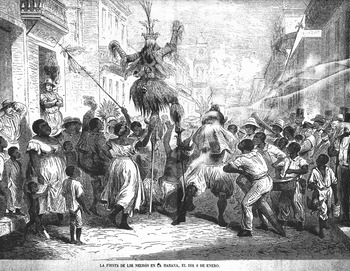
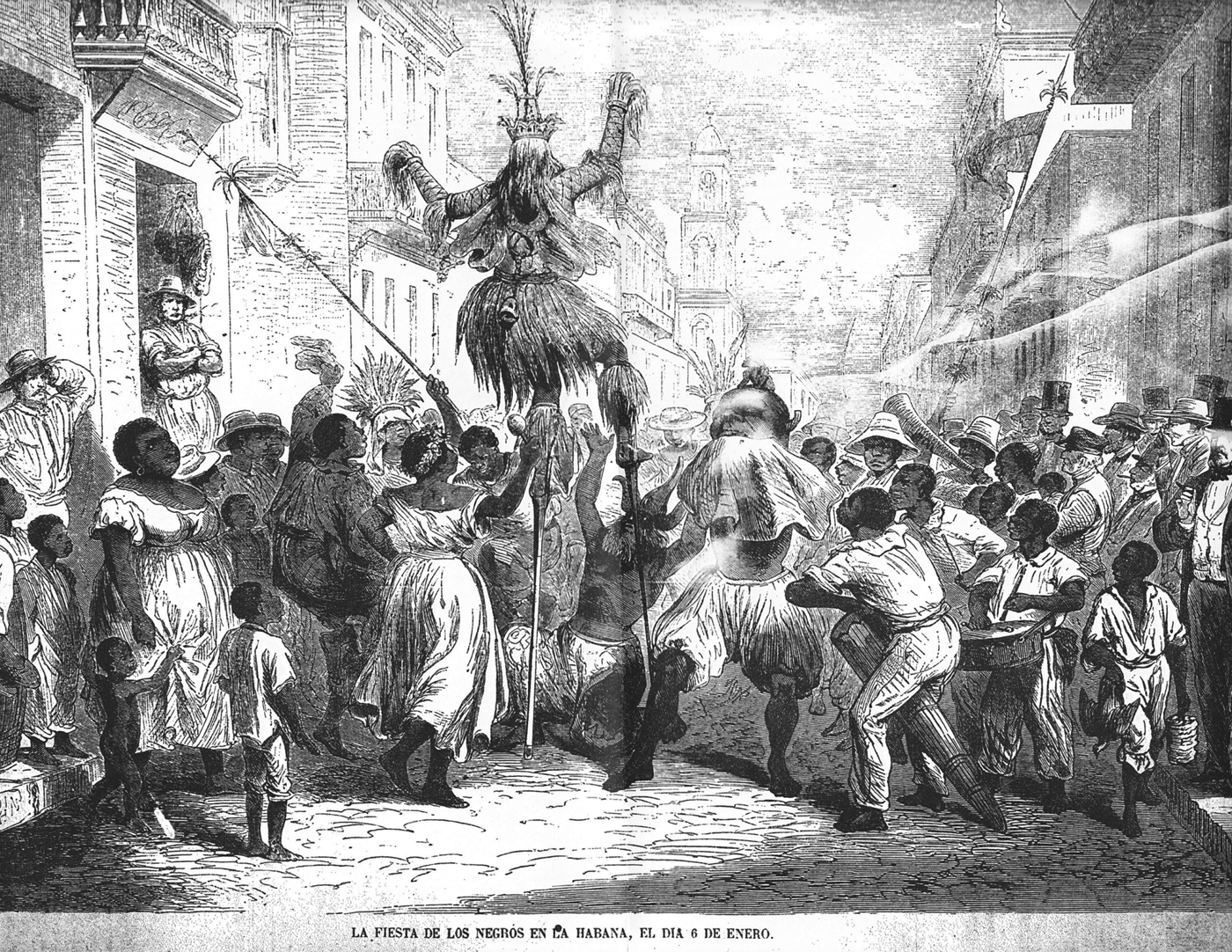
Some of the white Cuban deportees also expressed disapproval of the comportment of their black compatriots, though they often attributed it to their longstanding abuse at the hands of the Spanish and their lack of education.Footnote 86 After he and the other prisoners were unchained during the ocean crossing, for example, Miranda appeared scandalised by the crossing of boundaries of gender and sexuality, as two men of colour, one of whom spoke in falsetto and went by the name of Catalina, danced ‘extravagantly’ together. He objected to the ‘witches’ Sabbath’ (aquelarre) of the ‘bedevilled [endemoniados] Ñáñigos’, and was unappreciative of his shipmates’ musical performances, as they beat on cups and plates with spoons, and whistled to reproduce ‘the savage noise that they make in Havana by blowing into an empty earthenware pitcher’.Footnote 87 Once they arrived on Fernando Po, several of the authors were uncomfortable with the similarities between Afro-Cuban customs and the local cultural practices they observed on the island. Valdés Ynfante, for example, found Sunday festivities on Fernando Po evocative of Three Kings Day celebrations in Havana (see Figure 4), when Cubans of colour transformed themselves into ‘little devils’ (diablitos), donning distinctive tribal costumes and parading through the streets accompanied by percussive music. It was the immersion in African culture afforded by his deportation that prompted Valdés Ynfante to ‘comprehend’ what he characterised as the ‘savagery’ of musical forms that had become a part of Cuban life.Footnote 88 The authors of Fernando Po deportation texts had been interpellated within a Cuban society that for decades had been permeated by fears of ‘Africanisation’. Their forced transportation to the putative ‘homeland’ of some of their fellow Cubans was perhaps bound to provoke such anxieties.
Afro-Cubans Celebrating Three Kings Day in Havana. This is a widely-circulated image of these celebrations, which deportee narratives linked to cultural expression on Fernando Po.
To my knowledge there are no published narratives of black Cuban deportees to Fernando Po, nor has my research thus far turned up archival records in which they present their own accounts. A sense of their experiences may be gleaned not only from reading between the lines and against the grain of the white authors’ texts, but also through an amplification of traditional notions of what comprises the ‘archive’, and through alternative interpretive practices. In Benita Sampedro's important assertion with respect to the context of Equatorial Guinean history, ‘there are infinite forms of inscribing the Guinean archives besides writing, and besides writing in Spanish, all of which can be equally empowering against colonial centers and imperial pasts’.Footnote 89 In this spirit, it is possible to expand significantly upon Saluvet's observation that a medical assistant from the hospital organised dances similar to Cuba's ‘African cabildos [social clubs]’, and that ‘some deportees of colour found true solace in those festivities’.Footnote 90 Over the years black Cuban deportees interacted and even assimilated with many of the diverse communities of colour on the island, including the indigenous Bubis, the Fernandinos and the ‘liberated’ Cuban slaves who had first arrived in 1862. The legacy of those relationships is documented in the richly complex layers of cultural syncretism that scholars have begun to explore. The ethnomusicologist Isabela de Aranzadi, for example, has studied ‘oral and corporeal’ memory, musical instruments and performances, as well as written archival sources in order to explain how Cuban deportees of colour shared with African groups on Fernando Po the cultural practices that had earlier been carried to that island from Calabar, in some cases after passing first through the Caribbean; how those evolving practices then spread to different ethnic and linguistic groups within what is now Equatorial Guinea; and how surviving deportees transported the multiply syncretised traditions from Fernando Po back to Cuba, where they continued to infuse new life and purpose into Afro-Cuban cultural expressions.Footnote 91 Aranzadi asserts that ‘their legacy constitutes a clear form of resistance in Cuba and Fernando Po’; studies such as hers broaden significantly the ongoing theorisation of a ‘Black Atlantic’ space of cultural exchange as well as of political agency.Footnote 92
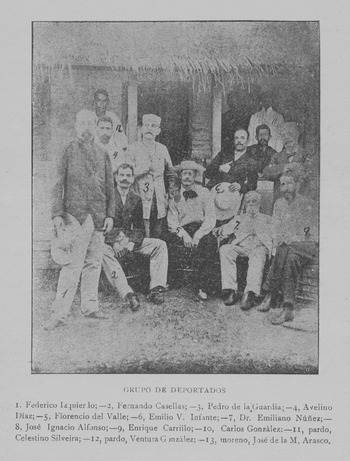
As the authorities feared, the deportations sometimes did facilitate an intensive degree of interrelationship among different groups – including among Cubans of many backgrounds – that may have bolstered and extended the reconceptualisation of identity, community and political alliances that was already in process on the Caribbean island during the decades of abolitionist and independence struggles. Moreover, even as they reveal the notable difficulty of overcoming deep-rooted prejudice, the published narratives provide tantalising glimpses into the opportunities to broaden the networks of exchange and solidarity that were a by-product of the deportations. The evocative photographic portrait of Valdés Ynfante together with other deportees on Fernando Po, for example, appears to tell a variety of stories. It registers the positioning of Cubans of colour along the margins, indeed within the very shadows of the dominant group: they stand behind the well-lit author and his white companions, their individual features lost in darkness. In the caption they are consigned to the end of the list, and, while the whites remain ‘unmarked’, they are classified in hierarchical fashion, with the two pardos listed ahead of the moreno (see Figure 5). Even so, the photograph seems to respond to an impulse to envision the consolidation of a diverse community on Fernando Po, one that might reflect the modes of multi-racial identification that had already found purchase in a variety of contexts within Cuba. On the military front, for example, since the Ten Years’ War both the infantry and the leadership of the liberation forces had been integrated, and insurgent Cubans eventually came to understand, as Ada Ferrer has shown, that ‘a revolutionary cross-racial alliance’ would be essential to the foundation of an independent nation.Footnote 93 Within the workers’ movement as well, Cubans of different backgrounds gradually joined forces in common cause; while the racial tensions that colonial authorities had encouraged still persisted, and labour unions were initially segregated, by the late 1880s organisations such as the Círculo de Trabajadores (Workers’ Circle) and the Alianza Obrera (Workers’ Alliance) did not limit membership, insisting that ‘labor does not have race’, and explicitly promoting anti-racism as Cubans of colour moved into prominent organisational roles.Footnote 94 In the 1890 May Day event in which Miranda had been one of some two dozen speakers, fellow anarchists such as the Afro-Cuban Alianza Obrera leader Fernando Guerra and the Spanish-born tobacco worker Cristóbal Fuentes demanded racial equality, and the peaceful demonstrators, ‘in complete fraternity, respond[ed] to the same ideal of the brotherhood of all workers’.Footnote 95 While this ‘new language of multiracial citizenship’, as Ferrer terms it, spread throughout Cuba,Footnote 96 it could also be carried beyond the confines of the island and the neighbouring zones of insurgent activism and support, as some deportees conceptualised a wider domain for their egalitarian ethos.
Valdés Ynfante's Portrait of Himself and Fellow Deportees. The author's name is written ‘V. Infante’.

In the text that accompanies his photographic portrait, Valdés Ynfante recalls the time the pardo Juan Ramos approached him to make and share some garlic soup; they pooled their resources, bought the ingredients, built a fire, and cooked up the meal – but it was an initiative that met with the disapproval of a Spanish military authority, who violently knocked over their cooking pot.Footnote 97 In a regime in which acute malnourishment functioned as a form of punishment,Footnote 98 the sharing of food could be an act of both solidarity and rebellion. It is significant that the deportees devote special attention to such moments, when worldviews might be exchanged in both word and deed, and here their narratives gesture towards the discourse of convivencia as they include broader groups within the sphere of ‘brotherhood’. Two Filipino socialists, a schoolteacher and a pharmacist, befriended Miranda and invited him to join them in meals of rice, bananas and salted meat that the three cooked alongside a river.Footnote 99 Decades earlier, Balmaseda had already underlined ‘the angelical kindness’ of the Fernandino and Bubi residents of the island, noting that the latter sold chickens, bananas and yams at modest prices or even provided them free to the more impoverished deportees.Footnote 100 Miranda was also exceptionally impressed by the generosity of the Bubis, who scrupulously shared all food within the community and reciprocated his gifts of crackers with eggs and kola nuts; he concluded that they were ‘people of the most tender customs, more true, more temperate and altruistic than I have ever seen’.Footnote 101 Throughout their forced travels, the deportees were also deeply moved by their encounters with allies in the wider circum-Atlantic context; here it is important to recall the support that over the decades Cuban separatists had sought and found in other Caribbean and American locales.Footnote 102 When Saluvet finally arrived for a stopover in Puerto Rico after the harrowing journey from Fernando Po, he was overwhelmed by the fact that ‘blacks, whites, mulattoes, the Chinese, English, French and North Americans, all insisted on demonstrating their friendship for us’. The author singles out a visit to their boat from a ‘family of colour’, underlining their ‘tender solicitude’, ‘refined kindness’, ‘compassion’, and ‘affection’. Saluvet is prompted to articulate a capacious understanding of his place in the world: ‘Among us there were men of all colours, of all ages, of all social classes, Peninsulars, Islanders, and Cubans alike […] we were all brothers.’Footnote 103 For his part, Miranda would come to dedicate his narrative to ‘my fellow men [semejantes] – white, black, yellow or red’ who suffered together on Fernando Po, and, after returning home from the African island, he wrote short stories promoting racial and class equality.Footnote 104
Several passages in Benedict Anderson's study of anarchist and anti-colonial networks in the late nineteenth century reveal that prisons in Spain – awful though their conditions were – sometimes facilitated the forging of cross-cultural alliances and the global exchange of ideas and strategies.Footnote 105 The Cuban deportee narratives make clear that an even broader range of citizens and subjects encountered one another through the penal colony of Fernando Po, and might find their perspectives or their political practices similarly amplified or even transfigured. In a remarkable passage in Balmaseda's text, after he was smuggled off Fernando Po and while awaiting safe passage to England from the West African coast, the author found himself on the shores of the tiny island of Corisco, now also part of present-day Equatorial Guinea. Corisco had previously been a base for the slave trader Miguel Pons,Footnote 106 and Balmaseda first had to overcome the terrified reaction of the Coriscans, who believed that he had come to enslave them; instead, he explained that Cuba was at war with the Spanish, and that in some parts of his country the slaves had already been freed. When Balmaseda learned that Spanish soldiers were soon due to arrive on Corisco, he feared for the fate of his new acquaintances, and counselled them on strategies they might adopt in order to save themselves and their homeland. Balmaseda's text evidences that in viewing the Coriscans as fellow ‘victims of Spanish despotism’, he had come to empathise, identify and collude with them.Footnote 107 Tales such as these, then, suggest that even though Spanish penal deportations aimed to suppress opposition to colonialist hierarchies, and to the forced labour regimes they sought to bolster, they also may have prompted or solidified different conceptualisations of allegiance and forms of resistance across an embattled Spanish empire.
Conclusion
In this article I have endeavoured to draw attention to an understudied chapter of both global penal colony and Spanish imperial studies, and to marshal a traditionally less-common microhistorical approach to this macrohistorical subject, by centring on Cuban independence activists’ experiences of and ruminations on deportation to and forced labour in one particular carceral site, Fernando Po. Although international convict transportation scholars have begun to examine Spain's involvement in this phenomenon, there has been very little consideration of the role played by African outposts within the empire, and I hope that this article sparks interest not only in the Fernando Po context treated here, but also in the North African presidios. Moreover, research on Spanish imperial projects has traditionally focused intensively on the Caribbean and Latin America in isolation from – and while attending less to – other geographical zones colonised by Spain; this article contributes to emerging efforts to grapple with multi-nodal figurations of space and networks of exchange that diverge from more compartmentalised conceptualisations of Spain's imperial system. The six published deportee narratives, analysed together and in detail here for the first time, reflect the larger shifts in identity formation and political strategisation that were occurring over the second half of the nineteenth century on the Caribbean island. But they also reveal complex paths of individual transformation, as deportees of dramatically divergent backgrounds, from the non-elite to the privileged, registered and processed the novel circumstances and communities they encountered within the wider imperial sphere. This study thus signals different routes of exploration into this tumultuous time period, and foregrounds fresh voices from the rich archive of anti-colonial discourse.
Acknowledgements
Warmest thanks to Gustau Nerín, who first recommended in 2009 that I work on the Cuban deportee texts; to Joan Casanovas, who kindly shared essential information with me in the final stages of this project; and to Donato Ndongo-Bidyogo, whose ethically-engaged creative and critical work regarding Equatorial Guinea is an ongoing source of inspiration. Earlier versions of this article were presented at Stanford University; Harvard University; the University of Illinois; the Modern Language Association conference; and the German Society of Hispanists conference. I am very grateful to the organisers (Lisa Surwillo, Brad Epps, Elena Delgado and Christian Tschilschke), as well as to the other speakers and audience members at those events (including Benita Sampedro, Jill Lane and the late Christopher Schmidt-Nowara), who offered the invaluable feedback that allowed me to expand and refine my ideas. I am also indebted to the three anonymous reviewers and the editors of the JLAS, who provided extraordinarily helpful suggestions for further revision.