Introduction
On July 14, 2016, the Bastille Day, usually marked by celebrations on the promenade des Anglais in Nice, a terrorist drove his truck at high speed down the promenade with the intention to kill as many people as possible. Most of the victims were received by 2 hospitals: An adult hospital, Reference Carles, Levraut and Gonzalez1 and the Lenval University Children’s Hospital (LUCH). Reference Haas, Fernandez, Bréaud, Dupont, Tran and Solla2-Reference Askenazy, Chauvelin, Gindt and Thümmler5 During the first night, the LUCH treated 44 victims, and among them, 32 children. Reference Haas, Fernandez, Bréaud, Dupont, Tran and Solla2-Reference Solla, Carboni and Fernandez4
Beyond the immediate effects on victims and the surrounding population, the burden of terrorism can affect the entire medical system. After the 2006 war in Lebanon and Israel’s northern frontier, Bar El, et al. Reference Bar-El, Michaelson, Hyames, Skorecki, Reisner and Beyar6 exposed the different consequences on a single institution, including the provision of emergency treatment, the referrals from other hospitals, the continuation of routine services, the safety of the hospital, and the logistics of staff. They also assessed the financial losses due to the decrease in revenue-generating activity at 10.2 million USD. The authors also included workers’ increased wages because of the extra hours worked (0.63 million USD); The expenses incurred in the changes to hospital organization, transportation, and protection (0.68 million USD). The overall losses (11.6 million USD) corresponded to 6% of the annual hospital budget; a return to full operating capacity took at least 3 weeks after the end of hostilities. Reference Bar-El, Michaelson, Hyames, Skorecki, Reisner and Beyar6
After the Boston marathon terror attack in 2013, Osgood estimated the total cost during the first week following the attack to be 776051 USD, Reference Osgood, Scanlon, Jotwani, Rodkey, Arshanskiy and Salem7 which primarily came from the loss of revenue from cancelled outpatient and inpatient care, as well as the expenses incurred due to overtime pay, salary expenses, Personal Protective Equipment kits, and hospitality services.
However, there is a lack of data about similar estimation in children’s hospitals or pediatric casualties after terrorist attacks. In our opinion, the specificity of traumatic pediatric treatment, and the higher vulnerability of children requires detailed analysis. Moreover, lessons should be learned from these large-scale events in order to increase the level of preparedness for future attacks designed to injure the maximum of bystanders, including children, who are ideally treated in specialized pediatric hospitals. We know also that terror impacts healthcare in the long run and we may hypothesize that children need medical and psychological support and follow-up years after the event.
Thus, the objective of this study is to describe the different economic impacts on a single pediatric institution following a terrorist attack.
Methods
Presentation of the Lenval Hospital
The LUCH is a Children Level I trauma center, with a total of 225 beds and specific capacities to receive pediatric casualties from a disaster. In 2016, the hospital employed 770 non-medical personnel, 90 attendings, and 42 residents. Its pediatric emergency department (PED) is the fourth largest PED in France with about 60000 emergencies per year, 1 triage zone, 11 emergency rooms, and 2 resuscitation beds. The emergency team on duty during a standard evening shift includes 2 senior pediatricians, 4 residents, 4 nurses and 3 childcare assistants. The healthcare staff had received reinforced training to face mass casualty incidents because the European Football Championship had taken place in Nice a few months earlier. Reference Haas, Fernandez, Bréaud, Dupont, Tran and Solla2-Reference Solla, Carboni and Fernandez4
Data Collection and Analysis
We examined data from the LUCH database of the July 14, 2016 terror attack victims, a centralized database of patient-based medical records that includes details on the principal diagnoses (ICD 9), and their associated cost for medical care based on hospital and out-of-hospital invoices. The estimated cost for each patient was taken from the invoice the hospital sent to the national insurance, according to current rates from the French healthcare system.
All medical costs are presented in USD. As of July 2016, 1 EUR = 1.10950 USD. We analyzed general demographic data, diagnosis, and the direct medical cost for each patient. We specifically analyzed the most expensive patients’ diagnosis and comorbidities.
The indirect costs were calculated from the hospital accounting, as the items that were previously absent or the difference between costs in 2016 vs previous year.
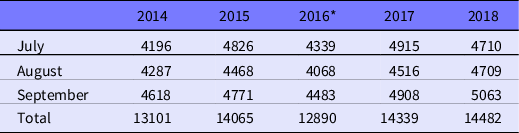
Moreover, we compared the number of patients who visited the PED in the same hospital during summer 2016 (July - September) with summers of 2014, 2015, 2017, and 2018. Each visit to the PED brings in an average of 82 USD; With this datum in mind, we calculated the revenue shortfall related to the decrease in emergency room visits for the summer 2016 and compared it to average of 2014, 2015, 2017, and 2018.
Results
Out of the 44 victims (24 women, 20 men), 20 required hospitalization, a majority for head injuries (n = 12) and lower limb fractures (n = 7). Of the victims, 11 suffered from acute stress reactions. Reference Haas, Fernandez, Bréaud, Dupont, Tran and Solla2-Reference Askenazy, Chauvelin, Gindt and Thümmler5
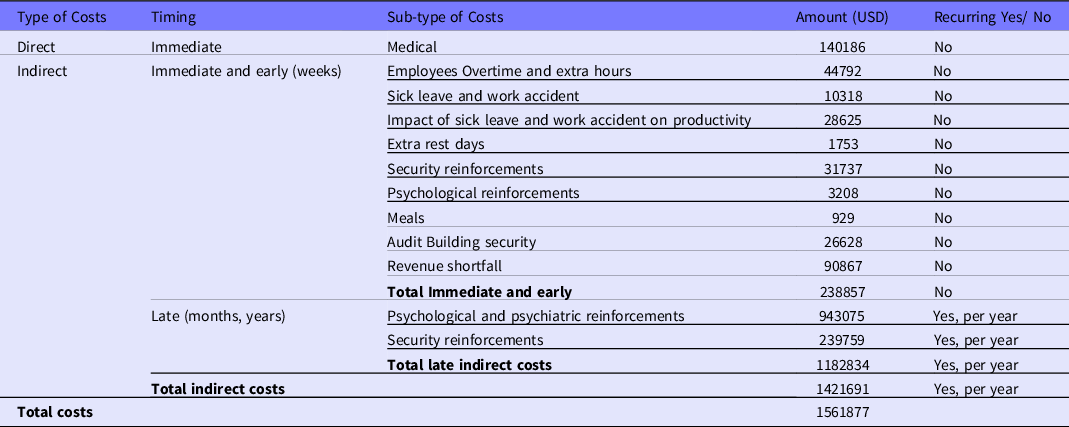
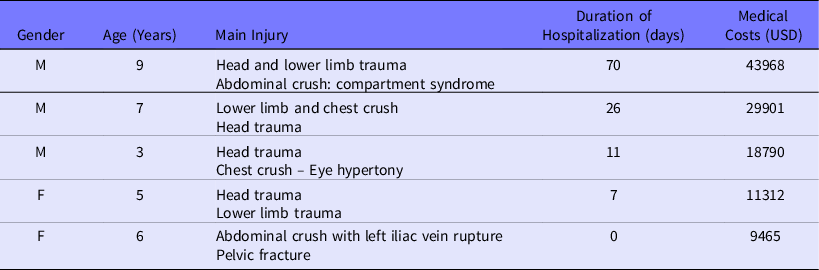
The total direct and indirect cost for the institution was within the range of 1.56 million USD (Table 1), corresponding to 2% of the 2016 annual budget. The direct medical costs represent 9% of the total cost. Accounting for 81% of the direct cost were 5 very expensive patients (Table 2).
Indirect and Direct costs

The 5 most expensive patients (81% of all medical costs)

We identified 11 items of indirect cost, mostly concerning the human resources, the revenue shortfall, and the security and psychiatric reinforcement (Table 1). The global number of patients assessed in our ER in summer 2016 (Table 3) was lower than in 2014 (-1, 6%), 2015 (- 8, 3%) 2017 (-10, 1%), and 2018 (-11%), with total average (-7, 5%) corresponding to 1106 patients, equaling 90867 USD.
Number of patients assessed at Emergency Room

* Terror attack period.
From the public point of view, the global cost equals 140186 USD (direct patient-related cost) plus 1421691 USD provided by the regional healthcare agency (RHA) to help the institution compensating the financial deficit.
Discussion
The financial burden for our institution included direct medical costs, indirect costs, and revenue losses. The indirect costs were much more important than the costs directly related to the care of the victims. We distinguished 3 different categories of costs pertaining to the timing: immediate, early (first weeks), and late (months, years) costs. Immediate costs of managing the casualties are difficult to differentiate between fixed (salaries, infrastructure) and variable costs per patient.
Early costs included reinforcements for psychological support, security reinforcements, coverage for extra-hours, burnout prevention. Indeed, the treatment of terror attack victims resulted in psychological consequences for the hospital teams who had to work extra hours under great pressure immediately and even weeks after the attack to debrief the immediate management and to answer the requests by the media, families, scientific societies, and journals. Reference Solla, Carboni and Bréaud3 The revenue losses can also be considered a cost for the hospital and from the collective point of view, related to unused ER capacities. Despite the immediate massive overload, we observed a paradoxical decrease in patients who visited the PED during summer 2016, which contrasts with the current upward trend; Indeed, fewer tourists were present in Nice after the attack and people avoided the promenade des Anglais because it reminded them of the attack. Considering that the hospital had facilities and staff to manage some 1000 patients more than they did during summer 2016, we assume the revenue shortfall increased the financial burden for the hospital. A decrease in routine activity has been described after a war period, Reference Bar-El, Michaelson, Hyames, Skorecki, Reisner and Beyar6 and is therefore logical after a terror attack.
Late costs included simulation training and teaching, building and IT security reinforcements, Psychiatric (RHA funded) increase in medical and paramedical workforce within local emergency psychiatric and psychological clinic, and the creation of a Psycho-Trauma Center with special interest in terror-related psychopathology. The need to reinforce the psychological and psychiatric teams confirmed that terror attacks have a clear impact on the immediate and long-term psychological well-being of patients. Reference Askenazy, Chauvelin, Gindt and Thümmler5 Initially, the long-term costs of this kind of disorders were underestimated.
Some other costs linked to the terror attack are either difficult to assess, or cannot be attributed to a specific hospital, such as support from the firefighters, community caregivers, and other volunteers. The RHA initially estimated the cost of this support to be around 475000 USD.
Lastly, some late indirect costs are beyond the scope of this article since they are not costs for the hospital. For example, the city of Nice invested heavily in the public space redesign of the Promenade des Anglais, partly EU-funded, in order to prevent a similar terror attack.
In our opinion, all these categories of direct and indirect costs should be part of institutional, regional or national disaster plans to support hospitals facing such exceptional health situations. Reference Gates, Arabian and Biddinger8,Reference Craigie, Farrelly, Santos, Smith, Pollard and Jones9 From the public point of view, we calculated the overall cost related to the patients and the financial support from RHA. From the hospital point of view, direct medical costs were covered from invoices sent to the French National Health Insurance, assuming current rates from public insurance correctly covered the fees for the patients’ healthcare. Indirect and non-medical costs were partially covered by the RHA, which provided immediate financial support according to the initial estimation. However, the final cost was higher, which resulted in a burden for the institution and reveals that the initial estimation did not take into account the long-term costs.
The main limit of this study is its retrospective design, which may lead to underestimation; However, in this context, this was the only possible way to collect and analyze data. Reference Solla, Tran and Rampal10
Conclusion
The financial burden of terror attack largely exceeds the cost of immediate treatment of victims, since indirect costs had a greater impact than did direct medical costs. Examining the level and variety of direct and indirect costs will lead to a better understanding of terror acts and to improved preparation for future attacks.
Acknowledgments
The institutions of the authors, namely the Lenval Children’s Hospital of Nice and the Bureau of Medical Affairs, National Insurance Institute of Israel, supported this work.
Ethics Statement
All procedures performed in this study were in accordance with the ethical standards of the institutional and national research committee, and with the 1964 Helsinki Declaration and its later amendments. The Institutional Review Board of Nice, France, declared no opposition and no need for formal review for a retrospective study with anonymized data.