Implications
Pigs must have access to manipulable substrates to investigate and root, as required by the EU directive (2008/120/EC). Without substrates, pigs may redirect exploratory behaviour towards other pigs and injure other pigs’ ears and tails. In a small study of 39 pens of growing pigs at a commercial farm, we compared long straw with chopped straw, which may be more practical for many indoor farms. Straw length had no effect on the following: duration of interaction with straw/solid floor, pen fixtures or other pigs; or on ear and tail injuries. Shoulder scratches and aggressive behaviour were slightly increased from a low base with chopped straw. Chopped straw may be a suitable substrate for pigs, but warrants further and more detailed investigation in larger studies.
Introduction
Even when they are fed ad libitum, growing pigs spend a considerable part of their active time exhibiting foraging and investigatory behaviour involving sniffing, rooting and chewing (Day et al., Reference Day, Kyriazakis and Lawrence1995; Zwicker et al., Reference Zwicker, Gygax, Wechsler and Weber2013). In pens with limited or no access to suitable materials that pigs can use as a focus for these behaviours, they re-direct their behaviour towards the floor, walls, other pen fixtures and towards other pigs, which can result in damaging behaviours such as ear, flank or tail biting (Van de Weerd et al., Reference Van de Weerd, Docking, Day, Breuer and Edwards2006; Studnitz et al., Reference Studnitz, Jensen and Pedersen2007; Day et al., Reference Day, Van de Weerd and Edwards2008).
Since 2001 (The Council of The European Union, 2001), EU directives (Latest revision: The Council of The European Union, 2008) require that ‘To enable proper investigation and manipulation activities, all pigs must have permanent access to a sufficient quantity of material such as straw, hay, wood, sawdust, mushroom compost, peat or a mixture of such, which does not adversely affect the health of the animals’. These directives have been implemented in national laws across the member states, thus – for example, Denmark requires that ‘pigs are given a sufficient quantity of straw or other manipulable material that can satisfy their needs for materials to occupy them and enable rooting’ (Danish Government, 2003).
Straw can be used as a manipulable material for pigs, and is commonly provided in outdoor production as well as in ‘high welfare’ indoor systems (e.g. Freedom Food, RSPCA, 2012). Even small amounts (e.g. 10 to 15 g /pig per day of straw) can reduce the incidence of behaviour directed towards other pigs, such as ear chewing, belly nosing and tail biting compared with when no straw is present (Zonderland et al., Reference Zonderland, Wolthuis-Fillerup, Van Reenen, Bracke, Kemp, den Hartog and Spoolder2008; Munsterhjelm et al., Reference Munsterhjelm, Peltoniemi, Heinonen, Halli, Karhapaa and Valros2009). However, long straw is not a practical material for many commercial indoor pig farms as it can block slatted dunging areas and slurry pumps, interfering with manure handling (Tuyttens Reference Tuyttens2005; Day et al., Reference Day, Van de Weerd and Edwards2008).
As an alternative to long straw, chopped straw has been suggested as being more practical, as it is less likely to block slatted floors (although blockage of pumps can still be an issue). Does chopped straw satisfy the behavioural needs of pigs? Day et al. (Reference Day, Van de Weerd and Edwards2008) found that using chopped straw (at 400 g/pig per day on solid concrete floors) changed the way in which pigs interacted with it – for example, ploughing it and licking it rather than picking it up like they did with long straw. They also found that tail biting was higher with chopped straw than with long straw, and recommended that it was not a suitable material. In the Day et al. (Reference Day, Van de Weerd and Edwards2008) study, tail biting was recorded during behavioural observations and tail injuries were not reported. It can be difficult to tell by observation whether damaging biting or non-damaging ‘tail in mouth’ behaviour is occurring (Schrøder-Petersen et al., Reference Schrøder-Petersen, Heiskanen and Ersboll2004).
In the present study, we investigated the effects of 100 g/pig per day of chopped or long straw. The study took place at commercial finishing farm with part-slatted floors with an automatic slurry scraper underneath, which could cope with the quantity of straw used. Solid wastes can be problematic for liquid slurry systems based on vacuum pumps (Day et al., Reference Day, Van de Weerd and Edwards2008). We used focal animal sampling at 2 and 9 weeks after the pigs arrived at the finishing farm (when they weighed ~40 and ~80 kg, respectively). We observed investigatory and rooting behaviour directed towards the straw/solid floor, the slatted floor, pen fixtures and other pigs, as well as aggression and feeding and drinking. Behaviour records were supplemented by scoring injuries to tails, ears and shoulders.
Animals, material and methods
Pigs and housing
The animals used in this study were 585 grower/finisher pigs of a standard Danish commercial genotype (Danbred Large white/Yorkshire×Duroc). They had been born and reared at a farm with 200 sows, where they had been tail docked and the males castrated at 2 to 4 days of age. Farrowing pens were equipped with crates and had slatted floors. The sow and piglets were not provided with straw in the farrowing unit. In the weaner accommodation on this sow farm, they had been provided with a handful of chopped straw per pen each day (~10 g/pig per day). On arrival, at the start of the study, the pigs were weighed as a batch and had a mean weight of 33 kg. Information on carcass weights of each batch was also obtained from the abattoir when the pigs were slaughtered (80 (84) days after arriving at the farm, weighing 112 (107) kg; figures are for batch 1 (batch 2 in brackets)). Thus, the productivity of the herd during the trial period was estimated at herd level (based on total feed consumption and growth) through AgroSoft. Pigs from two cycles were included in this study, referred to as batch 1 (June to August) and batch 2 (January to March). The pigs were housed in 39 mixed-sex pens of 15 pigs per pen.
Testing took place in a commercial finisher pig building in Denmark with two sections. An ‘all in all out’ system on herd level was used; therefore, each section was cleaned, disinfected and dried with a heat gun before each new batch of pigs. There were 24 pens per section, with space for 15 pigs per pen. The pens measured 2.4×4.8 m (11.5 m2; 0.77 m2/pig) and the solid floor had a 3% slope. This space allowance was higher than the minimum required by EU rules, which is 0.65 m2 for 85 to 110 kg pigs The Council of The European Union (1991). The floor was 1/3 slatted (dunging area) and 2/3 solid (lying area). The slats were constructed from concrete, and the solid floor was concrete. Pairs of adjacent pens (double pens) shared a central automatic feeder (with openings into each pen) and also shared a contact grid in the dunging area (1.15 m long, 1 m high; 11 vertical metal bars of 14 mm diameter). The animals were fed ad libitum on a complete mixed pelleted dry ration. Slurry was removed via an automatic scraper system under the slats, which was able to function with waste containing some straw (in contrast to slurry systems based on vacuum pumps designed for liquid slurry). Windows provided natural lighting. The room had an automatically controlled diffuse ventilation system. Roof-mounted vents automatically opened if the temperature rose by 2°C more than the set room temperature. At the start of the study, the temperature of the lying area was set at 27°C, and was gradually lowered to 18°C by the end of the study.
Experimental treatments
The 39 pens were allocated to the following two treatments: ‘Long straw’, in which 100 g of long straw was provided/pig per day (20 pens); and ‘Chopped straw’, in which 100 g chopped straw, chopped to an average of 5 to 6 cm in length (Batch 1: Ferri chopper, Batch 2: Skjold chopper), was provided/pig per day (19 pens). The straw was provided manually once daily in the morning at 0639 h (mean, range 0626 to 0657h) on the solid floor at the back of the pen. As adjacent pens sharing a feeder (double pen) had an open pen divider in the dunging area, these were always provided with the same straw length. The distribution of double pens with long or chopped straw was randomly assigned within each section of the building. In batch 1, pigs were given wheat straw; however, because of problems in the quality and length of the available wheat straw in winter, the pigs received winter barley straw in batch 2.
Behavioural observations
At the start of the experiment, three focal pigs were designated in each pen and were given ear tags enabling individual identification. The three focal pigs were selected visually from within each of the categories, 1/3 largest, 1/3 medium and 1/3 smallest pigs (estimated visually by the observer), to control for the possibility that size or dominance affects the behaviours of interest. Focal pigs were selected in such a way that both sexes were equally represented. For each double pen, we selected two female pigs and one castrated male in one pen, and two castrates and one female in the other pen (totalling three male castrates, three females).
Pig behaviour was video recorded (using an overhead video camera with an MSH Video Server) between 0600 and 2300 h on 2 recording days: one at 2 weeks after arrival (when pigs had an estimated weight of ~40 kg) and one at 9 weeks after arrival (estimated weight ~80 kg). Artificial lighting was left on during the whole recording period. This time window was chosen based on previous experiments, which have shown that pigs are not very active at night (Beattie and O’Connell, Reference Beattie and O’Connell2002).The day before each recording period, focal pigs were spray marked to facilitate individual recognition. Owing to technical problems, video recordings were available for only 37 of the 39 pens at 40 kg and for all 39 pens at 80 kg.
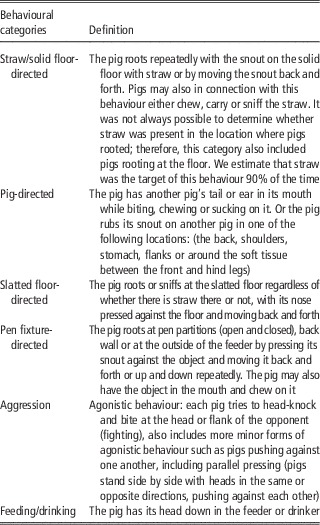
Continuous focal observations of pig behaviour were recorded from video images. The three focal animals in each pen were observed in a random order once an hour for 15 min each hour between 0600 and 2300 h (totalling 240 min per pig on each observation day). The frequency and duration of behaviours were recorded using an ethogram shown in Table 1.
The ethogram used during continuous observations of focal pig behaviour

Clinical scoring: tail, ear and shoulder lesions
Every 14 days (on four occasions in total), each pig was scored to record the incidence and severity of lesions to the tail (0 to 3 scale), ears (0 to 2 scale) and shoulders (0 to 2 scale), using a photographic and text scale. Definitions for the scores are given in Table 2.
Number of pens receiving scores for tail, ear and shoulder lesions (n=39) by straw length treatment

Each pen was assessed on four occasions 2 weeks apart, and the highest score for any individual pig in the pen is shown. Data shown in parentheses are counts of scores for individual pigs, where each pig’s highest score is shown. Fisher’s exact tests at the pen level (two-tailed) showed no significant effect of straw length on tails P=0.23 or ears P=0.12, but shoulder scratches were more common with chopped straw P=0.031.
Statistical analysis
The total duration of rooting/exploratory behaviour was calculated by totalling the behaviour directed towards the straw/solid floor, other pigs, pen fixtures and slatted floor. The duration of each behaviour shown in Table 1 was analysed using a mixed linear model (implemented with PROC MIXED in SAS). Straw length, pig age (2 weeks after arrival at the farm ~40 kg and 9 weeks ~80 kg), sex and size (small, medium or large) were included as systematic effects, and the interaction between straw length and age was included in models, but then removed as it was never significant. Pen was included as a random effect. Normality of the residuals and stability of variance were ensured by transforming data before analysis: we used the square root of the duration of the recorded variables. When transformation was necessary, back-transformed estimated means are reported, along with the range for this estimate, otherwise means and standard errors are reported. Fisher’s exact tests (in-silico.net/tools/statistics/fisher_exact_test) were used to analyse the effect of straw length on the number of pigs (and the number of pens) affected by lesions to the tail, ears or shoulders.
Ethical considerations
The test protocol was approved by the Danish Research Committee. Represented in the Committee were Aarhus University, Copenhagen University, Danish Meat Research Institute and Danish Pig Research Centre.
Results
Herd level production figures suggest that the farm showed above-average production performance. Daily weight gain during the test period was 958 g/day between 33 and 100 kg (Average for Danish farms in that year was 901 g/day, top 25% of farms achieved 975 g/day), and feed efficiency was 2.63 kg feed/kg of growth (average farms=2.86, top 25% 2.71). The mortality rate was 2.3% from the time the pigs were put into the pens until slaughter (average farms=3.5%, top 25%=2.9%). These data were only available at a batch level; therefore, treatment differences could not be investigated.
Focal observations of behaviour
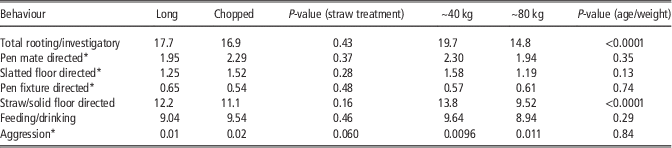
Straw length had no significant effect on any of the behavioural categories recorded (shown as percentages of the observed time in Table 3). Pigs spent about four to five times as long on straw/floor-directed behaviour (80 kg pig means Long straw=36 min 14 s, Chopped straw=31 min 47 s out of a 240 min observation) compared with behaviour directed towards pen mates (80 kg pig means Long straw=7 min 9 s, Chopped straw=7 min 44 s). There was an almost significant (F=3.66, P=0.060) effect of straw length on aggressive behaviour, although aggressive behaviour occurred at a very low level in both treatments (80 kg pig means Long straw=3 s, Chopped straw=6 s out of a 240 min observation).
Behaviour of three focal pigs in each group allocated long or chopped straw at 2 weeks (~40 kg) and 9 weeks (~80 kg) after arrival at the farm, expressed as per cent of observed time

Data are based on 2 observation days, each with 16 h 15 min focal pig observations. There were no significant interactions between straw length and age/weight.
Data with * is back-transformed.
There were effects of weight/age on behaviour. Pigs that weighed 40 kg compared with 80 kg pigs performed more rooting/investigatory behaviour overall, and more that was directed at straw/solid floor (Table 3). There were also a number of effects of sex on behaviour. Compared with castrated males, female pigs spent more time on pen fixture-directed behaviour (female mean (range)=0.71 (0.53–0.92), male=0.49 (0.34–0.66); F=6.71, P=0.011). There were no age or sex differences in pig-directed behaviour.
The size category of pigs influenced behaviour. Smaller pigs showed more ‘Total rooting/exploratory’ behaviour than larger pigs (small mean ±s.e.=19.1±0.8, medium=17.3±0.8, large=15.5±0.8, F=6.06, P=0.0030). In addition, small focal pigs rooted the straw/solid floor more than large pigs (small mean ± s.e.=12.8±0.6, medium=11.5±0.6, large=10.7±0.6, F=3.47, P=0.034), and the small and medium pigs rooted the slatted floor more than large pigs (small mean (range)=1.64 (1.27 to 2.06), medium=1.77 (1.38 to 2.21), large=0.83 (0.57 to 1.14), F=9.90, P<0.0001). However, there was no effect of size on pig-directed behaviour.
Pattern of behaviour over the day
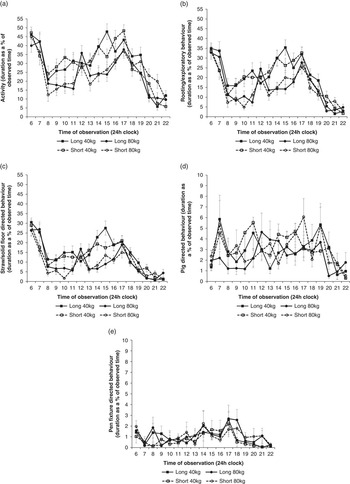
For key behaviour categories, plots were made to investigate the effect of straw length and age on the pattern of behaviour over time (Figure 1). All pigs showed two activity peaks: in the morning at 0600 to 0700 h when a person entered to provide straw, and also at around 1700 h when a person entered to check on them. As with the analysis of the whole day, it was evident that any differences were due to age (weight) rather than straw length, with younger pigs being more active (Figure 1a), exploratory (Figure 1b) and performing straw-directed behaviour (Figure 1c) between about 0900 and 1600 h. Pig-directed behaviour (Figure 1d) was low at 0600 h, presumably because fresh straw was occupying the pigs, and low at the end of the day when all activity reduced, but otherwise occurred at a similar level throughout the day. Pen fixture-directed behaviour (Figure 1e) was also low in the morning but increased during the afternoon activity peak.
Behaviour of three focal pigs in each group at different times of day by age/weight (2 weeks after arrival at the farm ~40 kg or 9 weeks after arrival ~80 kg) and by straw length (chopped or long). The data shown are mean (±s.e.) durations as a % of total observation time. Data are based on 2 observation days, each with 16 h 15 min observations. The different behaviours shown are: (a) Total activity (includes all behaviours from Table 1), (b) Total rooting/investigatory behaviours (includes behaviour directed at straw/solid floor, other pigs, slatted floor and pen fixtures), (c) Straw/solid floor-directed, (d) Pig-directed, (e) Pen fixture-directed. Note that different y-axis scales are used for (a to c), and for (d to e).

Clinical scoring: tail, ear and shoulder lesions
Results for tail, ear and shoulder scoring at both the pen levels (and the individual level) are shown in Table 2. As outbreaks of damaging behaviour often affect multiple pigs in a pen, the pen level is a more appropriate level of analysis, and statistics are presented at the pen level. Tail lesions were rarely observed, although two instances of injury occurred, both in chopped straw pens. There was no effect of straw length on ear lesions (P=0.12). Pens in which at least one pig had ‘few minor scratches’ were more common in chopped straw pens (P=0.031).
Discussion
Pigs need manipulable material to express their investigatory behaviour. One way of assessing whether this need has been met is to record the proportion of time that pigs spend using the material as opposed to pen fixtures and furnishings (Van de Weerd et al., Reference Van de Weerd, Docking, Day, Avery and Edwards2003). Studies of this kind have revealed that materials that are ingestible, odorous, chewable, destructible and deformable are attractive to pigs (Van de Weerd et al., Reference Van de Weerd, Docking, Day, Avery and Edwards2003; Studnitz et al., Reference Studnitz, Jensen and Pedersen2007; Van de Weerd and Day, Reference Van de Weerd and Day2009). Both long and chopped straw possess all of these characteristics.
In our study, there were no differences overall between long and chopped straw in the time spent rooting/investigating the straw/solid floor, or in behaviour directed at pen fixtures or the slatted floor part of the pen. There was also no suggestion of treatment differences at any time of the day (Figure 1). Therefore, based on the amount of time spent, there was no evidence that long straw was a better material for occupying pigs than chopped straw. Some caution is waranted, however, as during observations, it was not possible to determine with certainty whether pigs were rooting at the straw or the solid floor, thus these behaviours were combined into one category. As such, it is not possible to say for certain whether pigs were occupied by the straw itself. However, if chopped straw had been less attractive, or used up more quickly than long straw, then the duration of investigation of straw/solid floor would have been expected to decrease. Similarly, investigatory behaviour directed towards other locations, namely the slats, pen fixtures and other pigs, might have been expected to increase (or increase later in the day) but it did not. This suggests that pigs were either occupied by the chopped straw, or (less plausibly) that the presence of chopped straw somehow made the solid floor more attractive.
Day et al. (Reference Day, Van de Weerd and Edwards2008) found that certain types of behaviours were exhibited more with long straw (e.g. pick), while others were exhibited more with chopped straw (e.g. plough, sweep). Can these different forms of investigation or interaction with a material substitute for one another? Outdoor pigs prevented from rooting by nose-ringing exhibit investigatory behaviour for a similar duration as un-ringed pigs, substituting it by grazing, chewing and sniffing (Studnitz et al. Reference Studnitz, Jensen and Jorgensen2003a and Reference Studnitz, Jensen, Jorgensen and Jensen2003b). However, when nose-rings were removed, rooting became the main mode of exploration. This suggests that some substitution of different forms of investigatory behaviour is possible, but that rooting is the preferred activity. A possible concern for our study might be that by relying on the overall duration of all forms of interaction with the straw/solid floor, the importance of certain behaviours is overlooked. If (as suggested by the nose-ringing studies) rooting is the preferred mode of investigatory behaviour, then we should be reassured by the findings that pigs are able to perform rooting and related behaviours such as chew and sniff to a similar extent with both chopped and long straw (Day et al., Reference Day, Van de Weerd and Edwards2008). However, further work could investigate behaviour with short and long straw in more detail, as well as the motivation to exhibit the different forms of investigatory behaviour including rooting.
Is the amount of time spent using a material the best measure of its occupational value or its animal welfare benefit? As well as observing the duration of interaction with a material as we did, studies of choice and motivation can form a valuable part of overall welfare assessment. When pigs were free to choose between 3 min of access to either long, chopped or pelleted straw in a three-armed maze, they showed no clear preference between them (Jensen et al., Reference Jensen, Studnitz, Halekoh, Pedersen and Jorgensen2008). However, the choice paradigm was effective, as clearer preferences were obtained with different combinations of three materials: compost and peat were preferred over wood-shavings. In a study on the motivation of pigs to access different materials, where pigs learnt to push a panel repeatedly to gain access, pigs showed similar motivation to work for 3 min of access to 100 g rewards of long or chopped straw (Pedersen et al., Reference Pedersen, Holm, Jensen and Jorgensen2005), although peat and branches were even more preferred than straw. Taken together, these findings support our suggestion that chopped and long straw may have equal value for pigs. However, some caution is needed here, as the initial preference for 3 min of access to fresh materials may not tell us much about how attractive materials are after several hours on the pen floor.
In addition to occupying pigs need to root and investigate, the provision of substrates has a role in reducing harmful pig-directed behaviours such as ear, flank and tail biting (Van de Weerd et al., Reference Van de Weerd, Docking, Day, Breuer and Edwards2006; Zonderland et al., Reference Zonderland, Wolthuis-Fillerup, Van Reenen, Bracke, Kemp, den Hartog and Spoolder2008; Munsterhjelm et al., Reference Munsterhjelm, Peltoniemi, Heinonen, Halli, Karhapaa and Valros2009). Straw has been reported to be more effective than other substrates at reducing tail biting lesions (EFSA AHAW, 2014). In the present study, we found no effect of straw length on the level of pig-directed behaviour. This contrasted with the findings of Day et al. (Reference Day, Van de Weerd and Edwards2008) that tail biting was higher with chopped straw, atlhough they did not report tail injuries; therefore, some or all of their ‘tail biting’ may have been non-injurious ‘tail in mouth’ behaviour, which may be, but is not always, a precursor to damaging tail biting (EFSA, 2007; D’Eath et al., Reference D’Eath, Arnott, Turner, Jensen, Lahrmann, Busch, Niemi, Lawrence and Sandøe2014). However, the present study had in total low levels of pig-directed behaviour and combined different types of pig-directed behaviour (which may be motivationally distinct); therefore, further studies are needed to determine whether there are any differences between long and chopped straw in harmful social behaviour.
The almost significant (P<0.06) effect of chopped straw on aggression found here was unexpected. The significantly higher number of pens in which at least one pig had a few minor shoulder scratches corresponds with this apparent increase of aggression (Turner et al., Reference Turner, Roehe, D’Eath, Ison, Farish, Jack, Lundeheim, Rydhmer and Lawrence2009). These results contrast with those of Day et al. (Reference Day, Van de Weerd and Edwards2008) who found no effect of straw length on aggression. However, the low levels of aggressive behaviour, and the absence of any pigs with more than a few minor scratches, observed for both straw lengths suggest that the biological significance of this change is relatively minor.
Although not the main focus of our study, we saw effects of age/weight, size at a given age and sex on behaviour. The age effects we observed were similar to those reported by others (Day et al., Reference Day, Van de Weerd and Edwards2008; Jensen et al., Reference Jensen, Studnitz and Pedersen2010), with pigs showing more rooting/investigation overall and straw-directed behaviour at ~40 kg than at ~80 kg. The smallest pigs in the pen performed more rooting behaviour (directed at the straw/solid floor and slatted floor). As hunger can increase pigs’ foraging and exploratory behaviour (reviewed by Studnitz et al., Reference Studnitz, Jensen and Pedersen2007), a possible explanation for this is that smaller pigs had more difficulty gaining access to food due to their low dominance rank. In addition, we found that female pigs showed more straw/floor and pen fixture-directed behaviour, but no difference in pig-directed behaviour. As far as we are aware, size and sex effects are not usually found. Previous studies on exploratory behaviour in pigs generally make no mention at all of sex or size effects, or some studies state that they had no effect (size,Day et al., Reference Day, Kyrizakis and Lawrence1996; sex, Camerlink and Turner, Reference Camerlink and Turner2013). Possible effects of size and sex have been found in relation to tail-biting, where some studies report that females (Schrøder-Petersen et al., Reference Schrøder-Petersen, Heiskanen and Ersboll2004; Van de Weerd et al., Reference Van de Weerd, Docking, Day and Edwards2005; Zonderland et al., Reference Zonderland, Bracke, den Hartog, Kemp and Spoolder2010) and smaller pigs (Zonderland et al., Reference Zonderland, Schepers, Bracke, den Hartog, Kemp and Spoolder2011) are more likely to exhibit these behaviours, although many other studies have not found these effects (e.g. Breuer et al., Reference Breuer, Sutcliffe, Mercer, Rance, O’Connell, Sneddon and Edwards2005; Steinmetz and Pedersen, Reference Steinmetz and Pedersen2009).
Fresh straw seems to be particularly attractive to pigs. In our study, straw was only allocated once a day. Perhaps as a consequence, activity appeared to be more directed at pen fixtures in the afternoon, as also found by others (Jensen et al., Reference Jensen, Studnitz and Pedersen2010). Future studies should investigate the importance of frequency of straw allocation and total straw quantity (Oxholm et al., Reference Oxholm, Steinmetz, Lahrmann, Nielsen, Amdi and Hansenin press) in addition to straw length.
There is an ongoing debate on the type and quantity of material needed to comply with the EU directive (The Council of The European Union, 2001). The directives reference to ‘a sufficient quantity to enable proper investigatory activities’ is rather vague. Leaving aside the question of whether straw provides for proper investigatory activities, one measure of ‘sufficient quantity’ is how quickly the material is used up. In our study, chopped straw did provide a ‘permanent’ outlet for investigatory behaviour in the sense that there was always some remaining when new straw is allocated the next day, as reported by others using similar quantities (90 g/pig per day, Jensen et al., Reference Jensen, Studnitz and Pedersen2010). However, increasing quantities of straw above 92 g/pig per day to 1092 g and 2184 g/pig per day promote further increases in exploratory/rooting behaviour (Day et al., Reference Day, Burfoot, Docking, Whittaker, Spoolder and Edwards2002). Although Day et al. (Reference Day, Burfoot, Docking, Whittaker, Spoolder and Edwards2002) found no effect of increasing straw quantity on pig-directed behaviour, other authors have proposed that higher quantities of straw are necessary to keep pig-directed behaviours to a minimum (200 g/pig per day Olsson, Reference Olsson2011; 387 g/pig per day Pedersen et al., Reference Pedersen, Herskin and Forkman2013). In addition, the threshold for the quantity of material provided to reduce harmful pig-directed behaviours is likely to depend on whether the pigs in question are tail docked or not, as docking reduces tail biting risk (D’Eath et al., Reference D’Eath, Niemi, Vosough Ahmadi, Rutherford, Ison, Turner, Anker, Jensen, Busch, Jensen, Lawrence and Sandøesubmitted).
Although it was not systematically recorded in our study, farm staff reported that they needed to manually clean the dunging area to remove accumulated long straw to prevent wet and dirty straw spreading to the solid part of the pen. They did not need to do this when chopped straw was used, as pigs’ activity pushed it down between the slats. This observation is in line with suggestions of others that with slatted floors there is a lower labour requirement to maintain pen hygiene when using chopped straw rather than long straw (Tuyttens, Reference Tuyttens2005; Day et al., Reference Day, Van de Weerd and Edwards2008). However, our practical experience in this project was that, particularly in summer, any kind of straw can accumulate in the lying area and become dirty, increasing the labour requirement to ensure good pen hygiene in comparison with pens without straw. In addition, faecal contamination of substrates is thought to reduce their attractiveness to pigs (Scott et al., Reference Scott, Taylor, Gill and Edwards2009). Further research is needed to quantify and overcome this problem.
One shortcoming of our study was the use of wheat straw for one cohort of pigs and barley straw for the other. This distinction does, however, highlight the issue that ‘straw’ can vary not just in length (as in our study) but in other ways that are important to pigs, such as odour, texture and taste, which are likely to be affected by the type of crop and the weather during that growing season.
Our study farm had a lower mortality than the average Danish farms, on which straw is not usually provided, which might indicate that straw is beneficial. However, the study farm was atypical in other respects, having high health status, all-in all-out management and lower stocking density (0.77 m2/pig).
Conclusions
Providing long or chopped straw to pigs (at 100 g/pig per day) resulted in a similar duration of rooting/investigatory behaviour directed towards the straw/solid pen floor, towards pen fixtures or towards other pigs, and there was no difference in the number of lesions to ears or tails. There was an almost significant tendency for more aggression in pens with chopped straw than in pens with long straw, and significantly more pens with ‘few minor scratches’ on the shoulders, although aggression was rare for both treatments. Our findings suggest that when allocated at 100 g/pig per day in commercial part-slatted pens, chopped straw and long straw might provide similar opportunities for pigs to interact with a manipulable substrate. The reduced requirement for manual cleaning of pens makes chopped straw a practical option for many commercial farmers, although the quantity of straw used was too high for many vacuum pump-based liquid slurry systems. The use of chopped straw as a manipulable substrate for pigs warrants further research in larger and more detailed studies.
Acknowledgements
The project has received grants from the Danish Food Ministry of Rural Development’s programme (journal nr. 3663-D-09d00369) and from the Danish Pig Levy Fund (Svineafgiftsfonden), Project ID: VSP09/10/ 68th. SRUC is supported by the Scottish Government’s Rural and Environment Science and Analytical Services (RESAS) Division. The authors are grateful to the farmer Esben Mortensen for cooperating with this research, and Thomas Lund Sorensen assisted with on-farm data collection. Pia Brandt and Marie Lybye assisted with behavioural recordings as did the BSc biology students Sarah-Lina Schild and Camilla Sorensen.