INTRODUCTION
According to the FAO (2012), each year over 59 billion broilers are slaughtered worldwide to meet the growing demand from human consumption. Due to the increasing demand for meat, farmers have begun to select broilers for high growth rate, breast meat yield and the efficiency of feed conversion (Arnould & Leterrier Reference Arnould and Leterrier2007; Estevez Reference Estevez2007).
The best results for rearing broilers are achieved with optimum environmental conditions. For example, temperature is one of the major limiting factors for broiler growth (Lara & Rostagno Reference Lara and Rostagno2013). Broilers reared at high temperatures exhibit low feed intake (FI) and consequently poor performance rates (De Faria Filho et al. Reference De Faria Filho, Campos, Alfonso-Torres, Vieira, Rosa, Vaz, Macari and Furlan2007; Zuo et al. Reference Zuo, Xu, Abdullahi, Ma, Zhang and Feng2015). It was estimated that direct effects of high temperature on broiler metabolism are responsible for 46–50% of weight gain losses in broilers reared in warm environments, and the remaining 50–54% losses are due to FI reduction (Abu-Dieyeh Reference Abu-Dieyeh2006; Campos et al. Reference Campos, Fernandez-Alarcon, Souza, Nogueira, Hada, Carneiro, Macari, Oltjen, Kebreab and Lapierre2013).
In addition to a decrease in productive performance of broilers, heat exposure also induces changes in their carcasses. Broilers reared in environments with high temperatures have more fat deposition and less proteins in the carcass (Zhang et al. Reference Zhang, Jia, Zuo, Zhang, Lei, Ren and Feng2012), resulting from a low basal metabolic rate and reduced physical activity (Cheng et al. Reference Cheng, Hamre and Coon1997; Oliveira Neto et al. Reference Oliveira Neto, Oliveira, Donzele, Rostagno, Ferreira, Maximiano and Gasparino2000).
The changes in productive performance and carcass composition of broilers exposed to high temperature are also attributed to lower FI. Malnutrition alters plasma concentration of growth-controlling hormones in broilers (Gonzales et al. Reference Gonzales, Buyse, Loddi, Takita, Buys and Decuypere1998; Buyse et al. Reference Buyse, Decuypere, Darras, Vleurick, Kuhn and Veldhuis2000). More specifically, decreased levels of expression of growth hormone receptor (GHR) (Zhao et al. Reference Zhao, Muehlbauer, Decuypere and Grossmann2004) and liver insulin-like growth factor 1 (IGF-I) (Kita Reference Kita1998) are observed, which ultimately reduces muscle growth and increases the mobilization of energy for homeostasis (Buyse & Decuypere Reference Buyse and Decuypere1999). Furthermore, broilers reared at high temperatures show a lower concentration of plasma growth hormone (GH) (Buyse et al. Reference Buyse, Decuypere, Darras, Vleurick, Kuhn and Veldhuis2000).
As suggested above, heat stress (HS) and lower FI regulate the effect of GH on energy homeostasis, which may be associated with modifications of carcasses in broilers exposed to high temperature. To further investigate the modifications of carcasses, genes involved in energy metabolism can be identified and analysed for their role in fat deposition in broiler carcasses. Energy metabolism is maintained by the liver, where nutrients from the diet or from corporeal deposition are used in metabolic pathways regulated by neural and hormonal signals (Hillgartner et al. Reference Hillgartner, Salati and Goodridge1995). These hormonal signals regulate several genes including transcription factors such as the sterol regulatory element-binding protein-1c (SREBP-1) and the carbohydrate response element-binding protein (ChREBP), which are responsible for regulating energy homeostasis (Shimano et al. Reference Shimano, Yahagi, Amemiya-Kudo, Hasty, Osuga, Tamura, Shionoiri, Iizuka, Ohashi, Harada, Gotoda, Ishibashi and Yamada1999). The reduced expression of these two transcription factors observed during fasting (Richards et al. Reference Richards, Poch, Coon, Rosebrough, Ashwell and McMurtry2003; Wang et al. Reference Wang, Ko, Chin, Hsu, Ding and Chen2009) is correlated with the expression of genes for several enzymes from energy metabolism (Proszkowiec-Weglarz et al. Reference Proszkowiec-Weglarz, Richards, Humphrey, Rosebrough and McMurtry2009).
It still unknown whether fat deposition in broilers exposed to high temperatures is due to a reduction in FI or to the direct effect of HS. Considering the relationship between the environment and its role in gene expression as mentioned above, SREBP-1 and ChREBP become candidates for regulating fat deposition in broiler carcasses induced from HS. These transcription factors have not been investigated to identify their association with fat deposition in broilers as a response to HS.
The present study was performed to identify and describe the molecular mechanisms associated with the effects of high temperature and feed restriction due to chronic heat exposure at 32 °C, and to describe the productive performance and the characteristics of the carcass under such condition. To describe the involvement of the molecular mechanisms, the abundance of mRNA related to growth and energy metabolism was measured in the liver of broilers reared with high temperatures. Furthermore, the pair-feeding (PF) experimental approach isolated the specific effects of HS and feed restriction on growth performance and body composition.
MATERIAL AND METHODS
This experiment was performed following the rules of the Animal Ethics Committee (CEUA) of the School of Agriculture and Veterinary Science, São Paulo State University.
Broilers and experimental design
The broilers were reared in floor pens 1·7 × 2·5 m2 in three climatic chambers with wood shavings used as litter (10 cm deep). The side and top walls of the chambers were composed of insulating material and each chamber was equipped with four exhaust fans. To ensure the consistency of the temperature, cooling systems and infrared lamps were controlled by thermostats. The broilers were reared with continuous light for 24 h (15 lux).
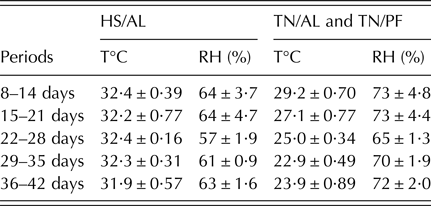
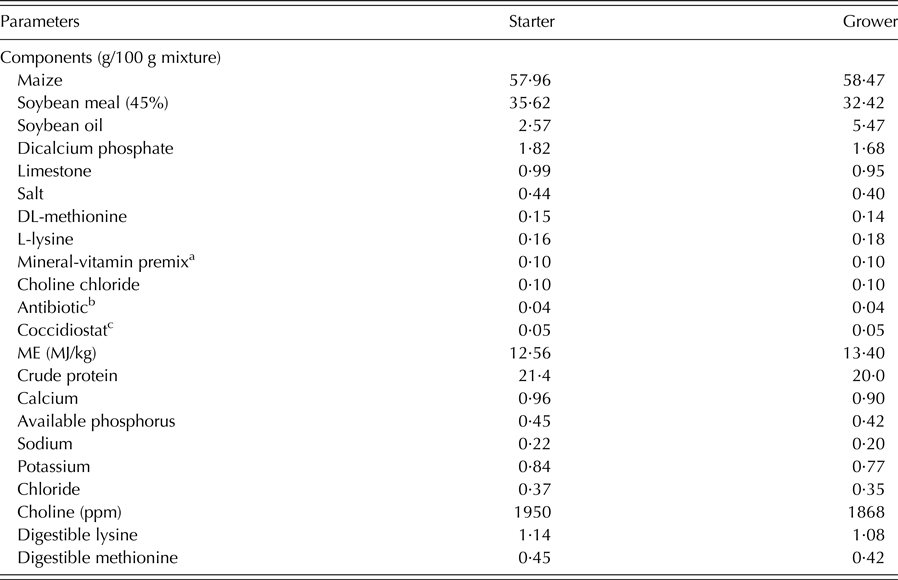
The broilers used in the present study were evaluated from 7 to 42 days of age: until 7 days old they were kept in a thermoneutral (TN) environment (Anon 2003) with average temperature and relative humidity of 31·8 ± 0·10 °C and 58·6 ± 2·66%, respectively. At 7 days of age, 441 male Cobb 500® broilers were distributed in a completely randomized experimental design, in a ‘pair-feeding’ system as described in Geraert et al. (Reference Geraert, Padilha and Guillaumin1996). The PF schedule was used to separate temperature effects from FI effects, by providing broilers reared in TN environments the same amount of feed as that consumed by stressed broilers on the previous day. The experimental design consisted of three treatments and seven replicates per treatment, each replicate with 21 broilers. Each treatment differed by the temperature at which broilers were reared and the feeding regime as follows: chronic HS fed ad libitum (HS/AL), TN environment fed ad libitum (TN/AL), and TN and PF on the FI of the group exposed to HS (TN/PF; Table 1). For this, each floor pen had one individual feeder and one individual drinker. The FI of broilers in the HS/AL treatment was measured daily at 8.00 a.m. for the seven replicates. Individual daily FI was calculated as the mean intake of each broiler in each individual replicate (21 broilers by replicate). Then, the same amount of feed was provided to the corresponding TN/PF replicate. The temperature of the environments was measured every hour throughout the experiment and weekly averages of temperature are shown in Table 1. All broilers received the same starter (1–21 days) and grower diets (22–42 days) (Table A1 in the Appendix).
Environmental temperature and relative humidity registered at climatic chambers during the experiment

HS/AL, Ad libitum-fed heat-exposed; TN/PF, pair-feeding thermoneutral; TN/AL, thermoneutral ad libitum-fed; T°C, environmental temperature; RH, relative humidity.
Data are expressed as means ± standard deviations.
Growth performance and body composition
For performance analysis, broilers and feed were weighed at 21 and 42 days old. The following performance indicators were obtained for each experimental unit: FI, body weight gain (BWG) and feed conversion ratio (FCR = FI/BWG).
At 21 and 42 days of age, one broiler from each replicate was separated and fasted for 6 h, then stunned by concussion and euthanized by bleeding. After slaughter, adipose tissue from the abdominal region surrounding the gizzard and between the intestines and abdominal wall was removed and weighed. The commercial cuts [breast, legs (thighs + drumsticks) and wings], with skin, were separated from the carcass and frozen at −20 °C for composition analysis. The cuts were thawed in the laboratory, crushed in a commercial meat grinder, dried in a forced air oven (55 °C for 72 h) and ground using a grinder ball. The cuts were then analysed for dry matter (DM) content using a forced air oven for 12 h at 105 °C; thereafter complete combustion at 600 °C for 4 h was used to attain ash. The Soxhlet extraction method was performed to obtain ether extract (EE) and the micro-Kjeldahl method was performed to obtain crude protein (CP). All procedures were performed following the protocols of Silva & Queiroz (Reference Silva and Queiroz2002).
Real-time quantitative polymerase chain reaction
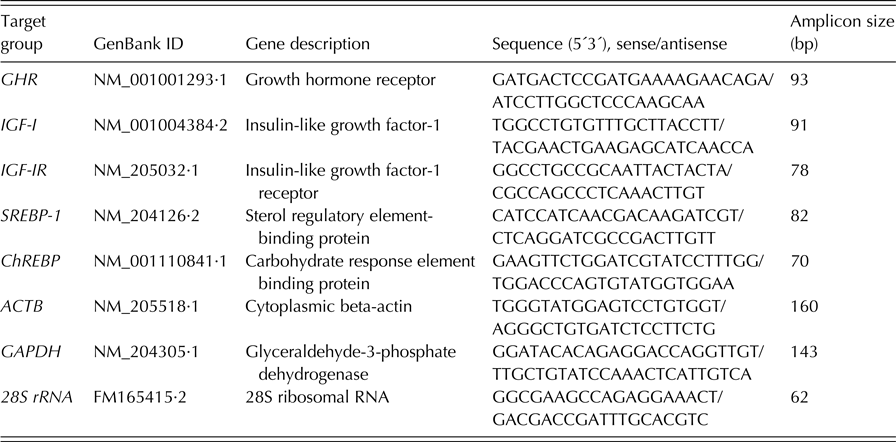
Total RNA was extracted from the liver using a Ribopure Kit (Ambion® – Life Technologies, Waltham, MA, USA). The protocol for RNA extraction was modified by the addition of a DNase treatment between the two wash steps prior to the elution of RNA from the ceramic column. The first-strand cDNA synthesis was performed by reverse transcription (RT) from equal quantities (5·0 µg) of total RNA using the SuperScript III First-Strand Synthesis SuperMix (Invitrogen – Life Technologies, Carlsbad, USA). The protocol for first-strand cDNA synthesis was modified by the addition of a final step of digestion with RNase H (1U) (Invitrogen) for 22 min at 37 °C. First-strand cDNAs were purified as described in Madsen et al. (Reference Madsen, Chang, Hickey, Rosa, Coussens and Burton2004) and was quantified in a NanoDrop spectrophotometer (ND-1000, Thermo Scientific, Waltham, USA). Working solutions were prepared and stored at −20 °C until real-time quantitative polymerase chain reaction (RT-qPCR) was performed. The set of primers used to determine the expression of the target genes (GHR, IGF-I, IGF 1 receptor [IGF-IR], SREBP-1 and ChREBP) and reference genes (beta-actin [ACTB], glyceraldehyde 3-phosphate dehydrogenase [GAPDH] and large ribosomal subunit [28S rRNA]) were designed using the Primer Express 3·0 software (Applied Biosystems – Life Technologies, Carlsbad, USA) (Table 2). To design the primers, previously described sequences of broiler genes from Genbank were used as reference. Furthermore, the primers were designed to amplify segments that contained at least one intron, which would eliminate the chance of amplifying residual genomic DNA.
Primers used for real-time PCR a
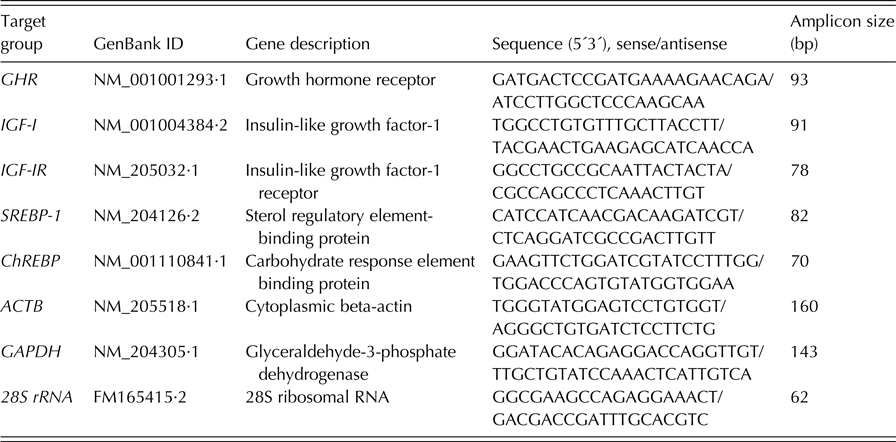
a Primers designed by Primer Express software (Applied Biosystems – Life Technologies, Carlsbad, USA).
Quantitative real-time PCR analysis was performed using the GeneAmp 7900 thermocycler (Applied Biosystems – Life Technologies, Carlsbad, USA) with the SYBR Green reagent (Invitrogen), following the protocol described by Coussens et al. (Reference Coussens, Colvin, Rosa, Laspiur and Elftman2003). The results of the RT-qPCR reactions were analysed with RQ Manager 1·2·1 (Applied Biosystems – Life Technologies, Carlsbad, USA) and the values of the quantification cycle (Cq) corrected for primer amplification efficiency and normalized using a control gene as described in Livak & Schmittgen (Reference Livak and Schmittgen2001). The amplification efficiency of the primers ranged from 90% to 110%. The stability of expression was calculated using geNorm (https://genorm.cmgg.be/) and NormFinder (https://moma.dk/normfinder-software), considering ACTB, GAPDH and 28S rRNA as candidates, which revealed GAPDH to be the most accurate to normalize gene expression results in the present study.
Statistical analysis
Data from all variables were tested for the presence of outliers using residual analysis and for homoscedasticity and normality of studentized errors using Brown and Forsythe's and Cramer-von Mises tests, respectively. After the removal of outliers, all data presented agreement with the model assumptions. The General Linear Models procedure in SAS statistical software, version 9.3 (SAS Institute Inc 2011) was used to perform all the analysis. Analysis of variance with fixed effect of treatment and random effect of experimental unit was performed for each variable. The statistical model used for performance and gene expression was:
 $$Y_{ij} = \; \mu + \; T_i + {\rm E}{\rm U}_j + \; e_{ij}$$
where Y ij is the observation ij; μ is the mean; T i is the fixed effect of treatment i; EU j is the random effect of experimental unit; and e ij is the effect of error of replicate ij.
For body composition variables (DM, EE, CP and ash), body weight was included as a covariate, and the statistical model used was:
 $$Y_{ijk} = \; \mu + \; T_i + \; \; {\rm B}{\rm W}_j + \; e_{ijk}$$
where Y ijk is the observation ijk; μ is the mean; T i is the effect of treatment i; BW j is the effect of body weight; and e ij is the effect of error of replicate ij. When significant differences were found, the means were compared by Tukey's test at P < 0·05.
RESULTS
Growth performance and body composition
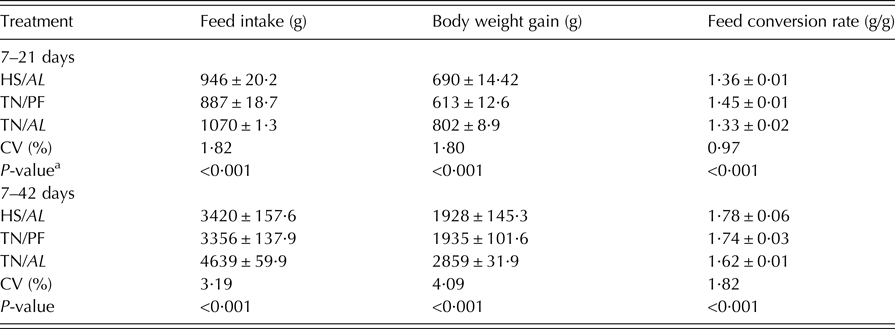
The broilers raised in the HS/AL treatment showed a lower FI and BWG (P < 0·001) and a higher FCR (P < 0·001) throughout the experimental period as compared with the TN/AL (Table 3).
Growth performance of broilers for the 7–21 and 7–42 day periods
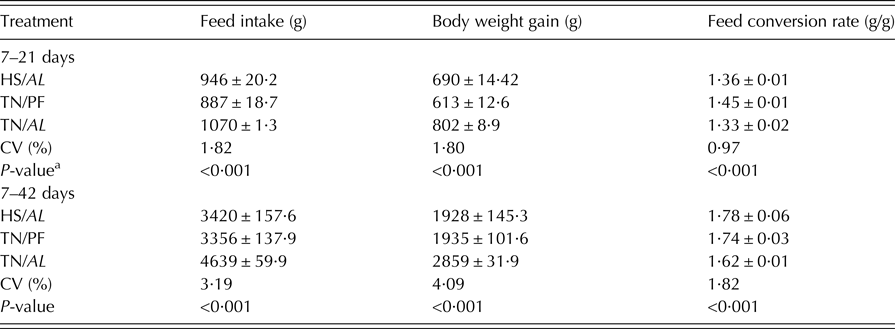
HS/AL, Ad libitum-fed heat-exposed; TN/PF, pair-feeding thermoneutral; TN/AL; thermoneutral ad libitum-fed, CV, coefficient of variation
a Tukey test.
Data are expressed as means ± standard deviations.
Abdominal fat values at 21 (2, 1 and 2% for HS/AL, TN/PF and TN/AL, respectively) and 42 days of age did not vary among treatments.
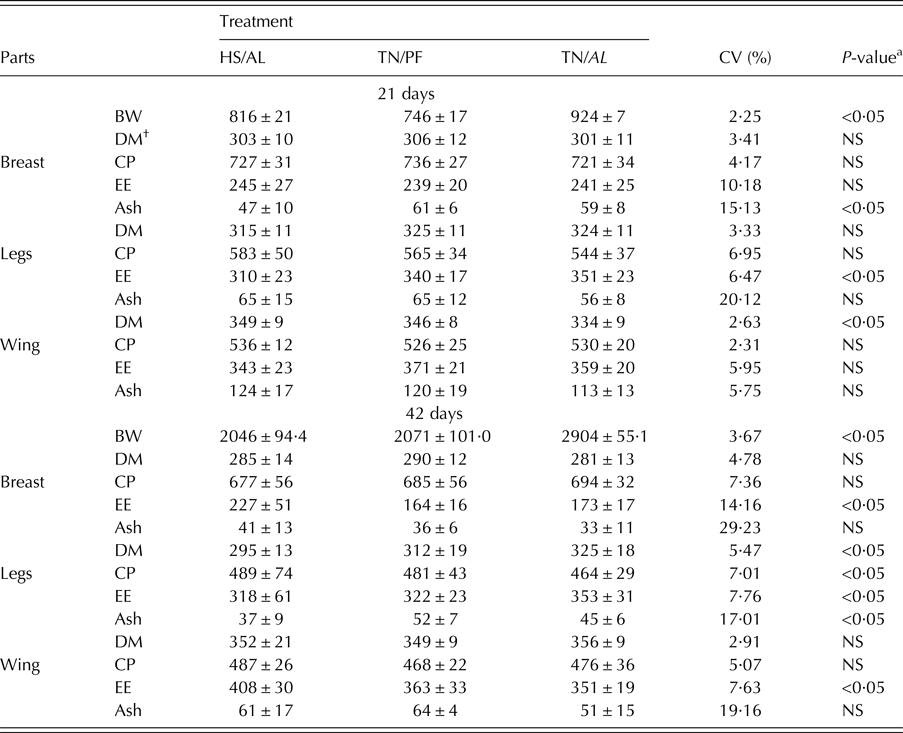
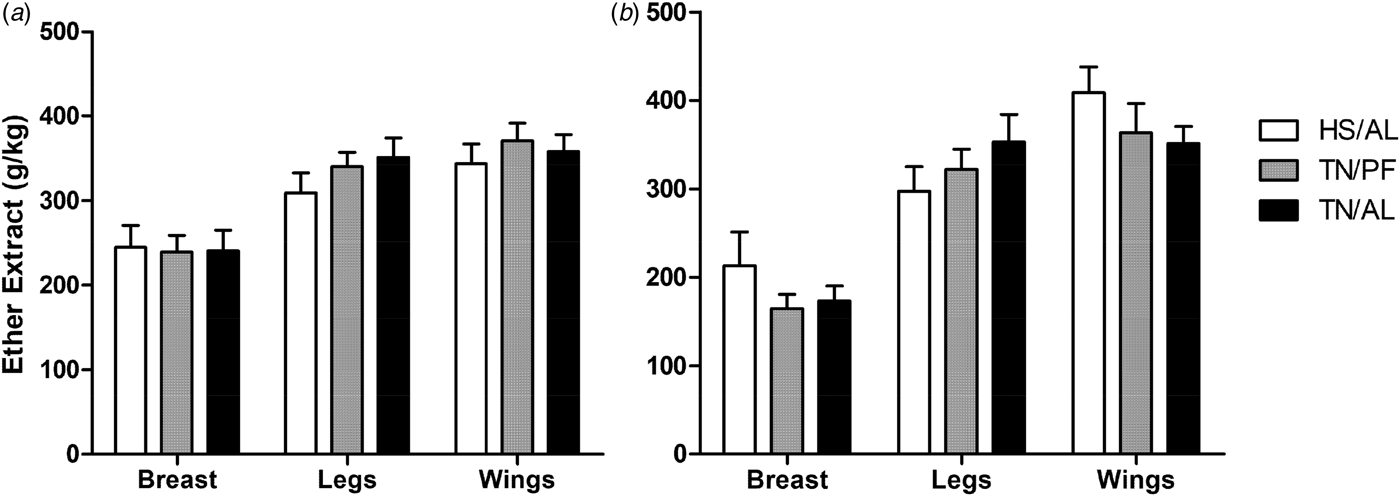
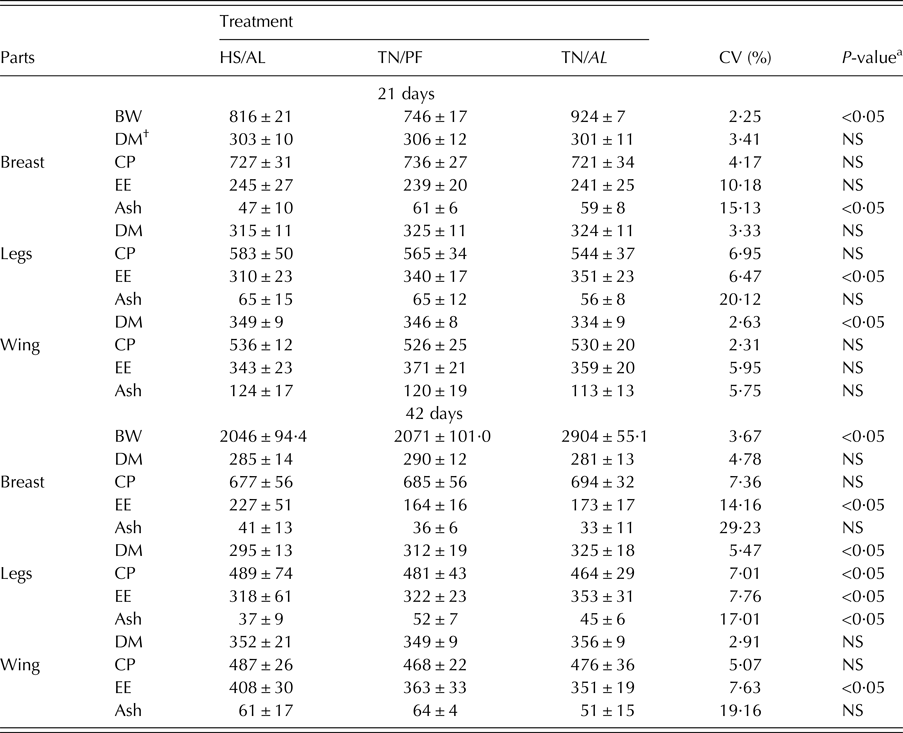
Complete results of the chemical composition of commercial cuts (DM, CP, EE and ash) at 21 and 42 days are shown in Table A2. The amount of EE in commercial cuts was affected significantly by HS, but not by feed consumption (Fig. 1). Thus, broilers from treatment HS/AL had higher EE values (P < 0·05) in the breast and wings (only at 42 days) and lower EE (P < 0·05) in the legs (days 21 and 42) than those from the TN/AL group. Broilers from the HS/AL treatment had lower ash (P < 0·05) in the breast and higher DM (P < 0·05) in the wings at 21 days, and lower DM (P < 0·05) in the legs at 42 days, when compared with broilers from the TN/AL treatment.
Effect of heat stress and feed restriction on the ether extract content in retail cuts at 21 (a) and 42 days (b). Data are expressed as means. Vertical bars indicate the s.d. of mean. HS/AL, Ad libitum-fed heat-exposed; TN/PF, pair-feeding thermoneutral; TN/AL, thermoneutral ad libitum-fed.

Gene expression analysis
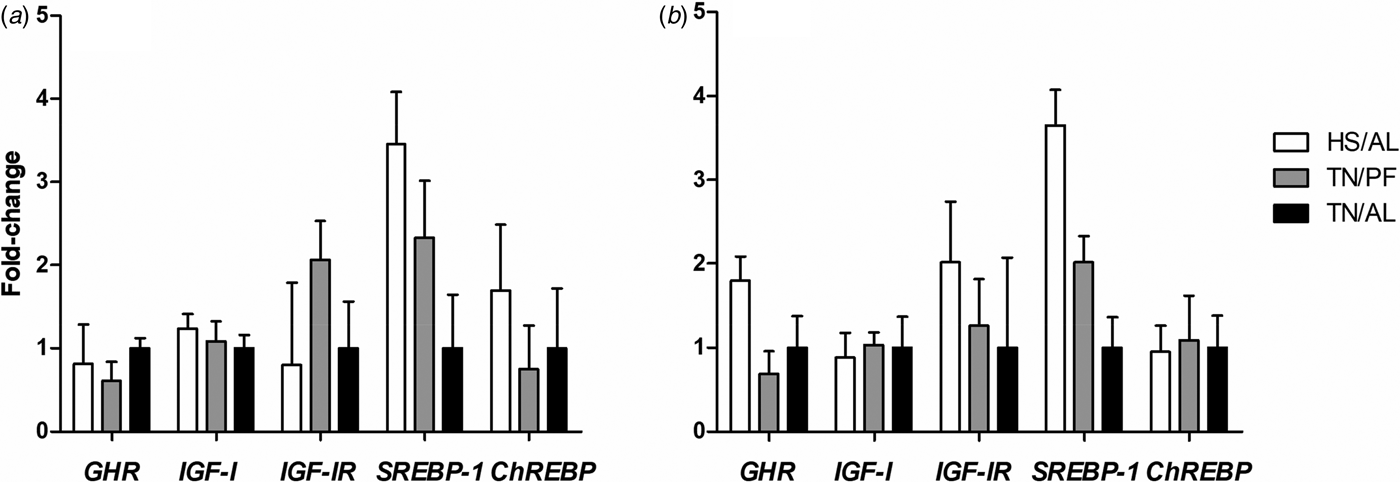
Heat stress induced a more than three-fold increase of SREBP-1 mRNA at 42 days (P < 0·01) (Fig. 2). A similar difference was found at 21 days, though not statistically significant (P = 0·079). Feed restriction was shown to induce a two-fold increase of SREBP-1 mRNA in both sampling ages, however, no statistical difference was detected. At 21 days, there was a decrease in GHR mRNA (P < 0·05) in the TN/PF treatment, which was not detected at day 42. Heat stress induced an increase in the expression of GHR (P < 0·05) at 42 days. The expression of other genes belonging to the somatotropic axis (IGF-I and IGF-IR) did not differ between treatments.
Effect of heat stress and feed restriction on the expression of genes of the somatotropic axis and energetic metabolism at 21 (a) and 42 days (b). Data are expressed as fold-changes over TN/AL. Vertical bars indicate the s.d. of mean. HS/AL, Ad libitum-fed heat-exposed; TN/PF, pair-feeding thermoneutral; TN/AL, thermoneutral ad libitum-fed; GHR, growth hormone receptor; IGF-I, insulin-like growth factor-1; IGF-IR, insulin-like growth factor-1 receptor; SREBP-1, sterol regulatory element-binding protein 1; ChREBP, carbohydrate response element binding protein.

DISCUSSION
Heat stress is one of the major limiting factors for broiler growth, because the exposure of broilers to high environmental temperatures generates behavioural, physiological and immunological responses (Lara & Rostagno Reference Lara and Rostagno2013). The performance impairment causes great losses to the poultry industry: it is estimated that HS results in annual losses of US$128–165 million in the USA (St-Pierre et al. Reference St-Pierre, Cobanov and Schnitkey2003). This is important both in tropical countries, where the temperature frequently exceeds 30 °C, and in temperate regions during the summer months. The findings of the current study confirm that broiler growth is reduced by HS, as reported previously (Campos et al. Reference Campos, Fernandez-Alarcon, Souza, Nogueira, Hada, Carneiro, Macari, Oltjen, Kebreab and Lapierre2013; Zuo et al. Reference Zuo, Xu, Abdullahi, Ma, Zhang and Feng2015). These data confirm the hypothesis that reduction in FI is the main cause of the effect on performance traits (Mignon-Grasteau et al. Reference Mignon-Grasteau, Moreri, Narcy, Rousseau, Rodenburg, Tixier-Boichard and Zerjal2015).
In addition to concerns about performance impairment, previous studies have shown increased lipid deposition in the carcass of broilers reared with high temperatures (Baziz et al. Reference Baziz, Geraert, Padilha and Guillaumin1996; Zhang et al. Reference Zhang, Jia, Zuo, Zhang, Lei, Ren and Feng2012). Similarly, in the current study, HS affected the concentration of EE in carcasses, but did not influence visceral fat deposition. In fact, the highest fat deposition in broilers reared under high temperature occurs in the subcutaneous and intermuscular tissues, with abdominal fat increasing only slightly (Baziz et al. Reference Baziz, Geraert, Padilha and Guillaumin1996), or even being broken down (Toplu et al. Reference Toplu, Oral, Nazligul, Karaarslan, Kaya and Yagin2014). The current data also showed increased lipid content in carcasses, in agreement with previous works (Baziz et al. Reference Baziz, Geraert, Padilha and Guillaumin1996; Zhang et al. Reference Zhang, Jia, Zuo, Zhang, Lei, Ren and Feng2012), occurring specifically in the breast and wings, not proportionally throughout the whole carcass. Since these cuts accounted for >40% of the carcass weight (data not shown), the increased lipid content in these areas are responsible for the increase in whole-carcass lipid content.
To analyse the mechanisms associated with changes in the composition of commercial cuts induced by HS and feed restriction, the expression of genes related to growth and energy metabolism was evaluated in the broilers’ livers. The PF method allowed identification of a reduced concentration of GHR mRNA as a specific effect of feed restriction. Zhao et al. (Reference Zhao, Muehlbauer, Decuypere and Grossmann2004) also observed a decrease in GHR mRNA as a result of feed restriction, but the experimental method used did not consider the effects of temperature. Because the circulating level of GH is higher in feed-restricted broilers (Gonzales et al. Reference Gonzales, Buyse, Loddi, Takita, Buys and Decuypere1998), the decreased expression of GHR observed in the current work may reflect a downregulation of its receptors. Feed restriction was shown to induce a two-fold increase of SREBP-1 mRNA in broilers of 21 and 42 days of age, but no statistical significance was detected. The increase of SREBP-1 in the present study differs from previous studies, which found a lower expression of SREBP-1 in fasted broilers (Désert et al. Reference Désert, Duclos, Blavy, Lecerf, Moreews, Klopp, Aubry, Herault, Le Roy, Berri, Douaire, Diot and Lagarrigue2008; Wang et al. Reference Wang, Ko, Chin, Hsu, Ding and Chen2009; Yang et al. Reference Yang, Zhuang, Rao, Li and Zhao2010). The conflicting results may have occurred because the dietary restriction throughout the present study was approximately 30%, whereas broilers in the other studies were fasted.
Heat stress did not affect the somatotropic axis genes evaluated at 21 days. At 42 days, however, the relative amount of GHR mRNA was higher in the HS/AL broilers. Expression of GH promotes metabolic responses to direct the energy for growth, suppressing lipogenesis and increasing hepatic gluconeogenesis (Schreibman Reference Schreibman2012). On the other hand, broilers can increase hepatic lipogenesis by increasing GHR expression because this receptor reduces the lipolytic effect of GH via dimerization (Vasilatos-Younken Reference Vasilatos-Younken1995; Hausman et al. Reference Hausman, Barb, Fairchild, Gamble and Lee-Rutherford2012). Thus, increased expression of GHR at 42 days may have increased lipogenesis, contributing to higher EE content in the breast and wings of the broilers exposed to HS.
The SREBP-1 results also indicate a lipogenic response in broilers subjected to HS. More specifically, the expression of SREBP-1 increased approximately 3·5 times at 42 days. Sterol-regulatory element-binding protein-1 is a transcription factor that becomes stimulated with the presence of insulin and is responsible for regulating energy metabolism, leading to lipogenenesis (Desvergne et al. Reference Desvergne, Michalik and Wahli2006). Previous studies have shown that broilers exposed to HS exhibit higher concentrations of plasma insulin (Sahin et al. Reference Sahin, Sahin, Onderci, Gursu and Cikim2002). In high temperatures, insulin regulates energy metabolism for higher use of carbohydrates and less oxidation of lipids (Rhoads et al. Reference Rhoads, Baumgard, Suagee and Sanders2013). To the knowledge of the present authors, the present study is the first to show that HS increases SREBP-1 gene expression in broilers. Assuming that insulin is the primary regulator of SREBP-1, the observed increase in SREBP-1 expression and associated fat deposition in broilers under HS may be regulated by increased levels of plasma insulin. Studies have not been performed to confirm the association of insulin, increases in fat deposition and SREBP-1 expression.
The evidence found relating to changes in the levels of SREBP-1 and GHR mRNA are indicative of these genes being involved in fat deposition in the carcass as a result of HS. To affirm the involvement of these genes in fat deposition, future studies should examine whether these observations are reflected at the protein level to fully and properly associate these mechanisms with the activity of these proteins.
The present study provides insights into the molecular mechanisms underlying fat deposition in broilers subjected to HS. The increased fat content in the carcass of broilers affected by HS appears to be regulated by distinct mechanisms, including reduced adipose tissue catabolism through higher GHR expression, as well as increased lipogenesis via SREBP-1 stimulation. The following two mechanisms could explain the difference in fat content between the commercial cuts in response to the specific effect of HS. The first is that increased hepatic lipogenesis and uniform triglyceride deposition in the carcass, with its higher utilization by the oxidative fibres of the legs (Baziz et al. Reference Baziz, Geraert, Padilha and Guillaumin1996), leads to the reduction of fat reserves in the adipocytes of the legs. The second is that increased hepatic lipogenesis and heterogeneous triglyceride deposition in the carcass, with increased activation of adipocytes in the breast and wings to receive more triglycerides than those present in the legs. Further research must be performed to clarify the mechanisms responsible for the difference of the fat composition between the commercial cuts of broilers reared with high temperatures and to clarify how abdominal fat is not changed in such conditions.
In conclusion, regardless of the feed restriction imposed by chronic exposure to 32 °C, HS increased fat content in the breast and wings and reduced the percentage of fat in the legs. The increased fat content in the breast and wings was accompanied by higher expression of GHR and SREBP-1, suggesting the involvement of both genes in the control of fat deposition when exposed to high temperatures.
The authors would like to thank the São Paulo Research Foundation (FAPESP – Fundação de Amparo à Pesquisa do Estado de São Paulo – Process numbers 08/54579-1, 08/52533-4, and 12/03927-5) and the National Council for Scientific and Technological Development (CNPq – Conselho Nacional de Desenvolvimento Científico e Tecnológico) for the financial support to conduct the research.
APPENDIX
Composition of starter (1–21 days) and grower (22–42 days) diets for broilers

Carcass parts composition of broilers at 21 and 42 days