INTRODUCTION
On the face of it, Canada is an inclusive country where racialized minorities are accepted. After all, it was the first country in the world to officially adopt a multicultural policy in 1971 (Richter Reference Richter2011). The policy would subsequently be enshrined into law in the Canadian Multiculturalism Act of 1988 (Brosseau and Dewing, Reference Brosseau and Dewing2018). That same year, the Government of Canada would apologize for the unlawful internment and dispossession of Japanese Canadians during the Second World War (Hickman and Fukawa, Reference Hickman and Fukawa2011; Massarutto Reference Massarutto2004; Stanger-Ross and Sugiman, Reference Stanger-Ross and Sugiman2017). Similarly, in 2006 the federal government would offer apologies to Chinese Canadians for not only imposing a head tax on them between 1885 and 1923 but also banning their immigration from 1923 to 1946 (Brosseau and Dewing, Reference Brosseau and Dewing2018; Winter Reference Winter2008).
The purported restorative justice initiatives would continue. In June 2008, Canada’s Prime Minister, Stephen Harper, would offer “full apology on behalf of Canadians for the Indian Residential Schools system” (Harper Reference Harper2008), a federally-funded genocidal program that left Indigenous children, families, and communities across Canada with emotional and physical scars that continue to this day (Wilk et al., Reference Wilk, Maltby and Cooke2017). In May 2016, the federal government would issue yet another formal apology to South Asian Canadians for the 1914 denial of disembarkation permission to Komagata Maru, a chartered Japanese ship carrying British Indian subjects to Vancouver, BC (Dhamoon et al., Reference Dhamoon, Bhandar, Mawani and Bains2019; Johnston Reference Johnston2014; Marwah Reference Marwah2017). However, despite the profusion of official statements of contrition, infringements on the rights, mobility, and opportunities of racialized Canadians continue.
It bears noting that racialized individuals in the context of this study constitute non-White Canadians who are subjected to processes that “construct races as real, different and unequal in ways that matter to economic, political and social life” (Ontario Human Rights Commission 2003). One reason for this paradoxical state is that the “politics of apology” (Cunningham Reference Cunningham1999), as outlined above, is designed to distract and divert attention away from addressing racial injustices into wordsmithing hollow statements that fail to “go beyond a mere state exercise of ‘performative [White] guilt’” (Corntassel and Holder, Reference Corntassel and Holder2008, p. 468). Thus, intolerance for racial differences continues to percolate in various systems and structures, with most White Canadians unmoored from Canada’s racial reality (i.e., not awake to how institutions target, dominate, and suffocate racialized bodies in the country).
For additional nuance, however, it is undeniable that Canada has made “empirically verifiable progress” (Mensah and Williams, Reference Mensah and Williams2017, p. 10) in addressing openly racist conditions, particularly in the areas of immigration and human rights. In fact, racialized minorities can lately be found in positions of power, with many in the current Canadian federal cabinet composition. Whether this makes the proverbial glass half empty or half full is a matter of one’s perspective but as Joseph Mensah and Christopher J. Williams (Reference Mensah and Williams2017) critically observe, such developments are often used to not only discount the salience of racism but also push the trendy narrative of Canada’s postracialism: that Canadians are past or beyond racism—that there now is a break from the country’s shameful xenophobic past and that, ultimately, Canada today is no longer discursively, practically, and materially the racist country that it used to be.
CONTAINING THE BODY FROM CONTAMINANTS: THE USE OF METAPHORS TO OUTLINE CORDON MINORITAIRE
Through examining lived experiences of racialized participants, this phenomenological study explores a particular manifestation of racial discrimination at work, cordon minoritaire, representing quarantine-like restrictions, limitations, and containment of mobility at work. To this end, this article makes use of two metaphors to advance our understanding of workplace racial discrimination: stranger for racialized individuals and body for workplaces where participants of this study worked. Cordon minoritaire will then be outlined as the process of containing the mobility of strangers within the body.
With respect to the first metaphor, stranger, cordon minoritaire at work operates through processes that flag strangers for containment. In this connection, Sara Ahmed (Reference Ahmed2000a, Reference Ahmed2000b) offers a relevant framework for how strangers, in the context of neighbourhood activities in Britain, are identified, produced, and flagged for recognition. Describing techniques that go into imagining, assessing, (re)producing, and distinguishing the stranger from that which is familiar and belonging from not belonging, she notes: “[s]trangers are not simply those who are not known in this dwelling, but those who are, in their very proximity, already recognised as not belonging, as being out of place” (Ahmed Reference Ahmed2000a, p. 21, emphasis in the original). As such, the recognition of the stranger is not a mere act of knowing but knowing again “as that which has already contaminated such spaces as a threat to both property and person” (Ahmed Reference Ahmed2000a, p. 22). In other words, to Ahmed (Reference Ahmed2000b), a stranger does not simply come “into being in an absence of knowledge” but is produced through a deliberate process of recognition as the stranger who is out of place (p. 49).
On the second metaphor, body, in Ahmed’s discourse (Reference Ahmed2000a) an ideal organic neighbourhood is analogized to a healthy body “fully integrated, homogeneous, and sealed… like a body that is fully contained by the skin” (p. 25). The implication here is that a healthy body “does not leak outside itself, and hence does not let outsiders (or foreign agents/viruses) in” (Ahmed Reference Ahmed2000a, p. 25). Drawing from this, an ideal and healthy workplace, from a racist perspective, is analogous to a purified White neighbourhood where belonging in/to that space is constantly monitored for contamination by strangers and their strange(r)ness. From this standpoint, quarantining against stranger contamination requires not only enforcement of locatable boundaries but also monitoring traffic around those boundaries to patrol for the intrusion of lurking strangers who have “already come too close… [and who are] always approaching,” encroaching upon familiar spaces (Ahmed Reference Ahmed2000a, p. 22). In the context of my study, the patrolling happened through cordon minoritaire processes that limited the mobility of trespassing strangers who had the audacity of entering purified White working neighbourhoods to eke out a living.
Subsequently, and relying on these two metaphors, the concept of cordon minoritaire will be presented—as inspired by the epidemiological doctrine of cordon sanitaire, or imposing restrictions on the movement of people in and out of defined spaces to quarantine them in the face of epidemics (Rothstein Reference Rothstein2015). In this respect, the use of cordon sanitaire to advance other socio-theoretical perspectives is not without precedent. The concept has been credited with influencing the development of political science notions of containment policy for example (Sempa Reference Sempa2018). Specifically, cordon sanitaire inspired the U.S. Government’s Cold War policy of containment, or the grand strategy of countering and limiting the sphere of the former Soviet Union’s influence on the world stage during the 1960s and 1970s (Sempa Reference Sempa2018).
Further, and more to the point of this research, the concept has also been used to present an analysis of xeno-racism in Europe, or the concerted political mobilization of European nations to demonize asylum seekers from fragile states as bogus claimants and masses of potential terrorists (Fekete Reference Fekete2001). The strategy here was fairly successful in limiting this vulnerable group’s access to critical life-altering resources in Europe (Fekete Reference Fekete2001). In view of this, and insofar as Canada is concerned, the country has experienced historically unprecedented growth in immigration from non-European countries for at least the past four decades (Block et al., Reference Block, Galabuzi and Tranjan2019; Neuman Reference Neuman2019). Considering this, and the fact that experiences outlined in this article provide an exposition of racialized structures and practices that cordoned off racialized workers with respect to their career freedoms and mobilities, it is the contention of this article that cordon minoritaire provides a useful conceptual framework for understanding quarantine-like restrictions that participants of this study experienced at work.
METHODS
This study examined lived experiences of racialized employees working in publicly funded places of work in British Columbia, Canada. Twenty-five participants were recruited between February and August 2018 and interviewed after administering informed consents. The interviews were audio recorded and subsequently transcribed verbatim. A semi-structured interview guide was used to ensure conversations stayed on topic and, to analyze data, hermeneutic phenomenological approach was used to inductively and intersubjectively unveil multiple meanings (de Sales Reference de Sales2003; Finlay Reference Finlay2014; Newberry Reference Newberry2012; Sembera Reference Sembera2007). This involved the use of hermeneutic circle, a process that required multiple reading of transcripts, coding, and structural analysis of data with the aim of identifying meaning units, condensed meanings, analytical subthemes, and themes (Lindseth and Norberg, Reference Lindseth and Norberg2004; McAuley Reference McAuley, Cassell and Symon2004; Wiklund et al., Reference Wiklund, Lindholm and Lindström2002).
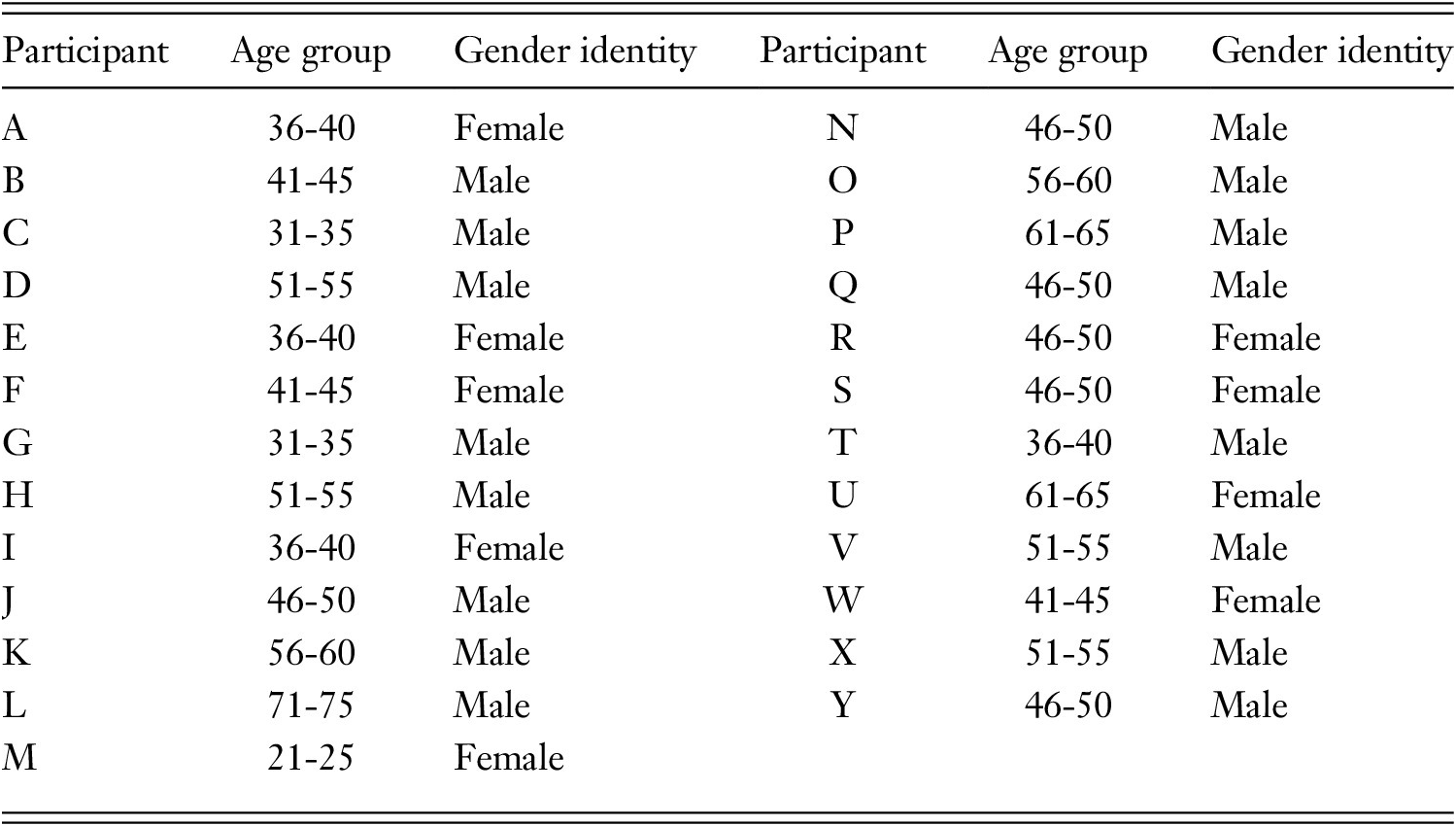
Participants came from a plurality of backgrounds and their demographic profile is as described in Table 1.
Summary of Participants’ Age and Gender Identity Self-Reports

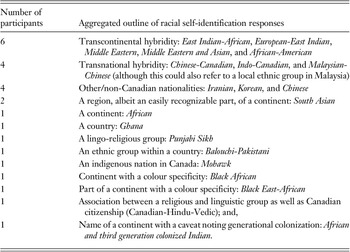
To ensure anonymity of participants, self-reported racial identification responses were aggregated as outlined in Table 2. Additionally, great care went into deciding what materially substantive excerpts were presented in this paper in support of data coding and thickening of descriptions. To this end, some insights that would have otherwise been illuminating but had the potential to identify participants were excluded due to concerns that someone might be able to connect the dots and recognize participants involved.
Participants’ Aggregated Racial-Identification Responses

RESULTS
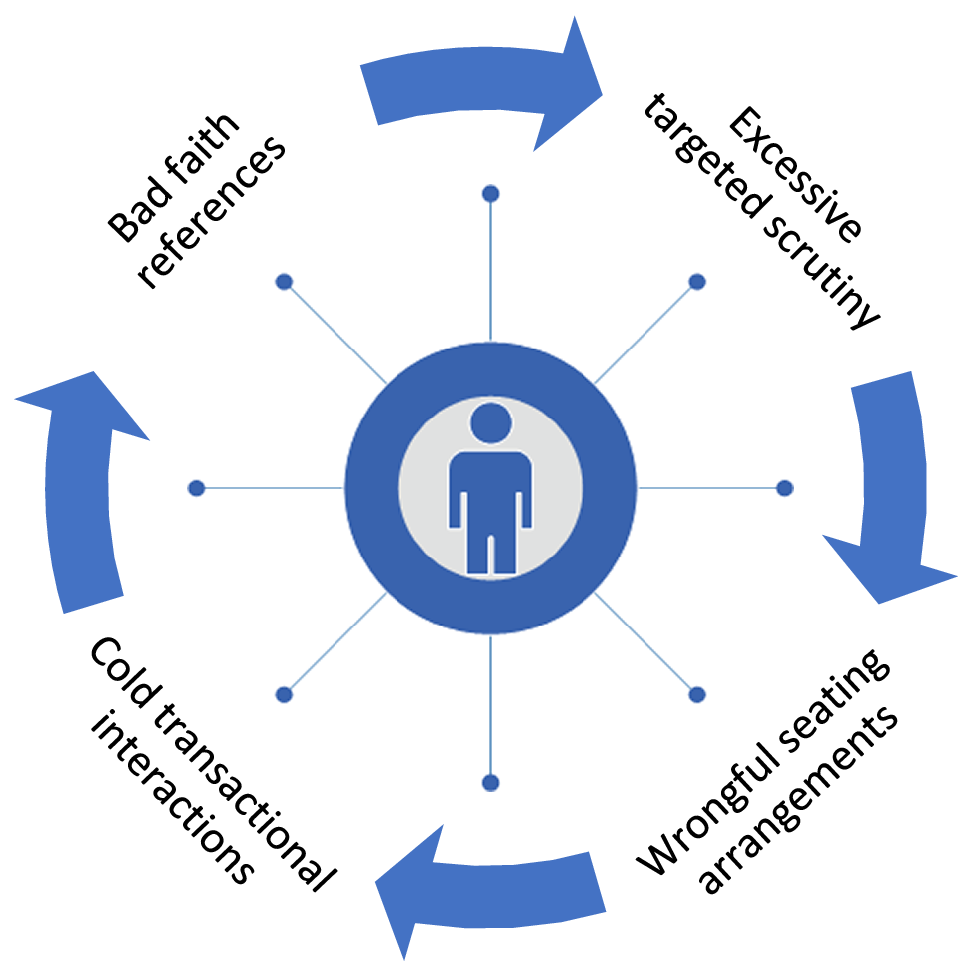
The following four analytical subthemes emerged from data outlining processes of cordon minoritaire, or quarantine-like movement restrictions on racialized participants of this study whose presence within White workplaces was perceived as foreign and objectionable. A summary of the subthemes is presented as following, under Figure 1. The human icon at the centre of the graphic is meant to represent participants and the subthemes that are encircling the human icon are positioned that way to convey their cordoning and/or quarantining functions.
Processes used to cordon off/quarantine racialized bodies at work

Excessive Targeted Scrutiny
Under this subtheme, participants outlined near daily encounters with excessive scrutiny at work. Specifically, they detailed scenes and scenarios that had made them feel “being constantly watched” (Participants A, C, J, M, N, O, and R), “suffocated” (Participants R and W), “cornered and treated like a rat” (Participant H), “micromanaged” (Participant A) and “made feel like a criminal” (Participant N) on account of being racialized at work. Recounting detailed stories of how White managers were constantly “breathing down [their] necks” (Participant C) and forcing them to “explain [themselves]” (Participants C and O) for decisions they had made in their professional work environments, the pain in these narratives was palpable based on my observation of participants’ facial expressions as well as breathing pauses as they recalled these experiences. Participants also discussed having to “write reports” (Participants C and M) to defend their work products and being harshly reprimanded in cases of minor infractions of the often-unstated rules.
Participant R, for example, described having been “made an example of” on the “rare occasion” when she had failed to attach a document to an email or fill out a form completely.
I feel like something that somebody else would get away with, or not be questioned, for me it has to be magnified … They are thinking that ‘oh maybe she’s lazy. Oh, we can deal with her because she’s gonna be a threat.’ … I don’t think they were thinking that hey, we are out to get her. But in their minds, it is … I’m not a normal person they deal with. So, in their minds, this has to be ‘oh my god, we have to,’ you know. I don’t know. I had never made that mistake. That was my first and I have worked for the government for nine years. There must be something more. Maybe they are thinking oh, she is a typical Black (Participant R).
Participant Y reported a similar experience. He had worked for his current employer for years. However, in one instance where he had committed a minor error that, according to him, was clerical in nature, the White manager had publicly berated him. “[I]f you do something that is slightly different then you are put on the spot and they start questioning, not because of the mistake but just because you made a mistake as being Black” (Participant Y). Basically, participants saw these attempts as part of the larger effort to mark them as non-belonging and ultimately confine and restrict them at work.
Another aspect of excessive scrutiny was related to unreasonable demands for documentation. Participants reported being expected to provide unnecessary proofs, intrusive details, and superfluous updates in support of mundane requests. For instance, Participant N recalled having fallen ill one day and calling in sick as a result. The next day when he reported to work, the manager had asked him for a sick note. He informed his manager that obtaining a medical certificate for a one-day medical absence was not procedurally required. However, the manager had insisted that it was up to her to decide and her decision was that a medical certificate was needed. Participant N then described in great detail that to produce this certificate, he waited for hours at a doctor’s office, convinced the doctor to write him a note and paid a fee for it.
A different dimension of excessive scrutiny at work was linked with the perception of punctuality or “getting clocked at work” (Participant X). Participant C, for instance, felt that his White manager was closely surveilling his work hours as a “daily thing.” He reported regularly experiencing stress and anxiety with the goal of ensuring that he would always be on time “right on the dot” (Participant C) at work. He then recounted the story of how, a day before our interview, the chain on his bike had come off on his way to work. However, instead of fixing the chain first, he had continued on his journey, running to work, lifting up and pushing his inoperative bike to his workplace fearing that if he was late by a minute, he would face the wrath of his White manager.
At this point, I noticed Participant C’s voice beginning to tremble. He was trying to clear his throat and was looking at the ceiling as a way of distracting himself to fight back tears. There was a long pause after which he detailed his intentions of lodging a complaint with the union about the way he was being treated at work. However, what had stopped Participant C from proceeding to file his complaint was the expectation that it would not receive attention. He described the unfairness of “systems” as follows:
We have the same accountability rules but [they are] applied differently to different people. And if it is not racism, why am I facing more scrutiny than other people? Are they using an objective study that show Black men like me don’t come to work and therefore need to be monitored and watched more closely? …Or do you have any evidence that I haven’t done my work when I was supposed to? Can you say to me that I don’t usually come to work on time and that is why you have been watching me like a hawk? I have been doing my work as expected. Like what kind of measurements have you been using to justify your treatment of me in this way? So, like if I ask them those questions, then am I kind of like unravelling another level of scrutiny on everything (Participant C).
In this respect, as Tania Das Gupta (Reference Das Gupta1996) points out, excessive targeted monitoring is a form of workplace harassment as it suggests that, in the White managers’ imagination, “workers of colour need more guidance, more corrections, and less independence given the inferiority of their labour power” (p. 36). As sediments of colonial thinking, the practice is designed to impart managerial fears onto racialized bodies by making them feel “constantly watched, judged and threatened with the prospect of being framed for dismissal” (Das Gupta Reference Das Gupta1996, p. 77). Thus, as far as cordon minoritaire is concerned, the utility of excessive targeted scrutiny comes in creating a perception of continuous surveillance at work to keep racialized bodies in check. This, as Tina Lopes and Barb Thomas (Reference Lopes and Thomas2006) have also observed, would then become part of veiled but discernible threats of creating a paper trail of evidence that could later be used against racialized workers.
Other than the above, the body of existing literature on this subject is under-developed. Research has examined excessive scrutiny by White supervisors doubting Black male resident assistants’ competence in six historically White institutions in the United States (Harper et al., Reference Harper, Davis, Jones, McGowan, Ingram and Spencer Platt2011). Similarly, studies have explored excessive and unnecessary monitoring of racialized workers by White line managers in Australia (Lewis and Gunn, Reference Lewis and Gunn2007) as well as Black and minority ethnic midwives and nurses in the United Kingdom (Pendleton Reference Pendleton2017). In all of these cases, it was determined that these processes had not only generated undue angst but had also fomented demoralizing conditions at work. Thus, excessive targeted scrutiny of racialized workers is an effective mechanism for “communicating relational messages” to “surveilled subjects” (Saulnier Reference Saulnier2017, p. 286) as a way of intimidating and cordoning them off to the undesired margins.
Wrongful Seating Arrangements
This subtheme constituted the spatial dimension of cordon minoritaire, an aspect that physically isolated participants into confined workspaces that were “pushed off to the edges” (Participant F). Examples of such workspaces include: “right in front of the fucking bathroom” (Participant M), “a dark office with no windows” (Participant A), and “off to the side, shoved away from public view” (Participant J). Participants further observed that, on the one hand, their desks and workspaces would get moved around more frequently compared to their White cohorts. On the other hand, when participants found themselves in ill-designed, inconsiderate, unfair, or unhealthy office spaces, their pleas for a change of workspace would often be disregarded and dismissed.
Participant N, as an example, reported that along with a number of other “coloured skin employees,” their desks would get pushed to unsuitable spaces, away from everyone else. He detailed a specific example of “coloured skins” being the first to move to an old building, when their department was moved to a different Ministry. In the example, while his White colleagues were left behind in the better building with “actual offices” after the move (Participant N), the “coloured skins” were asked to work in spaces that were neither designed nor appropriate to function as office accommodation.
It was right beside the kitchen… and our desks were placed so close to each other that I couldn’t turn my seat or push my chair back without hitting [my colleague’s] desk. There were two empty desks there [in regular office spaces] and for no reasons [my colleague] and I were put in there… Why did they… why just those two were put in that space that wasn’t even an office? And I talked to my supervisor and I said this isn’t an office. We can’t work here. He said, what do you mean? I said, who put [my colleague] and I in this corner? This is not even an office. It looks bad on the office because it shows that you are racists. It shows that you picked us two to sit here and all the Whites were put in actual offices… Is that because of the colour of our skin? Or is this because of the colour of our hair? (Participant N)
Participant P also described a similar scenario, except that in his case, the desk was placed in a potentially toxic place. Standing up from his chair, he first described the small size of the desk he was assigned to, relative to his White colleagues’ workspaces. Subsequently, and using hand gestures, he demonstrated the overall seating plan for the office and the restricted space into which his “tiny desk” was “forced to fit in there” (Participant P). He then went into detail about how painful it was to work in that desk as it was placed right next to a “giant printer” which emitted odorous, albeit invisible, chemical fumes that sent him home with headaches and feeling disoriented every day (Participant P).
So, they sat me next to a giant printer in a space that wasn’t technically an office space. I complained about the smell and the chemicals and the toxins. I thought [his White manager] had just disregarded it [his complaint]. But what he had done was that he had forwarded it to the Director, and then the Director had forwarded it to [the employer]. What [the employer] had done was to come back to the Director and say that they had done adequate studies to show that there is no [harmful health] effects. I kept that [email] here because I said that if I ever got sick, I’m gonna pull this email but I had inquired so I will have grounds to sue you now. (Participant P)
Similarly, Participant U described having been seated in an area of the office that did not have sufficient heating during late fall, winter, and early spring. When she approached her manager for a relocation to a desk that had been unoccupied for more than a year and had a proper heating system in place, her request was denied. “He said that it is there for a new person, but nobody showed up there for another year or so” (Participant U). She then discussed witnessing her White colleagues getting their desk move requests approved with ease but when it came to her, the manager had instructed her to stay where she was, suffering in cold Canadian temperatures. “They don’t like to hear it, but that is exactly what this is: racism” (Participant U).
With respect to existing literature on this subtheme, to my knowledge no studies have been conducted to examine this form of seating segregation that specifically targets racialized individuals at work. However, de facto spatial racial segregation is still practiced in Indigenous peoples’ reserves in Canada (Farha Reference Farha2019; Farooqui Reference Farooqui2019). There are also other shamefully discriminatory practices that target Indigenous children (Blackstock Reference Blackstock2010, Reference Blackstock2016) and Indigenous women (Day Reference Day2018), for example. Nonetheless, while de jure and codified racial partitioning is no longer a prominent feature of life in Canada, data under this subtheme exhibit a quite literal manifestation of segregation, a physical push of racialized workers to undesirable, unacceptable, and unhealthy margins of office spaces. Thus, discriminatory seating served as yet another mechanism for cordoning racialized workers away from the more conventional and dignified workspaces.
Cold and Transactional Interactions
This subtheme describes the psychological dimension of cordon minoritaire. But first, it is axiomatic that professional and personality differences impact the quality of interoffice interactions. However, participants described scenarios where White coworkers and superiors would not engage with them in ordinary social conversations—or would flat out ignore them. Indeed, in some cases, workplace Whites would rudely choose to look the other way when they encountered a racialized body. Participant R, for example, discussed how her White colleagues always kept things “at an arm’s length… at the professional level, meaning business only” with her. She attributed this behavior to her White colleagues’ “unconscious bias” (Participant R). In this vein, another respondent, Participant U, described being completely ignored by one of her superiors.
That was actually a Director… every time I ran into him, he would start looking at the ceiling or the wall or his shoes instead of saying hi or responding to my hi or talking to me. Sometimes he didn’t even know where to look [laughing]. And he was my Director! This made me so uncomfortable. He would just pass by my desk and not say a word, nothing… [But] he goes and talks to everybody else to say goodbye and have a good weekend, even to the guys who don’t work for him, but not for me. Nothing. (Participant U)
Participant U expressed that she felt bad for her “strange” Director and, as a result, how she was going above and beyond to accommodate his racism. “Sometimes when I was seeing him from a distance, I would change my route because I didn’t want to pass by him and make him feel uncomfortable [laughing]” (Participant U). Similarly, Participant C noted that he was working with some of his former university classmates. However, the former classmates would not acknowledge his presence at work. “For me, they are kind of like hesitant to approach me… they just say a very distant and cold hi and keep walking away from me” (Participant C). He further elaborated how the fact that his White colleagues were socializing with each other but not with him had made him feel “unwanted and unwelcomed” (Participant C).
In this context, another respondent, Participant P, recounted a specific instance where employees got together for the farewell party of one of their Directors. He detailed how he felt like an “outcast” as following:
So, I sat there, the Director and I had a conversation but many of them Whites there, they just didn’t wanna have conversations with me. Later on, I realized that the CIO [Chief Information Officer] and another executive were sitting there, no acknowledgement, nothing, right. Usually… they have acknowledgement for White people, but I have never had that acknowledgement from them… I’m a personable guy and I think you can see that… but that doesn’t matter because they wouldn’t even look at me. (Participant P)
When Participant M was new in her workplace, she started noticing something “weird.” Three of her colleagues “would see [her] but would look at the wall as [she] went by” (Participant M). I probed on what she meant by “looking at the wall” and her elaboration was the following:
So, they would react as soon as they saw me, and they would turn their heads away from me as I walked down the hallway. I was very confused because I recognized them as part of the same office, but I was still new. I tried to wave to them, but they would look the other way… I wouldn’t say that it brought me hardship, but it brought me a lot of confusion because I was like why are you doing this, right? (Participant M)
Reports of distant and unfriendly interactions in this study are consistent with previous research findings on racial discrimination, rejection, and avoidance behaviour from Whites (Carter and Forsyth, Reference Carter and Forsyth2010; Currie et al., Reference Currie, Wild, Schopflocher, Laing and Veugelers2012; Nadal et al., Reference Nadal, Escobar, Prado, David and Haynes2012). These unfriendly behaviours could be theorized as microassaults which are racial derogations characterized by a “nonverbal attack meant to hurt the intended victim” in a purposeful, conscious, and deliberate fashion (Sue et al., Reference Sue, Capodilupo, Torino, Bucceri, Holder, Nadal and Esquilin2007, p. 274). Ultimately, in addition to denying participants their humanity, these icy and contemptuous microassaults treated racialized workers as though they were emotionless automatons and created “conditions for purging, isolating, [and] eliminating” them (Williams Reference Williams2020).
Another theoretical linkage to the literature is provided by the concept of shunning. Whereas excessive targeted scrutiny singles out racialized workers for surveillance, shunning selectively isolates, marginalizes, and invisibilizes racialized individuals as a group (Coates Reference Coates2011). More specifically, as a “destructive instrument of oppression” that is informally practiced, shunning habitually ignores racialized groups and encourages the mainstream population to avoid contact with them through instilling fear about racialized bodies (Coates Reference Coates2011, p. 124). Subsequently, and paradoxically, “given the covert nature of this particular form of racism, those witnessing such selectivity may be less likely to define it as racist…[and] those being targeted are also less likely to be able to pinpoint the source of offence” (Coates Reference Coates2011, p. 125).
For these reasons, cold and transactional interactions operated by marking racialized individuals in ways that underscored their strangerness, steering them clear of socialization processes with powerful mainstream Whites. More precisely, the deprivation of socialization and the lack of acknowledgement for the racialized as human beings in the workplace are noteworthy as they exclude them from opportunities and promotional chances that come with proximity and visibility with decision-making executives. These deprivations also diminish racialized workers’ sense of worth and security at work as they get pushed to the peripheries—a safe distance away from the White centre where the bulk of critical workplace decisions are made.
Bad Faith References
Another finding of this study was that respondents described having become sceptical of their immediate supervisors supporting their vertical and horizontal career mobility, noting that most would not furnish them accurate references. For instance, Participant N reported that one of his managers would give him references that deliberately undervalued his work. However, during in-person conversations the manager would always give him the impression that he had furnished him “a glowing” reference. He would only find out after he interviewed for a position that the reason he did not get the job was the less-than-positive reference from his current manager. He then remarked that when a colleague had recently asked him to apply for a highly technical position in his field, a position for which very few, if any, internal candidates existed, he had hopelessly responded by commenting: “What is the point? They’ll make sure I never get it” (Participant N).
Participant P also noted having applied to a number of vacant positions after discussing the matter with his supervisor. The supervisor had, to Participant P’s face, signalled being supportive. However, Participant P would later discover that this had not been the case as the manager had furnished an inaccurate reference despite initial assurances to the contrary. I asked the participant how he had figured this out and he described that it was through engaging with a hiring committee member who had informed him that an unfavourable reference had prevented him from getting the job. “I didn’t find a job for all those thirteen years… I would go and do interviews but never get a job. And I could never understand what was going on… like… I started feeling… like my self-image kept going down, and down, and down” (Participant P).
Meanwhile, Participant M had experienced this form of “immobility” as well. She stated that publicly the message from her supervisor was: “I am supporting you… Behind me, there were messages suggesting that I was not a people’s person, I was having communication issues, and was incompetent” (Participant M). These feelings were echoed by Participant R as well, who noted that the “doublespeak” was more a function of structural racism embedded in institutional practices than a characteristic of one particular manager. “This shows what their true face and colours are. Because in their fake faces, they might say that they like you and accept you, but this is when it shows that they don’t see you as a person equal to them” (Participant R). Participant R expressed also being in a stagnant state career-wise and losing trust that her superiors would support her mobility.
Participant Q made a related observation. After serving for more than five years in a position, an opportunity that was one level up had opened up in his department due to a retirement. Participant Q had applied for the position and was told by one of the panel members that he was the top-scoring candidate. When I queried on how he had received that feedback, Participant Q mentioned that it was because the position was highly technical in nature and he knew the person who had conducted the tests. In addition, he mentioned that he was absolutely certain of the answers he had provided because he had done a similar job for over five years. Ultimately, he too would be deprived of an advancement opportunity because of a bad reference. Lastly, Participant W noted applying for an eligibility list for a position, a process in which she was initially successful. However, when the hiring manager had called her current supervisor for a reference, the supervisor had asked the hiring manager to exclude Participant W from further consideration.
As Participants N, M, P, Q, and W reported, bad faith references served to contain the movement of perceived contaminants, i.e. strangers at work. Specifically, since these references provided an evaluation of their work influenced by racial bias, they rendered racialized workers immobile career-wise. That is to say, as a mechanism of cordoning, bad faith references operated in recruitment processes to keep participants grounded quite literally where they were, fixed in static positions and deprived of horizontal and vertical career mobility opportunities.
The subtheme of bad faith references was another topic on which I had trouble locating previous research, likely owing to the fact that it may be an anomalous aspect of recruitment processes in the public sector as opposed to non-public sector contexts where it is more likely that applicants would have the liberty of presenting references from fairer and more trustworthy sources. Having said that, when it comes to the overarching theme of assessing the quality of work produced by racialized workers, Philomena Essed’s (Reference Essed, Das Gupta, James, Maaka, Galabuzi and Andersen2007) concept of underestimation offers potent explanation.
Underestimation, as Essed (Reference Essed, Das Gupta, James, Maaka, Galabuzi and Andersen2007) notes, forces a racialized professional to strive for perfection in her work because of a well-founded fear that “if she fails, it will not be seen as personal failure but as failure of a Black woman” (Essed Reference Essed, Das Gupta, James, Maaka, Galabuzi and Andersen2007, p. 212). Participants of this study also alluded to this phenomenon, particularly when discussing subjection to excessive targeted scrutiny, the first subtheme of these findings. In other words, the presupposition of incompetence prevails in the White imaginary to the extent that it maintains the fiction that racialized bodies are unable to perform up to the standards of the White workers (Essed Reference Essed, Das Gupta, James, Maaka, Galabuzi and Andersen2007). Thus, it is plausible to deduce that White managers provided prejudiced assessments because they genuinely had low opinions of racialized workers. Nevertheless, it is important to reiterate that while their references may have been cloaked in seemingly innocent and inoffensive language, they deprived racialized workers of career mobility and movement freedoms that others enjoyed.
DISCUSSION: FROM METAPHORS TO A METANARRATIVE
The metaphors employed here to advance our understanding of workplace racial discrimination—stranger for racialized individuals and body for the workplace—are useful in making sense of the racialized encounters with cordoning at work. Participant experiences described in this study exemplify the machinations of cordon minoritaire. For instance, they illustrate how strangers were recognized for “lurking as the threat of that-which-might-yet-be” (Ahmed Reference Ahmed2000a, p. 33) in the body, particularly as it relates to the first subtheme of this study’s findings, excessive targeted scrutiny of racialized bodies at work. Against this backdrop, it is important to note that the strangers played virtually no role in being recognized in this way. Rather, as Ahmed (Reference Ahmed2000a) observes in the context of neighbourhood watch in the UK, it was these strangers’ proximity that singled them out for cordoning away from “the purified space of the community [and] the sanitary life of the good citizen” (p. 22).
Moreover, strangers’ mobility containment in the body can also be viewed as part of the larger racial formation structures (Omi and Winant, Reference Omi and Winant1994)—or the national(ity) formation project as has been argued in the case of Canada by Sunera Thobani (Reference Thobani2007). Specifically, nationality formation in Canada is constituted in the national imaginary through a process that exalts White subjects as worthy and deserving nationals while marginalizing non-Whites as non-belonging strangers (Thobani Reference Thobani2007). The imaginary projects nationals as law-abiding, enterprising, and responsible citizens who are “compassionate, caring, and committed to the values of diversity and multiculturalism” (Thobani Reference Thobani2007, p. 4). Meanwhile, the non-White strangers are viewed with suspicion, as “susceptible to lawlessness,” with a tendency “to resort to deceit to gain access to valuable resources” (Thobani Reference Thobani2007, p. 4). Ultimately, Thobani’s (Reference Thobani2007) exaltation framework elucidates the metanarrative that excessive targeted scrutiny at work was necessary since racialized bodies were seen as undeserving, non-belonging, deceitful, and disloyal strangers.
With respect to the second subtheme, wrongful seating arrangements, it is reasonable to argue that participants’ racial backgrounds, perceived as undesirable in the national White imaginary, played a role. As Thobani (Reference Thobani2007) observes, the national imaginary represents strangers as “responsible for importing ‘their’ backward cultural practices into the country (dowry, honour killings), along with their diseases (West Nile Virus, Asian Bird Flu, Ebola), their ancient murderous hatreds (the Sikh/Indian, Tamil/Sinhalese conflicts, among others), and their criminal gangs (Colombian drug dealers, Chinese ‘snakeheads,’ Indo-Canadian gangs)” (p. 4). In this respect, and in the context of the ongoing COVID-19 pandemic (something that has repeatedly been dubbed as “the China plague” and the “Wuhan virus” by former U.S. President Donald Trump), evidence of the proliferation of anti-Asian rhetoric, racial harassment, xenophobic violence, and hate crimes throughout the Western world is emerging (Flanagan Reference Flanagan2020; Human Rights Watch Reference Watch2020; Keung Reference Keung2020). Thus, restricting participants to unfair, ill-designed, unhealthy, and even toxic workspaces could be seen as spatially cordoning the criminal, backward, disease prone, and menacing non-subjects to serve the metanarrative of containing any contamination that their presence poses to the exalted body of White nationals.
Of all the research subthemes presented above, cold and transactional interactions operated most effectively at the psychological level. Through deliberate deprivation of social engagements, combined with a lack of acknowledgement of their presence as human beings in civil bureaucratic environments, cold and transactional interactions were also designed to devalue the worth of racialized strangers. Conversely, and simultaneously, they gave the exaltation of White Canadians a tangible materiality. Put differently, these processes underscored the metanarrative that intentionally fetishized the worthiness of White Canadians while concomitantly cheapening the dignity, the pride, and the honour of non-White, non-belonging, undeserving, and non-national strangers.
On the fourth subtheme, bad faith references, it is conceivable that one rationalization was to preserve scarce resources such as employment and advancement opportunities for only rightfully deserving exalted White nationals. The stranger non-White subjects in this regard were insignificant, and inaccurate references were only given to reinforce this message. These bad faith references also supported another notion: associating Whiteness with “leadership, responsibility, education and skill” (Das Gupta Reference Das Gupta1996, p. 14). This concretized the exaltation of White nationals on the one hand while quarantining and keeping the strangers in their places on the other hand. Ultimately, inaccurate references were in line with, and furthering, the metanarrative of exalting White subjecthood, along with its supporting mythos and imaginations which have consistently exaggerated differences between White nationals and non-White strangers (Thobani Reference Thobani2007).
Beyond Thobani’s exaltation framework, another conceptualization that bears noting is that of racial ideologies and the control imperative as B. Singh Bolaria and Peter S. Li (Reference Bolaria and Li1988) note. Systemic racism outlined in this study persisted largely through the application of “non-racial discourses to ‘otherize’ immigrants and people of colour” (Das Gupta Reference Das Gupta, Wallis and Kwok2008, p. 154). Specifically, in none of the instances did participants note hearing or observing glaringly racist slurs or overtly slanderous insults. However, racial ideologies that were at play were devised to subordinate racial groups through conveying a consistent message that they occupied a subservient and subordinate position in the proverbial pecking order. These ideologies aimed to control bodies, workplaces, resources, movements, and opportunities. For these reasons, cordon minoritaire as a conceptual framework advances our understanding of the sophisticated nature and subtle forms of workplace racial containment, exploitation, and oppression.
CONCLUSION
Racism at work relentlessly continues to devastate the lives and livelihoods of racialized individuals, families, and communities. As the strangers are burdened with suspicions of incompetence, their work is devalued, their work ethic is questioned (directly or in the context of maintained unfavourable assumptions), and their bodies are subjected to close undue scrutiny. Participants of this study went into great detail to describe how racializing processes marked them as strangers and the ideology of racism informed those in power to make decisions about them at work. Specifically, they detailed the ways in which their perceived strangerness was used to deprive them of the ability to progress through the ranks and enjoy their work. This is important since, as Grace-Edward Galabuzi (Reference Galabuzi, Wallis and Kwok2008) observes, workplace racism is a significant cause of the “racialization of poverty” and the resulting widespread poverty among racialized groups in Canada (p. 90).
The racialization of poverty is linked to the deepening oppression and social exclusion of racialized and immigrant communities on one hand, and to the entrenchment of privileged access to economic opportunity for an elite section of the majority population on the other. Economic exclusion takes the form of labour-market segregation, unequal access to employment, employment discrimination, disproportionate vulnerability to unemployment, and underemployment. These are both characteristics and causes of social exclusion (Galabuzi Reference Galabuzi, Wallis and Kwok2008, p. 86).
In this regard, it also helpful to bear in mind that since open expressions of racist beliefs fly in the face of accepted norms in Canada, most White Canadians resort to practicing their racism without ever uttering a racist thought or acknowledging the fact that they are holding exclusionary belief systems (Henry and Tator, Reference Henry and Tator2010; Mensah and Williams, Reference Mensah and Williams2017). This, subsequently, creates pernicious conditions where racists “need never talk of ‘niggers’, ‘wogs,’ or ‘coons’” but subtly and effectively authorize “the very emotions of hostility that then get expressed in these terms” (Barker Reference Barker1981, pp. 4-5). Simply put, workplace racism as it relates to the Canadian context becomes more effective when it is manifested through imperceptible practices than when it is overtly preached.
Part of the reason why more subtle practices of racism are more effective is because they are deemed safer than direct verbal expressions. The White “middle-class are trained to subscribe” to values of tolerance and liberal egalitarianism “while holding ambivalent and sometimes conflicting attitudes” (Henry and Tator, Reference Henry and Tator2010, p. 43). Given this safety, performing racism appears to have gone mainstream, replacing the outright and vocal expressions of intolerance for the presence of racialized strangers at work. The literature would support this contention as well. Martin Barker (Reference Barker1981), for example, notes that the nature of racism has dramatically evolved to the point where the latest iteration is almost unrecognizably subtle. Consequently, this evolution “leaves the new racists free from any imputation of claiming to be superior to other races… [where] you do not even need to dislike or blame those who are so different from you—in order to say that the presence of these aliens constitutes a threat to our way of life” (Barker Reference Barker1981, p. 18).
In addition to safety, practicing racism offers discretion which, as Mensah and Williams (Reference Mensah and Williams2017) observe, “remains the hallmark of Canadian discrimination, unlike the situation in the United States where racial discrimination is often blatant” (p. 80). The discretion, however, poses a significant challenge to antiracist efforts in Canada as proving systemic employment discrimination remains an incredibly arduous task because of the complexities of systems as well as the fact that employment discrimination often “results from the operation of established procedures of recruitment, hiring, and promotion, most of which are not necessarily designed to promote discrimination” (Henry and Tator, Reference Henry and Tator2010, p. 84). Nonetheless, despite the discreet and subtle nature of racial discrimination at work, the cordon minoritaire conceptual framework has the potential to illustrate how racism is embedded in institutional mechanisms in ways that challenge any suggestions that these exclusionary practices were isolated incidents stemming from inadequate human resources training on racial tolerance.
Studies continue to demonstrate that Canadian racism has been consummated in terms of its subtlety and discretion (Al-Waqfi and Jain, Reference Al-Waqfi and Jain2008; Block and Galabuzi, Reference Block and Galabuzi2011; Cassin et al., 2007; Galabuzi 2006; Henry Reference Henry2017; Henry and Tator, Reference Henry and Tator2010; Lopes and Thomas, Reference Lopes and Thomas2006). Meanwhile, Canada is becoming increasingly diverse on account of unprecedented immigration. Furthermore, the findings of this paper trouble the myth of Canada as a bastion of multicultural acceptance. Bearing these in mind, addressing systematic racism needs sustained research focus, policy attention, and a broad-based institutional commitment to antiracist practice—in ways that keep pace with a racist landscape that seems to be in a state of constant flux. In light of this, cordon minoritaire was conceptualized to track the evolving contours of racism in the workplace but additional research is needed to thicken existing understanding of this phenomenon, in Canada and beyond.