INTRODUCTION
Dementia with Lewy bodies (DLB) is a neurodegenerative disorder in which dementia precedes or occurs conjointly with the development of mild parkinsonism, visual hallucinations, and fluctuations in arousal or attention (McKeith et al., Reference McKeith, Galasko, Kosaka, Perry, Dickson, Hansen and Perry1996, Reference McKeith, Dickson, Lowe, Emre, O’Brien, Feldman and Yamada2005). It is characterized pathologically by cell loss and the deposition of Lewy bodies in the substantia nigra and other brainstem nuclei (e.g., locus ceruleus, dorsal vagal nucleus), and by the presence of Lewy bodies and other forms of α-synuclein pathology in neocortical and paralimbic regions (Colosimo, Hughes, Kilford, & Lees, Reference Colosimo, Hughes, Kilford and Lees2003; Harding & Halliday, Reference Harding and Halliday2001). In many cases, concomitant Alzheimer’s disease (AD) pathology (e.g., neuritic plaques, neurofibrillary tangles) is present in medial temporal lobe structures and association cortices of the temporal, frontal, and parietal lobes (Hansen, Masliah, Galasko, & Terry, Reference Hansen, Masliah, Galasko and Terry1993; Harding & Halliday, Reference Harding and Halliday2001; Horimoto et al., Reference Horimoto, Matsumoto, Nakazawa, Yuasa, Morishita, Akatsu and Kosaka2003; Tsuboi & Dickson, Reference Tsuboi and Dickson2005).
DLB is often clinically confused with AD during life (Merdes et al., Reference Merdes, Hansen, Jeste, Galasko, Hofstetter, Ho and Corey-Bloom2003). Insidious onset of cognitive decline is usually the first and most prominent symptom in both diseases (Galasko, Gould, Abramson, & Salmon, Reference Galasko, Gould, Abramson and Salmon2000; Helmes, Bowler, Merskey, Munoz, & Hachinski, Reference Helmes, Bowler, Merskey, Munoz and Hachinski2003; Heyman et al., Reference Heyman, Fillenbaum, Gearing, Mirra, Welsh-Bohmer, Peterson and Pieper1999; Johnson, Morris, & Galvin, Reference Johnson, Morris and Galvin2005; Kraybill et al., Reference Kraybill, Larson, Tsuang, Teri, McCormick, Bowen and Cherrier2005; Olichney et al., Reference Olichney, Galasko, Salmon, Hofstetter, Hansen, Katzman and Thal1998; Stern et al., Reference Stern, Jacobs, Goldman, Gomez-Tortosa, Hyman, Liu and Albert2001). The nature of the cognitive decline is similar in DLB and AD with widespread deficits in episodic memory, executive functions, attention, language and semantic memory, and visuospatial abilities (for reviews, see Kraybil et al., Reference Kraybill, Larson, Tsuang, Teri, McCormick, Bowen and Cherrier2005; Metzler-Baddeley, Reference Metzler-Baddeley2007; Salmon & Hamilton, Reference Salmon and Hamilton2006; Troster, Reference Troster2008). Other clinical signs and symptoms that might help to distinguish DLB from AD, such as mild parkinsonism or visual hallucinations, may be subtle and occur to some degree in both groups (Merdes et al., Reference Merdes, Hansen, Jeste, Galasko, Hofstetter, Ho and Corey-Bloom2003).
Despite similarities in the cognitive deficits associated with DLB and AD, several studies have shown that visuospatial deficits are disproportionately severe in patients with DLB compared to equally demented patients with AD (Ala, Hughes, Kyrouac, Ghobrail, & Elble, Reference Ala, Hughes, Kyrouac, Ghobrial and Elble2001; Johnson et al., Reference Johnson, Morris and Galvin2005; Tiraboschi, Salmon, Hansen, Hofstetter, Thal, & Corey-Bloom, Reference Tiraboschi, Salmon, Hansen, Hofstetter, Thal and Corey-Bloom2006). These deficits have been shown using tests of visual perception (Calderon et al., Reference Calderon, Perry, Erzinclioglu, Berrios, Dening and Hodges2001; Lambon Ralph et al., Reference Lambon Ralph, Powell, Howard, Whitworth, Garrard and Hodges2001; Metzler-Baddeley, Baddeley, Lovell, Laffan, & Jones, Reference Metzler-Baddeley, Baddeley, Lovell, Laffan and Jones2010; Mori et al., Reference Mori, Shimomura, Fujimori, Hirono, Imamura, Hashimoto and Hanihara2000; Wood, Firbank, et al., Reference Wood, Firbank, Mosimann, Watson, Barber, Blamire and O’Brien2013; Wood, Watson, et al., Reference Wood, Watson, Firbank, Mosimann, Barber, Blamire and O’Brien2013) or visual search (Cormack, Gray, Ballard, & Tovee, Reference Cormak, Gray, Ballard and Tovee2004), and tests that require drawing simple and complex two-dimensional figures (Aarsland et al., Reference Aarsland, Litvan, Salmon, Galasko, Wentzel-Larsen and Larsen2003; Connor et al., Reference Connor, Salmon, Sandy, Galasko, Hansen and Thal1998; Galasko, Katzman, Salmon, & Hansen, Reference Galasko, Katzman, Salmon and Hansen1996; Gnanalingham, Byrne, & Thornton, Reference Gnanalingham, Byrne and Thornton1996; Hansen et al., Reference Hansen, Salmon, Galasko, Masliah, Katzman, DeTeresa and Alford1990; Noe et al., Reference Noe, Marder, Bell, Jacobs, Manly and Stern2004; Salmon et al., Reference Salmon, Galasko, Hansen, Masliah, Butters, Thal and Katzman1996) or the construction of three-dimensional objects (Hamilton et al., Reference Hamilton, Salmon, Galasko, Delis, Hansen, Masliah and Thal2004; Hansen et al., Reference Hansen, Salmon, Galasko, Masliah, Katzman, DeTeresa and Alford1990; Shimomura et al., Reference Shimomura, Mori, Yamashita, Imamura, Hirono, Hashimoto and Hanihara1998). In many cases, these particularly severe visuospatial deficits are apparent even though patients with DLB perform significantly better than those with AD on tests of episodic or semantic memory (Calderon et al., Reference Calderon, Perry, Erzinclioglu, Berrios, Dening and Hodges2001; Lambon Ralph et al., Reference Lambon Ralph, Powell, Howard, Whitworth, Garrard and Hodges2001).
The visuospatial deficit in DLB appears to involve dysfunction of relatively independent dorsal and ventral neural circuits (i.e., “streams”) that process different aspects of the visual scene (Ungerleider & Mishkin, Reference Ungerleider and Mishkin1982). Recent conceptualizations suggest that the dorsal visual stream processes “vision for action” (Milner & Goodale, Reference Milner and Goodale1995), such as visual guidance of hand movements during grasping and visual processing of the spatial layout of the world with regard to location, distance, relative position, and motion (de Haan & Cowey, Reference De Haan and Cowey2011; Milner & Goodale, Reference Milner and Goodale1995). The ventral visual stream, in contrast, processes “vision for perception” (Milner & Goodale, Reference Milner and Goodale1995), by which one perceives and recognizes shape, orientation, size, color, objects, faces, and text (de Haan & Cowey, Reference De Haan and Cowey2011; Milner & Goodale, Reference Milner and Goodale1995). The degree of specialization and level of inter-stream interaction remains subject to debate (Milner & Goodale, Reference Milner and Goodale1995; Schenk & McIntosh, Reference Schenk and McIntosh2010; Ungerleider & Mishkin, Reference Ungerleider and Mishkin1982); however, neural substrates of visuospatial perception may be governed by regions of confluence between the two primary visual streams.
Patients with DLB perform significantly worse than patients with AD on tests of object and form discrimination that engage the ventral visual stream, including fragmented letter identification (Calderon et al., Reference Calderon, Perry, Erzinclioglu, Berrios, Dening and Hodges2001), discrimination of “real” objects from non-objects (Calderon et al., Reference Calderon, Perry, Erzinclioglu, Berrios, Dening and Hodges2001), and size discrimination (Mori et al., Reference Mori, Shimomura, Fujimori, Hirono, Imamura, Hashimoto and Hanihara2000; Mosimann et al., Reference Mosimann, Mather, Wesnes, O’Brien, Burn and McKeith2004). They also perform worse than patients with AD on spatial tasks that engage the dorsal visual stream such as segregation of overlapping figures (Calderon et al., Reference Calderon, Perry, Erzinclioglu, Berrios, Dening and Hodges2001; Mori et al., Reference Mori, Shimomura, Fujimori, Hirono, Imamura, Hashimoto and Hanihara2000), identification of dot position (Mosimann et al., Reference Mosimann, Mather, Wesnes, O’Brien, Burn and McKeith2004), and motion perception (Landy et al., Reference Landy, Salmon, Galasko, Filoteo, Festa, Heindel and Hamilton2015; Mosimann et al., Reference Mosimann, Mather, Wesnes, O’Brien, Burn and McKeith2004).
In light of these findings, a widely used visual information processing task that might be sensitive to DLB and effective at distinguishing it from AD is the Hooper Visual Organization Test (VOT; Hooper, Reference Hooper1983). The VOT requires the perceptual and conceptual reorganization of the parts of a fragmented visual object into a coherent whole so that the object can be identified and named. This presumably necessitates the integration of spatial and object-identity information that has been separately processed by dorsal and ventral visual neural circuits. Consistent with this view, a functional magnetic resonance imaging (fMRI) study in which normal individuals performed the VOT showed that task-related activation was evident in dorsal stream cortical regions involved in spatial processing (i.e., bilateral superior occipital and posterior superior parietal cortex) and in ventral stream cortical regions involved in object identification and semantic retrieval (i.e., lateral occipital and posterior inferomedial temporal cortex) (Moritz, Johnson, McMillan, Haughton, & Meyerand, Reference Moritz, Johnson, McMillan, Haughton and Meyerand2004).
The VOT might also be particularly effective in assessing visuospatial abilities in DLB and AD because it does not place heavy requirements upon attention, executive functions, or motor manipulation skills that are necessary to perform some visuoconstructive tasks (e.g., Block Design Tests). These non-visuospatial abilities are often impaired in DLB or AD and could influence test performance and make it difficult to isolate a visuospatial deficit. The VOT does, however, require confrontation naming ability that may be compromised in patients with AD (Hodges, Salmon, & Butters, Reference Hodges, Salmon and Butters1991) or DLB (Hansen et al., Reference Hansen, Salmon, Galasko, Masliah, Katzman, DeTeresa and Alford1990). Brain areas involved in covert naming (i.e., left inferior/middle prefrontal gyrus) were activated on fMRI during the VOT (Moritz et al., Reference Moritz, Johnson, McMillan, Haughton and Meyerand2004). Thus, it is possible that one can effectively perform the perceptual integration aspect of the task, but score poorly because of inability to correctly name the perceived objects. Test administration and scoring methods that correct for naming ability can be used to mitigate this possibility (e.g., Paxton et al., Reference Paxton, Peavy, Jenkins, Rice, Heindel and Salmon2007).
The present study compared visuospatial processing deficits in DLB and AD using the VOT. It is known that patients with AD are often impaired on the VOT (e.g., Paxton et al., Reference Paxton, Peavy, Jenkins, Rice, Heindel and Salmon2007), but little is known about the performance of patients with DLB on this test, and no studies to date have retrospectively examined performance in autopsy-confirmed cases. How effectively the VOT might differentiate between patients with AD or DLB is also unknown. Because the VOT engages aspects of visual processing that are mediated by both dorsal and ventral visual processing streams, and both aspects of processing are often more impaired in DLB than in AD, we hypothesize that the VOT performance of patients with DLB will be more impaired (relative to normal elderly individuals) than that of equally demented patients with AD and may differentiate between the two disorders.
It may be the case, however, that varying degrees of concomitant AD pathology in patients with DLB modify the severity or salience of visuospatial deficits. To address this possibility, secondary analyses compared the performances of DLB subgroups with high or low Braak staging for AD pathology (Braak & Braak, Reference Braak and Braak1991) on the VOT and other neuropsychological test measures. If the visuospatial deficit in patients with DLB primarily reflects Lewy body pathology, there should be little difference in VOT performance of DLB patients with high or low AD-Braak stages. If, on the other hand, the visuoperceptual deficit is related to AD pathology, or the interaction between AD pathology and Lewy body pathology, then those DLB patients with high AD-Braak stages should perform worse on the VOT than those with low AD-Braak stages.
METHODS
Participants
Patients with dementia who were eventually confirmed at autopsy to have DLB (n=28) or AD (n=115) were included in the present study. All patients had been participants in the University of California, San Diego (UCSD) Shiley-Marcos Alzheimer’s Disease Research Center (ADRC) through which they received yearly physical, neurologic, and neuropsychological assessments. Eligible participants met the following inclusion criteria: (1) autopsy revealed no significant pathological process (e.g., hippocampal sclerosis, metabolic encephalopathy, or infarct with a clinical history of stroke) other than DLB or AD; (2) a comprehensive behavioral, motor, and neuropsychological battery, including the Hooper VOT, had been completed at one of the annual evaluations; and (3) they scored at least 14 on the Mini-Mental State Examination (MMSE) at the year of the VOT evaluation. A group of cognitively healthy elderly individuals (n=85) who served as normal controls (NC) in the UCSD ADRC and completed the VOT at one of the annual evaluations was included in the present study for comparison to the patient groups.
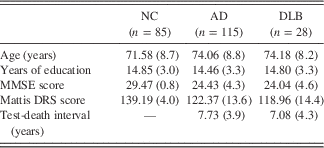
The mean age, years of education, and scores on the MMSE and Mattis Dementia Rating Scale (DRS) for the three groups at the time of the VOT evaluation are shown in Table 1. The groups did not differ significantly in age [F(2,228)=2.22; p=.11; pη2=.02] or education [F(2,228)=0.39; p=.68; pη2=.003]. The three groups differed on the MMSE [F(2,228)=58.76; p<.001; pη2=.34] and DRS [F(2,228)=66.48; p<.001; pη2=.37]. Post hoc group comparisons with Tukey’s least significant difference test (p<.05) showed that AD and DLB patients performed significantly worse than NC participants on each of these tests, but did not differ significantly from each other. The DLB and AD groups did not differ in the interval between the time of the VOT evaluation and death [t(141)=0.78; p=.44; d=.17] (see Table 1).
Mean (and SD) Age, Years of Education, Mini-Mental State Examination (MMSE) Score, and Mattis Dementia Rating Scale (DRS) Score of Normal Control (NC) Participants and Patients with Autopsy-Verified Alzheimer’s Disease (AD) or Dementia with Lewy Bodies (DLB)

Note. The mean (and SD) interval between the date of the Hooper Visual Organization Test evaluation and the date of death is shown for the AD and DLB patients.
Neuropathologic Examination and Diagnosis
Autopsy was performed within 12 hours of death using a protocol described by Terry, Peck, DeTeresa, Schechter, and Horoupian (Reference Terry, Peck, DeTeresa, Schechter and Horoupian1981). Briefly, the left hemibrain was fixed by immersion in 10% formalin for 5–7 days. Paraffin-embedded blocks from midfrontal, rostral superior temporal and inferior parietal neocortex, hippocampus, entorhinal cortex, basal ganglia/substantia innominata, mesencephalon, and pons were cut at 7-μm thickness for hematoxylin and eosin (H&E) and thioflavin-S staining, antiubiquitin immunostaining, and anti-α-synuclein immunostaining. Total plaques, neuritic plaques, and neurofibrillary tangle (NFT) counts, and the presence or absence of Lewy bodies in the locus coeruleus, substantia nigra, nucleus basalis, and neocortex were determined by the same examiner (L.A.H.) using the same criteria.
A modified Braak stage was obtained for each case using methods described by Hansen and Terry (Reference Hansen and Terry1997). Briefly, the modified Braak stage for AD pathology involves counting the number of NFT in at least five neuron clusters in layer two of the entorhinal cortex and then averaging the results. Cases with modified Braak Stage I to IV have fewer than 18 tangles, on average, in layer 2 of the entorhinal cortex and sparse neocortical tangles. Modified Braak Stage V cases have moderate numbers of tangles in at least two neocortical sections. In modified Braak Stage VI, all neocortical areas assessed have at least moderate numbers of tangles. Lewy bodies were absent in cases of “pure” AD.
Cases were only construed as DLB if Lewy bodies were found in the locus coeruleus, substantia nigra, and/or nucleus basalis of Meynert, as well as in the neocortex. Since all cases categorized as DLB had at least some Lewy bodies in multiple brainstem nuclei and the superior temporal gyrus neocortex, all Lewy body cases in the study qualified for either limbic (transitional) or diffuse neocortical categories proposed in consensus guidelines for the pathologic diagnosis of DLB (McKeith et al., Reference McKeith, Galasko, Kosaka, Perry, Dickson, Hansen and Perry1996). Furthermore, all DLB cases were neocortical Stage V or VI according to the proposed Lewy body-based staging of brain pathology related to sporadic Parkinson disease (Braak et al., Reference Braak, Del Tridici, Rub, de Vos, Jansen-Steur and Braak2003). Cases were not classified as DLB if Lewy bodies were only found in the amygdala. Of the 28 DLB cases, 15 achieved a high AD-Braak stage of V or VI, indicative of notable cortical neurofibrillary tangle formation, and 13 achieved a low AD-Braak stage (i.e., I–IV).
Procedure
Participants were tested individually in a quiet, well-lit room with the Hooper VOT (Hooper, Reference Hooper1983). The Hooper VOT is designed to measure an individual’s ability to visually organize perceptually fragmented stimuli. The test consists of line drawings of 30 relatively common objects that are fragmented into two or three pieces. The fragments for each object are arranged randomly on a stimulus card. The fragmented object drawings were presented, one at a time, to the participant who was asked to mentally reassemble the pieces and verbally identify each object. The participant was allowed 1 min to respond for each item and was encouraged to guess if no response was provided within the time limit. Correct responses were awarded one point, and responses that correctly identified, but did not name, the object were awarded a half point (e.g., the fragmented lighthouse was called a “tower”). A standard VOT score (Hooper, Reference Hooper1983) was calculated as the sum of points awarded for all 30 items.
In line with the administration and scoring procedures of Paxton et al. (Reference Paxton, Peavy, Jenkins, Rice, Heindel and Salmon2007), the standard administration of the VOT was immediately followed by a non-standard naming task in which participants were asked to name those objects that they did not correctly identify in the fragmented form when the intact (i.e., non-fragmented) object was presented as a line drawing. The participant was allowed 20 s to respond for each item and was encouraged to guess if no response was provided within the time limit. Correct responses in the intact-object naming task were awarded one point and responses that correctly identified but did not name the object were awarded a half point. A VOT naming score was calculated by summing the point values for items receiving full or partial credit in the fragmented and intact-object depictions. This VOT naming score was then used to generate a derived VOT score [(VOT score/VOT naming score) * 100)] that controls for the contribution of naming ability to VOT performance.
Several additional measures of visuospatial ability were administered as part of the annual ADRC neuropsychological evaluation during the same test session as the VOT. These included the Clock Drawing Test (spontaneous drawing and copy), the WISC-R Block Design Test (the children’s version was used to avoid floor effects in demented patients), and the Construction subscale from the DRS. Two tests of language (i.e., a 30-item Boston Naming Test and a semantic category fluency test) and two tests of episodic memory (i.e., the California Verbal Learning Test and the WMS-R Logical Memory Test) were also administered. These additional tests have been described in detail previously (Salmon & Butters, Reference Salmon and Butters1992).
The research protocol was reviewed and approved by the human subjects review board at the University of California, San Diego. Informed consent to participate in the present investigation was obtained at the point of entry into the longitudinal study from all patients or their caregivers consistent with California State law. Informed consent for autopsy was obtained at the time of death from the next of kin.
Data Analysis
Statistical analyses were completed using SPSSv20. Group differences in demographic and neuropsychological data, including VOT scores, were compared using one-way analysis of variance (ANOVA). Partial eta-squared (pη2) was used to measure effect sizes. Post hoc pair-wise group comparisons were made with Tukey’s least significant difference test (p<.05) when the one-way ANOVA was significant. The influence of concomitant AD pathology in patients with DLB on the performance of the VOT and other cognitive tests was examined by comparing DLB subgroups with high or low AD-Braak stages using Student’s t tests. Cohen’s d was used to measure effects sizes for these analyses. Receiver-operating-characteristic (ROC) analyses and logistic regression were used to evaluate how effectively the VOT score, or a combination of the VOT score and other visuospatial measures, differentiated between each patient group and NC participants or between DLB and AD patients.
RESULTS
Hooper VOT
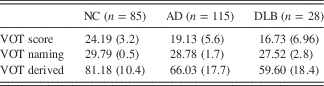
The mean VOT, VOT-naming, and derived VOT scores are shown for the three participant groups in Table 2. The groups differed on each of these measures [VOT: F(2,228)=37.01; p<.001; pη2=.25; VOT-naming: [F(2,228)=23.69; p<.001; pη2=.17; derived VOT: [F(2,228)=31.78; p<.001; pη2=.22]. Post hoc comparisons with Tukey’s tests showed that DLB patients scored significantly lower than both AD patients (p<.05) and NC participants (p<.05) on all three VOT measures. In addition, AD patients scored significantly lower than NC participants on all three measures (all ps<.05).
Mean (and SD) Scores Achieved by Normal Control (NC) Participants and Patients with Autopsy-Verified Alzheimer’s Disease (AD) or Dementia with Lewy Bodies (DLB) on the Standard Hooper Visual Organization Test (VOT) and the Naming Component of the VOT

Note. The mean (and standard deviation) derived VOT score that corrects for naming performance is also shown.
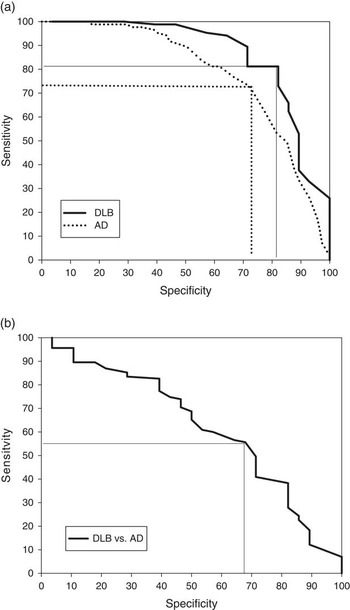
ROC curves were generated for standard VOT scores of DLB and AD patients by plotting sensitivity (i.e., percentage of patients scoring below a cutoff score) against specificity (i.e., percentage of NC participants scoring above a cutoff score) for every possible cutoff score. The resulting ROC curves for each group are plotted together in Figure 1a. The area under the curve was calculated for each group to provide concise indices of overall test discriminability that could be compared. Because it was decided a priori that sensitivity and specificity were of equal importance, the optimal cutoff score for each group was chosen to be where the sum of sensitivity and specificity reached a maximum value. The area under the curve (DLB=.86; AD=.78) and the sensitivity and specificity associated with the optimal cutoff score (DLB: optimal cutoff=21.5, sensitivity=81.2%, specificity=82.1%; AD: optimal cutoff=22.5, sensitivity=72.9%, specificity=72.2%) were better for the DLB group than for the AD group.
Receiver operating characteristic (ROC) curves for the Hooper Visual Organization Test (VOT). Sensitivity is plotted as a function of specificity for each possible cutoff score. (a) Shows ROC curves for patients with dementia with Lewy bodies (DLB) (solid line) or Alzheimer’s disease (AD) (dotted line) versus normal control participants. The sensitivity and specificity of the most effective cutoff score for each patient group is indicated. (b) ROC curves for patients with DLB versus patients with AD. The sensitivity and specificity of the most effective cutoff score are indicated.

The negative predictive value (NPV) of the VOT score was higher than the positive predictive value (PPV) for differentiating DLB from NC (PPV=57.9%; NPV=92.0%). In contrast, PPV (78.3%) was higher than NPV (65.9%) for differentiating AD from NC. This suggests that the absence of significant visuospatial dysfunction is a marker that DLB pathology is not likely to be present. Similar results were obtained when ROC analyses were applied to the derived VOT scores (results not shown).
ROC curves were also plotted to compare how effectively the standard VOT score differentiated patients with DLB from those with AD (Fig. 1b). The area under the curve (.62) and the sensitivity and specificity associated with the optimal cutoff score (optimal cutoff=19.5, sensitivity=55.6%, specificity=67.9%) were marginal. The NPV of the VOT score was higher than the PPV for differentiating DLB from AD (PPV=27.0%; NPV=87.7%), further suggesting that the absence of significant visuospatial dysfunction is a marker that DLB pathology is not likely to be present even in those with dementia. Similar results were obtained when ROC analyses were applied to the derived VOT scores (results not shown).
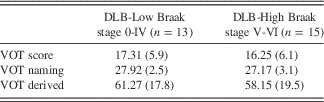
Exploratory analyses compared the VOT performance of DLB patients with high or low levels of concomitant AD pathology (i.e., DLB-High Braak versus DLB-Low Braak). The two DLB groups did not differ significantly in age (DLB-High Braak: mean=73.80; SD=9.8; DLB-Low Braak: mean=74.62; SD=6.2; t(26)=0.26; p=.80; d=.10), education (DLB-High Braak: mean=14.47; SD=2.9; DLB-Low Braak: mean=15.15; SD=3.8; t(26)=0.54; p=.59; d=.20), or MMSE scores (DLB-High Braak: mean=22.73; SD=4.5; DLB-Low Braak: mean=25.54; SD=4.3; t(26)=1.67; p=.11; d=.61). However, the DLB-High Braak group (mean=113.20; SD=13.8) scored significantly lower than the DLB-Low Braak group (mean=125.62; SD=12.5) on the Mattis DRS (t(26)=2.48; p=.02; d=.86). There were no significant differences in the VOT [t(26)=0.46; p=.65; d=.32], VOT-naming [t(26)=0.70; p=.49; d=.27], and derived VOT [t(26)=0.44; p=.66; d=.17] scores of DLB patients with high or low AD-Braak stages (see Table 3). This remained the case when DRS scores were used as a covariate to adjust for group differences in level of global cognitive impairment [all Fs<1; all pη2<.04].
Mean (and SD) Standard Hooper Visual Organization Test (VOT) Score, VOT Naming Score, and Derived VOT Score Corrected for Naming Performance Are Shown for Subgroups of Patients with Dementia with Lewy Bodies (DLB) with High or Low Braak Stage for Alzheimer’s Disease Pathology

Additional Cognitive Tests
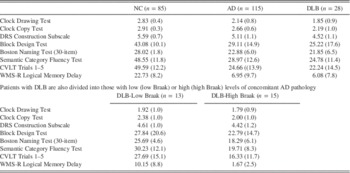
DLB and AD patients performed significantly worse than NC participants on the Clock Drawing [F(2,224)=28.99; p<.001; pη2=.21], Clock Copy [F(2,222)=15.09; p<.001; pη2=.12], Block Design [F(2,224)=31.02; p<.001; pη2=.22], and DRS Construction [F(2,224)=13.96; p<.001; pη2=.11] tests (see Table 4, upper panel). Post hoc comparisons showed that DLB patients performed significantly worse than AD patients on the Clock Copy (p<.05) and DRS Construction (p<.05) tests. DLB and AD patients also performed significantly worse than NC participants on the Boston Naming Test [F(2,224)=30.22; p<.001; pη2=.22], semantic category fluency test [F(2,222)=75.52; p<.001; pη2=.40], CVLT trials 1–5 [F(2,216)=92.11; p<.001; pη2=.46], and WMS-R Logical Memory delay [F(2,217)=81.11; p<.001; pη2=.43], but DLB and AD did not differ significantly on any of these measures.
Mean (and SD) Nuropsychological Test Scores of Normal Control (NC) Participants and Patients with Alzheimer’s Disease (AD) or Dementia with Lewy Bodies (DLB)

Comparison of DLB subgroups showed that the DLB-High Braak and DLB-Low Braak groups did not differ significantly on the Clock Drawing [t(25)=0.39; p=.70; d=.14], Clock Copy [t(25)=0.96; p=.35; d=.37], Block Design [t(25)=0.74; p=.47; d=.29], or DRS Construction [t(25)=0.45; p=.65; d=.18] tests (see Table 4, lower panel). This was despite the fact that DLB-High Braak patients scored significantly worse than DLB-Low Braak patients on several measures of language (Boston Naming Test [t(25)=3.56; p=.002; d=1.14]; semantic category verbal fluency [t(25)=2.65; p=.014; d=.92]) and memory (California Verbal Learning Test Trials 1–5 [t(23)=2.09; p=.05; d=.78]; Logical Memory Test Delayed Recall [t(23)=3.23; p=.004; d=1.09]).
Logistic regression analyses were performed to determine if consideration of additional tests of visuospatial ability would improve the ability of the VOT score to differentiate between patients with DLB and patients with AD. An overall model using a 20% base rate for DLB that included the VOT score, the Clock Copy score, and the DRS construction subscale score was significant [χ2(3)=9.57; p=.02] and correctly classified 78.1% of AD patients and 51.9% of DLB patients for an overall classification accuracy of 73.1% (similar results were obtained using the derived VOT score in the model). ROC analyses examined how effectively the Clock Copy and the DRS construction subscale scores individually differentiated patients with DLB from those with AD. The area under the curve for the DRS construction subscale score was .67, and 81.5% sensitivity and 45.2% specificity were associated with the optimal cutoff score of ≤ 5 (of 6). The PPV was 25.9% and the NPV was 91.2%. The area under the curve for the Clock Copy score was .62, and 29.6% sensitivity and 91.2% specificity were associated with the optimal cutoff score of ≤ 1 (of 3). The PPV was 35.3% and the NPV was 86.1%.
DISCUSSION
The results of the present study indicate that visual perceptual organization ability is more impaired in DLB than in AD. While both patient groups scored significantly worse than normal elderly individuals on the VOT, patients with DLB scored significantly worse than equally demented patients with AD. This was despite similar demographic features, severity of global dementia, and severity of deficits in episodic memory and language in the two patient groups. In addition, VOT performance was more effective at differentiating individual DLB patients from NC than it was at differentiating individual AD patients from NC; however, discriminability was only moderately effective in both cases. This pattern of results was evident when the test was administered and scored in its standard form or when performance was adjusted for a deficit in the ability to name visually intact objects.
The particularly severe visual perceptual organization deficit exhibited by patients with DLB is consistent with previous studies that show these patients are more impaired than patients with pure AD on a wide variety of visuospatial tasks (Aarsland et al., Reference Aarsland, Litvan, Salmon, Galasko, Wentzel-Larsen and Larsen2003; Ala et al., Reference Ala, Hughes, Kyrouac, Ghobrial and Elble2001; Gnanalingham et al., Reference Gnanalingham, Byrne and Thornton1996; Hamilton et al., Reference Hamilton, Salmon, Galasko, Delis, Hansen, Masliah and Thal2004; Hansen et al., Reference Hansen, Salmon, Galasko, Masliah, Katzman, DeTeresa and Alford1990; Salmon et al., Reference Salmon, Galasko, Hansen, Masliah, Butters, Thal and Katzman1996; Walker, Allen, Shergill, & Katona, Reference Walker, Allen, Shergill and Katona1997). The present results show that disproportionately severe visuospatial deficits in DLB are not limited to tasks that require construction or motor manipulation of stimuli, but can also be observed on tests that are primarily perceptual in nature (also see, Metzler-Baddeley et al., Reference Metzler-Baddeley, Baddeley, Lovell, Laffan and Jones2010; Wood, Firbank, et al., Reference Wood, Firbank, Mosimann, Watson, Barber, Blamire and O’Brien2013, Wood, Watson, et al., Reference Wood, Watson, Firbank, Mosimann, Barber, Blamire and O’Brien2013).
In the present study, patients with DLB performed significantly worse than those with AD on the VOT as well as on the Construction subscale of the Mattis DRS and the Clock Drawing Test. These three visuospatial tests also had similar sensitivity and specificity for distinguishing DLB from AD. It should be noted, however, that DLB and AD patients did not differ significantly on the Clock Drawing or Block Design tests. The differential sensitivity of various visuospatial tasks is consistent with previous results (e.g., Calderon et al., Reference Calderon, Perry, Erzinclioglu, Berrios, Dening and Hodges2001) and suggests that those tests that strongly engage semantic (e.g., the Clock Drawing Test) and executive control (e.g., the Block Design Test) processes that are affected to similar levels in DLB and AD are not effective in distinguishing between the two disorders.
Although as a group DLB patients performed worse than AD patients on the VOT, the test was not very effective at distinguishing between individual patients with DLB versus AD. An ROC analysis that compared the two groups showed that the most effective VOT cutoff score only correctly classified approximately 56% of DLB patients and 68% of AD patients. This was improved to approximately 78% accuracy in classifying AD patients when performance on the VOT was considered in conjunction with performance on additional visuospatial tasks (e.g., Clock Copy, DRS Construction subscale); however, classification of DLB patients remained low at approximately 52%. The particularly low accuracy in being able to detect DLB against the backdrop of AD using the VOT and other visuospatial tasks may be because visuospatial deficits are often present in patients with AD (Salmon et al., Reference Salmon, Thomas, Pay, Booth, Hofstetter, Thal and Katzman2002), and it is the absence of significant visuospatial impairment in a patient with dementia that suggests the absence of DLB pathology (Tiraboschi et al, Reference Tiraboschi, Salmon, Hansen, Hofstetter, Thal and Corey-Bloom2006). Consistent with this possibility, the NPV of the VOT score was high for differentiating DLB from NC (92.0%) or DLB from AD (NPV=87.7%).
The present study was aimed at better differentiating between DLB and typical AD presentations since these conditions are difficult to clinically distinguish during life, even with the use of the consensus criteria. This is especially true when DLB has concomitant AD or a dominant dementia presentation (Merdes et al., Reference Merdes, Hansen, Jeste, Galasko, Hofstetter, Ho and Corey-Bloom2003). It is unlikely that visuospatial tasks, including the VOT, would be useful for differentiating between patients with DLB and those with posterior cortical atrophy (PCA) associated with AD pathology given that both groups have significant impairment in this domain (Metzler-Baddeley et al., Reference Metzler-Baddeley, Baddeley, Lovell, Laffan and Jones2010; although more basic visual functions, e.g., discrimination of line orientation, might be more affected in PCA than DLB). Patients with the PCA variant of AD were not explicitly excluded from the present study, but none of the autopsy-confirmed AD patients had an initial PCA clinical presentation. Thus, the present results show that the VOT may have some value in helping to distinguish DLB from typical AD, but they do not suggest that the VOT would be useful in distinguishing between DLB and PCA. However, PCA is a rare condition and, unlike DLB (or typical AD), it presents with a circumscribed visuospatial deficit with relatively intact memory, executive functions, and language and can be differentiated from DLB and typical AD on that basis (Crutch et al., Reference Crutch, Lehmann, Schott, Rabinovici, Rossor and Fox2012).
DLB subgroups divided according to their Braak Stage did not differ in VOT performance. This finding suggests that the disproportionate severity of this deficit is not related to degree of concomitant AD pathology but might primarily reflect Lewy body pathology. This was not the case for other cognitive abilities, particularly those that are most prominently affected by AD. DLB patients with high AD-Braak stages performed significantly worse than those with low AD-Braak stages on tests of memory and language. This suggests that the effects of DLB pathology and concomitant AD pathology on memory and language are additive in patients with DLB. This may explain why the memory scores are slightly lower in the DLB group than in the AD group (although this difference may be specific to the free recall memory measures we examined; see Hamilton et al., Reference Hamilton, Salmon, Galasko, Delis, Hansen, Masliah and Thal2004).
When the DLB group is split into those with High or Low AD-Braak scores (which is based on AD pathology), the additive effect of AD pathology to DLB pathology is greater in the High AD-Braak group, explaining their worse memory performance compared to DLB with Low AD-Braak scores. Indeed, the High AD-Braak DLB group had worse (although not significant) memory and language performance than patients with only AD pathology, further suggesting that the effects of DLB and AD pathology are additive. In contrast, the High and Low AD-Braak DLB patients did not differ significantly on tests of visuospatial function, most likely because this cognitive function is strongly influenced by DLB pathology rather than AD pathology. Further studies are needed with larger groups of autopsy-confirmed DLB patients to determine if the visuospatial deficits in these patients are only related to the severity of DLB pathology, or if they are a function of combined DLB and AD pathology.
The poor sensitivity of the VOT for differentiating DLB from AD may reflect worse than expected VOT performance by patients with AD due to demands the task places on the ability to integrate two forms of visual information primarily processed in different visual cortical streams. Effective performance of the VOT requires the integration of spatial information (i.e., mental manipulation of the pieces of the visual stimulus) processed in the dorsal visual stream with object form information (i.e., identification of the object) processed in the ventral visual stream. Previous studies have shown that patients with AD are impaired at integrating motion and color information across the two visual streams even when those types of information are processed effectively within each stream (Festa et al., Reference Festa, Insler, Salmon, Paxton, Hamilton and Heindel2005). Loss of connectivity between the visual streams could have a similar effect on the VOT and make the test particularly difficult for patients with AD thereby reducing its ability to distinguish between AD and DLB patients.
The use of the naming adjustment in scoring the VOT was warranted given that patients with DLB were significantly worse than AD in naming items, even when the items were presented in an intact form. It should be noted, however, that the DLB and AD patients did not differ on an independent measure of confrontation naming (i.e., the Boston Naming Test) and were only mildly impaired in naming ability relative to NC participants. Furthermore, evidence for an important role of confrontation naming in VOT performance is mixed. Several studies have shown that the VOT performance of normal individuals (Paolo, Cluff, & Ryan, Reference Paolo, Cluff and Ryan1996; Paul et al., Reference Paul, Cohen, Moser, Ott, Zawacki and Gordon2001; Ricker & Axelrod, Reference Ricker and Axelrod1995) or patients with a variety of neurological disorders (Merten, Reference Merten2005) is more strongly related to performance on visuospatial or visual-perceptual tasks than on tests of confrontation naming.
This was also found to be true in the present study when relationships between VOT and Boston Naming Test (BNT) or Block Design Test scores were examined in the NC (VOT vs. Block Design: r=.49; VOT vs. BNT: r=.42), AD (VOT vs. Block Design: r=.65; VOT vs. BNT: r=.55), and DLB (VOT vs. Block Design: r=.73; VOT vs. BNT: r=.63) groups (all ps<.001). Because the VOT comprises common, easily-named objects, the impact of naming might only be observed in individuals with significant anomia. This possibility is supported by a study of stroke patients with moderate to severe anomia that showed they were impaired on the standard version of the VOT, but significantly improved their performance on a multiple choice version that did not require naming (Schultheis, Caplan, Ricker, & Woessner, Reference Schulteis, Caplan, Ricker and Woessner2000).
The prominent deficit in visuoperceptual organization abilities exhibited by patients with DLB is consistent with the neuropathological changes that occur in visual association cortices of the occipital and parietal lobes. Although some Lewy body pathology occurs in the occipital and parietal cortex of patients with DLB (Gómez-Tortosa et al., Reference Gómez-Tortosa, Newell, Irizarry, Albert, Growdon and Hyman1999; Harding, Broe, & Halliday, Reference Harding, Broe and Halliday2002; Higuchi et al., Reference Higuchi, Tashiro, Arai, Okamura, Hara, Higuchi and Sasaki2000; Kosaka, Yoshimura, Ikeda, & Budka, Reference Kosaka, Yoshimura, Ikeda and Budka1984; Pellise, Roig, Barraquer-Bordas, & Ferrer, Reference Pellise, Roig, Barraquer-Bordas and Ferrer1996; Rezaie, Cairns, Chadnick, & Lantos, Reference Rezaie, Cairns, Chadwick and Lantos1996; Yamamoto et al., Reference Yamamoto, Iseki, Murayama, Minegishi, Marui, Togo and Arai2006), white matter spongiform change with coexisting gliosis appears to be the most prominent feature of their occipital lobe pathology (Higuchi et al., Reference Higuchi, Tashiro, Arai, Okamura, Hara, Higuchi and Sasaki2000).
Hypometabolism and decreased blood flow in primary visual and visual association cortex of patients with DLB is evident with positron emission tomography or single photon emission computed tomography scanning (Albin et al., Reference Albin, Minoshima, D’Amato, Frey, Kuhl and Sima1996; Higuchi et al., Reference Higuchi, Tashiro, Arai, Okamura, Hara, Higuchi and Sasaki2000; Imamura et al., Reference Imamura, Ishii, Hirono, Hashimoto, Tanimukai, Kazuai and Mori1999, Reference Imamura, Ishii, Hirono, Hashimoto, Tanimukai, Kazui and Mori2001; Ishii et al., Reference Ishii, Imamura, Sasaki, Yamaji, Sakamoto, Kitagaki and Mori1998; Lobotesis et al., Reference Lobotesis, Fenwick, Phipps, Ryman, Swann, Ballard and O’Brien2001; Minoshima et al., Reference Minoshima, Foster, Sima, Frey, Albin and Kuhl2001), as is decreased activation in visual area V5/MT in response to presentation of visual objects during functional magnetic resonance imaging (Taylor et al., Reference Taylor, Firbank, He, Barnett, Pearce, Livingstone and O’Brien2012). These abnormalities occur relatively early in the course of DLB and are not evident in patients with AD. Because the occipital cortex is generally spared in AD, it is not surprising that visuoperceptual and visuospatial functions that may be dependent upon these cortices are disproportionately impaired in patients with DLB.
A limitation of the present study is the relatively long interval between the VOT evaluation and the time of death. It is possible that AD or DLB pathology initially developed or greatly worsened between testing and death. It should be noted, however, that both types of pathology are thought to occur decades before the onset of dementia (Bateman et al., Reference Bateman, Xiong, Benzinger, Fagan, Goate and Fox2012; Frigerio et al., Reference Frigerio, Fujishioro, Ahn, Josephs, Maraganore, DelleDonne and Ahlskog2011; Villemagne et al., Reference Villemagne, Burnham, Bourgeat, Brown, Ellis and Salvado2013), and in the present study, pathology was only used to verify the diagnosis and not as a correlate of severity of cognitive dysfunction. It is also the case that the DLB and AD patient groups in the present study did not differ significantly in average test–death interval. Finally, the results that were obtained in the present study did not change when all analyses were repeated with only those patients with a test–death interval of 9 years or less.
In summary, the present results demonstrate that visual perceptual organization ability, independent of constructional apraxia, is more impaired in patients with autopsy-confirmed DLB than in patients with autopsy-confirmed pure AD. The severity of this deficit in DLB patients is not related to stage of concomitant AD pathology, suggesting that posterior cortical Lewy body pathology contributes to their deficit. However, the ability of the VOT to effectively identify individual patients with DLB or AD might be mitigated by its demands on the integration of spatial and form information across distinct visual cortical circuits, a process that is sensitive to AD pathology (Festa et al., Reference Festa, Insler, Salmon, Paxton, Hamilton and Heindel2005).
Acknowledgments
This work was supported by NIH grants AG12963 and AG05131 to the University of California, San Diego, and the Shiley-Marcos Alzheimer’s Disease Research Center. The authors report no conflicts of interest related to the reported research.