Does the election of extremist political parties increase the incidence of violence and intolerance in the constituencies they represent? Despite substantial popular support for radical parties around the world, this question has largely evaded systematic investigation. There are at least two reasons to expect that electing extremist political parties will have adverse consequences for vulnerable population groups. Incumbency may empower extremists, enabling them to advance exclusionary policies via formal institutional channels while withholding state sanction from actors who harm minorities. Additionally, elevating extremists to official positions could have an emboldening effect, lending a stamp of legitimacy to intolerant worldviews and thereby encouraging their expression.
We test these claims using the case of Indonesia, which has a history of tensions between its main religious groups and a party system that pits secular nationalist parties against Islamist ones. Specifically, we use a natural experiment to estimate the effect of Islamist (as opposed to secular nationalist) incumbency on religious violence and attitudes toward religious minorities. Since the restoration of democracy in the late 1990s, Indonesia has undergone extensive decentralization. We focus on sitting members of the Dewan Perwakilan Rakyat Daerah-II (DPRD-II), the most local tier of legislative government, between 2004 and 2014. For identification, we restrict our attention to instances in which Islamists narrowly won or lost the last remaining seat to be allocated in each electoral constituency, under Indonesia's largest-remainder proportional representation (PR) system. Our contention is that victory for a given party in these races is independent of a constituency's potential outcomes, which, if true, allows us to attach a causal interpretation to the findings. Key features of the research design, measurement and analysis strategy were pre-registered.Footnote 1
The results of our analysis are mixed yet point in a consistent direction. We observe a rise in religious violence following the election of additional Islamist party legislators, although conflict events are rare in the datasets we examine and the results are sensitive to the choice of violence measure employed. Analyzing nationwide surveys of popular attitudes, we show that Islamist rule increases expressions of extreme religious intolerance among majority-group citizens. We also see that attitudinal effects are more pronounced for respondents interviewed in the presence of a bystander, corroborating the existence of a social emboldenment mechanism. Taken as a whole, there is thus some evidence that Islamist DPRD-II legislators worsen religious hostility in the areas they represent.
Background
Indonesia is an 18,000-island archipelago in Southeast Asia. It is the world's fourth most populous nation. Free and fair elections have been held on a regular basis since 1999. It is a Muslim-majority country: 87 per cent of the population identifies as Muslim, while the remainder largely identify as Christian or Hindu. Attacks on religious minorities – notably Christians and heterodox abangan Muslims – occur regularly. State authorities have sometimes been accused of complicity in such violence.Footnote 2
Indonesia enacted far-reaching political decentralization in the early 2000s. The centerpiece of this policy was the devolution of power to district executives – headed by a regent (the bupati or wali kota) – and district parliaments.Footnote 3 These parliaments, known as the DPRD-II, oversee the district's administration, govern the disbursement of central and provincial funds and craft local laws, including sharia laws (see Bush Reference Bush, Fealy and White2008, 12). Members of the DPRD-II are elected to multi-member constituencies comprising 3–15 seats. Legislators serve five-year terms. Ethnographic accounts suggest that legislators tend to be influential community leaders, with significant business, organizational and religious ties. They are frequently called on to arbitrate disputes and negotiate informal settlements (Haris Reference Haris2005).
Most legislators run for office under a party label. We focus on the impact of electing legislators from Islamist – as opposed to secular nationalist – parties in the 2004 and 2009 election cycles. Following Pepinsky, Liddle and Mujani (Reference Pepinsky, Liddle and Mujani2012), we categorize ‘Islamist’ parties as those that explicitly take Islam as their founding ideology (asas).Footnote 4 Secular nationalist parties, meanwhile, are those rooted in pancasila, the country's dominant and pluralistic political doctrine (see Appendix Table C1).Footnote 5
Indonesia transitioned from a semi-open-list PR system in the 2004 election to a fully open-list PR system in 2009, a change that may have blunted the impact of party affiliation in the latter cycle (see Appendix Section E.7). In the 2009 election, candidates faced stronger incentives to stake out independent political identities vis-à-vis their parties so as to elevate their personal profile and thus increase their ranking on their party's list (Fox Reference Fox2018). Our tests probe for this possible source of heterogeneity.
Research design
The unit of analysis is the DPRD-II constituency/election cycle (see Appendix Section B). We estimate the average effect of seating an additional legislator from an Islamist party on religious group relations. To do this we employ a type of regression discontinuity design. The strategy exploits one aspect of the largest remainder method – coupled with the Hare quota – used to translate votes for DPRD-II legislators into seats. Voters cast ballots for a party or a party-affiliated candidate.Footnote 6 Each party's vote total is divided by a quota number, which is the total number of votes cast in the constituency divided by the total number of seats to be assigned. In the first stage of seat apportionment, the whole number quotient from this division (rounding down) is the number of seats allocated to that party. There are always seats left to be allocated after this first stage. In the second stage, parties are ordered by their number of remainder votes from highest to lowest; these are the votes left over from the division performed in the first stage.Footnote 7 Seats are then assigned, one per party, in the order of the ranking until there are no more seats left to distribute.
Our research design exploits the final part of this procedure by examining narrowly contested races to secure the very last seat allocated in the constituency. In particular, we compare outcomes in (a) constituency/election cycles in which an Islamist party narrowly beats a secular nationalist party for the final seat (the treatment group) with (b) constituency/election cycles in which an Islamist party narrowly loses the final seat to a secular nationalist party (the control group). We pre-specified ‘narrowly’ to mean within 1 per cent of the total votes cast in the constituency.
Our identification assumption is that which party wins these close races is as good as random. Balance tests support this claim: treatment and control constituency/election cycles are not measurably different across a range of lagged covariates and lagged dependent variables (see Appendix Section D). Importantly, this quasi-experimental manipulation is potent. In the estimation sample, Islamists hold 15 per cent of constituency seats in the control condition and 29 per cent of seats in the treatment condition – a 14-percentage-point difference, equating to a 93 per cent relative increase (p < 0.0001). Appendix Figure C1 depicts this variation, plotting the distributions of Islamist-held seats across treatment and control units.
We look at two sets of outcomes. First, we assess the impact of electing an additional Islamist legislator on the incidence and lethality of religious violence over the course of their term in office, as recorded in two independent data sources: the National Violence Monitoring System (NVMS) – an events database derived from hand-coded newspaper reports (Barron, Jaffrey and Varshney Reference Barron, Jaffrey and Varshney2016) – and the Village Potential Statistics Survey, also known as PODES, which is a national census of village leaders. We examine the incidence of religious violence – a count of violent events, including those in which nobody died, and an indicator for whether any such event occurred – and the lethality of religious violence, gauged by a count of deaths, plus an indicator for whether any deaths occurred.Footnote 8 It is important to emphasize the possible shortcomings of each source of violence data. Violence reports in newspapers may be marred by reporting bias. Editors may devote column inches mostly to large incidents. Also, places that elect more Islamists may attract more journalistic scrutiny. Meanwhile, reports of violence by village heads could understate conflict inasmuch as leaders seek to portray their jurisdictions as peaceful. Given the lack of consensus about which measure is better – prominent quantitative research on Indonesia uses PODES and NVMS in roughly equal proportion – we opt for transparency and analyze both metrics. We later address the implications for interpretation.
For our second set of outcomes, we investigate effects on religious intolerance, drawing on a full battery of questions from two waves of the Indonesian Family Life Survey.Footnote 9 These questions ask how respondents would ‘feel’ about several hypothetical scenarios concerning religious out-groups: the extent to which they would object to having religious out-groups move into their village/neighborhood, rent a room on their property, marry a close relative or construct a place of worship locally. There are good reasons to believe these measures are context appropriate. The PODES village census reveals that 77 per cent of the electoral constituencies in our sample contained places of worship associated with multiple religions (that is, mosques plus temples and/or churches). The measures were devised and piloted by a reputed Indonesian polling firm. Further, the raw data evince substantial variation, suggesting they capture matters of heated social contestation.Footnote 10 Additional details of the data sources and variable codings are provided in Appendix Section C.
With respect to estimation, we perform a difference-in-means type analysis, regressing outcome variables on an indicator for whether an Islamist party won or lost the last allocated seat, restricting the sample to constituency/election cycles in which that last seat was won or lost by 1 per cent of all votes. Event counts are analyzed using negative binomial regression. All other outcomes are analyzed using ordinary least squares (OLS). Standard errors are conservatively clustered by constituency-cluster owing to the repeated cross-sectional structure of the data (see Appendix Section B).
Results
To begin, how does electing an additional Islamist (rather than secular nationalist) legislator affect the incidence and severity of local religious violence? Columns 1–4 of Table 1 summarize the estimated effects of Islamist incumbency on religious conflict, as recorded in the PODES dataset. We find that the election of Islamist politicians increased both the likelihood of religious violence occurring and the number of violent events. Constituencies where an Islamist party won the last allocated seat experienced a 2.2-percentage-point increase in the probability of any religious violence (Column 3). Yet there are no signs in the PODES data that the election of an additional Islamist legislator made local religious violence more deadly (Columns 2 and 4).
Estimated effects of Islamist victory on religious violence

Note: count models use negative binomial regression; binary outcomes use OLS. Standard errors are clustered by constituency-clusters. The NVMS and PODES samples have 363 and 569 clusters, respectively. Observations are constituencies in which the last seat was contested by Islamist and secular nationalist parties with a margin less than 1 per cent. *p < 0.1; **p < 0.05; ***p < 0.01
We now turn to parallel estimations using the NVMS newspaper data. Here, we find that the election of an additional Islamist legislator did not discernibly impact the number of events of religious violence (Column 5), or the probability of any religious violence breaking out (Column 7). Yet Columns 6 and 8 of Table 1 suggest the election of an additional Islamist legislator did increase the number of deaths caused by religious violence: we observe a 1.6-percentage-point rise in the probability of a constituency experiencing any deaths following the election of an extra Islamist (Column 8). We obtain an equivalent result – significant at the 1 per cent level – for the count estimates (Column 6).Footnote 11 A caveat is in order. The number of incidents of religious violence is low in the NVMS database. Only 14 per cent of constituencies experienced any such conflict during our study period, and fatalities occurred in only 1 per cent of constituencies. In a robustness check, we repeated the fatalities analysis in Column 8 using randomization inference. The estimated effects for fatalities continue to be positive and marginally statistically significant (p = 0.056).
The NVMS findings are somewhat at odds with those from the PODES sample. There are several potential explanations for the discrepancies. The reversed findings on event incidence between the NVMS and PODES could result from differences in geographic coverage. PODES measures were taken in all of Indonesia's thirty-three provinces, whereas NVMS documents violence in only eighteen provinces. However, when we reanalyze the PODES data limiting the sample only to the provinces covered by the NVMS, we find that Islamist incumbency has even larger impacts on the incidence of religious violence, and still no evidence of a change in fatalities (see Appendix Table E5). Therefore, we reject this possibility.
Next, the differences might emanate from reporting biases. The null result on lethality for the PODES data could be because village heads report minor incidents of communal violence but not fatal incidents that might signal egregious dereliction on their part. Lethal religious violence is indeed exceedingly rare in this dataset, providing little variation with which to estimate an Islamist incumbency effect. Inversely, the null result on events (both lethal and non-lethal) in the NVMS data could stem from journalistic inattention to low-intensity religious conflict, yielding an undercount. To be sure, these explanations are speculative. And despite some sensitivity to the choice of dependent variable, the evidence appears to favor the conclusion that local Islamist incumbency modestly increases violence.
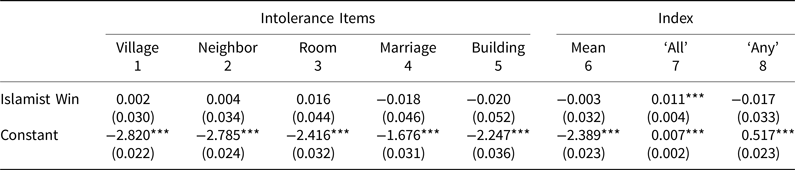
For the second set of outcomes, we explore the effect of electing an additional Islamist legislator on constituents' intolerance of religious minorities. The results are presented in Table 2. Islamist incumbency does not appreciably increase intolerance according to any of the individual survey measures (Columns 1–5) or judged by the ‘mean’ or ‘any’ indices (Columns 6 and 8, respectively). The most precisely estimated coefficient in Table 2 is that for the proportion of respondents answering they would strongly object to all five hypothetical situations – an index of extreme intolerance (Column 7). The estimated effect size in Column 7 is 1.1 percentage points, which is 1.6 times larger than the control group average for this index.
Effects of Islamist victory on self-reported intolerance

Note: standard errors clustered by 283 constituency clusters. Observations are constituencies in which the last seat was contested by Islamist and secular parties with a margin of less than 1 per cent. Intolerance measures indicate strong objection (4) to no objection (1) to the following questions: ‘How do you feel if … (A) someone with a different faith from you lives in your village? (B) someone with a different faith from you lives in your neighborhood? (C) someone with a different faith from you rents a room from you? (D) someone with a different faith from you marries one of your close relatives or children? (E) people who have a different faith from you build a house of worship in your community?’ *p < 0.1; **p < 0.05; ***p < 0.01
Source: Indonesian Family Life Survey
Discussion
Mechanisms
On balance, the results suggest that Islamist incumbency worsens local religious tensions in Indonesia, even if the estimated effect sizes are small and in some cases null or ambiguous. What explains the non-null results we do observe? We consider two possibilities. First, it is conceivable that Islamist parties provide extremist groups with material support on coming to power. In what we dub an empowerment mechanism, Islamist legislators may channel public funds or office-derived rents to groups sowing disorder, or they may use their authority to limit funding for local security forces tasked with curbing violence. Employing an instrumental variables approach that leverages the close elections described above, we fail to find evidence that Islamist party incumbency affects security budgets at the district level (Appendix Table E1). Intriguingly, though, we do see statistically significant evidence that Islamist incumbency increases citizens' investments in village-level security measures – perhaps because communities witness or anticipate more violence occurring when Islamists wield greater authority (Appendix Table E2).
A second possibility relates to social norms. When Islamists gain office, religious intolerance may become normalized as constituents update their beliefs about what kinds of attitudes are socially permissible. If Islamist incumbency exacerbates religious tensions through a process of social emboldening, then we might expect there to be heightened social desirability for expressing intolerant views about religious minorities in places with more Islamist legislators.
To evaluate this possibility, we repeat the analysis of religious intolerance in Table 2, yet now investigating subgroup heterogeneity in the estimated treatment effects according to whether or not another community member (that is, someone besides the respondent and the enumerator) happened to be present at the time of the face-to-face interview (cf Persen Reference Persen2018). This test, presented in Figure 1, offers some backing for the emboldenment mechanism. Across the five individual intolerance measures (Figure 1, Panels A–E) and the three index measures (Panels F–H), point estimates for the effect of Islamist incumbency are always larger when survey responses were elicited with a bystander present. In formal interaction tests, this difference is marginally statistically significant for three out of eight measures. It bears emphasizing that bystander presence was not randomly assigned. Still, this analysis offers prima facie evidence that Islamist incumbency may work to increase violence by altering beliefs about the social acceptability of expressing and acting on illiberal worldviews.
Impact of Islamist incumbency on expressions of intolerance, by bystander presence
Note: Beta coefficients from OLS regression for the eight intolerance outcomes. 95 per cent confidence intervals are plotted. Standard errors clustered by 219 constituency clusters. Observations are individuals in constituencies in which the last seat was contested by Islamist and secular parties with a margin of less than 1 per cent. The intolerance measures are the same as those described in the notes to Table 2. Each panel reports p-values for the interaction between ‘Islamist Win’ and a binary variable for bystander presence derived from OLS interaction models (not shown).

Extensions
We now investigate several further moderators of the main effects we observe. Returning to our violence outcomes, Appendix Figure E3 examines heterogeneity according to the total proportion of constituency seats occupied by Islamists. We see some signs that Islamist incumbency worsens violence more at higher concentrations of Islamist representation. One plausible inference is that extremist legislators bent on provoking conflict may benefit from a critical mass of like-minded politicians being in office locally.
Political dynamics at the district level also merit attention. Above the DPRD-II legislators sits the district executive or regent.Footnote 12 Regents have significantly more power than individual legislators. A regent who is ideologically disposed toward Islamist parties may grant more leeway to legislators wanting to foster religious friction.Footnote 13 In Appendix Figure E2, we explore whether the estimated effects of an additional Islamist party legislator on violence are magnified in districts where the sitting regent received an endorsement from an Islamist party during his/her election campaign. We find evidence for the expected interaction only in the analysis of the PODES data, and then only when a binary measure of ‘any violence’ acts as the dependent variable. There is no equivalent variation across the alternative violence measures.
We also consider variation in estimates by election cycle. As noted, while the method of assigning seats to parties was constant across the 2004 and 2009 elections, the method of distributing those seats to individual candidates changed, from semi-open to fully open-list PR (see Appendix Section E.7). By placing control over lists in the hands of voters, this shift may have weakened party cohesion – ideologically and organizationally – perhaps attenuating Islamist effects. Appendix Section E.7 offers several tests showing that the estimated treatment effects are qualitatively quite similar across the two election cycles. Our benchmark analysis is also unaffected by the inclusion of election-cycle fixed effects.
A final question is whether the effect of electing Islamists spills over into neighboring constituencies. We construct a measure of within-district violence that occurs outside the constituencies in our main estimation sample – that is, in constituencies where a close Islamist/secular election did not occur. In Appendix Table E4 we regress this measure on the share of close elections won by Islamists in the district, controlling for the district-wise share of close Islamist/secular elections. If spillovers were present, we should see a positive effect of Islamist victory on violence in nearby ‘unmanipulated’ areas. The results reveal almost no such signs.
Conclusion
This article makes three contributions. First, we provide evidence that electing extremist parties has negative, if modest, consequences for religious violence and attitudes toward religious minorities. Some have argued that including ‘flank’ parties in government can induce moderation, bringing radicals into the mainstream and tempering their policies and behaviors (for example, Lijphart Reference Lijphart1977). At least in the short run, we find that having extremists participate in local government does not seem to produce these salutary outcomes – although it remains possible that moderation would emerge over time.
Secondly, the results comport with findings from South Asia, where incumbency by secular nationalist parties has been shown to reduce religious violence (Nellis, Weaver and Rosenzweig Reference Nellis, Weaver and Rosenzweig2016). An advance made by this article is to evaluate whether a comparable effect holds for religious intolerance, a more widespread phenomenon than conflict.
Thirdly, Indonesia has long been known for its syncretic form of Islam (Geertz Reference Geertz1976). Yet more hardline practices and beliefs have surfaced in recent years. According to our analysis, the inroads made by Islamist parties since democratization may serve to inflame religious tensions, perhaps endangering Indonesia's social compact.
Supplementary material
The data, replication instructions, and the data's codebook are available in Harvard Dataverse at: https://doi.org/10.7910/DVN/BKI1X3, and online appendices at: https://doi.org/10.1017/S0007123419000462.
Acknowledgments
For comments on previous drafts, the authors would like to thank seminar and conference participants at APSA, MPSA, SEAREG and CPD. For generously sharing data, we would also like to thank Samuel Bazzi, Priya Mukherjee and Seth Soderborg.