Introduction
The severe acute respiratory syndrome coronavirus disease-2 (SARS-CoV-2) pandemic of 2020-2021 created numerous unanticipated challenges for clinicians in critical care transport (CCT). These CCT services had to rapidly adjust their clinical approaches and transport utilization stratagem to evolving patient demographics with a preponderance of adult respiratory failure. Organizations had to develop and implement new protocols and guidelines in rapid succession, often without the education and training that would have been involved pre-coronavirus disease 2019 (COVID-19). These changes were complicated by the need to protect crew members as well as to optimize patient care of severely critically ill patients.
This report offers one services’ best practices based upon their experience and the best available data. Clinical initiatives included changes to existing protocols for intubation, mechanical ventilation, and management of patients in cardiac arrest, as well as writing protocols to transport both awake and intubated proned patients. The service developed a protocol for helmet ventilation to minimize aerosolization risks for patients on noninvasive positive pressure ventilation (NIPPV). While these clinical protocols were developed specifically for COVID-19, the growth in practice will enhance the peri-transport care of patients with other causes of respiratory failure. Additionally, they logically will apply to future respiratory outbreaks and provide a model for the rapid adaptation of clinical processes to meet patient need.
Report
Adapting to COVID-19 not only required operational changes, but substantial clinical changes as well. To continually reassess practices, Boston MedFlight (BMF; Bedford, Massachusetts USA) established a working group of clinicians to create and review “living” COVID-19 transport protocols. This group worked remotely via email and monthly videoconferences to regularly update clinical approaches based on continual input from the front-line staff. These discussions also were an opportunity to review the best practices from other transport services and consortium hospitals. Establishing a group with the clinical staff, not just administrative leadership, ensured buy-in and optimized front-line knowledge. With the rapid changes, sometimes even occurring weekly, other crew members were updated using SharePoint (Microsoft Corp.; Redmond, Washington USA) and email. Examples of clinical changes, elaborated on below, included the transport of proned patients, changes to intubation and ventilation strategies, and altered care in cardiac arrest. The clinical staff rapidly adapted and embraced changes, largely because crew members were involved in designing the protocols.
Similarly, the organization rapidly implemented educational changes to allow the roll out and distribution of these clinical changes. Prior to COVID-19, continuing medical education occurred through biweekly staff meetings, in-person lectures, and hands-on training sessions, emphasizing the Simulation Center. Every clinician attended at least two live case-review meetings and a simulation day quarterly. However, this model was quickly reassessed and changed. The service discussed transitioning to high-yield remote staff meetings and the means of continuing in-person hands-on training in a safe manner.
Since the start of the pandemic, BMF has transported 1,500 patients with COVID-19, transporting over 75 in the prone position. No staff member has contracted COVID-19 at work, with five staff contracting it through home/social exposure. By implementing these clinical and educational modifications, the transport service has been able to adapt to a rapid change in the patient demographics while minimizing risk to the staff.
Discussion
Change in Team Approach
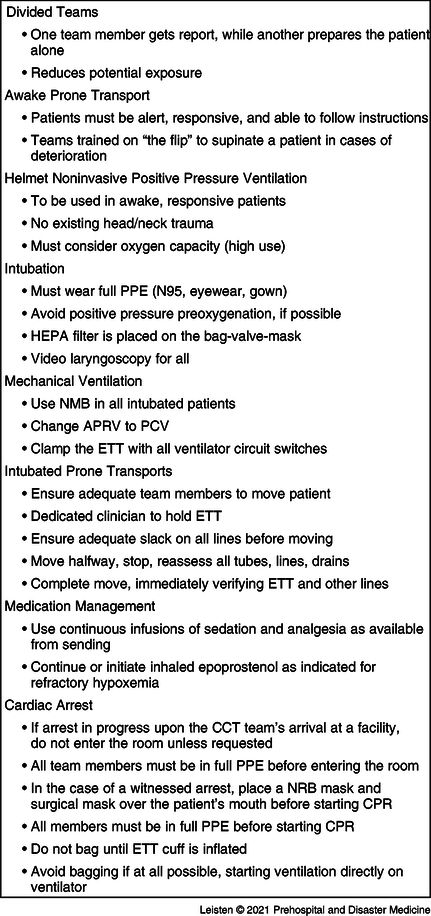
Clinical changes are outlined in Table 1. A key change in clinical operations was the development of a split-team approach. To minimize unnecessary team-member exposures and conserve personal protective equipment (PPE), the emergency medical technicians and pilots did not go inside the hospital, and pilots no longer participated in carrying bags and assisting with patient movement. The removal of these critical team members required adjustment to procedures, using sending and receiving facility staff for patient movement between stretchers. Bedside times increased and additional preparation was needed for each transport. Preparation included, but was not limited to, pre-drawn medications, removal of perishable products from monitor, removal of necessary equipment or medication from bags to prevent contamination of interior compartments, and utilization of a “COVID bag.” The “COVID bag” had many of the most commonly used supplies like flushes, alcohol prep pads, and syringes that could be easily accessed. After the call, the disposable bag and all unused contents were discarded in biohazard trash.
Clinical Changes for COVID-19

Abbreviations: PPE, personal protective equipment; HEPA, high-efficiency particulate absorbing filter; NMB, neuromuscular blockade; APRV, airway pressure release ventilation; PCV, pressure control ventilation; ETT, endotracheal tube; CTT, critical care transport; NRB, non-rebreather; CPR, cardiopulmonary resuscitation; COVID-19, coronavirus disease 2019.
A single provider would don all appropriate PPE and go to the bedside, packaging the patient for transport until the last step of transitioning the patient to the transport stretcher, often transitioning from the intensive care unit (ICU) ventilator to the travel ventilator without assistance. The bedside provider would also transition the patient to the transport monitor, all medications to the transport pumps, and manage any invasive lines or other equipment without alternate crew assistance. Meanwhile, the crew member receiving report would stay outside of the room and receive report and peruse documentation required for transport. The documentation would then be placed in a zip-lock bag for the remainder of the transport. Upon arrival to the receiving facility, the zip-lock bag is wiped down with Cavi wipes, and the crew member (after doffing their PPE) would retrieve the paperwork for the receiving facility staff.
Providers are used to having access to flight suit pockets and gear to manage a patient. When a provider is in full PPE, this access changes. While PPE has not explicitly changed patient care decisions, it has slowed some regularized processes of care. Additionally, the ravages of COVID-19 care found in any hospital - including fogged glasses, impaired vision, exhaustion, dehydration, and so on - were only magnified when providing the same level of critical care in a transport vehicle.
Awake Proning Protocol
Whether conscious or intubated and sedated, transporting patients in the prone position has previously been taboo due to the risks of being unable to access the patient’s airway en route. For patients who are not intubated, should they deteriorate, turning the patient supine to allow for airway management would be a substantial challenge. However, self-proning, or awake proning, has been used in patients with COVID-19 with success in improving oxygenation.Reference Paul, Patel and Royse1–Reference Padrão, Valente and Besen4 While some patients may eventually require intubation, for many awake, alert, and interactive patients with moderate to severe hypoxemia, a limited trial of awake proning is a reasonable approach. As such, awake proning has been employed in many emergency departments and ICUs. To adapt to the needs of COVID-19, a protocol for awake proning was created, with subsequent successful transport of patients in this manner.Reference Boomhower, Noland and Frakes5
Helmet Noninvasive Positive Pressure Ventilation
Although NIPPV is not universally indicated in acute respiratory distress syndrome (ARDS), some patients with COVID-19 respiratory failure may benefit from NIPPV.Reference Wilcox and Condella2,Reference Sivaloganathan, Nasim-Mohi and Brown6,Reference Mukhtar, Lotfy and Hasanin7 Traditional mask NIPPV carries a risk of aerosol generation, which is not optimal in the confined transport environment. Helmet-based noninvasive ventilation is a reasonable alternative for support in these patients. On August 6, 2020, the US Food and Drug Administration (FDA; Silver Spring, Maryland USA) issued an emergency use authorization to Subsalve USA (North Kingstown, Rhode Island USA) for its Subsalve Oxygen Treatment Hood. As such, the service developed a new protocol for the Subsalve helmet interface to initiate or to continue pre-existing (non-helmet) NIPPV.
A key consideration for NIPPV, particularly helmet-based noninvasive ventilation, is assuring adequate oxygen supply for each transport leg. The helmet interface creates two independent ventilated compartments, the helmet and the lungs, each with its compliance and volume. Therefore, traditional tidal volume and ventilator pressures may be different from what is customary for noninvasive ventilation. This device is appropriate only for bilevel positive airway pressure (BiPAP) in their configuration, and any patient on continuous positive airway pressure (CPAP) needs to be transitioned to BiPAP.
The absolute contraindications to use include open wounds in contact with helmet or head trauma, patients with known carotid disease, high ocular pressures, glaucoma, nausea, or vomiting. The relative contraindications to use include patients physically or mentally unable to remove their own helmet devices and hemodynamic instability, requiring a Medical Direction call.
Intubation
When intubating a patient with COVID-19, there are two primary concerns. First, these patients tend to be profoundly hypoxemic and can have very low nadir oxygen saturations and rapid clinical deterioration with intubation. The second concern is maintaining the safety of all involved clinicians and crew members.Reference Brown, Mosier and Carlson8
For all intubations, crew members must be wearing a N95 mask, goggles or a face shield, gloves, gown, and a head covering. To maintain clinician distance from the airway and improve the first-pass success rate, the service moved to video laryngoscopy only intubations.Reference Brown, Mosier and Carlson8 The high-efficiency particulate absorbing (HEPA) filter is placed on the bag-valve-mask, and all masking is preferred to be two-person to optimize the seal and minimize aerosolization. The minimum number of staff possible should be in the room, and the most experienced operator manages the airway. The patient is preoxygenated on 6LPM nasal cannula and 15LPM non-rebreather (NRB) with a plan to minimize positive pressure ventilation and NIPPV without the helmet configuration if the intubation is anticipated. After intubation, the first breath is given on the Hamilton T1 Ventilator (Hamilton Medical; Bonaduz, Switzerland) rather than with the bag, if possible.
Mechanical Ventilation
Since the publication of a large, randomized controlled trial of neuromuscular blockade (NMB) in ARDS finding no differences in outcomes,Reference Moss, Huang and Brower9 the transport service had moved away from the routine use of NMB in ARDS. However, with the COVID-19 pandemic, they rewrote the mechanical ventilation protocol to require use of NMB on all transported COVID-19 patients to prevent any patient movement, coughing, and minimize the risk of endotracheal tube (ETT) dislodgement. The routine use of NMB in COIVD-19 had unanticipated effects of conflicting with airway pressure release ventilation (APRV). As the benefits of APRV involve maintaining spontaneous ventilation, APRV is incompatible with this policy. As such, the service now changes all patients on APRV to assist-control for transport.
When transitioning intubated patients from a sending or receiving ventilator and the transport ventilator, they clamp the ETT to preserve positive end-expiratory pressure and reduce exposure to aerosols while also maintaining a limited crew at the bedside. During transport, patients are covered fully with sheets to reduce exposure and cover face/ETT to reduce aerosolization if disconnected.
Proning for Intubated Patients
Prone positioning has been shown to reduce mortality in patients with ARDS before COVID-19,Reference Cornejo, Diaz and Tobar10,Reference Guérin, Reignier and Richard11 and as such, it has been used liberally in COVID-19-associated respiratory failure. As with the transport of awake prone patients, transporting intubated prone patients is fraught with risk. Prone patients are at risk of line pulls and extubation.Reference Taccone, Pesenti and Latini12 If this were to occur in transport, it could be an immediately fatal event. Therefore, the previous practice was to supinate prior to departure, which could have adverse effects on patients with tenuous oxygenation and ventilation status. However, the pandemic resulted in the transport of many patients for consideration of extracorporeal membrane oxygenation (ECMO) after the failure of conventional management. This high-acuity patient population required adaptation to allow the transport of patients in the prone position. The CCT service wrote a prone transport protocol, emphasizing the potential for adverse outcomes, including extubation and cardiac arrest.
The protocol focuses on assessing all tubes, lines, and drains and ensuring they are untethered with adequate slack before movement. With a dedicated clinician holding the ETT, the patient is moved halfway, and then the lines are all reassessed. The need for extensive planning and coordinated movement of proned patients resulted in prolonged bedside care. However, this dedication to methodical assessment has resulted in the safe transport of numerous proned patients.Reference Seethala, Frakes and Cocchi13
Medication Management
Patients with COVID-19 often require the use of high doses of sedation and analgesia. Previously, the practice pattern had been reliant on bolus medications. However, this practice evolved to continuing infusions from receiving to reduce the need to administer bolus doses, thereby reducing contact with patients once packaged. Continuing infusions from sending improved access to sedative agents that other institutions lacked during the period of medication shortages and improved patient care, ensuring no gaps in administration with these patients on NMB.
Given the high rate of refractory hypoxemia, the service transported many patients on inhaled epoprostenol.Reference Foster, Frakes and Puopolo14,Reference Richards, Frakes and Saia15 Early in the pandemic, they attempted to minimize the use of inhaled epoprostenol, given the risks for aerosolization with any breaks in the ventilation circuit. However, once they determined the safety of appropriate PPE and developed experience, they determined that use of inhaled epoprostenol was low-risk to crew members. The service then reinitiated it into their practice.
Management of Cardiac Arrest
Transport clinicians do not assist with resuscitative efforts within the patient room for interfacility patients in arrest on their arrival. If asked to assist in the resuscitation, BMF clinicians must be in full PPE, including N95 mask, gown, eye protection, and gloves, before entering the room. When patients suffer cardiopulmonary arrest during transport, resuscitative efforts proceed as indicated. However, upon recognizing cardiac arrest, crew members stop to verify that they are in appropriate PPE, including N95 mask, gown, eye protection, and gloves, before continuing efforts. For patients without an advanced airway in place, crew members apply a NRB mask to the patient at 12-15LPM and then place a surgical mask over a NRB mask. Once the mask is in place, the team will begin chest compressions according to American Heart Association (AHA; Dallas, Texas USA) guidelines, apply multi-purpose pads (if not already applied), and otherwise follow Advanced Cardiac Life Support/Pediatric Advanced Life Support guidelines for cardiac arrest management. In contrast to prior practice, the team will pause compressions during airway placement to ensure filter is in an appropriate position on bag-valve-mask or ETT assembly. They do not resume compressions until ETT cuff is inflated and first breath is successfully delivered.
Remote Staff Meetings
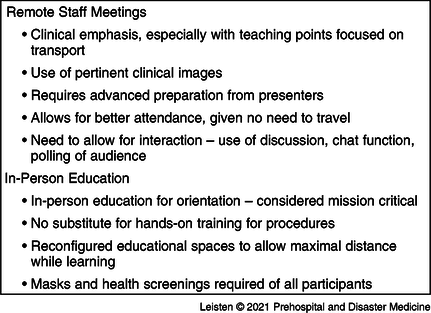
Table 2 lists key educational changes. At the beginning of the pandemic, the service quickly moved to a video conferencing case-review meeting, incorporating operation updates and an open forum but maintaining a strong emphasis on education, reserving at least two hours per meeting for educational initiatives. They quickly realized several benefits to video conferencing. Without the need for commuting and the option to attend part of a meeting, the Associate Medical Directors’ participation increased. Similarly, more team members can attend the meetings, and this pushed the IT department to develop rudimentary interconnectivity between their bases to allow remote on-duty teams to participate.
Educational Initiatives during COVID-19

Abbreviation: COVID-19, coronavirus disease 2019.
The virtual presentations were greatly enhanced by preparing slides, preferably with an emphasis on clinical images pertinent to the case, in a way that was not common in their prior model, which focused on a discussion of the case without visual aids. With an emphasis on clinically relevant points and images, they were able to maintain engagement and to facilitate adult learning. With both audio and chat options, they have found that staff interaction in the case discussions is non-inferior, and probably improved with the model change. A staff survey found high satisfaction with this model and allowed useful feedback for refinement. Staff emphasized the need for presenters to allow time to answer questions, due to challenges in navigating the mute button, and requested more interaction. This led to the implementation of a poll function during discussions, which has been well-received.
Additionally, they have used the opportunity to bring in outside speakers to discuss topics such as ECMO and neonatal transports. They are currently in a speaker series that would not have been possible without the virtual transition, as they invite Medical Directors from leading programs to address the teams in the “Great HEMS Programs Around the World” series.
Hands-On Training Sessions
Another challenge is the lack of clinical rotations due to the pandemic. While they provide the vast majority of the 75 annual clinical education hours-per-provider internally, clinicians previously attended in-hospital experiences with anesthesia, neonatal intensive care, pediatric cardiac surgery intensive care, and obstetrics, and participated in clinical rounds in the ICUs staffed by the Associate Medical Directors. With early infection control initiatives at the consortium hospitals, crew members were no longer allowed to participate in-hospital clinical rotations. However, the consortium hospitals prioritized their return for clinical education as they reopened to outsiders.
The transport service determined that their orientation program’s continuity was mission-critical and continued to provide live education to orientees in fully masked, socially distant, capacity-limited environments. While the crew members could not join anesthesia for introductory airway training, they developed a one-on-one physician training model for manikin instruction, involving seven attending physicians per orientee to coach adult and pediatric direct and video skills. This supplemented their existing, extensive, high-fidelity simulation program for initial airway instruction already in place before the pandemic, which they continued, uninterrupted.
For their live training, they reconfigured the education spaces for social distancing, which reduced capacity. The service now caps events to that capacity or to the commonwealth-determined safe maximum, which has been as low as ten people. They have a 100% mask requirement for all education events, wearing exhalation protected N95s for simulation events, and all participants complete the MedFlight health screening tool before beginning a session. During the pandemic, the service rolled out a new trauma care bundle that had been in development for a year. Part of this bundle includes finger thoracostomy. To teach this skill, Associate Medical Directors and surgeons from the consortium hospitals participated in numerous small group simulation sessions over the course of a week. By having no more than two learners at a station with an instructor, all masked, they were able to teach this new skill while minimizing risk to participants. For in-vehicle simulations, they run the vehicle exhaust for air circulation in the same way they require of clinical teams, and for classroom events, all doors are propped open.
Limitations
This narrative report is provided as a description of changes rapidly made during the COVID-19 pandemic and is limited by lack of a comparison group. Given the unique population at the height of the pandemic, comparing metrics between older patients with respiratory failure from COVID-19 and the usual CCT cohort, including younger patients with a variety of critical illnesses and injuries, would be less useful. Nonetheless, these changes have allowed the CCT service to transport over 1,500 COVID-19 patients while keeping staff safe.
Conclusion
The SARS-CoV2 pandemic of 2020-2021 created unprecedented challenges for the CCT sector. These CCT services had to rapidly adjust, developing new operational approaches, protocols, and guidelines in rapid succession. The growth bore out of a need to cater to this new patient population and their safety, as well as the safety of the crew members from SARS-CoV-2. The critical changes to operations involved adaptability, efficient communication, continual re-assessment, and implementation of novel approaches. This report offers one service’s best practices based upon their experience and the best available data. While these procedures were developed for the COVID-19 pandemic, they logically will apply to future respiratory outbreaks and may illuminate helpful changes for otherwise quotidian operations.
Conflicts of interest/funding
This work was funded by internal support at Boston MedFlight. The authors declare no conflicts of interest.