

1. Introduction
The 2007–8 financial crisis has sparked a renewed discussion of ways to combat financial instability. Should central banks take a more active step, moving beyond monetary policy narrowly conceived to stewarding the health of the financial system? Should other governments’ executive agencies actively cooperate with monetary authorities in taming financial turbulence? These and related questions are currently driving the literature on financial stability.
The present macroeconomic perspective on financial stability is monocentric, as exemplified by the creation of the Financial Stability Oversight Council and the expanded powers of the Federal Reserve. Much academic work defends, and even seeks to extend, this regulatory paradigm. The most notable strand of literature that defends this approach at country-level focuses on the importance of “macroprudential” policy (e.g. Engel, Reference Engel2015; Galati and Moessner, Reference Galati and Moessner2013; Hanson et al., Reference Hanson, Kashyap and Stein2011), which is paralleled at the international level by authors who see great promise in the top-down global governance approach (e.g. Eichengreen, Reference Eichengreen1999, Reference Eichengreen2002; Eichengreen et al., Reference Eichengreen, Tobin and Wyplosz1995; Rogoff, Reference Rogoff1999; Simmons, Reference Simmons2001, Reference Simmons, Borio and Toniolo2008). Previous “microprudential” approaches to regulation focused on bank-specific characteristics, such as capital ratios. Macroprudential policy, in contrast, emphasizes the importance of stabilizing the financial system as a whole by granting regulatory organizations the authority to take direct action on variables linked to systemic risk (Bernanke, Reference Bernanke2011).
A growing economic literature is critical of the current institutions and policies that attempt to bring about financial stability. The performance of existing institutions before the crisis has come under severe scrutiny (Borio and Disyatat, Reference Borio and Disyatat2011; Calomiris and Haber, Reference Calomiris and Haber2014; Calvo, Reference Calvo2013; Hogan et al., Reference Hogan, Le and Salter2015; Leijonhufvud, Reference Leijonhufvud2009; Taylor, Reference Taylor2007, Reference Taylor2009; see also Cachanosky and Salter, Reference Cachanosky and Salter2017, and the references therein). Skepticism about the effectiveness of post-crisis policy changes is also not uncommon (Hetzel, Reference Hetzel2008, Reference Hetzel2012; Salter, Reference Salter2014a, Reference Salter2014b; Salter and Tarko, Reference Salter and Tarko2017; Sumner, Reference Sumner and Beckworth2012, Reference Sumner2015). Furthermore, the desirability of the current financial regulatory institutions in general has been attacked (Boettke and Smith, Reference Boettke and Smith2013, Reference Boettke and Smith2015a, Reference Boettke and Smith2015b; Hogan, Reference Hogan2015; Selgin et al., Reference Selgin, Lastrapes and White2012). We agree with many of these critics, but we think that they lack the proper conceptual tools for analyzing viable alternatives.
To overcome this difficulty, we propose an approach to financial resilience that builds upon the preexisting institutional literature about resilience (Aligica and Tarko, Reference Aligica and Tarko2014). The governance of the financial system is a special case of the broader problem of building a resilient governance system – a system that can reliably deliver public goods and cope with unexpected shocks. We adapt the broader lessons of the institutional resilience literature to the issue of financial governance. Of particular interest is the theory advanced by Elinor Ostrom (Reference Ostrom1990, Reference Ostrom2005, Reference Ostrom2010) of how polycentric systems evolve rules for coping with shocks while avoiding over-optimization problems. This theory is part of the reason for Ostrom receiving a Nobel Prize in economics, and has had substantial theoretical and practical successes (Aligica and Tarko, Reference Aligica and Tarko2014; Costanza et al., Reference Costanza, Low, Ostrom and Wilson2001; Janssen et al., Reference Janssen, Anderies and Ostrom2004; E. Ostrom, Reference Ostrom2005: Chapter 9; E. Ostrom, Reference Ostrom2014; Toonen, Reference Toonen2010; Young et al., Reference Young, Berkhout, Gallopin, Janssen, Ostrom and van der Leeuw2006). In our view, this framework of analysis can also be applied to the governance of financial systems, and important ideas regarding the institutional foundations of robust governance systems have yet to be applied to financial governance.Footnote 1
This approach to understanding resilience is built on the concept of polycentric governance. A polycentric system of governance is comprised of many decision centers, in which “[e]ach unit exercises considerable independence to make and enforce rules within a circumscribed domain of authority” (E. Ostrom, Reference Ostrom2005: 283). Theories of polycentric governance are best known in the context of governing common pool resources,Footnote 2 but Vincent Ostrom has developed this idea with a much broader purpose in mind (Aligica and Boettke, Reference Aligica and Boettke2009; Aligica and Tarko, Reference Aligica and Tarko2012, Reference Aligica and Tarko2013; V. Ostrom, Reference Ostrom1991, Reference Ostrom and McGinnis1999; V. Ostrom et al., Reference Ostrom, Tiebout and Warren1961; Tarko, Reference Tarko2016, Chapter 2).
We organize the remainder of this paper as follows: Section 2 provides an overview of institutional resilience in general, to ground later analysis. Section 3 briefly overviews the possible shocks that can generate a financial crisis, highlighting the problems that must be overcome to prevent crises. Section 4 shows how polycentric banking systems can overcome these problems and provide robust financial governance. Section 5 engages the ‘design principles’ for robust governance devised by E. Ostrom. We show that polycentric financial governance meets the requirements that follow from these principles, while current top-down approaches do not. Section 6 concludes by discussing the implications of our argument.
2. Institutional resilience in polycentric systems
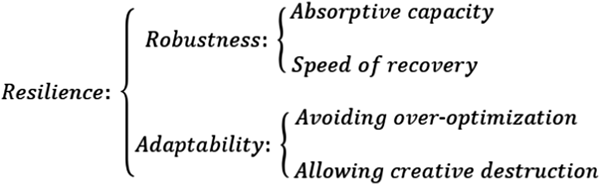
The institutional approach to resilience is summarized in Figure 1 (adapted from Tarko, Reference Tarko2016: Chapter 4).
Aspects of resilience

The concept of “robustness” (Adger, Reference Adger2006) includes, first, the system's absorptive capacity, i.e. its ability to experience a large shock without major negative consequences. The bigger the financial institution that can be allowed to fail without massively disrupting the whole system, the higher financial absorptive capacity the system has. Second, robustness also refers to the speed of recovery. Even if the shock had a large initial impact, some systems recover quicker than others. In the context of financial stability we can think of the speed with which the market rebounds after a financial crisis. For example, the Great Depression was massively prolonged by flawed monetary policy, such as the Fed's failure to prevent a collapse in the monetary base (see Friedman and Schwartz, Reference Friedman and Schwartz1963), as well as prolonged discount-window lending, which undermined the existing double-liability regime (e.g. White, Reference White2011). Various non-monetary policies, such as misguided regulations that increased the costs of doing business (e.g. Cole and Ohanian, Reference Cole and Ohanian2004), also worsened the Depression. This package of policies created an institutional system with a low speed of recovery.
Robustness provides only a static, equilibrium approach. Most problematically, it assumes that it is desirable for the system to return to the same state of affairs as before the shock. But this may not be the case. The vulnerability to shock may have revealed a design error. A resilient system learns from past errors and adapts to new conditions (Folke et al., Reference Folke, Carpenter, Elmqvist, Gunderson, Holling and Walker2002; Gunderson, Reference Gunderson2000). This concern brings to light two very different challenges to resilience: over-optimization and allowing “creative destruction.”
The mathematical theory of over-optimization was developed by Carlson and Doyle (Reference Carlson and Doyle1999, Reference Carlson and Doyle2000, Reference Carlson and Doyle2002), who refer to the problem of “highly optimized tolerance” (HOT). The idea was later adopted by Elinor Ostrom and her collaborators as a basis for their theory of ecological resilience (Janssen and Anderies, Reference Janssen and Anderies2013; Janssen et al., Reference Janssen, Anderies and Ostrom2004, Reference Janssen, Anderies and Ostrom2007; E. Ostrom, Reference Ostrom2014; Young et al., Reference Young, Berkhout, Gallopin, Janssen, Ostrom and van der Leeuw2006). Carlson and Doyle have demonstrated a striking mathematical phenomenon: optimization to cope with past shocks can itself create previously inexistent vulnerabilities with respect to other, unforeseen sources of uncertainty. The appendixFootnote 3 offers a more in-depth presentation, but, in a nutshell, the mechanism is this: economies of scale favor greater integration, but complex interactions generate power laws that enable large-scale failures. What Carlson and Doyle show is that “black swans” (Taleb, Reference Taleb2010; see also Knight, Reference Knight1921) are also created by the optimization process itself. They are not purely exogenous. As Carlson and Doyle (Reference Carlson and Doyle1999: 1,424) put it, “the most important feature of HOT states is the fact that the high performance and robustness of optimized designs with respect to the uncertainty for which they were designed [i.e. in economic parlance, risk] is accompanied by extreme sensitivity to additional uncertainty that is not included in the design.” This leads to “profound tradeoffs in robustness and uncertainty.” As it is optimized to the known sources of danger, the system develops, as a side effect, weak points thanks to complex interconnectivities, which open up the possibility of a “cascading spread of damage due to the seemingly innocuous breakdown of individual parts” (Carlson and Doyle, Reference Carlson and Doyle2002: 2,540).Footnote 4
The importance of this phenomenon for financial systems is obvious. Regulatory bodies create rules to cope with past challenges and shocks, but, in the process of optimizing the rules in such a manner, they run the risk of creating new, previously inexistent vulnerabilities. There is also the problem of regulatory evasion. Financial innovation, for example the creation of new assets, can be both an effort to secure economic profit on the market and an attempt to arbitrage around restrictive rules. For example, the Glass–Steagall Act, which separated commercial and investment banks, was rendered powerless by such market innovations long before it was actually repealed. The final de facto blow to it came with a 1984 Supreme Court decision that “established the principle that banks and brokerage firms could cross the Glass–Steagall lines through subsidiaries” (Vogel, Reference Vogel1996: 226). As Vogel (Reference Vogel1996: 31) has noted, “[i]ronically, the rigid segmentation between banks and brokerage firms in the United States has created incentives for financial innovation not found in countries without such barriers, such as Germany.”Footnote 5
This brings forth the question about “creative destruction.” An adaptable system is the result of the constant exploration of alternative innovations (Page and Miller, Reference Miller and Page2007). The fundamental challenge is that we don't know beforehand what the best solutions are. A polycentric system allows simultaneous and parallel practical explorations, while a monocentric one allows only academic theoretical debates. The lack of foresight also raises the hard question of how to effectively regulate innovations that could have highly disruptive, but hard to foresee, consequences (Thierer, Reference Thierer2016).
The institutional approach to this question is to look at the likely consequences of creatively destructive innovations. When designed to circumvent existing regulations to capture the quasi-rents created, in part, by those regulations, the social value of disruptive financial innovations, like the ones discussed above, is questionable. By contrast, financial innovations will be benign or beneficial in a polycentric system that does a better job of generating information and aligning incentives. To put it differently, in a monocentric system, there is a lot of money to be made by creating financial innovations that game the system or evade regulations. In contrast, in a polycentric system the main incentive is to make innovations that create social value. For example, as noted by Stringham (Reference Stringham2015: 67–69), when a single stock market is allowed to exist and fraudulent traders cannot be easily excluded from it, the incentive to engage in fraud is considerable and actually threatens the integrity of the entire stock market. By contrast, a polycentric system of several competing stock markets both reduces the risk of fraud and provides a wider diversity of services. The same logic applies not just to stock markets but to the entire financial system.
Regulatory evasion is not the end of the story. Along the lines of the HOT concept, it can generate previously inexistent vulnerabilities. Regulations create incentives to discover such regulatory evasions, which basically render obsolete the robustness calculations that formed the basis for setting up the regulations in the first place. Elinor Ostrom has highlighted this problem as crucial to understanding properly how to design a resilient system: “As soon as one design has proved itself in one environment, innovations in strategies adopted by participants or changes in the environment in which humanly designed system is in operation will produce unexpected results” (E. Ostrom, Reference Ostrom2005: 255). As such, simple equilibrium analysis “can be difficult to apply to systems in which some components are consciously designed” and one has to consider the “endogenous processes within a given system of interest and … address normative considerations associated with incentives and decisions” (Janssen and Anderies, Reference Janssen and Anderies2013, added emphasis).
The only way to avoid the problem of highly optimized tolerance is to decentralize the system and create “small isolated clusters that would be highly robust to changes in probability distributions or flaws” (Carlson and Doyle, Reference Carlson and Doyle1999: 1,423). Such a solution to the resilience problem is deliberately inefficient in terms of economies of scale.Footnote 6 However, the only way in which a complex system can be made resilient is by giving up the goal of maximum short-term efficiency, keeping the scale low, and implementing redundancies. The emphasis on polycentricity and diversity, i.e. preserving a redundant variety of institutional devices rather than adopting a one-size-fits-all solution, should be understood from this perspective, which stresses the importance of coping with uncertainty, rather than just risk.
As argued by Miller and Page (Reference Miller and Page2007), systems that evolve from the bottom up tend to err on the size of resilience, even at the cost of losing some efficiency: “Adaptive systems have to deal with the tension between the benefits of achieving precise behavior and the cost of increased system fragility” (139). The more precisely and efficiently one attempts to control everything, the larger the number of variables unavoidably becomes. As the space of possibilities becomes larger, (1) the probability of error increases and (2) the system's robustness to unpredictable shocks decreases. As such, Miller and Page (Reference Miller and Page2007: 140) argue that “[a]daptive systems tend to be inherently risk averse because, notwithstanding the potential gains to be made by taking even a favorable risk, it takes only a single loss to kill off an agent and eliminate it from the system forever.” Such adaptive systems may, hence, never reach the HOT over-optimization due to their built-in risk aversion. According to this argument, the short-term efficiency gains in monocentric systems are eventually undermined by their long-term fragility, and, hence, we should expect institutional evolution to produce polycentricity.
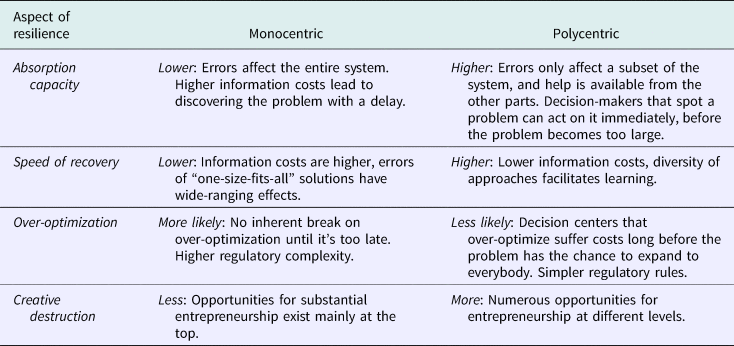
To summarize, a polycentric system tends to be more resilient than a monocentric one because it fares better on all the components of resilience (Table 1). Polycentric systems tend to have higher absorption capacities because shocks do not affect the whole system simultaneously in the same way. Because they preserve institutional diversity, and hence a diversity of beliefs about how to organize human affairs, they are less vulnerable to the problem of putting all their eggs in one basket. Similarly, apart from emergency situations in which quick agreement on one common action is vital, the speed of recovery tends to be higher in polycentric systems. Such systems are more market-like, and the information about who needs what has to travel a shorter chain of command. Furthermore, a diversity of approaches is available, which overcomes the problem of not knowing exactly which is the best solution and risking placing one's bet on the wrong solution. Polycentric systems are much less vulnerable to the problem of over-optimization – of highly optimizing the whole system to previous challenges, opening up new vulnerabilities – and, indeed, bottom-up institutional evolution tends to create resilient polycentric systems, rather than efficient-but-brittle monocentric ones. Finally, polycentric systems are far more entrepreneurial than monocentric ones, simply because they allow a diversity of points of view to coexist, and not just in theory, but also in practice.
Polycentric systems tend to be more resilient

3. Market failures and financial crises
Financial systems are a network of institutions using a wide variety of complex instruments. But the function of the financial system as a whole is easy to state: coordinate the investment market, i.e. bring together those in want of funds and those offering funds, and to provide credible assurances that loans are going to be repaid. Various methods of corporate financing and risk management can thus be understood as mechanisms that enable the tendency toward clearing in capital markets in a least-cost manner.
Suppliers of funds can deposit the money in a bank, buy stocks or buy bonds (usually via an investment fund acting as intermediary). Banks and investment funds provide liquidity to entrepreneurs supporting their investment plans. Some of these entrepreneurial plans succeed and generate profits, parts of which are used to repay the loans up the chain of lending all the way to the initial lenders. The banks and investment funds are also insured, which offers a cover for streaks of bad luck. Furthermore, credit rating companies provide additional information, helping the decision making of investment funds and insurance companies. Under normal circumstances, this decentralized system works smoothly. Errors are of course made all the time, as no one can know for sure which investment plans will succeed or fail, but the errors are compensated by the successful investments. Such a system is essential for economic growth as otherwise most entrepreneurs would lack capital.
The smooth operation of this system is governed by prices – interest rates, insurance premiums, stock prices, asset prices, etc. When accurate, these prices contain information about the relative risk of different investment plans. On this view, it makes sense to view financial crises as essentially an information problem. They would not exist if accurate common knowledge was available to depositors, investors and insurers. The common knowledge (stored in interest rates and the prices of various assets, stocks and bonds) is imperfect in the sense that various assets, stocks and bonds are often mispriced – as revealed by later events. The financial crisis occurs when some substantial fraction of these prices are suddenly revealed to be inaccurate. The errors here are not just at the individual level, as part of the normal noise in any market; they end up instead embedded at the level of the constellation of prices in the financial system. The question hence becomes, which system can discover these system-wide errors faster and which system provides the incentives to correct these errors more quickly: the polycentric system of self-regulation or the monocentric regulatory authorities?
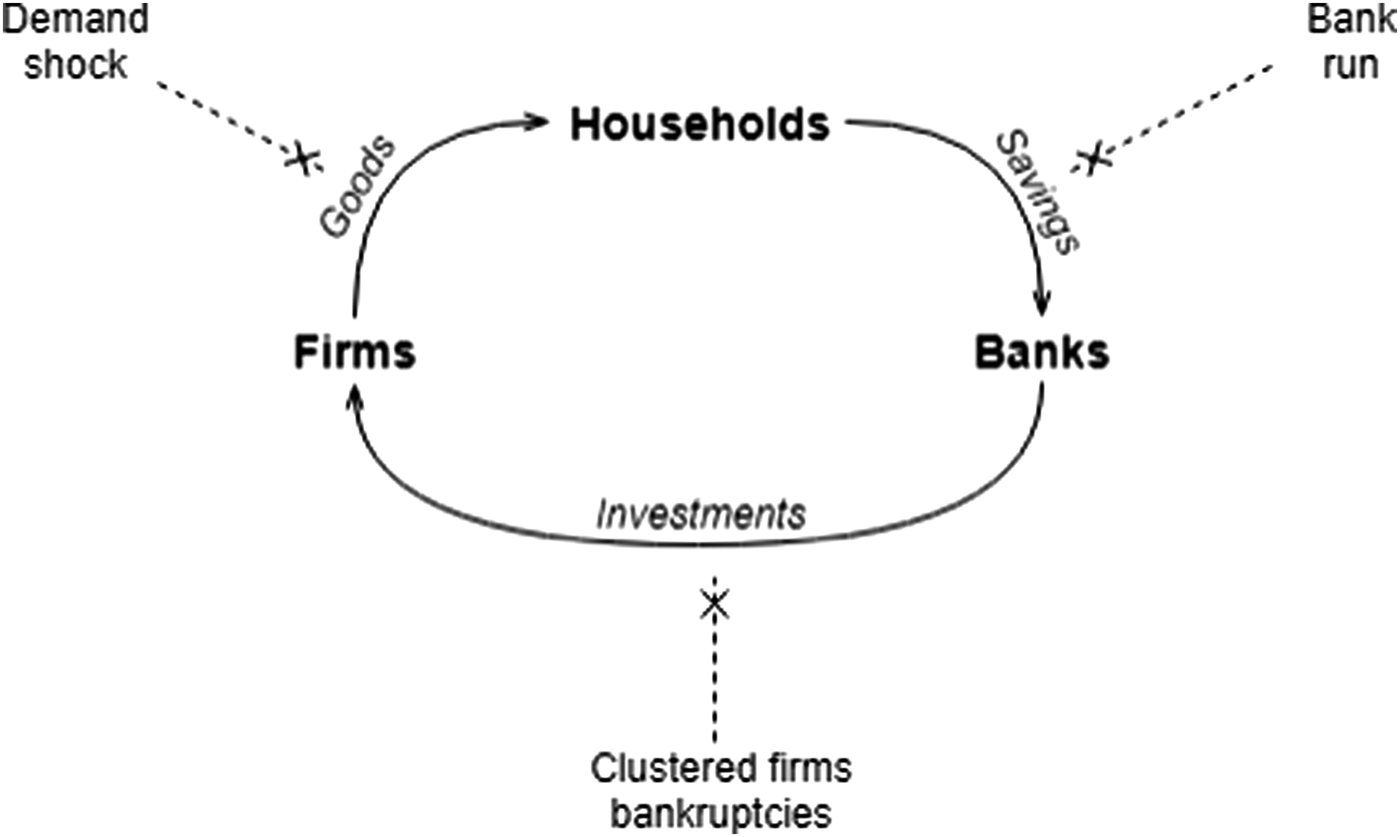
Three different types of shocks are possible in this simplified model (see Figure 2). First, households may become worried about possible bank failures, which can result in bank runs. In a way, such bank runs can also be understood as “balance-sheet shocks,” because they are caused by worries about the differences between bank liabilities and their assets. Second, households may unpredictably change their time preferences, altering their balance between consumption and saving. When households unexpectedly reduce their consumption, they can cause a demand shock, causing many firms to unexpectedly experience declining sales, which in turn can affect the banks’ balance sheets (along with other macroeconomic variables such as unemployment). Third, banks may previously have financed an unexpectedly large number of what we are now discovering are failed projects, i.e. malinvestments. If such failures occur in clusters, leading to correlated failures by firms to repay their loans, they can reduce the value of banks’ balance sheets, which, in turn, may lead to bank runs, bankruptcy, or both. This third type of shock becomes particularly difficult to analyze in the context of real world financial systems, because clusters of malinvestments can be created in many different ways.
Simplified circular flow model of a financial system

Given the complexity of the entire financial system, and our space constraints, we are going to illustrate the problem by looking at a key part of this system, the banking sector, and at balance-sheet shocks. We can see balance-sheet shocks as a proximate indicator for all three types of shocks described above. A balance-sheet shock, falling prices of banks’ assets due to widespread sales, can call into question the integrity of the entire financial system. In these cases, bank liabilities become information-sensitive, and if depositors (and creditors to the bank more generally) have reason to suspect bank insolvency due to asymmetrically distributed and costly-to-acquire information (Gorton, Reference Gorton1988), each depositor has an incentive to withdraw their funds as quickly as possible. As banks are forced to sell assets at fire-sale prices, the financial health of other banks, and to the financial system as a whole, is weakened as well (Gorton, Reference Gorton2010).
The overwhelmingly dominant perspective on how to ameliorate these problems holds that various regulations can force banks to behave in a manner more consistent with the health of the financial system as a whole. Microprudential approaches focus on changing the behavior of individual banks and other financial organizations; in the aggregate, each bank behaving in a stability-conducive manner will result in a stable financial system. Examples include regulatory standards for capital, leverage, and liquidity in individual banks. Macroprudential approaches hold that regulators need to act directly on variables that determine systemic risk, which may not be evident if the sole focus is on individual financial organizations’ balance sheets. Systemic risk is related to the procyclicality of a financial system, so constraints on banks’ loan-to-value and debt-to-income ratio are proposed as macroprudential tools.
But both microprudential and macroprudential policies rely on discretionarily crafted rules. The theory of institutional resilience, and the literature on polycentricity more broadly, raises substantial doubts as to whether such top-down regulatory solutions in general can be successful. In particular, those implementing top-down regulations face knowledge and incentive problems that make it unlikely that financial stability will result. The alternative is to think about the possibilities for self-governance in a polycentric financial system. In the same way as economists used to assume, before Elinor Ostrom's work, that the only way of solving a tragedy of the commons was by means of top-down government regulations, economists are currently assuming that the commons problems generating financial crises can only be solved by top-down financial regulations.
4. Polycentric financial governance
Not all decentralized and lightly regulated banking systems constitute polycentric banking systems. The key feature of any polycentric system is that the constituent organizations are governed by an overarching set of rules, which, depending on their details, are more or less successful in aligning the information and incentives of individual actors with broader social goals such as financial stability. These rules are typically enforced, not in a top-down regulatory fashion by authoritative non-market actors who can be conceived as operating outside, or upon, the polycentric system, but by mutually agreed procedures for monitoring and enforcing agreements that punish behavior which is privately beneficial but socially costly (Selgin and White, Reference Selgin and White1994). This is not to say there is no role for the public sector; in fact, the public sector frequently performs an important function by constituting parts of these systems by protecting property rights, enforcing contracts, and upholding a non-discriminatory rule of law.
A polycentric financial system is thus not one without regulations, but one in which the regulations are created endogenously by the actors, rather than exogenously by a government regulator. How are these endogenous regulations created? The most interesting and important institution in this regard is the interbank clearinghouse.
Endogenous stability: the interbank clearinghouse
A decentralized banking system faces the following problem. Due to network externalities, banks have some vested interests in accepting each other's bank notes in order to protect their currency network. If a bank were not to accept other banks’ notes, the recalcitrant bank would find its own currency network restricted. But, once banks do this, they create a tragedy of the commons problem. When one bank expands its supply of bank notes, this affects all the other banks in the network. For example, under a gold standard regime, because note redemption is not costless, the feedback mechanism between imprudent banks and specie outflows is weakened, providing incentives at the margin for over-issue. A flexible exchange rate system between different banks could in principle solve this issue, but it would also create significant transaction costs and undermine the benefits of having a single currency network. The clearinghouse helped solve this commons problem (and others).
The interbank clearinghouse can be viewed as an evolved mechanism for governing financial organizations’ behavior. Profit-maximizing banks, in a polycentric (and hence also decentralized and competitive) system, have incentives to cooperate to a limited degree in establishing some regular mechanisms by which they can clear liabilities against each other, at a lower cost than otherwise. This mitigates the problem of the costly note redemption mentioned previously. Banks that have initially cleared liabilities bilaterally eventually come to clear multilaterally to economize on transaction costs. In addition, once the institution of the clearinghouse evolved to perform this function, banks in a polycentric system discovered that there are scale economies with the clearinghouse collecting and sharing information, enforcing minimum quality standards (such as capital ratios), and facilitating low transaction cost emergency lending, should a member bank of the clearinghouse system so require.
These functions are very similar, on the surface, to proposed regulatory solutions. Information sharing among clearinghouse members helps to overcome well-known asymmetric information problems; the maintenance of quality standards through bank examinations and capital requirements (Gorton, Reference Gorton and Mullineaux1987) prevent any one bank from free riding on the reputation capital that comes from being a member of the clearinghouse association in good standing; and facilitating emergency loans fulfills a role similar to that of a lender of last resort (White, Reference White1989: 233). Rather than being the fortuitous result in a very small number of banking systems, the emergence and governance functions of the clearinghouse appear in numerous cases: “Eventually all the banks within an economy will be connected through one or a small number of clearinghouses … [t]he histories of the best-known early clearinghouses, in London, Edinburgh, and New York, all conform to this general pattern” (White, Reference White1989: 231).
From a stability standpoint, the chief benefit of the clearinghouse is to prevent the perceived insolvency of even a large and interconnected bank from growing into a crisis. One famous example is the 18th-century Scottish banking system, and its response to the failure of Douglas, Hernon & Co., more commonly known as the Ayr Bank.Footnote 7 The Ayr Bank opened in 1769, and within three years it had become public knowledge that it had over-issued its liabilities. The clearinghouse, fully operating by this point in Scottish banking history, facilitated a speedy return of Ayr's excess liabilities, which it could not honor. Ayr was forced to close, and this generated a sufficiently large spillover as to force 14 of the 32 Scottish banks to close (White, Reference White1995: 27). Ayr was a significant component of the Scottish banking system. Its balance sheet “accounted for an estimated 25 percent of Scottish banknotes in circulation, 25 percent of deposits, and 40 percent of total bank assets” (Goodspeed, Reference Goodspeed2016: 4). Common sense suggests that its failure should have crippled the Scottish banking system for some time. And yet, while there was some turmoil in financial markets, the Scottish banking system as a whole remained solvent. This was due in part to the efficacy of transactions conducted through the clearinghouse. Other large Scottish banks were able to divest themselves of Ayr's liabilities before its failure, shoring up their own balance sheets. While there was a large spike in liquidity demand following the Ayr failure, it lasted only one business day, and the largest note-issuing banks could continue business as usual (White, Reference White1995: 29). In the language of resilience, the clearinghouse both assured a very high financial absorption capacity, and a very fast speed of recovery.
Limited cooperation through the interbank clearinghouse provided governance concerning the maintenance of quality standards, information sharing, counterfeiting prevention, etc. It also lowered the transaction cost of emergency loans. It was in each bank's interest to follow the clearinghouse's rules, because being a member of the clearinghouse in good standing was a valuable stock of reputational capital. Information-wise, by facilitating regular clearings and emergency loans, the clearinghouse helped generate information concerning monetary equilibrium and the appropriate pricing premium for short-term liquidity in times of financial turbulence. The gradual evolution of the clearinghouse explains how, at each stage of newly acquired responsibilities, cooperation through the clearinghouse was both incentive- and information-compatible for banks.
From a governance perspective, the clearinghouse should be viewed as a multifaceted network of communication and limited cooperation, aimed at stewarding the systemic solvency of the banking system. Even relatively mundane activities that took place through the clearinghouse, such as note exchange, were a mechanism for lowering the costs associated with the assessment of member banks’ balance sheets. This was particularly important during times of financial turbulence, in which one of the most important collective problems was quickly and accurately ascertaining which banks were in danger and which banks were sound – indeed, this is the root of the collective action problem associated with banking and financial panics. Again referencing the Ayr Bank failure, the clearinghouse system was crucial in securing the limited cooperation necessary to match extant liabilities with their respective banks, and hence police the system-wide balance sheet. “The episode of the Ayr Bank did not impugn but, in fact, confirmed the effectiveness of the Scottish note exchange system in preventing over-issue by a single bank” (White, Reference White1995: 28). More responsible Scottish banks can and did divest themselves of Ayr's liabilities when it became clear Ayr had lent excessively. Because of this, “only those private banking houses involved with the Ayr Bank's circulation of bills were brought down” (White, Reference White1995: 29). And the clearinghouse also created profit opportunities for other large banks to undertake actions commensurate with systemic health, as when two other large banks, the Bank of Scotland and the Royal Bank, advertised on the eve of Ayr's liquidation that they would accept the defunct banks’ notes. “The benefits of this action to the two banks are clear: it would bolster public confidence, attract depositors, and help put their own notes into wider circulation” (White, Reference White1995: 29). Importantly, this was only a feasible strategy for the two banks due to the financial and reputational networks established through the clearinghouse.
More generally, the design of the clearinghouse system was to minimize redemption costs, but the function of the clearinghouse system was to reduce systemic spillovers of balance sheet shocks to individual banks. It was not created to serve this function. Rather, it represents a stable evolutionary strategy of limited cooperation among profit-maximizing banks. Nonetheless, it serves as a crucial institution for promoting resilience in polycentric banking systems. Of course, the clearinghouse system does not work in a vacuum. Its effectiveness depends in part on a much wider set of institutions, described below. And, unlike the clearinghouse, these institutions were not endogenous progressions within the banking system, but rather exogenous bedrocks to the banking system itself.Footnote 8
Exogenous stability: The hard budget constraint and extended liability
Polycentric banking systems did not exist ‘on their own’, isolated from the framework of institutions that governed commercial relationships more generally. Polycentric banking systems were embedded in a common-law legal system, subject to the general and familiar laws of contract, property, and torts, as well as the laws governing the conditions under which individuals could organize in a corporate capacity. This legal system is properly understood as exogenous to the banking system. Two features in particular merit special attention: the presence of a ‘hard’ budget constraint, and the requirements of an extended liability regime for shareholders. These two, in combination, gave banks strong incentives to behave in a manner conducive to financial stability (Salter et al., Reference Salter, Veetil and White2017; Turner, Reference Turner2014), and also partially constituted the framework of rules for generating the knowledge that they used to do so.
Hard budget constraints meant, in short, that banks in a polycentric system could not count on extra-market sources of liquidity if they found themselves subject to worrying portfolio shocks. Emergency loans could be facilitated through the clearinghouse, but this liquidity already existed within the system as a function of another banks’ liability float. Inability to pay back depositors, then, would have only one consequence: the triggering of liquidation procedures, which, due to extended liability, meant that depositors could claim the personal wealth of bank shareholders,Footnote 9 in proportion to an individual shareholder's total ownership of the bank. This obviously gave banks strong incentives not to overload their portfolio with exotic, or otherwise excessively risky, assets.
Extended liability played an important role in minimizing the effects of the previously discussed Ayr Bank failure:
[I]n the absence of a formal lender of last resort, the unlimited liability of the partners in Douglas, Hernon & Co. [the Ayr Bank] in effect served that role … which allowed the defunct bank to gradually work off its toxic assets and satisfy creditors while the company's assets, and those of its partners, were slowly liquidated. (Goodspeed, Reference Goodspeed2016: 133)
In contrast to a lender of last resort, which can be thought of as an external liquidity source capable of performing bailouts, extended and unlimited liability are ways to ‘bail-in’ funds. This solves the same problem as a lender of last resort, but without the problems of moral hazard. Again with reference to the Ayr failure and liquidation, for each $500 share of stock, Ayr shareholders on average paid nearly $3,000 in order to meet the bank's outstanding obligations (Goodspeed, Reference Goodspeed2016: 9). Because of the extended liability system, “the Ayr Bank's losses were borne entirely by its 241 shareholders. The claims of its creditors, including note-holders, were paid in full” (White, Reference White1995: 29).
These two institutions, in combination with those discussed in previous subsections, also performed an informational role: with a hard budget constraint binding on the financial system itself, resources, including capital and risk, were subject to a competitive pricing process that could be used to determine the expected payoff of a portfolio and, in times of potential turbulence, to ascertain on what terms emergency loans between one bank and another would be mutually profitable. In other words, they facilitate the market process that creates the information. The underlying institutions of property, contracts, torts, and partnerships and corporations ensured that banks could not have access to liquidity created ex nihilo by a non-market last-resort lender. Individual and system-wide budget constraints were binding, and hence the information was as accurate as it could be. This, coupled with the requirement that bank shareholders’ wealth would be subject to seizure should a bank fail to meet its obligations, provided strong incentives to economize on risk. It also created the necessary environment for the knowledge-generating features of the market price system, which banks relied on in conducting their general intermediation services.
5. Robust financial governance in light of E. Ostrom's “design principles”
Let us return now to Elinor Ostrom's theory of resilient governance. After analyzing a variety of both successful and failing common-pool resource systems, she laid out a set of “design principles” – a set of heuristics about the basic functions that a successful governance system performs. Salter and Tarko (Reference Salter and Tarko2017) contend that these “design principles” are actually helpful for understanding a wider variety of governance systems. We follow this idea here with respect to financial stability.
The design principles are (E. Ostrom, Reference Ostrom1990: 90; Reference Ostrom2005: 259; Reference Ostrom2010: 653; Reference Ostrom2014; Wilson et al., Reference Wilson, Ostrom and Cox2013):
(1) Clearly defined group boundaries. In case of the financial system, clearinghouses and financial exchanges, in the context of legal embeddedness, establish these boundaries. The membership in a given clearinghouse or stock exchange signals the adherence to certain rules. As previously discussed, membership in the clearinghouse was contingent on specific safety and information-sharing requirements. Historically these exchanges also operated on a club-like basis, with voluntary rules for aligning knowledge and incentives (e.g. Stringham, Reference Stringham2002, Reference Stringham2003, Reference Stringham2015).
(2) Proportionality between the benefits and costs of various actors. This criterion is largely satisfied simply due to (a) the operation of the price system and (b) the common law principles of bankruptcy. Banks that sponsor successful investments gain from it, while those that malinvest suffer losses proportional to the size of their error. When a financial institution fails, the laws relating to extended liability, which typically underlie polycentric banking systems (Salter et al., Reference Salter, Veetil and White2017; Turner, Reference Turner2014) assure a penalty proportional to the size of the damage.
(3) Most individuals affected by the rules are included in the collective choice group that can modify these rules. This is one of the main differences between polycentric financial system and the current monocentric system governed by top-down regulations. In case of the present system, financial institutions are regulated by an outsider. This does not mean that the financial institutions affected by regulations are not involved. They are involved through lobbying, rent seeking, and regulatory capture. However, as far as the entire system is concerned, these are zero-sum or even negative-sum interactions. By contrast, a polycentric financial system is a self-governing system in which banks and other financial institutions form voluntary clubs. Their interactions are hence turned into positive-sum games. Rent-seeking and regulatory capture are eliminated because the system is not under political control.
(4) Monitors and enforcers of rules are accountable for their actions. Clearinghouse activities, such as penalizing members for reckless behavior, need themselves to be contestable by those within the system. If the clearinghouse had the final say, perhaps due to a well-intentioned but misguided law, we would be dealing merely with a peculiar form of monocentricity, not with polycentricity. Salter and Tarko (Reference Salter and Tarko2017) note that:
[m]onitoring is undertaken by a combination of bank shareholders, whose incentives and information are a function of market mechanisms, and informal self-regulation within the clearinghouse … there is a reciprocal checking of possible predation by the clearinghouse on banks, and banks on the clearinghouse, with no one agent in a privileged position to impose costs without recourse or fear of reprisal.
(5) Graduated sanctions for breaking the rules. As in the case of the proportionality heuristic, graduated sanctions are provided by a combination of the price system and the rules for settling property and contract disputes under the common law. Legal redress is not the first step; reckless financial institutions don't immediately go bankrupt. At first, when doubts about their activities first appear, their share price declines, increasing the likelihood of takeover, new management and restructuring. As in the example of Ayr Bank, even greater penalties are possible, the exact size of the penalty being decided by the rules of the legal system. When a bank engages in riskier investments it needs to offer higher interest rates to depositors and it faces higher insurance premiums. If a bank is saved from bankruptcy by other banks in the clearinghouse, such emergency loans are provided at high interest. These price increases act at graduated penalties for engaging in riskier activities.
(6) Access to low-cost local arenas for conflict resolution providing decisions perceived as fair. Because financial institutions acquire each other's liabilities, conflicts can occur. But, because the judicial system may be exceedingly costly, members of clearinghouses and exchanges devise internal conflict resolution mechanisms or contract this service with existing adjudication companies (e.g. Dowd, Reference Dowd, Boettke and Coyne2015; Stringham, Reference Stringham2015; White, Reference White1989).
(7) External governmental authorities recognize, at least to some extent, the right to self-organize. One of the biggest problems faced by a polycentric financial system is the top-down interference of government institutions. Unfortunately, government institutions usually lack both the knowledge and the incentives to regulate the financial sector properly (Salter and Tarko, Reference Salter and Tarko2017). Hence, their top-down interventions tend to be destabilizing, replacing the knowledge- and incentive-aligning features of polycentric systems with their more fragile monocentric counterparts. This “design principle” is particularly important to keep in mind because it implies that any transition toward a resilient financial system would necessarily be thanks to an explicit change in public policy.
(8) ‘Appropriation, provision, monitoring, enforcement, conflict resolution, and governance activities are organized in multiple layers of nested enterprises’ (E. Ostrom, Reference Ostrom2005: 259; original not italicized). The financial system provides a wide variety of services at different scales. This is one of the main reasons why it is so difficult to have top-down regulation. The point of this design principle is that the wide variety of governance activities (monitoring, enforcement, and conflict resolution) need to be located at the same levels as the regulated activities. In the current system, there is a massive mismatch between the scale of the financial regulators (federal) and the scale of operation of financial institutions (going all the way to individual level and exhibiting variety across local geographical regions). This mismatch has two important negative consequences.
On one hand, the regulator, even if we assume no corruption or capture, does not have the information to actually be an effective regulator. A regulator will tend to promote overly discrete “solutions,” simply out of the practical impossibility of mapping out all the details and complexities from so high above. The information feedback to which a top-down regulator, at whatever level of government, has access will necessarily preclude solutions best tailored to the needs of the system at any point in time.
In addition, federal regulation in the post-Continental Illinois era makes the market as a whole less competitive, by favoring “Big Players,” i.e. those whose success depends less on relatively predictable criteria such as making profits, and more on relatively opaque criteria such as conformity to complex regulatory standards. This in itself makes the system as a whole more fragile: the Big Players have fewer incentives to act responsibly and whatever errors they make will have wide-ranging consequences. As Koppl (Reference Koppl2002: 128) notes, “[i]n asset markets, the presence of Big Players can induce ‘herding’ or ‘bandwagon effects’ and therefore ‘irrational bubbles.’” Furthermore, “reducing the reliability of expectations, Big Players diminish the informational capacity of markets. Markets become less efficient mechanisms for the generation and transmission of information” (Koppl, Reference Koppl2002: 130). The most important components of modern monocentric financial systems, namely government regulators and central banks, are also examples of Big Players (Koppl, Reference Koppl2014) whose actions render markets less predictable. The most salient example in recent times is the turbulence in financial markets caused by the Fed's ambiguity on bailout criteria during the financial crisis. That Lehman was left to fail while Bear Stearns received a bailout shows that, while ex post criteria can always be devised to rationalize a decision, the behavior of Big Players during the 2007–8 crisis was unpredictable according to any rule or procedure known by market participants.Footnote 10 Thus Big Players, while often intended by their proponents to be a source of stability in financial systems, in reality undermine the stability of such systems.
6. Conclusion: Implications and paths to financial stability
When we apply the theory of resilience to the financial system, we arrive at a serious indictment of the current approaches to securing financial stability. These top-down regulatory attempts are not only doomed to failure, but they are likely to gradually make matters worse. Our paper has only performed a comparative institutions analysis, showing that a polycentric financial system and free banking system would be more resilient. The problem of transition is different, and is massively complex in itself, and we cannot do it justice here.
Historical examples of free banking systems are useful in understanding which institutions have worked to make financial systems stable, and to provide useful insights for developing a more general theory of polycentric banking and financial systems. It is probably still premature to think about how to engineer a transition to a fully polycentric banking system, as our understanding is still preliminary. We also do not claim that polycentric banking systems are the only possible way of building a more stable financial system. However, our analysis does suggest that the current focus solely on top-down regulations is overlooking important ideas, and a better system would almost certainly include a move in a more polycentric direction (although some elements of top-down management are perhaps still desirable). Scholars working in the fields of financial economics and financial regulation should pay much more attention to bottom-up institutional remedies, and place much less faith in top-down approaches that rely implicitly on an engineering mentality that is unsuited to the nature of the problem.