Introduction
Metamaterials are the artificial materials that exhibit the physical properties like negative permittivity and negative permeability [Reference Smith, Padilla and Vier1] which are not present in ordinary materials. The metamaterial, being an unnatural structure has gained attentiveness in various applications such as perfect lens [Reference Fang, Lee, Sun and Zhang2], cloaking [Reference Schurig, Mock, Justice, Cummer, Pendry, Starr and Smith3], absorbers [Reference Landy, Sajuyigbe and Mock4], and antenna size shrinking [Reference Erentok and Ziolkowski5]. Further, the 2D planar structures of metamaterials i.e. metasurfaces are also used in various applications to enhance the antenna characteristics such as the gain ofthe antenna [Reference Chaimool, Chung and Akkaraekthalin6], the front-to-back ratio of the antenna [Reference Chung and Kharkovsky7], and many more. Over the last few years, a lot of work has been carried out over metamaterial absorber (MMA). However, small footprint, high peak absorption response, wide bandwidth, wide incident angle independent, and polarization-insensitive are still in the researcher's radar. Nevertheless, the wide bandwidth along with the small size is quite challenging for the researchers. However, numerous works have been carried out to get wide bandwidth but thicker substrate and large electrical footprint became a big constraint in many applications. In [Reference Jiang, Xia and Li8], a metamaterial decoupling cell has been incorporated in between the antenna array to enhance the isolation between the MIMO antenna elements. However, it may lead to the shifting of the resonance peak from its aimed frequency. Bhattacharyya et al. [Reference Bhattacharyya, Ghosh, Chaurasiya and Srivastava9] and Wang et al. [Reference Wang, Liu, Bian, Mao, Liu, Ma and Chen10] have investigated absorber structures for a wideband response. However, the thickness of the substrate and non-flattop absorption limits their application. Moreover, lumped circuit elements [Reference Li, Guo, Cao, Li, Zhang and Zhang11, Reference Yuan and Cheng12] have been incorporated at the top surfaces of the MMA to widen the bandwidth, however, this leads to fabrication complexity. In [Reference Sood and Tripathi13–Reference Barde, Choubey and Sinha15], a planar absorber structure has been presented to give a wider response. However, the limited bandwidth of the structure limits its application in various fields. In work [Reference Ranjan, Choubey, Mahto, Sinha and Barde16], the absorber structure has been observed for presenting the wideband response. But the thickness of the structure is the biggest concern. Wang et al. [Reference Wang and Cheng17] has investigated a meander wire structure loaded with resistors to provide a broader response. However, this meander wire structure and loaded resistors make the structure more complex. Further, the proposed absorber can also be compared with the structure having filter-like characteristics [Reference Wu, Li and Liu18, Reference Jeong, Lee and Lee19]. It is known that the absorber and the filter both serve the same purpose of removing or eliminating the unwanted component from the signal. However, they are used in different applications. The absorber is used in applications like radar cross-section reduction, antenna, sensors, and many more whereas the filter is used in instrumentation, electronics, and communication systems especially in signal and image processing systems.
In this paper, a super-compact, polarization-insensitive ultra-wideband (UWB) MMA is designed. The proposed design comprises two resonating elements namely L-shaped strip and diagonal rectangular strip. The MMA covers the frequency range from 10.34 to 22.05 GHz having full width at half maximum (FWHM) of 11.71 GHz. The oblique incidents confirm that the peak absorption remains invariant up to 50° of incident angle. Moreover, the geometry is polarization insensitive in nature. The design mechanism is illustrated by the surface current distribution plot. The comparison of the proposed structure with the reference structures is explained in Table 1. From Table 1, it is observed that the proposed absorber structure has very compact size as compared to all other reference structures. Further, it provides the ultra-wideband absorption from 12 to 21 GHz and provides very good FWHM as compared to all other reference structures. Thus, it is confirmed that the proposed design is a very prominent structure in terms of size, UWB absorption, and FWHM.
Comparison table

a It is slightly thicker as compared to other designs. However, it is compensated by the small size and ultrawide bandwidth.
Configuration and design of UWB absorber
The proposed UWB MMA is composed of three layers. The top layer consists of a resonating design and the bottom layer consists of a ground plane which is completely formed of metal. The metallic layer uses copper of thickness of 0.035 mm and conductivity σ = 5.96 × 10⁷ S/m. The top and bottom layers are separated by a dielectric substrate FR-4 of thickness 1.54 mm and dielectric constant ɛ r = 4.4. The full-wave simulations and optimizations of the proposed absorber structure are accomplished with the use of finite integration technique (FIT)-based computer simulation microwave studio (CST MWS) [20] with periodic periphery conditions. However, the absorption rate [A(ω)] of the proposed absorber is calculated by equation A(ω) = 1 − |S 11(ω)|2 − |S 21(ω)|2 where S 21(ω) is the transmission coefficient and S 11(ω) is the reflection coefficient. Since the ground surface is completely covered with metal, this prevents the incident wave transmission from one port to another port. Therefore, the transmission coefficient will be zero [S 21(ω) = 0] [Reference Mishra, Kumari and Chaudhary21]. Thus, absorptivity can be calculated by A(ω) = 1 − |S 11(ω)|2.
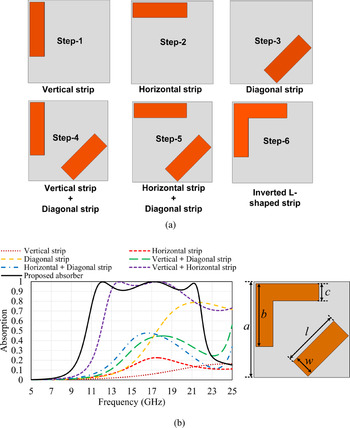
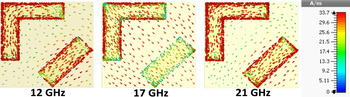
To interpret the wideband absorption mechanism, the design evolution of the proposed structure (design steps) and the corresponding absorption curve is shown in Figs 1(a) and 1(b), respectively. It is interestingly noticed that only single strip either vertical strip (Step-1) or horizontal strip (Step-2) provides very low absorption as clearly depicted in Fig. 1(b). However, individual diagonal strip (Step-3) resonates at 21 GHz with peak absorption of 80%. The absorption peak in Step-3 (diagonal strip) is higher than Step-1 (vertical strip) and Step-2 (horizontal strip) because eigenvalues vanishing identically corresponding to the number of holes result in resonances that are twofold degenerate [Reference Kruger and Scheidl22]. Further, the diagonal strip is added to the Step-1 and Step-2 resulting in Step-4 and Step-5 which are observed in the evolution process. The absorption peak for Step-4 and Step-5 is shown in Fig. 1(b). It is noticed that the combination of vertical strip and diagonal strip (Step-4) resonates at 18 GHz. However, the combination of horizontal strip and diagonal strip (Step-5) resonates at 16 GHz with very low absorption rate. Moreover, when we combine vertical strip and horizontal strip (Step-6), the absorption curve drastically changes, and provides a wideband absorption with a resonance peak at 14 and 18 GHz. Finally, to make UWB nature of the proposed absorber, all three strips are combined together which not only introduces a strong coupling between them but also increases their corresponding capacitances. Hence, the proposed structure resonates at lower frequency i.e. 12 GHz along with the high absorption peaks at 17 and 21 GHz, as shown in Fig. 1(b). The strong mutual coupling among strips provides overlapping of the close resonances resulting in UWB absorption from 12 to 21 GHz with more than 97% absorptivity. Furthermore, interpretation of the resonances can also be explained by the surface current distribution as shown in Fig. 2. It is noticed that at 12 GHz (lowest resonance), the almost same current density appears on vertical, horizontal, and diagonal strip due to which strong mutual coupling takes place. Therefore, the electrical length is increased and absorber resonates at 12 GHz with the peak absorption rate of 99%. However, maximum current is concentrated on inverted L-shaped strip at 17 GHz while equal current is concentrated at inverted L-shaped strip and diagonal strip at 21 GHz. From Fig. 1(b), it is interesting to notice that at 21 GHz, the resonance of diagonal strip (Step-3) and inverted L-shaped strip (Step-6) cross each other, hence the same magnitude of the surface current appears at these strips.
(a) Design evolution of proposed absorber, (b) absorptivity corresponding to design steps. Detail dimensions are a = 5 mm, b = 3.3 mm, c = 0.9 mm, l = 3 mm, and w = 1.1 mm.

Surface current distribution.

Further, the normalized input impedance (Z in) of the proposed UWB absorber, shown in Fig. 3 is calculated by using equation (1) [Reference Kalraiya, Chaudhary, Abdalla and Gangwar23]:

Normalized input impedance of the proposed UWB absorber.

It is observed that the imaginary part and the real part of the normalized input impedance becomes approximately equal to zero and unity, respectively, at the absorption peaks i.e. 12, 17, and 21 GHz. The unity value of the real part indicates the perfect impedance matching of the structure which leads to the maximum absorption.
Furthermore, the metamaterial characteristics i.e. effective permittivity (ɛ eff) and effective permeability (μ eff) of the proposed UWB absorber are analyzed and calculated using equation (2) and (3), respectively:


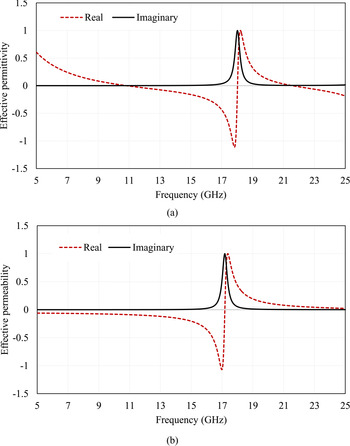
where k 0 is the wavenumber of the free space and d is the thickness of a single unit cell of the structure. The obtained real and imaginary parts of the effective permittivity (ɛ eff) and effective permeability (μ eff) are shown in Figs 4(a) and 4(b), respectively. The negative values of (ɛ eff) and (μ eff) in some part of the characteristic confirms that the proposed structure meets the metamaterial properties.
(a) Effective permittivity of the proposed UWB absorber, (b) effective permeability of the proposed UWB absorber.

Parametric sensitivity
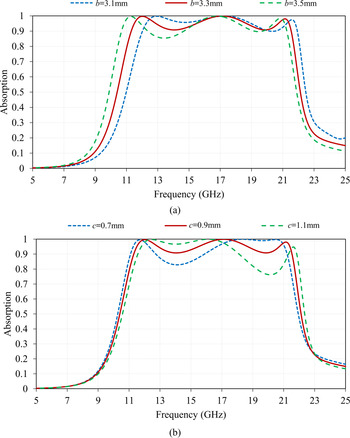
Further, the parametric sensitivity of the proposed absorber is observed by varying different parameters. Initially, the length “b” and width “c” of the L-shaped structure are varied keeping all other parameters fixed. It is observed from Fig. 5(a) that the increase in the length of the structure led to an increase in the inductance of the structure as a result of which the absorption peak shifts towards the lower frequency side. Moreover, while increasing the width of the L-shaped geometry, the absorption peak shifts towards the higher frequency side due to the decrease in the corresponding capacitance of the geometry as shown in Fig. 5(b).
(a) Effect of length of L-shaped structure “b”, (b) effect of width of L-shaped structure “c”.

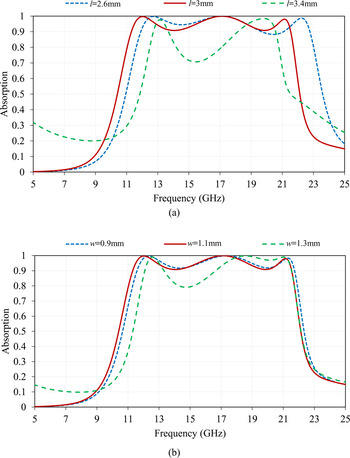
Furthermore, the effect of variation of parameters of the diagonally placed-rectangular shaped structure is also observed. It is observed from Figs 6(a) and 6(b) that while increasing the length “l” and width “w” of the diagonally placed-rectangular shaped structure, the bandwidth of the proposed wideband absorber decreases along with the decrease in the impedance matching and while decreasing the length of the diagonally placed-rectangular shaped structure, the absorption curve becomes wider but does not provide a good impedance matching.
(a) Effect of length of diagonally placed rectangular-shaped structure “l”, (b) effect of width of diagonally placed rectangular-shaped structure “w”.

Analysis of simulated results
All the design, simulation, and optimization of the proposed absorber are carried out using CST MWS. The proposed UWB absorber structure is observed under the transverse electric (TE) mode as well as the transverse magnetic (TM) mode as a function of frequency and wavelength. It is observed that the proposed design provides the same bandwidth along with the same peak absorptivity for both (TE and TM) modes as presented in Fig. 7. Moreover, the structure resonates at frequency 12, 17, 21 GHz and their corresponding wavelength i.e. 0.025, 0.017, and 0.014 m as shown in Figs 7(a) and 7(b), respectively. Further, in order to verify the property of MMA, the cross-polarization and co-polarization reflection coefficients are considered and shown in Fig. 8. The cross-polarization reflection coefficients (rxy and ryx) and the co-polarization reflection coefficients (rxx and ryy) are equal along x or y direction. Thus, we can consider only one polarization state for the incident wave [Reference Zhao and Cheng24]. It is observed from the figure that the cross-polarization reflection coefficient is approximately zero in the entire UWB band i.e. from 12 to 21 GHz whereas the co-polarization reflection coefficient is less than −10 dB and provides three dips near to 12, 17, and 21 GHz.
(a) Absorption rate under TE and TM modes as a function of frequency, (b) absorption rate under TE and TM modes as a function of wavelength.

Reflection coefficients of cross-polarization (rxy and ryx) and co-polarization (rxx and ryy).

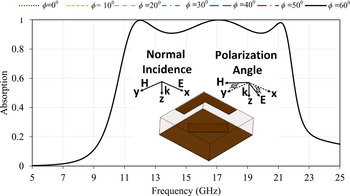
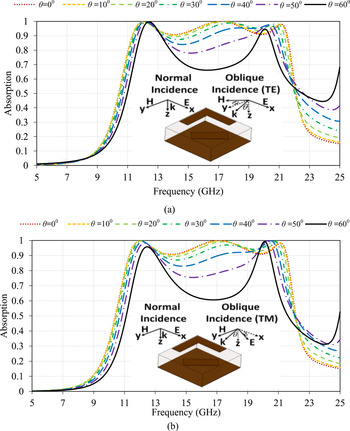
Furthermore, the proposed absorber is studied for the polarization sensitivity under the normal incidence angle. The direction of the wave vector is kept constant while the electric field and magnetic field directions are changed to examine the polarization behavior of the proposed structure. Although, no change is noticed under different polarization angles. It is clearly observed that as the polarization angle varies, the curves overlap each other thus making it polarization-insensitive in nature as shown in Fig. 9. Furthermore, the incident angle variation is analyzed to interpret its effect on the absorption rate as shown in Fig. 10. Firstly, the direction of the electric field is kept constant while the magnetic field and wave vector directions are varied by an angle θ as depicted in Fig. 10(a). Thereafter, the direction of the magnetic field is kept constant while the electric field and wave vector directions are varied by an angle θ as depicted in Fig. 10(b). It is noticed that the absorption rate remains almost the same up to 50° as the incident angle varies from normal incidence to oblique incidence. However, beyond 50° of oblique incidence, absorption decreases and additional peaks appear close to higher resonance due to the theory of multiple reflection and interference [Reference Wanghuang, Chen, Huang and Wen25].
Absorption response of proposed absorber with the variation of polarization angle (ϕ).

(a) Absorption response of proposed absorber with the variation of incident angle (θ) for TE polarized wave, (b) absorption response of proposed absorber with the variation of incident angle (θ) for TM polarized wave.

Experimental validation
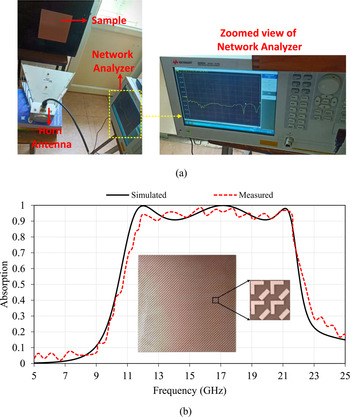
In order to impersonate the infinite periodicity of the unit cell, a 40 × 40 array of dimensions 200 × 200 mm2 of the proposed absorber is fabricated. The measurement setup contains a horn antenna, absorber holder, coaxial cables, and a network analyzer.The measurement is carried out using Keysight ENA series network anlayzer E5063A (100 KHz -18 GHz) however, the plot is showing upto 25 GHz. The measured result of the proposed absorber is closesly matched upto 18 GHz (the maximum range of network analyzer). Moreover, the measured result beyond 18 GHz is predicted based on the simulated data and measured data (upto 18 GHz).
The measurement setup of the fabricated prototype of the proposed absorber is shown in Fig. 11(a). The fabricated proposed absorber structure is positioned in forefront of the horn antenna at a distance 60 cm (far-field). Initially, the reflectance of the backplane (completely metallic) of the absorber is measured thereafter, the reflectance of the front side of MMA is measured. Then, metamaterial reflectance is normalized by backplane (metallic plate) reflectance. Finally, measured absorption is obtained which is compared with the simulated one as shown in Fig. 11(b). The minor variations between simulated and measured results are noticed. The fabrication tolerances and free space measurement inaccuracies have often led to these minor variations in the measured and simulated results.
(a) The measurement setup of the fabricated prototype of the proposed absorber, (b) the comparison of the simulated and the measured results.

Conclusion
In this paper, a super-compact UWB MMA has been analyzed. The unit cell configurations of the proposed structure are optimized to get the wider bandwidth with high absorption. The measured results confirm the proposed MMA achieving UWB absorptivity from 12 to 21 GHz with FWHM of 11.71 GHz. The absorption rate is more than 97% over the entire range of frequency. Further, the parametric sensitivity of the proposed absorber is observed by varying different parameters. Moreover, the polarization sensitivity and the consequence of incident angle are analyzed and observed the insignificant change is observed in peak absorption with the variation of polarization angle (ϕ) and small variation in peak absorption with the variation of incidence angle (θ). The proposed MMA is compared with reference absorber and observed that it is super compact with respect to size and has a wide bandwidth and FWHM. The proposed MMA covers Ku and K bands approximately and, therefore, has different quality applications in stealth technology, thermal imaging, detection, antenna systems, and other EM devices.
Acknowledgements
The authors would like to thank Department of Electronics and Communication Engineering, TIET, Patiala, Punjab for providing necessary instrument facility to carry out the measurement and would also like to thank Thapar Institute of Engineering and Technology, Patiala, Punjab for providing seed money grant as financial support to carry out this research.
 Manpreet Kaur received her B.Tech. degree in Electronics and Communication Engineering from the Punjabi University, Patiala, India in 2017 and M.Tech. degree in Electronics and Communication Engineering from the Thapar Institute of Engineering and Technology, India. Currently, she is pursuing her Ph.D. degree in the Department of Electronics and Communication Engineering, Thapar Institute of Engineering and Technology, Patiala, India. Her research interests include MIMO antennas, metamaterial absorbers, electromagnetic band gap structures, and so on. She has published three papers in various peer-reviewed international journals and conferences.
 Hari Shankar Singh was born in Sonbhadra (U.P.), India, in 1990. He received his B.Tech. degree from the IEC College of Engineering and Technology, Greater Noida (U.P.), India, in 2011 and Ph.D. degree from the Department of Electronics Engineering, Indian Institute of Technology, Banaras Hindu University, India, in 2015. Currently, he is working as Assistant Professor in the Department of Electronics and Communication Engineering, Thapar University, Patiala, Punjab. His research interests include microstrip antennas, MIMO antenna systems, ultrawideband (UWB) antennas, metamaterial absorbers, electromagnetic bandgap (EBG) structures, RFID antennas, mobile antennas, and multiple antenna–user interactions. His Ph.D. thesis has been awarded the best under the category of Ph.D. symposium in IEEE UPCON 2016, held at IIT (BHU), Varanasi. He has published more than 70 papers in various peer-reviewed international journals and conferences.