Hospital-acquired infections occur in 3%–6% of hospitalized patients,Reference Suetens, Latour and Kärki1, 2 increasing length of stay and costs associated with hospitalizations.Reference Lü, Cai and Cheng3 Interventions to prevent the acquisition of hospital pathogens among patients are aimed at decreasing the horizontal transfer of pathogens from patient to patient or from contaminated surfaces or communal equipment to noncolonized patients.Reference Weber, Rutala and Anderson4
Recent studies have shown that sink drains are potentially important environmental reservoirs of antibiotic-resistant pathogens.Reference Buchan, Graham and Lindmair-Snell5, Reference Kizny Gordon, Mathers and Cheong6 We recently found that sink drains adjacent to toilets within the patient zone had much higher presence of Klebsiella pneumoniae carbapenemase (KPC) genes than sink drains farther away from toilets.Reference Buchan, Graham and Lindmair-Snell5 To follow-up this finding, we compared a hydrogen peroxide product against bleach, finding the hydrogen peroxide product more effective at decreasing colony-forming units (CFU) in the drains.Reference Buchan, Arvan and Graham7 Here, we aimed to determine the ideal frequency of sink drain disinfection and to compare the effectiveness of 2 different hydrogen peroxide disinfectants at decreasing CFU in sink drains.
Methods
This study was performed in a medical intensive care unit (MICU) with 26 single rooms located in a 565-bed teaching hospital in Milwaukee, Wisconsin. Each room in the MICU has 2 sinks, 1 located next to the toilet and 1 next to the room entrance. In this study, we evaluated only the sinks located next to the toilets.
Two different disinfectants were compared in this study: product A (hydrogen peroxide, octanoic acid, and peroxyacetic acid; Virasept, Ecolab, St Paul, MN) and product B (hydrogen peroxide-based disinfectant; Peroxide Multi Surface Cleaner and Disinfectant, Ecolab) recently evaluated by our group.Reference Buchan, Arvan and Graham7 Product A came ready to use and product B required dilution according to the manufacturer’s instructions (6 ounces of disinfectant per gallon of water). Both products were applied using foaming devices by a single environmental services (EVS) staff member.
All 26 sink drains were randomly assigned to 3 groups: product A, product B, and control (no sink drain disinfection). The random assignment was performed by a team member (J.H.), and this allocation was not disclosed to other team members until after the statistical analysis was completed. Daily and terminal cleaning remained unchanged throughout the unit during the study.
The sink drains were sampled as previously described using E-swabs (Copan Diagnostics, Brescia, Italy).Reference Buchan, Graham and Lindmair-Snell5, Reference Buchan, Arvan and Graham7 Swabs were introduced as far down as possible through the sink’s strainer. The sink-drain walls were swabbed using two 360° circular motions. All the drains were sampled by the same investigator (J.R.), who was blinded to the group allocation. Sampling was performed on day 0 (morning prior to product application) and on days 1, 3, 5, and 7 after the intervention. All samples were obtained in the morning and were processed within 4 hours of collection.
Quantification of gram-negative burden was determined by serial dilution in saline plated to MacConkey agar, and dilutions that contained 20–200 colonies were used for CFU determination.
The means of the natural logarithm (Ln) of CFUs (1 + CFU) and their 95% confidence intervals for all 3 groups were compared for each sampling day. Linear regression and analysis of variance were used to compare the CFU reduction among all 3 groups adjusted by baseline counts. All analyses were performed using R version 3.5.0 software (R Foundation for Statistical Computing, Vienna, Austria).
Results
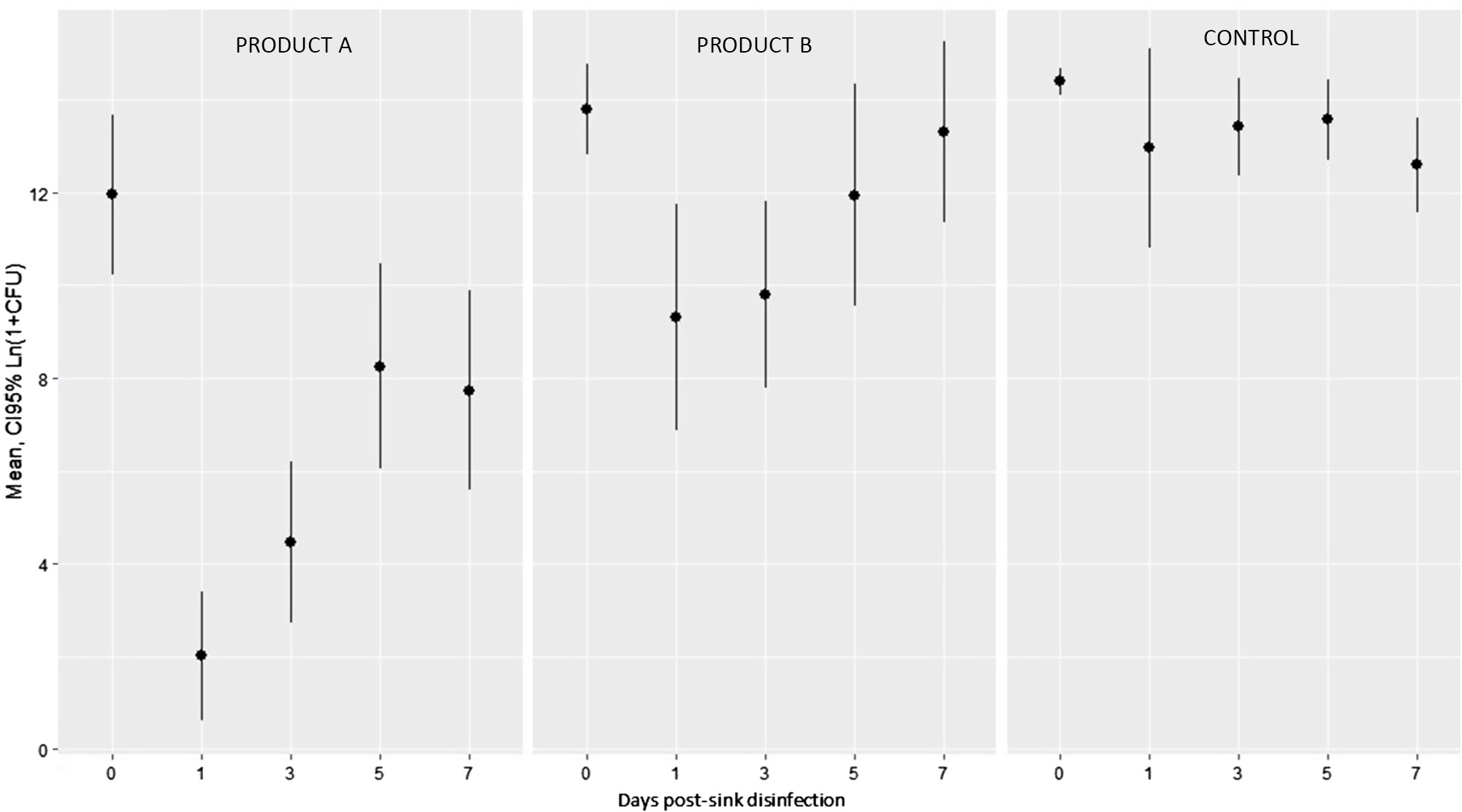
The mean ln (1 + CFU) and 95% confidence intervals for each group are shown in Figure 1. All 3 groups had similar baseline CFU counts (P > .05). On day 1, we observed a significant reduction in the CFU in the group treated with product A compared to its baseline counts (11.95 CFU/mL to 2.01 CFU/mL P < .01). Product B decreased in CFU from baseline (13.80 CFU/mL) to day 1 (9.31 CFU/mL), although the difference was not statistically significant (P = .11). The CFU counts in the control sinks remained unchanged throughout the experiment. We observed a greater reduction of CFU from day 0 to day 1 in group A compared to product B (P = .04) or the control (P < .01). On day 3, we observed a greater CFU reduction in the sinks treated with product A than sinks treated with product B (P = .04) or the control (P = .003). We observed no CFU reduction on day 3 when product B was compared against the control after adjusting for baseline CFU counts (P = .21). The CFU counts for all 3 groups returned to baseline levels on days 5 and 7.
Mean and 95% confidence interval natural logarithm of colony forming units by day after sink disinfection and group assignment. Day 0: swabs obtained morning prior to product application. Day 1: swabs obtained the day postintervention. Day 3: swabs obtained 3 days postintervention. Day 5: swabs obtained 5 days postintervention. Day 7: swabs obtained 7 days postintervention. Product A: hydrogen peroxide, octanoic acid, and peroxyacetic acid; Virasept (Ecolab, St Paul, MN). Product B: hydrogen peroxide-based disinfectant; Peroxide Multi Surface Cleaner and Disinfectant (Ecolab). Control: no additional disinfection. Note. ln, natural logarithm; CFU, colony-forming units.

The EVS staff reported that application of product B was more laborious than for product A due to the extra dilution step. Both products required a maximum of 30 seconds per sink to apply, were easy to use and dispense, and created minimal odor.
Discussion
In this study, we compared the magnitude and duration of the effect of 2 different disinfectants on the CFU counts inside sink drains. We found that product A was better at decreasing CFU than product B. The effects of both product A and B disappeared by day 5.
In a previous study, we found that hydrogen peroxide (product B) was superior to bleach at disinfecting sink drains.Reference Buchan, Arvan and Graham7 However, this initial study, we did not determine the ideal frequency of disinfection.
Recent studies have shown the relevance of sink drains in the horizontal transmission of KPC-producing organisms. Several interventions have been evaluated to disinfect the sink drains, including chemical disinfection, changing the design of these sinks, and application of heating and vibrating devices.Reference Kizny Gordon, Mathers and Cheong6 Based on our results, relative affordability and easiness of application, regular application of a mixture of hydrogen peroxide, octanoic acid, and peroxyacetic acid foam (every 3–5 days) should be considered in settings where there is concern that sink drains are acting as reservoirs of resistant pathogens. Nevertheless, the clinical relevance of sink disinfection using the products tested in this study and their impact on different pathogens should be further evaluated.
Acknowledgments
None.
Financial support
No financial support was provided relevant to this article. Ecolab provided the products used for this study; however, the company did not participate in the study design or in the interpretation of the findings.
Conflicts of interest
L.S.M.P. has received grant funds from Cepheid. B.B. has been a consultant for Luminex, has served as speaker for Biofire, and has received grant funding from Cepheid, Alere/TechLab, and GenePOC. All other authors report no other conflict of interest relevant to this article.