Introduction
Maruca vitrata Fabricius (Lepidoptera: Crambidae) (legume pod borer, LPB) is a common insect pest of a number of bean crops around the world and causes severe damage to economically important legumes in South and Southeast Asia as well as in sub-Saharan Africa (Schläger et al., Reference Schläger, Ulrichs, Srinivasan, Beran, Bhanu, Mewis and Schreiner2012). The larvae of LPB damage legumes from the seedling to the podding stage, especially during the dry seasons (Singh and Jackai, Reference Singh and Jackai1988; Phompanjai and Jamjanya, Reference Phompanjai and Jamjanya2000). Yield reductions of up to 80% resulting from LPB damage have been reported (Singh et al., Reference Singh, Jackai, Dos Santos, Adalla and Singh1990; Afun et al., Reference Afun, Jackai and Hodgson1991; Dreyer et al., Reference Dreyer, Baumgartner and Tamo1994; Ulrichs and Mewis, Reference Ulrichs and Mewis2004). Infestation levels of pigeon pea in Bangalore ranging from 9 to 50% in leaves (9.9%), pods (37.8%) and flowers (9.9%) have been reported by Karel (Reference Karel1985). Phompanjai and Jamjanya (Reference Phompanjai and Jamjanya2000) estimated 36% damage caused to cowpea flowers and pods by LPB in Thailand.
The current methods of control rely on chemical pesticides; however, these are widely known to have undesirable effects on non-target organisms, cause pollution in the ecosystem and have negative consequences for human health. Chemical pesticides generally yield immediate positive results with regard to pest control and this encourages most farmers to rely on them. The conventional chemical control of LPB in cowpea has been extensively studied by Booker (Reference Booker1965), Taylor (Reference Taylor1968), and Singh and Allen (Reference Singh, Allen, Summerfield and Bunting1980). The common chemical pesticides used against LPB in legume crops include endosulfan, triazophos, cypermethrin, dimethoate, monocrotophos, profenofos, lambda cyhalothrin, indoxacarb and spinosad (Dina and Medaiyedu, Reference Dina and Medaiyedu1976; Jackai, Reference Jackai1983; Chaudhari, Reference Chaudhari1988; Lal and Yadava, Reference Lal and Yadava1988; Ekesi, Reference Ekesi1999). A survey carried out by Sodavy et al. (Reference Sodavy, Sitha, Nugent and Murphy2000) has revealed that Cambodian farmers spray major vegetables including yard-long bean up to 20 times per season with about five different pesticides mixed together in a tank (as cited in Srinivasan et al., Reference Srinivasan, Yule, Chang, Malini, Lin, Hsu, Schafleitner, Holmer, Linwattana, Nath and Keatinge2012).
Neem (Azadirachta indica A. Juss; Meliaceae) originated in India and now has a worldwide distribution. The tree is one of the most common sources of plant-derived biopesticides, especially its active ingredient, azadirachtin. Bioactive compounds from all parts of the neem tree (Van der Nat et al., Reference Van der Nat, Van der Sluis, De Silva and Labadie1991; Chawla et al., Reference Chawla, Kumar and Bansal1995) have been shown to exhibit toxicity in insects through growth-regulating effects on the moulting process during ecdysis (Sieber and Rembold, Reference Sieber and Rembold1983) and to affect insect pests through a number of mechanisms, such as effects on hormonal processes and embryogenesis, antifeedant effects (Schmutterer, Reference Schmutterer1990; Ascher, Reference Ascher1992) and oviposition deterrence (Kumar et al., Reference Kumar, Poehling and Borgemeister2005; Kumar and Poehling, Reference Kumar and Poehling2007). In addition, azadirachtin has low toxicity against non-target organisms and low persistence in the environment (Schaaf et al., Reference Schaaf, Jarvis, Van der Esch, Giagnacovo and Oldham2000); both characteristics are desirable for a biocide (Pereyra et al., Reference Pereyra, Rossini and Darrigran2012). However, few detailed and comprehensive studies have been carried out on the quality and standards of neem-derived biopesticides, especially from field demonstrations.
Bacillus thuringiensis (Bt) is a soil bacterium that produces crystal proteins (δ-endotoxins). These exhibit pesticidal effects and are used as a biopesticide (Lambert and Peferoen, Reference Lambert and Peferoen1992; Schnepf et al., Reference Schnepf, Crickmore, Van Rie, Lereclus, Baum, Feitelson, Zeigler and Dean1998). Bt is effective at controlling the growth of LPB (Otieno and Karikuri, Reference Otieno, Karikuri and Magallona1991). The δ-endotoxins are denatured by the alkaline environment of the insect's digestive tract into a soluble form that is catalysed by proteases found in the insect's gut and result in the liberation of toxins from crystal proteins. The toxins then enter into the gut cell membrane and form a spore. Paralysis of the digestive tract leads to death by starvation (Dean, Reference Dean1984). Genes coding the selected toxins in Bt have been screened and transferred into many crops, termed Bt gene-modified crops, to protect against damage caused by insect pests. The δ-endotoxins isolated from different subspecies of Bt (Höfte and Whiteley, Reference Höfte and Whiteley1989) are Cry1A (Bt subsp. kurstaki) and Cry1Ca (Bt subsp. aizawai). These are commercially formulated biopesticides that exhibit effectiveness against LPB in Taiwan. However, relatively few studies have reported on the effects of Bt toxins on LPB in Asia (Srinivasan, Reference Srinivasan2008). It is vital that the disruption of the ecosystem through the misuse of chemical pesticides be avoided; therefore, a safe, efficient and eco-friendly pest control strategy is required (Srinivasan, Reference Srinivasan2008). Consequently, the biopesticide Bt can be an alternative and more ecosystem-friendly option for the integrated management and efficient control of LPB (Jeyarani and Karuppuchamy, Reference Jeyarani and Karuppuchamy2010) and for the development of integrated pest management tools.
However, the reported effects of neem and Bt vary considerably from country to country and from product to product. The availability of quality biopesticides and standardized products is often a big challenge. In addition, as LPB is supposed to have a number of biotypes with varied levels to tolerance of Bt, currently studies are being carried out to determine the baseline susceptibility and the possibility of using neem and Bt in laboratory and field conditions.
The objectives of this study were to estimate the effect of commercial Bt and neem products on various instars of LPB larvae in laboratory and field experiments and develop strategies to minimize or avoid the use of chemical pesticides in crop production and contribute to the sustainable management of this insect pest.
Materials and methods
Insect culture
The initial population of LPB was collected from a field in Pathumthani Province and subsequently mass-reared in the laboratory without exposure to any chemical or biopesticide for a year before the start of the experiments. For experimental purposes, same-day laid eggs were mass-reared to obtain a synchronized population. Sesbania grandiflora (Fabaceae) plants were grown in pots in a screen house and the larvae raised on the flowers in the laboratory without exposure to any pesticide. The larvae were maintained at the temperature range of 25–28 °C and relative humidity range of 60–80% under a 12 h dark–12 h light photoperiod until pupation.
Laboratory experiments
The biopesticide NeemBaan® (1300 ppm azadirachtin) from Bio-Control Research Laboratories (BCRL), India, and commercial biopesticide formulations based on Bt, Bactospeine® (Bt subsp. kurstaki) and Florbac® (Bt subsp. aizawai), were used in the study. Insect bioassays were conducted on six larval instars; larvae of each instar were treated with seven concentrations of NeemBaan® and 11 concentrations of Bactospeine® and Florbac® (Table 1); water was used as the control treatment agent. Sesbania grandiflora flowers were sprayed with different doses of biopesticides and allowed to dry in the laboratory prior to being exposed to the test population. For each treatment, five larvae were introduced into a cup containing S. grandiflora flowers treated with biopesticides. The cups were covered with perforated lids. The incubation conditions were the same as those followed in the laboratory, mentioned earlier. The numbers of dead and alive larvae were counted 4 days after exposure and converted into the percentage of mortality.
Commercial biopesticides used in the laboratory experiments on the larvae of six instars with the respective concentrations

Bt, Bacillus thuringiensis.
Field experiments
The field experiments were conducted at AIT in Pathumthani, Thailand, to standardize the biopesticide NeemBaan® against LPB in the yard-long bean plant. The experiments consisted of three treatments and four replicates (240 cm2 for each plant at 60 × 40 cm spacing; 24 plants/treatment), organized into a randomized complete-block design. The treatments were as follows: 1000, 4000 and 6000 ppm of NeemBaan®, with a recommended dose of cypermethrin 10EC at 1 litre/ha as a positive control and an untreated control. The treatments were commenced 3 weeks after seed sowing and continued at weekly intervals until the final harvest. After rainfall, the treatments were repeated. The plants were grown by following the recommended crop management practices and monitored at each harvest for damage caused by LPB. Five plants per replication were harvested for a total of four harvests. The pods were categorized as damaged or undamaged and the percentage of damage was calculated.
Data analysis
In the laboratory experiments, the dead and alive larvae were counted at the end of the experiments and converted into the corrected mortality percentage using Abbott's formula (Abbott, Reference Abbott1925). In addition, the dataset was subjected to a homogeneity test and the data were pooled in case of homogeneity. Prior to analysis of variance, the data were subjected to arc-sine square root (asin(sqrt(–/100)) transformation. Non-transformed data were used to plot graphs or construct tables. Tukey's HSD (Honestly Significant Difference) test was carried out for mean separation (SAS, 1999).
Similarly, in the field experiments, the pods from each harvest were weighed and the percentage of damage was calculated. The processes of data transformation and analysis were the same as those followed in the laboratory experiments.
Results
Laboratory experiments
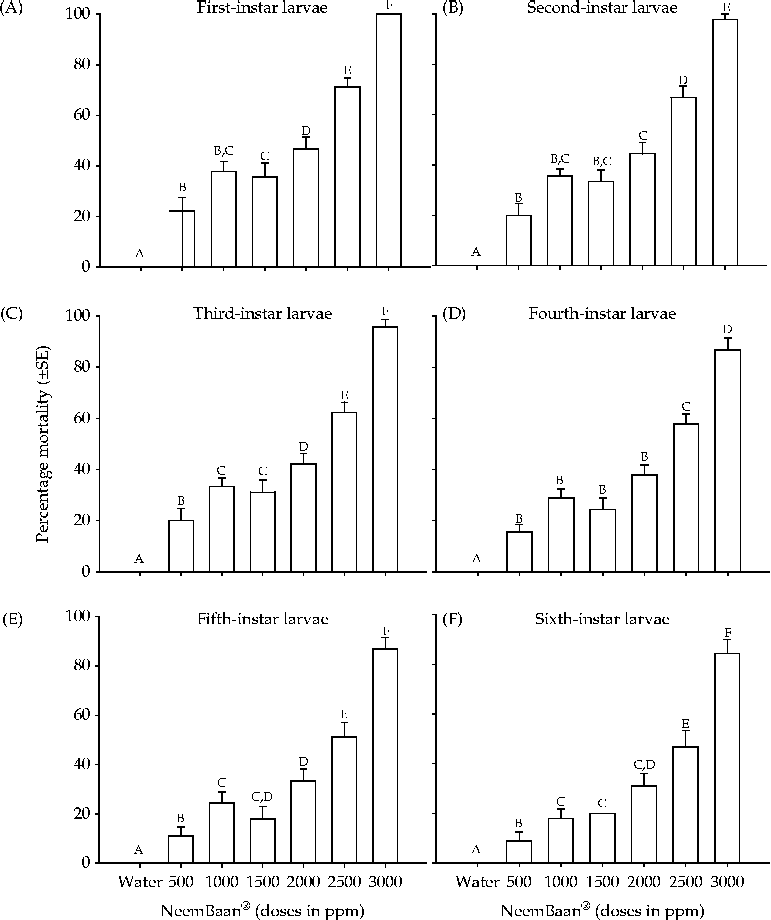
The different concentrations of NeemBaan® caused significant mortality in each larval instar (Fig. 1; first instar: F= 185.65; df = 6,62; P< 0.05; second instar: F= 147.02; df = 6,62; P< 0.005; third instar: F= 116.82; df = 6,62; P< 0.05; fourth instar: F= 71.47; df = 6,62; P< 0.05; fifth instar: F= 34.19; df = 6,62; P< 0.05; and sixth instar: F= 31.34; df = 6,62; P< 0.05). An increasing trend of higher mortality was observed with an increase in the dose of NeemBaan®. The mortality rate was >80% at a dose of 3000 ppm in all the instars (Fig. 1A–F). However, the later larval instars were found to be less susceptible, especially at lower doses (500–1000 ppm). The mortality rate was approximately 40% in the first and second instars at a dose of 1000 ppm of NeemBaan®. It was found to decrease in the fifth and sixth instars (24.44 and 17.78%, respectively) at the same dose. Hence, the susceptibility of LPB to higher doses of NeemBaan® was highly significant than that of LPB to the lower doses in all the larval instars (P< 0.05).
Percentage of mortality (mean ± SE) in the different larval instars of legume pod borer when treated with different doses of NeemBaan®: water (control), 500, 1000, 1500, 2000, 2500 and 3000 ppm under laboratory conditions. Bars with the same letters are not significantly different Tukey's HSD (Honestly Significant Difference) test.

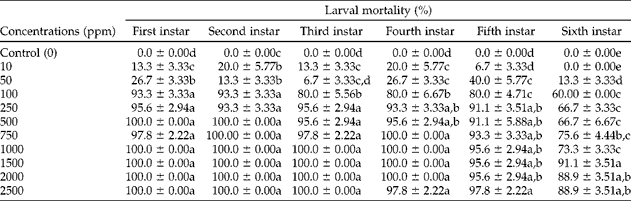
Various concentrations (10–2500 ppm) of Bactospeine® (results summarized in Table 2) and Florbac® (results summarized in Table 3) were tested. In the laboratory experiment carried out using Bactospeine®, a significantly high mortality rate was recorded (P< 0.05) in all the tested larval instars when treated with different concentrations. In each instar, a higher dose resulted in a higher mortality rate. When all the instars were treated with a dose >1000 ppm, a mortality rate of 73.3–100% was observed. For instance, absolute mortality was observed in the first, second and third instars, 97.8–100% in the fourth instar, 95.6–97.8% in the fifth instar and 73.3–91.1% in the sixth instar (Table 2). The later larval instars were found to be less susceptible.
Percentage of mortality in the larvae of different instars (mean±SE) of legume pod borer caused by Bactospeine® (Bacillus thuringiensis subsp. kurstaki) under laboratory conditions
Means followed by the same lower case letters within a column are not significantly different (P< 0.05; Tukey's test; SAS Institute, 1999).
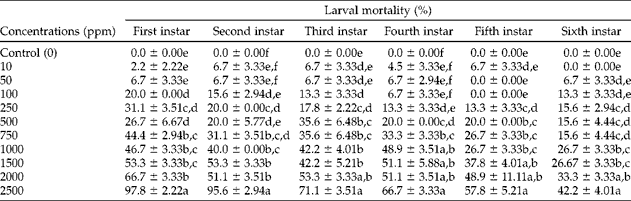
Percentage of mortality in the larvae of different instars (mean±SE) of legume pod borer caused by Florbac® (Bacillus thuringiensis subsp. aizawai) under laboratory conditions
Means followed by the same lower case letters within a column are not significantly different (P< 0.05; Tukey's test; SAS Institute, 1999).
Different concentrations of Florbac® had significant effects (P< 0.05) in all the larval instars. Higher doses resulted in a higher mortality rate. The toxicity of Bactospeine® was significantly higher than that of Florbac®, as mortality rates of 60–93.3% were observed in all the six instars at a lower dose (100 ppm) of Bactospeine®, whereas mortality rates of only 6.7–20% were observed for Florbac® at the same dose. Bactospeine® applied at a dose of 500 ppm resulted in 100% mortality of younger larvae (first and second instars), whereas Florbac® at a dose of 2500 ppm was required to achieve 97.8% mortality in the first instar.
Field experiments
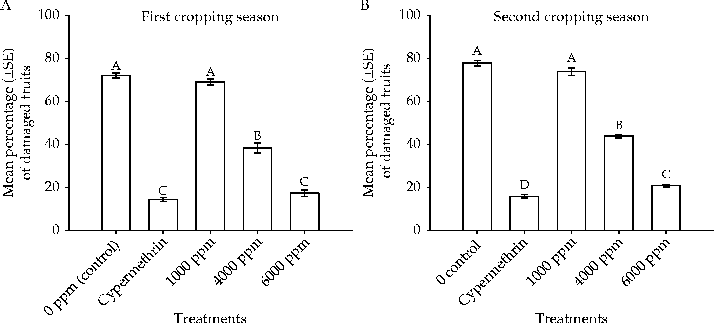
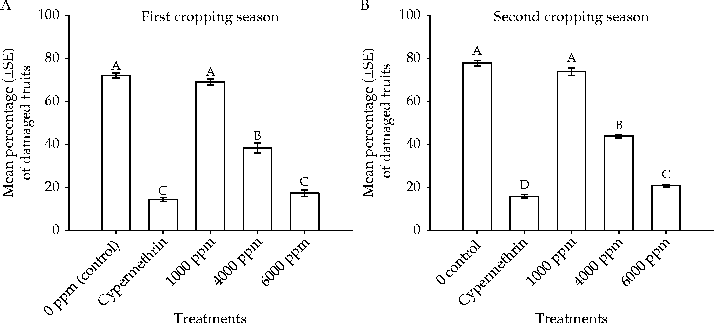
In the first cropping season, a weekly prophylactic spray of NeemBaan® significantly reduced the damage caused by LPB (F= 294.21; df = 4.19; P< 0.05) (Fig. 2). However, when the effect of a dose of 6000 ppm was compared with that of cypermethrin at the same dose, no significant difference was observed. Similarly, no significant effect of NeemBaan® was observed at a lower tested dose of 1000 ppm compared with the control. Similar trends in results were observed in the second cropping season, although the effect of the 6000 ppm dose was lower than that in the first cropping season. The chemical cypermethrin was most effective at reducing pod damage to less than 20% (F= 513.2; df = 4.19; P< 0.05). In the field experiments carried out during both the cropping seasons, NeemBaan® applied at a dose of 6000 ppm significantly reduced pod damage to approximately 20%.
Impact of different treatments on the mean percentage ( ± SE) of damaged fruits due to legume pod borer in the field experiments. Treatments used were water spray (control); cypermethrin (positive control); 1, 4 and 6 ml/l NeemBaan®. Bars with the same letters are not significantly different Tukey's HSD (Honestly Significant Difference) test.
Discussion
The limited availability of baseline information on the effects of neem-based biopesticides, in general, and of Bt on LPB was the most compelling reason for conducting this series of experiments. Also, the issue of quality is yet another problem limiting the possible adoption of biopesticides as a valid means for managing this insect pest by farmers. The results of the present study support those of the recent studies in which neem-based biopesticides have been found to be effective only at higher doses for most lepidopteran pests (Jayadevi and Kumar, Reference Jayadevi, Kumar, Srinivasan, Shelton and Collins2011). In a laboratory experiment, Yule and Srinivasan (Reference Yule and Srinivasan2013) found that 90% mortality was achieved with ThaiNeem111® at 50,000 ppm. However, in the laboratory experiments carried out in the present study, more than 80% mortality was observed at a dose of 3000 ppm of NeemBaan® in all the larval instars. There could be several reasons for this, such as differences in the strain of LPB and/or the quality of the neem product.
Different Bt δ-endotoxins have already been evaluated against LPB at AVRDC, Taiwan (Srinivasan et al., Reference Srinivasan, Yule, Chang, Malini, Lin, Hsu, Schafleitner, Holmer, Linwattana, Nath and Keatinge2012); Cry1Ab, one of the major toxins in Bt subsp. kurstaki, was found to be the most toxic followed by Cry1Ca, a major toxin in Bt subsp. aizawai (Srinivasan, Reference Srinivasan2008). In another study, among the different commercial formulations of Bt tested, Dipel® (Bt subsp. kurstaki) and Florbac® (Bt subsp. aizawai) were found to be the most toxic against LPB in Taiwan (AVRDC, 1996, 1997). However, a recent study carried out by Yule and Srinivasan (Reference Yule and Srinivasan2013) in Thailand has demonstrated that the insect is more susceptible to Bt subsp. kurstaki than to Bt subsp. aizawai. In the present study, we also found that all the larval instars were more susceptible to Bactospeine®. This could be due to the differences in the major toxins present in the formulations; the results are consistent with those of an earlier study carried out in Thailand (Yule and Srinivasan, Reference Yule and Srinivasan2013). Moreover, at all doses, older larvae were less susceptible to Bt biopesticide formulations than younger larvae. These results support those of an earlier study carried out by Faridi et al. (Reference Faridi, Pourmirza, Safaralizadehm and Taghaddosi2011) showing that younger larvae of the Colorado potato beetle are more susceptible to Bt than older instars, based on LD50 values (LD50 is the dose of a toxic compound that causes death in 50% of a group of experimental animals to which it is administered: used as a measure of the toxicity of drugs). Different patterns of susceptibility to Bt were found at different larval stages. Thus, the susceptibility of different instars at the time of application of Bt biopesticide formulations is a key factor that can help control the insect pests in field conditions (Faridi et al., Reference Faridi, Pourmirza, Safaralizadehm and Taghaddosi2011).
The results of the laboratory and field experiments were not compared, but the trends of mortality indicated that NeemBaan® was more effective in laboratory conditions. This could be due to the high exposure of neem products to UV rays in field conditions that resulted in the loss of bioefficacy (Kumar and Poehling, Reference Kumar and Poehling2007). In the field experiments, the efficacy of the high-dose treatment of NeemBaan® was on a par with that of cypermethrin. However, the high application doses of neem products resulted in high costs because of their unstable bioefficacy after exposure to the field environment. Hence, the currently available biopesticide formulations, such as neem, may not be able to control pests such as LPB when used alone (Yule and Srinivasan, Reference Yule and Srinivasan2013). Combining various methods of neem application (e.g. the slow-release neem pellets as soil application, seed treatment and foliar application) and the use of UV blockers and combinations of neem and Bt can possibly enhance the efficacy of the biopesticide products in field conditions to yield results comparable to those of the laboratory experiments.
Conclusion
The effective management of LPB with biopesticides requires comprehensive studies in laboratory and field conditions and in different regions. Obtaining baseline information on the effects of neem- and Bt-derived biopesticides is an essential step towards the development of an adequate and effective strategy for the control of LPB in Thailand. This study has demonstrated that the insect is highly susceptible to Bt subsp. kurstaki in laboratory conditions and to a high dose of neem-based biopesticides in field conditions. The results suggest that maintaining and enhancing the effectiveness of biopesticides are vital steps to achieve a satisfactory control of LPB.
Acknowledgements
This study was supported by funds from the Federal Ministry for Economic Cooperation and Development, Germany, through AVRDC – The World Vegetable Center, Taiwan.