

INTRODUCTION
The exceptional vigour, precocity and high yield of Posnette's (Reference Posnette1951) seedlings derived from the first crosses involving Pound's (Reference Pound1938) seedling collection of cocoa from Peru and similar observations in Trinidad were attributed to ‘hybrid vigour’ (Bell and Rogers, Reference Bell and Rogers1956; Montserin et al., Reference Montserin, de Verteuil and Freeman1957). Wide crossing to exploit hybrid vigour became the accepted method of cocoa breeding (Toxopeus, Reference Toxopeus, Ferwerda and Wit1969). Today, improvement of once genetically isolated ‘populations’ is being adopted as a means of maintaining their identity so that when inter-crossed they will express hybrid vigour (Eskes et al., Reference Eskes, Paulin, Clement, N'Goran, Sounigo, Lachenaud, Cilas, Berry and Yagmpam1994). In cocoa, hybrid vigour is considered to be as useful for conferring establishment ability as it is for precocity and high early yield (Toxopeus, Reference Toxopeus, Wood and Lass1985).
Allen (Reference Allen1988) described the precarious sexual reproductive ‘strategy’ of the species in its natural habitat, with low rates of seed production, recalcitrant seeds and dependence on dispersal by mammals, usually over short distances and to heavily shaded situations, with low survival rates. In these circumstances, extremely vigorous growth of the seedlings and precocity would be advantageous. Bartley (Reference Bartley2005, p. 88) reported a nineteenth century observation of exceptional precocity in one uncultivated population. The biology of the crop would suggest that in its natural habitat, ‘populations’ could evolve by genetic drift into isolation, inlocalities such as river valleys. The latter hypothesis, which is confirmed by molecular data (Lanaud et al., Reference Lanaud, Motamayor and Risterucci2001), was strongly advocated by Bartley (Reference Bartley2005).
Atanda and Toxopeus (Reference Atanda and Toxopeus1971) reported increased yield from inter-crossing unrelated, partially inbred cocoa types of Trinitario and lower Amazon Forastero origin. They also reported that the bi-parental crosses were more vigorous than their parents. This work apart, there has been little in the way of formal investigation of hybrid vigour in cocoa. One reason may be that parents are usually preserved as clones, propagated as plagiotrops,Footnote 1 which until recently were considered to be difficult in agriculture, especially in West Africa. When clones were tested as budded orthotrops and as budded plagiotrops there was little difference between them for yield (Cope, Reference Cope1953; Pang et al., Reference Pang, Lim and Lockwood1994). Likewise, there was little difference in yield between rooted cuttings and buddings, as both orthotrops and plagiotrops (Cope, Reference Cope1953). It has always been thought that seedlings and clones should not be mixed in long-term trials, because the difference in growth habit would lead to differential competition, with the seedlings gaining an advantage unless the seedlings and clones were pruned differently, which would introduce a bias.
The yield of cocoa genotypes is heavily influenced by planting density (Lockwood and Pang, Reference Lockwood and Pang1996; Mooleedhar and Lauckner, Reference Mooleedhar and Lauckner1990). Some Upper Amazon clones are precocious and high yielding when grown at planting densities that are appropriate to their vigour, perhaps three times the customary one, among them NA33, PA13 and PA300 (Lockwood and Pang, Reference Lockwood and Pang1996). Some are highly vigorous during the pre-bearing period, a trait that is usually associated with establishment ability. Toxopeus (Reference Toxopeus1968) commented that a surprisingly large proportion of second generation Upper Amazon clones showed good establishment ability in Nigeria.
In cocoa, as in other orchard crops, the optimum planting density for low vigour material is much higher than it is for highly vigorous genotypes. In apples and other fruit crops, yield increases have been explained in terms of ‘yield efficiency’, the ratio of economic yield to vegetative growth (for example, Larsen and Fritts, Reference Larsen and Fritts1982). Daymond et al. (Reference Daymond, Hadley, Machado and Ng2002) applied this concept to cocoa in Brazil, demonstrating the potential for yield improvement in the crop by selectively breeding for more efficient partitioning to the yield component. In Sabah, yield efficiency showed additive inheritance in factorial mating designs (Pang, Reference Pang2006).
In bi-parental crosses involving diverse cocoa types, general combining abilities predominate for yield, vegetative growth, yield efficiency and bean weight. In nine factorial matings at Golden Hope Research Centre, Sabah (previously known as Scientific Department, BAL Plantations Sdn Bhd), involving 75 parents, the average additive component of genotypic variance (r 2) were 87.2, 87.3, 85.9 and 86.4% for yield, trunk cross-sectional area, yield efficiency and bean weight respectively (Joe Thau-Yin Pang, in preparation). These observations suggest a consistently large additive component to the inheritance of these four traits. Variation in heterosis among the crosses is inseparable from other non-additive components in these analyses. When there is a very high additive component of genotypic variance, the phenotype should be a good guide to breeding value, but Bartley (Reference Bartley1967) argued that ‘the performance of bi-clonal hybrids is not related to the performance of the parents as clones’. However, Lockwood and Pang (Reference Lockwood and Pang1993) concluded that the correlation between the yield of clones grown at planting densities that may have been near their optimum and their general combining abilities for yield was strong enough to be useful.
The concept of ‘juvenile’ and ‘mature’ phases (Doorenbos, Reference Doorenbos and Ruhland1965) is well established in perennial crops (for a review see Duneberg, Reference Duneberg1977), with juvenile plants characterized by rapid growth, ease of rooting and lack of flowering, as occurs in seedling cocoa trees before they jorquette. Masseret et al. (Reference Masseret, Alvarez, Fontanel and Pétiard2005) reported that over the first two years, cocoa plants raised from somatic embryoids grew about 40% faster than plants that were propagated conventionally from the same clone. However, the faster growth of plants derived from somatic embryoids compared to budded ones is not necessarily a juvenility effect as vascular discontinuities in bud unions are associated with dwarfing effects in apples (Soumelidou et al., Reference Soumelidou, Battey, John and Barnett1994).
This paper discusses four experiments in Sabah in which different bi-parental crosses were compared with their clonal parents as both seedlings and clones. The focus is on seedling vigour and whether there is hybrid vigour for yield over and above the effect of vegetative vigour in young trees before differential competition sets in.
MATERIALS AND METHODS
The experimental work was undertaken at Golden Hope Research Centre, Sabah, located just outside Tawau in Sabah, Malaysia (about 4°N, 118°E), at an elevation of about 80 m asl. The soils were highly fertile, young volcanic ash derived from basalt. The average annual rainfall was 2000–2100 mm, well distributed, with the driest month averaging about 130 mm. The more significant pest and disease problems were cocoa pod borer (Conopomorpha cramerella), which was controlled by sanitation and the spraying of insecticides, and vascular streak dieback disease, caused by infection with Oncobasidium theobromae, which was controlled by sanitation and by spraying fungicides during the nursery and establishment phases.
All vegetative propagation was by budding plagiotropic buds onto young seedling rootstocks. A single cross from a seed garden was used in the absence of interactions between clonal genotype and rootstock (Pang, Reference Pang2004).
The parents used in the study were all of Upper Amazon Forastero type of Peruvian origin except ‘PA’35:
IMC67 (Iquitos Mixed Calabacillo, Pound, Reference Pound1938)
NA33 (Nanay, Pound, Reference Pound1938)
PA13, 300 (Parinari, Pound, Reference Pound1938)
‘PA’35 (an unidentified introduced clone with Trinitario affinities)
SCA9 (Scavina, Pound, Reference Pound1938).
Molecular data suggest a close relationship between the Nanay and IMC material (Sounigo et al., Reference Sounigo, Christopher, Ramdahin, Umaharan and Sankar2001). The Scavina and Parinari material are more distant from both groups and each other. The one Trinitario clone is distinct. There is no cause to question the identification of the Upper Amazon material except possibly IMC67. The pod shape and other characteristics indicate that it is an IMC, but it may not be IMC67 itself. However, the labelling of the clones may not correspond to that in germplasm collections elsewhere in the world.
SCA9 × PA13 and SCA9 × PA300 were chosen as high-yielding crosses from trial CA55 planted in August 1986. They were thought to be two of the highest yielding crosses in the breeding programme. IMC67 × PA300, also from CA55, was chosen because some trees had a low pod value (number of pods required to produce a unit of dry cocoa beans). NA33 × ‘PA’35 was selected from trial CA70 planted in May 1987 (Joe Thau-Yin Pang, in preparation) because NA33 was thought to be a better parent than NA32, and a seedling of ‘PA’35 × NA32 had proved commercially valuable as clone BAL209 (see for example Pang, Reference Pang2004). In NA33 × ‘PA’35, selection was for self-compatibility only. In the other three families, seedling trees were selected for bean weight and for a positive deviation from the regression of yield on single tree girth. Because SCA9 × PA13 and SCA9 × PA300 have smaller beans on average than IMC67 × PA300, most of the selection pressure was for bean weight in these two crosses.
Twenty-two seedlings were propagated from each cross. They were arranged as 22 entries in different trials for each cross (‘cloned seedlings’). Each trial also included:
• the original cross reproduced by making one budding each from a random sample of the original seedlings (clone control)
• the original cross reproduced as seeds, by manual pollination of the two parents (seedlings)
• the parents as clones
• two commercial clones as controls in Trial CA209 and three in each of the other three trials.
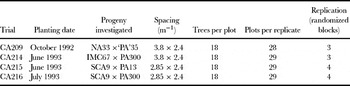
Planting dates and other experimental details are summarized in Table 1. The budding was done in the first quarter of 1992 (CA209) and in December 1992–January 1993 for the other three trials. Husbandry practices were the commercial norm, with minimal pruning of the clones to ensure a manageable growth habit. Experience had shown that this practice did not cause a perceptible check to vegetative growth.
Planting dates, entries and spacing in four cocoa clone trials.

Stem diameters were measured with calipers, approximately 15 cm above ground level. Harvesting was at two-week intervals from commencement of bearing 15–17 months after planting, with the weight of wet cocoa measured on a plot basis. The conversion ratio from wet to dry weight was assumed be 35%. The trials were terminated in June 1996 following the sale of BAL Plantations Sdn Bhd to Golden Hope Plantations Bhd.
Yield efficiency was calculated as the yield in grams dry cocoa per tree from the commencement of bearing divided by the stem cross-sectional area in cm2 in September or October 1995.
Standard errors of differences were calculated from the residual mean square in the analysis of variance and the replication of the contrasts under examination (Snedecor and Cochran, Reference Snedecor and Cochran1967; section 4.10).
RESULTS
There were statistically significant differences (p < 0.001) for yield, trunk cross-sectional area and yield efficiency among the entries in all four trials.
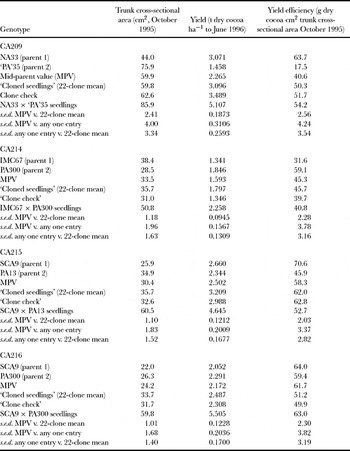
In all four trials the seedlings were by far the most vigorous material: in the two SCA9 crosses (Trials CA215 and CA216) the trunk cross-sectional area of the seedlings was about 1.7 times larger than the average of the ‘cloned seedlings’ and in the other two crosses the seedlings were 43% and 42% more vigorous (Table 2). The yields of the seedlings were 145 and 221% of those of the ‘cloned seedlings’ for the Scavina crosses, 164% for the Trinitario cross (CA209) and 126% for the other inter-Amazon cross (Trial CA214), with the shortest period of yield recording.
Trunk cross-sectional area, yield and yield efficiency of clones, seedlings and parental clones and mid-parent values of four bi-parental crosses in separate cocoa trials.

The mean trunk cross-sectional areas and the yields of the 22 ‘cloned seedlings’ were greater than those of the clone control in three of the four crosses, the difference being statistically significant (p < 0.01 and p < 0.05) for CA214 and CA215 respectively.
In CA209 and in CA214, the mid-parent value (MPV) for mean trunk cross-sectional area was not significantly different to that for the clone control or the mean of the ‘cloned seedlings’. In trial CA215, the MPV for trunk cross-sectional area was significantly (p < 0.001) less than that of the ‘cloned seedlings’ but not of the clone control. In trial CA216, the MPV for trunk cross-sectional area was significantly (p < 0.001) less than that of the ‘cloned seedlings’ and the clone control.
The average yield of the ‘cloned seedlings’ was significantly greater than MPV in all four trials (p < 0.001 in CA209 and CA215, p < 0.05 in CA214 and CA216). Similar results were obtained in comparisons between MPV and the clone control.
SCA9 and NA33 had the highest values for yield efficiency in the trials where they were used as parents. IMC67 and especially ‘PA’35 had much lower values. The seedlings were both the most vigorous and the highest yielding entries in all four trials with relatively large values for yield efficiency, although not the largest values in any of the trials. In three of the four trials the yield efficiency estimates for the clone control and ‘cloned seedlings’ were close together; in CA214 the ‘cloned seedlings’ had higher yield efficiency than the clone control, but the difference was not significant at p = 0.05. In trial CA209 the yield efficiency of the clone control and the ‘cloned seedlings’ were significantly (p < 0.05 and p < 0.001 respectively) greater than MPV; in CA214 and CA215 the differences were not significant (p > 0.05) and in CA216 the yield efficiencies of the clone control and ‘cloned seedlings’ were below MPV, with the difference significant at p < 0.01 and p < 0.001 respectively.
DISCUSSION
The comparisons between parents grown as clones and their progeny grown as clones suggests that much, but possibly not all, of the ‘hybrid vigour’ observed in seedlings derived from Upper Amazon clones should not be interpreted as heterosis. Rather, there is an epigenetic effect, such that when seedlings of Upper Amazonian parentage are converted into clones they lose vigour, which can be restored through somatic embryogenesis. It remains uncertain whether the effect is juvenility or the consequence of grafting. Seedlings should not be compared with clones when considering hybrid vigour.
The comparison of the ‘cloned seedlings’ to the clone control suggests that the results were not disturbed unduly by the selection pressure that was applied. As the trials were young when they were terminated, and the planting densities were relatively low, it is highly unlikely that differential competition developed among the entries. Equally, the results should not be dismissed as being too preliminary to be of value, because hybrid vigour in cocoa is considered to be a decisive factor in the establishment ability and precocity of so-called ‘hybrid’ varieties and the basis of the claimed high yield potential of such material. As already indicated, there has been little investigation of this guiding principle of cocoa breeding over the 50 years since it was adopted.
The smallest departure from mid-parent value for vegetative vigour was in the single Trinitario cross (NA33 × ‘PA’35), which is thought to be the widest of the four crosses. If there is heterosis in cocoa and it is correlated with genetic distance, then its expression might have been strongest in this cross. If inbreeding of the parents is more important in determining heterosis in cocoa, then the usually heterozygous nature of the Trinitarios might have worked against this cross. Although the heterozygosity of ‘PA’35 in particular is not known, its progeny are highly variable from tree to tree.
Juvenility and maturity are a continuum, as has been described, for example, in teak (Tectona grandis, Husen and Pal, Reference Husen and Pal2006). It is possible that the seedlings that provided the budwood for the ‘cloned seedlings’ when propagated by budding 55 months (CA209) and 77 months (CA214–216) after planting retained a measure of juvenile vigour, as Husen and Pal observed in nine-year old teak trees. Perhaps this juvenility was expressed in the cloned families, but had been lost from the parental clones themselves, and this contributed to the positive departures from MPVs. Possibly the weakness of the parent clones was amplified by use of planting densities that were too low by a factor of two or more for clones like NA33 and SCA9. The lack of mutual protection might well have checked their growth. It is also possible that there was a topophytic effect. When the seedlings were propagated, the budwood was the first generation of plagiotropic material, whereas the parents had been propagated at irregular intervals from plagiotropic branches over some 50 years.
Yields in these young trials were strongly correlated with vegetative vigour and so the ability to exploit the available space. The seedlings grew faster than the clones, so the trees were larger and consequently early yields were higher. As it is highly likely that they had different optimum planting densities at maturity, yield efficiency may be preferred to yield as a measure of potential economic advantage from departures from MPVs in bi-parental crosses. Furthermore, hybrid vigour for yield based on vegetative vigour alone would not contribute to increased yield at maturity. Only one cross, NA33 × ‘PA’35 showed a large positive departure from MPV. In this cross, one of the parents lacked precocity, so the MPV was depressed.
Unpredictable departures from additivity in the inheritance of early vigour will hinder evaluation of material, by making it difficult to predict the optimum planting densities for the evaluation of new crosses. Less vigorous material requires higher planting densities, which are under the farmer's control, and can be varied over quite wide limits without undue effect on the economics of crop production. The results show that clones are less vigorous than the seedlings from which they are selected. This may explain why it has proved so difficult to select good clones in good families when working at a single planting density chosen for its agricultural suitability to the seedlings. Masseret et al.'s (Reference Masseret, Alvarez, Fontanel and Pétiard2005) results suggest that the optimal planting density for a set of seedlings is lower than that of the parental clones, which is consistent with our unpublished observations at Golden Hope Research Centre, Sabah, that seedlings derived from the best commercial clones in Sabah were too vigorous when grown at the optimum planting density for the clones themselves. Critical work is required to quantify the relationship between the optimum planting densities of clones and seedlings: our experience suggests a difference of about 40%. The combination of wide variation in optimum planting density of the clones themselves and the optimum planting density of clones being higher than that of related seedlings may explain Bartley's (Reference Bartley1967) observation on the lack of a relationship between the phenotype and the genotype for yield.
The results of these experiments, the first comparison between cocoa clones and the clonal descendants of their bi-parental crosses, suggest that if the concept of powerful hybrid vigour for yield were not already embedded in cocoa, it would not now be adopted unreservedly. A large proportion of the ‘hybrid vigour’ seen in the first crosses in Ghana and in Trinidad can be re-interpreted as being due to a difference in vigour between seedlings and clones combined with the intrinsic precocity and high yield potential of some but not all Upper Amazon material. Much of the establishment ability and precocity claimed as benefits of heterosis are also open to re-interpretation as traits of some of the Upper Amazon progenitors.
The comparisons between clonal parents and their cloned offspring leave open the question of whether there is significant heterosis over and above the epigenetic effect on seedlings. Given that there is no suggestion of heterosis for yield efficiency, in practice the question may not be an important one anyway, except for establishment ability. If ‘hybrid vigour’ does not ensure high potential material, simple recurrent selection is an appropriate breeding strategy, at least until the better ‘populations’ have been identified in practical breeding programmes. For the next two or three generations it will be appropriate to inter-cross the clones that perform best under current agricultural conditions, especially planting density, while avoiding inbreeding. The success of such a strategy was demonstrated in Java 70 years ago (Van Hall, Reference Van Hall1930).
Acknowledgements
The authors wish to thank Tuan Hj. Khairudin Hashim, Executive Director of Golden Hope Research Sdn Bhd for permission to publish this paper.