Introduction
Classical biological control programs involve the intentional introduction of a natural enemy (i.e., pathogen, parasite, parasitoid, or predator) from an alien pest's native range to control a pest in its adventive range (De Bach, Reference De Bach1968), and worldwide many important pests have been controlled using this control method (De Bach and Schlinger, Reference De Bach and Schlinger1964; Caltagirone and Doutt, Reference Caltagirone and Doutt1989; Evans et al., Reference Evans, Soares and Yasuda2011; Kairo et al., Reference Kairo, Paraiso, Gautam and Peterkin2013 among others). One concern is that released natural enemy species will adversely affect indigenous organisms (so-called ‘non-target’ species) that integrate the food web in the habitat (De Bach, Reference De Bach1968). Assessments of efficacy and specificity are now integral components of risk assessments before natural enemies are introduced, and rigor for those assessments has increased in recent decades.
Most successful classical biological control programs with ladybird beetles (Coleoptera: Coccinellidae) involve species with specialized diets, being primarily soft scale (Hemiptera: Coccidae) feeders (Dixon, Reference Dixon2000) [i.e. Rodolia cardinalis (Mulsant) to control Icerya purchasi Maskell in citrus orchards in California] (De Bach and Schlinger, Reference De Bach and Schlinger1964; Caltagirone and Doutt, Reference Caltagirone and Doutt1989). In contrast, most attempts to use generalist-feeding ladybird beetle species have failed to control the target species (Evans et al., Reference Evans, Soares and Yasuda2011) and occasionally resulted in non-target effects from predation upon non-intended prey, increased competition, intraguild predation, and displacement of indigenous predatory species (Elliott et al., Reference Elliott, Kieckhefer and Kauffman1996; Follet and Duan, Reference Follet and Duan2000; Koch et al., Reference Koch, Venette and Hutchison2006; Evans et al., Reference Evans, Soares and Yasuda2011; Sloggett, Reference Sloggett2017).
Possibly as early as 1912, releases of Cryptolaemus montrouzieri Mulsant (Coleoptera: Coccinellidae), the ‘mealybug destroyer’, began in Central and South America (reviewed in Kairo et al., Reference Kairo, Paraiso, Gautam and Peterkin2013). This lady beetle is indigenous to Australia and can feed upon at least 94 insect species in 12 families (Babu and Azam, Reference Babu and Azam1987; Kairo et al., Reference Kairo, Paraiso, Gautam and Peterkin2013). It may be one of the most widely released natural enemies having first been introduced in California between 1891 and 92 by Albert Koebele to control mealybugs (Hemiptera: Pseudococcidae) in citrus. Also, it has been released in more than 40 countries in temperate and tropical regions (Maes et al., Reference Maes, Grégoire and De Clercq2015). In Brazil, C. montrouzieri was introduced to control citrus mealybugs Planococcus citri (Risso) (Sanches and Carvalho, Reference Sanches and Carvalho2010; Kairo et al., Reference Kairo, Paraiso, Gautam and Peterkin2013), and occurs in various regions of Brazil, including the Southeast and Northeast regions, in the states of São Paulo, Bahia, and Pernambuco (Sanches and Carvalho, Reference Sanches and Carvalho2010; De Bortoli et al., Reference De Bortoli, De Laurentis, Gravena, Vacari and De Bortoli2014; Marques et al., Reference Marques, Lima, Melo, Barros and Paranhos2015; Lopes, Reference Lopes2016; Sá et al., Reference Sá, Oliveira, Costa and Lopes2020).
Little attention has been given to the potential for C. montrouzieri to displace indigenous predatory species in Brazil. This exotic species shows overlap in food niche with Brazilian native ladybirds that prey upon mealybugs (Pseudococcidae) (Marques et al., Reference Marques, Lima, Melo, Barros and Paranhos2015; Pacheco da Silva et al., Reference da Silva VC, Kaydan, Silva-Torres and Torres2019; Sá et al., Reference Sá, Oliveira, Costa and Lopes2020). For instance, C. montrouzieri has been reported in the semiarid region of the state of Pernambuco, such as Petrolina, where there is the occurrence of native species such as Tenuisvalvae notata (Mulsant) ( = Hyperaspis notata Mulsant) (Coleoptera: Coccinellidae), and share mealybug preys such as Phenacoccus solenopsis Tinsley, Ferrisia dasylirii Cockerell, Ferrisia virgata Cockerell, and Maconellicoccus hirsutus (Green) (Wu et al., Reference Wu, Zhang, Liu, Xie, He, Deng, De Clercq and Pang2014; Barbosa et al., Reference Barbosa, Oliveira, Giorgi, Silva-Torres and Torres2014a; Marques et al., Reference Marques, Lima, Melo, Barros and Paranhos2015; Lopes, Reference Lopes2016).
The lady beetle T. notata is indigenous to South America (Dreyer et al., Reference Dreyer, Neuenschwander, Baumgärtner and Dorn1997a), but its ecology is largely unknown. It occurs in Brazil, Bolivia, Colombia, and Paraguay. In Brazil it has been reported from the states of Amapá, Bahia, Mato Grosso do Sul, Rio de Janeiro, Rondônia, São Paulo and Pernambuco (Dreyer et al., Reference Dreyer, Neuenschwander, Baumgärtner and Dorn1997a; Peronti et al., Reference Peronti, Martinelli, Alexandrino, Marsaro-Júnior, Penteado-Dias and Almeida2016). Adults and larvae of this species have a high predation rate upon mealybugs (Barbosa et al., Reference Barbosa, Oliveira, Giorgi, Silva-Torres and Torres2014a). In Colombia, it has shown a preference for Phenacoccus herreni Cox and Williams, whereas in Brazil and Paraguay it was associated with the cassava mealybug, Phenacoccus manihoti Matile-Ferrero (Löhr et al., Reference Löhr, Varela and Santos1990; Sullivan et al., Reference Sullivan, Castillo and Bellotti1991). In the state of Pernambuco, Brazil, T. notata adults have been collected in association with P. solenopsis and F. on cotton, and in association with the false cochineal scale Dactylopius opuntiae Cockerell on prickly pear, Opuntia ficus-indica (L.) (Barbosa et al., Reference Barbosa, Oliveira, Giorgi, Silva-Torres and Torres2014a; Giorgi et al., Reference Giorgi, Barbosa, Oliveira and Torres2018; Torres and Giorgi, Reference Torres and Giorgi2018). In the state of São Paulo, T. notata was found in association with the pink-hibiscus mealybug Maconellicoccus hirsutus (Green) on Hibiscus rosa-sinensis (Malvales: Malvaceae) (Peronti et al., Reference Peronti, Martinelli, Alexandrino, Marsaro-Júnior, Penteado-Dias and Almeida2016). T. notata was introduced successfully in Africa in the 1980s to control the cassava mealybug (Herren and Neuenschaeabder, Reference Herren and Neuenschawander1991; Chakupurakal et al., Reference Chakupurakal, Markham, Neuenschwander, Sakala, Malambo, Mulwanda, Banda, Chalabesa, Bird and Haug1994).
Forecasts of the distribution of T. notata and C. montrouzieri would be a useful first step to estimate potential regional impacts after the introduction of C. montrouzieri in the state of Pernambuco. Species distribution models driven by climate are particularly informative for generalist-feeding insects because suitable temperature and moisture conditions are likely to dictate geographic range limits (e.g., Jalali et al., Reference Jalali, Mehrnejad and Kontodimas2014; Rehman and Kumar, Reference Rehman and Kumar2018). The resulting forecasts may be useful to identify potential areas of species co-occurrence or climatic refugia, where conditions are suitable for one species but not the other. Wyckhuys et al. (Reference Wyckhuys, Koch, Kula and Heimpel2009) used such an approach to estimate where a candidate parasitoid for release might co-occur with non-target prey species. Differences in climatic suitability may also provide insight into the potential outcome of the competition. For instance, Barahona-Segovia et al. (Reference Barahona-Segovia, Grez and Bozinovic2016) investigating the effects of temperature on the exotic coccinellids Hippodamia variegata (Goeze) and H. axyridis, and the native Eriopis chilensis (Germar) in Chile have shown that H. axyridis had better performance at lower temperatures (≈20°C), which could, in turn, lead to a displacement of its current distribution in that country. On the other hand, H. variegata and E. chilensis had better performances at higher temperatures (30°C), resulting in high niche overlap and potential competition of these later species. Thus, assessments of climate suitability may be useful to determine where an introduced natural enemy might permanently establish when the introduced natural enemy might be active (i.e., climate-driven phenology), and whether displacement of indigenous predatory species is possible.
In this context, bioclimatic models of species distribution or ecological niches are tools applied in different situations (Beaumont et al., Reference Beaumont, Hughes and Poulsen2005), such as estimation of the distribution of invasive species (Peterson, Reference Peterson2003), and the pest risk assessment (Nietschke et al., Reference Nietschke, Magarey, Borchert, Calvin and Jones2007). Under field conditions, they help to predict insect development in a range of temperatures and estimate population dynamics of pest and natural enemy species (Fan et al., Reference Fan, Groden and Drummond1992; Briere and Pracros, Reference Briere and Pracros1998; Kim and Lee, Reference Kim and Lee2008; Moerkens et al., Reference Moerkens, Gobin, Peusens, Helsen, Hilton, Dib, Suckling and Leirs2011). Therefore, this study used the CLIMEX software to estimate: (i) the potential global geographic distribution of T. notata and C. montrouzieri; (ii) the phenology of these species in four localities representing four different micro regions of the state of Pernambuco, Brazil; and (iii) the possible interactions between T. notata and C. mountrouzieri in a scenario of co-existence of the two species in South America under current climate conditions.
Materials and methods
Climex software
We used the ‘compare locations’ feature within CLIMEX ver. 4.0 (Hearne Software, Melbourne, Australia) to estimate climate suitability for T. notata and C. montrouzieri. CLIMEX has been applied to a wide range of plants, insects, and pathogens. Poutsma et al. (Reference Poutsma, Loomans, Aukema and Heijerman2008) used CLIMEX to estimate the geographic distribution of H. axyridis. Similarly, Ceballo et al. (Reference Ceballo, Walter and Rochester2010) used CLIMEX to evaluate the effects of climate conditions in southeast Queensland, Australia, on the efficacy of the parasitoid Coccidoxenoides perminutus Girault to control the citrus mealybug (P. citri).
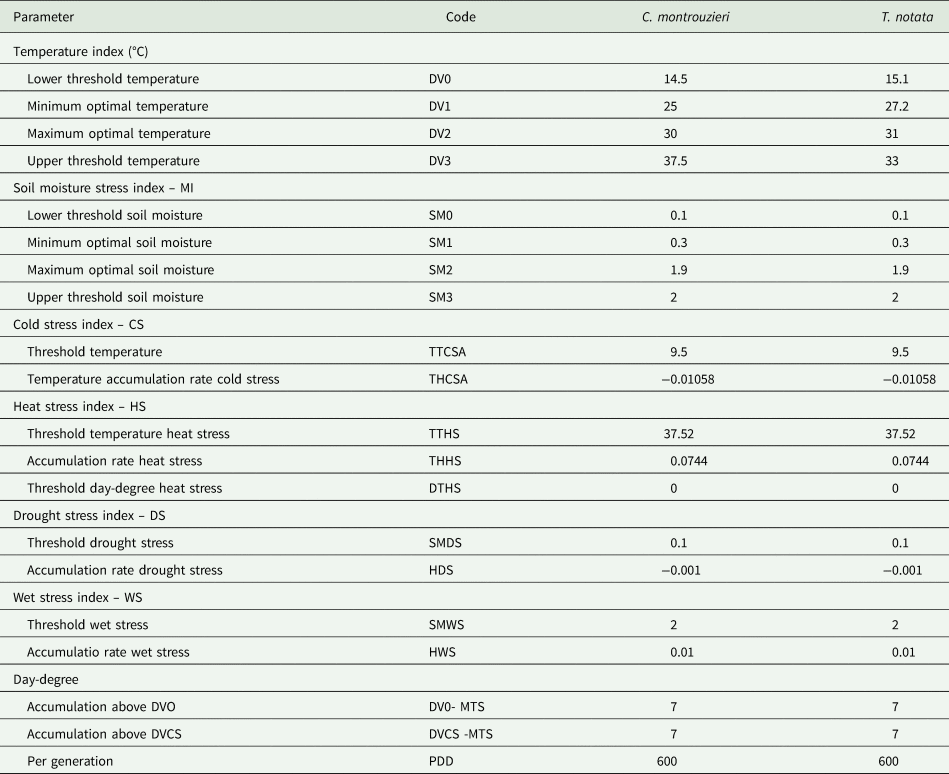
The concepts and mathematics behind CLIMEX have been reviewed extensively elsewhere (Sutherst et al., Reference Sutherst, Maywald and Kriticos2007). Eight parameters characterize cardinal and optimal temperatures (DV0-DV3) and moistures (SM0-SM3) for population growth; another eight or more parameters describe thresholds and rates for stress accumulation from cold, heat, drought, or wetness. Parameters used in this study are described in table 1. CLIMEX then utilizes these biologically informed parameters with climatic records to calculate a series of environmental indices. The Ecoclimatic Index (EI) represents an overall measure of climatic suitability (Sutherst et al., Reference Sutherst, Maywald and Kriticos2007) and varies from 0 to 100. An EI = 0 indicates that the climate in an area would not allow a species to persist throughout a year, though periods may occur with ephemeral populations from seasonal immigrants. Conversely, an EI = 100 indicates perfect climate suitability for the species year-round. For intermediate cases, when EI = 1–10, the climate would be considered marginal; when EI = 11–25, the climate is favorable; when EI = 26–50, the climate is very favorable; and when EI = 51–99, the climate is nearly ideal.
CLIMEX parameters (function ‘Compare Climate’) used for the estimates of the global distribution of Cryptolaemus montrouzieri and Tenuisvalvae notata

Estimate of geographic distribution using CLIMEX
The parameters used to estimate C. montrouzieri response to temperature primarily were derived from previous literature. Thus, the lower threshold temperature for population growth (DV0) was set at 14.5°C (Gutierrez et al., Reference Gutierrez, Daane, Ponti, Walton and Ellis2008) and is consistent with results found by Babu and Azam (Reference Babu and Azam1987). Jalali et al. (Reference Jalali, Singh and Biswas1999) indicated that the optimal (minimum and maximum) temperatures for the development of C. montrouzieri were 25°C (DV1) and 30°C (DV2), respectively. As Saljoqi et al. (Reference Saljoqi, Nasir, Khan, Ehsan-ul-Haq Asad and Raza2014) found positive population growth at 32°C, the upper temperature threshold for C. montrouzieri development (DV3) was 37.5°C. This value was lower than the 38.5°C cited by Gutierrez et al. (Reference Gutierrez, Daane, Ponti, Walton and Ellis2008), but their projection was beyond the range of experimental data considered. The parameters used for heat stress (thresholds and accumulation rates) were derived from Solangi et al. (Reference Solangi, Karamaouna, Kontodimas, Milonas, Lohar, Abro and Mahmood2013), and parameters for cold stress were estimated from lower lethal time observations from Maes et al. (Reference Maes, Grégoire and De Clercq2015). Moisture requirements for growth and drought and wet stress parameters (SM0-3, SMDS, HDS, SMWS and HWS) were taken from the model developed by Poutsma et al. (Reference Poutsma, Loomans, Aukema and Heijerman2008) for H. axyridis with one modification. The threshold for drought stress accumulation (SMDS) was set to 0.1, the moisture level that is the approximate permanent wilting point for plants. Piercing-sucking insects, the primary prey for C. montrouzieri, are generally less abundant under such conditions (Sconiers and Eubanks, Reference Sconiers and Eubanks2017) and an examination of predicted vs observed distributions in Australia provided reassurance that these parameters were adequate (table 1).
Less information was available for T. notata. Empirical results from Dreyer et al. (Reference Dreyer, Neuenschwander, Bouyjou, Baumgärtner and Dorn1997b) and Ferreira (Reference Ferreira2019) indicated T. notata threshold temperatures were 15.1, 27.2, 31, and 33°C for DV0, DV1, DV2, and DV3, respectively. No information has been published about the effects of extreme temperatures or moisture on T. notata, and not enough locations with T. notata have been reported to estimate CLIMEX parameters reliably through integrative geographic fitting. Thus, other parameters used in the model were the same as those used for C. montrouzieri (table 1). After the parameter adjustment for both species in the model, population distribution graphs were constructed based on 10-arcminute climate summaries (CM10: World 1975H_V1.1_WO) provided with CLIMEX.
Phenology of ladybird beetles
Determining the seasonal phenology of ladybird beetle species is important to pest management in biological control programs, and contributes to preview the potential occurrence and relative abundance of those natural enemies in the field. Seasonal changes in the Growth Index from CLIMEX provide a good indicator of changes in the abundance and activity of a species at a specific location (Venette, Reference Venette2017). Seasonal changes in the Growth Indices were estimated for C. montrouzieri and T. notata in different locations of the state of Pernambuco, Brazil: Chã Grande (Lat: −8.2522/Long: −35.4549), Petrolina (Lat: −9.3948/Long: −40.4962), Surubim (Lat.: −7.8711/Long.: −35.7533), and Belo Jardim (Lat.: −8.3446/Long.: −36.4134). Those locations represent different climate regions within the state of Pernambuco, wherein mealybugs are considered common pests attacking fruit crops (Pacheco da Silva et al., Reference da Silva VC, Kaydan, Silva-Torres and Torres2019), and T. notata has been collected in some of those locations associated with different mealybug species (Barbosa et al., Reference Barbosa, Oliveira, Giorgi, Silva-Torres and Torres2014a).
Interaction between predators
The relative favorableness of the climate for T. notata and C. mountrouzieri was estimated by the difference in the EI of both species. In areas with negative values of EI, the climate is more suitable for T. notata. On the other hand, in areas with positive values of EI, the climate is more suitable for C. montrouzieri. Finally, in areas where the difference of EI values falls between −3 and +3, those locations are not likely to confer climate advantage to either of the species.
Results
Estimate of geographic distribution using CLIMEX
The Ecoclimatic Indices for T. notata and C. montrouzieri varied from 0–94 to 0–100, respectively. Climates that are particularly suitable for the establishment of both ladybird beetle species occur in areas of South America, Africa, and Australia. In Europe, where both species are absent, the model prediction is consistent, as well as, in North America, North of Africa and large portion of Australia, the model prediction is supported by the actual nonexistence distribution of C. montrouzieri and T. notata in those areas (fig. 1).
CLIMEX map for potential global distribution of Tenuisvalvae notata (a) and Cryptolaemus montrouzieri (b) showing the Ecoclimatic Index (EI). Darker areas are highly favorable for the occurrence of lady beetles. Unsuitable areas (EI = 0), marginally suitable areas (1 ≤ EI < 10), suitable area (10 ≤ EI < 25), and strongly suitable areas (25 ≤ EI < 100).

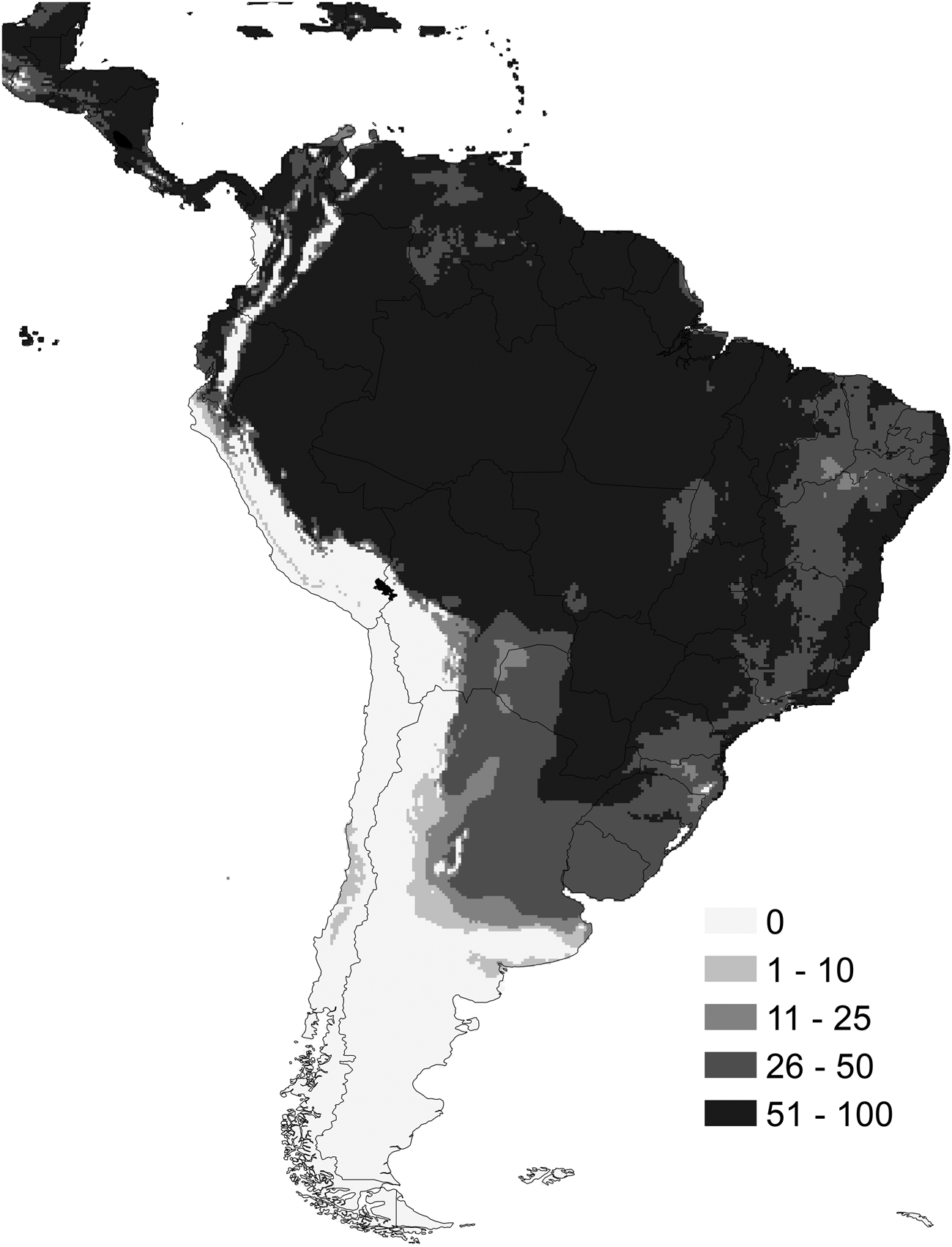
Regarding C. montrouzieri, in general, areas near the Equator or with higher temperatures were more suitable for this species. Particularly, suitable regions occur in parts of Central America, the North region, and Northeast coast of Brazil, as well as parts of the Southeast and Midwest regions of Brazil, where the EI estimated was higher than 80, indicating a very suitable climate for C. montrouzieri establishment. In addition, most part of the Brazilian territory is suitable for C. montrouzieri with EI > 60, with only a small area with EI between 0 and 20, being those locations with low suitability for this species (fig. 2). Interestingly, in Australia where C. montrouzieri is indigenous, there is a less total area suitable for this species with EI > 80, since part of Australia has a prevailing desert climate, imposing difficulties to this ladybird beetle development and survival, in comparison to most part of South America, where the climate was more suitable (fig. 1).
CLIMEX map estimated for the potential distribution of Cryptolaemus montrouzieri in South America. The probability ranges are temperature intervals of the Ecoclimatic Index (EI). Unsuitable areas (EI = 0), marginally suitable areas (1 ≤ EI < 10), suitable area (10 ≤ EI < 25), and strongly suitable areas (25 ≤ EI < 100).

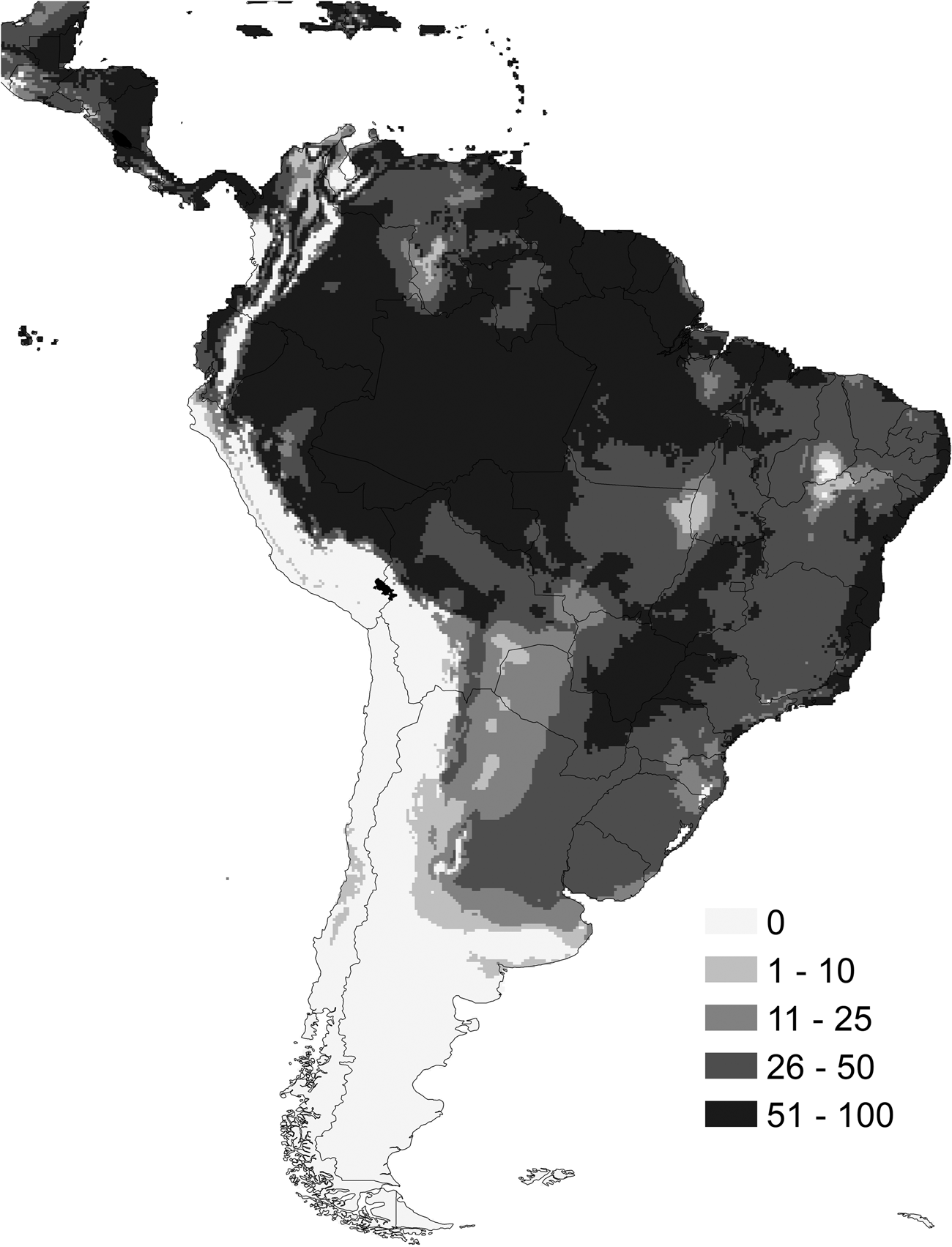
Regarding T. notata, the model estimated an EI > 80 in parts of the North region of South America, including the North and Northeast coast of Brazil, and parts of the Brazilian Midwest on the boundaries with Paraguay (fig. 3). According to the model, the largest part of the Brazilian territory is unsuitable for T. notata with EI between 0 and 20, in comparison to C. montrouzieri (fig. 1).
CLIMEX map estimated for the potential distribution of Tenuisvalvae notata in South America. The probability ranges are temperature intervals of the Ecoclimatic Index (EI). Unsuitable areas (EI = 0), marginally suitable areas (1 ≤ EI < 10), suitable area (10 ≤ EI < 25), and strongly suitable areas (25 ≤ EI < 100).

Phenology of ladybird beetles
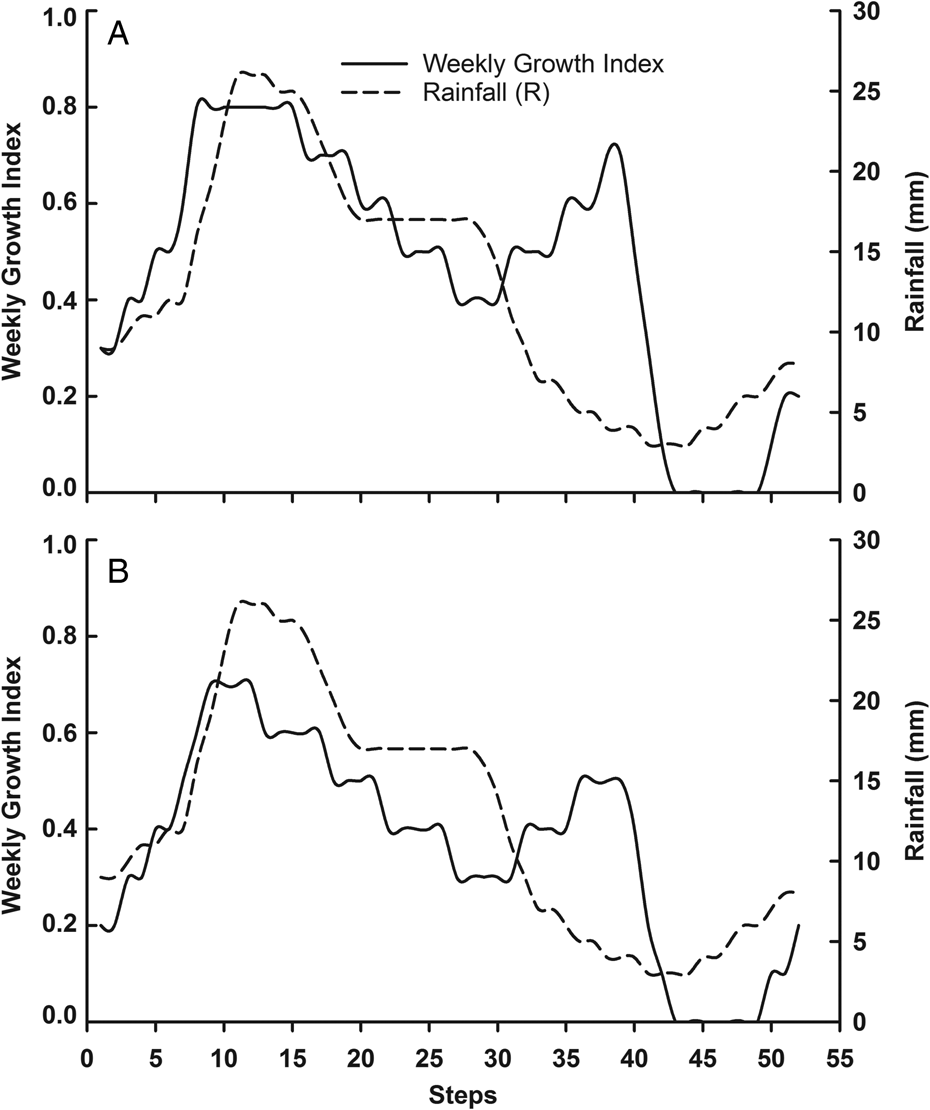
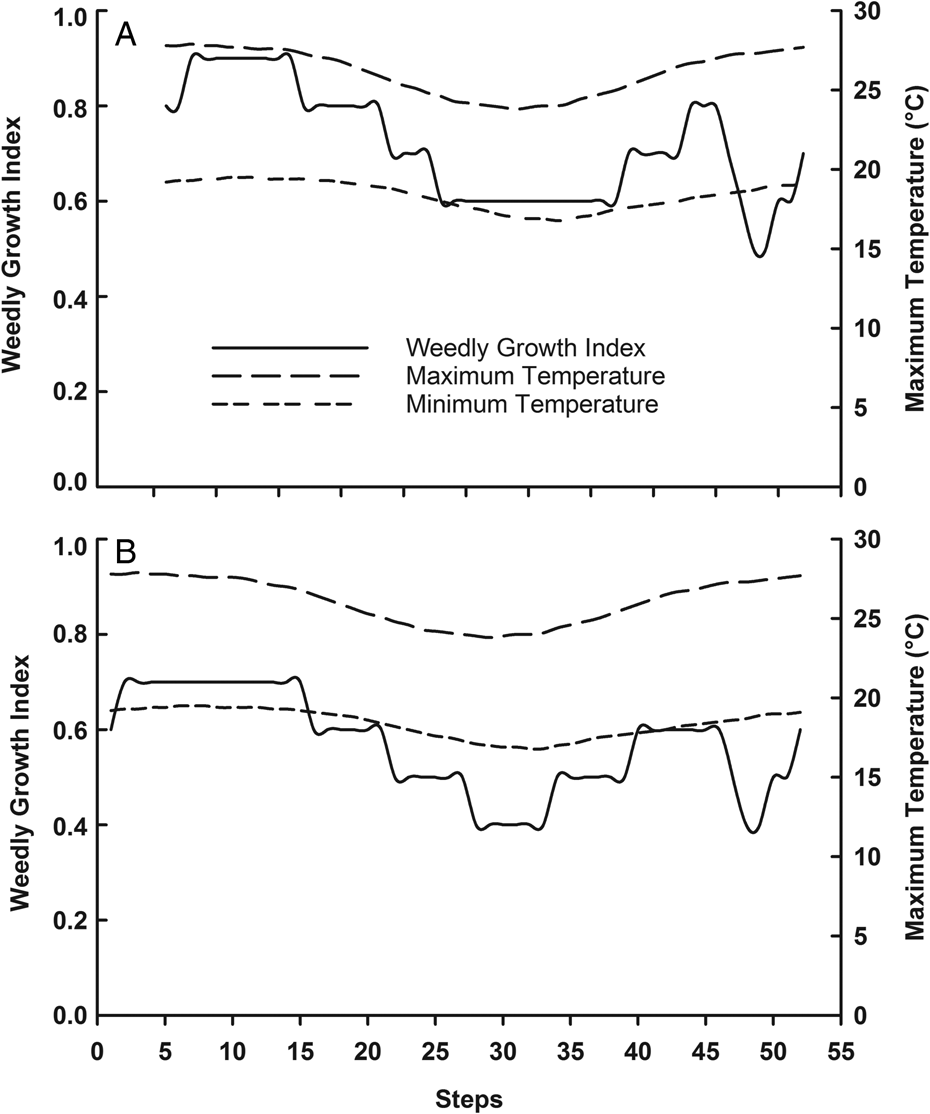
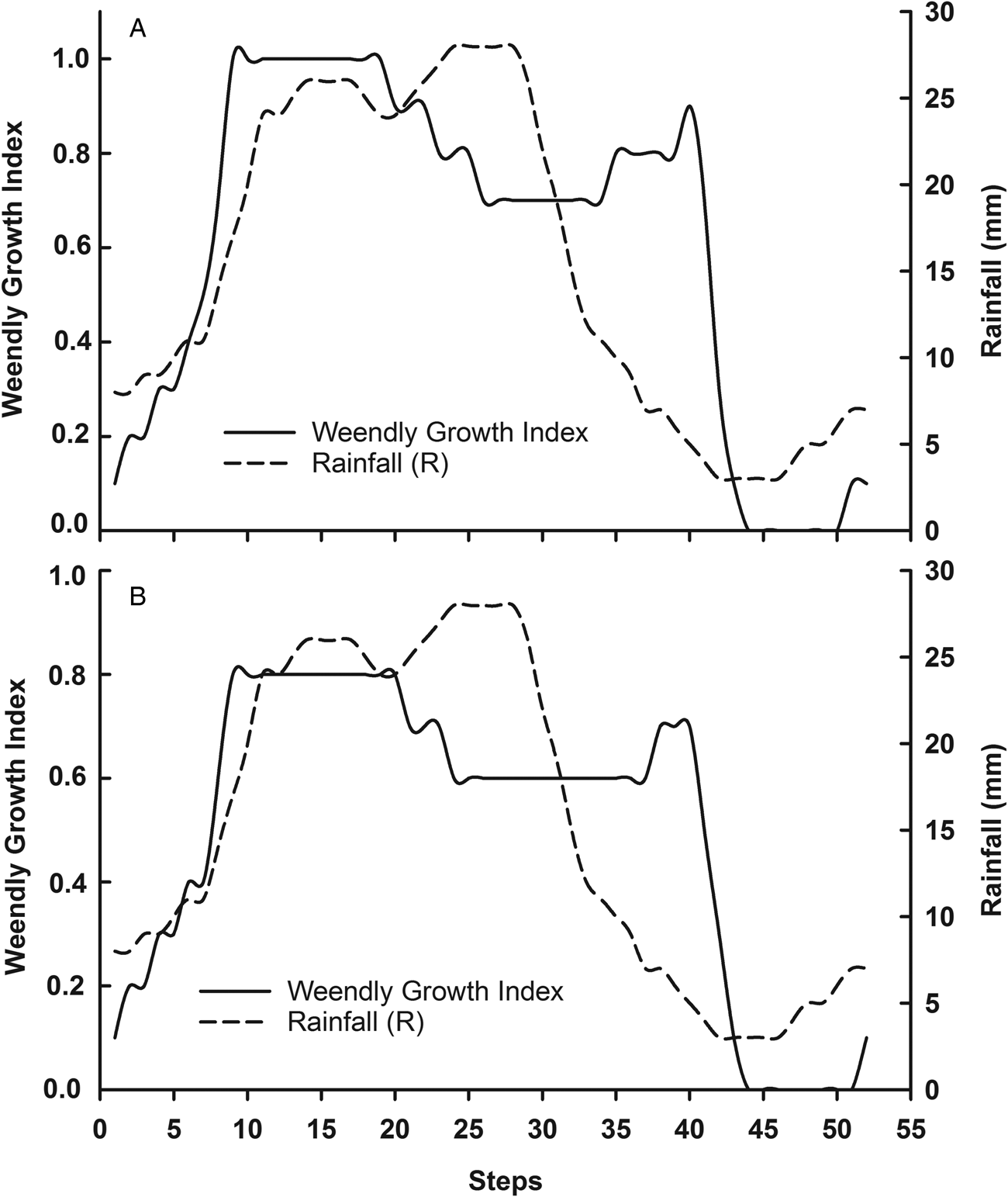
Regarding the potential phenology of T. notata and C. montrouzieri in Belo Jardim (fig. 4), Chã Grande (fig. 5), Petrolina (fig. 6) and Surubim (fig. 7), none of these locations offered climate stress conditions by either cold, heat, or drought to ladybird beetles occurrence. In general, only rainfall affected the population dynamic of predators, except for Chã Grande where the temperature also contributed to the estimates of the phenology of ladybird beetles throughout the year (fig. 5). All four locations had EI > 25, being considered suitable for the population growth of the ladybird beetles. Moreover, among the four locations, Petrolina had the lowest EI estimated, EI = 34, hence considered the location relatively least suitable for ladybird beetles occurrence. In contrast, Belo Jardim and Surubim had similar EI values, 61 and 66, respectively, and Chã Grande had the highest value of EI = 94.
Phenology of Cryptolaemus montrouzieri (a) and Tenuisvalvae notata (b) in Belo Jardim, Pernambuco, Brazil (Lat.: −8.3446/Long.: −36.4134). Step (Weeks).

Phenology of Cryptolaemus montrouzieri (a) and Tenuisvalvae notata (b) in Chã Grande, Pernambuco, Brazil (Lat: −8.2522/Long: −35.4549). Step (Weeks).

Phenology of Cryptolaemus montrouzieri (a) and Tenuisvalvae notata (b) in Petrolina, Pernambuco, Brazil (Lat: −9.3948/Long: −40.4962). Step (Weeks).

Phenology of Cryptolaemus montrouzieri (a) and Tenuisvalvae notata (b) in Surubim, Pernambuco, Brazil (Lat.: −7.8711/Long.: −35.7533). Step (Weeks).

Interaction between predators
CLIMEX estimates for the interaction between T. notata and C. montrouzieri in the scenario of current climate conditions showed that the climate of South America is more suitable for C. montrouzieri establishment than for T. notata in most locations as seen in the substantial difference in EI values obtained for these species (fig. 8). Areas with a climate that favored T. notata (negative values) were rare in South America but were slightly more common in the Indonesian archipelago. In contrast, areas with strong positive values were common and included all Brazilian territory, being more suitable for C. montrouzieri (fig. 8).
CLIMEX map for the difference in the Ecoclimatic Index (EI) of Tenuisvalvae notata and Cryptolaemus montrouzieri in South America under the current climate condition. Areas with a strong positive value are more suitable for T. notata, being those places rare. Areas with strong negative values are more suitable for C. montrouzieri. Similar areas (EI difference between −4 and + 4) are not likely to favor neither of the predator species.

Discussion
The CLIMEX software proved to be a useful tool to forecast climatic suitability as seen in previous studies (Allen et al., Reference Allen, Foltz, Dixon, Liebhold, Colbert, Régnière, Gray, Wilder and Christie1993; MacLeod et al., Reference MacLeod, Evans and Baker2002; Sutherst and Maywald, Reference Sutherst and Maywald2005). On this note, it is important to mention that many studies have addressed the effects of some of those factors on C. montrouzieri, but few have included T. notata. To our knowledge, this is the first study addressing the potential global distribution of these two predatory coccinellids, especially because both are good candidates for biological control programs. Both species studied here show preference and high predatory capacity upon mealybugs, either as larvae or as adults (Babu and Azam, Reference Babu and Azam1987; Wu et al., Reference Wu, Zhang, Liu, Xie, He, Deng, De Clercq and Pang2014; Barbosa et al., Reference Barbosa, Oliveira, Giorgi, Silva-Torres and Torres2014a, Reference Barbosa, Oliveira, Giorgi, Oliveira and Torres2014b; Marques et al., Reference Marques, Lima, Melo, Barros and Paranhos2015). In fact, C. montrouzieri and T. notata overlap in their food niches resulting in competition and intraguild predation, due to similarity in food diet, habitat, and the thermal requirement to development of both species (Ferreira et al., Reference Ferreira, Silva-Torres, Venette and Torres2020; Oliveira, Reference Oliveira2020; Sá et al., Reference Sá, Oliveira, Costa and Lopes2020).
Many exotic predatory ladybird beetles have been introduced in various regions of the world as part of classical biological control programs. Some factors favor the establishment of exotic species, such as the capacity to respond to alternative prey (Evans and Toler, Reference Evans and Toler2007), high fecundity rates (Kajita and Evans, Reference Kajita and Evans2010), oviposition inhibition (Hodek and Michaud, Reference Hodek and Michaud2008), and larger body size (Roy et al., Reference Roy, Jablonski and Valentine2002). These factors are associated with better fitness and dispersal capacity, promoting the establishment and rapid spread of these ladybird beetles to other regions. For instance, C. moutrouzieri has been used commercially in many biological control programs worldwide to control mealybugs and some aphids and psyllids (Pluke et al., Reference Pluke, Escribano, Michaud and Stansly2005; Gutierrez et al., Reference Gutierrez, Daane, Ponti, Walton and Ellis2008; Mani and Krishnamoorthy, Reference Mani and Krishnamoorthy2008). According to Fand et al. (Reference Fand, Gautam and Suroshe2010), C. mountrouzieri has a higher predatory performance than other coccinellids, and in comparison to T. notata, other studies have shown it has a higher predation rate and acts as intraguild predator, outcompeting this indigenous species (Oliveira, Reference Oliveira2020).
The global forecast of climate suitability for T. notata and C. montrouzieri suggests the establishment of those species is possible in many parts of the world, especially near the Equator. The model also estimated that a larger part of South America, where T. notata is indigenous, is more suitable for the establishment of the exotic C. montrouzieri, including locations unsuitable for the indigenous species T. notata. Therefore, in various locations of the south hemisphere, where C. montrouzieri was introduced intentionally through classical biological control programs, its chances of survival are higher. In addition, the EI difference estimated for both coccinellids under the current scenario of climate condition shows that C. montrouzieri could have a broader distribution than T. notata in South America, possibly because C. montrouzieri has a wider thermal tolerance than T. notata (Ferreira et al., Reference Ferreira, Silva-Torres, Venette and Torres2020). Moreover, the model prediction was based on climate suitability as an indicator of potential global distribution. It does not mean that in all areas predicted as suitable, C. moutrouzieri and T. notata are currently interacting. In fact, we cannot affirm how long it will take for C. mountrouzieri to occupy suitable areas in South America, for instance. It may be possible that this never happens in some locations since other abiotic or biotic factors such as dispersal capability will shape distribution. But in areas where it already occurs, as in the state of Pernambuco, it may out-compete the native T. notata when food is scarce (Oliveira, Reference Oliveira2020).
In areas of Europe, and North America (i.e. Canada and the US high plains), the model prediction is according to the current distribution of C. montrouzieri (Kairo et al., Reference Kairo, Paraiso, Gautam and Peterkin2013), and those areas have limited places for hibernation, and extreme climate conditions, such as freezing winters. This could explain why those areas have not registered the occurrence of T. notata and C. montrouzieri. Moreover, in part of Africa and the central region of Australia, those coccinellids are absent, probably due to the desert/arid climate condition in those locations, with low or no vegetation, which makes it difficult to the establishment of both prey and predators.
Sutherst et al. (Reference Sutherst, Maywald and Kriticos2007) have suggested that CLIMEX seems to be more appropriate to estimate the distribution of species found in more restricted areas than those species that are cosmopolitan, being easier to relate the climate of the origin location and other continents. For C. montrouzieri and T. notata CLIMEX predictions are easily comparable to places where these predators have been introduced and established, such as South America and Africa, respectively, as well as other places where their occurrence have been cited in the literature. Therefore, observed data could compare model estimations for the global distribution of these predatory species out of their native range. For instance, outside their origin location, C. montrouzieri occurs in Africa, Asia, and America (Kairo et al., Reference Kairo, Paraiso, Gautam and Peterkin2013), and T. notata in Africa (Benim, Zambia) (Chakupurakal et al., Reference Chakupurakal, Markham, Neuenschwander, Sakala, Malambo, Mulwanda, Banda, Chalabesa, Bird and Haug1994; Dreyer, Reference Dreyer, Neuenschwander, Baumgärtner and Dorn1997a, Reference Barbosa, Oliveira, Giorgi, Oliveira and Torres1997b), providing support for parameters estimated by the CLIMEX model, as EI values estimated for those locations were higher than 25, characterizing suitable places for both species.
Regarding the phenology of C. montrouzieri and T. notata throughout the year in four locations of the state of Pernambuco, Chã Grande, Petrolina, Surubim and Belo Jardim, representing different microclimate regions within the state, the model estimated EI > 25 at all locations, suggesting climate suitability to the occurrence of C. montrouzieri and T. notata. Because the state of Pernambuco is located in the Northeast region of Brazil, climate change within the state is more related to precipitation than to temperature, except for places of high altitude such as Chã Grande where the temperature tends to have larger variance and may reach lower digits during the winter season in comparison to the other locations studied here. Consequently, rainfall was the most limiting factor acting upon phenology of these predatory species in Petrolina, Surubim and Belo Jardim, except for Chã Grande where temperature fluctuation has also contributed to insect phenology throughout the year.
Finally, for the interaction between C. montrouzieri and T. notata in South America under the scenario of current climate condition, the model estimated that a larger area of this continent is more suitable for C. montrouzieri than for T. notata, which would be favored in rare locations, even though this is its native region. Thus, one can assume that when both predatory species co-occur in the same location, the result of the competition between them would be affected by the local climate condition, and may result in displacement of the indigenous species, as the introduced one is a better competitor and adapted to local conditions (Ferreira, Reference Ferreira2019; Oliveira, Reference Oliveira2020). In this context, many studies have suggested a reduction in the abundance of native coccinellids after the establishment of exotic species (Turnipseed et al., Reference Turnipseed, Ugine and Losey2014; Bahlai et al., Reference Bahlai, Colunga-Garcia, Gage and Landis2015; Diepenbrock et al., Reference Diepenbrock, Fothergill, Tindall, Losey, Smyth and Finke2016). However, it is important to be cautious when evaluating those effects. For instance, Harmon et al. (Reference Harmon, Stephens and Losey2007) did not find a consistent and significant decline in abundance of indigenous coccinellid species after the introduction of Coccinella septempunctata (L.) and H. axyridis in the USA and Canada. Also, Bahlai et al. (Reference Bahlai, Colunga-Garcia, Gage and Landis2015) looking at 24-year long data regarding coccinellid community in Michigan Southwest, showed that the impact of the exotic coccinellid species on indigenous ones varies with the degree of their interaction. This decline could be triggered by food competition among predatory species (dietary overlap with exotic species), habitat compression where exotic species are expected to dominate in crop areas whereas native species are pushed to natural or semi-natural habitats, intraguild predation, but also could be increased by the local climate conditions.
In conclusion, this study suggests that both coccinellids T. notata and C. montrouzieri could experience a climate suitable for establishment in areas of a warmer climate, such as Equatorial and Tropical zones. In addition, most of South America is more suitable for C. montrouzieri than for T. notata according to the EI. In addition, beyond temperature and precipitation, other biotic interactions with prey, host plants, and other predators may regulate insect phenology and determine the success of biological control programs in different locations. For T. notata much more remains to be learned as little is known about its distribution, ecology, and predatory capacity within its native range. Further research is needed to address those questions and how exotic species like C. moutrouzieri could affect the native T. notata regarding its distribution and potential use in biological control in Brazil.
Acknowledgements
This study was financed in part by the Coordenação de Aperfeiçoamento de Pessoal de Nível Superior - Brasil (CAPES) through PROEX-PPGEA with Master Grant to L.F.F.