Implications
Although the high non-starch polysaccharide and the low metabolisable energy contents of white lupins (Lupinus albus L.) limit their use in broiler diets, the relatively high contents of protein, digestible amino acids and fat make it potentially beneficial. The high non-starch polysaccharide content of white lupins, however, is a nutritional concern and resulted in an increase in the relative weight of the small intestine and caeca of broilers in this study. Overall, the present results showed that, when diets are balanced in terms of metabolisable energy and digestible amino acids, white lupins can be used at a 200 g/kg inclusion level as a partial replacement for soybean meal in broiler starter diets without any adverse effects on the performance or excreta quality.
Introduction
The search for new plant protein sources has attracted considerable attention in recent years as a result of the ban of inclusion of animal protein meals in diet formulations in some countries and the ever-increasing price of soybean meal. In addition, continued growth in the poultry industry is driving the demand for alternative protein ingredients that are locally available and economical and can be used as substitutes for conventional protein meals. Of the various possibilities (Ravindran and Blair, Reference Ravindran and Blair1992), grain legumes such as lupins (Lupinus spp.) have good potential. Of the more than 200 species of Lupinus, five species (L. albus, L. angustifolius, L. luteus, L. mutabilis and L. polyphilu) are suitable for cultivation as high-protein crops (Gladstones, Reference Gladstones1998).
White lupins (Lupinus albus L.) represent a potential grain legume with good protein quality in non-ruminant diets. The feeding value of early cultivars of lupins to poultry was poor because of the presence of high concentrations of toxic and bitter alkaloids (Olver and Jonker, Reference Olver and Jonker1997; Olkowski et al., Reference Olkowski, Olkowski, Amarowicz and Classen2001). However, plant breeding programmes have paid considerable attention to selecting lupin cultivars with almost zero alkaloid content and current lupin cultivars are largely alkaloid free (Cowling et al., Reference Cowling, Huygbe and Swiecicki1998). Despite this development, the usefulness of lupins in poultry diets remains limited because of the uncertainty of their nutritional value and the presence of anti-nutritional factors, such as non-starch polysaccharides (NSP), tannins and protease inhibitors, which can lower nutrient digestibility and performance (Jezierny et al., Reference Jezierny, Mosenthin and Bauer2010). It is also known that the level of anti-nutritional factors in grain legumes varies depending on the cultivar (Gatel, Reference Gatel1994).
Published data on the apparent metabolisable energy (AME; Brenes et al., Reference Brenes, Marquardt, Guenter and Rotter1993; Hughes et al., Reference Hughes, van Barneveld and Choct1998) and the ileal amino acid digestibility (Ravindran et al., Reference Ravindran, Hew, Ravindran and Bryden2005) of white lupins for broilers are scant. Moreover, data available on the energy value and amino acid digestibility of grain legumes have often been obtained in studies that have evaluated only one sample of the legume. Knowledge of the variability of these parameters is essential to develop matrix values for more precise feed formulations. Published data on the suitability of white lupins, as a replacement for soybean meal, in broiler diets are limited and contradictory (Karunajeewa and Bartlett, Reference Karunajeewa and Bartlett1985; Olver and Jonker, Reference Olver and Jonker1997; Viveros et al., Reference Viveros, Centeno, Arija and Brenes2007), with some studies showing adverse effects on performance and others reporting performance similar to control diets at inclusion levels of over 200 g/kg.
The present evaluation of white lupins consisted of two parts. In the first phase, the AME, nitrogen-corrected AME (AMEn) and apparent ileal amino acid digestibility values of three cultivars of white lupins were determined. In the second phase, using the AME and digestible amino acid values determined in the first phase, diets containing 200 g/kg of the three cultivars of white lupins were formulated and the effects of feeding these diets on the performance of broiler starters were investigated. The high contents of NSP in lupins, through their effect on digesta viscosity, could impact on the digestive tract development of broilers and excreta quality. For this reason, the influence of dietary treatments on these two parameters was also determined.
Material and methods
The experimental procedures were approved by the Massey University Animal Ethics Committee and complied with the New Zealand Code of Practice for the Care and Use of Animals for Scientific Purposes.
Ingredients
A total of three cultivars of white lupins, namely, Promore, Kiev mutant and Ultra, were used. These alkaloid-free cultivars are new introductions into New Zealand. White lupin seeds in raw form, with hulls, were ground to pass through a 3-mm sieve in a hammer mill before inclusion in the diets. Other ingredients were obtained from commercial suppliers in ground form. Representative samples of lupin cultivars were analysed, in triplicate, for dry matter (DM), nitrogen, ether extract, ash, starch, amino acids, NSP and trypsin inhibitor activity.
Experiment 1 – Metabolisable energy and digestibility assay
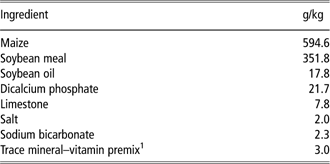
A maize–soybean meal basal diet was formulated (Table 1) and three assay diets were then developed by substituting 250 g/kg (w/w) of the basal diet with the three cultivars of white lupins. All diets contained titanium oxide (3 g/kg) as an indigestible marker to calculate the ileal digestibility of amino acids.
Composition (g/kg air dry basis) of the basal diet, Experiment 1

1Provided per kg diet: Co, 0.3 mg; Cu, 5 mg; Fe, 25 mg; I, 1 mg; Mn, 125 mg; Zn, 60 mg; choline chloride, 638 mg; trans-retinol, 3.33 mg; cholecalciferol, 60 μg; dl-α-tocopheryl acetate, 60 mg; menadione, 4 mg; thiamin, 3.0 mg; riboflavin, 12 mg; niacin, 35 mg; calcium panthothenate, 12.8 mg; pyridoxine, 10 mg; cyanocobalalamin, 0.017 mg; folic acid, 5.2 mg; biotin, 0.2 mg; antioxidant, 100 mg; molybdenum, 0.5 mg; selenium, 200 μg.
Male broilers (Ross 308) that were a day old were raised in floor pens and fed a commercial broiler starter diet (230 g/kg CP) till day 21. Feed and water were available at all times. On day 21, 64 birds of uniform BW were selected and randomly assigned to 16 cages (four birds per cage). The birds were offered a commercial broiler finisher diet (180 g/kg CP) until the introduction of assay diets on day 28. On day 28, four replicate cages were randomly assigned to each assay diet.
The AME was determined using the classical total excreta collection method. The diets, in mash form, were fed to birds from day 28. Feed intake and excreta output were measured quantitatively per cage from day 32 for 4 consecutive days. The excreta from each cage were pooled, mixed, sub-sampled and freeze-dried. The dried excreta samples, together with samples of the diets, were subsequently ground to pass through a 0.5-mm sieve and stored in airtight plastic containers for analysis of DM, gross energy (GE) and nitrogen content.
On day 35, all birds were euthanised by an intracardial injection of sodium pentobarbitone solution and the contents of the lower half of the ileum were collected according to the procedures of Ravindran et al. (Reference Ravindran, Hew, Ravindran and Bryden2005). The ileum was defined as that portion of the small intestine extending from the Meckel's diverticulum to a point approximately 40 mm proximal to the ileo–caecal junction. The ileum was divided into two halves and the digesta was collected from the lower half towards the ileo–caecal junction. Digesta from birds within a cage were pooled and processed as described by Ravindran et al. (Reference Ravindran, Hew, Ravindran and Bryden2005). The diet and digesta samples were then analysed for DM, titanium oxide and amino acids.
Experiment 2 – Performance trial
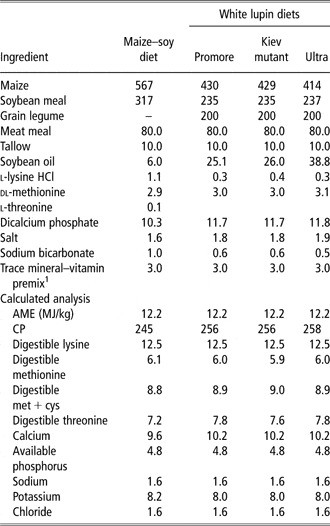
A total of four diets, including a maize–soybean meal control diet and three experimental diets containing 200 g/kg of the three cultivars of lupins, were formulated using the AME and ileal digestible amino acid values determined in Experiment 1 to contain similar levels of metabolisable energy and ileal digestible amino acids (Table 2). After mixing, the experimental diets were pelleted at 70°C.
Ingredient composition and calculated analysis (g/kg as fed) of experimental diets, Experiment 2

AME = apparent metabolisable energy; met = methionine; cys = cysteine.
1Provided per kg diet: Co, 0.3 mg; Cu, 5 mg; Fe, 25 mg; I, 1 mg; Mn, 125 mg; Zn, 60 mg; choline chloride, 638 mg; trans-retinol, 3.33 mg; cholecalciferol, 60 μg; dl-α-tocopheryl acetate, 60 mg; menadione, 4 mg; thiamin, 3.0 mg; riboflavin, 12 mg; niacin, 35 mg; calcium panthothenate, 12.8 mg; pyridoxine, 10 mg; cyanocobalalamin, 0.017 mg; folic acid, 5.2 mg; biotin, 0.2 mg; antioxidant, 100 mg; molybdenum, 0.5 mg; selenium, 200 μg.
A total of 128-day-old male broilers (Ross 308) were individually weighed and assigned to 16 cages (eight birds per cage) in electrically heated battery brooders, so that the average initial weight per cage was similar. Each of the four dietary treatments was then randomly assigned to four cages. The temperature was maintained at 32°C during the first week and was gradually decreased to approximately 23°C by the end of the third week. Ventilation was controlled by a central ceiling extraction fan and wall inlet ducts. The birds were provided with 20 h of fluorescent illumination per day. The diets were offered ad libitum from days 1 to 21. Water was freely available throughout the trial.
BW and feed intake were recorded at weekly intervals. Any bird that died was weighed and the weight was used to adjust feed per gain. Feed per gain was calculated by dividing the total feed intake by weight gain of live plus dead birds. Excreta was scored on day 21 for consistency on a scale of 1 to 5, with a score of 1 representing normally formed excreta and 5 representing watery and sticky excreta (Wu et al., Reference Wu, Ravindran, Thomas, Birtles and Hendriks2004). On day 21, three birds, closest to the average cage weight, were selected per cage, weighed and sacrificed by cervical dislocation. The length (±0.1 mm) of the small intestine (from the pyloric junction to the ileal–caecal junction) and caeca (from the ostium to the tip of each caeca) was determined with a non-rigid tape on a wet glass surface to prevent inadvertent stretching. Following freeing of each of these components from any adherent mesentery, their full and empty weights (±0.1 g) were determined along with those of the crop, proventriculus and gizzard. The weights of the liver, spleen and pancreas were also determined.
Chemical analysis
The DM, crude fat and ash contents were calculated according to the procedures of Association of Official Analytical Chemists (AOAC, 2005). Nitrogen content was determined using an FP-428 nitrogen determinator (LECO® Corporation, St Joseph, MI, USA).
Soluble, insoluble and total NSP concentrations were determined using the Megazyme dietary fibre analysis kit (Megazyme International Ireland Ltd, Wicklow, Ireland). GE was determined using an adiabatic oxygen calorimeter (Gallenkamp Autobomb, London, UK) standardised with benzoic acid.
Amino acid concentration was determined by HPLC as described by Ravindran et al. (Reference Ravindran, Morel, Rutherfurd and Thomas2009). Cystine and methionine were analysed as cysteic acid and methionine sulphone by oxidation with performic acid for 16 h at 0°C and neutralisation with hydrobromic acid before hydrolysis. Tryptophan was not determined. The titanium oxide content was measured using the colorimetric method described by Short et al. (Reference Short, Gorton, Wiseman and Boorman1996). The procedure to determine trypsin inhibitor was according to the method of Valdebouze et al. (Reference Valdebouze, Bergeron, Gaborit and Delort-Laval1980).
Calculations
The difference method approach was used to calculate the AME and apparent ileal digestibility coefficient (AIDC) of amino acids.
The AME values of the test diets and white lupin cultivars were calculated using the following formulas, with appropriate corrections made for differences in the DM content:


Correction for zero nitrogen retention was made using a factor of 36.54 kJ per gram nitrogen retained in the body.
The AIDC of amino acids in the test diets and lupin cultivars were calculated, using titanium oxide as the indigestible marker, as follows:


where, (AA/Ti)d is the ratio of amino acid and titanium in the diet and (AA/Ti)i the ratio of amino acid and titanium in ileal digesta.
Statistical analysis
Data were analysed using the one-way analysis of variance according to the General Linear Models procedure of SAS (1997), with cage as the experimental unit. Differences were considered to be significant at P < 0.05 and significant differences between means were separated using Fisher's Least Significant Difference test.
Results
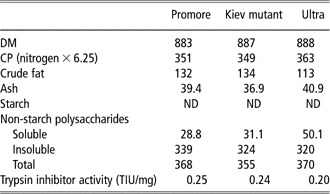
The chemical composition of white lupin cultivars is summarised in Table 3. The CP (349 to 363 g/kg) contents of the three cultivars were similar. The total NSP contents (355 to 370 g/kg) of the three cultivars were also comparable, but marked differences were found for the soluble NSP contents. The soluble NSP content of Ultra cultivar was higher than those of the other two cultivars. Differences were observed between cultivars in terms of the crude fat contents (113 to 134 g/kg), with Ultra cultivar having the lowest fat content. Trypsin inhibitor activity was found to be negligible (<1 TIU/mg) in all three cultivars.
Chemical composition (g/kg DM) of white lupin cultivars

DM = dry matter; ND = not detected.
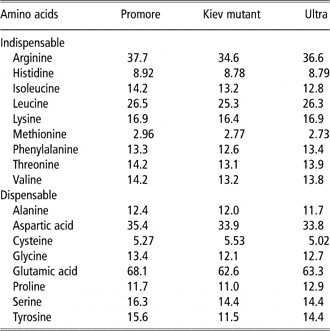
The amino acid concentrations of the three cultivars are presented in Table 4. Arginine was the most abundant indispensable amino acid, whereas glutamic acid was the abundant dispensable amino acid. All white lupin cultivars were moderate sources of lysine, but deficient in methionine and cysteine.
Amino acid concentration (g/kg DM) of the three white lupin cultivars

DM = dry matter.
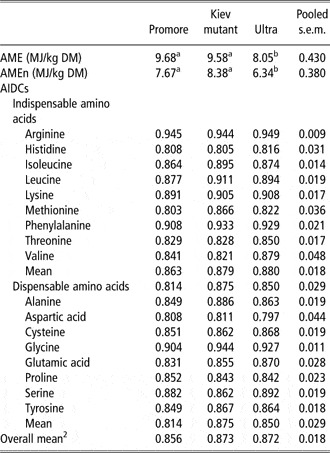
Cultivar differences (P < 0.05) were observed in the AME and AMEn of white lupins (Table 5). The AME values were determined to range between 8.05 and 9.68 MJ/kg DM. The AME and AMEn values of the Ultra cultivar were lower (P < 0.05) than those of the Promore and Kiev Mutant Broad cultivars. The AIDC of amino acids, however, was found to be similar (P > 0.05) between cultivars (Table 5). Amino acids in white lupins were well digested. The average ileal digestibility coefficients of the 17 amino acids in the three lupin cultivars were high (0.86 to 0.87).
AME, AMEn and AIDC of amino acids in three cultivars of white lupins for broilersFootnote 1

AME = apparent metabolisable energy; AMEn = nitrogen-corrected apparent metabolisable energy; AIDCs = apparent ileal digestibility coefficients.
a,b Means in a row with different superscripts differ (P < 0.05).
1 Each value represents the mean of four replicates (four birds per replicate).
2 Average digestibility of 17 amino acids.
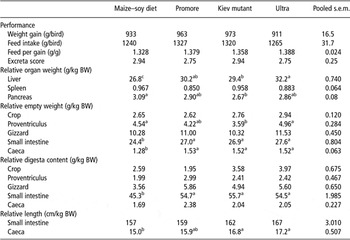
The effects of feeding diets containing 200 g/kg of the three lupin cultivars on the performance, excreta score and digestive tract development of broilers are presented in Table 6. The weight gain, feed intake and feed per gain of birds fed diets containing lupins did not differ (P > 0.05) from those fed the maize–soybean meal diet and there were no cultivar differences. The excreta scores of birds fed lupin-based diets were found to be similar (P < 0.05) to those fed the maize–soy diet.
Effects of diets containing 200 g/kg white lupins on the performance (1 to 21 days post hatch), digestive tract development and excreta quality of broilersFootnote 1

a,b,c Means in a row with different superscripts differ (P < 0.05).
1 Each value represents the mean of four replicates (eight birds per replicate).
Digestive tract parameters were affected by the dietary inclusion of 200 g/kg white lupin (Table 6). Birds fed diets containing lupins had higher (P < 0.05) relative liver weights. The relative weight of the pancreas in birds fed the Kiev mutant diet was lower (P < 0.05) than that in birds fed the maize–soy diet. The relative empty weight of the proventriculus of birds receiving the Kiev mutant-based diet was lower (P < 0.05) than those fed the maize–soy and Ultra-based diets, but similar (P > 0.05) to that of the Promore-based diet. The birds fed diets containing lupins had higher (P < 0.05) relative empty weights of the small intestine and caeca. The relative digesta weights of the small intestine of birds fed diet containing all cultivars of lupins were higher (P < 0.05) than that of the basal diet. With the exception of Promore, feeding broilers with diets containing lupins resulted in marked increases (P < 0.05) in the relative length of the caeca.
Discussion
The compositional data showed that white lupins are valuable sources of protein (>300 g/kg DM) and fat (>100 g/kg DM). The CP and crude fat contents determined for the three cultivars were within the range of 300 to 410 and 59 to 146 g/kg, respectively, reported in the literature (Gatel, Reference Gatel1994; Petterson et al., Reference Petterson, Sipsas and Mackintosh1997). The amino acid profiles of the lupin cultivars are in agreement with those reported by Green and Oram (Reference Green and Oram1983) and Ravindran et al. (Reference Ravindran, Hew, Ravindran and Bryden2005). White lupins were moderately good sources of lysine, but were poor in sulphur-containing amino acids, which are characteristics of grain legumes in general (Gatel, Reference Gatel1994). The level of trypsin inhibitor activity found in these faba bean cultivars tested was negligible, suggesting that these cultivars could be incorporated in raw form in poultry diets without the need for thermal processing.
Virtually no starch was found in white lupins, in contrast to other grain legumes such as field peas and faba beans (Petterson et al., Reference Petterson, Sipsas and Mackintosh1997; Nalle et al., Reference Nalle, Ravindran and Ravindran2010a and Reference Nalle, Ravindran and Ravindran2011). The carbohydrate reserves in white lupins were the NSP. White lupins contained 355 to 370 g/kg total NSP, which is in agreement with those reported by Kocher et al. (Reference Kocher, Choct, Hughes and Bros2000). The high contents of soluble NSP (29 to 50 g/kg DM) determined in white lupins can be a concern in poultry nutrition and may have implications for digesta viscosity and nutrient utilisation in birds (Smits and Annison, Reference Smits and Annison1996).
The AME values of the three cultivars were determined to range between 8.05 and 9.68 MJ/kg DM, which are comparable to those reported by Brenes et al. (Reference Brenes, Marquardt, Guenter and Rotter1993), but considerably lower than the values (13.3 to 14.9 MJ/kg DM) reported by Hughes et al. (Reference Hughes, van Barneveld and Choct1998) for white lupins (cv. Kiev Mutant). Lupin kernels were evaluated in the latter study, whereas seeds with hulls were used in this study and the dilution effect of hulls may explain, at least partly, the observed discrepancy. The proportion of hulls in the lupin seeds can be as high as 0.32, and Nalle et al. (Reference Nalle, Ravindran and Ravindran2010b) reported that dehulling of Australian sweet lupin seeds resulted in marked reductions in NSP contents and improved AME values.
Amino acids in white lupins were well digested, with all amino acids having digestibility coefficients over 0.80. No cultivar effects were observed on the AIDC of amino acids. Only one previous study has reported the ileal amino acid digestibility of white lupins for broilers (Ravindran et al., Reference Ravindran, Hew, Ravindran and Bryden2005). On average, the apparent ileal digestibility values determined in this study were higher than those reported by Ravindran et al. (Reference Ravindran, Hew, Ravindran and Bryden2005), which may be explained by differences in the assay methodology. The difference method was used in this study, whereas the direct method was used in the study by Ravindran et al. (Reference Ravindran, Hew, Ravindran and Bryden2005) to determine amino acid digestibility. It has been suggested that the use of the direct method to determine the amino acid digestibility of ingredients with low-to-moderate protein contents will result in underestimation because of greater proportions of amino acids from endogenous sources, relative to amino acids of dietary origin, in ileal digesta at low dietary amino acid intakes (Ravindran and Bryden, Reference Ravindran and Bryden1999; Lemme et al., Reference Lemme, Ravindran and Bryden2004).
It was evident that feeding diets containing 200 g/kg white lupins had no deleterious effects on the performance of broiler starters. Similarly, Karunajeewa and Bartlett (Reference Karunajeewa and Bartlett1985) reported that broiler starter diets could contain 220 g/kg white lupins (cv. Hamburg), with no adverse effects on growth. However, the present findings are in contrast with those of Olver and Jonker (Reference Olver and Jonker1997) and Viveros et al. (Reference Viveros, Centeno, Arija and Brenes2007), who showed that the use of 200 g/kg white lupins reduced the growth rate and feed efficiency of broiler starters. The observed discrepancy between studies may reflect differences in cultivars or feed formulation strategies, especially failure to balance for AME and digestible amino acids. In the study of Viveros et al. (Reference Viveros, Centeno, Arija and Brenes2007), the diets were not balanced for AME and digestible amino acids. An old cultivar of white lupins with a relatively high alkaloid content was used in the study of Olver and Jonker (Reference Olver and Jonker1997), whereas alkaloid-free modern cultivars were used in this study.
Some authors have suggested that the inclusion of white lupins in broiler diets should not exceed 100 g/kg due to the possible incidence of wet-sticky droppings, which may be caused by its high NSP contents (Edwards and van Barneveld, Reference Edwards and van Barneveld1998). In this study, however, no evidence of negative effects on excreta quality was observed even at a 200 g/kg inclusion level.
The higher relative weights of the small intestine and caecum in birds fed diets containing lupin cultivars may be related, at least in part, to the effects of dietary NSP. High NSP levels may also explain the longer caecum in birds fed diets containing lupins compared with those fed the maize–soy diet. These findings are in agreement with those of Brenes et al. (Reference Brenes, Marquart, Guenter and Viveros2002), who observed that increasing lupin content in the diet resulted in an increase in the relative size of several sections of the gastrointestinal tract. These findings are also in general agreement with those of Jørgensen et al. (Reference Jørgensen, Zhao, Knudsen and Eggum1996), who reported that feeding high-fibre diets increased visceral organ mass and intestinal length relative to empty BW compared with birds fed low-fibre diets. The negative effects of NSP on the physiology and morphology of the digestive tract have been attributed to their viscous nature and interaction with gut microflora (Smits and Annison, Reference Smits and Annison1996; Gabriel et al., Reference Gabriel, Lessire, Mallet and Guillot2006). The higher relative digesta content in the small intestine of birds fed white lupin diets may be explained by the increase in gut viscosity caused by dietary soluble NSP, which could lead to a lower gastric emptying rate of solids and liquids and transit time in the small intestine (Smits and Annison, Reference Smits and Annison1996). However, the observed effects of lupin diets on digestive tract development had no adverse influence on the performance of birds.
Inclusion of 200 g/kg lupins in broiler diets increased the relative weight of liver. As alkaloid-free lupin cultivars were used in the study, the significance of this finding is unclear.
Overall, the present results showed that white lupins are a good source of digestible amino acids and a moderate source of AME. It is concluded that, when diets are balanced in terms of metabolisable energy and digestible amino acids, white lupins can be included at a level of 200 g/kg in broiler starter diets, with no detrimental effect on performance. Further studies are warranted to investigate the possibility of higher levels of inclusion of white lupins in broiler diets through the removal of hulls (Nalle et al., Reference Nalle, Ravindran and Ravindran2010b) and/or the use of NSP-degrading enzymes.
Acknowledgements
This project was partly supported by the sustainable farming fund of the Ministry of Agriculture and Forestry, Wellington. The site-specific farming project funding and reporting are facilitated through the Foundation of Arable Farming (FAR). The assistance of Jacqui Johnston of FAR is gratefully acknowledged.