INTRODUCTION
The Central Andean Highlands are the centre of origin of the potato crop (Solanum spp.), where over many centuries of potato cultivation several unique production technologies have co-evolved (Halloy et al. Reference Halloy, Ortega, Yager and Seimon2005; Caycho personal communication). Some of these technologies have become widely adopted, whereas others have remained restricted to their centre of invention. Reasons for this regional endemism of selected technologies are probably related to their specific adaptation to the conditions of the Andean highlands and potato cultivation. Nevertheless, with the potato crop expanding, particularly into highland regions of tropical and sub-tropical Africa and Asia, neglected technologies might become useful for regions with similar topographic and agro-ecological conditions.
In the Central Peruvian highlands, potatoes are commonly cultivated in fields 3500–4300 m asl. Andean soils are often of rather marginal quality and highly variable climatic conditions characterize the cropping environment. The risk of crop damage from diverse abiotic factors such as hail, drought and frost is generally high and therefore farmers consciously spread their options across environments through practices such as field scattering while, at the same time, adopting diverse livelihood strategies (Goland Reference Goland1993; Zoomers Reference Zoomers1999). Andean farming systems are generally mixed, integrating both livestock and high levels of inter- and intra-specific crop diversity based on species such as the potato (Solanum spp.), oca (Oxalis tuberosa), olluco (Ullucus tuberosus), mashua (Tropaeolum tuberosum), maca (Lepidium meyenii), quinoa (Chenopodium quinoa) and old world crops such as barley (Hordeum vulgare) and oats (Avena sativa).
The three commonly grown potato cultivar categories (improved, native-floury and native-bitter) are each represented by a different set of botanical species. Improved cultivars generally have Solanum tuberosum subsp. tuberosum within their pedigree. Native-floury cultivars are extremely diverse and belong to S. tuberosum subsp. andigena, Solanum chaucha, Solanum goniocalyx, Solanum stenotomum and Solanum phureja. Native-bitter cultivars are used for traditional freeze-drying and belong to Solanum curtilobum, Solanum ajanhuiri and Solanum juzepczukii. Improved cultivars are grown in almost all agro-ecologies ranging from sea level to altitudes of up to 4300 m asl and native-floury cultivars are usually cultivated 3500–4300 m asl, i.e. improved and native-floury cultivars are found in these regions without a sharp separation by altitudinal belts. Patchiness and altitudinal overlap are shaped by broad adaptability and multifaceted cropping rationales of farmers (Zimmerer Reference Zimmerer1998, Reference Zimmerer1999). However, native-bitter cultivars are mainly grown 4000 m asl.
The main planting season, called qatun tarpuy (big planting) in Quechua, starts with farmers planting with the first rains in October/November (spring, southern hemisphere). To prepare an adequate seed bed for the potato and mitigate climatic, topographic and labour constraints, Andean farmers have developed three distinct footplough-based tillage systems.
The footplough or chakitaklla is a tool of pre-Inca origin still commonly used throughout the Andes today (Cook Reference Cook1918; Gade & Rios Reference Gade and Rios1972; Rivero Luque Reference Rivero Luque1990; Hocquenghem Reference Hocquenghem2008). Depending on the region it consists of a shaft 0·8–2·5 m long made out of one or two wooden parts, a footrest on the left to increase the pressure for the digging and an iron share 75–300 mm wide and 200–500 mm long to cut into compacted soils.
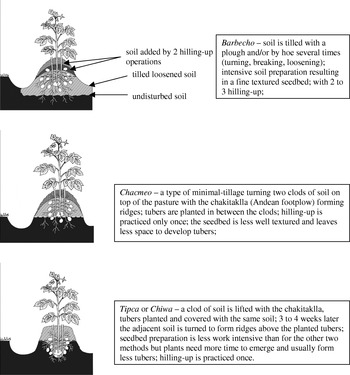
The barbecho tillage system is predominantly used for improved and commercial native-floury potato cultivars. Barbecho consists of turning, breaking and loosening the soil before planting tubers, followed by two separate incidences of hilling. Between February and March, when the soil is still moist, it is turned with the footplough, leaving big clods. During the dry season (June–August) these clods are broken up with a hoe (chiwaku; allachu) and a more or less fine structured seed bed is prepared (Fig. 1). This same process may also be done with an oxen- or tractor-drawn plough, but in the central Peruvian highlands animal or mechanized traction is generally restricted to the wealthier farmers. Barbecho generates a relatively fine structured seed bed with a layer of tilled and loosened soil. For that reason, farmers prefer this tillage system for plain fields.
Characteristics of Andean tillage systems for potato cultivation in high elevation zones.

Chiwa is a type of minimal tillage that starts by making an opening in the pasture, lifting a sod of soil and depositing a potato seed 100–200 mm deep in the soil. Then the seed is covered with the same sod. In this manner, a field is planted in a relatively short time with a spacing of c. 250–400 mm between plants and 900–1100 mm between rows. After 4–6 weeks, a ridge with a height of c. 300 mm is built on top of the emerging plants with clods of soil dug up from the sites of the potato rows. Simultaneously, inorganic fertilizer or manure is applied. The operation of ridging is the first and only incidence of hilling. Depending on the region, the chiwa tillage system is also known as tipka, chuki, qaqi, imicha or yakuycha. The chiwa tillage system is better adapted to planting on slopes compared with barbecho. Planting on mountain slopes is a widely used technique in the Andean highlands to make best use of the undulating landscape and to avoid the effect of the night frosts that tend to be more severe in the plains, where the cold air can accumulate and damage susceptible crops, such as potato.
Chacmeo is also a type of minimal tillage and consists of turning two clods of soil on top of the pasture to form a row; seed tubers are planted in between the clods (above the former soil surface level) and hilling is practiced only once. Ridges are built with the chakitaklla during January and April. The seed potato is placed in the ridge above the pasture level so that the plant may use nutrients released through decomposition. The chacmeo tillage system is well adapted to slope planting compared with the barbecho system. In some regions, the chacmeo tillage system is also known as chacma or suca.
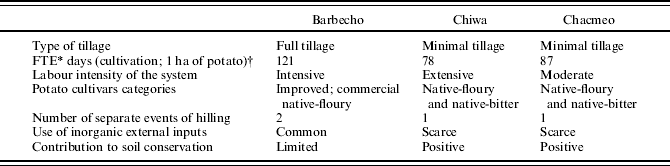
Very little is known about the biophysical advantages of these tillage systems and, with few exceptions (Bourliaud Reference Bourliaud, Hervé, Morlon and Reau1988), almost no references exist. However, each of the tillage systems has distinct features; some of which may potentially affect crop development, plant growth, tuber formation and finally yield (Table 1). These features may interact with the diverse agro-ecological conditions at these altitudes, as climatic and soil conditions can vary substantially even in small areas (Hervé Reference Hervé, Hervé, Genin and Riviere1994). Furthermore, the different potato species and numerous cultivars, their respective phenotypes and their distinct demand for growth conditions may also interact with the type of tillage system applied.
Key features of the three foot plough-based tillage systems
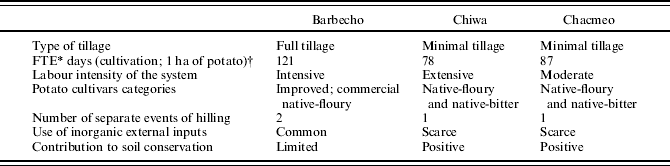
* FTE=full time equivalent.
† Source: De Haan et al. (Reference De Haan, Bonierbale, Juarez, Poma and Salas2008).
The experiment described in the present paper investigated the effect of the three different tillage systems on potato tuber yield and other yield parameters and their interactions with site-specific, agro-ecological factors, with genetic variability represented by the three potato cultivar categories and varying growth conditions influenced by different types and amounts of fertilizer applied. The objective was to improve understanding of the effect of these factors on crop yield and draw lessons concerning the potential advantages and disadvantages of each tillage system.
MATERIALS AND METHODS
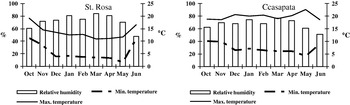
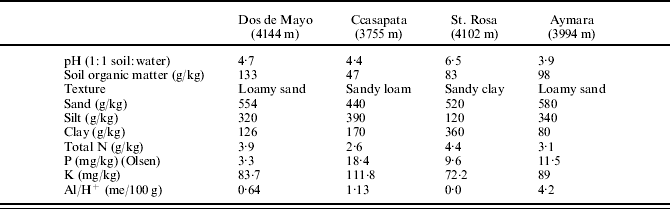
A series of five separate field experiments were planted on the communal land of four different farmers' communities in the Central Andean Highland of the Huancavelica Department, Peru. The fields used had been in fallow from 3 to 5 years previous to planting. Two trials were established at 4010 and 4144 m asl, respectively, in the community of Dos de Mayo (18°05′26·9″S, 75°21′10·1″E) during the rainy season from November to May 2005/06. However, the trial at the lower site of Dos de Mayo was affected by water logging and poor seed quality. The harvest results were very variable and were not included in the overall analysis and evaluation of the experiment. In the following season, November–May 2006/07, two trials were planted on the land of the communities of Ccasapata (12°43′26·5″S, 74°45′6·8″E) at 3755 m asl and St. Rosa (12°43′55·6″S, 74°45′50·8″E) at 4102 m asl. Additionally, one more trial was implemented at the community of San Jose de Aymara (12°14′28·44″S, 75°03′59·3″E) at 3994 m asl. Soil characteristics of all trial sites are shown in Table 2 as well as the temperature and relative humidity measurements for St. Rosa and Ccasapata in Fig. 2.
Climate data for two farmers' communities representing potato cultivations in high elevations (St. Rosa) and on lower fields (Ccasapata).

Soil characteristics for four trial sites of the Central Andes of Peru
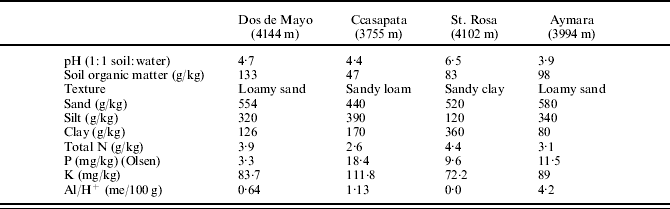
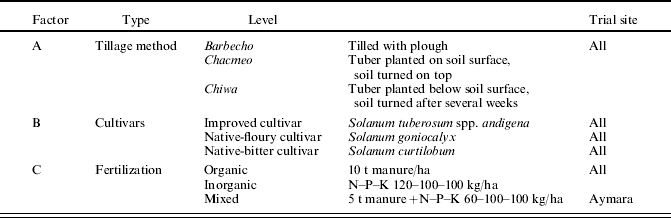
Table 3 specifies the variables determining each trial design: tillage system (A), cultivars (B) and fertilizer applications (C). The trials at each site (except in Aymara) were planted in three separate blocks, each block prepared with a different tillage system. Cultivar and fertilization treatments were applied within each block, completely randomized with four replications. For statistical analysis, each block was first analysed as an independent experiment, and then the variances of the three experiments were compared. As the differences of the error variances did not exceed the factor 2·0, the three separate experiments at each site could be analysed as one trial (Gomez & Gomez Reference Gomez and Gomez1984). Yield data were subjected to analysis of variance using SAS statistical software. The trial in Aymara was planted as a randomized complete block design for factor A, with factors B and C as split plots on A. Each treatment was replicated four times. The treatments and potato cultivars were the same for the four trials in Dos de Mayo, Ccasapata and St. Rosa. In Aymara, one fertilizer treatment was added. Hence, the trial results from Dos de Mayo, Ccasapata and St. Rosa were combined for statistical analyses to evaluate the effect of the different environments on yield, whereas the trial in Aymara was analysed separately because of its differences in design and treatments.
Treatment factors of a series of experiments conducted in the Central Andean Highlands of Peru during the rainy seasons 2005/06 and 2006/07
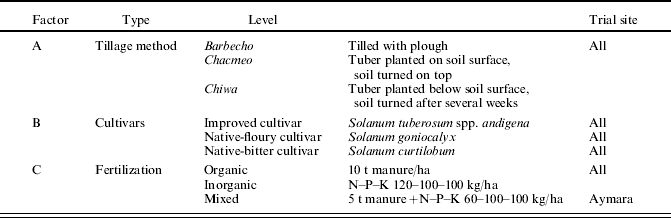
Plots consisted of six rows with 18 plants each, planted with a spacing of 0·90–1·10 m between rows and 0·30–0·35 m between plants, depending on the tillage system. General plot size ranged between 30 and 35 m2. Fertilizer was applied at planting and hilling-up for all treatments installed in plots prepared with chiwa, chacmeo and barbecho. For all trials, the entire organic fertilizer and the P and K portion of the inorganic fertilizer were applied at the first application date and only the inorganic N fraction was split into two applications, with 60 kg/ha at planting and 60 kg/ha at hilling.
No pesticides were applied in the trials in the communities of Dos de Mayo, Ccasapata and St. Rosa. In Aymara, crops were protected against Andean potato weevil (Premnotrypes spp.) by applying phenylpyrazol (Regent) and potato leaf blight (Phytophthora infestans) by applying difenconazole (Score) and ethylene bisdithiocarbamate (Dithane M-45 WP NT) at label recommendations.
At harvest, the central rows of each plot were harvested to determine potato tuber yield and the number of tubers harvested. In Ccasapata and St. Rosa, plant emergence was recorded in 2006/07 and tuber sub-samples of each treatment were taken to be oven dried to determine their dry matter content. All trials were planted with the active participation of the respective farming communities.
RESULTS
Soil characteristics and plant emergence
The soils of the four sites had a high proportion of sand and relatively little clay, except for St. Rosa with about 350 g clay/kg (Table 2). Three soils were strongly acidic with pH values between 3·9 and 4·4, which is characteristic for the central Andean highlands. The soil at St. Rosa was almost neutral with a pH of 6·5. All soils had high contents of organic matter ranging between 50 and 130 g/kg, which again is a common feature of Andean soils at these altitudes. Plant available P was low to medium and K concentrations were in the medium range.
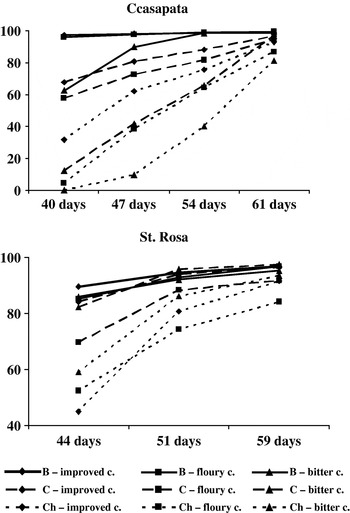
Plant establishment and survival were slightly higher in 2005/06 than in 2006/07 with densities of about 3·0 plants/m2 at harvest compared with 2·8 plants/m2, respectively. The type of tillage system had some influence with 5–7% lower plant densities in the chiwa system particularly in 2005/06. However, more important in this respect was the choice of cultivar as the native-bitter cultivar had higher densities at harvest than the native-floury cultivar or the improved cultivar (data not shown). In Ccasapata, the lower site, more than 0·90 of all plants of all three cultivars planted in the barbecho system had emerged at 47 days after planting (DAP), whereas in the chacmeo and chiwa systems plant emergence was slower, reaching 0·90 about 2 weeks later (Fig. 3). In all tillage systems, the improved cultivar showed the fastest rate of emergence. The native-bitter cultivar and, to some extent, the native-floury cultivar were clearly slower especially in the chiwa system. At St. Rosa, 50 DAP plant emergence was 0·80–0·90 in barbecho and chacmeo for all cultivars. In chiwa, emergence was slower with cultivars reaching c. 0·80 at 59 DAP.
Plant emergence in percent of three potato cultivars planted with three different tillage systems at two sites during the rainy season 2006/07. B, Barbecho; C, Chacmeo; Ch, Chiwa; c., cultivar.

General yield observations
Results from the harvests of three trials (Dos de Mayo, Ccasapata and St. Rosa) were combined for their analysis and showed interactions among all factors (site×tillage×cultivar×fertilizer). In order to present and evaluate the data in a comprehensive way, first general observations are shown and subsequently more interactions added to eventually explain the whole complexity of the results. Furthermore, the trial sites were divided into three environments according to their altitude: low (Ccasapata, 3755 m asl), intermediate (Aymara, 3994 m asl) and high (Dos de Mayo, 4102 m asl and St. Rosa, 4144 m asl). As mentioned earlier, the trial at Aymara was analysed separately. Nevertheless, in its general features the results confirmed findings of the other trials, adding some extra information due to the more detailed study of the response to fertilizer.
Sites
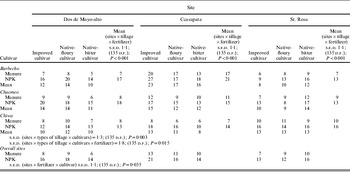
Trials established at lower and intermediate altitudes had greater overall tuber yields (on average 2–4 t more of fresh tubers/ha) compared with the trials at higher altitudes. Differences in yield among the treatments were smaller and less variable for trial sites at high altitude compared with low altitudes (Tables 4 and 5).
Fresh tuber yields in t/ha of different potato cultivars planted in plots prepared with three distinct tillage methods at three sites during the rainy seasons from November to May 2005/06 and 2006/07. s.e.d. listed for significant effects only

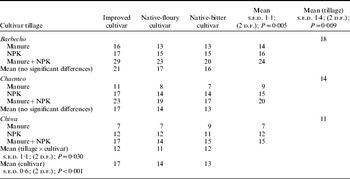
Fresh tuber yields in t/ha of different potato cultivars planted in plots prepared with three distinct tillage methods at Aymara, rainy season from November to May 2006/07. s.e.d. listed for significant effects only

Site, tillage system and cultivars
At the low and intermediate sites (Ccasapata and Aymara), potatoes planted in barbecho produced greater yields than the ones in chacmeo or chiwa. At the high sites (Dos de Mayo-alto and St. Rosa), the results were more variable but tuber yields from land prepared with chiwa or chacmeo were as great as or even greater than yields from barbecho. Improved cultivars showed the highest yield potential, out yielding the native cultivars in the barbecho system at the low and intermediate sites but not at the high-altitude sites. Under chiwa tillage, the yield levels and actual tuber yields of all cultivars were similar at the lower and upper sites (except the native-bitter cultivar in Ccasapata), whereas under chacmeo tillage the improved cultivars had greater yields at the lower sites and similar yields at the upper sites as compared with the native cultivars.
Site, tillage system, cultivars and fertilizer
Inorganic fertilizer application always increased yields compared with organic manure irrespective of the site, type of tillage or the cultivar used, except in barbecho with the improved cultivar in Ccasapata and in chacmeo with the native-floury cultivar in St. Rosa. The reasons for these two exceptions are unknown. However, yield increases differed and ranged from 3 to 10 t/ha depending on the interactions among the different factors. Percentage yield increments were generally lower in the barbecho system and greater in the chiwa system at the low and intermediate sites compared with the high ones. For chacmeo, increments were more variable and no clear trend could be established. They were similar at the lower and intermediate sites (except for the native-bitter cultivar), but differed at the higher sites, being greater at Dos de Mayo compared with St. Rosa. The trial at Aymara showed that an additional yield increase could be achieved with a mix of organic and inorganic fertilizer applications rather than pure organic or inorganic regimes. Although only half the rate of the organic and inorganic fertilizer amounts was applied, yield increments ranged from 2 to 10 t/ha compared with the full inorganic rate.
Yield components – number of tubers/m2 and mean weight/tuber
Average tuber weight, number of tubers/m2 and dry matter content of tubers were determined for the trials in Ccasapata and St. Rosa (2006/07). Tuber numbers and average tuber weight were clearly influenced by the tillage system, the growth conditions (site and type of fertilization) and the potato cultivar.
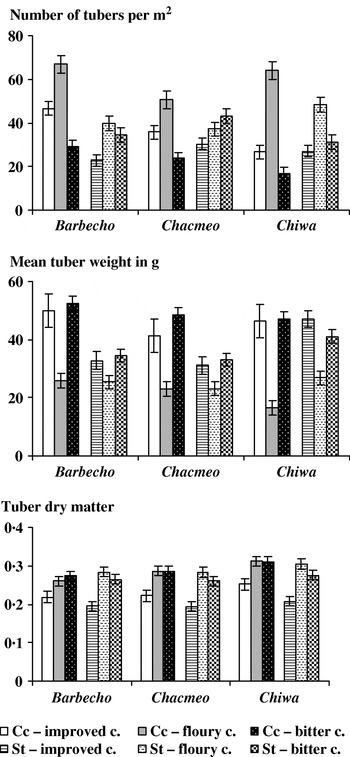
The native-floury cultivar produced, on average, more tubers/m2 than the improved and the native-bitter cultivar but had also the lowest mean tuber weight for all treatments and sites (Fig. 4a, b). It produced up to 60% more tubers at the lower site than at the higher one and had fewer tubers in chacmeo at both sites compared with barbecho or chiwa. Mean tuber weights were similar for the improved and the native-bitter cultivar for the three tillage systems but in barbecho and chacmeo they were considerably lower at the higher site than at the lower one. In chiwa, mean tuber weights were alike at both sites.
Tuber numbers/m2, average tuber weight in g and percent of tuber dry matter for three potato cultivars grown in different tillage systems at two sites in the Central Andean highlands, rainy season 2006/07. Cc, Ccasapata; St, St. Rosa; c., cultivar.

Inorganic fertilization resulted in increased tuber numbers for the native cultivars in all tillage systems but for the improved cultivar only in the chiwa system. Mean tuber weights were increased for the improved cultivar in all treatments but not for the native-bitter one. The native-floury cultivar generally showed increased mean tuber weights except for the two treatments (Ccasapata – barbecho and St. Rosa – chacmeo), which were mentioned before as having no yield increases associated with inorganic fertilization (data not shown).
Tuber dry matter yields
The proportion of tuber dry matter was determined to compare fresh tuber weights with actual dry matter production (Fig. 4). The improved and the native-bitter cultivars had 2–4% higher dry matter contents at the lower site (Ccasapata) compared with the higher site (St. Rosa); only the native-floury cultivar had similar contents at both sites (except in the barbecho system). Likewise, tubers grown in the chiwa system had the highest content of dry matter at both sites compared with chacmeo and barbecho for all cultivars. Both native cultivars had considerably higher dry matter contents compared with the improved cultivar. Inorganic fertilization reduced the dry matter content as compared with organic fertilization, especially for the native-floury cultivar and to a lesser extent for the improved and native-bitter cultivars (data not shown).
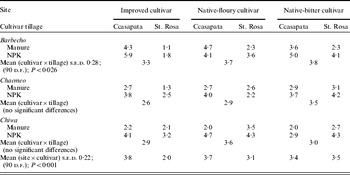
Therefore, the magnitude of the differences in dry matter tuber yield among potato cultivars grown in three distinct tillage systems varied from those observed with fresh tuber yields (Table 6). In particular, the differences in yield between the improved cultivar and the two native cultivars were altered. For example, in Ccasapata the improved cultivar produced 20% more fresh tubers in chacmeo but yields were similar for all cultivars considering dry matter production. In St. Rosa, the native cultivars produced c. 30–50% more fresh tuber yield in barbecho than the improved cultivar but c. 100% more dry matter tuber yield. Likewise in chiwa (St. Rosa) all cultivars had similar fresh tuber yields but for dry tuber weight the native cultivars out yielded the improved cultivar by 44 and 30%, respectively.
Dry matter weights of tubers in t/ha of different potato cultivars planted in plots prepared with three distinct tillage methods at two sites during the rainy seasons from November to May 2006/07. s.e.d. listed for significant effects only

s.e.d. (sites×types of tillage)=0·25; (18 d.f.); P<0·001.
s.e.d. (sites×types of tillage×cultivars×fertilizer)=0·54; (90 d.f.); P=0·024.
DISCUSSION
Soils with low pH and low clay contents are relatively common in the central Andean highlands. These properties affect nutrient availability and might limit crop productivity. Decomposition processes at high altitudes are slow, because of low temperatures, seasonal drought and natural acidity of the soils, resulting in an accumulation of organic substance that improves several soil characteristics, such as nutrient and water retention, soil temperature and structural stability of soil aggregates (RuiJun & FuXing Reference RuiJun and FuXing2005; Tang et al. Reference Tang, Zhang, Schroder, Payton and Zhou2007). Nevertheless, availability of nutrients, especially nitrogen and phosphorus, is often low, which is one of the reasons why farmers grow at most three to four crops (sometimes only one) before leaving the field fallow or as a natural pasture to recuperate for at least 3–4 years before cultivating it again. For the same reason, farmers always grow potato as the first crop in the rotation cycle. It has a high nutrient demand and it is the most important crop for their subsistence and is therefore provided with the best nutrient supply after fallow. In this context, the tillage system, the way to prepare the soil for planting, is a major component of the solution space farmers make to achieve best use of limited resources such as labour, land, soil fertility, seed or fertilizer for crop production. The term solution space refers to all combinations of values of critical management variables that deliver positive results when a particular technology is used (Reece & Sumberg Reference Reece and Sumberg2003).
The current experiment showed interactions for the four factors site×tillage×cultivar×fertilization, indicating that the three tillage systems provided different growth conditions to specific potato cultivars in different altitudinal zones. Soil tillage has a direct effect on nutrient mineralization rates and availability of (soil and fertilizer) nutrients for plants but also on water retention capacity and soil temperature and therefore on plant development and yield (Malhi et al. Reference Malhi, Lemke, Wang and Chhabra2006; Oorts et al. Reference Oorts, Nicolardot, Merckx, Richard and Boizard2006). The cultivars clearly showed different degrees of adaptation to these growth conditions at the different altitudinal levels, expressed as variations of their tuber yield. For example, yields differed considerably between sites, showing increments of 40–160% in Ccasapata but only of 50–90% in St. Rosa. Inorganic fertilization was most efficient, producing the greatest rates of increment when applied in chiwa at the lower and intermediate sites (Ccasapata, Aymara) as compared with organic fertilization. A possible explanation would be that in chiwa the potato plant used most of its reserves to grow from its planting depth, 200 mm below the original soil surface, through the additional soil layer (ridge) turned on top before reaching the sunlight and consequently had an instant high demand for nutrients. These nutrients were more readily available, and in greater quantities, with inorganic than with organic fertilization. Conversely, increments in chiwa in the upper fields were lower because other growth factors than nutrient supply, such as water retention, storage of light energy, temperature, etc., might become more decisive.
Manure is essential for the potato crop to be able to use the nutrient supply from inorganic fertilizer effectively. Manure, especially in these adverse agro-ecologies, has other functions than being only a source of nutrients, often resulting in synergistic effects of organic and inorganic fertilizers. Some reasons substantiating this observation are (i) that organic fertilizer provides specific micronutrients that limit plant growth but are not provided by the ‘normal’ mineral NPK application (Mallory & Porter Reference Mallory and Porter2007), (ii) that soil organic carbon contents are often associated with increased water supply capacity of the soil (Liebig & Doran Reference Liebig and Doran1999; Barzegar et al. Reference Barzegar, Yousefi and Daryashenas2002), (iii) that soil organic matter increases cation exchange capacity (Black & White Reference Black and White1973), which improves nutrient retention and nutrient availability for the plant or (iv) that application of organic carbon stimulates microbial activity, thereby nutrient mineralization and availability (Tu et al. Reference Tu, Louws, Creamer, Mueller, Brownie, Fager, Bell and Hu2006; Srivastava et al. Reference Srivastava, Roseti and Sharma2007) and (v) increases the suppressiveness of soils for plant pathogens (Tamm Reference Tamm, Bruns, Leifert, Fuchs, Thürig, Specht and Fliessbach2006).
The improved and the native-floury cultivars produced greatest yields when grown in favourable growth conditions, i.e. at the lower sites in a well-prepared seed bed (barbecho) and with inorganic fertilization. When these conditions were not met such as at the higher sites, yield reductions were notable. The cultivars produced fewer and smaller tubers, although the native-floury cultivar still showed better adaptation to these conditions than the improved one. A similar effect could be observed when these cultivars were grown in chacmeo or chiwa at the lower sites; yields were reduced and fewer tubers produced compared with the barbecho system. Reasons for this could be the physical and spatial restrictions due to the smaller growth space surrounded by untilled soil in these systems and/or the prolonged and more energy-consuming time to emergence, which renders the young plants more susceptible to stress during early growth.
The bitter cultivar produced relatively constant yields in all three tillage systems at the lower and upper sites (except in Ccasapata), indicating a limited yield potential in more favourable growth conditions but a better yield stability in more marginal conditions compared with the other cultivars. It produced more tubers/m2 at the higher site, indicating a better adaptation to these growth conditions.
The effect of the type of tillage on the dry matter content of potato was striking. The chiwa system increased tuber dry matter content by up to 2%, more pronounced for the native cultivars and less for the improved cultivar. Furthermore, there were other genetic and site-specific differences. The native cultivars produced 5–10% more dry matter than the improved cultivar and there was a tendency for higher dry matter contents at the lower site than the upper one. Hence, an evaluation of the dry matter yields of the different cultivars showed that the yield advantage in fresh tubers of the improved cultivar was mainly due to its better water harvesting capacity but not to an increased dry matter production compared with the native cultivars. At the lower site dry matter yields of the cultivars were similar within the respective tillage systems, whereas at the upper site the native cultivars, especially when fertilized with organic manure, often out yielded the improved cultivar. These facts clearly support farmers' statements that tubers from local cultivars grown in chiwa or chacmeo and fertilized with organic manure are of a better quality and have a better taste (starchier) than the ones from improved cultivars produced in barbecho (Caycho personal communication).
The experiment showed that the tillage system interacted with and influenced a variety of factors. Therefore, farmers have to make complex decisions considering productivity v yield stability, internal v external resource use, labour requirement during peak times v a more uniform distribution or extensive v intensive production. The chiwa and to some extent the chacmeo technique seemed to reduce risks generating relatively stable yields for different environments and genetic material, whereas the barbecho system sought to optimize growth conditions for the potato crop but was more liable to stress and the use of external resources, which might affect crop productivity considerably. Presently, farmers often use the barbecho system to produce potatoes of improved cultivars for the market, which has specific quality requirements (size, form, colour, disease free, etc.), investing the greatest share of internal and external resources. They use the chiwa and chacmeo systems to produce native cultivars for their home consumption, valorizing their taste, cooking qualities and lower resource requirements.
The authors are grateful for funding provided by the government of Spain (INIA) through the project ‘Conservation and Sustainable Use of Native Potatoes in Huancavelica, Peru’ and to the four farming communities for their valuable collaboration and assistance in implementing, managing and evaluating these field trials.