





As a LEGO® fan and a public historian with expertise in history of science, imagine my excitement when, while scrolling through social media, I saw an advert for a new LEGO® set: “The Evolution of STEM.” Finally, a LEGO® set I could buy and legitimately build for work!
Released in March 2025, this 879-piece set is from the LEGO® IDEAS range. This model was initially pitched by a fan-designer, who won the “Celebrate the Wonder of STEM” contest in 2023.Footnote 1 This model is but one of a range of historical LEGO® sets including the Titanic, the Great Pyramid of Giza, and a Viking Village.Footnote 2 Based on an analysis of the “The Evolution of STEM” set, this article reads LEGO® for adults as a genre of public history with distinct characteristics. I argue that the legofication of the past offers an active, participatory experience of historical engagement, but one that simplifies complex histories into easily consumable narratives. By commodifying the past into celebratory narratives that appeal to audiences, legofication produces a form of micro-commemoration that, like other types of commemoration, is contested.Footnote 3
1. Constructing the past
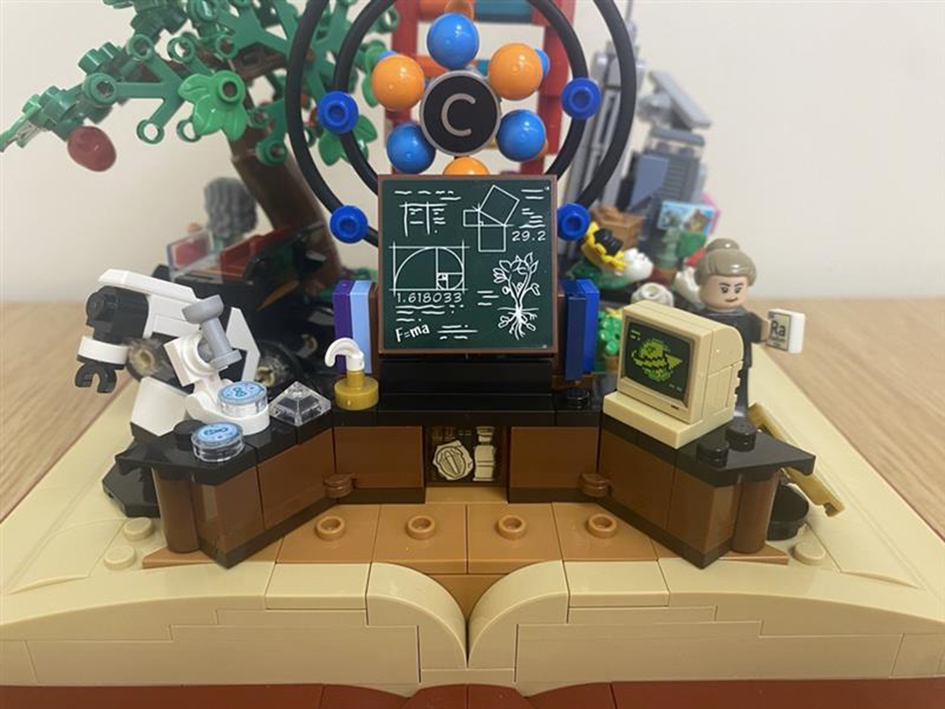
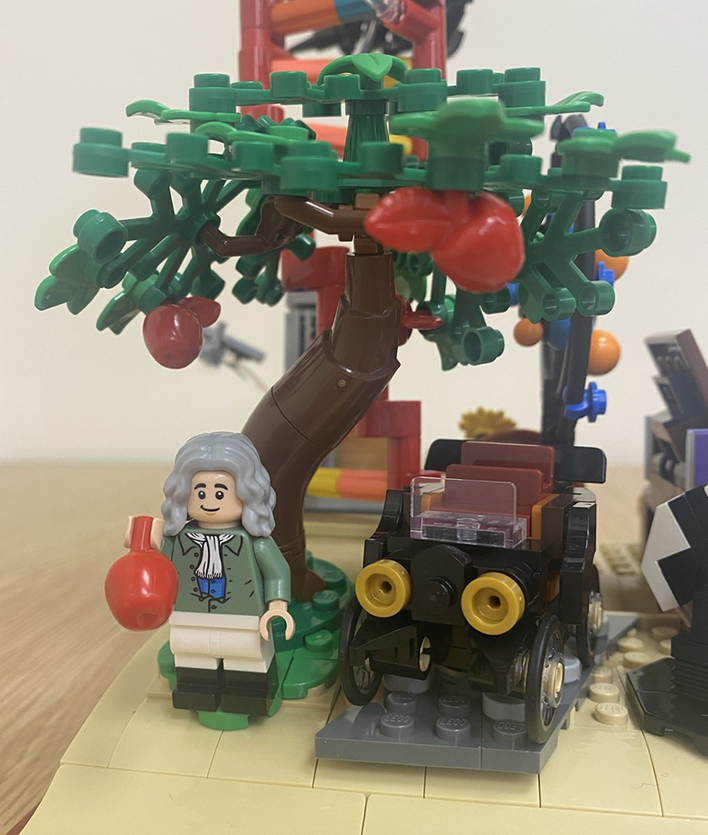
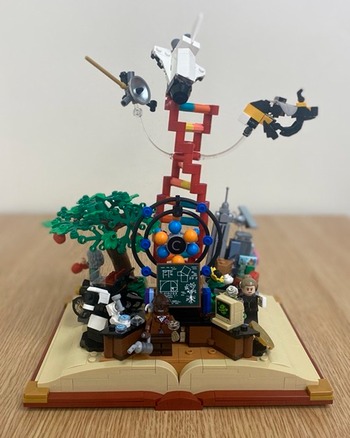
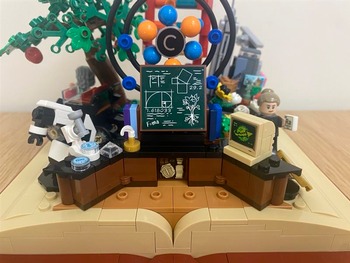
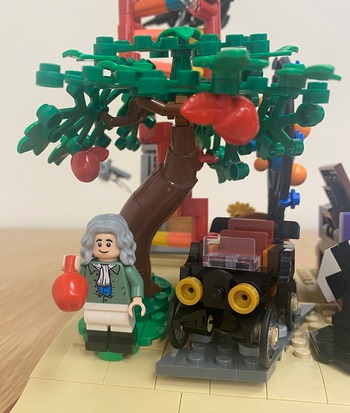
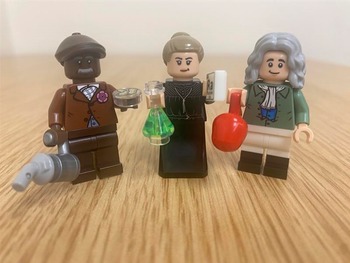
The history of STEM has been translated into LEGO® bricks. Once built, the model features some of the great symbols of science in the form of plastic bricks, bursting forth from an encyclopaedia. A DNA strand emerges most prominently in the centre, with a carbon atom in front of it, and the NASA Voyager probe, a space shuttle, and a bumblebee flying around them (figure 1). A multiplicity of symbols of science and technology are crammed into the scene, including a computer, a mini plane, a microscope and a tiny chalkboard showing Fibonacci’s spiral and Newton’s Second Law of Motion (figure 2). Three scientists have been immortalised in LEGO® as minifigures: George Washington Carver (1864–1943), American agriculturalist and inventor; Isaac Newton (1643–1727), English polymath (figure 3); and Marie Skłodowska-Curie (1876–1934), Polish-French physicist and chemist.
“The Evolution of STEM” model fully built. Author’s own photograph.

Figure 1. Long description
The model is constructed on a base that resembles a large open book with tan pages.
* At the base level, several minifigures are positioned around a central desk. A chalkboard sits in the center displaying mathematical and biological diagrams, including a Fibonacci spiral and a plant root system. To the right of the desk is a vintage computer monitor and a female scientist minifigure. To the left is a male scientist minifigure and laboratory equipment.
* Behind the desk, a large atomic model with blue and orange electrons surrounding a central nucleus with the letter C is mounted.
* To the left of the center, a green leafy tree with red apples represents Newtonian physics.
* To the right of the center, a grey skyscraper represents engineering and architecture.
* Rising from the center is a tall red double helix D N A strand.
* At the very top of the D N A strand, a white space shuttle is perched, pointing upward.
* Two transparent curved rods extend from the upper D N A strand. The left rod supports a satellite with a golden dish. The right rod supports a black and yellow robotic arm or drone.
The desk at the front of the model. Author’s own photograph.
Isaac Newton holding an apple under an apple tree, at the back left of the model. Author’s own photograph.
Legofication as public history is not just a representation of the past, but an active process of structured doing, similar to other genres of public history in popular culture, like video games.Footnote 4 Building the models is a form of tactile, playful, participatory history. Taylor and Ingraham highlight the sensory experience of building LEGO®, describing it as a “clickable media”: “people engage first and foremost with their fingers.”Footnote 5 In relation to historical models, this is a unique material interaction with the past. This sensory engagement is infused with playfulness and the nostalgia commonly associated with childhood toys, which goes some way to explain the success of LEGO® for adults, which, in 2021, accounted for 20 percent of their sales.Footnote 6 The basic brick design has not changed since 1958, and the bricks click together and snap apart in the same manner they always have.Footnote 7 LEGO® has a broad appeal across generations, and thus tactile nostalgia is a core feature of engagement with legofied pasts.
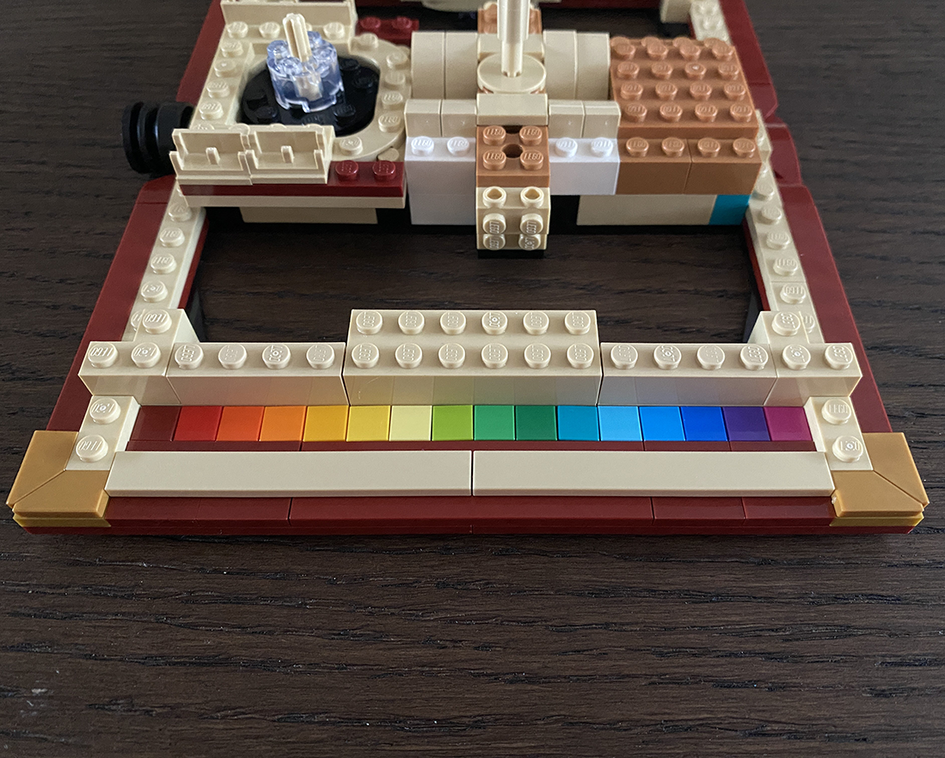
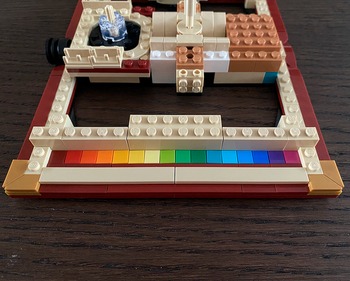
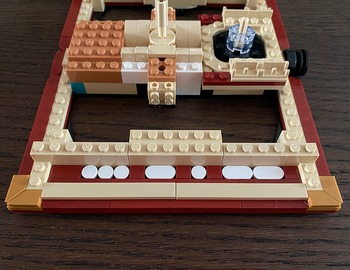
This nostalgia is paired with curiosity, which LEGO® successfully inculcates into their builds through the use of “easter eggs.” “Easter eggs” are concealed clues that need to be decoded. In this model, to build the encyclopaedia base, one has to build an infrared spectrum and a secret message in Morse code, which an internet search showed to mean “STEM” (figures 4 and 5). If my own experiences can be considered representative, these details were highly effective at engaging curiosity and an appetite to know more. Indeed, invocations of curiosity have been identified as a driver of engagement with games, and the discovery and decoding of Easter eggs are intrinsically rewarding.Footnote 8 Notably, these details cannot be seen once the model is complete; as such, it is only through the process of building that the user experiences this injection of curiosity, stimulating the need to interpret elements of the build. This playful curiosity is a unique characteristic of LEGO® as a genre of public history. The legofication of the past is not just the completed model, but the engaging process of active building.
The infrared spectrum built into the left side of the base. Author’s own photograph.
Morse code for STEM built into the right side of the base. Author’s own photograph.

2. Simplifying the past
It’s not all fun and games, though. In providing a playful, nostalgic experience, complex histories are simplified. In this instance, this has parallels with older historiographic traditions of a teleological narrative, a march of progress from then to now to the future.Footnote 9
Anna Maerker has described how a teleological narrative and a celebration of individuals in public serve to legitimise science, for professional and national reasons, and to inspire the next generation of scientists.Footnote 10 The language of inspiration and progress is evident in the instruction manual: “STEM fields have always been built on the achievements of past explorers and pioneers. Their curiosity, creativity and collective pursuit of knowledge continues to inspire and propel us towards their discoveries and technological advancements.”Footnote 11 The result is a digestible narrative, and perhaps a comforting one, that presents science as leading the way to solve the world’s problems.
Paired with this teleological narrative is an emphasis on individual genius, shaping and reinforcing the already iconic status of Carver, Newton and Skłodowska-Curie. The celebratory narrative is confirmed on the LEGO® website: “It’s an extraordinary line-up of truly great figures in history.”Footnote 12 As Maerker and Ludmilla Jordanova have shown, public histories of science often uncritically invoke the names of individual geniuses who are exalted in a manner similar to saints.Footnote 13 In this instance, each has been given a place in popular culture by the instantly recognisable form of a 3-brick minifigure. Each is clasping symbols of the work with which they are most associated. Skłodowska-Curie holds a conical flask and the square of the periodic table for Radium (which she discovered). Carver holds a petri dish with peanuts on it, referencing his agricultural work on peanuts. Newton holds the apple that was said to have fallen from the tree that led to his discovery of gravity (figure 6). An adult viewer likely can decode the meanings of these symbols—perhaps, particularly of Newton—but, if they cannot, these small details serve as further “Easter eggs.” These moments connect the scientists to the broader simplified narrative of a teleological history of science, that moves from one great discovery to the next.Footnote 14
Minifigures of Carver, Newton, and Skłodowska-Curie. Author’s own photograph.

LEGO® minifigures are a metaphor for celebrating individual geniuses devoid of context. When JD Bernal wrote that an emphasis on geniuses in the history of science “lessened them in stature,” he did not mean compressing their histories into 3 cm of plastic. In fact, he meant that divorcing historic scientists from their social environments diminishes their accomplishments.Footnote 15 Here, Carver, Newton, and Skłodowska-Curie exist in a timeless tableau with nothing anchoring them to their own period and place. The barriers Skłodowska-Curie faced as a woman are erased, creating the impression that any woman could have been a ground-breaking scientist if she was only clever enough.Footnote 16 The broader context of systemic racism has been erased from Carver’s life, who was born into slavery in c.1864 and raised in the Jim Crow South. The reduction of Carver to a symbol could be appropriated for abhorrent means if it is perceived as “an indication that slavery and segregation could not have been too bad if they produced a Carver.”Footnote 17 In the imaginary world of LEGO®, racism and sexism do not exist. The medium of LEGO® does not allow for the nuance of historical reality, and instead necessarily simplifies and reduces to create more palatable historical narratives that appeal to their audience and correspond to their brand of playfulness.
3. From commodification to commemoration
Legofied pasts are first and foremost, commodified pasts. Commodification becomes commemoration as the completed sets and minifigures are displayed in the home. The particular symbols and figures immortalised have been selected because they are already recognisable and are marketable. This bears parallels with other public histories of science; Jordanova has pointed out that individual heroes attract audiences.Footnote 18 The iconic status of the historic inventions, discoveries and figures is subsequently reinforced by legofying them. In a profit-driven context, a “usable past” becomes one that can be made recognisable, collectable and marketable.Footnote 19 Brands like LEGO® are agents in the construction of historical meaning in public, reflecting and reinforcing what is worthy of being commodified and thus commemorated.
LEGO® for adults is most clearly a commemorative practice once the sets have been built. Unlike children’s engagement with LEGO®, which is built and unbuilt endlessly, models for adults are pitched as décor once they are complete—in this instance, “Science-themed décor.”Footnote 20 Once on display in the home, models become signifiers of identity.Footnote 21 The minifigures in particular hold parallels with commemorative statues as they are humanoid, and have the potential to be displayed.Footnote 22 However, the authority of public statues is conferred via careful selection of public space.Footnote 23 LEGO® sets are made and marketed in public, and have a virtual presence on the web, but the built models exist only in private spaces like the home. As a genre of public history, LEGO® for adults can be read as a micro-commemoration; consumers may identify with the legofied historical representations, and choose to purchase, build, and display them in their homes.
As a commemorative practice, legofied pasts share another characteristic with other forms of public commemoration; they have invited controversy intertwined with identity politics. Like public statues, legofied pasts impose a singular narrative that privileges some groups over others, raising questions about identity and who “owns” the past.Footnote 24 Here, LEGO® suggests the West “owns” the history of science by choosing scientists exclusively from the USA and Europe.Footnote 25 The public contestation, however, has centred on the naming of Skłodowska-Curie as “Marie Curie,” with the omission of “Skłodowska.” Critics argued the omission erased her Polish identity, and LEGO® responded by adding “(née Skłodowska)” after Curie.Footnote 26 This can be seen to be a form of co-creation, as consumers have shifted the official representation of Skłodowska-Curie. The participatory role of the public is evident in other forms, such as fan-designed historical models pitched on internet forums, minifigures of historical figures being sold by businesses unaffiliated with the LEGO® group, and the use of LEGO® bricks to build statues for historic anniversaries.Footnote 27 As a genre of public history, LEGO® is not just a participatory experience of building, but a contestation and co-creation of historical meaning through official and unofficial LEGO® channels.
4. From legofied pasts to legofied humanities? From legofied pasts to legofied humanities
At the time of revising this article, I found myself once again sidetracked by an advert for LEGO®. This time, it was the “University of Science,” a legofied university, celebrating various fields of science. The University of Science even has its own commemorative practices—a tiny bust is on display of a bearded man (a scientist?).Footnote 28 This was a reminder that “The Evolution of STEM” is not an isolated curiosity but a reflection of a culture that exalts science as the world’s intellectual heritage. I have yet to see an equivalent celebration of the humanities. Yet these are the very disciplines we need to unpack the implications of who, what, why, where, and how historical meaning is created, contested, and celebrated.
This article has introduced LEGO® for adults as a distinctive genre of public history. It is not just a translation of history into bricks, but a participatory engagement with the past through tactile construction and playful nostalgia. This rests on a simplification of the past, which can serve a celebratory narrative akin to commemoration when on display in the home, but also contested and co-created in public. If LEGO® is amongst the ways the public identify with history, it deserves the same critical attention as other forms of public history.
And, perhaps, LEGO® affords other opportunities for the humanities. As we are increasingly under pressure to justify our contributions to the world, maybe we need to embrace LEGO® as a mode of communication, crack out the childhood LEGO® and start legofying the value of the humanities.
Author contribution
Conceptualization: K.C.; Investigation: K.C.; Writing - original draft: K.C.; Writing - review & editing: K.C.
Acknowledgements
The author would like to thank Dr Carly O’Neill-Barrett and Dr Rhiannon Garth Jones for reading early drafts of this article, and the anonymous peer reviewers for their helpful suggestions.
Conflict of interests
The author declares no competing interests.

 Open access

