Highlights
-
• The EVT expansion from 6 to 24 h treatment window is expected to result in a positive return on investment.
-
• The higher the percentage of suspected strokes treated with EVT, the better the return on investment and the lower the threshold cost avoidance needed for the EVT24h implementation to break even the cost.
Background
Current practice in Alberta, based upon stroke guidelines, is to treat appropriate acute ischemic stroke patients with thrombolysis within 4.5 h and endovascular thrombectomy (EVT) within 6 h from stroke onset, defined as when the patient was last seen well. However, some patients present to medical attention many hours after stroke onset (up to 24 h) and may still benefit from acute treatment. Often, these patients reside in rural regions where distance to a tertiary care center contributes to delayed presentations. Randomized trials have shown that treatment-eligible patients can be identified by brain and neurovascular imaging. Reference Jovin, Nogueira and Lansberg1,Reference Desai, Haussen and Aghaebrahim2 Expanding treatment access could result in fewer patients living a life of disability, particularly those who live in rural or remote areas and are far away from hospitals that provide EVT.
Currently, in the province of Alberta, triage for stroke is broadly set at the provincial level at 6 h from stroke onset. Within this time frame, patients are transported by Emergency Medical Services (EMS) to a stroke center; beyond this time frame, they are transported to the nearest facility. Based upon data from randomized trials, the stroke programs at the two comprehensive stroke centers began treating patients in later time windows, and this has resulted in approximately 20% of the total EVT population being treated in the 6–24 h time window from stroke onset. It is expected that the change of EMS triaging of stroke calls from 6 to 24 h window would result in better clinical outcomes for patients and economic outcomes for the provincial health system.
Previous studies have suggested that the cost-savings to the healthcare system associated with EVT treatment for stroke within the current 6 h treatment window are between $5 and $6 million per year as compared to medical treatment only. Reference Thanh, Jeerakathil and Stang3 The purpose of this study is to estimate the potential cost impact and return on investment (ROI) of expanding the treatment window and hence the triage time criteria from 6 to 24 h.
Methods
We performed the analysis in four steps. First, the health service utilization (HSU) cost per patient (U) in one year after being treated with EVT24h was estimated. Second, we developed a formula to calculate benefits (B) of EVT24h: B=(U/(1-R))*R, where the term U/(1-R) was the HSU cost per patient in one year after being treated without EVT and R was the cost avoidance as a percentage of the HSU cost reduced by EVT. Third, an intervention cost (C) was estimated. Finally, the ROI and net monetary benefit (NMB) were estimated.
To estimate U, which was defined as the incremental cost of HSU incurred during the year of EVT treatment compared to the prior year without treatment and which included costs for inpatient, outpatient and physician services as well as prescription drugs, we used a retrospective cohort design. All stroke patients treated with EVT between 6 and 24 h from last seen well (herein called EVT24h) in Alberta from April 1, 2021, to March 31, 2024, were identified from the Quality Improvement & Clinical Research (QuICR) database, a comprehensive pan-Alberta stroke registry. 4
Each patient unique lifetime identifier was linked to the following Alberta health administrative databases: 5 hospital Discharged Abstract Database for acute hospital inpatient services; the National Ambulatory Care Reporting System for outpatient services (including emergency department [ED] and outpatient clinic visits); Practitioners Claims database for physician services (including general practitioner [GP] and specialist visits); and Pharmaceutical Information Network (PIN) for prescription drugs (dispensed by community pharmacies). The average number of prescriptions filled outside of the hospital per person per year was counted, where any new prescription or prescription refill dispensed is counted as one prescription.
HSU costs were estimated from a publicly funded health system perspective. Inpatient and outpatient services were based on the Canadian Institute for Health Information case-mix group plus methodologies, 6 where the cost of a hospital/outpatient episode is equal to the resource intensity weight multiplied by the cost per standard hospital stay. Costs for physician services were based on the paid amounts for claims that physicians made to the Alberta Health Care Insurance Plan. 7 For alternative payment plan (e.g., salary or capitation) claims (∼6%), where the paid amounts are not available, we used the system-assessed amounts as a proxy. Costs for prescription drugs were estimated based upon dispensed amounts recorded in the PIN database and prices per unit from the Alberta Drug Benefit List. 8
To estimate R, the cost avoidance as a percentage of the HSU cost reduced by EVT, we compared the HSU cost between patients with stroke treated with and without EVT by using the following formula: R = ((U2 − U1)/U2)*100, where U1 is the HSU cost per patient treated with EVT and U2 is the HSU cost per patient treated without EVT. Because all eligible patients were treated with EVT, there were no data for patients who were eligible and untreated with EVT. Therefore, R estimated from our previous study on the ROI of EVT6h Reference Thanh, Jeerakathil and Stang3 was used as a proxy for the base-case analysis. This is justifiable based upon randomized trial data, which report that patients treated in later time windows have at least as large or larger treatment effect size as compared to patients treated within 6 h from onset. Reference Albers, Marks and Kemp9,Reference Nogueira, Jadhav and Haussen10
To estimate intervention costs, we included costs for EVT, diagnostic imaging (DI) and ambulance transportation, which were obtained from AHS Finance, Diagnostic Imaging Department and EMS, respectively. These included costs for stroke observational beds, personnel (nurses and rehabilitation supports), DI (EVT and CT angiography [CTA]) and transportation. Transportation costs included the cost of both patients treated with EVT and those transferred because they were triaged as a suspected stroke within the window but deemed ineligible for EVT upon arrival at the hospital. All suspected stroke patients (including both those who were eligible and those who were ineligible to receive EVT24h) were assumed to be transported via ambulance and received CTA. The percentage (P) difference between the number of patients treated with EVT and the number of patients with suspected stroke retrieved from the EMS 2023–2024 program data was used to proportionately estimate the total cost of ambulance (C_amb) and CTA (C_cta) for all EVT-eligible and EVT-ineligible patients. The cost per ambulance ride was provided by Alberta EMS and calculated as the 2023–2024 total EMS expenses divided by the total number of EMS events. This was then added by the cost of EVT24h (C_evt) to get an average cost per EVT patient using the formula C =(C_cta+C_amb)/P+C_evt.
To estimate ROI, we divided the benefit by the cost (ROI = B/C). To estimate NMB, we subtracted the cost from the benefit (NMB = B–C). Reference Drummond, Sculpher, Torrance, O’Brien and Stoddart11 To estimate the NMB for the Alberta health system per year, we multiplied the NMB per patient estimated above by the number of patients treated with EVT24h per year, which was retrieved from the QuICR registry. 4
Sensitivity analyses
Deterministic and probabilistic sensitivity analyses were performed to assess the impact of parameter variations on ROI. For the deterministic analysis, we used a one-way sensitivity analysis, allowing one variable to vary at a time, from the lower to the upper value of 95% confidence interval of each parameter. The probabilistic sensitivity analysis allowed all variables to vary simultaneously, using gamma distributions for costs and triangle distributions for proportions. We ran 100,000 samples and reported the probability for the NMB to be greater than 0 or the ROI to be greater than 1. A threshold analysis was also performed to estimate the break-even cost avoidance rate (TR%) for the intervention cost to be equal to the benefit of EVT24h using the formula TR = [C/(C + U)]*100.
All costs and benefits were converted to 2024 Canadian dollars using the Canadian Consumer Price Index via the Bank of Canada Inflation Calculator. 12 Stata SE version 17.0 (www.stata.com) and TreeAge Pro version 2020 (www.treeage.com) were used for data analyses.
This study was approved by the Conjoint Health Research Ethics Board, University of Calgary (Ethics ID: REB25-1435).
Results
Estimating the HSU cost (U)
Patient characteristics of the cohort that received EVT24h used to estimate U are shown in Table 1. Between April 1, 2021, and March 31, 2024, there were 288 EVT24h patients. Specifically, 49.3% were male (95% CI 43.5–55.1), with an average age of 70.3 (95% CI 68.7–71.8). The average Charlson comorbidity index score was 3.12 (95% CI 2.91–3.32), and case fatality, defined as death in hospital, occurred in 25.7% (95% CI 20.6–30.8). The proportion of patients in the total EVT-treated population that were classified as EVT24h rose across fiscal years, with 26.7% of EVT24h patients in 2021/22, 30.9% in 2022/23 and 42.4% in 2023/24.
Characteristics of patients treated with EVT24h from 2021/22 to 2023/24

FY = fiscal year.
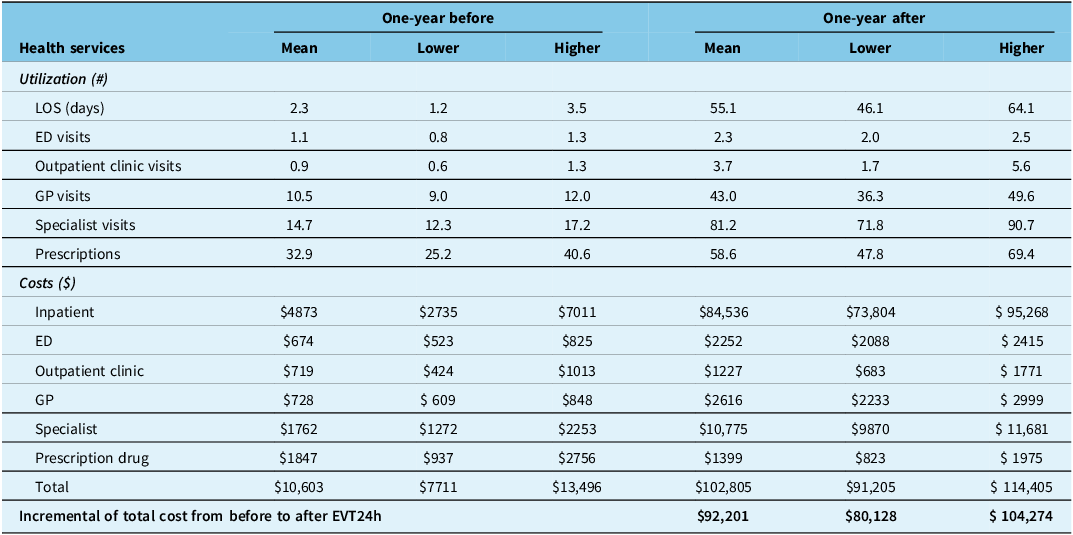
HSU numbers (costs) of these patients in one year before EVT and one year after EVT and the difference or incremental cost from before to after are shown in Table 2. In one year after EVT24h, with 55.1 hospital days ($84,536), ED visits 2.3 ($2252), outpatient visits 3.7 ($1227), GP visits 43.0 ($2616), specialist visits 81.3 ($10,775) and prescriptions dispensed 58.6 ($1399), the total HSU cost per patient was $102,805. In one year before EVT24h, the corresponding numbers were 2.3 ($4873) hospital days, 1.1 ($674) ED visits, 0.9 ($719) outpatient visits, 10.5 ($728) GP visits, 14.7 ($1762), specialist visits and 32.9 ($1847) prescriptions dispensed, giving the total HSU cost per patient of $10,603. The incremental cost from before to after was therefore equal to $102,805−$10,603 = $92,201 (rounded).
Health services utilization and incremental cost per patient from before to after being treated with EVT24h

Estimating the impact of EVT24h or cost avoidance (R)
From Table 2 of our previous study, Reference Thanh, Jeerakathil and Stang3 and excluding the cost for long-term care, the total HSU cost per patient with ischemic stroke in one year after receiving EVT6h was $136,652 (U1). This number for patients receiving standard care was $195,786 (U2). Using the formula R = ((U2 − U1)/U2)*100, the cost avoidance R was estimated at 30% (Supplementary Table S1).
Estimating intervention cost (C)
Based on the cost per endovascular therapy (C_evt) of $8242, the cost per CTA (C_cta) of $220, the cost per ambulance (C_amb) of $919, the percentage of EVT receivers among patients with suspected stroke (P) of 7.1% and using the formula C=(C_cta+C_amb)/P+C_evt, the cost of EVT24h implementation was estimated at $24,358 per EVT patient (Supplementary Tables S2 and S3).
Of note, 7.1% was based on 1090 patients receiving EVT (both 6 and 24 h) among 15,423 suspected stroke patients from April 1, 2021, to March 31, 2024. C_amb was based on $665,954,000 EMS expenses over 724,783 events, which were retrieved from EMS data.
Estimating ROI and NMB
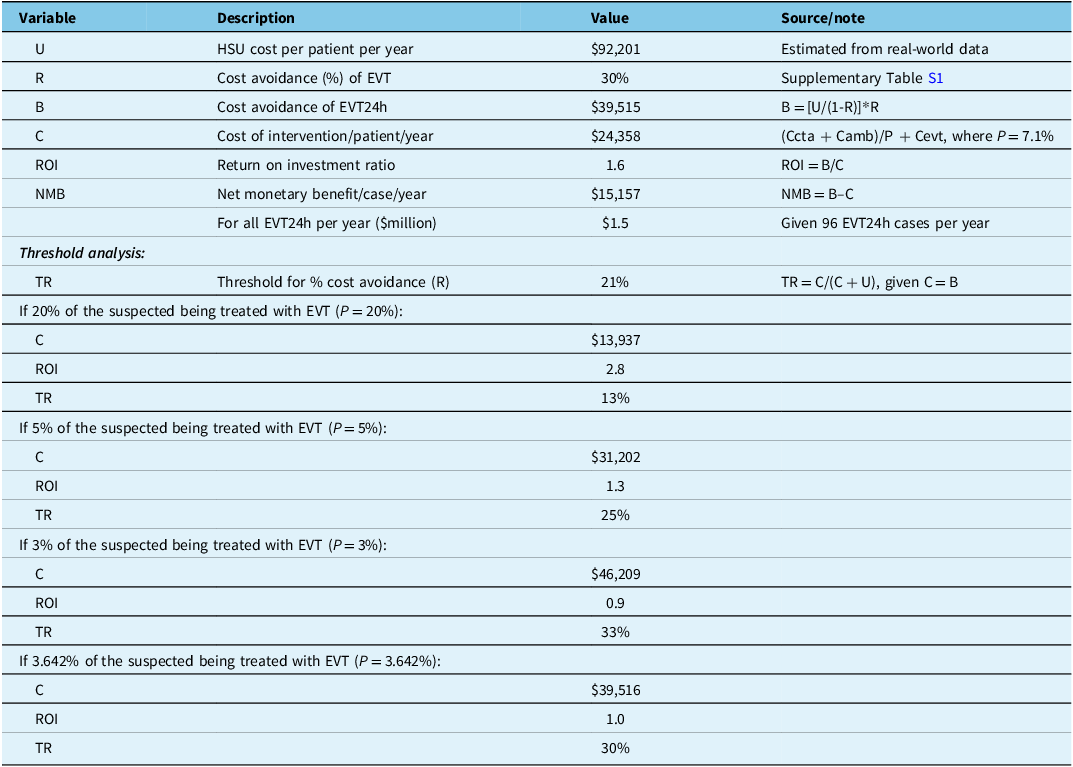
Table 3 shows inputs, formulas and estimated ROI and NMB of EVT24h. Given U = $92,201 and R = 30%, the benefit per patient (B) was estimated at $39,515. Dividing B by the intervention cost (C) of $24,358, the ROI was estimated at 1.6 (every 1 dollar invested results in an estimated return of $1.6 dollars in cost avoidance). Subtracting C from B, the NMB in terms of cost avoidance per patient was $15,157. Given that there were 96 EVT24h cases per year, the cost avoidance for the health system was estimated at $1.5 million annually.
Return on investment and net monetary benefit of EVT24h

HSU = health service utilization; EVT = Endovascular Therapy.
Sensitivity analysis
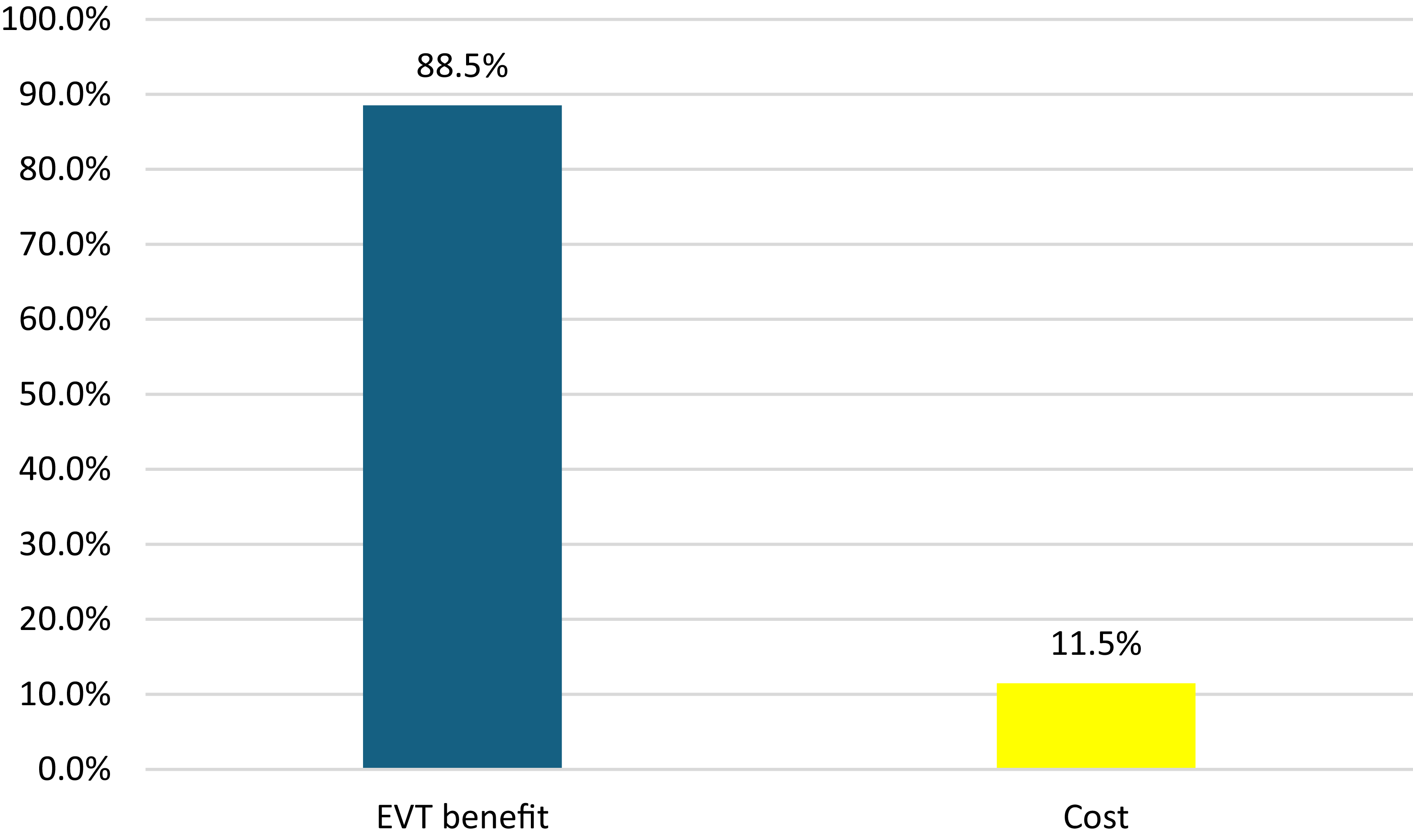
Deterministic and probabilistic sensitivity analyses were performed to assess the impact of parameter variations on outcomes. Figure 1 depicts the deterministic sensitivity analysis, showing NMB of EVT24h ranged from −$8013 to $25,362, corresponding to ROI ranged from 0.7 to 2.0. These outcomes were most sensitive to the change in the impact or cost avoidance (R) of EVT24h, followed by the percentage of patients receiving EVT treatment among the suspected and total HSU costs. The least sensitive inputs were costs for CTA, EVT and ambulance transportation. With inputs and assumptions presented in Supplementary Table S4, the probabilistic sensitivity analysis showed that the probability for the EVT24h to be cost-avoidable (NMB > 0 or ROI > 1) was 88.5% (Figure 2).
Range of net monetary benefit by variation of input parameters. EVT = Endovascular Therapy; HSU = health service utilization.

Probability of EVT24 to result in cost avoidance. EVT = Endovascular Therapy.

The threshold analyses showed that the impact on cost avoidance (R) for the EVT24h initiative to break even the cost of implementation was 21% (Table 3). The ROI would increase to 2.8, and the R threshold would decrease to 13% if the number of patients treated with EVT was 20% of the suspected strokes who were transported to the two provincial stroke centers performing EVT procedures. On the other hand, the ROI would decrease to 0.9–1.3, and the R threshold would increase to 25–33% if the number of patients transported and treated with EVT decreased to 3–5%. The break-even point for this variable was 3.642%, where the ROI was 1 and the R threshold was 30%.
Discussion
We used modeling techniques based upon real-world data to estimate the net benefit as well as ROI for the expansion of EVT to 24 h. Our results suggest that the economic benefit of the expanded EVT24h window is greater than the cost of providing the service. Specifically, the incremental HSU cost (per patient HSU costs post EVT less baseline costs) was $92,201 at one year. Accounting for the effectiveness of EVT relative to no treatment, the estimated cost avoidance was $39,515 (cost without EVT24h would have been $131,716 at one year). Meanwhile, EVT service costs were $24,358 per patient, resulting in an NMB of $15,157 and an ROI of 1.6 (meaning that every dollar invested would return $1.6). The more suspected strokes treated with EVT24h, the better the ROI and the lower the threshold cost avoidance impact needed for the EVT24h implementation to break even. The probability of EVT24h being cost-saving was 88.5%.
Others have found EVT within the 6 h window (EVT6h) to avoid costs. Our previous work estimated a net savings per patient of EVT6h in Alberta of between $43,000 and $55,000 and an ROI of 3.5–5.6 at one year. Reference Thanh, Jeerakathil and Stang3 Other international studies similarly suggest that EVT6h is cost-effective at one year or more, Reference Servick, Demchuk and Shuaib13–Reference McMeekin, Flynn and Allen17 with some indicating EVT leads to long-term cost-savings. Reference Kunz, Almekhlafi and Menon18 The economic impacts of the expanded treatment window have been modeled, using trial data as well as data from implementation, and the results have been mixed. Reference Peultier, Redekop and Allen19,Reference Pizzo, Dumba and Lobotesis20 One 2021 Australian study finds treating patients beyond 4.5 h is associated with less quality adjusted life year (QALY) gains and higher costs relative to best medical practice for patients who do not meet the DAWN or DEFUSE 3 trial criteria (though the procedure is cost-effective for patients that do meet the trial criteria and are treated within the expanded window). Reference Gao, Bivard and Parsons21 A 2023 study from the Netherlands using MR CLEAN-LATE trial data to model the cost-effectiveness of late-window EVT over a lifetime horizon shows that the late-window EVT is cost-effective with an incremental cost-effectiveness ratio (ICER) of €13,091 per QALY gained from a societal perspective. Reference Pinckaers, Evers and Olthuis22 Similarly, a 2020 UK study suggests that EVT 6–24 h may be cost-effective based upon DAWN/DEFUSE 3 patient criteria, with ICERs ranging from $1564–$5253 per QALY gained. Reference Pizzo, Dumba and Lobotesis20 A 2024 Canadian analysis based upon ESCAPE-LATE trial patients, treating patients with EVT, compared to best medical care, was dominant; however, the authors suggest that this is largely due to baseline patient differences; when adjusting for differences in mRS scores, late EVT was less cost-effective with an ICER of $357,527 per QALY gained from a health system perspective. Reference Ospel, Zerna and Harrison23 Future economic study of the implemented expanded EVT treatment windows is recommended.
The infrastructure for an expanded EVT treatment window has already been in place in Alberta, with two existing comprehensive stroke centers, imaging equipment, expertise and integrated EMS systems. There has already been a practice of treating patients within the 24 h treatment window at the comprehensive centers. However, this service needs to be standardized across the province, ensuring all patients, including those living in rural Alberta who rely on EMS and existing EMS protocols, will also receive the service. The results of this work have demonstrated that modifying EMS procedures to triage patients within an expanded 24 h window will benefit rural patients, improving equity in access to EVT and therefore improving patient health outcomes and functional status. However, further study is needed to better understand how the stroke centers are affected by the change to a 24 h window, considering the increase in sensitivity will result in more patients being transported and treated at these centers. In addition, there should be further investigation as to whether other services are affected, such as the impact of an EMS crew being pulled to transport a suspected stroke patient from a rural region to one of the stroke centers, as these resources will no longer be available for several hours in that rural region.
There are a few limitations to this study to be acknowledged. First, there were no available controls to compare EVT24h patients with patients who would be eligible for EVT24h but did not receive it. As a result, we modeled the impact of EVT24h on cost avoidance, based upon the effectiveness of EVT6h. It is reported that EVT for acute posterior circulation patients with tandem lesions treated within 6–24 h after last seen well is associated with similar rates of clinical and safety outcomes (mRS range of 0–6 points and 0–3 at 90 days and 1 year), compared to patients treated within 6 h. Reference Doheim, Li and Zhao24 Conservatively, we performed a threshold analysis and found that the EVT24h would be cost-avoidable if its impact on HSU cost avoidance was equal to or greater than 70% of that of EVT6h (R > = 21% vs. 30% of EVT6h). Second, these results are based upon a soft rollout of the expanded treatment window. Therefore, the upcoming rollout of EMS triage protocols in rural areas has not been captured in the present analysis yet. However, it is noticeable that patients from North and South (2 rural) zones accounted for 23% of all patients treated with EVT24h in this study, while the population in these two zones accounted for only 17% of the provincial population. 25 Third, it is not possible to predict how many patients will be transported based upon this new pathway with suspected strokes that are ineligible for EVT24h. We conservatively assumed that ineligibility would be similar to current rates of EMS transported suspected strokes and included these transport and imaging investigation costs in our analysis. However, a previous study Reference Albers, Marks and Kemp9 has found that the percentage of people screened and found to be eligible for EVT24h was higher than in the EVT6h. Therefore, our estimated ROI and NMB are likely underestimated. Based on an additional sensitivity analysis, if 10–15% of the transported patients were treated with EVT24h, then ROI would range from 2.0 to 2.5 and NMB from $19,883 to $23,680 (results available upon request). Finally, this analysis was conducted from the publicly funded health system perspective, which may underestimate savings from a societal perspective if long-term care costs, patient out-of-pocket costs and lost productivity savings for stroke survivors and their caregivers were included.
Conclusion
The expansion of EVT from 6 to 24 h window is expected to result in a positive ROI. The higher the percentage of suspected strokes treated with EVT, the better the ROI and the lower the threshold cost avoidance needed for the EVT24h implementation to break even. The results can be used as a comparator for future economic evaluations of the EVT24h expansion using real-world data.
Supplementary material
The supplementary material for this article can be found at https://doi.org/10.1017/cjn.2026.10598.
Acknowledgments
We thank the Health Shared Services Alberta for providing data access.
Author contributions
All authors participated in study conception and design and interpretation of results. All the co-authors contributed to the project implementation and data collection. The first and second authors analyzed data and drafted the first version of the manuscript. The last author supervised the whole process. All authors revised and approved the manuscript before submission and take responsibility for the contents of the article.
Funding statement
None.
Competing interests
MDH declares:
-
• NoNO Inc.: Grant to the University of Calgary for the ESCAPE-NA1 trial, ESCAPE-NEXT trial.
-
• Canadian Institutes for Health Research: Grant to the University of Calgary for the ESCAPE-NA1 trial, ESCAPE-NEXT trial and ACT-GLOBAL trials.
-
• Medtronic: Grant to the University of Calgary for the ESCAPE-MeVO study.
-
• Boehringer-Ingelheim GmbH: Grant to the University of Calgary for the ACT-GLOBAL trials.
-
• Sun Pharma Brainsgate Inc.: Paid work for adjudication of clinical trial outcomes adjudication.
-
• US Patent 62/086,077: Licensed to Circle NVI.
-
• US Patent 10,916,346: Licensed to Circle NVI.
-
• DSMC Chair of Oncovir Hiltonel trial (end 2023).
-
• DSMC Chair of DUMAS trial (end 2023).
-
• DSMB member of ARTESIA trial (end 2023).
-
• DSMB member of BRAIN-AF trial (end 2023).
-
• DSMB member of LAAOS-4 trial (ongoing).
-
• President of Canadian Neurological Sciences Federation (not for profit).
-
• Circle Inc., Basking Biosciences: Private stock or stock option ownership.
All other authors have no conflict of interest to declare.
AI use disclosure statement
We did not use any AI tools for this paper.