Introduction
Kochia is a highly invasive and problematic broadleaf weed species in the Great Plains of North America (Friesen et al. Reference Friesen, Beckie, Warwick and Van Acker2009). Kochia emerges early in the spring with an extended period of emergence, an aggressive growth habit, a high tolerance to biotic and abiotic stresses (heat, cold, salt, and drought), a low soil seedbank persistence (< 2 yr), and a high fecundity potential (>100,000 seeds per plant) (Dille et al. Reference Dille, Stahlman, Du, Geier, Riffel, Currie, Wilson, Sbatella, Westra, Kniss, Moechnig and Cole2017; Friesen et al. Reference Friesen, Beckie, Warwick and Van Acker2009; Kumar et al. Reference Kumar, Jha, Dille and Stahlman2018). Kochia can disperse its seeds over distances of up to 1,000 m at speeds of up to 300 cm s−1 through wind-mediated tumbling in the late fall (Baker et al. Reference Baker, Withrow, Brown and Beck2010; Beckie et al. Reference Beckie, Blackshaw, Hall and Johnson2016; Christoffoleti et al. Reference Christoffoleti, Westra and Moore1997). The protogynous and monoecious flowering biology of kochia enables a high degree of outcrossing (11% to 17% downwind) and pollen-mediated gene flow within and among field populations (Beckie et al. Reference Beckie, Blackshaw, Hall and Johnson2016; Mengistu and Messersmith Reference Mengistu and Messersmith2002; Stallings et al. Reference Stallings, Thill, Mallory-Smith and Shafii1995).
Herbicide-resistant (HR) kochia is a major concern for growers in the US Great Plains, including Kansas. Kochia biotypes that are resistant to photosystem II inhibitors, acetolactate synthase (ALS) inhibitors, synthetic auxins, or 5-enolpyruvyl-shikimate-3-phosphate synthase (EPSPS) inhibitors have been confirmed in this region (Heap Reference Heap2018). Varanasi et al. (2015) have recently reported a kochia biotype with multiple resistance to all these four herbicide sites of action in Kansas. The first reports of dicamba-resistant (DR) kochia in wheat-fallow fields surfaced in 1995 (Cranston et al. Reference Cranston, Kern, Hackett, Miller, Maxwell and Dyer2001; Heap Reference Heap2018). Since then, there have been reports of DR kochia populations from six states in the United States and one Canadian province (Crespo et al. Reference Crespo, Bernards, Sbatella, Kruger, Lee and Wilson2014; Jha et al. Reference Jha, Kumar and Lim2015; Kumar and Jha Reference Kumar and Jha2016; Preston et al. Reference Preston, Belles, Westra, Nissen and Ward2009; Varanasi et al. Reference Varanasi, Godar, Currie, Dille, Thompson, Stahlman and Jugulam2015; Westra Reference Westra2016). Compared with its resistance to ALS inhibitors and glyphosate, the evolution and spread of DR kochia is geographically limited despite the use of dicamba for more than three decades. This effect in kochia can possibly be attributed to a fitness cost associated with the resistance to dicamba (Kumar and Jha Reference Kumar and Jha2016; LeClere et al. Reference LeClere, Wu, Westra and Sammons2018). However, the widespread occurrence of glyphosate-resistant (GR) and ALS inhibitor–resistant kochia across the 10 US Great Plains states have resulted in increased use of auxinic herbicides (dicamba and fluroxypyr) for kochia control. A drastic decline in dicamba price was another reason for greater use of dicamba to manage GR and ALS-resistant kochia. The recent commercialization of DR crops will bring about a further increase in dicamba use by growers, which in turn may further exacerbate the problem of DR kochia in this region.
The use of alternative, effective herbicide tank mixtures (multiple sites of action), including soil residual PRE herbicides, is often recommended as a component of an integrated weed management program to manage an HR weed population in the field (Beckie Reference Beckie2006; Kumar and Jha Reference Kumar and Jha2015; Norsworthy et al. Reference Norsworthy, Ward, Shaw, Llewellyn, Nichols, Webster, Bradley, Frisvold, Powles, Burgos, Witt and Barrett2012). Previous studies have documented variable levels of kochia control with PRE herbicides. For instance, kochia control with PRE herbicides such as flumioxazin (280 g ai ha−1), pendimethalin (140 g ai ha−1), or pyroxasulfone (420 g ai ha−1) ranged from 53% to 70% in two separate field studies (Lloyd et al. Reference Lloyd, Johnson, Gover and Sellmer2011; Stahlman et al. Reference Stahlman, Olson, Thompson and Zollinger2010). Control with PRE applied acetochlor + atrazine (260 + 210 g ha−1), S-metolachlor + atrazine + mesotrione (855 + 319 +85 g ha−1), and sulfentrazone (210 g ha−1) was ≥91% at 12 wk after treatment (WAT) (Kumar and Jha Reference Kumar and Jha2015). Control in that study did not exceed 82% with PRE applied metribuzin (425 g ha−1), metribuzin + linuron (425 + 840 g ha−1), and pyroxasulfone + atrazine (118 + 560 g ha−1) treatments at 12 WAT (Kumar and Jha Reference Kumar and Jha2015). In a greenhouse study, Ou et al. (Reference Ou, Thompson, Stahlman and Jugulam2018) also found that dicamba applied PRE at 350 or 420 g ha−1 provided 94% to 97% control of DR kochia compared with only 10% control with dicamba applied POST at 560 g ha−1. Most of the previous field studies had tested PRE herbicides in the early-spring timing; however, there seems to be a lack of published information on the effectiveness of the fall application timing of PRE herbicide tank mixtures for kochia control in fallow. The fall application timing of these PRE herbicides may be more crucial to prevent early-emerging kochia cohorts (as early as February in Kansas), especially when it is difficult to make timely herbicide applications in the spring. The main objectives of this research were to (1) characterize the level of dicamba resistance in the newly evolved DR kochia accessions from Kansas (wheat–sorghum–fallow rotation) and (2) determine the effectiveness of fall- or spring-applied PRE herbicide tank mixtures for kochia control in fallow.
Materials and methods
Plant material
Fully matured seeds of two DR kochia accessions (KS-110 and KS-113) were collected from individual plants that survived a 560 g ae ha−1 rate of dicamba (Clarity® herbicide, BASF Corp., Research Triangle Park, NC 27709) from two separate farm fields (38.85°N, 99.33°W and 38.85°N, 99.34°W) at the Kansas State University Agricultural Research Center (KSU-ARC), near Hays, KS, in the fall of 2015. For each accession, seeds were collected from six to eight plants (survivors) in a chemical-fallow field (wheat–sorghum–fallow rotation). Each field was about 2 ha in size and had a summer fallow phase. The surviving DR kochia plants were randomly scattered in each field. The sampled fields had received frequent dicamba applications in the crop rotation over more than 8 yr. Seeds of a dicamba-susceptible (DS) kochia accession were collected from a pastureland with no previous history of dicamba use, within a vicinity of 2 km from the fields where the DR accessions were collected. Sampled kochia seed heads were hand-threshed and cleaned with an air-propelled column blower. For each accession, seeds of individual kochia plants were combined into a single sample and stored in paper bags at 4 C until used. Progeny seeds of DR and DS kochia accessions were subsequently generated in the greenhouse under pollen isolation conditions for dose–response experiments.
Dicamba dose response
Greenhouse experiments were conducted at the KSU-ARC near Hays, KS, during fall 2016 and spring 2017. Seeds of each DR and DS kochia accession were sown separately on the surface of germination trays (50 by 30 by 10 cm) filled with a commercial potting mixture (Miracle-Gro® Moisture Control® Potting Mix; Miracle-Gro Lawn Products, 14111 Scottslawn Road, Marysville, OH). The greenhouse conditions were maintained at 25/22 ± 3 C day/night temperatures and 16/8 h day/night photoperiods, supplemented with metal halide lamps (400 μmol m−2 s−1). Seedlings from each accession were then transplanted and separately grown in 10-cm diam plastic pots containing the same potting mixture as previously described. Actively growing, young kochia seedlings (8 to 10 cm tall), were treated with dicamba at doses of 0, 280, 560, 1,120, 1,680, 2,240, and 2,800 g ae ha−1. All dicamba treatments were applied using a stationary spray chamber (Research Track Sprayer, De Vries Manufacturing, Hollandale, MN 56045) equipped with an even flat-fan nozzle tip (TeeJet 8001EXR, Spraying System Co., Wheaton, IL 60139) calibrated to deliver 112 L ha−1 of spray solution at 241 kPa. Experiments were conducted in a randomized complete block design with 12 replications (one plant per pot), and repeated in time. The aboveground plant biomass was hand-harvested 4 WAT to determine the dry (after oven drying at 65 C for 3 d) weights.
Field experiments
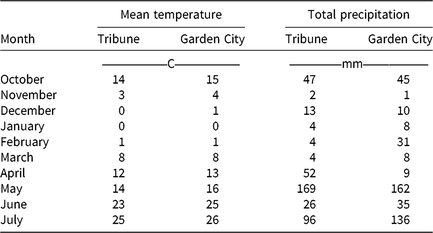
Two separate field experiments were conducted in the fall of 2014: one at the Kansas State University Southwest Research and Extension Center near Garden City, KS, and the other at the Kansas State University Southwest Research Center near Tribune, KS. The objective was to determine the residual activity of fall- (early December) vs. spring- (late February) applied PRE herbicide tank mixtures labeled in corn, grain sorghum, soybean (Glycine max L. Merr.), and/or chemical-fallow for kochia control. The study at each site was conducted in a fallow field for a season-long evaluation of PRE herbicide efficacy (soil residual activity) in the absence of crop competition. The soil at the Garden City site was a Ulysses silt loam (35% sand, 38% silt, and 27% clay), with 1.4% organic matter and a pH of 8.0. The soil at the Tribune site was also a Ulysses silt loam, with 2.5% organic matter and a pH of 7.9. The weather data at each study site were collected from Kansas Mesonet weather stations. Monthly mean air temperatures (C) and total precipitation (mm) during the study period at each site appear in Table 1. The field at each site was under a no-till, wheat–sorghum–fallow rotation for >5 yr, with a natural infestation of kochia. Historically, each study site had received two to three applications of glyphosate during the summer fallow period, chlorsulfuron plus MCPA in wheat, and atrazine-based herbicide programs in sorghum for weed control. Table 2 lists the PRE herbicide tank mixtures tested, as well as trade names and manufacturer information. Both field sites had a natural uniform infestation of kochia. A nontreated control was included for treatment comparison. All PRE herbicide treatments were applied with a CO2-pressurized backpack sprayer equipped with flat-fan nozzles (Turbo Teejet XR110015-VP, Spraying Systems Co., P.O. Box 7900, Wheaton, IL 60139), calibrated to deliver 140 L ha−1 of final spray solution at 225 kPa at each study site. At each site, experiments were conducted in a randomized complete block design with three (Tribune) or four (Garden City) replications, and a plot size of 3 m by 6 m. The percent kochia control was visually assessed at a 4-wk interval after the spring application timing on a scale of 0 to 100% (0 being no control and 100 being complete control). Visually assessed percent control ratings were based on the emergence and general suppression/stunting of kochia seedlings in treated compared with nontreated plots.
Monthly mean air temperature (C) and total precipitation (mm) at Tribune and Garden City, Kansas, during the study period (2014–2015).

List of preemergence (PRE) herbicides tested for kochia control in fallow fields at Garden City and Tribune, KS.

Statistical analyses
All data collected in greenhouse and field experiments were subjected to ANOVA using the PROC MIXED procedure in SAS® 9.3 (SAS Institute, Inc., Cary, NC) to test the significance of the fixed effects—that is, experimental run/site, selected kochia accession, treatment (dicamba dose in dose–response assays and PRE herbicides in field experiments), and their interactions. The random effects in the model included replication and all interactions involving replication. Data were checked for ANOVA assumptions by using PROC UNIVARIATE and PROC MIXED in SAS, and all data met the ANOVA requirements.
Data on percent visible injury or shoot dry weight (% of nontreated) for each kochia accession from dose–response assays were regressed over dicamba doses using a three-parameter log-logistic model in R software (Ritz et al. Reference Ritz, Baty, Streibig and Gerhard2015; Seefeldt et al. Reference Seefeldt, Jensen and Fuerst1995):
 $$y = \{ d/1+\exp \left[ {b\left( {logx-loge} \right)} \right]\}$$
where y represents the shoot dry weight (g plant−1), d is the upper limit, b is the slope of each curve, e is the dicamba dose needed for 50% response (i.e., 50% fresh weight or dry weight reduction, referred as I50 or GR50 values, respectively), and x is the dicamba dose. The lack-of-fit test (P > 0.05) indicated that the chosen model accurately described the data. Other nonlinear regression parameter estimates, such as standard errors and 95% confidence intervals, were computed using the drc package in R software. The resistance factor (R/S ratio) for each DR accession was estimated by dividing the I50 or GR50 value by the I50 or GR50 value of the DS accession.
For field experiments, means for the visually assessed percent control of kochia were separated using the Fisher’s Protected LSD test at P < 0.05. For each tested herbicide, kochia control was modeled as a function of time using Equation 1, where y is the visual control estimate, d is the estimated control provided at 0 wk after the spring-applied PRE herbicide (WASPRE), and e is the number of WASPRE required for the control to drop to 50% of d. From this model, the time after spring PRE application required for kochia control to drop below 80% was estimated and compared for fall vs. spring application timing at both locations using R software.
Results and discussion
Dicamba dose response
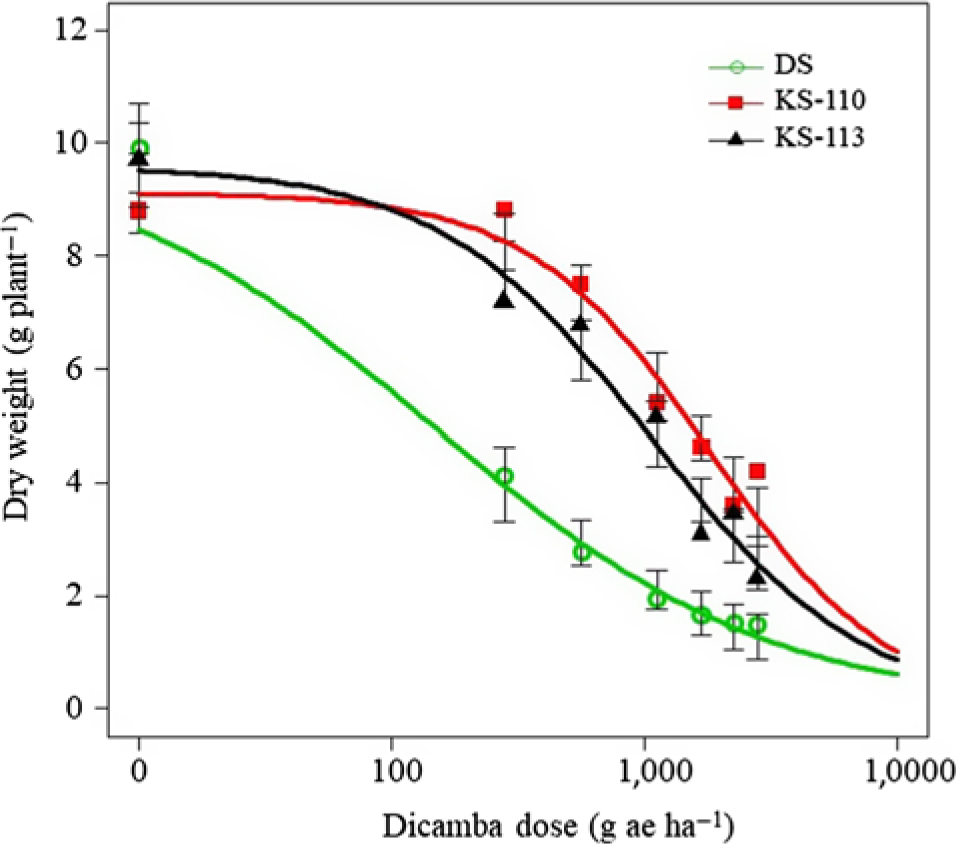
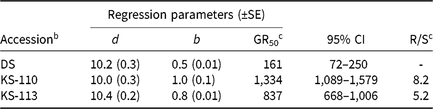
Based on the shoot dry-weight response, the GR50 values (dicamba dose required to achieve 50% shoot dry-weight reduction) for KS-110 and KS-113 accessions were 1,334 and 837 g ae ha−1, respectively, and were 5 to 8 times more resistant than the DS accession (Table 3; Figure 1). Cranston et al. (Reference Cranston, Kern, Hackett, Miller, Maxwell and Dyer2001) reported up to 4.5-fold resistance to dicamba in DR kochia inbreds obtained from field populations collected in 1993 to 1994 from Montana (first DR kochia report in the United States). Later on, Jha et al. (Reference Jha, Kumar and Lim2015) found a 6.8-fold level of resistance to dicamba in one of the three tested kochia accessions from Montana. Our results are also comparable with Nandula and Manthey (Reference Nandula and Manthey2002), who reported 5- to 10-fold levels of resistance to dicamba in DR kochia accessions collected from North Dakota. Similarly, Crespo et al. (Reference Crespo, Bernards, Sbatella, Kruger, Lee and Wilson2014) reported about 2.5-fold variation in susceptibility to dicamba across seven field-collected accessions from Nebraska. In a recent study, LeClere et al. (Reference LeClere, Wu, Westra and Sammons2018) reported a 38-fold resistance to dicamba in a DR kochia inbred line from western Nebraska.
Shoot dry-weight response of dicamba-resistant (KS-110 and KS-113) and dicamba-susceptible (DS) kochia accessions in whole-plant dicamba dose–response assays.

Regression parameter (Equation 1) estimates for the whole-plant dose response of dicamba-resistant (DR) vs. dicamba-susceptible (DS) kochia accessions from Hays, KSa.

a Data are based on shoot dry weight.
b Abbreviations: DS, dicamba-susceptible kochia accession collected from a pasture field near Hays, KS; KS-110 and KS-113, putative dicamba-resistant kochia accessions from fallow fields near Hays, KS.
c GR50 is the effective dose (g ae ha−1) of dicamba for 50% shoot dry-weight reduction, respectively; R/S (resistance index) is the ratio of GR50 of a dicamba-resistant to GR50 of the susceptible kochia accession.
Field experiments
The monthly mean air temperatures during the fall application timing (December) of the PRE herbicides were 1 C and 0 C at the Garden City and Tribune sites, respectively (Table 1). The monthly mean air temperature during the spring application timing (February) was 1 C at both sites. Monthly mean air temperatures were between 8 C and 26 C during the remaining study period at both sites. The accumulated precipitation during the study period was 445 mm at the Garden City site and 417 mm at the Tribune site (Table 1).
Garden city site
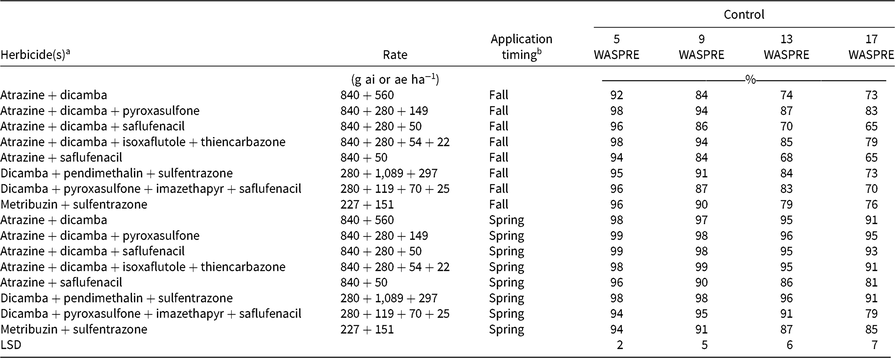
All PRE herbicide tank mixtures applied either in the fall or spring timing provided 90% to 99% residual control of kochia at 5 and 9 WASPRE, with the exception of atrazine + dicamba, atrazine + dicamba + saflufenacil, and atrazine + saflufenacil when applied in the fall (84% to 86% control at 9 WASPRE) (Table 4). However, at the later evaluation dates (13 and 17 WASPRE), there was a greater decline in kochia control with the fall compared to the spring application timing. Control declined to 65% to 76% at 17 WASPRE with a majority of the PRE herbicide tank mixtures when applied in the fall, with only atrazine + dicamba + pyroxasulfone treatment providing a more consistent control (83% at 17 WASPRE). In contrast, residual control with the spring application timing of the PRE herbicide tank mixtures ranged from 85% to 95% at 17 WASPRE, except with atrazine + saflufenacil and dicamba + pyroxasulfone + imazethapyr + saflufenacil (averaged 80% control) (Table 4). Consistent with these results, Kumar and Jha (Reference Kumar and Jha2015) also reported excellent (93% to 100%) kochia control at 8 wk after treatment (WAT) with spring-applied PRE herbicides containing atrazine, dicamba, isoxaflutole, metribuzin, pyroxasulfone, and/or sulfentrazone in Montana. PRE herbicide mixtures containing atrazine can provide extended residual activity on kochia (up to 17 WAT), thus reducing the reliance on repeated POST applications of glyphosate and dicamba, more frequently used for burndown weed control in fallow. Atrazine is not desirable as a stand-alone treatment because of the widespread occurrence of triazine-resistant kochia in the US Great Plains, including Kansas (Heap Reference Heap2018).
Visual estimates of control of kochia with PRE herbicide programs applied in the fall vs. spring timing at the Kansas State University Southwest Research and Extension Center, Garden City, KS in 2015.

a Fall applications were made on December 4, 2014, and spring applications were made on February 23, 2015.
b Abbreviation: WASPRE, weeks after spring-applied PRE herbicides.
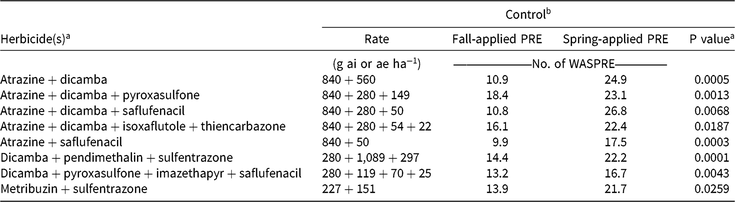
The tested herbicide programs at the Garden City site provided residual kochia control further into the season if applied at early spring compared with fall timing. The time interval observed before each tested herbicide dropped below 80% kochia control was significantly less for fall vs. spring application timings, and the differences ranged from 3.5 to 16 wk of kochia control (Table 5).
Estimated number of weeks after spring PRE (WASPRE) when fall- vs. spring-applied treatments dropped below the 80% level of control for kochia at the Kansas State University Southwest Research and Extension Center, Garden City, KS in 2015.

a Estimates and comparisons of WASPRE for fall- vs. spring-applied treatments were made using R software.
Tribune site
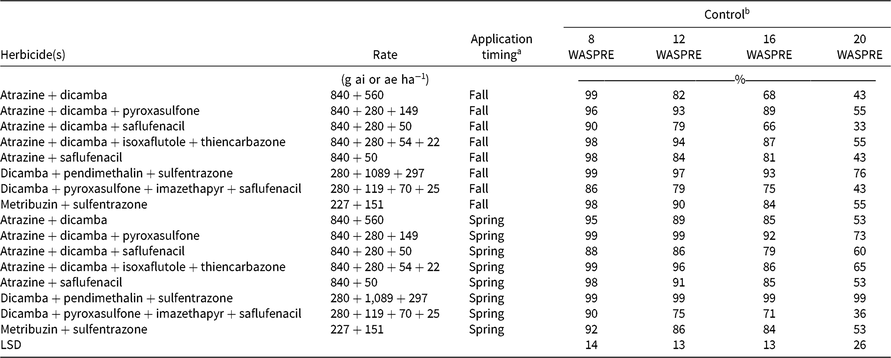
Kochia control with a majority of PRE herbicide tank mixtures applied in the fall or spring timing at the Tribune site was consistent with the Garden City site, especially at the early evaluation dates. At the Tribune site, all PRE herbicide treatments provided excellent kochia control (90% to 99%) at 8 WASPRE, except dicamba + pyroxasulfone + imazethapyr + saflufenacil applied in the fall or atrazine + dicamba + saflufenacil treatments applied in the spring (average 87% control) (Table 6). We observed a significant decline (up to 31%) in kochia control from 8 through 16 WASPRE with atrazine + dicamba and atrazine + dicamba + saflufenacil applied in the fall, and dicamba + pyroxasulfone + imazethapyr + saflufenacil applied in the spring (Table 6). At 20 WASPRE, kochia control was inadequate (<60%) with a majority of the PRE herbicide programs in the fall or spring timing. This greater decline in the soil residual activity of the PRE herbicides at the later evaluation date might be due to a higher soil organic matter content at the Tribune compared to the Garden City site (Dunigan and Mclntosh Reference Dunigan and Mclntosh1971; Upchurch and Mason Reference Upchurch and Mason1962).
Visible estimates of control of kochia with PRE herbicide programs applied in the fall or spring timing at the Kansas State University Southwest Research Center, Tribune, KS in 2015.

a Fall applications occurred on December 4, 2014, and spring applications occurred on February 23, 2015.
b Abbreviation: WASPRE, weeks after spring-applied PRE herbicides.
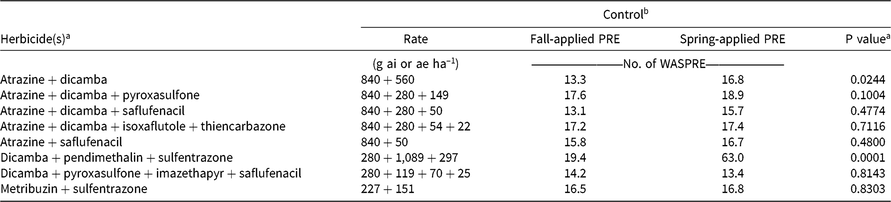
In contrast to the Garden City site, the time taken by a majority of the tested herbicides to drop below 80% kochia control was not statistically significant between fall vs. spring timing at the Tribune site, except for atrazine + dicamba and dicamba + pendimethalin + sulfentrazone treatments (Table 7). These results suggest that for many herbicides there was no weed control benefit to applying herbicides in the spring for kochia control near the Tribune site. However, spring applications of atrazine + dicamba and dicamba + pendimethalin + sulfentrazone did provide extended control of kochia compared with fall applications at Tribune.
Estimated number of weeks after spring PRE (WASPRE) when fall vs. spring applied treatments dropped below the 80% level of control for kochia at the Kansas State University Southwest Research Center, Tribune, KS, in 2015.

a Estimates and comparisons of WASPRE for fall- vs. spring-applied treatments made use of R software.
Practical implications
Results from this research confirm the development of kochia in western Kansas with moderate to high levels of evolved resistance to dicamba. The underlying mechanism(s) conferring dicamba resistance in these DR kochia accessions from Kansas is still unknown. However, a recent study on DR kochia inbred lines from western Nebraska has shown a point mutation (glycine to asparagine amino acid change within a highly conserved region of an AUX/IAA protein) conferring cross resistance to dicamba, 2,4-D, and fluroxypyr (LeClere et al. Reference LeClere, Wu, Westra and Sammons2018). In that study, LeClere et al. (Reference LeClere, Wu, Westra and Sammons2018) found a fitness penalty endowed by the auxinic herbicide resistance trait (LeClere et al. Reference LeClere, Wu, Westra and Sammons2018). Similar findings on the fitness cost (reduced vegetative growth and reproductive traits) of DR vs. DS kochia lines from Montana have been previously reported (Kumar and Jha Reference Kumar and Jha2016). The observed fitness cost may explain the limited spread of DR kochia despite the long history of dicamba use in the cereal-based cropping systems of the US Great Plains (Kumar and Jha Reference Kumar and Jha2016). Nevertheless, growers should exploit the fitness penalty associated with dicamba resistance to manage DR kochia with multi-tactic weed control methods, such as tillage, cover crops, competitive crops in rotations, and alternative effective herbicide sites of action (Kumar et al. Reference Kumar, Jha, Dille and Stahlman2018; Kumar and Jha Reference Kumar and Jha2015). The recent commercialization of dicamba-tolerant soybean will enhance the utility of dicamba for in-crop broadleaf weed control and will most likely increase the selection pressure for further development and spread of DR kochia in the US Great Plains region. Therefore, growers should adopt proper dicamba-use stewardship programs to sustain the long-term utility of dicamba.
Results from field experiments suggest that fall application timing of PRE herbicide tank mixtures (multiple, effective sites of action) will effectively control early-emerging cohorts of kochia in the spring during the fallow phase of a 3-yr, wheat–corn/grain sorghum–fallow rotation, in western Kansas. However, follow-up POST applications will likely be needed for season-long control of kochia (Kumar and Jha Reference Kumar and Jha2015), especially when control from fall applications begins to fail earlier in the season compared with spring applications, such as at the Garden City site. The higher precipitation (47 mm) at the Garden City site compared with the Tribune site (12 mm) during winter months (January to March) might have contributed to a greater herbicide degradation and a drop in percent kochia control below 80% earlier in the spring at the Garden City site. Atrazine-based PRE herbicide tank mixtures, dicamba + pendimethalin + sulfentrazone, and metribuzin + sulfentrazone applied in the early spring (mid to late February) can provide effective kochia control for 3 to 4 mo depending upon the rates used. Soil-applied PRE herbicides serve as a component of a sound, integrated weed management program to manage HR weed populations (Norsworthy et al. Reference Norsworthy, Ward, Shaw, Llewellyn, Nichols, Webster, Bradley, Frisvold, Powles, Burgos, Witt and Barrett2012). Results from this research indicate that the tested PRE tank mixtures can provide extended residual control of kochia. However, the soil activity of some of these PRE herbicides (especially when applied in the fall) can decline drastically by late summer depending upon the prevailing weather conditions, soil organic matter, and soil moisture.
Future research will investigate whether a known point mutation found in the Nebraska kochia line is also responsible for dicamba resistance in these DR accessions from Kansas. Long-term studies are advisable to understand the impact of crop competition, diverse crop rotations, and cover crops on the life history traits (fitness) and population dynamics of these DR kochia accessions to develop ecologically based weed management plans for herbicide resistance mitigation.
Author ORCID
Vipan Kumar https://orcid.org/0000-0002-8301-5878
Acknowledgments
The authors appreciate the technical assistance of Grant Boyer and Pat Geier at the Kansas State University in conducting the greenhouse and field experiments. We also greatly appreciate the financial support from the Weed Science Society of America John Jachetta Undergraduate Research Award to Ryan Engel for conducting the greenhouse research. We thank BASF and Bayer CropScience for partial support in field experiments. No conflicts of interest have been declared. This publication is contribution no. 19-016-J from the Kansas Agricultural Experiment Station, Manhattan, KS.