Since 2000, four successful revolutions have occurred in the post-communist region, each overthrowing regimes practicing fraudulent elections and bringing to power new coalitions in the name of democratization. These successful revolutions have inspired democratic oppositions throughout the post-Soviet states toward emulation, and democratic revolution has come to the center of attention within the American government and democracy-promoting NGOs as a strategy for democratization. Like European monarchs after 1848, post-Soviet strongmen have grown tremendously concerned about the transnational spread of revolution. Most have already taken countermeasures to stave off such a possibility. Thus, post-Soviet Eurasia has become a region consumed by the hope, fear, and aftermath of modular revolutionary change.
I use the term “modular” in the way in which Tarrow used the term to describe the spread of collective action across groups.1
Modular action is action that is based in significant part on the prior successful example of others—a model being, in one of Webster's definitions, “an example for imitation or emulation.” Modular phenomena like the democratic revolutions that have occurred among the post-communist states present a challenge for social science theorizing, because the cross-case influences that in part drive their spread violate the assumption of the independence of cases that lies at the basis of much social scientific analysis—both analyses based on the Millian method, as well as those statistical analyses that rely on the assumption that the result of each throw of the political dice is independent of the results of prior throws. In social science the problem of cross-case influences is sometimes known as “Galton's problem,” named after Sir Francis Galton, who in 1889 criticized an analysis of Edward Tylor that claimed to show correlations between economic and familial institutions in a wide variety of societies and explained them from a functionalist standpoint. Galton questioned whether these customs were independent of one another, speculating that they may have ultimately derived from an earlier common source. Modular phenomena based in the conscious emulation of prior successful example constitute only one form of cross-case influence; spillover effects, herding behavior, path-dependence, and reputational effects are other ways in which cases may be connected with one another. Not all social phenomena are modular, and Galton's problem is not a universal one. But in a globalizing, electronic world in which local events are often monitored on a daily basis on the other side of the planet, the challenges posed to social scientific analysis by Galton's problem (and by modular behavior in particular) are growing in many spheres of activity.Galton's problem is a significant issue within the study of democratization and revolution. Since the 1980s it has generally been recognized that democratization has come in waves affecting particular world regions or groups of countries within relatively compact periods of time, and scholars ranging from Huntington to Whitehead have written of the demonstration effects of one case on another.2
There is indeed considerable cross-national statistical evidence, much of it coming from the international relations field, that demonstrates that cross-case influence has played an important role in fostering democratization. Dividing the world into seven regions, Pevehouse has shown in a cross-national time-series study that, controlling for other factors, an authoritarian regime's odds of a democratic transition are increased anywhere from 6 to 10 percent for each country in its world region that is democratic.3 Yet, much of the comparative politics literature on democratization continues to treat cases as if they were entirely independent of one another and has failed to probe the consequences that might flow specifically from change through example. A review article concerning what the past two decades in the study of democratic transitions have taught us, for instance, does not even raise the issue.4Geddes 1999.
Tarrow 1998; Katz 1997; Selbin 1997. For reviews of the literature, see Foran 1993; Goldstone 2001b; Goodwin 2001. For a critique of the study of revolutions for failing to recognize their interdependence across time, see Sewell 1996.
My purposes in this article are two-fold: to lay out an approach to the study of modular political phenomena in general, and to analyze the modular democratic revolutions currently taking place in the post-communist region in accordance with this approach. The spread of democratic revolution to the post-Soviet states was not predicted by most analysts. Scholars who write about democratic revolutions had argued that the most likely regimes to experience democratic revolutions were sultanistic regimes or frozen post-totalitarianisms (Juan Linz's term for ossified communist regimes).7
None of the regimes that have so far experienced modular democratic revolution could be characterized in such terms. Moreover, prior to these revolutions most analysts believed that the structural conditions for successful revolution in the region were weak, and that governments would undoubtedly repress any such attempt. Post-Soviet states were believed to have reached some type of dismal equilibrium of pseudo-democracy and corruption, and that some version of authoritarianism was an inescapable part of the post-Soviet legacy (the Baltic being the only exceptions). Even most Serbs, Georgians, Ukrainians, and Kyrgyz did not believe that such events were possible prior to their occurrence.8 The rise of modular democratic revolution in the post-communist states thus confounded expert predictions and public expectations alike—not the first time this has happened in this part of the world.Those analysts who were skeptical about the possibilities for revolution in the post-communist region were perhaps not so far off the mark. Taken individually, the structural conditions for revolutionary success in each of these countries could be seen as lacking in certain respects. But analysts failed to take into consideration the power of example. My argument is that within modular phenomena the influence of example can substitute to some extent for structural disadvantage, allowing some groups that might be less structurally advantaged to engage in successful action by riding the influence of the prior example of others. Herzen called this history's “chronological unfairness,” for by taking advantage of the actions of one's predecessors, one does not have to pay the same price.9
Quoted in Berlin 1960, xx.
After introducing the subject of modular democratic revolution, I will lay out an approach to the study of modular phenomena in general, focusing on the tradeoffs between structural facilitation, the power of example, and institutional constraints. I will illustrate this approach through the example of the spread of modular democratic revolution in the post-communist region, with comparisons to the diffusion of separatist nationalism in the Soviet Union during the glasnost era—a modular process that I have studied in depth elsewhere.10
For another perspective on the modular character of these revolutions, see Bunce and Wolchik 2006. Bunce and Wolchik include the elections in Slovakia in 1998 and in Croatia in 2000 among the modular processes involved in the post-communist electoral revolutions.
What Is Modular Democratic Revolution?
In the study of collective action, the notion of modularity has often been applied to the borrowing of mobilizational frames, repertoires, or modes of contention across cases. The revolutions that have materialized among the post-communist states since 2000 are examples of a modular phenomenon in this sense, with prior successful examples affecting the materialization of subsequent cases. Each successful democratic revolution has produced an experience that has been consciously borrowed by others, spread by NGOs, and emulated by local social movements, forming the contours of a model.11
Beissinger 2002.
1) the use of stolen elections as the occasion for massive mobilizations against pseudo-democratic regimes;
2) foreign support for the development of local democratic movements;
3) the organization of radical youth movements using unconventional protest tactics prior to the election in order to undermine the regime's popularity and will to repress and to prepare for a final showdown;
4) a united opposition established in part through foreign prodding;
5) external diplomatic pressure and unusually large electoral monitoring; and
6) massive mobilization upon the announcement of fraudulent electoral results and the use of non-violent resistance tactics taken directly from the work of Gene Sharp, the guru of non-violent resistance in the West.12
Sharp 1993.
Sharp is the head of the Albert Einstein Institute in Boston and the author of a manual on non-violent resistance that has become a bestseller among would-be democrats in the post-communist region. The philosophy underlying Sharp's understanding of how democratization is to be achieved is the polar opposite of that which scholars associated with the pacting school advocate. He plainly speaks out against negotiating with dictators and calls for a powerful and disciplined resistance force armed with techniques of non-violent protest and a grand strategic plan for liberation.
Sharp's ideas shaped the development of the civil disobedience strategy of the Serbian opposition in 1999 after several failed attempts at bringing down Milošević and were especially influential with the dissident student group Otpor (Resistance), which played a central role in the Bulldozer Revolution. Since then, Otpor activists have become, as one Serbian analyst has put it, “a modern type of mercenary,” traveling around the world, often on the bill of the U.S. government or NGOs, in order to train local groups in how to organize a democratic revolution.13
Quoted on National Public Radio 2004.
United States Institute of Peace, 2001, 5.
Barbash 2003.
USAID granted millions of dollars to the Poland-America-Ukraine Cooperation Initiative (PAUCI), which is administered by Freedom House. PAUCI then sent these funds to numerous Ukrainian NGOs. For details on funding and its role in the Orange revolution, see Wilson 2005, 183–189.
For an analysis by Freedom House advocating “people power” movements as the most promising path to constructing stable democracy, see Karatnycky and Ackerman 2005.
The emulative character of these revolutions is evident in the transnational linkages connecting them. Georgian civil society activists first formed links with Otpor in spring 2003 (six months before the Rose Revolution), when they visited Belgrade on a trip sponsored by the Soros Foundation. Within days of their return, they had created Kmara (meaning “Enough”)—the Georgian version of Otpor—then consisting of 20 activist students, eventually turning it into a 3,000-strong movement. Otpor activists from Serbia continued to interact with Kmara in the months preceding the Rose Revolution, training them in techniques of non-violent resistance, and were, as one of the founders of Kmara noted, “a huge source of inspiration” for the group. Kmara even borrowed the logo of Otpor (the clenched fist). The local Georgian branch of the Soros Foundation helped support Kmara out of its $350,000 election support program, and Kmara and other opposition groups received significant financial and organizational support from the National Democratic Institute.18
In Ukraine, the youth movement Pora, which played the central role in making the Orange Revolution, was modeled in turn on Georgian and Serbian movements. Under the influence of Georgian and Serbian examples, it developed its own action program in spring 2004. Fourteen Pora leaders were trained in Serbia at the Center for Non-Violent Resistance, an organization set up by Otpor activists to instruct youth leaders from around the world in how to organize a movement, motivate voters, and develop mass actions. Pora even conducted summer camps in civil disobedience training for its members.19Yablokova 2004.
Quoted in Bojic 2005.
The Georgian leader Mikheil Saakashvili tells the story of how a Kyrgyz opposition leader confronted him outside a Moscow hotel after the Rose Revolution, telling him that he was the future Saakashvili of his country.21
Karumidze and Wertsch 2005, 26.
Page 2005.
Each example of successful revolution brought about a fresh rash of attempts at emulation. In the wake of the Orange and Tulip revolutions, interest in modular democratic revolution among democratic activists throughout the post-Soviet region was enormous. In Russia, university students organized a movement known as “Walking Without Putin”—a democratic youth group whose name is a parody of the pro-Putin youth group “Walking Together.” Other groups known as Red Pora, Russian Pora, and Orange Moscow sprang into existence. In Belarus, the youth movement Zubr (Bison), modeled on Otpor, was in operation since 2001, inspired by the Serbian events. Azerbaijani and Kazakhstani opposition leaders immediately flew to Kyiv after the Orange Revolution to learn how they might emulate the Ukrainian success.23
Pala 2004.
Russian 2000, January 24, 2005, in BBC Monitoring.
Thus, each of these revolutions drew inspiration and expertise from previous cases, and each has inspired a rash of emulative activity. At the same time, each was based on local initiative and local sources of dissatisfaction, and each played itself out somewhat differently. They were not manufactured abroad, though they did rely on some critical foreign (mainly U.S.) support. Nevertheless, Georgian, Ukrainian, and Kyrgyz revolutions were heavily influenced by preceding revolutions and took previous cases as a model for their actions. These revolutions and the numerous attempts to emulate them were not entirely independent cases, but rather an interrelated modular phenomenon in which opposition groups borrowed frames, strategies, repertoires, and even logos from previously successful efforts and gained inspiration from the acts of others.
Structure and Example in Modular Political Action
How should we conceptualize causation within modular phenomena such as the modular democratic revolutions of the post-communist region—i.e., within a set of interrelated cases rather than a set of independent cases? My work on nationalist mobilization in the Soviet Union in the glasnost era has something to contribute to this issue, because modular democratic revolution shares certain underlying similarities with the modular spread of nationalism.25
Beissinger 2002.
See also Muiznieks 1995.
The tide of nationalism in the Soviet Union during the glasnost period was a modular phenomenon par excellence, and because I was able to unpack it with some degree of rigor, I use it here as a paradigm for understanding modular phenomena more generally. Based on this experience, all modular political phenomena share five basic features in common.
First, modular phenomena are made possible by the sense of interconnectedness across cases produced by common institutional characteristics, histories, cultural affinities, or modes of domination, allowing agents to make analogies across cases and to read relevance into developments in other contexts. These shared characteristics promote the monitoring of activity across cases by agents in different contexts who see themselves in analogous structural positions. Ironically, these very same policies, institutional arrangements, and modes of domination which in one temporal context are utilized to uphold order become, under the influence of modular change, lightning rods for accelerated challenges to order across multiple cases. In the modular democratic revolutions currently taking place among the post-communist states, corrupt, patrimonial, pseudo-democratic regimes that rely on electoral fraud have found that the very tools that they have used to maintain themselves in power have created opportunities for democratic oppositions to challenge them. Electoral fraud became the defining opportunity for challenging these regimes precisely because these are regimes that rely heavily on electoral falsification to maintain themselves in power, making them vulnerable at the point of elections. Fairbanks (2004) has suggested that pseudo-democratic regimes may be particularly susceptible to this type of mobilizational challenge, in large part because these are regimes that are pretending to be something they are not.27
Fairbanks 2004.
In table 1 I have produced a list of 29 elections among the post-communist states between January 2000 and December 2006 whose elections have been judged to have been seriously flawed by the Organization for Security and Cooperation in Europe (OSCE). Given the central role of flawed elections in the revolutionary model as it has developed in the four cases of successful revolution, this sample could be understood as the set of moments that these states were potentially vulnerable to modular democratic revolution. The timing of fraudulent elections has served as the frame for mobilizational opportunities for several reasons: the outrage produced from stolen elections is greater when regimes have freshly engaged in electoral fraud; removal of officials is more difficult to carry out after they have been sworn into office and have gained the legal authority to rule; and regimes are generally more vulnerable during the electoral cycle, easing the likelihood of repression. In a modular process one might expect action outside the basic parameters of the modular frame would normally be associated with lowered chances of success, since the model is specifically constructed to take advantage of the vulnerabilities of those it challenges. Indeed, in April 2005 Belarusian oppositionists attempted to utilize the fresh experience of the Ukrainian and Kyrgyz revolutions to stage their own revolution outside of the electoral cycle; they were able to muster only 2,500 followers to the streets, and many were arrested. Similarly, in April 2004, in imitation of the Rose Revolution, Armenian democratic activists attempted to organize a “Carnation Revolution” outside of the electoral cycle, mounting demonstrations of two to three thousand that called for annulment of the fraudulent 2003 Armenian elections; police dispersed the crowds violently, injuring up to a dozen people.28
RFE/RL Newsline, April 13, 2004.
Electoral opportunities for modular democratic revolution among post-Communist regimes with flawed elections, 2000–2006*

Because modular democratic revolution has been structured by the institutional contingency of elections, there has generally been a limited time frame for revolutionary action embedded within it, running from the time when fraudulent results are announced to when fraudulently elected officials are formally sworn into office. Indeed, the tactic of the Serbian, Georgian, Ukrainian, and Kyrgyz regimes was to certify the falsified electoral results and swear in officials as quickly as possible, establishing the fraudulent electoral outcome as a fait accompli and making it more difficult to contest. In the Kyrgyz case the revolutionary seizure of power occurred several days after the fraudulently-elected parliament was sworn in, leading to a post-revolutionary crisis that left the fraudulently-elected parliament in place and undermining the original rationale for the revolution. In 12 of these 14 countries whose elections are listed in table 1, more than one flawed election occurred during the 2000–2006 period, reflecting the iterative nature of opportunities for modular action. Over the 2007–2010 period 13 additional elections are scheduled to take place in those post-communist states practicing flawed elections in which modular revolution has not yet occurred, at which time these states will again be potentially at risk.
A second feature of modular political phenomena is that emulation of prior success is the basic mechanism that drives the spread of modular phenomena. Emulation captures the analogy-making processes central to modular action better than the notion of contagion. Contagion models are often associated with spillover effects or herding behavior. Economists studying the spread of financial crises, for example, have focused on the herding behavior of investors as an explanation of the mechanisms driving sudden flows of capital. Such behavior is shaped through the power of conformity—i.e., the fear of the consequences of acting differently from others.29
See Noelle-Neumann 1984.
Hirschman 1991, 158.
This leads to a third point about modular phenomena in general: the weight of example in affecting behavior across cases follows the pattern of a tipping model. At first the influence of example increases gradually over time with each success. But it eventually hits a tipping point produced from the cumulative weight of successful examples, as the onset of emulative action multiplies rapidly across groups. This is illustrated in figure 1, which provides the Kaplan-Meier estimates of the probability that a democratic revolutionary youth movement modeled on Otpor or similar organizations was formed during the 1998–2006 period in the fourteen post-communist states whose elections have been judged by the OSCE to have been seriously flawed. Emulation of Otpor and its tactics began shortly after the success of the Bulldozer Revolution, and a significant spurt in movement formation occurred in the wake of the Rose Revolution. But after the Orange Revolution in 2004, as figure 1 shows, a tipping point was reached where movement formation spread rapidly across groups. The temporally compact, sequential, step-like pattern of action in figure 1 is typical of a modular phenomenon, reflecting the way in which prior action influences subsequent cases.31
For analogous processes within the glasnost tide of nationalism, see Beissinger 2002, 128.

Probability of formation of democratic revolutionary youth movements among post-Communist regimes with flawed elections, 1998–2006 (Kaplan-Meier estimates)
Of the 29 flawed electoral cycles listed in table 1, slightly more than half were characterized by an absence of any attempt to mobilize protest demonstrations in the wake of fraudulent elections.32
In one case (Albania in 2005) protest was unnecessary due to an opposition electoral victory.
Fourth, in addition to emulation, modular behavior also involves active efforts by those who have already been successful to spread action laterally, again largely for strategic reasons. The incentives for such behavior derive from a confluence of the demand for knowledge by others seeking to emulate success and the strategic advantages obtained by those who have already succeeded from what Spruyt has termed “mutual empowerment”—the tendency to seek support through the creation of structurally similar peers.33
Such an effort contains a strong strategic element, in that the ability to roll back successful challenge is greatly diminished if others are engaged in similar actions. Moreover, successful challengers often seek to reproduce themselves elsewhere in order to consolidate support, harnessing the power of numbers through promotion of groups elsewhere sharing similar goals.34DeNardo 1985.
Beissinger 2002, 160–162.
Karmanau 2004.
Dlugy 2005; Russian 2000, January 24, 2005, in BBC Monitoring.
PrimaNews, March 3, 2005.
A fifth feature of modular phenomena is that the spread of modular action is not a random process, but is shaped across space and time by certain pre-existing structural conditions. Essentially, as a modular phenomenon proceeds, increasing numbers of groups with less conducive structural pre-conditions are drawn into action as a result of the influence of the prior successful example of others. This is illustrated visually in figure 2, which shows how the timing of initial separatist action across groups in the Soviet Union during the glasnost period intersected with particular structural factors (specifically, a group's population size, the status of its federal unit, its level of urbanization, and its degree of linguistic assimilation—factors which are statistically related to separatist mobilization and are well-documented to be associated with nationalist mobilization in other contexts). A closer look reveals that initial separatist action accelerated within several, compact periods of time (mid-1988, early 1989, and 1990) due to the combined effect of institutional openings and the influence of the prior actions of others. But figure 2 also starkly shows that both the likelihood of action and the timing of action were systematically shaped by pre-existing structural conditions. For instance, as can be seen in figure 2a, large groups were not only more likely to engage in separatist action; they also tended to engage in action earlier. Similar patterns of differentiation in the timing and likelihood of action are visible for the ethno-federal status of a group, its level of urbanization, and its degree of linguistic assimilation. Certain periods of cross-national influence were associated with action by groups possessing particular sets of structural advantages. For example, in 1990 groups that were less urbanized and did not possess union republics, but which were also less assimilated tended to be mobilized into separatist action for the first time. Some features of groups, such as the degree to which they were linguistically assimilated, did not come to matter until later in the spread of the modular process, while other factors, such as group size or union republic membership, mattered mainly in the early part of the process. Thus, structure and example interacted, so that the likelihood and timing of action were produced in significant part out of an interaction between cross-case influence and structural facilitation.

Probability of first separatist demonstration by subgroup among forty Soviet nationalities, 1987–1992 (Kaplan-Meier estimates)
Analogous processes to those that shaped modular behavior in the glasnost period have been at work in the modular spread of democratic revolution. Figure 3 provides the Kaplan-Meier estimates of the probability of formation of democratic revolutionary youth movements by subgroup for several of the structural factors for which one might expect there to be (for theoretical reasons) a relationship with the phenomenon: gross enrollment rates in tertiary education; infant mortality rates; oil exports; and political rights (measured using the Freedom House seven-point scale). Education has long been associated with democratization, and the emergence of new elites through the expansion of education has often been connected with revolution as well.39
The rise of a new generation of students in the post-communist states strongly oriented toward Europe, steeped in liberal ideas, and willing to take risks in their defense has been a critical factor in the spread of modular democratic revolution in the region. One of the characteristic features of these revolutions has been the attempt to appeal to youth through the use of unconventional protest tactics, rap music, logos, stickers, and public relations akin to brand-name marketing.40Garfield 2004.
On Serbia, see Cohen 2001, 350. Pora was formed in Ukraine in spring 2004 when students from Sumy province marched on Kyiv protesting the forced amalgamation of institutes. Russian 2000, January 24, 2005, in BBC Monitoring. In Georgia, students politicized as a result of growing corruption within the university system.
See, for instance, Karl 1997.
Ross 2001.

Probability of formation of democratic revolutionary youth movements by subgroup among post-Communist regimes with flawed elections (Kaplan-Meier estimates)
Figure 4 generalizes this relationship, picturing the trade offs within modular phenomena between the influence of example on subsequent action and the minimal structural requirements for action. Essentially, in a modular process each example of prior successful action lowers the structural requirements for subsequent action by others. At some point in a modular phenomenon this process reaches a tipping point (t3 in the figure) where the structural requirements for action drop precipitously, as groups with less conducive structural conditions are drawn into action by the cumulative influence of the prior successes of others. Eventually, modular phenomena confront a second tipping point (t4 in the figure) where the effect of example on subsequent action begins to diminish rapidly and fade. As the evidence presented earlier indicates, within modular democratic revolution the first tipping point (t3) was crossed in 2005 in the wake of the Orange Revolution, when movement formation spread rapidly across groups, so that groups engaging in action after this tipping point are likely to possess less conducive structural conditions for action than those who acted prior to the tipping point. As I will suggest, because of the way in which institutions have responded to modular democratic revolution, the second tipping (t4) in figure 4 (where the power of example begins to dissipate) was also crossed sometime after the Tulip Revolution, so that whatever influence example has exerted on democratic revolutionary outcomes has likely already occurred.

Structural requirements for action and the influence of example in modular phenomena
Institutions and Outcomes in Modular Political Processes
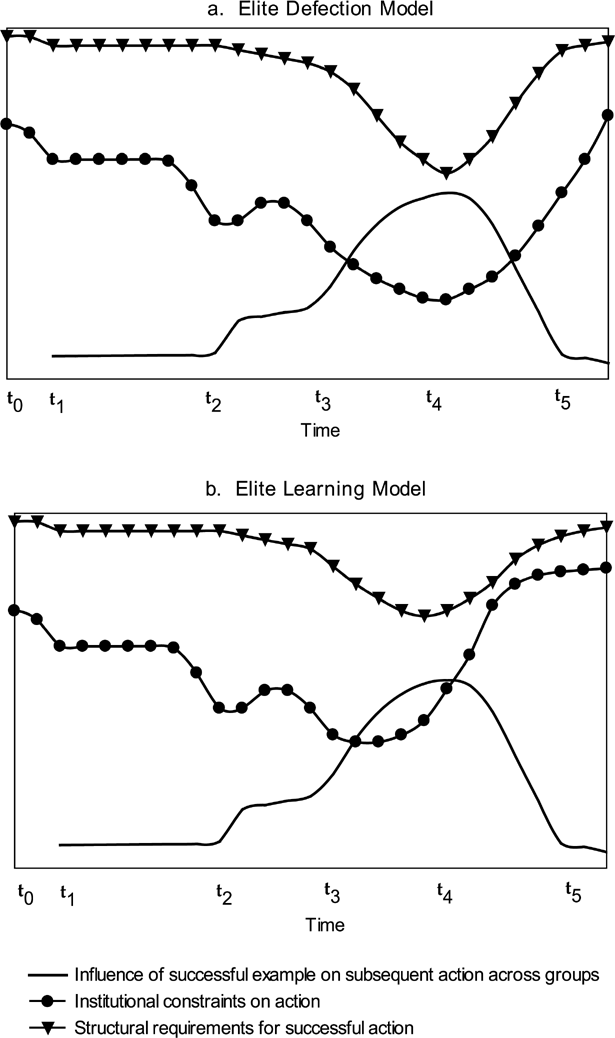
Two additional important elements of modular phenomena are missing from figure 4: the role of institutions, and the effect of example on political outcomes. A further lesson we can derive about modular phenomena from the glasnost experience is that example exercises its effects not only on those who would look to it in support of change, but also on those who would potentially oppose it. In figure 5 I provide two models for how example could affect those who oppose modular change. In what I call the elite defection model (figure 5a), once example gains momentum and crosses the tipping point where modular behavior accelerates across groups, a general expectation about the direction in which events are flowing demoralizes those representing established institutions, potentially promoting defections among them and encouraging bandwagoning behavior. Here, established elites entertain doubts about their own legitimacy and the future of the structures they are defending, so that a demonstration of the vulnerability of such structures in other contexts leads them to co-opt opposition demands or to seek to bail out before it becomes too late.

Influence of example and institutional constraints on structural requirements for success in modular phenomena
But there is a second way in which institutions can respond to modular processes—one that corresponds to the Russian proverb “Repetition is the mother of learning.” Under what I have called in figure 5b the elite learning model, established elites opposing modular change learn the critical lessons of the model from its repeated successes and failures and impose additional institutional constraints on actors to prevent the model from succeeding further. Under this model, established elites retain a belief in the future of current institutions, hold that established elites in other contexts where modular change was previously successful squandered that future as a result of foolish moves, and respond to the threat of modular change by moving aggressively to prevent such challenges, repressing them and raising the institutional constraints that they face.
The elite defection model was precisely what occurred throughout much of the Soviet Union as the glasnost mobilizational cycle accelerated, with nomenklatura elites in many places refashioning themselves as nationalists in an attempt to coopt or pre-empt the spread of the module. Soviet institutions had particular difficulties adjusting to the modular spread of separatist nationalism in part because they were themselves undergoing reform and were in a state of disarray. Repeated massive mobilizations in disparate corners of the country demoralized those in power, fostered elite divisions, undermined the morale of the military and the police, and eventually created a sense of the inevitable flow of events toward Soviet breakup.45
Beissinger 2002, 320–384.
Elite co-optation and defection have played an important role among early risers in the spread of modular democratic revolution. In the Serbian, Georgian, Ukrainian, and Kyrgyz cases, defections from the police and the armed forces ultimately made repression impossible and were the most immediate causes of revolutionary success in each of these cases.46
For details, see United States Institute of Peace 2001, 9; Cohen 2001, 417, 425; Karumidze and Wertsch 2005, 15, 39, 47, 54; Chivers 2005; Kuzio 2005b, 2004; MacWilliam 2005; Solovyov 2005.
However, there is ample evidence that an elite learning model is more relevant among later risers for modular democratic revolution than it was for the modular spread of nationalism in the glasnost era. This is evident in the growing restrictions on civil society organizations in Russia, Belarus, Uzbekistan, Azerbaijan, and Kazakhstan. In the wake of the Orange and Tulip Revolutions authoritarian regimes have cracked down on opponents, closed down or monitored more closely relations with democracy-promoting NGOs, and established closer relations with Russia as a way of providing international support against the threat of transnational revolution.47
Torbakov 2005.
Deheryan 2005.
What the institutional responses to modular processes suggest is that the impact of modular processes on political outcomes can differ quite substantially depending on the ways in which institutions react to them. The argument, depicted in figure 5, is that in modular political phenomena there is an effect of example on political outcomes under conditions of both elite defection and elite learning, though the effect on outcomes is deeper and more extensive in the former than in the latter case. These effects of a modular process on outcomes occur at two levels. First, there is the simple constitutive role played by example in a modular process—that is, without the prior example of others, there likely would have been no set of cases in the first place, since the cases themselves were constituted by the emulation of the action of others or the possibility of such emulation. Would strong Georgian or Ukrainian separatist movements have emerged in the glasnost era without the prior effect of the Baltic example? Or would a Rose or Orange revolution have occurred in Georgia and Ukraine if there had been no previous Bulldozer Revolution in Serbia? The answer to both questions is likely “no.” In both of these modular processes, the actions that were emulated were largely outside the realm of the imaginable prior to the materialization of the example that was emulated. Thus, the influence of example in a modular process is built into the very phenomena that we measure, so that success is in significant part defined by successful emulation and failure by unsuccessful emulation or a lack of attempt to emulate whatsoever.
But I would argue that there is also a more direct influence of example on outcomes than simply this constitutive effect. Rather, example can, in some cases, substitute for structural advantage, thereby allowing some less structurally advantaged cases to succeed where, in the absence of cross-case influences, they would have been unlikely to do so. Example is, of course, more effective in inspiring action than in producing successful action. The glasnost experience suggests that in a modular process there are considerably more failures than successes among later risers. In the glasnost case this was true even under circumstances of elite defection (where institutional constraints for late risers continue to drop) rather than elite learning (where the institutional constraints facing late risers increase sharply). This is suggested as well by an analysis of those structural conditions that, based on the nature of the model, on theory, or on case histories of the four successful revolutions, one might expect to be associated with successful modular revolution. Given the central role of stolen elections in the model, one would expect modular democratic revolution to meet less success in cases in which electoral fraud is not practiced. Indeed, in the March 2005 legislative elections in Moldova, though the opposition had publicly vowed beforehand to replicate the Orange Revolution, the absence of significant electoral fraud made mobilization to contest the results difficult. Similarly, theory has long suggested that mobilization is less likely in contexts that are relatively open (where grievances can be co-opted) or relatively closed (where they can be suppressed), and that successful action is most likely in those cases located in the middle—an inverted-U relationship between mobilization and openness.49
Eisinger 1973.
Tarrow 1998.
Foran has argued that a necessary condition for successful revolution is a robust political culture of opposition.52
Foran 2005, 21–22.
Skocpol 1979.
Cohen 2001, 417, 425; Karumidze and Wertsch 2005, 15, 39, 47, 54; Chivers 2005; Kuzio 2005a, 2005b; Kuzio 2004; Solovyov 2005.
In Georgia, police defections to the opposition were aided by the fact that on the eve of the revolution they had not been paid for three months (one of the advantages of mounting revolution in an extremely weak state). Similarly, the weakness of the Kyrgyz police, who had a reputation for corruption and poor training and who had openly fired on peaceful demonstrators in the past, had long been a source of concern to the regime and the international community, including an OSCE effort since 2003 to train them in methods of crowd control and “constructive partnership” with the population; Eggleston 2003.
In table 2 I have summarized the presence of these and other factors analyzed earlier (large or growing enrollment in higher education, penetration by transnational democracy-promotion NGOs, and the absence of an energy-export economy) for the cases of successful revolution and for those elections in the region that will take place in the 2007–2010 period. As the patterns suggest, four of these conditions (a conducive degree of political openness, a recent tradition of protest, regional divisions within the dominant cultural group, and opposition control over local government) need not be present for successful revolution, though their presence may make success more likely. The remaining six (the presence of electoral fraud, significant opposition representation in the legislature, large or growing enrollments in higher education, weakened ties between the regime and the police or military, a significant presence of transnational democracy-promoting NGOs, and an absence of an energy-export economy) are shared across all successful cases and may well be necessary conditions for success. The purpose of such an analysis is not to predict whether democratic revolutions will or will not succeed in specific cases. Rather, as table 2 shows, when one looks across this list of structural conditions facilitating revolutionary success, those states that have yet to experience modular democratic revolution face considerably less conducive conditions for success than those which have already succeeded—with the sole exception of Kyrgyzstan. Moreover, none of them possess all six structural features commonly shared across the four successful cases.
Structural advantages facilitating modular democratic revolution in prior successful revolutions and in forthcoming elections, 2007–2010

This should not be taken as evidence that outcomes in a modular process are completely structurally determined and that example has no independent effect on outcomes. Rather, as the Kyrgyz case suggests and as is depicted in figure 5, modular processes do have distinctive patterns of outcomes that are not predictable by reference to structure alone, even under conditions of the elite learning model (where the effect of example is offset to a significant degree by rising institutional constraints). This is true for several reasons. First, once a modular process crosses the initial tipping point, it emboldens oppositions to act where they might otherwise not have acted, and anytime significant numbers are encouraged to act, there is always some small probability, simply from chance effects, that some will be able to succeed. Moreover, it is not at all clear that elites always learn the right lessons necessary to prevent the spread of the model, or may learn these lessons too late. This is, at least, the way in which many leaders of the post-Soviet states view the overthrow of Kyrgyzstan President Askar Akaev—and one reason why Uzbekistan President Islam Karimov inflicted an overwhelming blow two months later against demonstrators in Andijan, massacring up to five hundred people in a brutal show of force intended to arrest the further spread of revolution. By contrast, Akaev at first refused to give orders to use violence against demonstrators, against the advice of his own aides. Indeed, the Tulip Revolution is a prime example of how modular phenomena spread over time to cases in which facilitating conditions are less conducive to success, yet some of these less structurally advantaged cases at times nonetheless succeed despite their disadvantages. The Tulip Revolution occurred almost accidentally and in contradiction with the plans of opposition leaders, who had viewed the wave of unrest that eventually sparked the revolution as merely a preparatory phase for a second wave of mobilizations that was to attend upcoming presidential elections in June. But when government-associated thugs began to beat demonstrators who had arrived in Bishkek from the south, a backlash ensued that led to the unplanned storming of the presidential palace by a core of motivated and outraged youth. Prior to the Kyrgyz revolution, the three successful modular revolutions mobilized numbers ranging from a hundred thousand to up to a million participants in peaceful protests. The Kyrgyz opposition, by contrast, was at most capable of generating fifteen thousand participants in protests—hardly enough to force resignation of Akaev through the kind of “people power” tactics that had succeeded in Serbia, Georgia, and Ukraine. Indeed, the Tulip Revolution succeeded only because it was violent—an innovation on the revolutionary model that originally inspired it due in significant part to the absence of sufficient structural support for successful non-violent action. Thus, a third way in which those who are less structurally advantaged can succeed in a modular process is through revision of the model in accordance with their structural weaknesses. As a modular process develops, permutations on the model are likely, as groups with less conducive structural conditions attempt to compensate for their structural disadvantages by innovating on the model. In sum, example can have a palpable and important impact not only on the onset of action within a modular process, but also on outcomes of action, helping the materialization of successful revolutions (or successful nationalisms) where otherwise the structural conditions for their success would have been lacking had cases occurred in complete isolation from one another.
The Consequences of Modular Change
We have seen that the effect of example on subsequent behavior within modular phenomena is profound. Within the modular democratic revolutions that have spread across the post-communist states, prior cases of revolutionary success have encouraged a widespread transnational borrowing of revolutionary modes of confrontation, inciting action where it otherwise would have been unlikely. Indeed, in the wake of the Orange Revolution a tipping point was crossed where example encouraged action even among groups facing relatively unfavorable structural circumstances. We have also seen that example exercised an effect on outcomes, helping to make successful revolution materialize in some circumstances where it otherwise would have been unlikely on the basis of structural advantage alone. The Tulip Revolution in Kyrgyzstan was the product of such a process. But we have also seen that the effect of modular phenomena on political outcomes varies depending on how established elites among later risers react to modular processes—whether they choose to co-opt modular processes and defect, or whether they learn lessons from the model's iterative character and take measures to prevent its further spread by imposing additional institutional constraints. In contrast to the modular spread of nationalism in the glasnost era, when institutions failed to adapt to modular processes and co-optation of opposition demands and elite defection were widespread, we have seen an elite learning process occurring among later risers in the spread of modular democratic revolution, raising the institutional constraints to action and likely limiting the further effect of example on outcomes.
These effects of modular processes on outcomes point to the reasons why we need to take into consideration the cross-case influences of example in our research and the purchase we gain on subjects like democratization, revolution, or nationalism by incorporating the power of example into our work. For one thing, one of the features of modular political phenomena is the way in which modular change often takes us by surprise. The effect of example is to make action and even successful action materialize in cases in which they would not have otherwise been likely, so that example makes possible action and outcomes that structure alone would not have permitted. Kuran has written about the element of surprise embedded within revolutions due to what he calls preference falsification—the tendency of individuals to cover up their genuine preferences for fear of repression, expressing them only when the opportunity to do so materializes, setting off a behavioral cascade.56
Kuran 1989.
Second, there is the issue of how the cross-case influences within modular phenomena might affect traditional social science findings on subjects such as nationalism, revolution, or democratic transition, where modular change is common. Since modular processes alter the way in which the overall pattern of outcomes is produced, the set of causal relationships underlying a phenomenon could look quite different when the phenomenon occurs within the context of modular change as opposed to when it occurs in isolation from other cases. Indeed, one would expect that the effect of example on outcomes would vary depending on where a case is located temporally in the modular process (before or after the tipping point) and whether the modular process is accompanied by elite defection or elite learning behavior among those potentially opposing its spread.
Third, there is the issue of the unintended side effects of modular change. We have seen that as modular phenomena spread and incite action where structural conditions are less conducive to success, there is high potential for permutations on modular action. Violence and civil war, for example, have at times been incited through processes of modular democratic change, as local actors, incited to action by change in other contexts, innovate on existing models of action or become drawn into action that leads in unintended directions.57
Indeed, as those involved in these events testify, civil war was only narrowly averted in the Georgian, Ukrainian, and Kyrgyz revolutions.58See, for instance, Karumidze and Wertsch 2005, 71.
Finally, modular change has significant implications for what follows afterward. Through its ability to substitute for the structural requirements that would have been necessary had action occurred in isolation from other cases, the power of example provides the possibility for what Foucault called “chance-reversal”—that is, to turn unlikely nations into seemingly inevitable nations, unlikely revolutions into seemingly inevitable revolutions, and unlikely democratizers into seemingly inevitable democratizers. As Geddes (1999) has shown, out of the 85 democratic transitions that occurred from 1974 through 1999, only 30 developed into stable democracies.59
Geddes 1999.