Livestock farmers always have a wish for producing replacement dairy heifers to meet the increasing demand for milk, which ultimately leads to economic benefit to farmers. Pre-sexed sperm or embryo mediated livestock production along with other genomic, proteomic and phenomics technologies offers a promising breeding strategy to meet the increased demand for food production (Rath et al., Reference Rath, Barcikowski, De Graf, Garrels, Grossed, Klein, Knabe, Knorr, Kunz, Meyer, Michel, Moench – Tegeder, Rehbock, Taylor and Washausen2013). Among these, sperm sexing is one of the newest reproductive technologies available to the livestock sector (Bhalakiya et al., Reference Bhalakiya, Haque, Patel, Chaudhari, Patel, Madhavatar, Patel, Hossain and Kumar2018). Separation of X and Y-sperm for preselection of the desired sex is economically important in livestock production, which allows the livestock sector to produce the optimal proportion of males and females (Bhalakiya et al., Reference Bhalakiya, Haque, Patel, Chaudhari, Patel, Madhavatar, Patel, Hossain and Kumar2018). Controlling the sex ratio entails direct returns in the livestock sector, allowing improved management of food production, animal welfare improvement, faster genetic selection and a decrease of environmental impact. The principal benefit of using sexed semen is increased numbers of heifer calves born, with approximately 70–80% and sometime 90% of successful pregnancies resulting in a female calf (De Vries, Reference De Vries2018). The subsequent increased availability of replacement heifers may be utilized to expand herd size and production. Using female sexed semen may also allow farmers to reduce the incidence of dystocia during calving (female calves are lighter than male calves: Norman et al., Reference Norman, Hutchison and Miller2010). Therefore, use of sexed semen in dairy husbandry has grown rapidly in developed nations (Holden and Butler, Reference Holden and Butler2018), but not in developing countries. Here, veterinary services have been traditionally funded, managed and delivered by the public sector as well as suffering from budget constraints (Carney, Reference Carney1998). However, the current scenario has shifted over to decentralization, cost recovery, withdrawal from selected services and contracting, and there has been renewed effort to encourage farmers to adopt the newer demand driven technologies like sexed semen. Therefore, farmers' willingness to pay for sexed semen will directly and indirectly empathize their interest, acceptability and affordability towards a new technology. Kumar et al. (Reference Kumar, Mirajkar, Singh and Singh2011) also argued that the willingness to pay for the veterinary services depends on various factors such as herd size, annual income from livestock enterprise, age of the farmer, etc., which can be considered while fixing the charges for veterinary services by the services providers in both public and private domain. Hence, the present study was designed with the objective to assess the willingness to pay for sexed semen technology as well as to identify its potential adopter.
Materials and methods
Sampling plan
The study was conducted, purposefully, in Haryana, a dairy progressive state of India. The state is divided into two regions, Eastern zone and Western zone. Eastern zone was selected based on the higher number of crossbred cattle than the Western zone. Out of 12 districts in Eastern zone of Haryana, two districts namely Karnal and Yamunanagar were selected due to having the highest crossbreed populated districts. From each selected district, three blocks were selected randomly. Thus, Karnal, Indri and Gharaunda from Karnal district; and Jagadhari, Radaur and Sadhaura from Yamunanagar district were selected randomly for the present study. From each block, 15 commercial dairy farmers were selected randomly. A commercial dairy farmer was defined as a producer of marketed surplus of least 100 l milk per day for 200 d in a year. From each block, one village adjacent to the animal health centre was randomly selected. Thus, Mangalpur, Taprana and Gagsina villages were selected from Karnal, Indri and Gharaunda blocks of Karnal, respectively and Fakarpur, Chotta Bass and Rajpura villages were selected from Jagadhari, Radaur and Sadhaura block of Yamunanagar district, respectively. From each village, 20 small holder dairy farmers were selected randomly. Small holder dairy farmers who had at least two dairy animals in milk on the day of visiting the household were considered as the respondent for the present study. Thus, 90 commercial dairy farmers and 120 small holder dairy farmers were selected as respondent and total sample size of this study was 210.
Analytical framework
Policymakers are often interested in how the public values goods and services that are not traded in the marketplace. These values can be estimated using contingent valuation (CV) methods, in which survey questions elicit respondents' willingness to pay (Alberini and Kahn, Reference Alberini and Kahn2006). In the recent years, Contingent Valuation Method has been increasingly applied to assess willingness to pay for veterinary and animal husbandry services (Kumar et al., Reference Kumar, Mirajkar, Singh and Singh2011). Therefore, farmers' willingness to pay for ‘sexed semen of dairy animal’ was determined by Contingent Valuation Method (CVM) in the present study. The double-bounded CV model was used in which survey respondents are asked a sequence of questions that progressively narrows down the willingness to pay, because this method has been shown to generate more efficient estimates than those based on a single question on an open-ended question (Watson and Ryan, Reference Watson and Ryan2007).
Model for willingness to pay
The maximum likelihood function was estimated using the interval regression command ‘intreg’ in STATA 12.
The probability that WTP1 lies between WTPi1 and WTPi2 is given by Morey et al. (Reference Morey, Rossman, Chestnut and Ragland1997) as below:
 $$Prob\lpar {WTP_{i1} \le WTP_i \le WTP2_i} \rpar = Prob\lpar {WTP \lt WTP_{i2}} \rpar - Prob \lpar {WTP_{i \gt }WTP_{i1}} \rpar $$
Then, the expectation of the individual small holder dairy farmer's WTP, E(WTP) was:
 $$\eqalign{\lpar {WTPi} \rpar & = E\lpar {WTPi} \rpar + {\rm \xi }\,{\rm \lpar for\ small\ holder\ dairy\ farmers\rpar } \cr \; & = {\rm \alpha } + {\rm \beta }_iX_i + e_i} $$
Expectation of the individual commercial dairy farmer's WTP, E(WTP) was:
 $$\eqalign {\lpar {WTPi} \rpar & = E\lpar {WTPi} \rpar + {\rm \xi }\,{\rm \lpar for\ commercial\ dairy\ farmers\rpar } \cr & = {\rm \alpha } + {\rm \beta }_iX_i + e_i} $$
Where, WTP = Willingness to pay; βi = Coefficients of the explanatory variables; Xi = Series of explanatory variables which influenced farmers' WTP; e i = Random error-term which is normally independently distributed with the mean zero and constant variance.
Results and discussion
All aspects of sexed semen for dairy cattle were presented before the small holder dairy farmers and commercial dairy farmers and they were asked whether they would like to pay for these services or not. Farmers who said that they were willing to pay, were further asked the amount of willingness to pay. Table 1 clearly depicts that almost all of the commercial dairy farmers were ready to pay for sexed semen services with an amount more than double of the small holder dairy farmers. Commercial dairy farmers understood the importance and advantages of sexed semen technology service to maintain proper economic return of the herd in the long term. Fetrow et al. (Reference Fetrow, Overton and Eicker2007) reported that sexed semen is more expensive than conventional semen in USA with the average premium around $30 per straw as compared to conventional semen, varying up to $40 depending on the sire (De Vries, Reference De Vries2018). Layek (Reference Layek2015) reported that price of sexed semen in India varied between INR 1500–4500 (around $20–60) depending upon the breed and pedigree of the bull used for producing the sexed semen and the quantity purchased. However, dairy farmers of Punjab were being charged only INR 600 per straw with 50% governmental subsidy covering the remainder of the total cost (Talokar Reference Talokar, Behera, Singh and Mandal2017). Uttarakhand Livestock Development Board of Indian state Uttarakhand started producing sexed semen with the technical partnership of ST Genetics, USA and fixed the cost of sexed semen at INR 1150 irrespective of all breeds, and a reduced rate of INR 390 for indigenous breeds. This amount nevertheless remains expensive for small holder dairy farmers. At the same time, engagement of highly skilled AI workers is needed for better applicability of sexed semen due to its lower sperm count, lower conception rate and limited availability. Every commercial dairy farm had round the clock service of trained veterinarian or AI worker, whereas, small holder dairy farmers had limited accessibility. Therefore, commercial dairy farmers may be more likely to adopt sexed semen technology.
Farmers' willingness to pay for sexed semen for dairy cattle

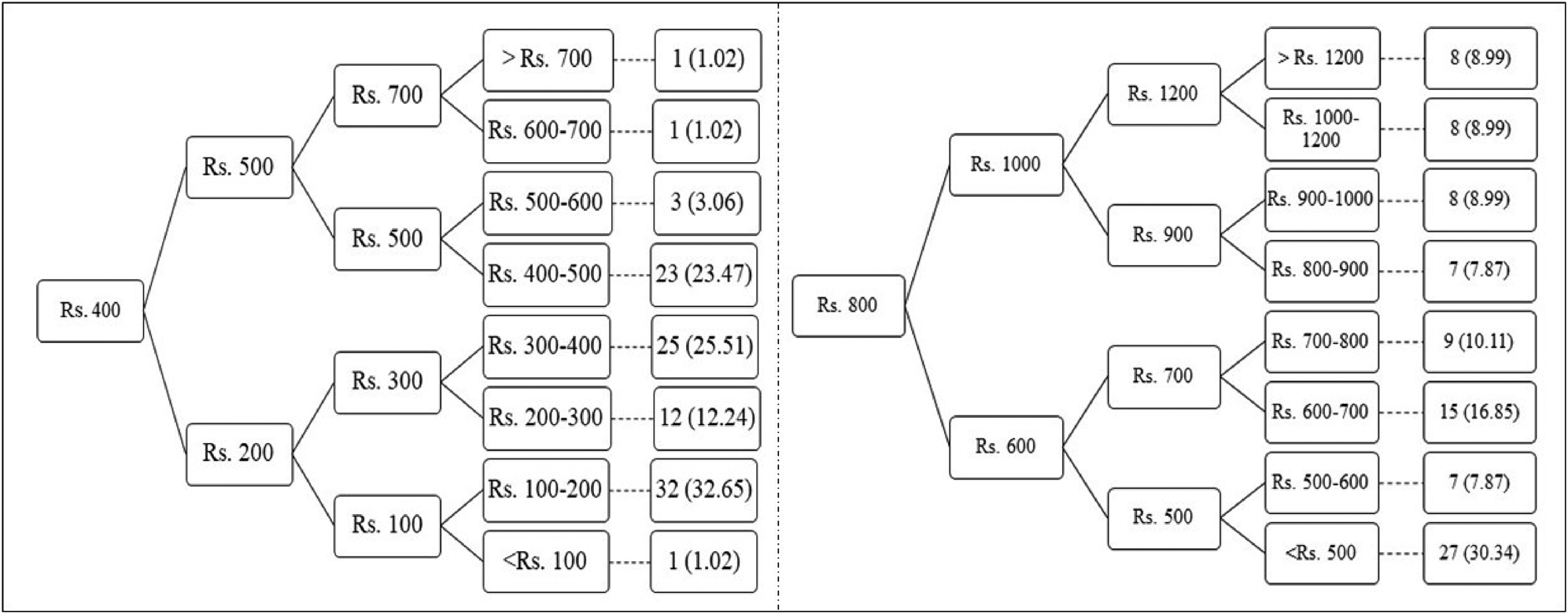
Figure 1 highlights the pattern of willingness to pay for sexed semen services by the small holder dairy farmers (left panel), which is widely distributed from less than INR 100 to more than INR 700. A large portion of the small holder dairy farmers (33%) were willing to pay INR 100–200 for per straw of the sexed semen followed by 25% at INR 300–400. Almost all of the commercial dairy farmers were willing to pay for the sexed semen and their pattern of willingness to pay for this service is presented in the right panel (Fig. 1). Willingness varied widely from less than INR 500 to more than INR 1200. A maximum of 30% per cent of commercial dairy farmers were willing to pay less than INR 500 whilst 17–18% per cent of them were prepared to pay INR 600–700 or more than INR 1000, respectively. Every commercial dairy farmer would like to get female calves to maintain the proper productivity of their farm in the long term. Therefore, they were ready to pay for this service at levels higher than the small holder dairy farmers. A very few of the small holder dairy farmers (2%) were willing to pay INR 600 and more, compared with an equivalent figure of 62% of commercial farmers. These figures clearly depict the interest and acceptability of the sexed semen among the commercial dairy farmers. Hence, this innovation in dairy husbandry sector may be promoted among the commercial dairy farmers for its better utilization.
Pattern of willingness to pay for sexed semen per straw by the small holder dairy farmers (n = 98, left panel) and the commercial dairy farmers (n = 89, right panel). Values in parenthesis of the last column of the figure indicate percentage (75 INR = 1 USD).

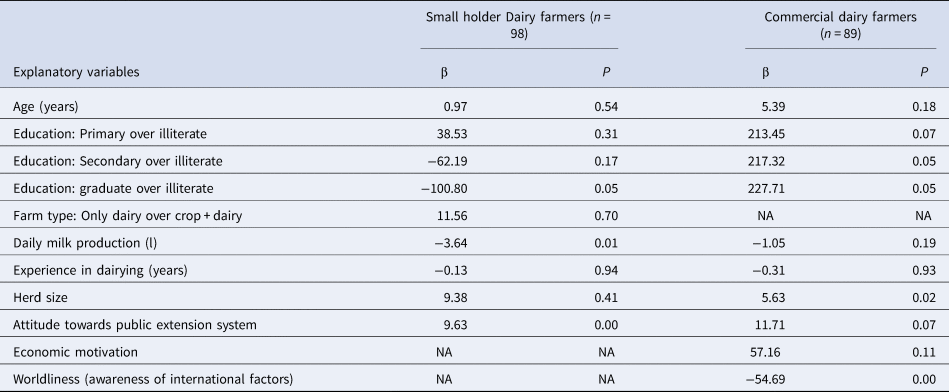
The interval regression model was also fitted to explore the important predictors of differential extent of willingness to pay (WTP) for the sexed semen services by the small holder dairy farmers as well as commercial dairy farmers. Among all predictors, the attitude towards public extension system was the most significant and positive contributor, while daily milk production was the most significant negative contributor at five percent level of significance (Table 2). In India, sexed semen is available at subsidized rate through the public livestock extension system. Therefore, farmers' positive attitude towards public extension system will help for better adoption of sexed semen technology by paying subsidized rate. Farmers who were always in contact with extension services, were more likely to get more information regarding importance and utility of the sexed semen. Education, herd size and worldliness (general awareness of international factors) of the commercial dairy farmers were found to be other significant factors (Table 2). Sexed semen was a comparatively new technology in dairy science and educated commercial dairy farmers were aware and interested in paying for the new technology. The positive effect of herd size was in part a consequence of feed costs and a strong desire to avoid having to feed male calves. This sort of factor can operate in both directions: Franks et al. (Reference Franks, Telford and Beard2003) reported that herd size was one of the major factors that influenced use of sexed semen by the UK suckler beef producers, who were requiring male calves. In a similar fashion, Khanal (Reference Khanal2010) found that adoption of sexed semen by USA dairy farmers was based on the farmer's planning horizon including age, education, off-farm work, farm size and specialization.
Factors determining extent of willingness to pay (WTP) for sexed semen of dairy animal

NA, Not applicable in the respective model.
In conclusion, our findings report the willingness to pay for sexed semen by the farmers of a dairy progressive state of India. Majority of the small holder dairy farmers and almost all the commercial dairy farmers were ready to pay, but at different amounts. Commercial dairy farmers were prepared to pay more than double what small holder dairy farmers would pay, and it can be concluded that commercial dairy farmers are the potential adopters with the present rate of subsidy. We have also shown that commercial dairy farmers with higher level of education, large herd size and positive attitude towards public extension system are more likely to adopt sexed semen. These findings have policy relevance for public extension systems in relation to future dairy animal breeding strategies in India and other developing nations.
Supplementary material
The supplementary material for this article can be found at https://doi.org/10.1017/S0022029920001065
Acknowledgement
We have a sincere gratitude to the Director, ICAR-National Dairy Research Institute, Karnal for providing all the facilities for this study. We are also thankful to our esteemed dairy farmers for sharing their views and giving time for the research work.