1. Introduction
Understanding the origin and evolution of mafic rocks and characterizing their source composition can provide crucial insights into the tectonic settings associated with their mode of formation. It is now well-known that in a collisional orogenic environment, mafic rocks are generated either in a subduction-driven post-collisional scenario involving slab break-off, lithospheric delamination and partial melting (Kay & Kay, Reference Kay and Kay1993; Song et al., Reference Song, Wang, Wang and Niu2015, among many others) or during continental rifting associated with lithospheric extension (Fairhead, Reference Fairhead1988; Wilson, Reference Wilson1989). Collisional orogens are also related to elevated thermal regimes (>900 °C), leading to the formation of high- to ultrahigh-temperature (HT-UHT) metamorphic rocks due to high mantle heat flow before orogenesis (Clark et al. Reference Clark, Healy, Johnson, Collins, Taylor, Santosh and Timms2015 and references therein). As ultra-hot collisional orogens are closely linked to the formation of supercontinents across the globe (Brown, Reference Brown2007; Kelsey & Hand, Reference Kelsey and Hand2015), the role of mafic magmatism in the generation of HT-UHT granulites needs to be examined in detail.
The Precambrian Southern Granulite Terrane (SGT; Fig. 1a) of India that occupies a central position in the east Gondwana supercontinent assembly is known for its high geotherm prevalence associated with intense crustal reworking and melting that has also affected other Gondwanan crustal fragments during the Himalayan-scale collision orogen referred to as the East African Orogen (650−480 Ma; Collins et al. Reference Collins, Clark and Plavsa2014 and references therein). The SGT has proliferous occurences of HT-UHT metapelites primarily reported in the Madurai block, where these rocks are mostly seen aligned along the transcrustal Suruli shear zone (SSZ), later named as the Kambam UHT belt (KUB; Brandt et al. Reference Brandt, Schenk, Raith, Appel, Gerdes and Srikantappa2011, Reference Brandt, Raith, Schenk, Sengupta, Srikantappa and Gerdes2014; Dev et al. Reference Dev, Tomson, Sorcar and Nandakumar2021; Fig. 1a). The heat source responsible for the formation of HT-UHT rocks in the Kambam UHT belt is interpreted to be due to the equilibration at the root of collisional mountain belt with required thermal input for crustal heating by upwelling of hot asthenosphere (Brandt et al. Reference Brandt, Schenk, Raith, Appel, Gerdes and Srikantappa2011, Reference Brandt, Raith, Schenk, Sengupta, Srikantappa and Gerdes2014), or due to conductive heating associated with the accumulation of moderately enriched heat-producing elements (HPE) in the crust during collisional orogeny (Clark et al. Reference Clark, Healy, Johnson, Collins, Taylor, Santosh and Timms2015) or due to a combination of tectonic-driven processes including HPE enrichment and equilibration at the continental root (Dev et al. Reference Dev, Tomson, Sorcar and Nandakumar2021). Also, in many Precambrian collisional orogens, mafic magmatism has been proposed as an alternative heat source for regional-scale HT-UHT metamorphism (Kelsey & Hand, Reference Kelsey and Hand2015 for review). The Kambam UHT belt hosts voluminous mafic granulites that are found in close spatial association with HT-UHT granulites. However, tectonic models proposed for this UHT belt have failed to examine whether the mafic emplacements have played any role in generating extreme thermal conditions. In this context, the present study assumes significance, as it aims for a detailed understanding of the petrogenesis of hitherto unreported mafic granulites from the area, and its implications on the current understanding of the tectonic evolution of Kambam UHT belt.
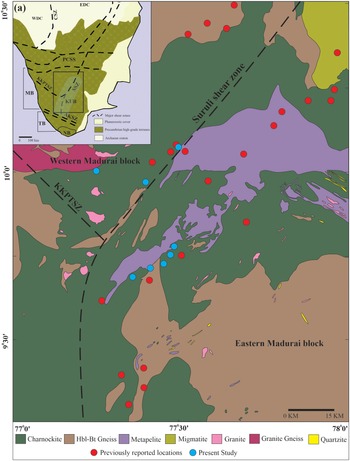
(a) Simplified geological map of Madurai block (modified after GSI, unpub. map, 1981). Inset shows Southern Granulite Terrane (modified after Kumar et al. Reference Kumar, Rao, Plavsa, Collins, Tomson, Gopal and Babu2017). Madurai block (MB), Trivandrum block (TB), Nagercoil block (NB), Palghat–Cauvery shear system (PCSS), Suruli shear zone (SSZ), Karur–Kambam–Painavu–Trichur shear zone (KKPTSZ), Achankovil shear zone (AKSZ) and Kambam UHT Belt (KUB).

2. Geological setting
Southern Granulite Terrane (SGT) is a composite of polymetamorphic terrains with prolonged crustal evolution history ranging from early Archaean to late Neoproterozoic, preserving the evidence for polyphase deformation, multiple tectonothermal and multiphase exhumation and cooling histories (Ghosh et al. Reference Ghosh, de Wit and Zartman2004; Plavsa et al. Reference Plavsa, Collins, Foden, Kropinski, Santosh, Chetty and Clark2012; Tomson et al. Reference Tomson, Rao, Kumar and Choudhary2013; Brandt et al. Reference Brandt, Raith, Schenk, Sengupta, Srikantappa and Gerdes2014; Collins et al. Reference Collins, Clark and Plavsa2014; Kumar et al. Reference Kumar, Rao, Plavsa, Collins, Tomson, Gopal and Babu2017; Dev et al., Reference Dev, Tomson, Sorcar and Nandakumar2021; Dev et al., Reference Dev, Tomson, Sorcar and Francis2022b). SGT is bounded to the north by the Archaean granite–greenstone terrain of the Dharwar craton (Chadwick et al. Reference Chadwick, Vasudev and Hegde2000; Jayananda et al. Reference Jayananda, Moyen, Martin, Peucat, Auvray and Mahabaleswar2000). SGT is composed of different crustal blocks named as the Salem, Madurai, Trivandrum and Nagercoil that are separated by crustal-scale shear zones (see Collins et al. Reference Collins, Clark and Plavsa2014 for review). The Madurai block, which is the largest crustal block in SGT, constitutes different lithological units such as charnockites, hornblende/garnet biotite gneisses, HT-UHT Mg–Al granulites, quartzites, calc-silicates and two-pyroxene mafic granulites along with intrusives such as syenites, granites, anorthosites and carbonatites. The available structural, geochemical and geochronological data suggest multiple classification schemes for the Madurai block. Ghosh et al. (Reference Ghosh, de Wit and Zartman2004) proposed a Neoproterozoic shear zone named the Karur–Kambam–Painavu–Trichur shear zone (KKPTSZ; Fig. 1) within the SGT that defined two distinct terranes within the Madurai block i.e., an Archaean basement terrane to the north and a Proterozoic terrane to the south. The southern limit of KKPTSZ was redesignated as an isotopic boundary by Plavsa et al. (Reference Plavsa, Collins, Foden, Kropinski, Santosh, Chetty and Clark2012). Srinivasan and Rajeshdurai (Reference Srinivasan and Rajeshdurai2010) proposed a NE–SW-trending shear zone aligned parallel to the eastern flank of KKPTSZ known as the Suruli shear zone (SSZ; Fig. 1), separating the Madurai block into western and eastern blocks with distinct lithological associations. Brandt et al. (Reference Brandt, Raith, Schenk, Sengupta, Srikantappa and Gerdes2014) designated the area parallel to SSZ as the Kambam ultrahigh-temperature belt (KUB; Fig. 1), owing to the presence of lithological associations characteristic of HT-UHT metamorphism where peak metamorphic conditions up to 1100 °C and 12 kbar with both clockwise and anticlockwise P–T trajectories were reported (Dev et al. Reference Dev, Tomson, Sorcar and Nandakumar2021 and references therein).
3. Sampling and petrography
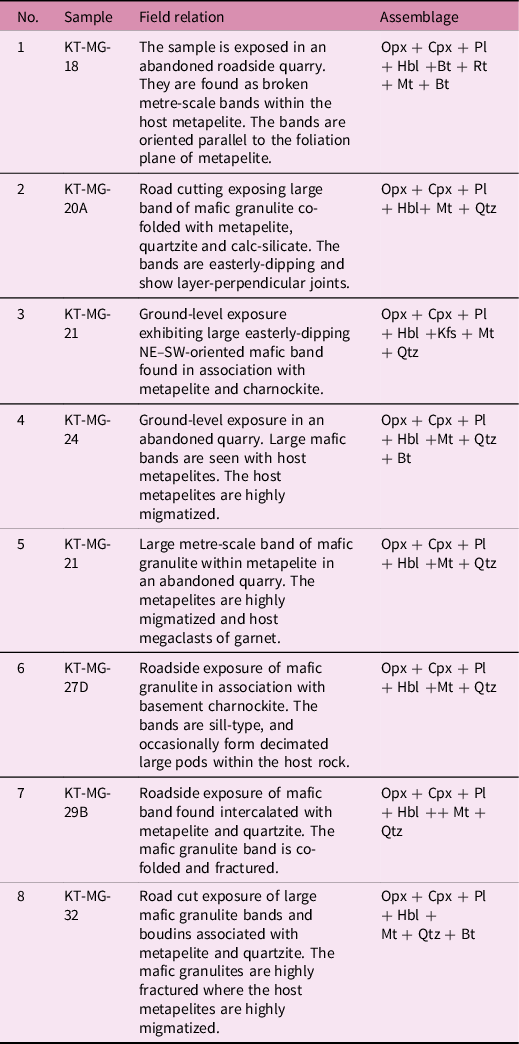
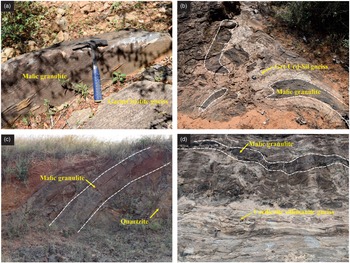
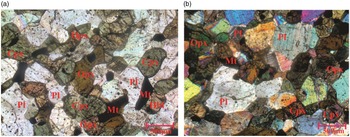
Previous reports on mafic rocks from the Madurai block (red circles in Fig. 1b) are limited to field mapping and thermobarometric studies (Geological Survey of India (GSI), unpub. data; Prakash et al. Reference Prakash, Arima and Mohan2007; Ray et al. Reference Ray, Tiwari and Sarkar2021). For the present study, mafic granulite samples were collected from eight newly identified locations along the central part of the Madurai block within the Kambam UHT belt (blue circles in Fig. 1b). Description of the field occurrence and mineralogy of the samples is given in Table 1. The exposures are seen as sub-metre- to metre-scale thick bands, variously associated with quartzites, metapelites and calc-silicate rocks (Fig. 2a–d). The mafic bands are mostly easterly-dipping with a steep slope (Fig. 2a), in conformity with the overall structural trend of the Suruli shear zone (Srinivasan & Rajeshdurai, Reference Srinivasan and Rajeshdurai2010). No distinct chilled margin is observed in most cases, due to surface weathering. The effect of cooling and deformation in these rocks is evidenced by the presence of joints within these bands (Fig. 2c). At locations where the host metapelites are migmatized, the mafic bands also show similar outcrop features representing large-scale melt movement (Fig. 2d). In addition to thick bands, mafic granulites are also found as boudins and disseminated bands within the host granulites, mainly oriented along the foliation trend but locally forming large shear sense markers (Fig. 2b, d). Petrologically, the rocks are medium-grained with inequigranular granoblastic texture. Major mineral phases include plagioclase, orthopyroxene, clinopyroxene and hornblende with minor amount of quartz, biotite and magnetite (Fig. 3). Accessory phases constitute zircon, rutile and titanite.
Field occurrence and major mineral assemblages of mafic granulites

(a–d): Field photographs of mafic granulites from Kambam UHT Belt: (a) NE–SW-trending mafic granulite band associated with garnet–biotite gneiss; (b) disseminated mafic granulite bands within host metapelite; (c) syn-folded easterly-dipping mafic granulite bands associated with quartzites; and (d) mafic granulite band (occasionally forming boudins) hosted in migmatized metapelites.

4. Analytical methods
4.a. Whole-rock geochemistry
Mafic granulites were crushed into small chips using a jaw crusher and later were fine-powdered using a chrome-steel ring mill at the Thin section and sample preparation laboratory at the National Centre for Earth Science Studies (NCESS), India. The samples were analysed for major elements using a Bruker Pioneer S8 Tiger wavelength-dispersive X-ray fluorescence (WD-XRF) at NCESS following the analytical protocol described in Dev et al. (Reference Dev, Tomson, Sorcar and Nandakumar2021). The sample powders were dissolved in a reagent grade HF: HNO3 acid mixture in Savillex screw-top vessels for trace element and rare earth element (REE) analysis. The analysis was performed using an Agilent 7800 Quadruple ICPMS at the LAM-ICPMS facility, National Geophysical Research Institute, Hyderabad, India. 103Rh was used as the internal standard for sample analysis. G-2, JG-2, GA and AGV-2 were repeatedly analysed to ensure drift correction and calibration. For chondrite normalization, values are chosen from Anders & Grevesse (Reference Anders and Grevesse1989), whereas primitive mantle normalization values are from Sun & McDonough (Reference Sun and McDonough1989). The whole rock geochemical data was processed and plotted for major and trace element discrimination diagrams using GCDkit 5.0 (Janoušek et al. Reference Janoušek, Farrow and Erban2006).
4.b. Zircon U–Pb geochronology, trace element and Hf isotope analysis
All samples were crushed and sieved into desirable fractions for conventional Wilfley table-magnetic separation technique. Separated grains were manually handpicked and mounted on a standard epoxy disc of 25 mm diameter. The internal structure of these grains was examined by cathodoluminescence (CL) and back scatter electron (BSE) imaging using CAMECA SXFive-TACTIS electron probe microanalyser (EPMA) at NCESS. Single-spot U–Pb isotope and trace element analysis of zircons was performed at the Isotope Geochemistry Facility (IGF), NCESS, using a Teledyne CETAC, Nd:YAG (solid-state laser) coupled with Agilent 7800 quadrupole ICPMS. The analytical protocol is according (Dev et al., Reference Dev, Tomson, Sorcar and Francis2022a). 91500 zircon was used as the primary standard, whereas Plesovice and BB11 zircons were monitored for quality check. Data reduction and calculation of isotope ratios and ages were performed offline using Iolite 4.4 (Paton et al. Reference Paton, Hellstrom, Paul, Woodhead and Hergt2011) with the integrated Visual Age Package (Petrus & Kamber, Reference Petrus and Kamber2011), and calculated isotopic ratios and ages were processed using Isoplot 4.15 (Ludwig, Reference Ludwig2012). During the analytical session, Plesovice (Sláma et al. Reference Sláma, Košler, Condon, Crowley, Gerdes, Hanchar, Horstwood, Morris, Nasdala, Norberg, Schaltegger and Whitehouse2008) and BB11 (Santos et al. Reference Santos, Lana, Scholz, Buick, Schmitz, Kamo, Gerdes, Corfu, Tapster, Lancaster and Wiedenbeck2017) zircons yielded a weighted mean 206Pb/238U age of 337 ± 1.5 Ma (N = 23) and 560 ± 2.5 Ma (N = 23) respectively, all within the reported error limit. For in situ trace element determination, NIST 610 (Pearce et al. Reference Pearce, Perkins, Westgate, Gorton, Jackson, Neal and Chenery1997) were used as primary reference standards for time-drift correction and quality monitoring with 29Si (IS value = 14.98 %) as the internal standard. Ti-in-zircon crystallization temperatures (Ferry & Watson, Reference Ferry and Watson2007) were calculated using αSiO2 = 1 and αTiO2 = 0.6. Hafnium isotopic composition of zircons was analysed at the IGF, NCESS, using a Teledyne CETAC, Nd: YAG (213 nm) solid-state laser coupled with Nu Plasma 3 Multicollector ICPMS (MC-ICPMS). Zircons analysed for U–Pb dating were reanalysed, and spots were positioned close to the previous crater due to spatial limitation. The analytical protocol is according to Dev et al. (Reference Dev, Tomson, Sorcar and Nandakumar2021). 91500 zircon and Plesovice zircon were used as the primary standard and quality monitor. Data reduction and calculation of ratios were performed offline using the Hf isotope package in Iolite 4.4 (Paton et al. Reference Paton, Hellstrom, Paul, Woodhead and Hergt2011). During the analytical session, Plesovice zircon yielded a standard corrected 176Hf/177Hf ratio of 0.282417 ± 0.000029 (n = 8) with values within the reported error limit. A 176Lu decay constant of 1.865 × 10⁻¹¹ yr−1 (Scherer et al., Reference Scherer, Münker and Mezger2001) was used to calculate initial Hf isotopic ratios (176Hf/177Hf). The initial epsilon Hf and two-stage depleted mantle model ages (T DM) were calculated using chondritic uniform reservoir (CHUR) ratios of 176Hf/177Hf = 0.0332 and 176Lu/177Hf = 0.282772 (Blichert-Toft & Albarède, Reference Blichert-Toft and Albarède1997), depleted mantle ratios of 176Hf/177Hf = 0.283251 (Nowell et al. Reference Nowell, Kempton, Noble, Fitton, Saunders, Mahoney and Taylor1998) and 176Lu/177Hf = 0.0384 (Griffin et al. Reference Griffin, Pearson, Belousova, Jackson, Van Achterbergh, O’Reilly and Shee2000). Calculation of TDM (crustal) ages assumes a 176Lu/177Hf ratio of 0.015, corresponding to average continental crust (Griffin et al., Reference Griffin, Belousova, Shee, Pearson and O’Reilly2004). All uncertainties are reported at 2σ confidence level.
5. Geochemistry
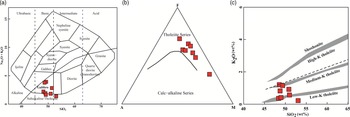
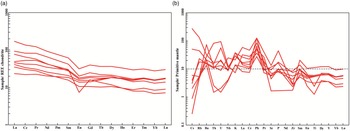
Geochemical data of mafic granulites are provided in Appendix 1 in the Supplementary Material available online at https://doi.org/10.1017/S0016756823000079. The samples are characterized by SiO2 = 48.74–53.25 wt %, Al2O3 = 5.74–14.43 wt %, TiO2 = 0.27–2.42 wt %, Na2O = 0.79–2.94 wt % and K2O = 0.22–1.14 wt %. FeOT varies between 10.04 and 15.42 wt %, whereas CaO and MgO vary between 8.16 and 13.08 wt % and 4.41 and 20.67 wt %, respectively. Mg# ranges between 0.24 and 0.70. The total alkali (Na2O + K2O) and K2O/Na2O range between 1.46 and 4.06 and 0.18 and 1.13, respectively. In the silica versus total alkali (TAS) diagram (Fig. 4a; Cox et al. Reference Cox, Bell and Pankhurst1979), the samples fall within the gabbro field and are classified as subalkaline. The tholeiitic nature of the samples is demonstrated in the AFM diagram (Fig. 4b; Irvine & Baragar, Reference Irvine and Baragar1971), while the K2O–SiO2 diagram (Fig. 4c; Rollinson, Reference Rollinson2014) classifies them as low- to medium-K tholeiites. The samples are characterized by moderate REE enrichment with ∑REE ranging between 48 and 217 ppm and with values 10–100 times to that of chondrite. Chondrite-normalized REE patterns suggests weakly enriched light REE (LREE) (SmN/LaN = 0.36–0.79) and nearly flat to slightly fractionated heavy REE (HREE) (LuN/GdN = 0.46–1.14) with a prominent negative Eu anomaly (Fig. 5a). The primitive mantle normalized multi-element variation diagram displays the relative enrichment of large-ion lithophile elements (LILE) and weakly negative anomalies of high field strength elements (HFSE), including Nb, Zr and Ti (Fig. 5b).
Representative photomicrographs illustrating mineral assemblages in mafic granulites.

(a) TAS diagram (after Cox et al. Reference Cox, Bell and Pankhurst1979); (b) AFM diagram (Irvine & Baragar, Reference Irvine and Baragar1971); and (c) K2O–SiO2 diagram (Rollinson, Reference Rollinson2014).

(a) Chondrite-normalized REE diagram of mafic granulites. (b) Primitive-mantle-normalized trace element diagrams of mafic granulites.

6. Zircon U–Pb geochronology, and Lu–Hf isotopes and trace element studies
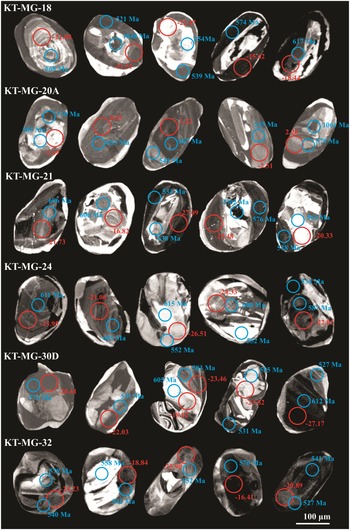
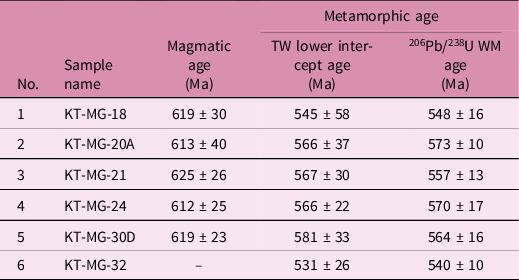
Cathodoluminescence imaging of zircons (Fig. 6) from each sample reveals internal zoning patterns that can be categorized into three types – (1) geometric centres with dark CL, (2) oscillatory zoned cores with dark/bright CL, and (3) planar/sector zoned rims with bright and dark CL that occasionally truncate into inner domains. The zircon U–Pb, trace element and Ti-in-zircon temperature data are presented in Appendix 2, and Hf isotope data of zircons in Appendix 3, in the Supplementary Material available online at https://doi.org/10.1017/S0016756823000079. A summary of U–Pb ages is given in Table 2.
(a) Cathodoluminescence images of selected zircon grains from mafic granulites. Blue circles mark the position of the laser spot for U–Pb dating and ages are given as 206Pb/238U ages (in Ma). Red circles mark the position of Hf isotope analysis with corresponding ϵHf(t) values. Laser spot sizes are scaled to size.

Summary of U–Pb data

6.a. KT-MG-18
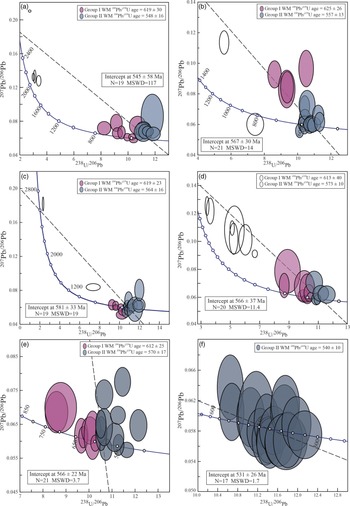
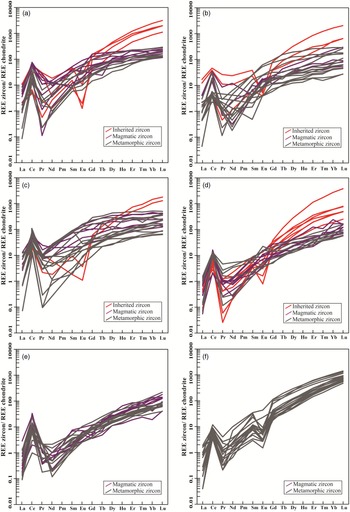
The zircons are characterized by U and Th concentrations of 76–947 ppm and 26–388 ppm, respectively, with Th/U ranging between 0.10 and 1.30. Nineteen U–Pb spot analyses on zircons from the sample yield 206Pb/238U age distribution between 522 and 2014 Ma, with a Tera–Wasserburg lower intercept at 545 ± 58 Ma (MSWD = 117) (Fig. 7a). Among these, the oscillatory zoned domains (Th/U = 0.51–1.30) yield a weighted average 206Pb/238U age of 619 ± 30 Ma (MSWD = 20) whereas the analyses from planar/sector zoned rims (Th/U = 0.10–0.46) define a weighted average 206Pb/238U age of 548 ± 16 Ma (MSWD = 3.8). Chondrite normalized REE pattern of zircons are characterized by positively sloping profile with LuN/LaN = 19–1376, SmN/LaN = 1–82, LuN/GdN = 2–25 and Eu/Eu* = 0.03–1.48 (Fig. 8a). Ti concentration in zircons range between 4 and 21 ppm, with Ti-in-zircon temperature estimates varying between 716 and 877 °C (Ferry & Watson, Reference Ferry and Watson2007). The Hf isotopic composition of zircons show initial 176Hf/177Hf ratios with a narrow range between 0.281760 and 0.281974, whereas ϵ Hf(t) ranges between −21.08 and −15.6. The calculated Hf–TDM model ages for the sample are between 2.49 and 2.95 Ga.
U–Pb geochronological data of zircons analysed from mafic granulites presented in Tera–Wasserburg diagrams: (a) KT-MG-18; (b) KT-MG-20A; (c) KT-MG-21; (d) KT-MG-24; (e) KT-MG-30D; and (f) KT-MG-32.

Chondrite normalized REE pattern of zircons from mafic granulites: (a) KT-MG-18; (b) KT-MG-20A; (c) KT-MG-21; (d) KT-MG-24; (e) KT-MG-30D; and (f) KT-MG-32.

6.b. KT-MG-20A
Zircons from the sample show U and Th contents of 52–609 ppm and 4–128 ppm respectively, with Th/U ranging between 0.02 and 0.85. U–Pb analyses of 20 spots on zircons yield 206Pb/238U age distribution between 546 and 1062 Ma, with a Tera–Wasserburg intercept at 566 ± 37 Ma (MSWD = 11.4) (Fig. 7b). The oscillatory zoned domains of these zircons (Th/U = 0.54–0.85) define a weighted mean 206Pb/238U age of 613 ± 40 Ma (MSWD = 10.7), while the rims (Th/U = 0.02–0.49) define a weighted average 206Pb/238U age of 573 ± 10 Ma (MSWD = 5.3). Chondrite normalized REE pattern of zircons are characterized by a positively sloping profile with LuN/LaN = 13–2778, SmN/LaN = 1–90, LuN/GdN = 2–26 and Eu/Eu* = 0.09–2.28 (Fig. 8b). Ti concentration in zircons ranges between 2 and 18 ppm, with Ti-in-zircon temperature estimates ranging between 645 and 860 °C (Ferry & Watson, Reference Ferry and Watson2007). Hf isotopic composition of zircons show initial 176Hf/177Hf ratios with a narrow range between 0.282333 and 0.282485. ϵ Hf(t) ranges between −2.57 and 3.2, and Hf–TDM model ages are between 1.34 and 1.69 Ga.
6.c. KT-MG-21
Twenty-one spot analyses on zircons from the sample yield U concentration between 108 and 733 ppm, Th concentrations between 45 and 856 ppm, and Th/U ratios between 0.10 and 1.26. 206Pb/238U ages from the zircons range between 516 and 2302 Ma, with a Tera–Wasserburg lower intercept at 567 ± 30 Ma (MSWD = 14) (Fig. 7c). Among these, the oscillatory zones (Th/U = 0.55–1.26) define a weighted average 206Pb/238U age of 625 ± 26 Ma (MSWD = 7.3), whereas the sector/planar zoned rims (Th/U = 0.10–0.46) yield a weighted average 206Pb/238U age of 557 ± 13 Ma (MSWD = 8.1). Zircon chondrite normalized REE pattern is characterized by positively sloping profile with LuN/LaN = 9–1607, SmN/LaN = 1–65, LuN/GdN = 1–28 and Eu/Eu* = 0.12–1.50 (Fig. 8c). Ti concentration in zircons range between 1 and 20 ppm, yielding Ti-in-zircon temperature estimates between 623 and 939 °C (Ferry & Watson, Reference Ferry and Watson2007). The Hf isotopic composition of zircons show initial 176Hf/177Hf ratios with a narrow range between 0.281564 and 0.281942, whereas ϵ Hf(t) ranges between −30.23 and −15.33, and Hf–TDM model ages between 2.51 and 3.37 Ga.
6.d. KT-MG-24
The zircons from the sample have U and Th concentrations of 129–1789 ppm and 44–1742 ppm, respectively. Th/U ratios of zircons vary from 0.09 to 1.74. U–Pb analyses on twenty-one spots define a discordia with a Tera–Wasserburg lower intercept at 566 ± 22 Ma (MSWD = 3.7), and 206Pb/238U ages range from 534 to 1654 Ma (Fig. 7d). U–Pb ages from oscillatory zircon domains (Th/U = 0.55–1.74) define a weighted average 206Pb/238U age of 612 ± 25 Ma (MSWD = 13), whereas the rims (Th/U = 0.30–0.09) yield a weighted average 206Pb/238U age of 570 ± 17 Ma (MSWD = 5.9). Chondrite normalized zircon REE patterns are characterized by positively sloping profile with LuN/LaN = 28–13 417, SmN/LaN = 2–39, LuN/GdN = 2–46 and Eu/Eu* = 0.15–1.96 (Fig. 8d). Ti concentration in zircons varies between 4 and 16 ppm, and the estimated Ti-in-zircon temperature values range between 710 and 1021 °C (Ferry & Watson, Reference Ferry and Watson2007). The initial 176Hf/177Hf ratios of zircons show a narrow range from 0.281680 to 0.281993. ϵHf(t) ranges between −26.51 and −14.93, and Hf–TDM model ages are between 2.44 and 3.13 Ga.
6.e. KT-MG-30D
Nineteen spot analyses on zircons yield U concentrations between 65 and 1196 ppm and Th concentrations between 54 and 427 ppm, yielding Th/U ratios between 0.10 and 1.91. The samples also define a 206Pb/238U age spectrum between 510 and 709 Ma, with a Tera–Wasserburg lower intercept at 581 ± 33 Ma (MSWD = 13) (Fig. 7e). Oscillatory domains of zircons (Th/U = 0.58–1.91) define a weighted average 206Pb/238U age of 619 ± 23 Ma (MSWD = 13) whereas the rims (Th/U = 0.10–0.37–0.37) yield a weighted average 206Pb/238U age of 564 ± 16 Ma (MSWD = 22). Chondrite normalized zircon REE patterns are characterized by a positively sloping profile with LuN/LaN = 10–272, SmN/LaN = 18–1, LuN/GdN = 3–17 and Eu/Eu* = 0.75–2.03 (Fig. 8e). Ti concentration in zircons varies between 5 and 16 ppm, yielding Ti-in-zircon temperature estimates between 723 and 847 °C (Ferry & Watson, Reference Ferry and Watson2007). The Hf isotopic composition of zircons show initial 176Hf/177Hf ratios between 0.281624 and 0.281898. ϵ Hf(t) ranges from −27.17 to −17.07, and Hf–TDM model ages are between 2.61 and 3.22 Ga.
6.f. KT-MG-32
Zircons from the sample show U and Th concentrations of 565–1316 ppm and 154–673 ppm, yielding Th/U ratios between 0.27 and 0.47. U–Pb analyses on seventeen spots define a discordia with a Tera–Wasserburg lower intercept at 531 ± 26 Ma (MSWD = 1.7), with 206Pb/238U age distribution between 510 and 578 Ma (Fig. 7f). U–Pb ages from planar/sector zoned rims (Th/U = 0.27–0.47) zircon domains define a weighted average 206Pb/238U age of 540 ± 10 Ma (MSWD = 12). Chondrite normalized zircon REE patterns are characterized by a positively sloping profile with LuN/LaN = 297–30 494, SmN/LaN = 2–758, LuN/GdN = 10–31 and Eu/Eu* = 0.08–0.95 (Fig. 8f). Ti concentration in zircons varies from 1 to 15 ppm, with Ti-in-zircon temperature estimates between 611 and 836 °C (Ferry & Watson, Reference Ferry and Watson2007). Hf isotopic composition of zircons show initial 176Hf/177Hf ratios within the range of 0.281697 and 0.281950, whereas ϵ Hf(t) ranges between −25.90 and −16.41 and Hf–TDM model age is between 2.53 and 3.10 Ga.
7. Discussion
7.a. Tectonic setting
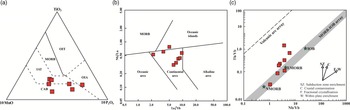
Whole-rock major and trace element geochemistry of mafic granulites, along with tectonic discrimination diagrams can be used as an effective proxy for identifying their geological settings and the processes responsible for their formation (Cui et al. Reference Cui, Sun, Zhao and Zhang2021 and references therein). On the TiO2–MnO–P2O5 triangular discrimination diagram (Mullen, Reference Mullen1983), most of the samples fall within the field of continental arc basalts (CAB), validating arc environment for the generation of parent magma (Fig. 9a). The continental arc affinity is further supported by the La/Yb – Nb/La diagram (Hollocher et al. Reference Hollocher, Robinson, Walsh and Roberts2012), where all samples fall within the continental arc field (Fig. 9b). Geochemical characteristics of these rocks include relative enrichment of LILE and LREE over HFSE with negative anomalies for Nb, Zr and Ti on the primitive mantle normalized multi-element spider diagram (Fig. 5b), all indicative of arc-type magmatism derived from a subduction-modified enriched mantle source (Deevsalar et al. Reference Deevsalar, Shinjo, Ghaderi, Murata, Hoskin, Oshiro, Wang, Lee and Neill2017; Yang et al. Reference Yang, Ganguly, Shaji, Dong and Nanda-Kumar2019 and references therein). Additionally, high La/Nb (1.3–3.1) and La/Ta (9.0–33.3) and low Zr/Ba (0.06–0.59) ratios of the samples are indicative of a subcontinental lithospheric mantle (SCLM) source (Menzies et al. Reference Menzies, Kyle, Jones and Ingram1991; DePaolo & Daley, Reference DePaolo and Daley2000) whereas high Ba/Ta (97.9–425.8) and Ba/Nb (17.2–56.3) ratios suggest subduction-related magmas (Fitton et al. Reference Fitton, James, Kempton, Ormerod and Leeman1988). The enrichment of LILE and LREE with minor fractionation also indicate partial melting and metasomatism of the subducted slab (Wang et al. Reference Wang, Wang and Sun2013), where water-bearing low-density silicate melts from the subducted slab or asthenosphere enriches the source (O’Reilly & Griffin, Reference O’Reilly and Griffin2013). The high Sr/Nd (1.8–24.1) ratios and moderately high LILE/HFSE ratios also corroborate the addition of slab-derived fluids, whereas the highly variable Ba/Rb (2.7–150.6) ratios and near-constant low Nb/La (0.32–0.74) ratios also suggest metasomatism in the source region by slab-derived components (Deevsalar et al. Reference Deevsalar, Shinjo, Ghaderi, Murata, Hoskin, Oshiro, Wang, Lee and Neill2017 and references therein). Moreover, the significant deviation of trace element ratios such as Nb/U (4.7–95.3), Ta/U (0.5–20.4) and Ce/Pb (2.9–14.0) in the sample from mid-ocean ridge basalt (MORB) point to fractionation of these elements in their magma source by non-igneous processes before partial melting of their mantle source, most likely subduction-related (Cui et al. Reference Cui, Sun, Zhao and Zhang2021). The subduction-assisted mantle source modification is demonstrated by the Th/Yb vs Nb/Yb diagram (Pearce, Reference Pearce2008), where all samples plot above enriched and normal MORB (E- and N-MORB) array (Fig. 9c). The moderately sloping REE patterns (LuN/LaN = 0.15–0.75) and HREE depletion (Yb < 5) suggest the possible presence of garnet in the melt residue. A mantle source with residual spinel will produce (Gd/Yb)N ratios of ∼1.2 and (Dy/Yb)N ratio less than 1.5, whereas, for a mantle source with residual garnet, higher (Gd/Yb)N and (Dy/Yb)N ratio greater than 2.5 is noted (Deevsalar et al. Reference Deevsalar, Shinjo, Ghaderi, Murata, Hoskin, Oshiro, Wang, Lee and Neill2017). Additionally, the low (Gd/Yb)N (0.8–2.3) and (Dy/Yb)N ratios (1.1–1.7) of the studied samples point to the contribution of spinel and minor garnet in the residual melt. These results suggest the formation of mafic granulites by the melting of a mantle source with garnet and spinel mineralogy, which is either from the garnet–spinel transition zone or by the mixing of garnet and spinel bearing melts. This is more evident from the assimilation and fractional crystallization (AFC) modelling detailed in the following section.
(a) TiO2–MnO–P2O5 diagram (Mullen, Reference Mullen1983); (b) La/Yb–Nb/La diagram (Hollocher et al. Reference Hollocher, Robinson, Walsh and Roberts2012); (c) Th/Yb vs Nb/Yb diagram (Pearce, Reference Pearce2008).

7.b. Crustal contamination and AFC modelling
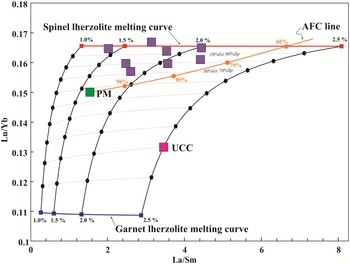
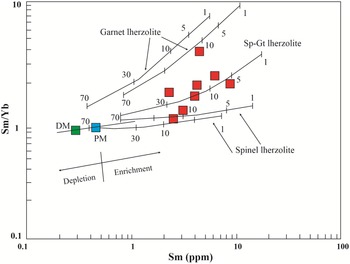
During emplacement, mantle-derived mafic magmas undergo chemical modification/contamination either due to the assimilation of crustal materials (Khalaf et al., Reference Khalaf, Khalaf and Oraby2011, among many others) or by the thermal erosion of floor rocks (Yang et al. Reference Yang, Ganguly, Shaji, Dong and Nanda-Kumar2019 and references therein). In the studied samples, the presence of inherited zircons and strong negative ϵ Hf(t) values necessitate the examination of the role of crustal contamination in parental magma during emplacement. The wide range of K2O/P2O5 (0.66–6.59) together with TiO2/P2O5 (0.54–7.00) ratios point to the incorporation of silicic crustal components, possibly from a crust of granitic composition (Carlson & Hart, Reference Carlson and Hart1988). The ratio between incompatible elements such as Sm/La (0.23–0.49) and TiO2/Zr (0.01–0.07) of the studied samples are close to the average composition of continental crust (Sm/La = 0.17 and TiO2/Zr = 0.003; Wedepohl, Reference Wedepohl1995). These values are similar to the basement charnockites reported from the study area (Sm/La = 0.12 and TiO2/Zr = 0.002; Tomson et al. Reference Tomson, Rao, Kumar and Choudhary2013), indicating the incorporation of crustal material. The argument for crustal contamination is further discussed using the AFC modelling. For that, we have adopted the La/Sm vs Lu/Yb (Fig. 10) AFC model using the ‘PetroGram’ Excel spreadsheet of Gündüz and Asan (Reference Gündüz and Asan2021). For melt modelling, non-modal fractional melting was performed with spinel- and garnet lherzolite as end members (Frey, Reference Frey1980; McDonough, Reference McDonough1990) and primitive-mantle (PM) values (Sun & McDonough, Reference Sun and McDonough1989) as the primary melt composition for constructing the AFC line (for input data see Appendix 4 in the Supplementary Material available online at https://doi.org/10.1017/S0016756823000079). The average composition of Madurai block charnockites (Tomson et al. Reference Tomson, Rao, Kumar and Choudhary2013) was used for possible contaminant. In the La/Sm vs Lu/Yb diagram, all samples fall along mixing lines between 1 and 2.5 % melts with a spinel/garnet lherzolite contribution ratio between 100/0 and 70/30. Considering PM as the parent source, modelling suggests an AFC up to 66 % (assimilation rate / fractional crystallization rate = 0.29). This indicates the dominance of spinel component in the source, which underwent melting with minor contribution from garnet. This is compatible with the observations from trace element geochemistry pointing to their origin by the mixing of garnet and spinel bearing melts. Similar results are also obtained from the Sm/Yb – Sm plot (Fig. 11; Zhao & Zhou, Reference Zhao and Zhou2007), suggesting 5–30 % melting of spinel to spinel–garnet lherzolite source. Furthermore, the low Ce/Y ratios for these rocks (<2.5) are suggestive of parent melt generation within the spinel–garnet stability field at a depth of c. 60–80 km (McKenzie & Bickle, Reference McKenzie and Bickle1988). As the spinel–garnet transition boundary is expected at a depth of ∼80 km (Takahashi & Kushiro, Reference Takahashi and Kushiro1983), the lithosphere beneath Madurai block is likely to be dominated by spinel–lherzolite where the incorporation of garnet–lherzolite into these components could have been initiated by the upwelling asthenosphere resulting in the formation of a mixed mantle source for parent melt generation.
Assimilation and fractional crystallization (AFC) model using La/Sm vs Lu/Yb bivariant diagram for mafic granulites. UCC: Upper continental crust; PM: primitive mantle.

Sm/Yb – Sm plot (Zhao & Zhou, Reference Zhao and Zhou2007). DM: depleted mantle, PM: primitive mantle.

7.c. Zircon U–Pb, trace element and Hf isotope data
Zircon U–Pb, trace element and Hf data obtained from LA-ICPMS/LA-MC-ICPMS are discussed following the data presented in Section 6. In general, the geometric centres of the zircons with dark CL are characterized by higher HREE enrichment and strong negative Eu anomaly compared to the oscillatory zoned and planar/sector zoned domains. These cores produce older (>750 Ma) strongly discordant ages with variable Th/U ratios. Zircons with similar U–Pb ages and chemical characteristics are reported from basement charnockites in the study area by Kumar et al. (Reference Kumar, Rao, Plavsa, Collins, Tomson, Gopal and Babu2017). These basement charnockites are identified as the prominent contributor to the chemical contamination of these rocks, as revealed from AFC modelling (Fig. 10). In addition, the whole-rock geochemistry of the mafic granulites reveals significant depletion in Zr and Hf, indicating retention of minor zircons in the slab residue as inherited magmatic crystals (Rubatto & Hermann, Reference Rubatto and Hermann2003). Hence the older ages obtained from the samples are interpreted as inherited ages. U–Pb ages obtained from oscillatory zones within zircons and their high Th/U ratio (>0.5) suggest their formation by magmatic crystallization. The weighted mean 206Pb/238U ages from these domains range from 612 ± 25 Ma to 625 ± 26 Ma, which is interpreted as the timing of mafic magmatism in the area (Table 2). The high MSWD associated with these ages can be due to partial Pb loss during subsequent high-grade metamorphism (Takamura et al. Reference Takamura, Tsunogae and Tsutsumi2020) and is reported from the terrane by many workers (Brandt et al., Reference Brandt, Raith, Schenk, Sengupta, Srikantappa and Gerdes2014; Dev et al., Reference Dev, Tomson, Sorcar and Francis2022a). The planar/sector zoned rim domains show distinct low Th/U ratios (<0.5), and ages from this group represents the timing of metamorphism recorded in the mafic granulites bracketed between 573 ± 10 Ma and 540 ± 10 Ma. These ages are also in agreement with the timing of HT-UHT metamorphism reported from SGT, which suggests the prevalence of a long-lived HT metamorphic event in the area, spanning at least ∼35 Ma. This is similar to earlier studies that proposed ∼40 Ma duration for the HT-UHT metamorphism in Madurai block (Clark et al., Reference Clark, Healy, Johnson, Collins, Taylor, Santosh and Timms2015; Dev et al., Reference Dev, Tomson, Sorcar and Nandakumar2021).
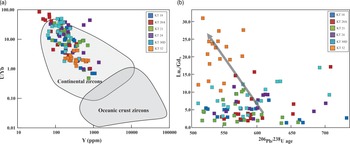
Trace element analyses of the zircons from the mafic granulites demonstrate arc affinity by their high U/Yb (>1) ratio. In contrast, the negative correlations between Ti and Hf concentrations reveal imprints of a fractional crystallization process associated with parent magma generation (Kohn et al. Reference Kohn, Engi and Lanari2017 and references therein). The considerably high Hf and low Zr/Hf ratio in these zircons also indicate their growth from a fractionated melt (Fu et al., Reference Fu, Page, Cavosie, Fournelle, Kita, Lackey, Wilde and Valley2008). In the Y vs U/Yb zircon discrimination diagram (Grimes et al. Reference Grimes, John, Kelemen, Mazdab, Wooden, Cheadle, Hanghøj and Schwartz2007), most of the samples fall within the continental zircon field, supporting the proposed continental arc origin for the samples (Fig. 12a). The LuN/GdN vs U–Pb age plot (Fig. 12b) indicate that, younger zircons have higher LuN/GdN values than older ones. An increase in LuN/GdN values suggest the breakdown of minerals enriched in HREE, possibly garnet that supplied HREEs during the zircon growth (Rubatto et al. Reference Rubatto, Chakraborty and Dasgupta2013). Since the studied samples are garnet absent, the HREE enrichment in zircons can be either sourced from the breakdown of garnet in the parent melt or from the garnet bearing basement charnockites that are identified as the significant contaminant source of these rocks.
(a) Y vs U/Yb zircon discrimination diagram (Grimes et al. Reference Grimes, John, Kelemen, Mazdab, Wooden, Cheadle, Hanghøj and Schwartz2007); and (b) LuN/GdN vs U–Pb age plot for zircons from mafic granulites.

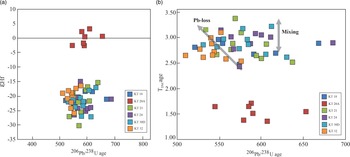
Hafnium isotope data of zircons show two tight population groups: (1) samples with 176Hf/177Hf ranging between 0.281564 and 0.281993 and ϵ Hf(t) values ranging between −30.23 and −14.93, and (2) samples with higher 176Hf/177Hf between 0.282333 and 0.282485 and ϵ Hf(t) values between −2.57 and 3.22 (Fig. 13a). The former samples have T DM ages between 2.44 Ga and 3.37 Ga, whereas the latter group includes T DM ages between 1.34 Ga and 1.69 Ga. This points to the involvement of two distinct parental sources in magma generation (Fig. 13a). The samples with older T DM ages and highly negative ϵ Hf(t) values suggest extreme reworking of a Archean to Palaeoproterozoic melting source. In contrast, the younger T DM ages and near-positive ϵ Hf(t) values point to a considerably lower degree of reworking of a Mesoproterozoic source with juvenile signatures for the generation of parental magma. However, all these samples were emplaced during the late Neoproterozoic, evidenced by their similar magmatic ages between 612 and 625 Ma obtained from oscillatory zoned domains. This is also shown in the T DM age vs U–Pb age diagram (Fig. 13b), where a mixing trend is observed at this magmatic age window, suggesting the mixing of different sources. Pb loss characterizes the post emplacement period, observed around ∼580 Ma (from Fig. 13b), which also overlaps with the oldest metamorphic age recorded in the samples (KT-MG-30D: 581 ± 33 Ma), resulting from the widespread Neoproterozoic metamorphism that affected the terrane.
(a) Age vs ϵ Hf(t) of zircons; (b) T DM age vs U–Pb age diagram. Mixing and Pb-loss trends are from Zeh et al. (Reference Zeh, Gerdes, Klemd and Barton2008).

7.d. Geodynamic implications
As discussed in the foregoing, the Ediacaran–Cambrian Gondwana assembly was associated with the development of UHT metamorphic assemblages in the Kambam UHT belt, with heat supplied either by HPE enrichment or equilibration at the continental root or by a combination of both (Brandt et al. Reference Brandt, Schenk, Raith, Appel, Gerdes and Srikantappa2011; Clark et al. Reference Clark, Healy, Johnson, Collins, Taylor, Santosh and Timms2015; Dev et al. Reference Dev, Tomson, Sorcar and Nandakumar2021). Even though regional-scale HT-UHT granulite formation is commonly linked to any of these processes across the globe (see Kelsey & Hand, Reference Kelsey and Hand2015 for review), the presence of voluminous, syn-metamorphic mafic or ultramafic emplacements is also considered as an alternative heat source for UHT granulite formation (Kemp et al. Reference Kemp, Shimura and Hawkesworth2007; Giustina et al. Reference Giustina, Pimentel, Ferreira Filho and de Hollanda2011; Guo et al., Reference Guo, Peng, Chen, Jiao and Windley2012; Klaver et al. Reference Klaver, De Roever, Thijssen, Bleeker, Söderlund, Chamberlain, Ernst, Berndt and Zeh2016; Wang et al. Reference Wang, Wei, Tian and Fu2020). In the Kambam UHT belt, UHT metamorphism (593 Ma and 530 Ma) closely follows the emplacement of mafic granulites (612 Ma to 625 Ma) in the area, and the similarity in these ages suggest that advective heating during mafic magmatism combined with asthenospheric upwelling could have triggered UHT metamorphism. Hence, the crust was pre-conditioned by the regional-scale mafic magmatism through which, heat source for UHT metamorphism was sustained for a longer period. Such a pre-conditioning process may not be temporally related to UHT events, i.e. they occur prior to the event or it occurs during a sufficiently long-lived slab window-related event (Kelsey & Hand, Reference Kelsey and Hand2015 and references therein). This model of an external heat source for UHT metamorphism is in agreement with the results from the adjacent Trivandrum block, where granulite formation exclusively by HPE enrichment is considered implausible without thermal input from an external source (Nandakumar & Harley, Reference Nandakumar and Harley2019). In addition to these mafic granulites, closely associated voluminous igneous rocks (charnockites, granites and syenites) with coeval emplacement ages (our unpublished data) can also contribute heat to sustain such a long-lived UHT orogen.
Geochemical and geochronological studies constrain a subduction–collisional tectonic environment for the emplacement and metamorphism of these mafic granulites. Hafnium isotopic signatures suggest parental magma generation from both Archean and Proterozoic melting sources with different degrees of reworking. The calculated T DM model ages and ϵ Hf(t) values for these rocks are in good agreement with the reported values of associated rocks from the study area (Kumar et al. Reference Kumar, Rao, Plavsa, Collins, Tomson, Gopal and Babu2017). The remarkable agreement of T DM model ages with the whole-rock Sm–Nd model ages of rocks from this domain (Plavsa et al. Reference Plavsa, Collins, Foden, Kropinski, Santosh, Chetty and Clark2012; Tomson et al. Reference Tomson, Rao, Kumar and Choudhary2013) indicates the involvement of Archean and Proterozoic melting sources. Similar meta-gabbros/mafic granulites have been reported from other Gondwanan counterparts such as Trivandrum block (Yang et al. Reference Yang, Ganguly, Shaji, Dong and Nanda-Kumar2019), Nagercoil block (Sajna et al. Reference Sajna, Tomson, Dev, Sorcar and Kumar2022; Kroner et al. Reference Kröner, Santosh, Hegner, Shaji, Geng, Wong and Xie2015), Sri Lanka (Santosh et al. Reference Santosh, Tsunogae, Malaviarachchi, Zhang, Ding, Tang and Dharmapriya2014; Takamura et al. Reference Takamura, Tsunogae, Santosh, Malaviarachchi and Tsutsumi2015) and Antarctica (Takamura et al. Reference Takamura, Tsunogae and Tsutsumi2020), with similar emplacement/metamorphic ages suggesting that this Neoproterozoic mafic magmatism is a pervasive igneous event that can be traced across different East Gondwana fragments. Together with previously published results, these inferences suggest a collision setting between western Madurai block and eastern Madurai block along the Kambam UHT belt and Suruli shear zone. This observation is in agreement with previous studies interpreting the Kambam UHT belt and Suruli shear zone as a Neoproterozoic collisional boundary within SGT (Srinivasan & Rajeshdurai, Reference Srinivasan and Rajeshdurai2010; Brandt et al. Reference Brandt, Raith, Schenk, Sengupta, Srikantappa and Gerdes2014). This argument is further validated by the contrast in elastic thickness (Te) between the western Madurai block and eastern Madurai blocks where the latter has the higher Te (Ratheesh-Kumar et al. Reference Ratheesh-Kumar, Dharmapriya, Windley, Xiao and Jeevan2020). The location of SSZ also overlaps with the earlier proposed structural arc along the eastern part representing a collisional boundary between western and eastern blocks (Cenki & Kriegsman, Reference Cenki and Kriegsman2005).
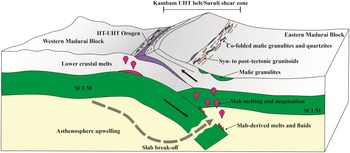
As SGT and Madurai block forms an integral component in the East Gondwana amalgamation, the significance of the Kambam UHT belt and Suruli shear zone needs to be explored in a terrain boundary perspective and demonstrated using a new tectonic model as illustrated in Fig. 14. Although the exact age of collision between the eastern and western Madurai blocks is unknown, the late Neoproterozoic collision along SSZ resulted in the subduction of SCLM below the eastern Madurai block. Collision led to NW-directed thrusting of the eastern Madurai block onto the western Madurai block (Srinivasan & Rajeshdurai, Reference Srinivasan and Rajeshdurai2010), initiating significant crustal thickening. The post-collisional extension and slab break following the subduction of SCLM triggered the upwelling of hot asthenosphere, which interacted with the subducted slab and lithospheric basement, forming lower crustal emplacement of these mafic granulites between 612 and 625 Ma. Also, this collisional belt must have acted as a depositional basin for sedimentary units (Collins et al. Reference Collins, Clark and Plavsa2014). These sedimentry units were later transformed to HT-UHT metapelites due to advective heating during mafic magmatism along with asthenospheric upwelling and continued orogenic crustal thickening. This proposal of collisional tectonics for UHT metamorphism in Madurai block is validated by the clockwise P–T evolution trend (Dev et al. Reference Dev, Tomson, Sorcar and Nandakumar2021 and references therein) which is commonly reported for UHT granulites from collisional orogens across the globe (Brown, Reference Brown2006, Reference Brown2007). A continued collision during the Neoproterozoic period resulted in regional-scale deformation and dextral shearing along the Suruli shear zone, and the exhumation of these mafic granulites, which were later co-folded with metapelites and quartzites, forming large-scale interference folding patterns (Srinivasan & Rajeshdurai, Reference Srinivasan and Rajeshdurai2010). This period is also marked by the emplacement of syn-and post-collisional granitoids along this belt, with coeval emplacement ages (our unpublished data), which might have acted as stitching plutons marking the final phase of the collision. All these evidences argue that the Kambam UHT belt and Suruli shear zone represents a Neoproterozoic collisional boundary in the Madurai block within the SGT, associated with the final stage of Gondwana supercontinent assembly.
Schematic illustration of petrogenetic/tectonic model proposed for the generation of mafic granulites and associated lithologies in KUB.

8. Conclusion
Geochemical, geochronological and isotopic studies of mafic granulites within the Kambam UHT belt located along the Suruli shear zone in the Madurai block of SGT throws light on their petrogenesis and tectonic setting. Geochemistry of the samples reveals their low- to medium-K tholeiitic nature with arc affinity. The mafic granulites are formed by the partial melting of a subduction-modified enriched mantle source that has been modelled with a spinel/garnet lherzolite contribution ratio between 100/0 and 70/30. Zircon U–Pb geochronology of the samples constrains their emplacement age between 612 Ma and 625 Ma and metamorphism between 581 Ma and 531 Ma. This overlaps with the timing of HT-UHT metamorphism in the Kambam UHT belt, offering an alternative view on the heat source responsible for the formation of HT-UHT granulites. Zircon Hf isotopic studies of the samples reveal the involvement of reworked mixed melting source in the generation of parental magma. In light of the above, a collisional tectonic model is proposed to explain the formation of mafic granulites involving the western and eastern Madurai blocks along the Kambam UHT belt and Suruli shear zone.
Supplementary material
To view supplementary material for this article, please visit https://doi.org/10.1017/S0016756823000079
Acknowledgements
The authors thank Director, NCESS for providing unconditional support to carry out this work. Dr Sneha Mukherjee, Mr K Eldhose, Mr N Nishanth and Mr Sarath Kumar S are acknowledged for support during fieldwork, sample preparation and analysis. ADJ gratefully acknowledges PhD research funding support through the DST-INSPIRE Programme (DST/INSPIRE Fellowship/IF170781). TVK acknowledges the financial support from an in-house project MLP-6406-28(EVB) and thanks Director, CSIR-NGRI for his continuous support and encouragement.